ChatGPT
 Google AI
 Grok
Grok Claude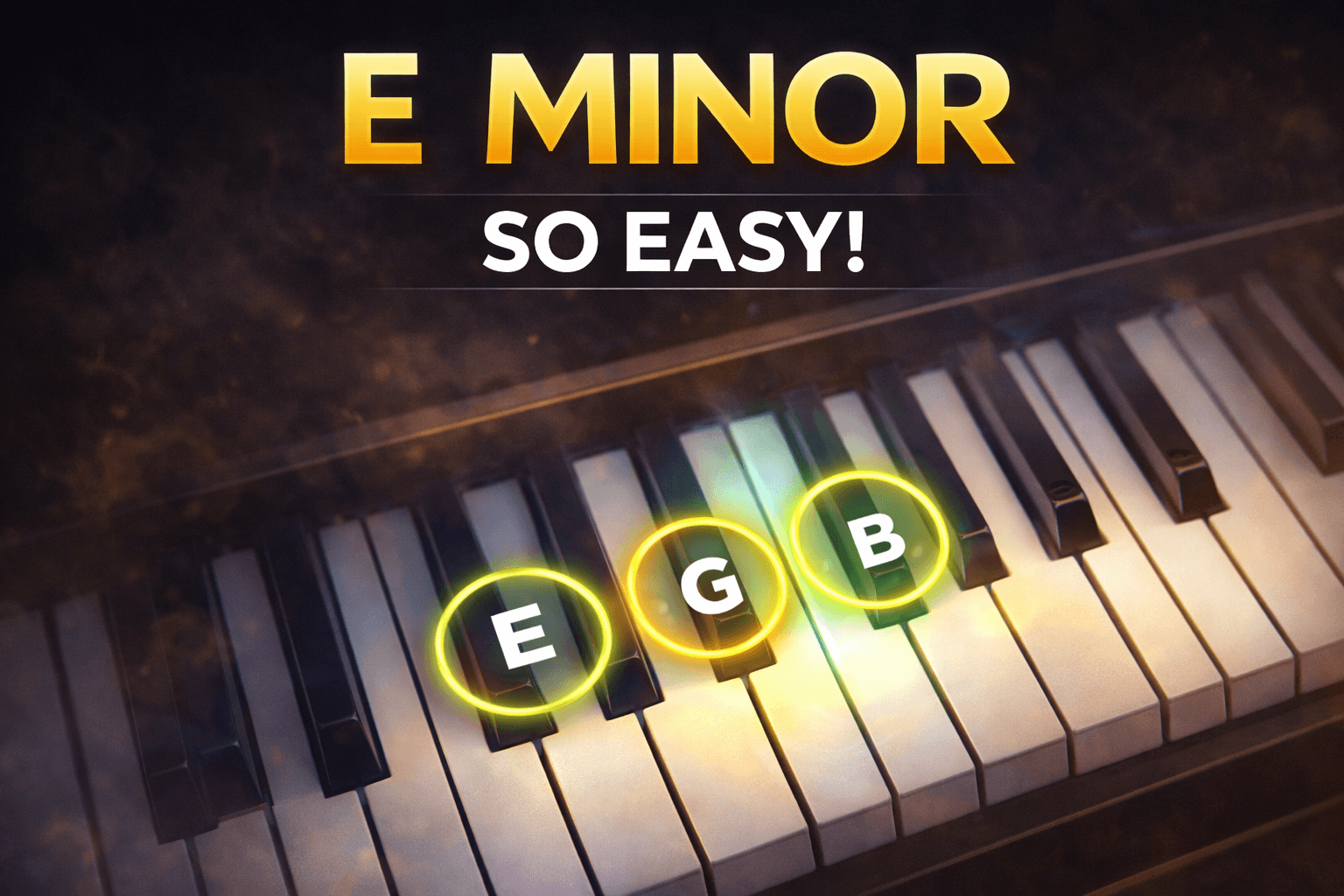
Learning the E minor chord on piano is an essential part of developing strong foundational skills in minor chord theory, emotional expression, and smooth chord transitions. The E minor piano chord, built using the notes E, G, and B, produces a naturally melancholic yet warm sound that is widely used across genres such as pop, classical, jazz, rock, R&B, and movie soundtracks. As one of the most common beginner piano chords, E minor is easy to learn, easy to incorporate into chord progressions, and extremely versatile in song composition.
This comprehensive guide explains everything you need to know about the E minor chord on piano—its notes, finger placement, chord inversions, common progressions, songs that use the Em chord, helpful exercises, theory foundations, and recommended tools for practicing piano chords online. Whether you are a beginner learning your first minor chord or an intermediate player improving smooth transitions and musical expression, this guide provides a complete step-by-step explanation.
Introduction to the E Minor Chord
 The E minor chord (Em) is one of the most recognizable minor triads in music. Built from the notes E, G, and B, this chord forms the minor counterpart of the brighter E major chord. Playing Em on piano gives your music a reflective, emotional, and sometimes dramatic tone. It often appears in ballads, film music, modern pop compositions, and emotional instrumental arrangements.
Because it uses only one black key in related scales (F# in E minor scale), the Em chord is particularly beginner-friendly. Many piano students first explore minor chords through A minor, D minor, and E minor due to their simplicity and intuitive finger placement.
Below is the triad structure of the E minor chord:
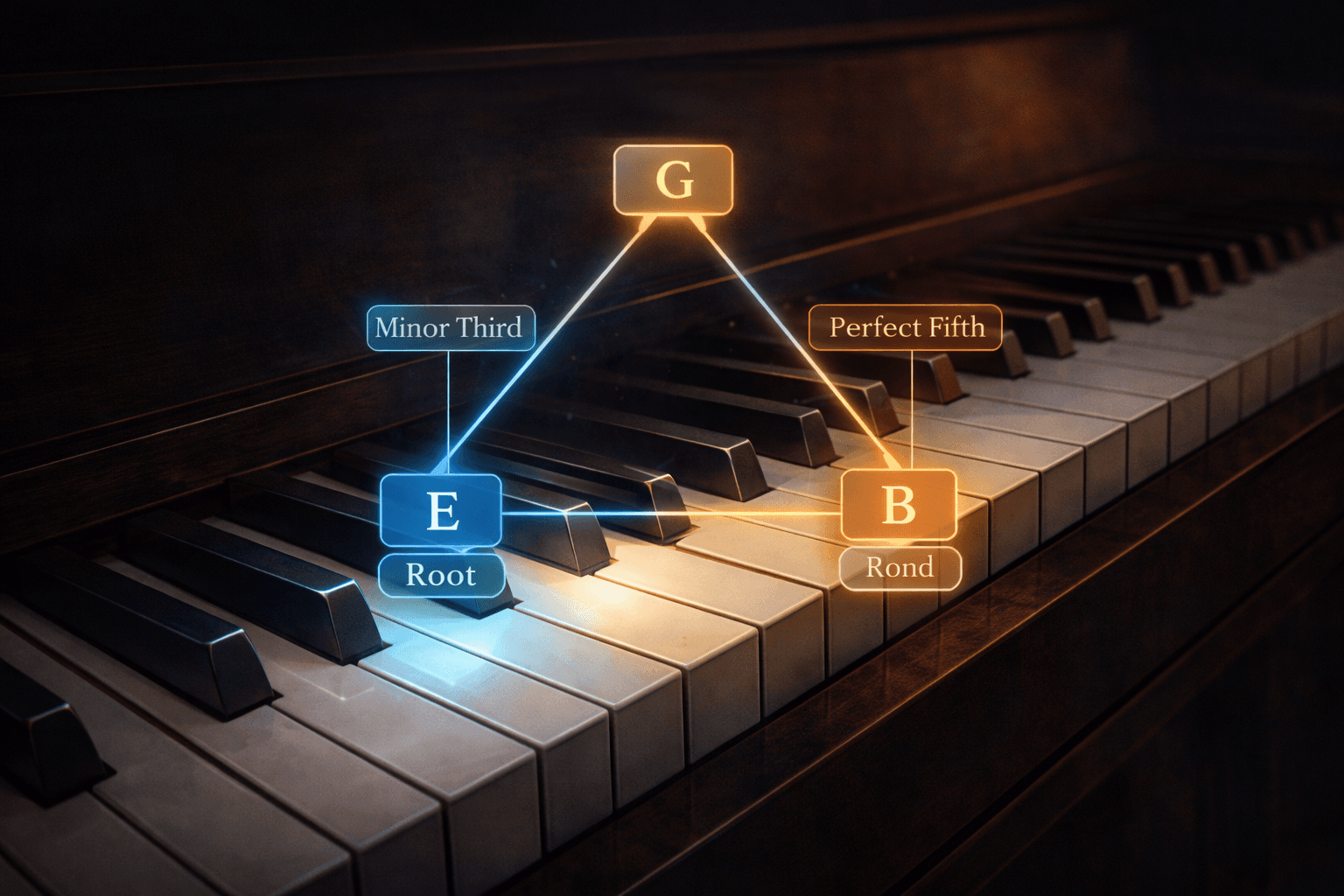
E Minor Chord Notes Table
Note Role E Root G Minor Third B Perfect Fifth
The relationship between these notes gives E minor its distinct minor quality. Understanding the role of each note helps students recognize chord qualities, improve ear training, and transition smoothly into learning chord inversions.
How to Play the E Minor Chord in Root Position
 The root position of the E minor chord places E as the lowest note, followed by G and B. This position is ideal for beginners because it is easy to visualize on the keyboard and helps strengthen basic hand coordination.
Right-Hand Fingering
- Thumb on E
- Middle finger on G
- Pinky on B
Left-Hand Fingering
- Pinky on E
- Middle finger on G
- Thumb on B
Practicing this root position repeatedly helps build muscle memory and trains your hands to press all three notes together evenly. Beginners often struggle with uneven key pressure, so slow practice is essential.
Keyboard Note Layout (Text Diagram) E G B | | | White White White
Even though G and B are spaced a little farther apart visually, this chord is among the simplest minor shapes because it aligns naturally with the hand’s resting position on white keys.
Understanding the Structure of the E Minor Triad
 The E minor chord follows the standard structure of a minor triad:
- Minor Third: E → G (3 semitones)
- Major Third: G → B (4 semitones)
This combination creates the signature minor sound.
Interval Structure Table
Interval Semitones Notes Minor Third 3 E → G Major Third 4 G → B Perfect Fifth (Root → Fifth) 7 E → B
Every minor triad follows this 3 + 4 semitone formula. Recognizing this helps players identify minor chords anywhere on the keyboard.
Inversions of the E Minor Chord on Piano
 Chord inversions change the bottom note of the chord while keeping the same three notes. Inversions are essential for creating fluid transitions between chords and making music sound more professional.
Three Forms of the E Minor Chord
- Root Position – E, G, B
- First Inversion – G, B, E
- Second Inversion – B, E, G
Each inversion has its own brightness, texture, and purpose in chord progressions.
How to Play E Minor 1st Inversion (G – B – E)
 In first inversion, G becomes the lowest note. This version sounds lighter and more open than the root position.
Right-Hand Fingering
- Thumb on G
- Index/Middle finger on B
- Pinky on E
Left-Hand Fingering
- Pinky on G
- Index/Middle finger on B
- Thumb on E
First inversion is highly useful for smooth transitions, especially when moving between chords like C major, D major, or G major.
How to Play E Minor 2nd Inversion (B – E – G)
 Second inversion places B at the bottom. This version is effective for upward progressions and arpeggio-based passages.
Right-Hand Fingering
- Thumb on B
- Middle finger on E
- Pinky on G
Left-Hand Fingering
Because second inversion feels stable and balanced, it commonly appears in accompaniment patterns and modern piano comping.
Arpeggios and Broken Chords in E Minor
Arpeggios help strengthen flexibility and improve coordination. Practicing E minor arpeggios prepares you for classical pieces, pop accompaniments, and improvisation.
Basic E Minor Arpeggio Pattern
Right Hand: E → G → B → E → B → G → E
Left Hand: E → G → B → E → B → G → E
Practicing broken chords (E → G → B → G → E) helps with smooth transitions and finger mobility.
The E Minor Scale and Its Connection to the Em Chord
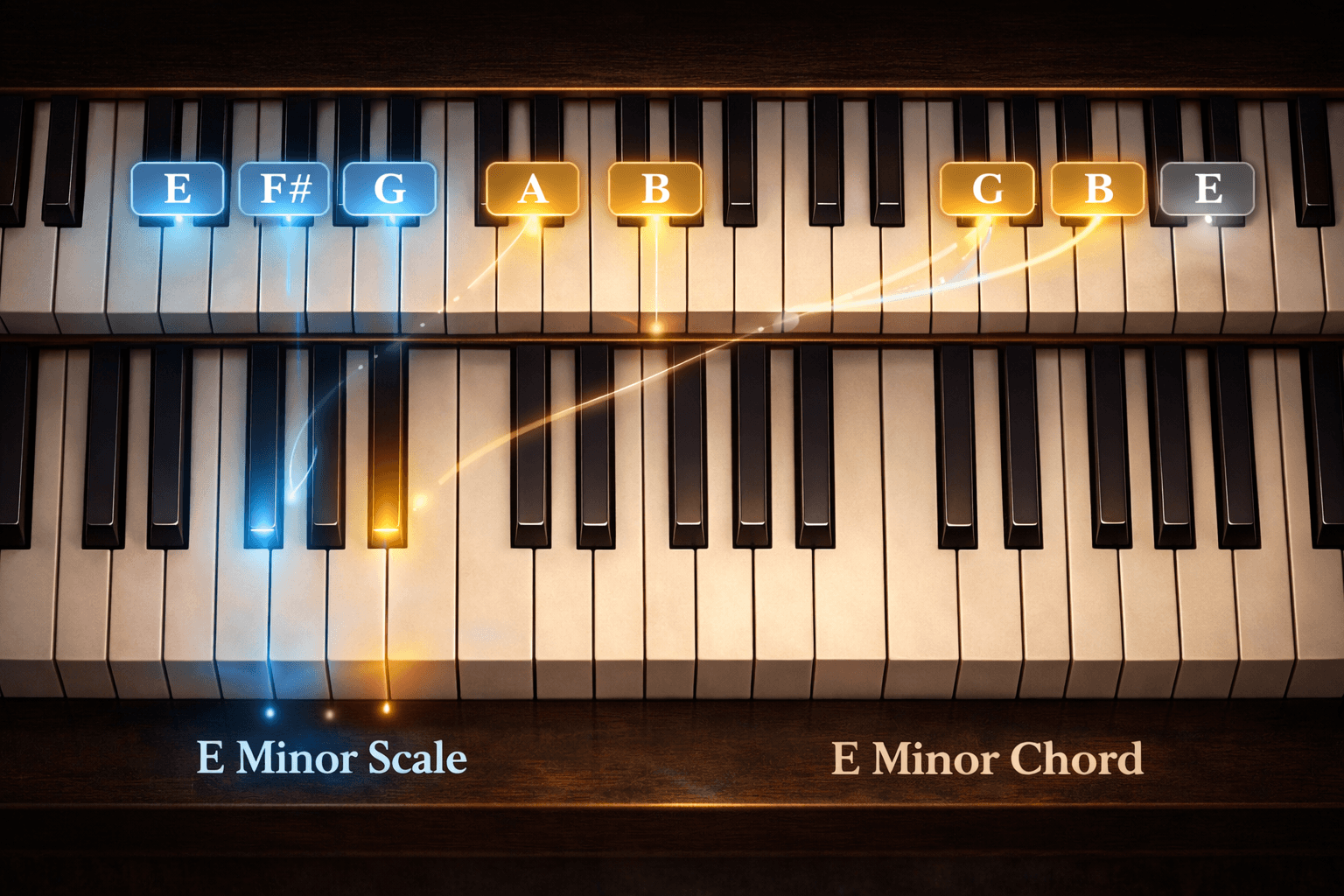 Understanding the scale helps with chord progressions, melody creation, and improvising.
E minor has three common forms:
Natural E Minor Scale
E – F# – G – A – B – C – D – E
Harmonic E Minor Scale
E – F# – G – A – B – C – D# – E
Melodic E Minor Scale
Ascending: E – F# – G – A – B – C# – D# – E Descending: E – D – C – B – A – G – F# – E
The Em chord is built from scale degrees 1, 3, and 5.
Chord Progressions in the Key of E Minor
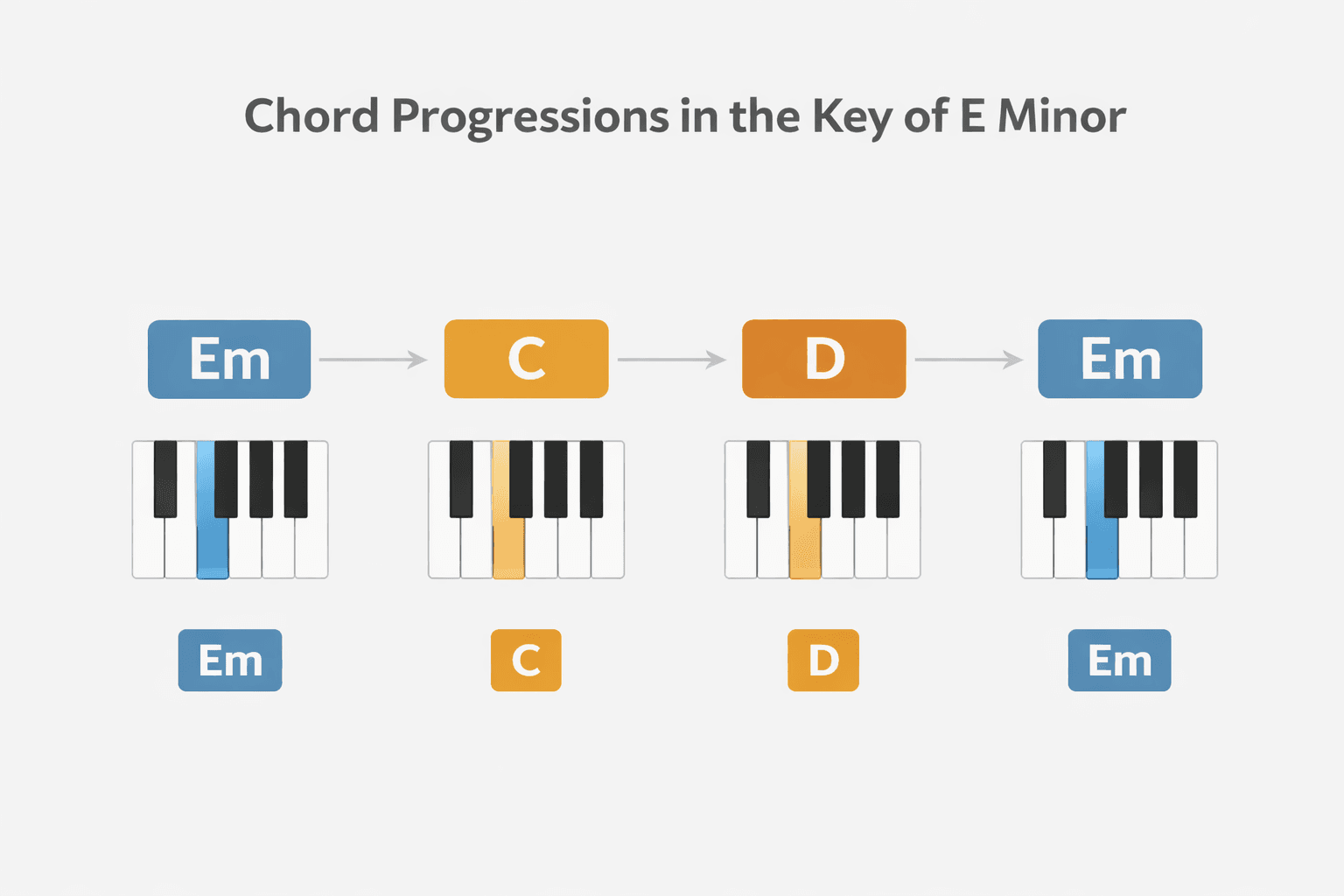 Common Beginner Progressions
Progression Notes Em – C – G – D E G B – C E G – G B D – D F# A Em – D – C E G B – D F# A – C E G Em – G – D – A E G B – G B D – D F# A – A C# E
Intermediate Progressions
Progression Notes
Em – B7 – C – Am E G B – B D# F# – C E G – A C E Em – D – B7 – Em E G B – D F# A – B D# F# – E G B Em – C – A – B7 E G B – C E G – A C# E – B D# F# A
Advanced / Emotional Progressions
Progression Notes
Em – G – Am – C – B7 E G B – G B D – A C E – C E G – B D# F# A Em – Cmaj7 – Am7 – D9 E G B – C E G B – A C E G – D F# A C E Em – Em/D – C – Am – B7 E G B – D E G B – C E G – A C E – B D# F# A
These progressions can be practiced using root position or inversions to improve smooth transitions.
Popular Songs That Use the E Minor Chord
Many well-known songs use Em as a primary chord because of its emotional depth.
1. Ed Sheeran – Photograph E minor adds warmth and reflective tone to the verses.
2. Coldplay – The Scientist The chord contributes to the song’s melancholic foundation.
3. Imagine Dragons – Believer The Em chord anchors the song’s dramatic tension.
4. Bob Marley – No Woman No Cry E minor is used in transitions between major chords.
5. Linkin Park – Numb Strong emotional and minor-driven progressions centered around Em.
Learning these songs helps beginners apply the chord in real music and improves timing and coordination.
Genre Applications of the E Minor Chord
E minor fits naturally into numerous musical styles:
Pop Used for emotional verses and melodic hooks.
Rock Forms darker harmonic foundations and power progressions.
Classical Appears frequently in romantic-era piano compositions.
Jazz Used in modal interchange, minor ii–V–i patterns, and improvisation.
Film Music Creates tension, mystery, and emotional storytelling.
Tools to Learn and Practice the E Minor Chord
 Apps like Flowkey, Simply Piano, and Chordify provide visual guidance and structured tutorials. Chord generator tools also help beginners practice inversions, progressions, voicings, and arpeggios.
Tips and Tricks for Mastering the E Minor Chord
- Practice slowly in root position first.
- Transition to inversions only after mastering finger placement.
- Play along with songs that use Em.
- Practice arpeggios daily.
- Combine Em with neighboring chords like G, C, and D.
- Record your practice to track progress.
- Use both hands to develop independence.
Common Mistakes Beginners Make
- Pressing keys unevenly
- Poor wrist posture
- Jumping between chords instead of using inversions
- Practicing too quickly
- Ignoring finger numbering
- Not learning progressions
Correcting these early accelerates improvement.
Frequently Asked Questions (FAQs)
What notes are in the E minor chord?
The E minor chord contains the notes E, G, and B.
How do I play the E minor chord on piano?
Right hand: thumb on E, middle finger on G, pinky on B. Left hand: pinky on E, middle finger on G, thumb on B.
What are the inversions of E minor?
First inversion: G – B – E Second inversion: B – E – G
Which songs use the E minor chord?
Songs by Coldplay, Ed Sheeran, Linkin Park, and Bob Marley heavily feature E minor. Is E minor a beginner-friendly chord? Yes. It uses only white keys and is easy to visualize.
Is E minor a sad chord?
E minor produces a warm, emotional, and reflective sound typical of minor chords.
How can I practice the E minor chord smoothly?
Practice slowly, use proper fingering, and integrate chord transitions such as Em–C–G–D or Em–C–Am–B7.