ChatGPT
 Google AI
 Grok
Grok Claude
The Dorian mode on piano is one of the most versatile and expressive musical modes. It has a minor feel because of its minor third above the tonic note, yet it also sounds bright due to the major sixth interval. This combination creates a smooth, jazzy, and flexible scale that appears in rock, jazz, and folk music.
Learning the Dorian mode piano scale strengthens understanding of western music theory, scale degrees, and modal music. Pianists can apply it to improvisation, chord progressions, and melodies. Recognizing Dorian mode intervals across different keys improves technical skill and builds confidence in modal performance.
Introduction to the Dorian Mode
 The Dorian mode in music is the second mode of the major scale, giving it a unique blend of minor darkness with subtle brightness. Musicians often rely on the Dorian mode piano scale to create emotional and dynamic grooves that are more expressive than the standard minor scale.
Learning the Dorian mode on piano helps students understand the structure of musical modes. It teaches them how the root note, tonic note, and scale degrees interact to create modal melodies and harmonic structure that can enhance jazz, blues, and contemporary compositions.
Why the Dorian Mode is One of the Most Popular Musical Modes
The Dorian mode piano is popular because it combines a minor tonality with a major sixth, creating a smooth, uplifting sound. This balance allows modal music to feel emotional without being too dark or heavy, making it ideal for improvisation and melody writing.
How the Dorian Mode Appears in Modern Piano Music
Many contemporary jazz and rock piano pieces use the Dorian mode scale to create modal melodies. Understanding Dorian mode music theory allows pianists to identify scale degrees and harmonies that make songs feel expressive, dynamic, and engaging.
Why Piano Students Should Learn the Dorian Mode
Learning the Dorian mode on piano improves awareness of musical modes and diatonic scales. Pianists gain the ability to identify modal chord progressions, recognize melodies in real songs, and practice improvisation using Dorian mode intervals across different keys.
What the Dorian Mode Means in Music Theory
 In Dorian mode music theory, the scale is defined as the second mode of the major scale, beginning on the second scale degree. The interval pattern includes a minor third and a major sixth, creating a distinct minor feel with added brightness compared to the natural minor.
The Dorian mode piano scale is widely used in jazz and modal rock because its intervals provide flexibility for improvisation. Musicians can experiment with modal music, explore chromatic scale approaches, and create Dorian mode melodies that are expressive and smooth.
Definition of the Dorian Mode
The Dorian mode is a seven-note diatonic scale that begins on the second degree of a major scale. It contains intervals such as major second, minor third, perfect fourth, perfect fifth, major sixth, and minor seventh.
Relationship Between Dorian Mode and the Major Scale
The Dorian mode scale uses the same notes as its parent major scale, but starting on the second scale degree. For example, D Dorian uses all the white keys from D to D, making it a minor mode with a lifted sixth.
Historical Origins of the Dorian Mode
The Dorian mode originates from ancient Greek modes, where it was used to evoke certain moods. Later, medieval theorists adapted it into church music, and today it forms a core part of modal music and western music theory.
Why Musicians Describe Dorian as a Minor Mode
Though minor in character due to its minor third, the Dorian mode piano scale feels more open and bright because of the major sixth. This balance gives melodies a unique color that is ideal for jazz, rock, and modal compositions.
Structure and Formula of the Dorian Scale
 The Dorian mode piano scale has a unique step pattern that separates it from both the major scale and the natural minor scale. The formula is Whole–Half–Whole–Whole–Whole–Half–Whole, which places the major sixth interval above the tonic note.
Practicing the Dorian mode scale helps students understand scale degrees, modal music theory, and interval patterns. Recognizing this pattern on the piano allows pianists to play the scale in any key and use it for improvisation, melody writing, or Dorian mode chord progressions.
Whole Step and Half Step Pattern
The Dorian mode formula is built as W–H–W–W–W–H–W. This pattern highlights the minor third and major sixth, giving the scale its recognizable sound that is both expressive and versatile for modal harmony.
Dorian Mode Scale Formula Explained
The Dorian scale formula in terms of scale degrees is 1–2–♭3–4–5–6–♭7–8. This formula shows why the mode sounds minor yet brighter than the natural minor or Aeolian mode.
Dorian Mode Semitone Pattern Table
Step Interval 1 → 2 Whole 2 → 3 Half 3 → 4 Whole 4 → 5 Whole 5 → 6 Whole 6 → 7 Half 7 → 8 Whole
The flattened third and seventh create the minor feel, while the major sixth adds brightness.
Why the Dorian Mode Sounds Smooth and Jazzy
The Dorian mode piano scale is smooth because of the major sixth interval, which prevents the scale from feeling too dark. This characteristic makes it ideal for jazz improvisation, modal grooves, and rock melodies.
Intervals Found in the Dorian Mode
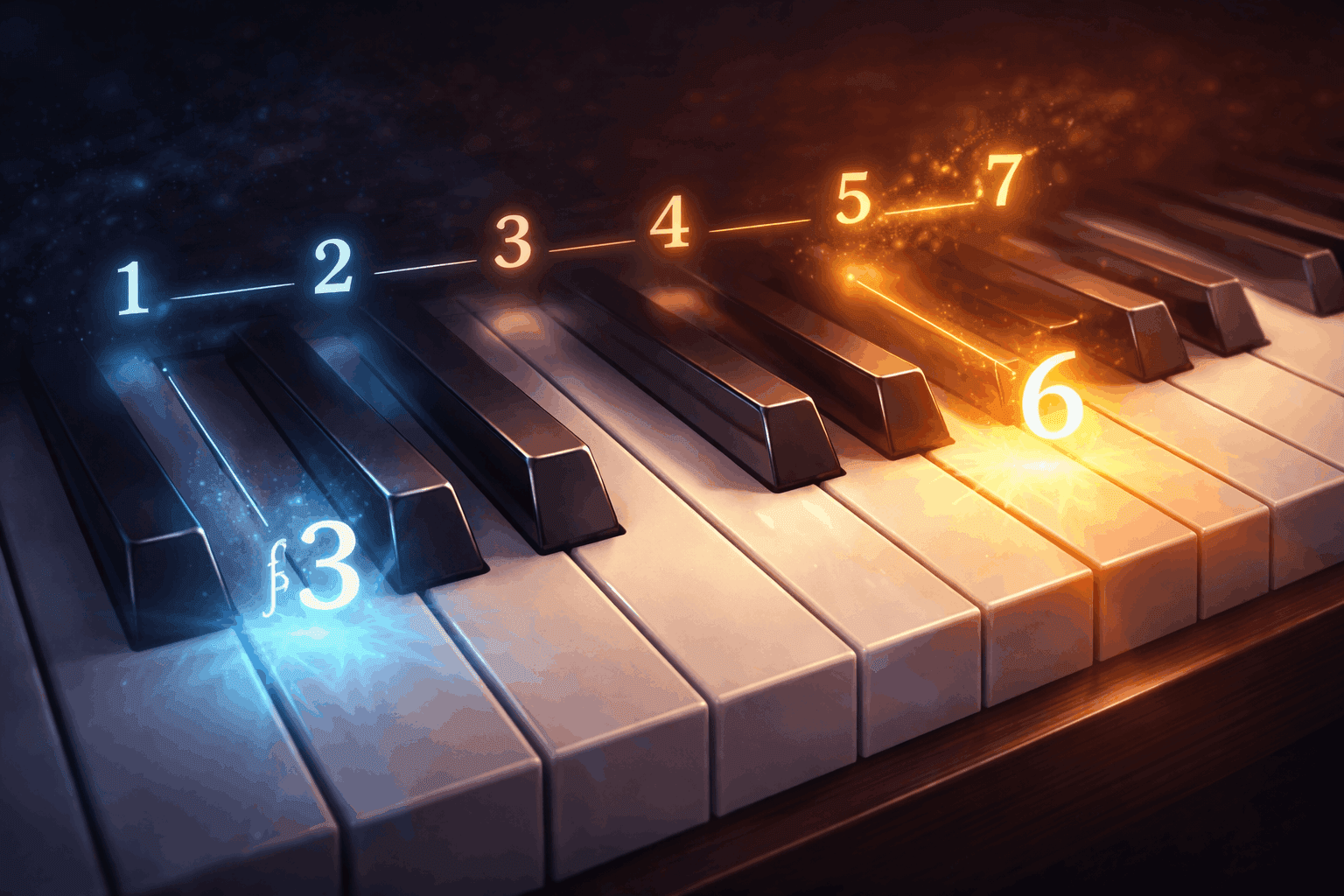 The Dorian mode on piano is defined by its unique interval structure, which gives the scale a minor tonality with subtle brightness. Understanding the Dorian mode intervals helps pianists identify which notes create tension, which are stable, and how the scale shapes both melodic structure and harmonic structure.
Learning these intervals allows musicians to play Dorian mode melodies, improvise, and construct chords that match the scale. Recognizing scale degrees, minor third, major sixth, and minor seventh enhances the ability to create expressive music across all keys.
Understanding Musical Intervals in Piano Theory
In western music theory, intervals define the distance between two notes. In the Dorian mode piano scale, the intervals include major second, minor third, perfect fourth, perfect fifth, major sixth, and minor seventh, all of which give the scale its characteristic sound.
Interval Pattern of the Dorian Mode
The Dorian mode interval pattern is 1–2–♭3–4–5–6–♭7–1. This arrangement differentiates it from the natural minor scale, particularly through the raised sixth, which brightens the scale and allows melodic creativity.
How Intervals Shape the Dorian Sound
The combination of minor third and major sixth gives the Dorian mode piano scale its distinctive smooth, jazzy, and modal character. Pianists can highlight these intervals to create emotional and expressive Dorian mode melodies.
Visualizing Dorian Intervals on the Piano Keyboard
Pianists can see the Dorian mode piano scale visually as a series of keys where the minor third and minor seventh intervals define the minor tonality, while the major sixth adds lightness. For example, D Dorian uses all white keys from D to D.
Dorian Mode Scales in Different Keys
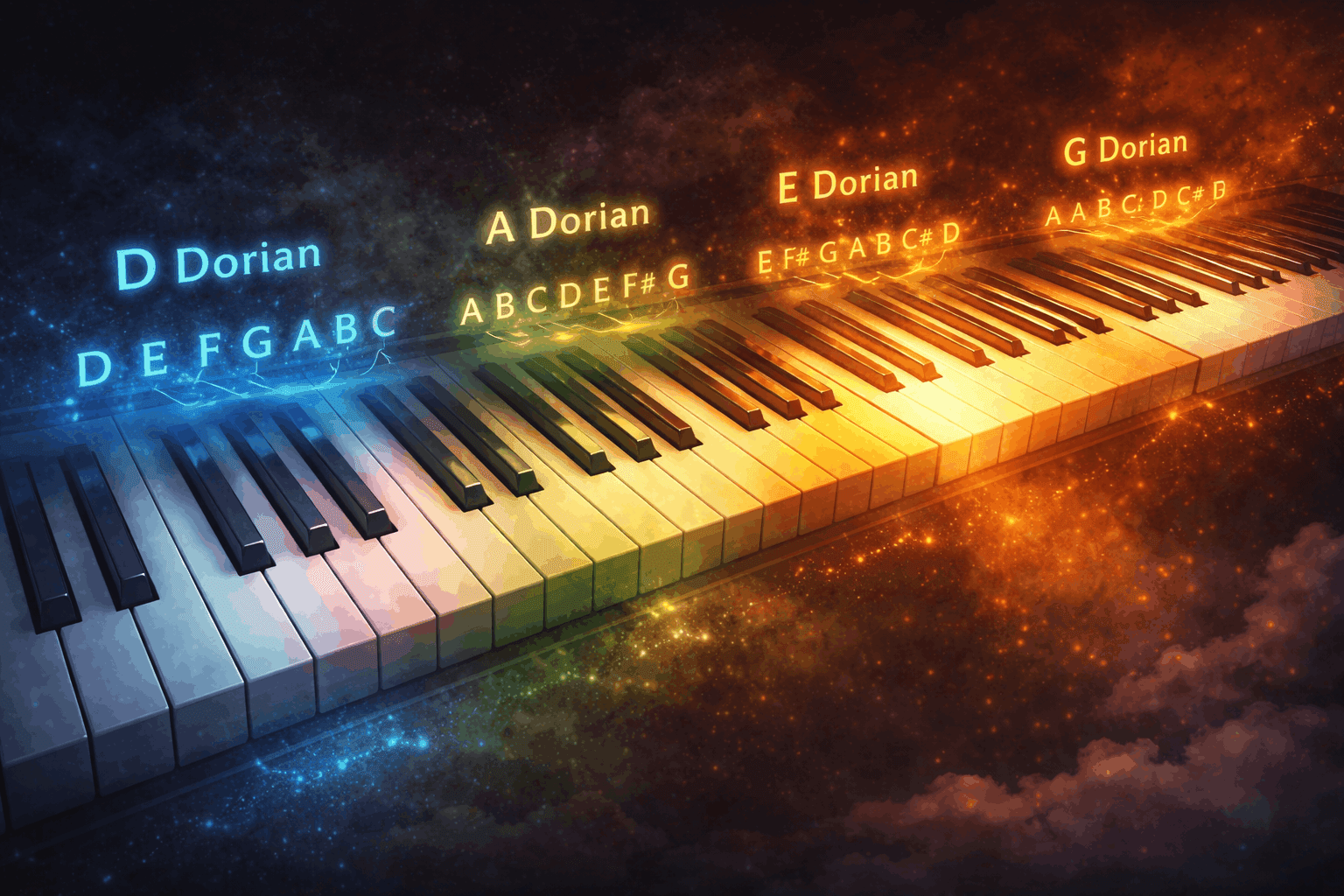 The Dorian mode piano scale can be applied to any key. Each key follows the same interval pattern, allowing pianists to transfer knowledge across the keyboard. Practicing Dorian scale exercises in multiple keys strengthens both technique and theoretical understanding.
Each key’s Dorian mode corresponds to its parent major scale, starting on the second scale degree. Understanding key signatures helps pianists quickly locate root notes, flattened thirds, and flattened sevenths in all keys.
D Dorian Mode (The Most Common Example)
The D Dorian scale contains the notes D, E, F, G, A, B, and C. Its minor third (F) and major sixth (B) produce the distinctive Dorian sound used in jazz, funk, and folk music.
A Dorian Mode
The A Dorian scale uses the notes A, B, C, D, E, F♯, and G. It corresponds to the G major scale and demonstrates how the Dorian mode formula applies to different starting notes.
E Dorian Mode
E Dorian contains the notes E, F♯, G, A, B, C♯, and D. Its minor third (G) and major sixth (C♯) illustrate how the scale’s tonal character stays consistent across keys.
G Dorian Mode
The G Dorian scale uses G, A, B♭, C, D, E, and F. It comes from the F major scale, showing how the flattened third and seventh create the familiar Dorian groove.
Understanding Key Signatures in Dorian Scales
The key signature of a Dorian mode is identical to its parent major scale. Pianists can quickly identify which notes are sharp or flat, helping with Dorian mode piano exercises and improvisation.
Dorian Mode Key Table
Key Notes Parent Major Scale D D E F G A B C C Major A A B C D E F♯ G G Major E E F♯ G A B C♯ D D Major G G A B♭ C D E F F Major
This table shows how the Dorian mode scale appears in multiple keys, highlighting flattened third and seventh degrees.
Chords Built from the Dorian Mode
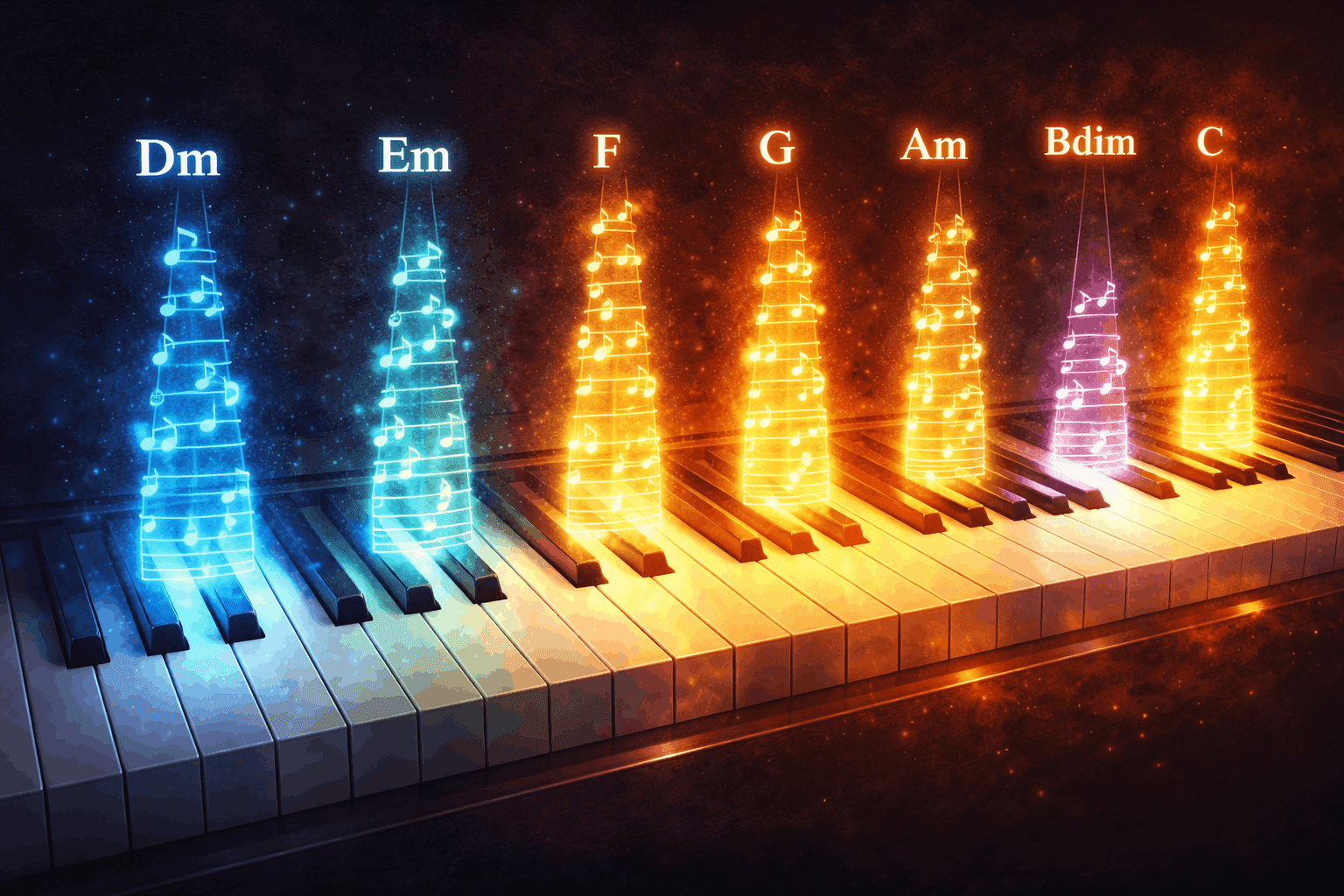 The Dorian mode piano scale produces a distinct set of chords because of the minor third and major sixth. These Dorian mode chords are essential for modal jazz, funk, and rock, where the scale supports harmonic structure that is both minor and bright.
Understanding triads and seventh chords in the Dorian mode piano scale allows pianists to build chord progressions, create modal melodies, and accompany improvisation. Chord progressions derived from Dorian sound smooth, open, and slightly jazzy.
Triads in the Dorian Mode
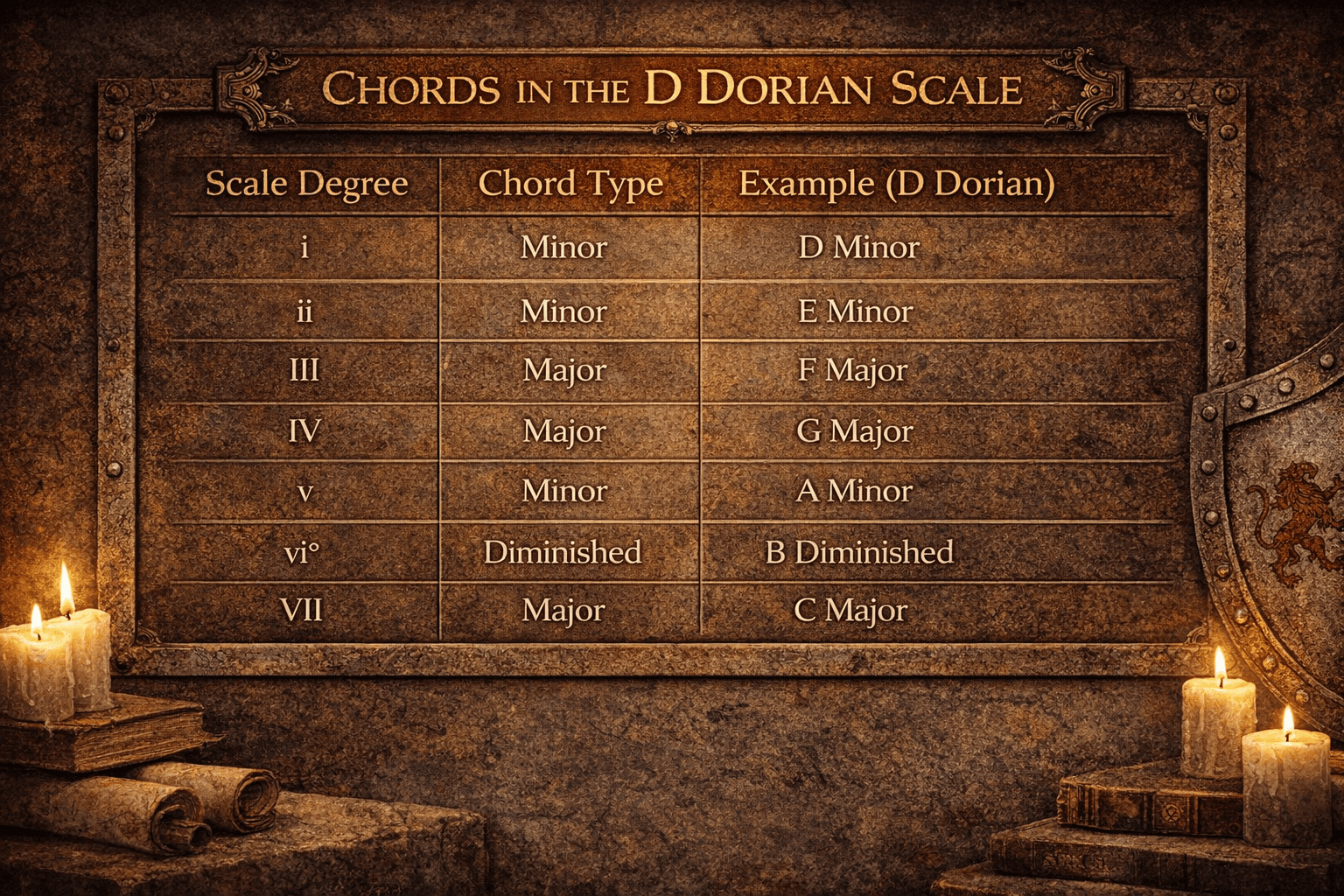
Triads are formed by stacking every other note from the Dorian mode scale. The first chord is minor, but the sixth degree produces a major chord, creating a unique harmonic flavor.
The Seven Diatonic Chords
Common Chord Progressions in Dorian
Common Dorian mode chord progression patterns emphasize the minor tonic and major sixth chords. For example, i–IV–v–i produces a jazzy or folk-like sound, while i–VII–IV works in funk or rock.
How Dorian Chords Support Melody
The Dorian mode chords reinforce the melodic structure of the scale. Pianists can highlight the minor third and major sixth intervals to maintain the characteristic Dorian sound in modal music.
Step-by-Step Guide to Playing the Dorian Mode on Piano
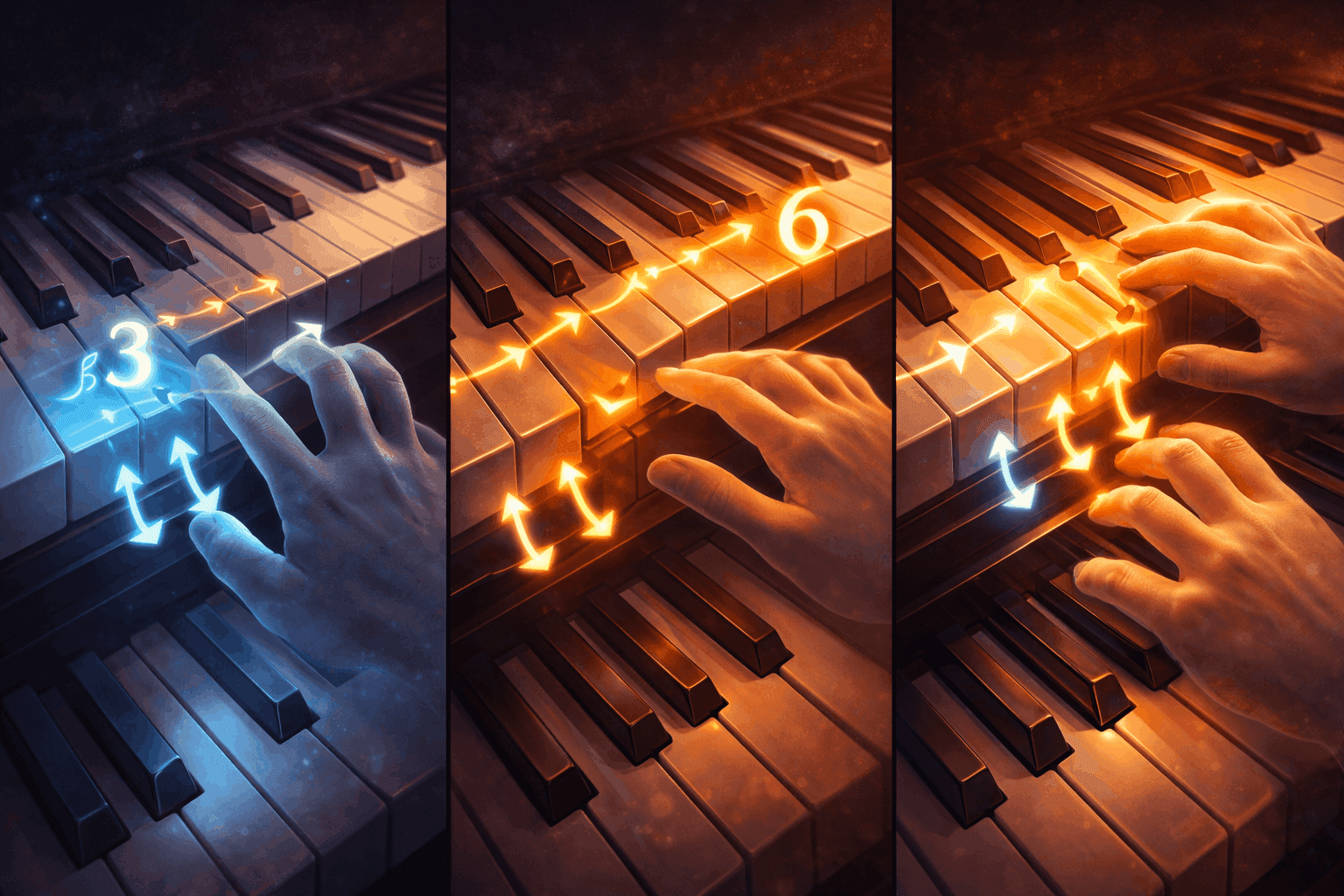 Mastering the Dorian mode on piano becomes simple once you understand its unique interval pattern. This mode combines a minor third with a major sixth, giving it a smooth, jazzy sound. Starting in one key and gradually practicing in others helps pianists internalize scale degrees, Dorian mode intervals, and modal harmony, building confidence for melodies and improvisation. Regular practice also develops finger strength, hand coordination, and control over dynamics.
Begin with the D Dorian Scale
Start with D Dorian, using the notes D, E, F, G, A, B, and C. This scale follows the Dorian mode formula of W–H–W–W–W–H–W, where the minor third (F) and major sixth (B) define its characteristic sound. Play slowly at first, focusing on smooth transitions between notes and recognizing the tonic note and root note for a strong sense of tonal center.
Correct Finger Position and Hand Technique
Maintain a relaxed wrist and curved fingers to ensure smooth motion. Proper Dorian mode fingering piano allows even tone, prevents tension, and makes switching to other keys easier. Using the right fingerings now saves frustration later when improvising or playing melodies in multiple keys.
Practicing the Scale with the Right Hand
Start with the right hand to focus on the Dorian mode step pattern and the relationship between scale degrees. Repeat ascending and descending slowly to internalize the melodic structure, emphasizing how each interval, from the minor third to the major sixth, contributes to the mode’s distinct sound.
Adding the Left Hand
Once comfortable with the right hand, bring in the left hand starting with the pinky on low D. Play the scale ascending and descending, using proper fingering to strengthen coordination. The left hand anchors the bass and reinforces your awareness of Dorian mode intervals across the keyboard, crucial for smooth two-handed playing.
Playing Hands Together Smoothly
Combine both hands slowly, keeping even tempo and clarity. Focus on how the right-hand melody interacts with the left-hand bass. Practicing hands together develops timing, finger independence, and helps you apply the Dorian mode piano scale in real musical contexts, including improvisation.
Practicing the Mode in Multiple Keys
After mastering D Dorian, move to other keys such as A Dorian (A, B, C, D, E, F♯, G) or G Dorian (G, A, B♭, C, D, E, F). Transposing the Dorian mode piano scale trains your brain to recognize diatonic patterns, understand key signatures, and strengthen improvisation skills, allowing you to play confidently in any key.
Extra Tips for Effective Practice
Incorporate rhythmic variation like triplets or syncopation to make scales musical rather than mechanical. Experiment with dynamics—play softly (piano) or loudly (forte) to practice expressive control. Finally, improvise short melodies over simple Dorian chord progressions like Dm7–G7 to connect theory to practical musical application.
How Musicians Use the Dorian Mode in Real Music
 The Dorian mode in music is widely used in jazz, funk, blues, and rock. Its minor tonality with a bright sixth makes it perfect for modal melodies, groove-based riffs, and chord progressions that feel smooth yet expressive.
Musicians use the Dorian mode piano scale to create unique textures in modal music. Improvisers highlight the minor third, major sixth, and minor seventh to give their melodies and harmonies a characteristic Dorian flavor.
Dorian Mode in Jazz Improvisation
Jazz musicians rely on Dorian mode chords and the Dorian scale over minor seventh harmonies. This allows flexible melodic exploration while maintaining tonal stability.
Dorian Mode in Rock and Funk
Funk and rock songs use the Dorian mode piano scale to create catchy grooves and riffs. The major sixth interval adds brightness to minor chords, giving compositions a distinct tonal character.
Why the Dorian Mode Feels Smooth and Balanced
The Dorian mode piano scale feels less dark than natural minor because of the major sixth. Pianists can highlight this interval to produce melodies that are expressive, yet relaxed.
Using Dorian for Melody Writing
Composers and improvisers can write Dorian mode melodies by emphasizing the flattened seventh and major sixth. This approach gives the music modal color and flexibility.
Popular Songs That Use the Dorian Mode
Several famous compositions rely on the Dorian mode piano scale to achieve their unique sound. Analyzing Dorian mode examples allows students to connect theory with practical music-making.
Scarborough Fair – Modal Analysis
The folk song “Scarborough Fair” is in D Dorian, emphasizing the minor third and major sixth to create its haunting, modal melody. Pianists can practice this song to internalize Dorian mode intervals.
So What – Jazz Modal Example
Miles Davis’ “So What” uses D Dorian as its foundation. The scale defines the modal structure, guiding improvisation over minor seventh chords and highlighting the Dorian mode step pattern.
Eleanor Rigby – Modal Harmony
The Beatles’ “Eleanor Rigby” features Dorian mode harmony, blending minor tonality with melodic brightness. Pianists can explore the Dorian mode piano scale while analyzing chord progressions in this song.
Practicing These Songs on Piano
Learning songs in Dorian mode allows pianists to practice scale exercises, develop Dorian mode fingering piano, and apply theory to real music. Regular practice strengthens both hands, improves timing, and develops familiarity with modal melodies.
Dorian Songs Table
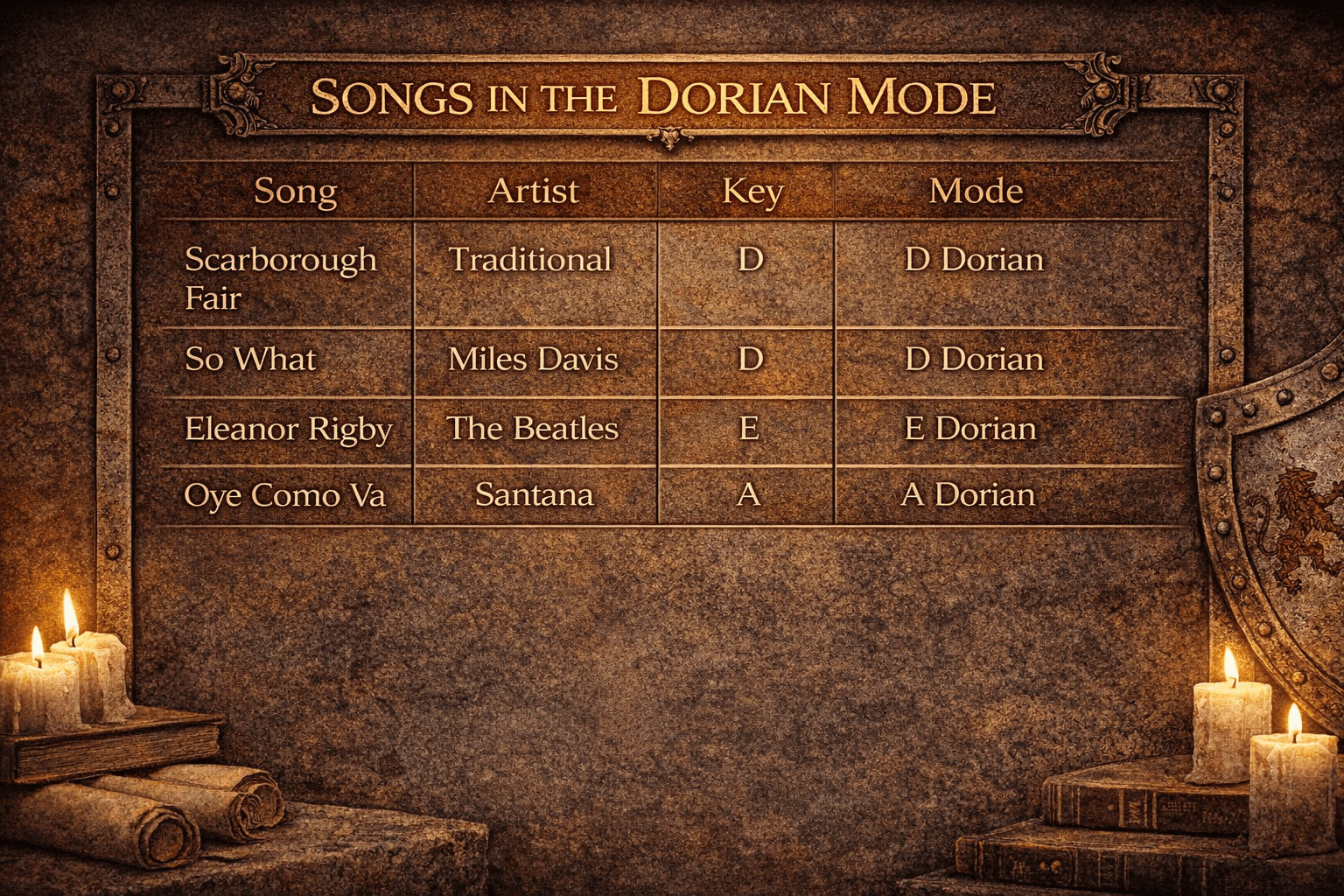
This table illustrates how the Dorian mode scale is used across genres from folk to jazz and rock.
Learning the Dorian Mode with Art Gharana
The Dorian mode piano scale becomes easier to master when students follow structured lessons with clear explanations. Art Gharana teaches Dorian mode piano explained concepts using simple examples, combining theory and practical exercises that show how modal music works in real compositions.
With Art Gharana, beginners can learn scale degrees, Dorian mode intervals, and chord patterns step by step. The curriculum emphasizes hands-on practice, allowing students to apply Dorian mode melodies and chord progressions in familiar songs while building strong musical foundations.
Final Thoughts on Mastering the Dorian Mode
Mastering the Dorian mode on piano strengthens understanding of modal music, improvisation, and chord progression. Its unique minor tonality with a major sixth allows pianists to create melodies that are expressive, jazzy, and flexible for various genres.
By practicing Dorian scale exercises, analyzing Dorian mode examples, and learning songs in this mode, pianists develop technical skill, melodic awareness, and deeper knowledge of piano music theory scales. Understanding the Dorian mode piano scale opens doors to all seven modes and enriches musical creativity.