ChatGPT
 Google AI
 Grok
Grok Claude
The D Minor chord is one of the most expressive and emotionally rich chords in Western music. Known for its melancholic yet deeply beautiful sound, D Minor has been used for centuries in classical compositions, cinematic music, jazz standards, pop ballads, and contemporary genres. Understanding how to play, analyze, and use the D Minor chord on piano is essential for anyone learning harmony, songwriting, or accompaniment.
This comprehensive guide explains the D Minor chord in detail, including its theory, variations, finger positions, inversions, arpeggios, scales, chord progressions, practice drills, real song applications, and more. By the end, you will be able to confidently use D Minor in any musical context.
What is the D Minor Chord?
 The D Minor chord is a minor triad built from the 1st (root), minor 3rd, and 5th degrees of the D minor scale. The formula for a minor chord is always:
Root + Minor 3rd + Perfect 5th
For D Minor:
- Root = D
- Minor 3rd = F
- Perfect 5th = A
Therefore, the notes of the D Minor chord are:
D – F – A
This chord has a darker and more introspective quality compared to a major chord due to the lowered 3rd interval.
D Minor Chord Formula and Intervals
The structure of any chord depends on the intervals between notes. Here is how D Minor is constructed.
Intervals in D Minor
Interval Distance Notes Root - D Minor 3rd 3 semitones F Perfect 5th 7 semitones A
Semitone Breakdown
- D → F = 3 semitones
- F → A = 5 semitones
- D → A = 7 semitones
This formula (3+4 pattern) creates the minor triad sound.
How to Play the D Minor Chord on Piano
Below are the standard hand positions for playing the chord.
Right-Hand Fingering
- D (thumb) = 1
- F = 3
- A = 5
Left-Hand Fingering
- D (pinky) = 5
- F = 3
- A = 1
These fingerings apply to the root position triad.
D Minor Chord on the Keyboard
Here are the exact keys:
Note Key Type D White key F White key A White key
This makes D Minor one of the easiest minor chords to play because it contains no black keys.
D Minor Chord Symbol Variations
D Minor can appear in sheet music or chord charts with different symbols:
Symbol Meaning Dm D Minor D- D Minor Dmin D Minor Dm triad Triad form
All of these mean the same chord: D–F–A.
D Minor Scale (Natural, Harmonic, Melodic)
To understand the chord more deeply, here are the D minor scale variations.
Natural Minor Scale (Aeolian Mode) D – E – F – G – A – Bb – C – D
Harmonic Minor Scale D – E – F – G – A – Bb – C# – D
Melodic Minor Scale (Ascending) D – E – F – G – A – B – C# – D Descending follows natural minor**.
D Minor Chord Inversions
Inversions change the order of the chord tones while keeping the same notes.
Root Position (D Minor) D – F – A Right-hand fingering: 1–3–5
First Inversion (Dm/F) F – A – D Right-hand fingering: 1–2–5 or 1–3–5
Second Inversion (Dm/A) A – D – F Right-hand fingering: 1–3–5 or 1–2–5
Comparison Table Inversion Notes Bass Note Symbol Root D–F–A D Dm 1st F–A–D F Dm/F 2nd A–D–F A Dm/A
Each inversion produces a slightly different emotional tone and is used for smooth voice leading.
D Minor Chord Arpeggios
Arpeggios break the chord into individual notes played in sequence.
D Minor Arpeggio Notes
D – F – A – D
Right-Hand Arpeggio Fingering
1 – 2 – 3 – 5
Left-Hand Arpeggio Fingering
5 – 3 – 2 – 1 Arpeggios are essential for classical pieces, improvisation, and hand independence exercises.
D Minor Chord Variations and Extensions
Advanced players often expand the chord with 7ths, 9ths, 11ths, and 13ths.
D Minor 7 (Dm7)
D – F – A – C Formula: 1–b3–5–b7
D Minor 9 (Dm9)
D – F – A – C – E
D Minor 11 (Dm11)
D – F – A – C – E – G
D Minor 13 (Dm13)
D – F – A – C – E – G – B
Suspended Variants
- Dsus2 = D – E – A
- Dsus4 = D – G – A
Added-Tone Variants
- Dm(add9) = D – F – A – E
- Dm(add11) = D – F – A – G
Altered Variants
- Dm6 = D – F – A – B
- DmMaj7 = D – F – A – C#
How D Minor Sounds Compared to Other Chords
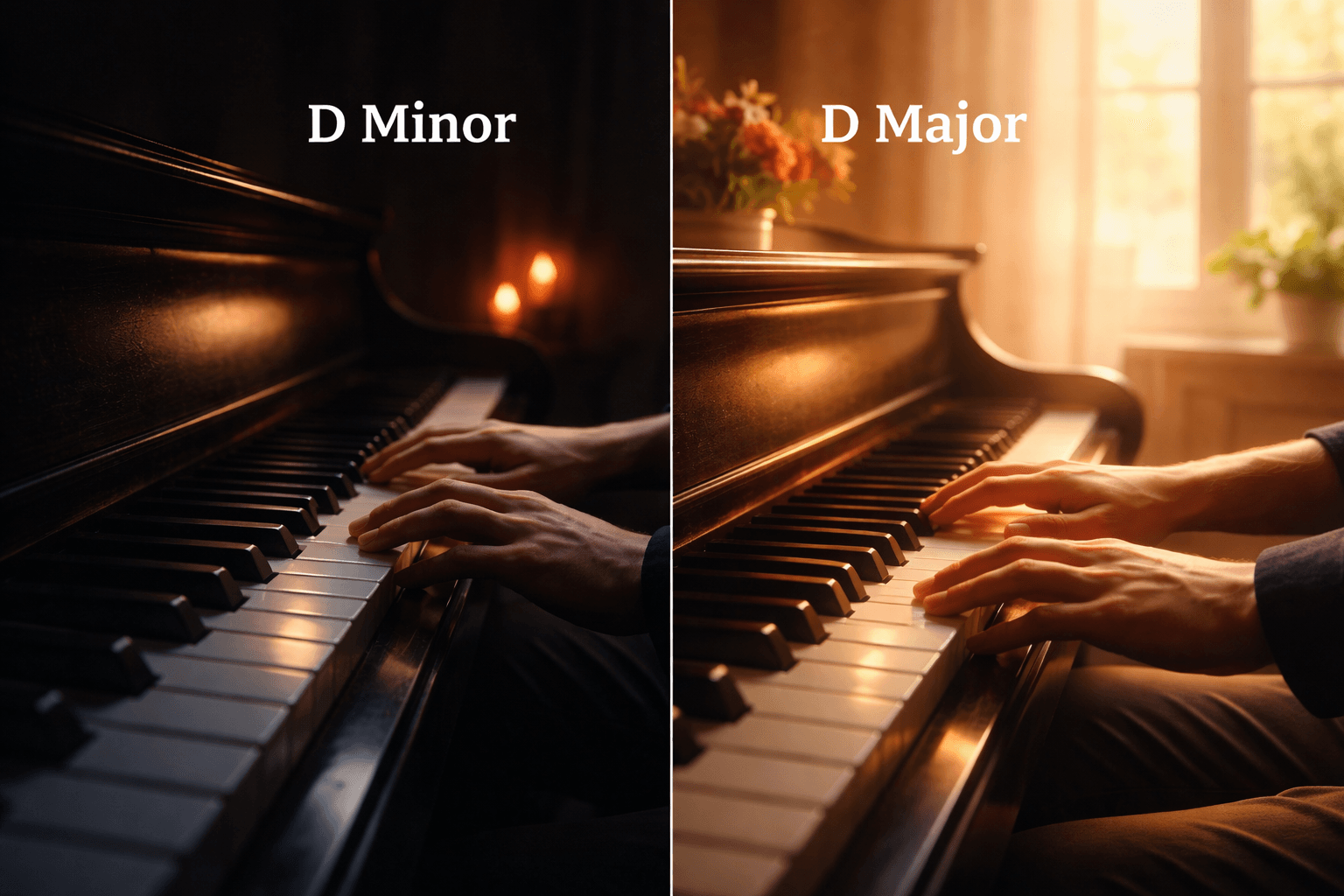 D Minor’s emotional color is distinct:
Chord Quality Mood D Major Bright Warm, triumphant D Minor Dark Emotional, nostalgic Dm7 Jazzier Softer, smoother Dm9 Lush Rich, atmospheric
D Minor Chord in Different Genres
Classical Used in dramatic symphonies and expressive piano works.
Pop Common in emotional ballads and cinematic themes.
Rock Creates depth in chord progressions.
Jazz Extensions like Dm7, Dm9, and Dm11 are common.
EDM / Ambient Used for atmospheric pads and progressions.
Chord Progressions Using D Minor
Below are the most common and professional-level progressions.
Basic Progressions
- Dm – Gm – A
- Dm – Bb – C
- Dm – Am – F
Intermediate Progressions
- Dm – Bb – F – C
- Dm – F – C – Gm
- Dm – A – Dm – Gm
Advanced Progressions
- Dm7 – G9 – Cmaj7 – Fmaj7
- Dm – C – Bb – A
- Dm9 – Gm11 – A7sus4 – Dm
Popular Songs Using D Minor
Classical
- Mozart – Requiem (many sections in D Minor)
- Beethoven – Ninth Symphony (sections)
Pop / Modern
- Adele – Rolling in the Deep
- Billie Eilish – Ocean Eyes
- Sting – Shape of My Heart (Dm is a central chord)
Film Music Hans Zimmer often uses D Minor in emotional scenes.
D Minor in the Circle of Fifths
D Minor is the relative minor of F Major.
Key Accidentals D Minor 1 flat (Bb)
This relationship is helpful for modulation and composition.
D Minor in Modes
- Aeolian (natural minor)
- Dorian when the 6th is raised (D–E–F–G–A–B–C–D)
- Phrygian if the 2nd is lowered (D–Eb–F–G–A–Bb–C–D)
How D Minor Functions in Harmonic Context
In the Key of D Minor
Scale Degree Chord Function i Dm Tonic iv Gm Subdominant v or V Am or A Dominant
In the Key of F Major (relative major)
Degree Chord Role vi Dm Tonic substitute
Piano Exercises for Mastering D Minor
Exercise 1: Root Position Drills Play D–F–A repeatedly using metronome counts.
Exercise 2: Inversion Cycling Cycle between root, first, and second inversions.
Exercise 3: Arpeggio Practice Hands separate → hands together.
Exercise 4: Chord-to-Scale Connection Play D Minor scale then immediately play chord forms.
Exercise 5: Progression Training Practice Dm → Bb → F → C in different octaves.
D Minor Chord Practice Routine (10 Minutes)
- 1 minute – D Minor triad
- 2 minutes – Inversions
- 2 minutes – Arpeggios
- 2 minutes – Progressions
- 3 minutes – Play with metronome in multiple octaves
Advanced Concepts
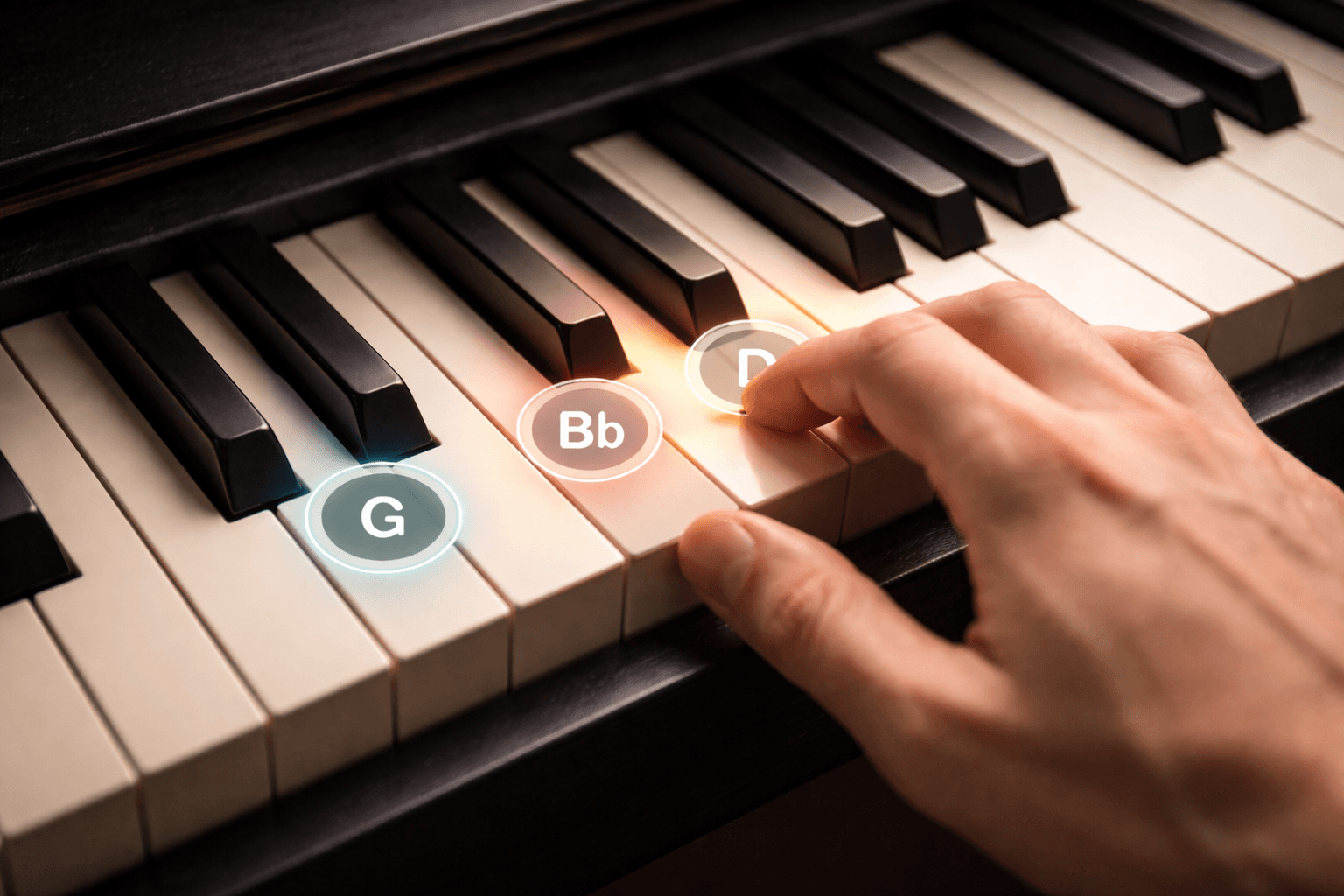 Voice Leading
Move between D Minor and its related chords smoothly by shifting minimal notes.
Voice Leading
Move between D Minor and its related chords smoothly by shifting minimal notes.
Harmonic Substitution
Replace D Minor with:
- Dm7
- Dm9
- F Major (relative)
- Bb Major (subdominant of relative major)
D Minor in Jazz Modes
Used frequently in:
- D Dorian
- D Aeolian
- D Melodic Minor
Composition Tips with D Minor
 Emotional Context
D Minor is ideal for:
- Mysterious themes
- Emotional ballads
- Sad, haunting melodies
- Cinematic scoring
Melodic Writing
Use the minor 3rd (F) for emotional emphasis.
Bassline Patterns
Use:
- D → A → D
- D → F → A
- D → C → Bb → A
Frequently Asked Questions (FAQs)
1. What notes make up the D Minor chord on piano?
The notes are D, F, and A.
2. Is D Minor a sad chord?
Yes. It has a naturally emotional and melancholic sound due to the minor 3rd.
3. What is the D Minor scale?
The natural scale is D – E – F – G – A – Bb – C – D.
4. What is the difference between D Minor and D Major?
D Major has F#, while D Minor has F.
5. How do I make my D Minor chord sound richer?
Add extensions such as:
- Dm7
- Dm9
- Dm11