ChatGPT
 Google AI
 Grok
Grok Claude
What Is the D Major Guitar Chord?

The D major guitar chord is a cornerstone of modern guitar playing. It belongs to the major chord family and consists of three essential notes: D (root), F# (major third), and A (perfect fifth). These three notes form the D major triad and give it a bright, clear, and uplifting sound that is widely used in popular, rock, and folk music. If you want structured guidance to master chords like this, you can explore these online guitar classes designed for beginners and intermediate players.
The D chord guitar diagram helps beginners visualize guitar finger placement. By understanding its chord tones and major chord formula, guitarists can play the D major chord in multiple positions. This foundational chord also serves as a stepping stone for movable D chord shapes and barre chords across the fretboard.
What Makes the D Chord Special
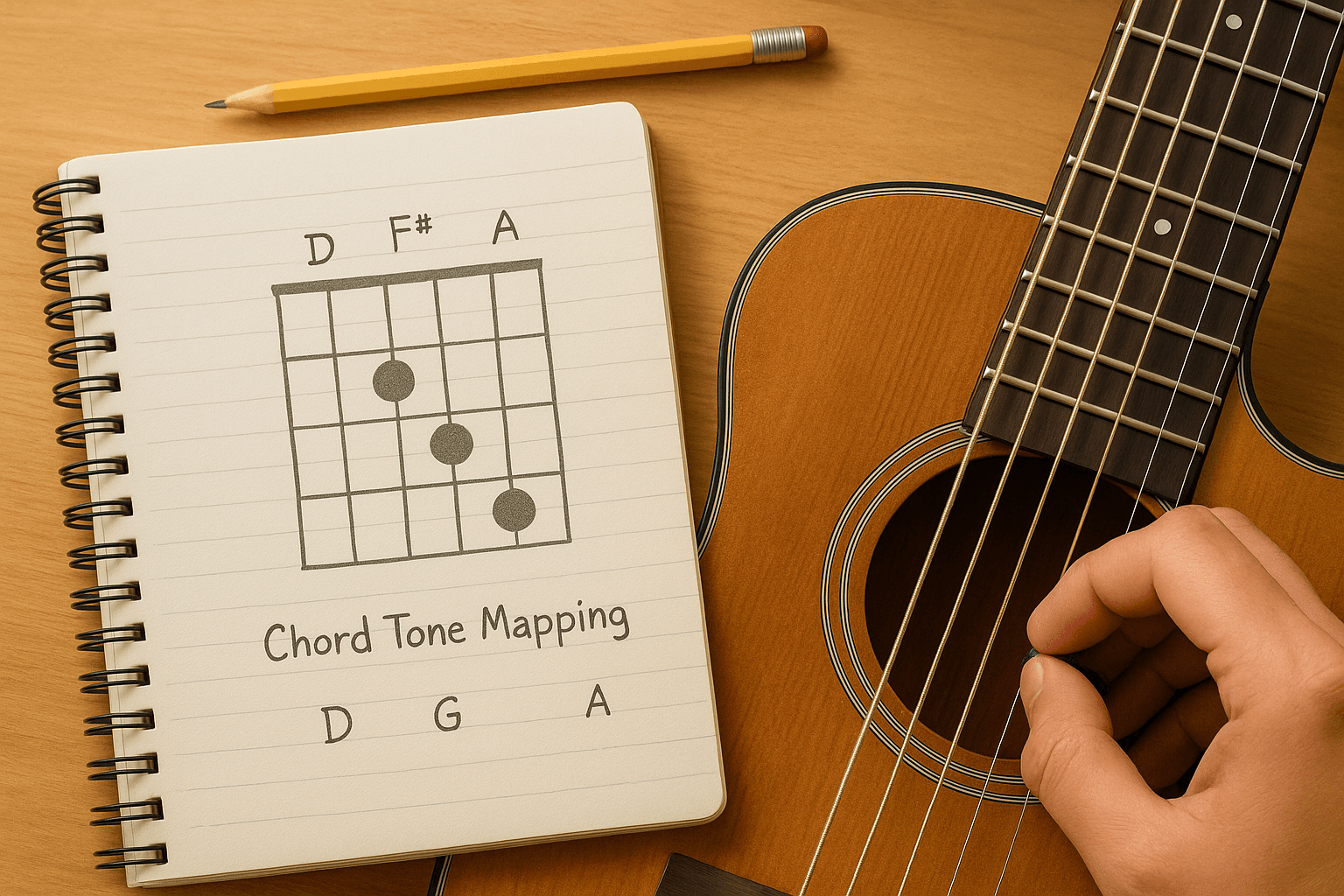
The D major chord is unique for its bright, resonant tone. It functions as the tonic in the key of D major and as a dominant chord in keys like G major and A major. Its root–major third–perfect fifth formula creates a harmonic structure that sounds stable and uplifting, making it a favorite for countless songs.
Guitarists appreciate the D chord guitar finger positions because they are adaptable. Beginners can start with the open D guitar chord, while advanced players explore movable D major barre chord shapes. Learning this chord strengthens hand dexterity and opens doors to chord inversions and D major chord variations.
D Major Chord Notes and Formula
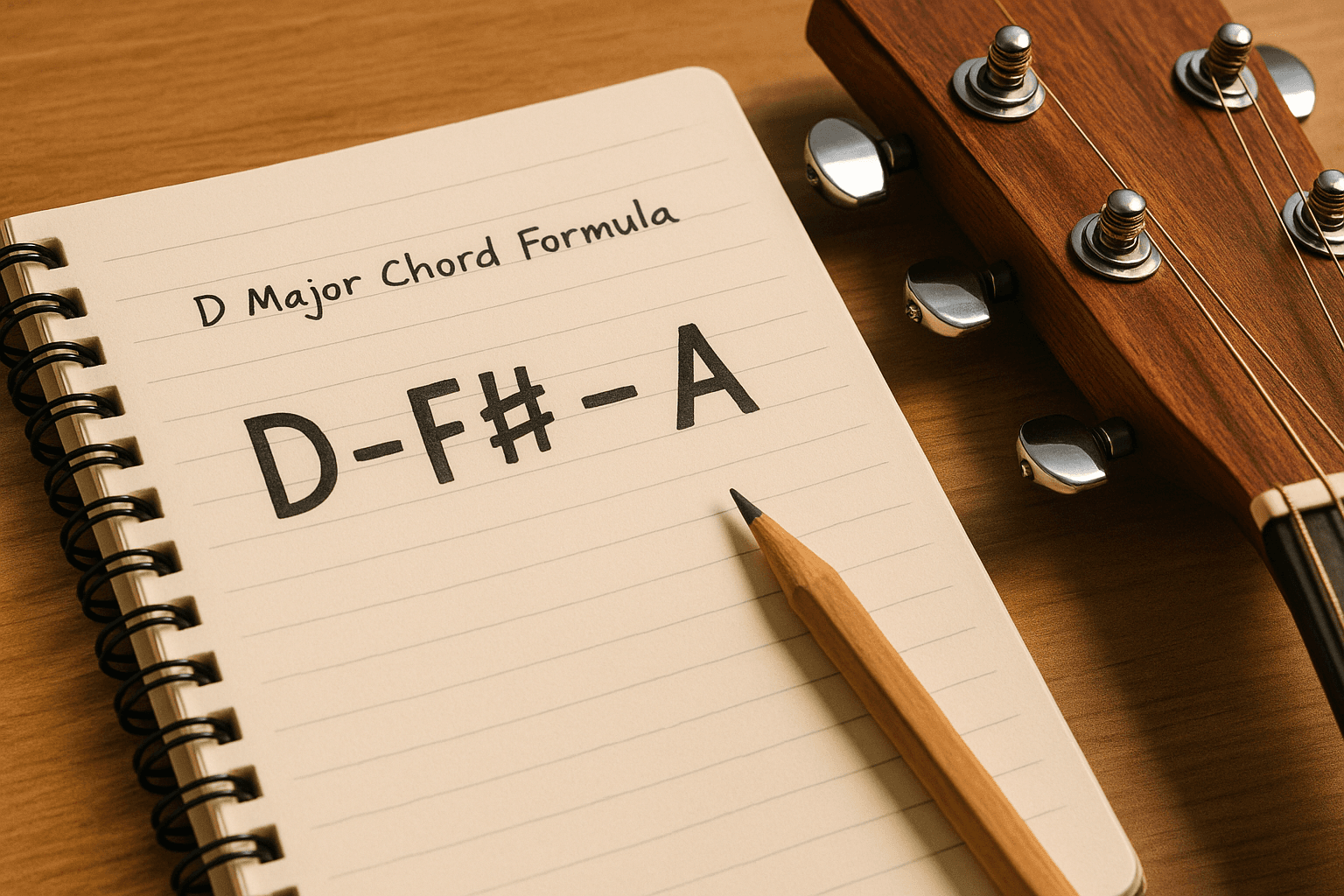
Understanding the D major chord structure begins with the major chord formula, which stacks the root, major third, and perfect fifth. For D major, this formula results in the notes D–F#–A. These triad notes combine to produce the familiar bright tone of D major.
| Note | Interval |
|---|---|
| D | Root |
| F# | Major Third |
| A | Perfect Fifth |
By studying this table, guitarists can visualize the chord tones and apply them in various D major chord positions. This understanding also aids in playing scales over D major chord and constructing chord progressions using D major.
How the Major Chord Is Built
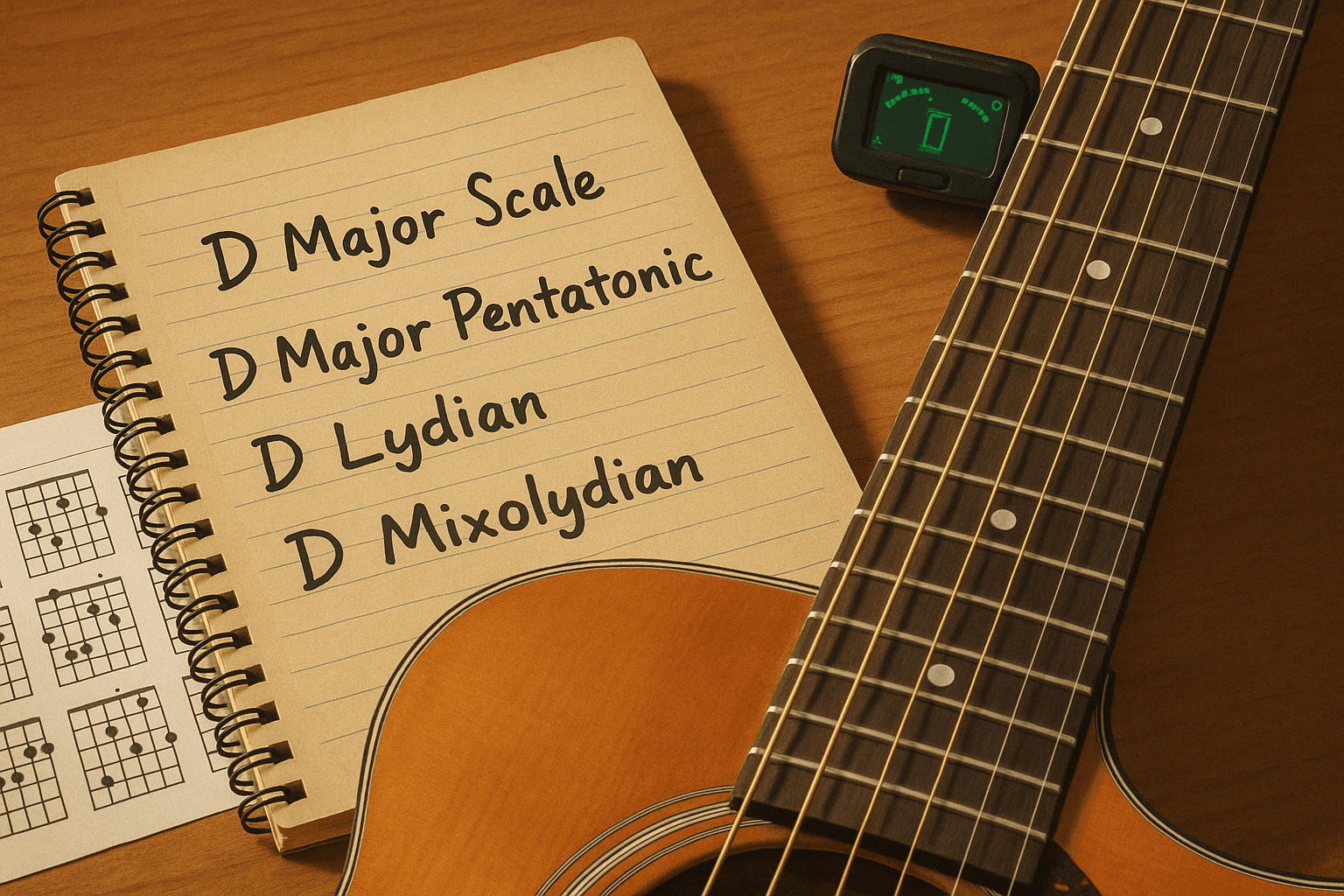
The D major chord is built by stacking thirds from the D major scale (D E F# G A B C#). The root note D, the major third F#, and the perfect fifth A are combined to form a triad. This approach is consistent with all major chord theory and helps in how to build chords on the guitar.
This triad formula explains why D major sounds bright. By mapping the chord tones across the fretboard, guitarists can create D major movable chord shapes, barre chord versions, and open chord variations. Learning this chord tone mapping is essential for improvisation and creative playing.
D Major Chord on Guitar
The Basic Open D Major Shape
- Place your index finger on the G string, 2nd fret.
- Middle finger on the high E string, 2nd fret.
- Ring finger on the B string, 3rd fret.
- Strumming from the D string down produces a clear, ringing tone.
- Proper guitar finger placement ensures each note resonates clearly.
- This shape lays the foundation for mastering D major chord positions and movable D chord shapes later.
Keys Where You'll Find the D Major Chord
The D major chord is present in several keys. It acts as the tonic in D major, as the V chord in G major, and as the IV chord in A major. Understanding keys containing D major chord helps in transposing and songwriting.
| Key | I | ii | iii | IV | V | vi | vii |
|---|---|---|---|---|---|---|---|
| D Major | D | Em | F#m | G | A | Bm | C#dim |
| G Major | G | Am | Bm | C | D | Em | F#dim |
| A Major | A | Bm | C#m | D | E | F#m | G#dim |
| E Minor | Em | F#dim | G | Am | Bm | C | D |
| F# Minor | F#m | G#dim | A | Bm | C#m | D | E |
These relationships demonstrate D major chord usage and its flexibility in music keys and chords.
Common Chord Progressions With D Major
- I–IV–V in D Major (D–G–A): Foundational in rock and folk.
- vi–IV–I–V (Bm–G–D–A): Provides emotional depth, widely used in pop.
Understanding these progressions aids in improvisation and scales to play over D major chord. Combining D major chord theory with practical application allows guitarists to create dynamic rhythms and seamless chord transitions across songs.
Scales to Play Over a D Major Chord
- D Major Scale (D E F# G A B C#): Bright, classic.
- D Major Pentatonic (D E F# A B): Simple, melodic.
- D Lydian Scale (D E F# G# A B C#): Dreamy, spacious.
- D Mixolydian Scale (D E F# G A B C): Bluesy, relaxed.
These scales are ideal for improvising on D major, playing scales over chords, and exploring chord tone visualization across the fretboard.
| Scale Name | Notes | Mood / Feel |
|---|---|---|
| D Major Scale | D E F# G A B C# | Bright, classic |
| D Major Pentatonic | D E F# A B | Simple, melodic |
| D Lydian Scale | D E F# G# A B C# | Dreamy, spacious |
| D Mixolydian Scale | D E F# G A B C | Bluesy, relaxed |
Popular Songs That Use the D Major Chord
- Hotel California by The Eagles
- Sweet Home Alabama by Lynyrd Skynyrd
- Love Hurts by Nazareth
- Knockin' on Heaven's Door
- Brown Eyed Girl
These examples illustrate D major chord sound in real music and provide practical templates for beginner guitar chords and advanced compositions.
How to Play the D Major Chord: Guitar Shapes & Positions

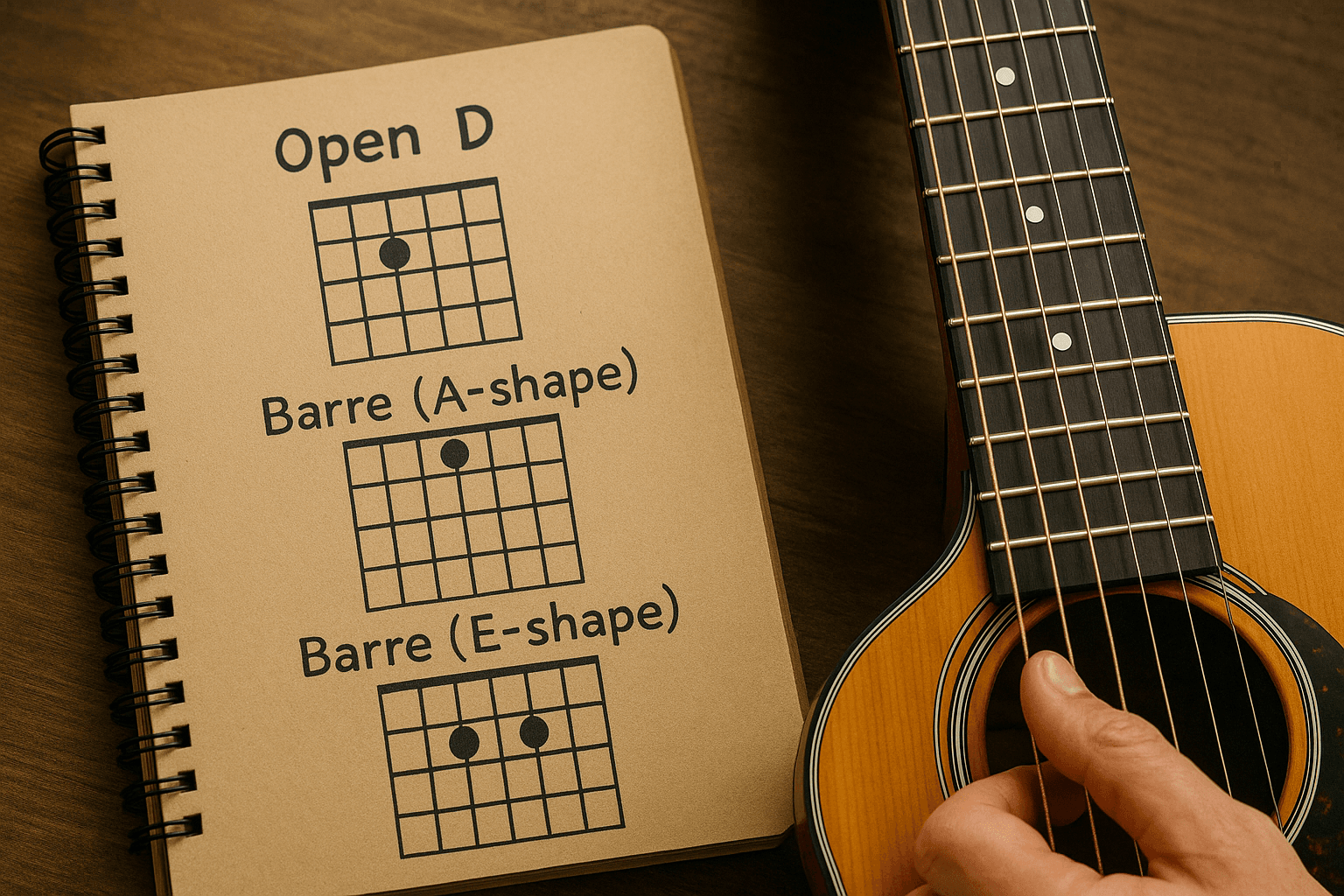
The D major chord can be played in open position or as movable barre chords. Open D is ideal for beginners, while barre positions allow the chord to be transposed across the neck. The CAGED system guitar connects these positions to maximize fretboard knowledge. To explore more guitar-learning resources and tutorials, you can visit Art Gharana.
| Position | Root Note | Shape | Type |
|---|---|---|---|
| Open D | D string | Open | Basic chord |
| Movable D | A string, 5th fret | Barre | E-shape |
| Barre D | E string, 10th fret | Barre | A-shape |
| High voicing | B string, 12th fret | Movable | Inversion |
Practicing these shapes develops D major chord finger stretch and strengthens D chord transitions in various chord progressions using D major.
Alternate Voicings and Extensions
- Dmaj7: Produces a jazzy tone.
- Dsus2: Softens the chord.
- Dsus4: Adds tension.
These are essential for creating D major chord variations and exploring chord inversions across the neck. Choosing open vs barre versions depends on context and tonal preference.
Play This Chord With Other Roots
- Slide the D shape up the neck to play E major, F# major, or G major.
- The CAGED system guitar shows how D major in the CAGED system connects with other chord shapes, enhancing both rhythm and lead playing.
How to Build the D Major Chord on Guitar
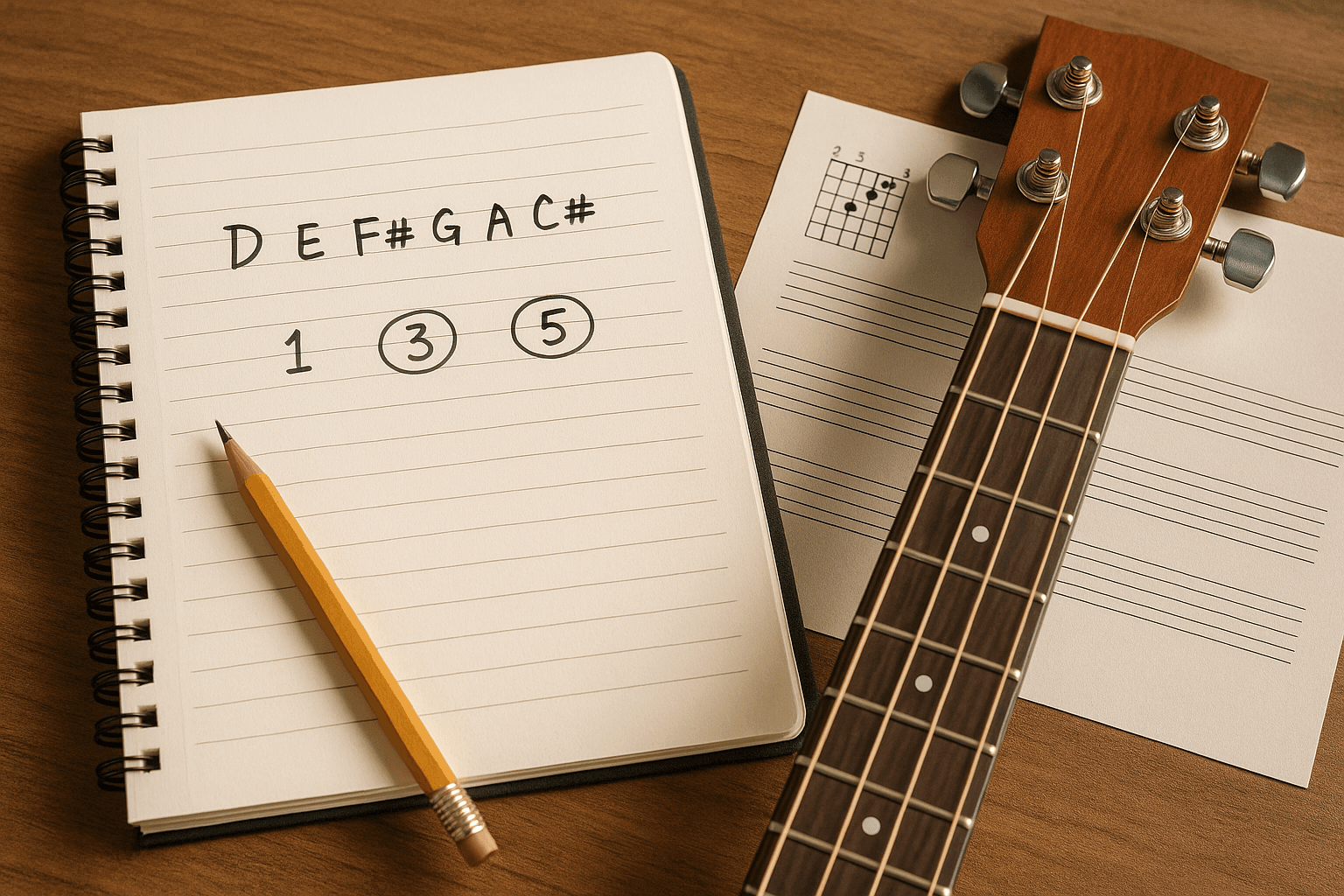
Building D major starts with identifying the chord tones D, F#, and A across the strings. Using chord tone mapping, guitarists can form triads, inversions, and movable barre chord patterns. Understanding how chords are built strengthens fretboard knowledge and allows creative voicings anywhere on the neck.
Tips to Master the D Major Chord
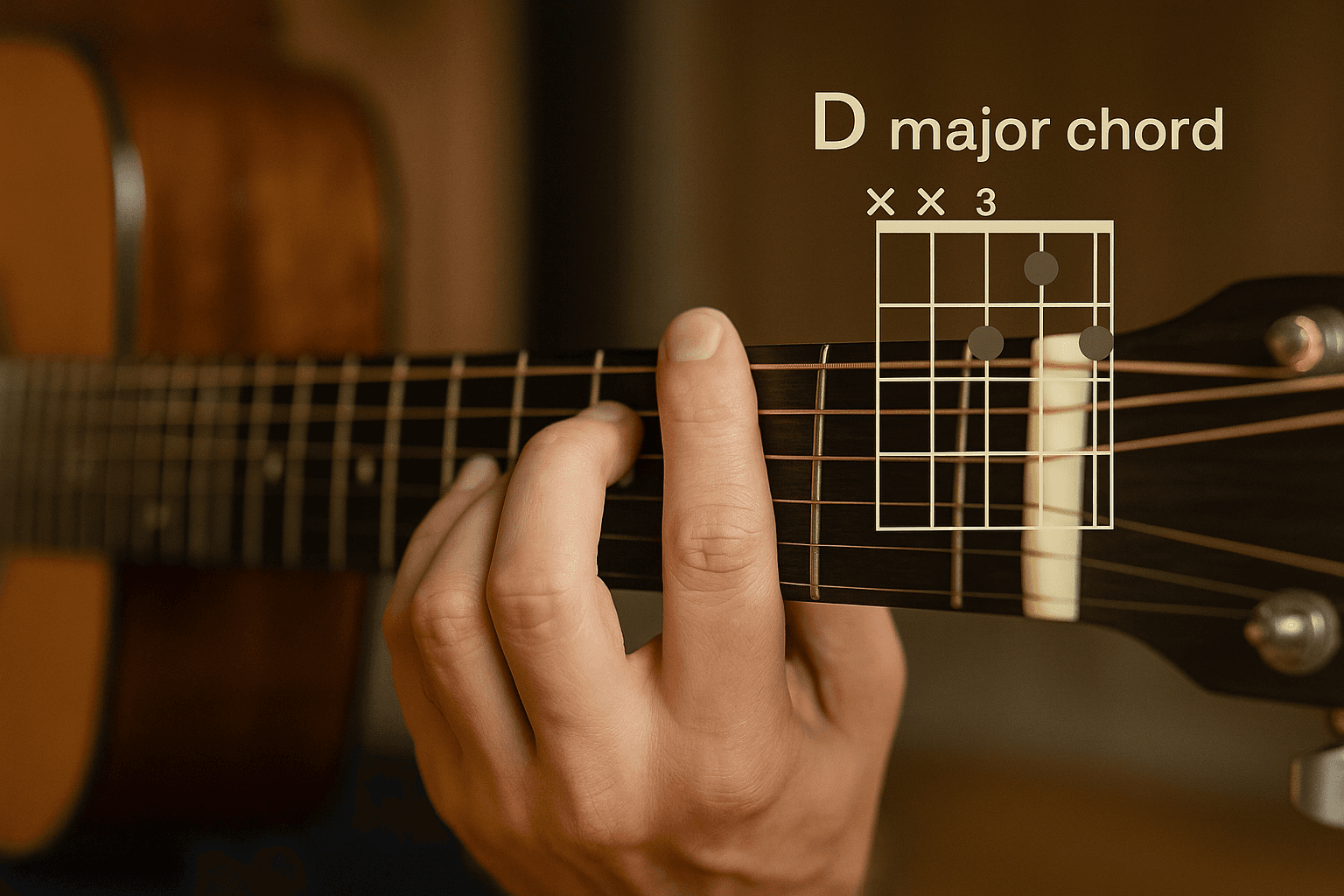
- Maintain proper hand position and finger arching to avoid fatigue.
- Practice D chord finger stretch and transition exercises like D–G, D–A, or D–Bm–G–A.
- Using a metronome ensures smooth timing.
| Exercise | Duration | Goal |
|---|---|---|
| D chord finger stretch | 5 mins | Flexibility |
| D–G transition | 10 mins | Clean changes |
| D–Bm–G–A progression | 10 mins | Flow |
Daily practice improves chord voicings across fretboard and builds confidence in D major chord practice.
Troubleshooting Common Problems
- Buzzing strings: Adjust fingers slightly closer to frets.
- Muted strings: Curl fingers properly.
- Hand fatigue: Practice open position and gradually introduce barre chords.
Advanced Applications of the D Major Chord
- Use D major arpeggios for lead lines.
- Explore D major chord inversions and high voicings for richer texture.
- Apply movable D chord shapes to songwriting, integrating them in chord progressions using D major.
- The CAGED system guitar allows seamless movement and expanded creativity.
For personalised guidance while mastering these techniques, you can book a trial class with a professional instructor.
FAQ About the D Major Guitar Chord
Q1: Is D major easy to play on guitar?
It requires finger stretching but is a fundamental beginner guitar chord.
Q2: What are the notes in D major chord?
D (root), F# (major third), A (perfect fifth).
Q3: Which chords go well with D major?
G, A, Bm, and Em fit perfectly in D major chord progressions.
Q4: How to play D chord without straining fingers?
Use Dmaj7 or barre versions higher up the neck.
Q5: Difference between D major and D minor?
D major is D–F#–A, bright and uplifting. D minor is D–F–A, darker and sadder.
Conclusion
The D major chord is essential for guitarists, providing a bright, harmonic tone across genres. Mastering D major chord positions, open and barre shapes, and movable D chord shapes enhances your ability to play any song. Combining D major chord theory, chord tone mapping, and practice routines ensures mastery of transitions, chord voicings across the fretboard, and confident improvisation. Whether for beginners or advanced players, understanding D major chord construction unlocks the full potential of the guitar.