ChatGPT
 Google AI
 Grok
Grok Claude
The tabla is India's most iconic percussion instrument, a pair of hand-played drums that produces one of the world's most sophisticated rhythmic and tonal systems. For Indian-American families in the USA, learning tabla online is now genuinely practical with the right setup, a qualified teacher, and a consistent practice schedule. This complete guide covers what the tabla is and how it works, what age children can start, what equipment you need, how online lessons are structured, how the tala system works for beginners, common challenges and solutions, and how to find a qualified teacher from anywhere in the US.
There's a reason the tabla appears in almost every Indian classical music performance, in Bollywood recordings, and in concert halls from Mumbai to Manhattan. Its combination of tonal richness, rhythmic sophistication, and sheer physical beauty when performed well makes it one of the world's truly great instruments.
For Indian-American families in the USA, the tabla also carries deep cultural meaning. It's the instrument that kept the beat at your parents' childhood concerts, at the temple, at family gatherings. Teaching your child to play tabla is a direct transmission of that rhythmic heritage.
Online tabla lessons for beginners in the USA have made this transmission possible from anywhere in the country. This guide tells you exactly what you need to know before you start.
What Is the Tabla? Instrument Anatomy and How It Works
The Two Drums and Their Distinct Roles
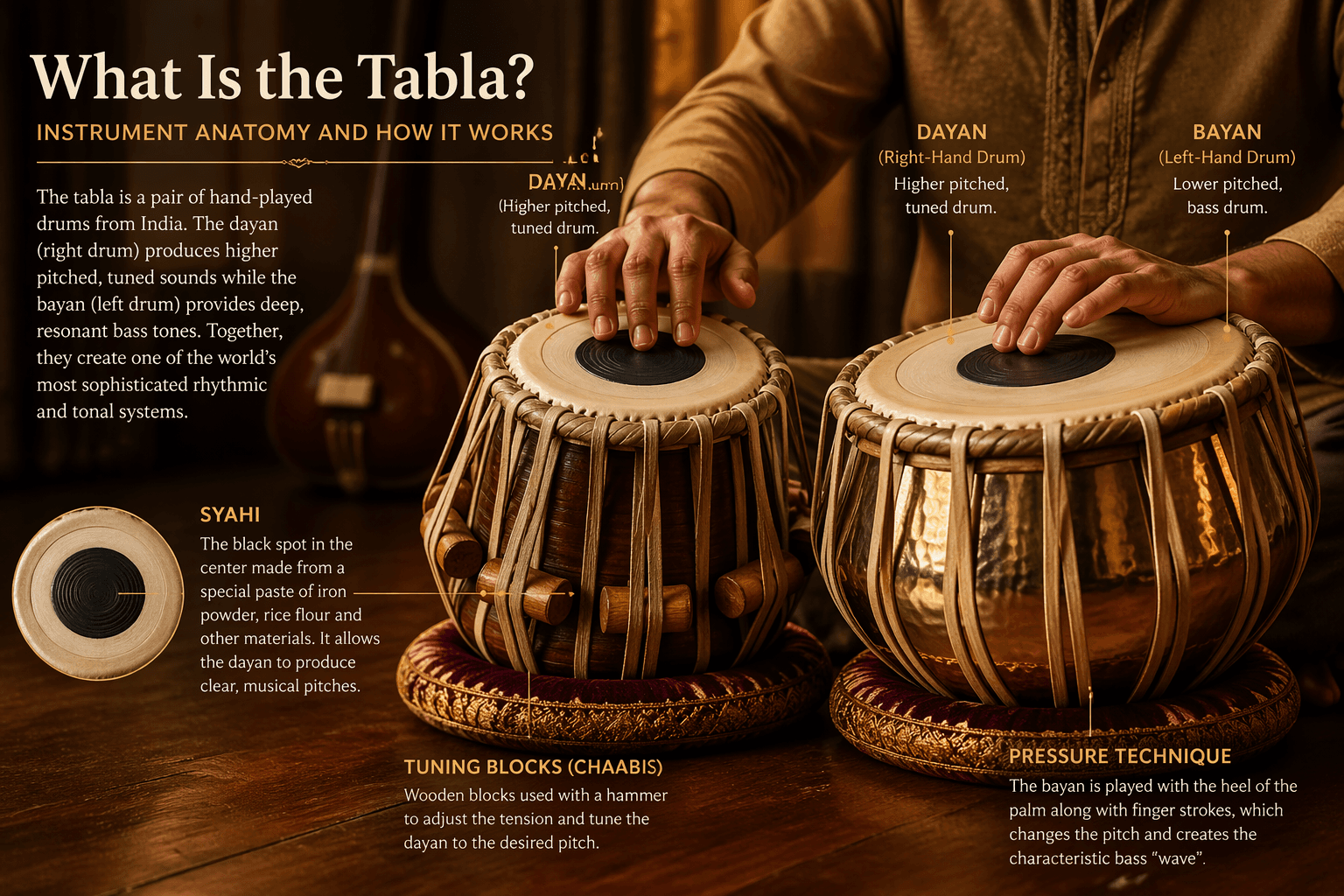
The tabla is not a single drum but a pair of complementary instruments played together:
The Dayan (Right-Hand Drum)
The dayan is the smaller, higher-pitched drum, played with the right hand. Its distinctive features:
Body: Typically constructed from a solid block of wood, traditionally either rosewood (sheesham) or another dense hardwood. The cylindrical wooden body has a relatively small diameter (typically 5-6 inches at the playing head) and a narrower waist.
Head: A double-layered head made from goatskin. The outer ring is a broader goatskin layer. The inner area contains the most distinctive element of the tabla: the syahi, a black paste made from a mixture of iron powder, rice flour, and other materials applied in multiple, carefully calibrated layers. The precise application, size, and hardness of the syahi is what gives the dayan its ability to produce tuned pitches, making it one of the very few percussion instruments in the world capable of sounding specific musical notes.
Tuning: The dayan is tuned to the tonic (Sa) of the raga being performed. Tuning is done by adjusting the tension of the lacing (thin leather strips) using a hammer to tap the wooden blocks (chaabis or pegs) around the rim.
The Bayan (Left-Hand Drum)
The bayan is the larger, lower-pitched drum, played with the left hand and the heel of the palm. Its distinctive features:
Body: Made from metal (brass or copper, occasionally nickel or chrome), giving it a richer, more resonant bass sound than a wooden body would produce.
Head: Buffalo hide or goat skin with a smaller, harder syahi patch. The larger size and metal body produce the characteristic deep bass tones.
Pressure technique: Unlike the dayan, the bayan is played with pressure applied by the heel of the left palm against the drumhead simultaneously with finger strokes. This pressure technique modulates the pitch of the bass tones, producing the characteristic ascending and descending bass effects (the "wave" quality of tabla bass sounds).
The Bol System — The Language of Tabla
What makes the tabla uniquely sophisticated among percussion instruments is its comprehensive verbal recitation system called bols. Every sound the tabla makes has a specific name:
Single stroke bols (dayan):
- Na: Ring finger strikes slightly off-centre on the dayan. Clear, open ring.
- Ta: The same as Na but in the context of certain compositions.
- Tun: Index or ring finger on the edge of the dayan. Ringing, bright sound.
- Ti/Te: Finger combinations producing a light, pitched sound.
Single stroke bols (bayan):
- Ge (or Ghe): Flat of all four fingers on the bayan centre.
- Ke: Flat hand slap on the bayan.
Combined bols:
- Dha: Ge (bayan) + Na (dayan) played simultaneously. The characteristic combined sound of tabla.
- Dhin: Ge (bayan) + Tun (dayan). Produces the characteristic resonant sound.
- Tete: Rapid alternation between two dayan strokes.
Learning the bols begins immediately in tabla training, simultaneously with the physical technique. Students learn to speak the bols aloud as they play them, which builds the rhythmic awareness and physical coordination simultaneously.
The Tala System — Rhythmic Cycles for Beginners
All Indian classical music unfolds within rhythmic cycles called talas. The tabla player marks and maintains these cycles throughout a performance. The most important tala for beginners : Teen Taal (Teentaal) — 16 Beats: The most fundamental tala in Hindustani music. Divided as 4+4+4+4. The basic theka (repetitive rhythmic phrase that marks the cycle) is:
Dha Dhin Dhin Dha | Dha Dhin Dhin Dha | Dha Tin Tin Ta | Ta Dhin Dhin Dha
The first beat of every cycle is called Sam (pronounced "sum") and is the structural anchor of all Indian classical music performance.
Keherwa — 8 Beats: Divided as 4+4. Used in lighter classical, folk-based, and devotional music.
Rupak Taal — 7 Beats: Divided as 3+2+2. An asymmetric tala introduced after Teen Taal is comfortable.
What Age Can Children Start Tabla?
Age Recommendations and Developmental Readiness
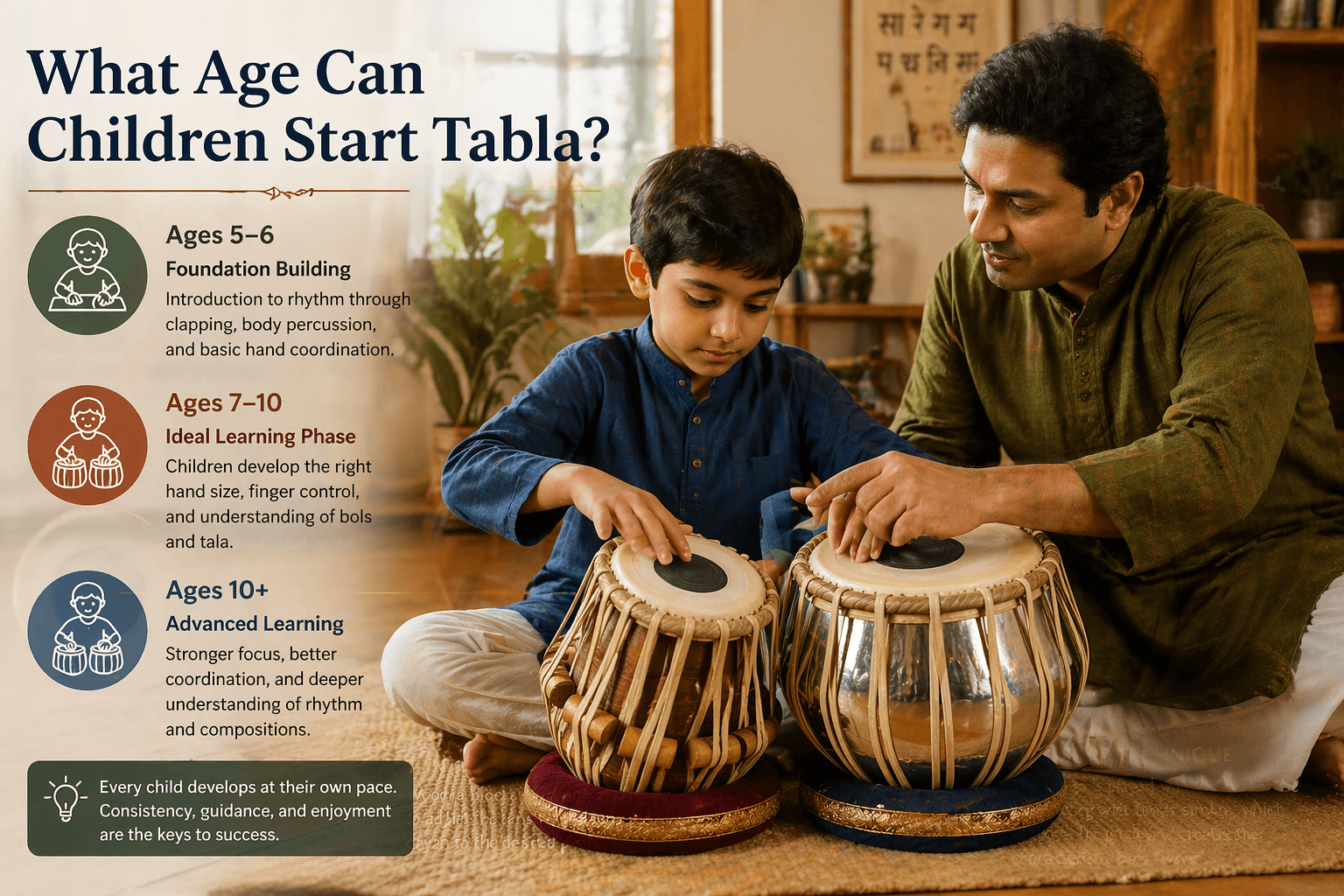
Most experienced tabla teachers recommend starting children around ages 7 to 8 for the following reasons:
Hand size: Full tabla technique requires the hand to comfortably span the different striking zones of the dayan. Very young children (under 6) often don't have hands large enough for correct technique.
Fine motor development: The specific finger control required for individual tabla bols (particularly the controlled ring finger placement for Na and the isolated finger techniques for other bols) requires a level of fine motor development that most children reach around age 7.
Cognitive readiness: Understanding the bol system and tala structure requires basic mathematical and rhythmic comprehension that develops strongly around age 7-8.
Starting Tabla at Different Ages
Ages 5-6 (introductory programs): Some teachers offer introductory rhythm programs that use basic hand drums, thali (plate tapping), and body percussion to build rhythmic awareness and hand coordination before formal tabla technique is introduced. These programs are genuinely valuable and create an excellent foundation.
Ages 7-10 (ideal beginner window): The optimal starting age range for full tabla technique. Children in this range develop technique quickly and build the muscle memory for correct bols before incorrect habits can form.
Ages 10+ and adults: Excellent candidates for tabla learning. Older beginners understand theoretical concepts faster, have better existing hand coordination, and are more disciplined about home practice. The tabla's initial physical demands are manageable for anyone in good health.
What Equipment Do You Need to Start Tabla?
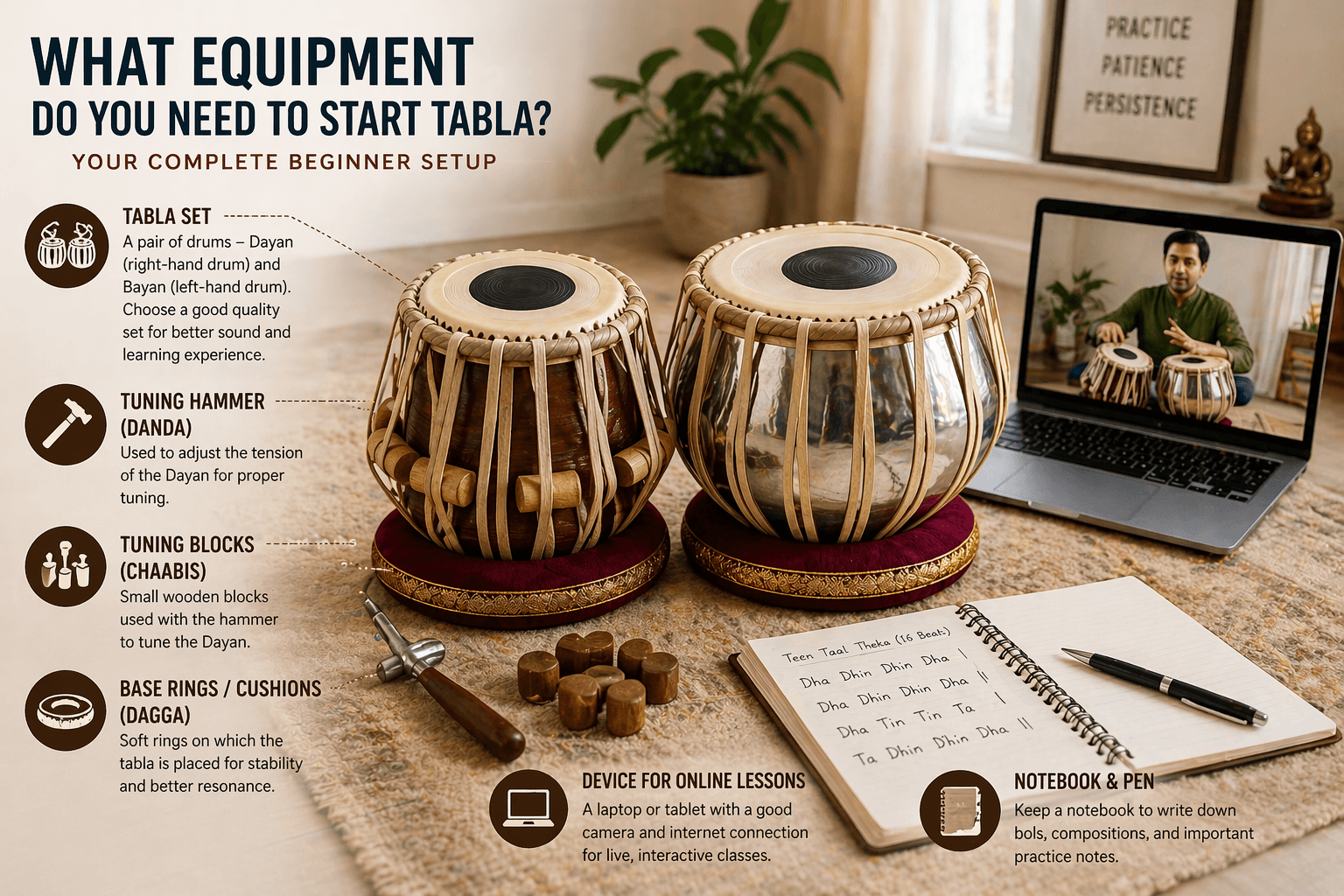
The Tabla Set — Choosing Your First Instrument
For beginners in the USA, a basic acoustic tabla set is the appropriate starting instrument. Budget approximately:
Entry level ($80-$150): Basic wooden dayan with brass bayan. Functional for learning bols and basic technique. Sound quality is adequate but not exceptional. Suitable for the first 6-12 months.
Mid-range ($200-$400): Better quality wood selection, metal quality bayan, more carefully applied syahi. Significant improvement in sound and tuning stability. Appropriate for serious beginners and intermediate students.
Professional-level ($500+): Highest quality wood, superior bayan resonance, carefully tuned by craftsmen. Not necessary for most students in the first two years.
What to Look for in a Tabla Set
- Dayan body: Solid sheesham (rosewood) or other dense hardwood. Avoid tabla with visibly cracked or repaired bodies.
- Syahi quality: The black patch should be centred, smooth, and firmly adhered. Uneven or cracked syahi produces poor tone.
- Lacing condition: The leather lacing should be even and not visibly dry or cracked.
- Bayan metal quality: Brass or copper bayan have better resonance than cheaper alloys.
Where to buy in the USA: Reliable sources include Maharaja Musicals, Tabla Shop (online), and various Indian instrument retailers in major US cities with significant Indian communities. Your teacher will provide specific recommendations.
Additional Equipment
Hammer (danda) and tuning rings (chaabis): Included with most sets. Essential for tuning the dayan to match the sruti of practice sessions.
Cushion/ring (dagga): The bayan traditionally rests on a cloth ring when not being played. Usually included with sets.
Tabla stand: Optional but useful for apartment living or when floor-level playing is uncomfortable. Various designs available online.
Setting Up Your Device for Online Tabla Lessons
Camera position is crucial for effective online tabla instruction. Set up your camera so it shows:
- Both drums clearly in frame
- Your hands on both drums simultaneously
- Sufficient angle to see the striking position and technique
A standard laptop or tablet camera works well. Position it at a level slightly above the drums, angled slightly downward. Your teacher needs to see your exact finger placement, striking zone, and technique in real time.
How Online Tabla Lessons Are Structured
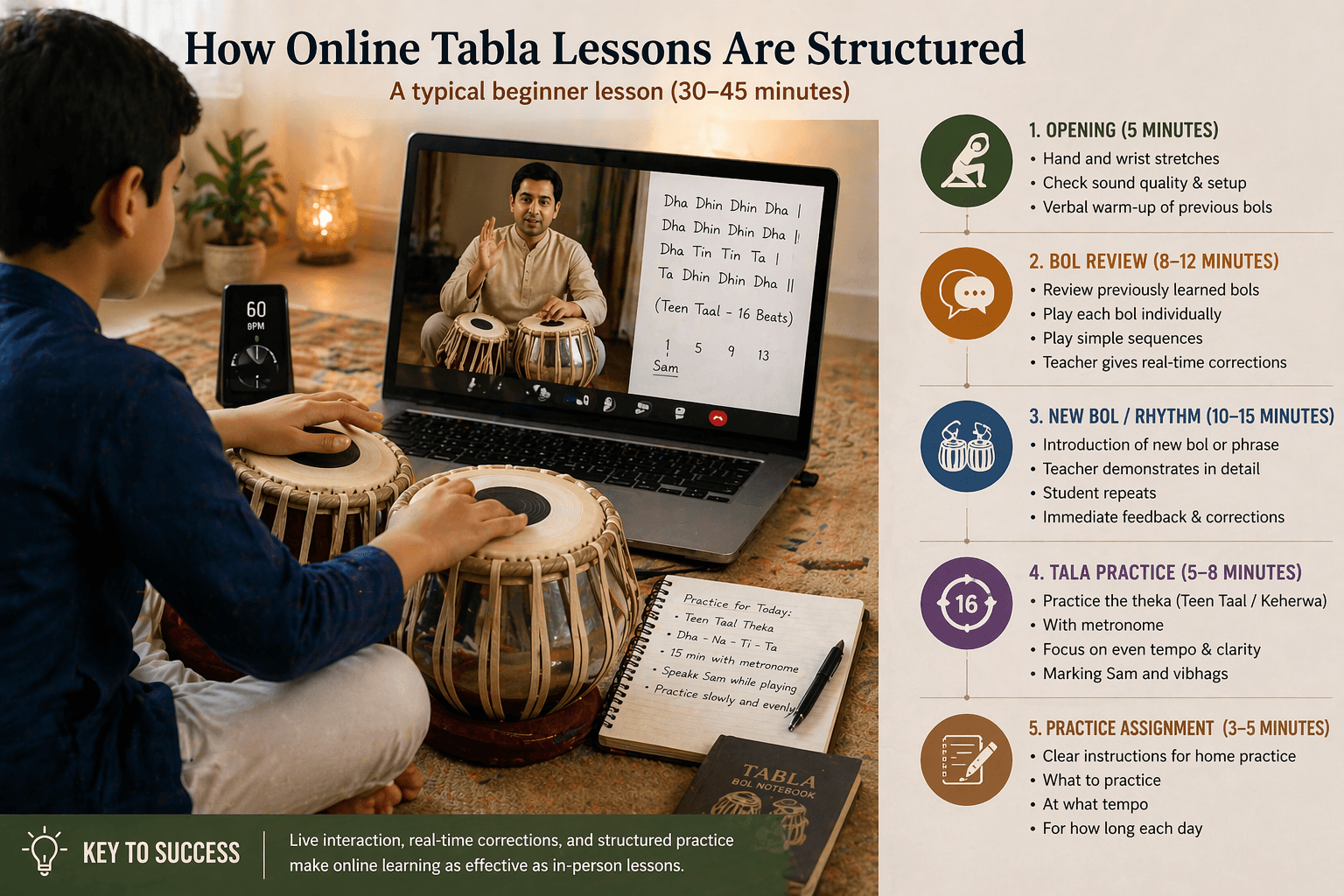
A Typical Beginner Session (30-45 Minutes)
Opening (5 minutes)
Brief hand and wrist stretches. The teacher checks equipment and sound quality. A short verbal warm-up reviewing bols from the previous lesson.
Bol Review and Reinforcement (8-12 minutes)
The teacher reviews the bols introduced in the previous session. The student demonstrates each bol individually, then in simple sequences. The teacher corrects striking position, hand angle, and sound quality in real time.
New Bol or Rhythm Phrase (10-15 minutes)
Introduction of a new bol or a new sequence (typically a short segment of a theka or a simple compositional phrase). The teacher demonstrates in detail, breaking down each component. The student repeats, and the teacher provides immediate corrections.
Tala Practice (5-8 minutes)
Practicing the theka (Teen Taal or Keherwa) at a consistent tempo with a metronome. Focus on evenness of tempo and clarity of each bol within the cycle.
Practice Assignment (3-5 minutes)
Clear specification of what to practise at home, at what tempo, and for how long each day.
The Role of Bol Recitation in Tabla Learning
One of the unique features of tabla pedagogy is the integration of verbal bol recitation with physical performance. Students learn to speak the bols aloud simultaneously with playing them, or to practise the bol sequences verbally without the drum as a form of mental rehearsal.
This bol recitation practice is one of the most powerful tools in tabla learning and is fully effective as homework without requiring the drum. Students can practise bols vocally while commuting, before bed, or any time the drum is unavailable.
Your teacher will introduce bol notation (written sequences of bols) as a reference tool. This notation helps students track compositional structures and maintain accuracy in home practice.
Common Beginner Challenges and Practical Solutions
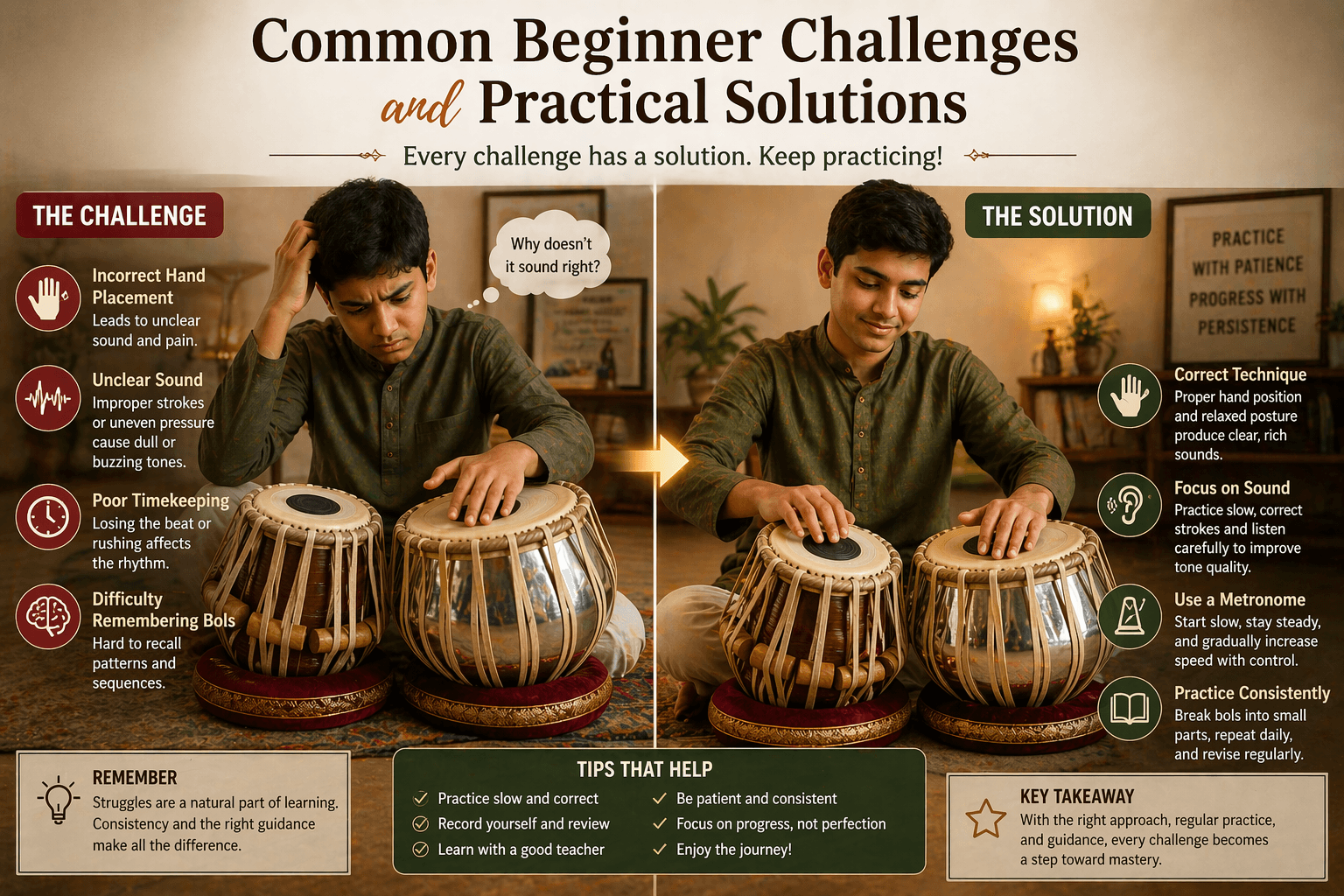
Challenge 1 - Achieving Clear, Distinct Bol Sounds
Many beginners initially produce muffled, indistinct bols that don't match the clean sounds the teacher demonstrates. This is almost universally a technique issue with finger placement, striking angle, or hand positioning.
Solution: Live instruction is the only reliable solution to this specific challenge. The teacher can see exactly what's happening and correct it immediately. No YouTube tutorial or written guide can substitute. If you're struggling with bol clarity, increase lesson frequency temporarily.
Challenge 2 - Coordinating Both Hands
Playing both dayan and bayan simultaneously while maintaining tala awareness is cognitively demanding. Many beginners find their left hand (bayan) lags behind the right.
Solution: Practise each hand separately until each bol is reliable, then combine. Start combined practice at very slow tempos, much slower than you think necessary. Speed comes naturally once the coordination is established.
Challenge 3 - Tuning the Dayan
Tabla tuning (adjusting the tension of the lacing to change the pitch of the dayan) is a skill that takes practice. Many beginners overtighten, causing the syahi to crack, or undertighten, producing muddy tone.
Solution: Ask your teacher to guide you through a complete tuning session in one of your early lessons. Watch their technique carefully. Practise small incremental adjustments rather than large ones. Use a tuner app to verify pitch as you learn.
Challenge 4 - Maintaining Steady Tempo
A common beginner error is speeding up when playing easier bols and slowing down on difficult ones, creating an uneven, non-musical tempo.
Solution: Always practise with a metronome, especially in the first year. Set it much slower than you think you need (typically 50-60 BPM for beginning theka practice). Build speed gradually only once the tempo is even.
Conclusion
The tabla is one of the world's great percussion instruments. For Indian-American children and adults in the USA, learning it online is now genuinely practical, accessible, and deeply rewarding. The investment in the right instrument, the right teacher, and a consistent daily practice routine pays back in a lifetime of musical and cultural connection.
Three things to take away. First, get the right equipment from the start. A decent tabla set makes learning dramatically more effective. Second, develop bol recitation as a daily verbal practice. It's the most efficient tabla homework you can do. Third, always practise with a metronome. Rhythmic evenness is everything in tabla.
At Art Gharana, our certified tabla teachers offer live 1:1 online lessons for beginners across the USA. Book a free trial class today and begin your rhythmic journey.
Frequently Asked Questions
1. Do I need a tabla before my first lesson?
For a genuine trial class, some teachers can work without a tabla to assess your interest and learning style. For ongoing lessons, you'll need your own set within the first two to three weeks to practise between sessions.
2. How long does it take to play a basic Teen Taal theka?
Most beginners can produce a recognisable Teen Taal theka within 4-8 weeks of regular practice. Producing it cleanly with correct individual bols and steady tempo typically takes 3-6 months of consistent daily practice.
3. Is tabla harder to learn than Western drums?
The tabla and Western kit drums have very different technical demands and learning curves. Tabla requires developing highly specific finger and palm strokes that take time to build. The initial learning curve for correct bols is steeper than basic kit drumming, but the tonal and rhythmic depth available to advanced tabla players is extraordinary.
4. Can adults with no musical background learn tabla online?
Yes, completely. Adults with no prior musical experience learn tabla effectively online. Adult beginners often progress quickly due to cognitive maturity and disciplined home practice. Patience and consistency are the key virtues.
5. What is the difference between tabla and mridangam?
Tabla is the primary percussion instrument in Hindustani (North Indian) classical music. Mridangam is the primary percussion instrument in Carnatic (South Indian) classical music. Both are double-headed hand-played drums, but they are structurally different instruments with different bol systems, playing techniques, and musical contexts.