ChatGPT
 Google AI
 Grok
Grok Claude
Bharatanatyam is the classical dance of South India and one of the oldest, most sophisticated and most spiritually profound performing arts traditions in human history. For Tamil, Telugu, Kannada and Malayalam families living across the United States, Bharatanatyam training is not simply an extracurricular activity. It is one of the most meaningful investments a family can make in their children's cultural identity, personal development and connection to a heritage that stretches back thousands of years.
Finding a genuinely qualified Bharatanatyam teacher in the USA has always been a challenge. In New Jersey's Edison corridor, the Bay Area's Fremont and Cupertino communities and Houston's Sugar Land suburbs, established teachers exist, but quality varies widely, flexibility is limited and the one to one format that produces the deepest results is rare. Across much of the country, no local option exists at all. Art Gharana's live online programme brings certified Bharatanatyam classes in the USA to every family nationwide, in your time zone, from your home.
Bharatanatyam in the USA: New Jersey, Texas and California
New Jersey and the Mid-Atlantic Region
New Jersey's South Indian community, concentrated in Edison, Iselin, South Brunswick, Plainsboro and surrounding areas, is one of the most culturally vibrant in the country. The numerous South Indian temples including the Sri Venkateswara Temple in Bridgewater and the Hindu Temple Society in Flushing across the border in New York host regular classical dance performances, Bharatanatyam recitals and arangetrams. Cultural competitions and community events throughout the year provide children who have trained well with rich performance opportunities.
Texas: Houston, Dallas and Austin
Texas's South Indian community has grown dramatically over the past decade, with Houston's Sugar Land, Pearland, Katy and Stafford areas developing dense Tamil and Telugu populations with active cultural organisations, temples and community events. Houston hosts one of the most significant Bharatanatyam performance communities outside India in North America, with regular recitals, cultural festivals and the annual performances at the India Culture Center and Telugu Association events providing meaningful platforms for trained students.
California: Bay Area and Los Angeles
California's South Indian community is the largest in the USA. The Bay Area's Fremont, Milpitas, Cupertino and Sunnyvale areas have established Bharatanatyam schools and teachers, but the concentration in specific cities means that families in broader Bay Area suburbs, the Peninsula, the East Bay hills or Silicon Valley often find that quality local instruction is either unavailable or involves significant travel. Los Angeles's South Indian community in Artesia, Cerritos and the San Gabriel Valley faces similar challenges.
The Rest of the Country
For the millions of Tamil and South Indian families living in Georgia's Atlanta suburbs, North Carolina's Research Triangle, Washington's Bellevue and Redmond, Illinois's Schaumburg and Naperville, and every other community across the country, local Bharatanatyam instruction of consistent quality is often simply unavailable. Art Gharana's nationwide programme serves all of these families equally.
The Meaning of Bharatanatyam for South Indian American Families
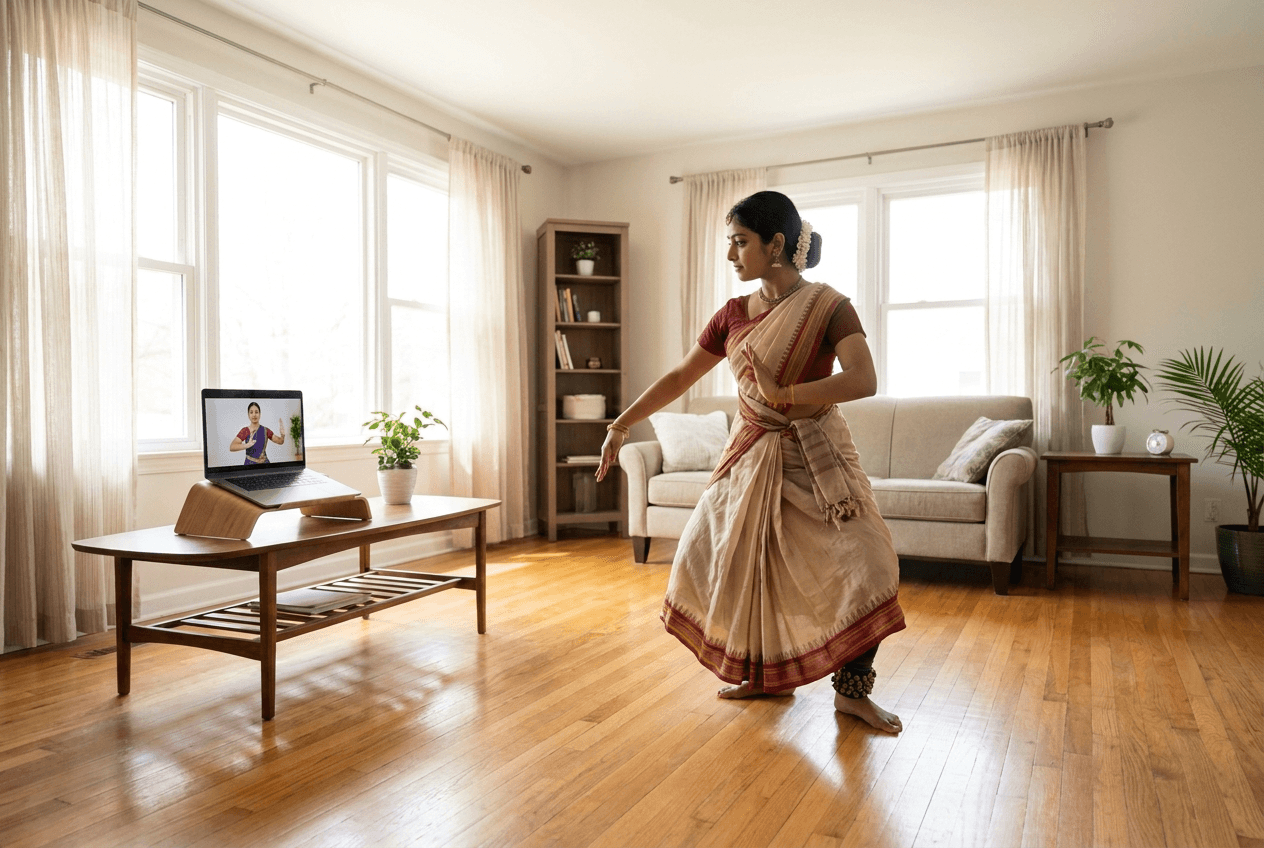 The name Bharatanatyam encodes its own identity. Bha stands for bhava, the emotional expression that animates performance. Ra stands for raga, the melodic framework that gives the dance its musical soul. Ta stands for tala, the rhythmic cycle that governs movement. Natyam means dance. The form originated as a devotional offering in the temples of Tamil Nadu, performed by devadasis as a form of worship, and its revival in the twentieth century transformed it into the internationally celebrated classical tradition it is today.
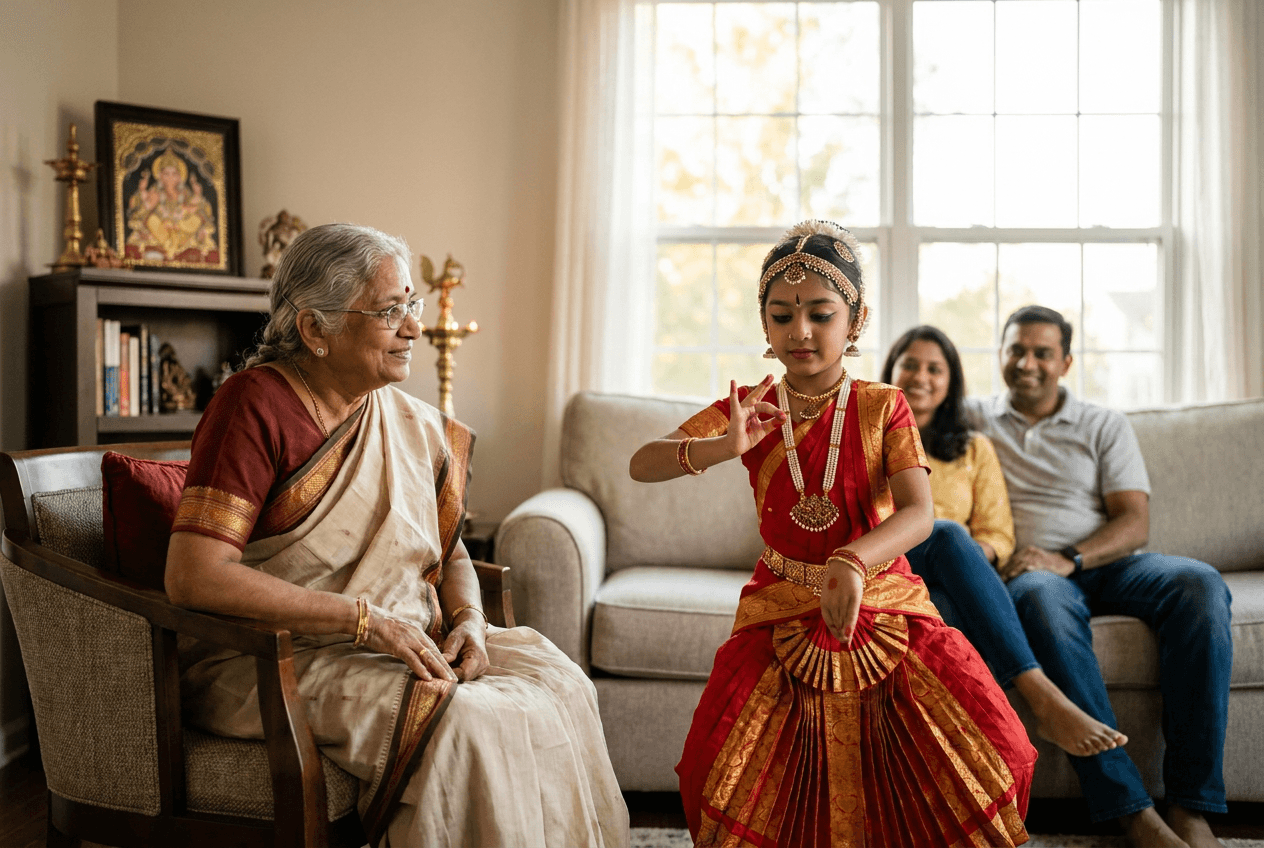
For Tamil and South Indian children growing up in suburban New Jersey, Houston or the Bay Area, Bharatanatyam offers something that no American extracurricular activity can replicate: a direct, physical, embodied connection to the devotional tradition, the music, the mythology and the aesthetic sensibility of their cultural heritage. When a child performs the alarippu or the tillana at a temple event, they are stepping into a tradition that their grandmothers, great-grandmothers and generations of South Indian women before them inhabited. That continuity is profound and irreplaceable.
The Physical and Cognitive Benefits
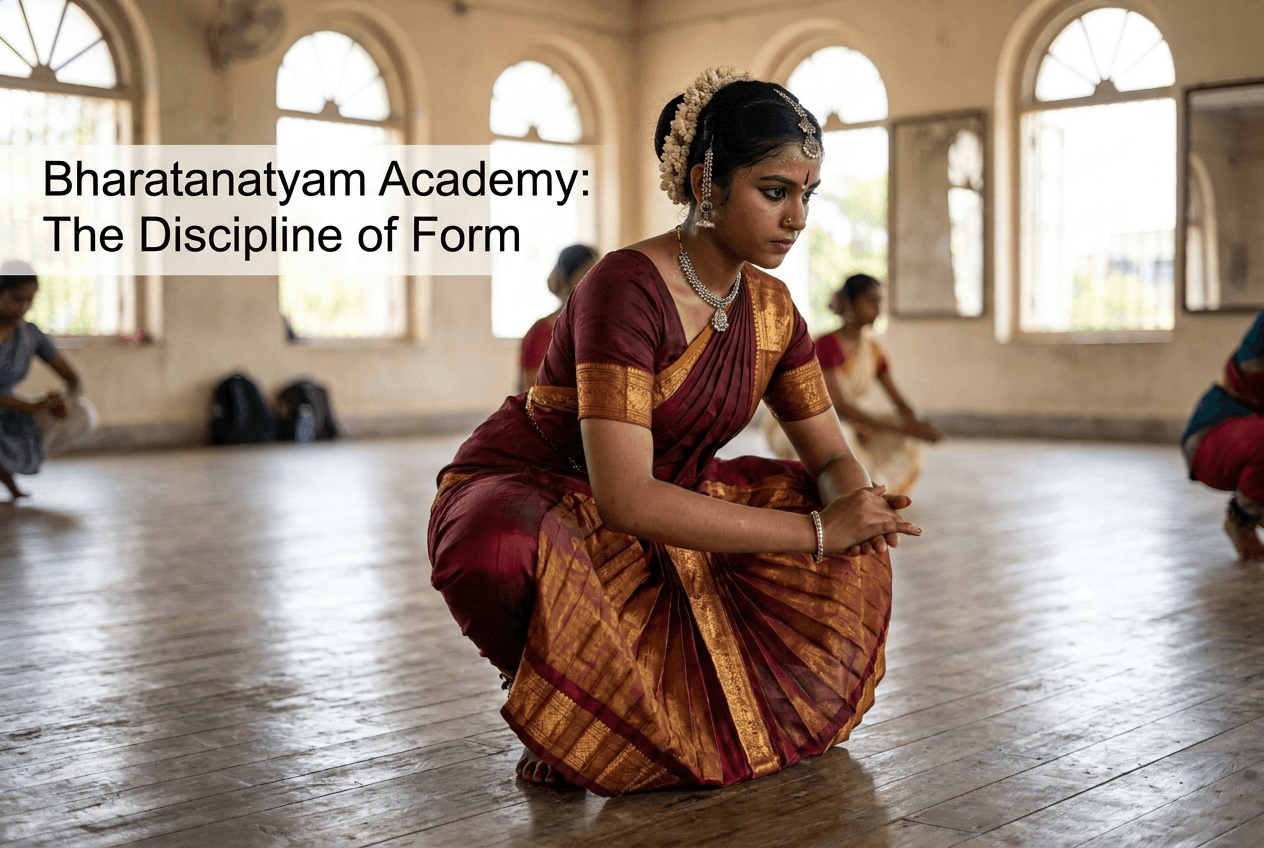
Physical Strength and Endurance
The aramandi, the characteristic bent-knee position that forms the foundational stance of Bharatanatyam, develops extraordinary leg strength and endurance. Maintaining this position through long practice sessions builds muscular strength that is functionally comparable to sustained squat training. The adavu patterns build coordination, balance and proprioceptive awareness. Children who train seriously in Bharatanatyam develop physical capabilities that consistently exceed their peers in strength, flexibility and body control.
Memory and Cognitive Development
The memorisation demands of Bharatanatyam are extraordinary. Students must simultaneously hold choreographic sequences, musical phrases, rhythmic structures, hand gesture vocabulary and expressive narrative content in working memory and reproduce them with precision under performance conditions. This multidimensional memorisation challenge develops working memory capacity, pattern recognition and sustained attention in ways that directly and measurably support academic performance.
Emotional Intelligence
The abhinaya component of Bharatanatyam develops emotional intelligence and empathy to an extraordinary degree. Learning to identify, understand and authentically portray a wide range of human emotional states through facial expression, gesture and body language is a capacity that shapes how children engage with other people, understand emotional situations and regulate their own emotional responses.
The Curriculum: From Basics to Arangetram
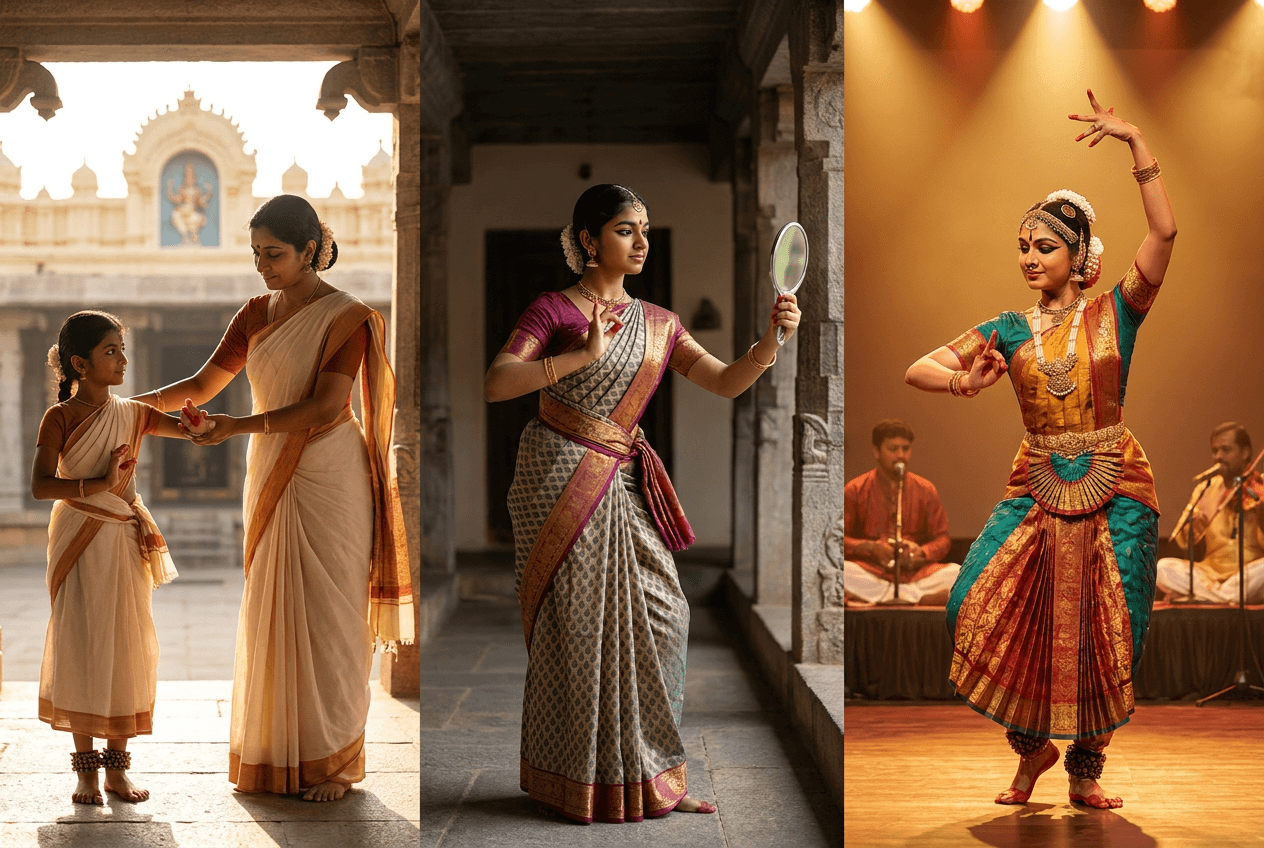
Foundation and Elementary Stages
All training begins with the fundamental postures, the basic adavu vocabulary and an introduction to Carnatic music. Students learn the aramandi stance, the samabhanga position, the primary asamyuta hastas, and the basic adavu patterns that form the building blocks of all Bharatanatyam choreography. The first compositional piece, the alarippu, is introduced once postural fundamentals are established.
Intermediate Stage
At the intermediate stage, students expand their adavu vocabulary, learn jatiswarams and begin working on the varnam, the most substantial and complex compositional form in the Bharatanatyam repertoire. Abhinaya training becomes more systematic, with students learning to narrate specific stories with genuine conviction and expressive precision.
Arangetram: The Formal Debut Performance
The arangetram is the formal solo debut performance that represents the culmination of foundational Bharatanatyam training. It is one of the most significant cultural milestones in South Indian family life and is typically held in a temple, community hall or performance venue after several years of serious training. Art Gharana teachers guide students through every dimension of arangetram preparation, from the selection and choreography of the performance repertoire to costume, jewellery, stage lighting, live musician coordination and the performance itself. For families in the USA planning a US-based arangetram, this guidance is invaluable.
How Art Gharana Compares
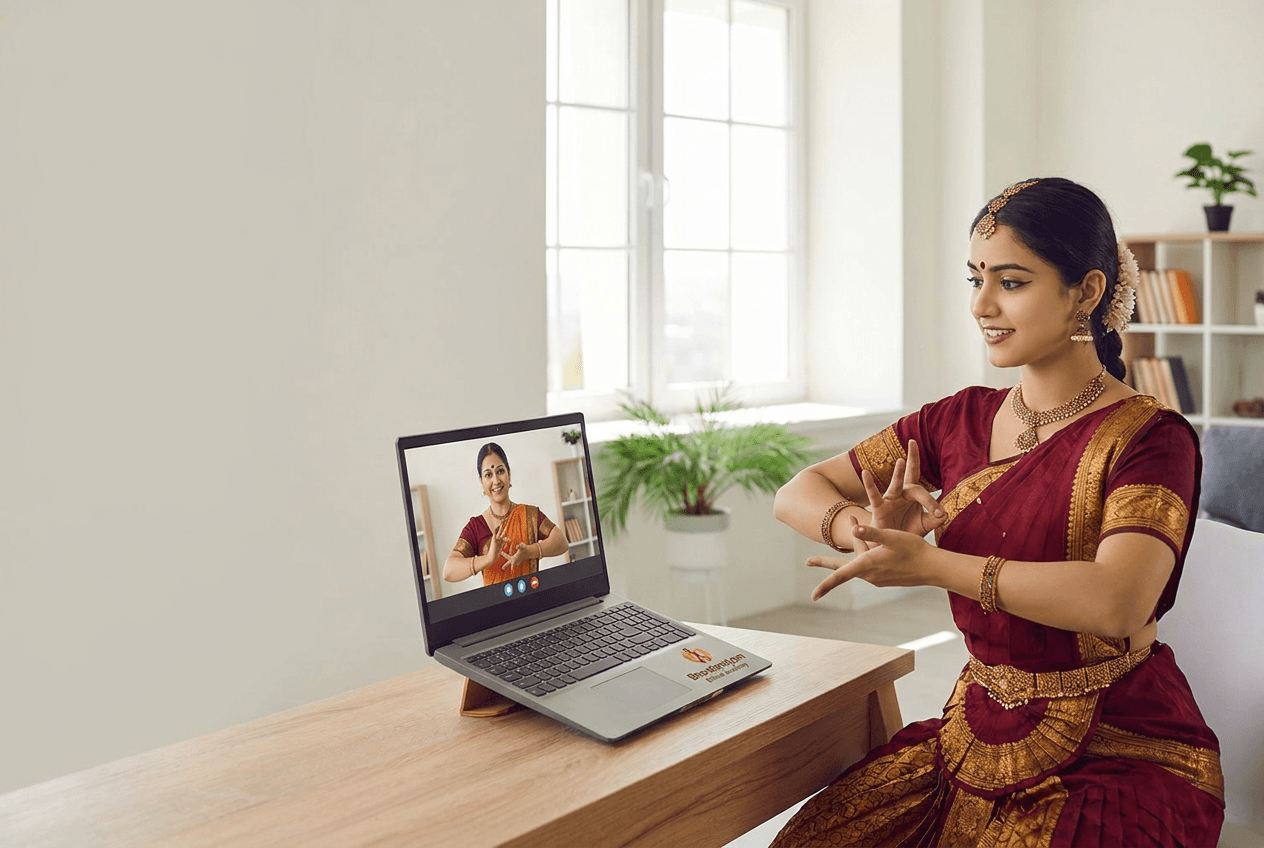 US families evaluating online Bharatanatyam options will encounter several types of provider. Here is a clear comparison.
The arangetram support gap is particularly important for US families. Most online Bharatanatyam providers operate from India or the UAE and are oriented towards students who will hold their arangetram in India. Art Gharana's teachers understand the US context, have supported students through arangetrams held in US temples and community halls, and can guide you through every aspect of organising a US-based arangetram from the ground up.
Bharatanatyam and Carnatic Vocal Together
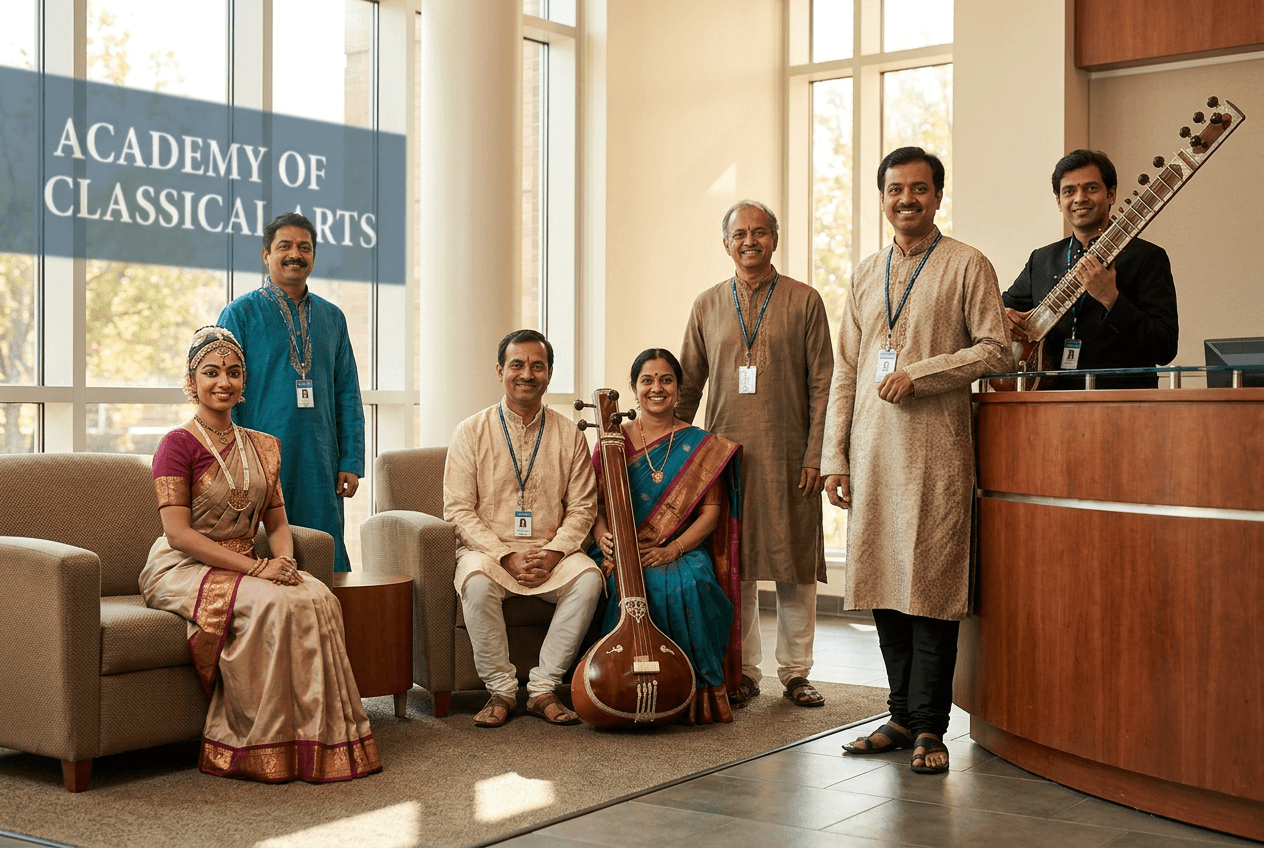 Bharatanatyam and Carnatic music are inseparable traditions, and the most accomplished Bharatanatyam dancers are also deeply conversant with the music they dance to. Our Carnatic vocal classes are taken by many Bharatanatyam students precisely for this reason. A dancer who can sing the Carnatic compositions they are performing brings an entirely different quality of musical understanding to their abhinaya, and the rhythmic intelligence developed through Carnatic vocal training directly enriches footwork precision.
For families interested in the full range of Indian classical arts, our Kathak classes, Bollywood dance classes and [full range of courses]https://www.artgharana.com/courses) are all available with the same live one to one format and US-friendly scheduling.
About Art Gharana
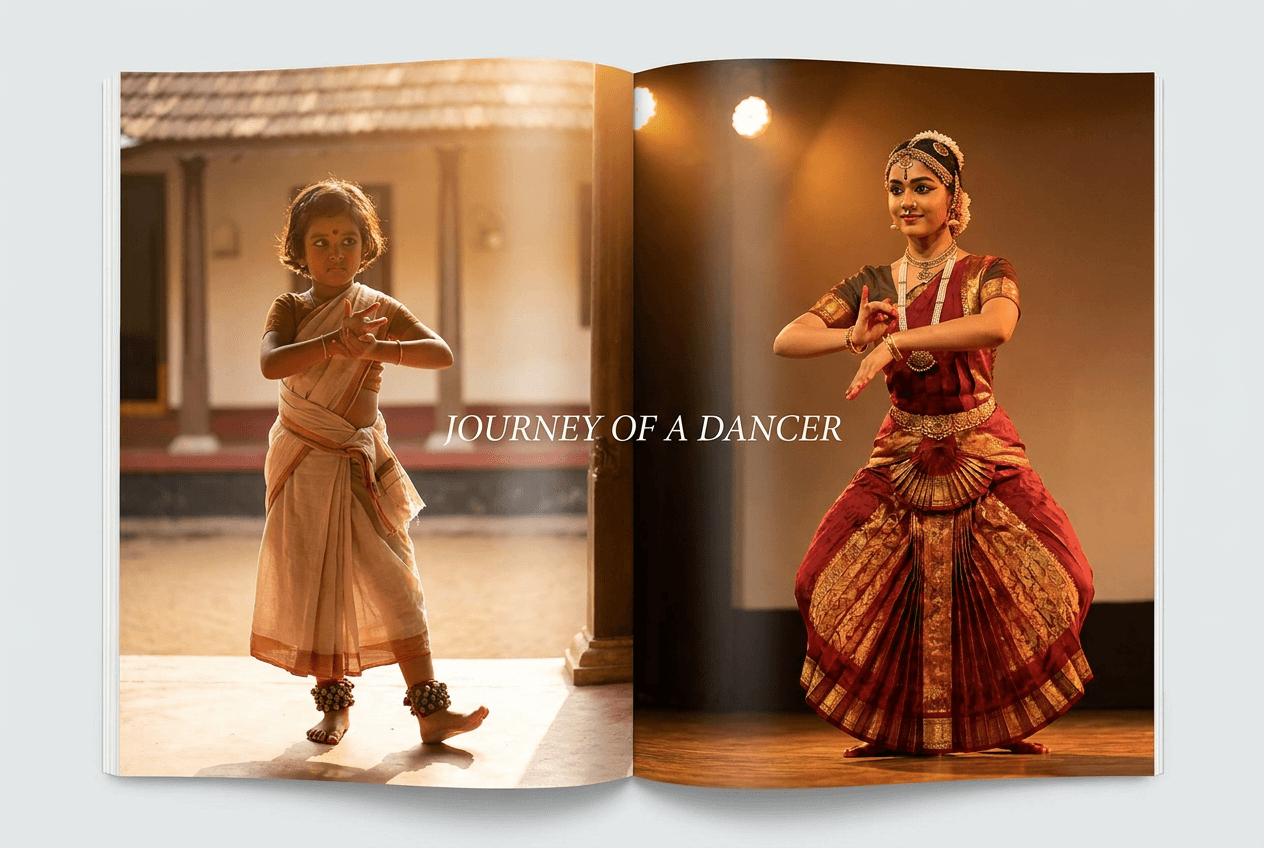 Art Gharana is a specialist online Indian arts education platform with over 50 certified teachers. Our Bharatanatyam programme serves South Indian families across the USA with live, one to one online classes in all US time zones. Browse teacher credentials on our teacher profiles page and review our plans and pricing to choose the right plan for your family.
Frequently Asked Questions
1. Are there qualified Bharatanatyam teachers available online for US families?
Yes. Art Gharana connects US families with certified Bharatanatyam teachers for live one to one classes in US time zones, with morning, evening and weekend slots across Eastern, Central, Mountain and Pacific.
2. Does Art Gharana support arangetram preparation for US-based students?
Yes. Our teachers guide students through every aspect of arangetram preparation including repertoire selection, choreography, costume, jewellery, stage presentation and, for US-based arangetrams, the practical logistics of organising a performance in an American temple or community venue.
3. What age can children start Bharatanatyam?
Children can begin from age 5. The beginner curriculum is fun, gentle and age-appropriate for young learners with no prior dance experience.
4. Do I need to be South Indian to enrol my child?
No. Bharatanatyam is open to all children regardless of cultural background. Many Art Gharana students in the USA come from North Indian, non-Indian and mixed-heritage families who are drawn to the artistry and discipline of the classical tradition.
5. How long does it take to reach arangetram level?
Most students reach arangetram readiness after five to seven years of consistent weekly training combined with regular home practice. The pace depends significantly on practice frequency and the student's natural aptitude.
Book Your Child's Free Trial Class Today
Whether your family is in New Jersey, Texas, California or anywhere else in the USA, Art Gharana's certified Bharatanatyam teachers are ready to begin your child's classical journey. Completely free first lesson, live one to one instruction, US time zone scheduling, full arangetram support. Head to our book a free trial class page and take the first step today.
Preparing Your Home for Bharatanatyam Training
Online Bharatanatyam classes require a little preparation to work well. The most important requirement is sufficient clear floor space for your child to move in all directions without obstruction. A bare floor rather than carpet helps with footwork clarity. Position your device so the teacher has a full-body view from head to toe. Good lighting from the front, without strong backlighting from a window behind your child, ensures the teacher can see facial expressions and hand positions clearly. Comfortable, loose-fitting clothing that allows free movement is all that is needed for the first class. Bare feet are standard for Bharatanatyam training.
South Indian Temples and Bharatanatyam in the USA
The network of South Indian temples across the United States plays a central role in sustaining Bharatanatyam culture in the diaspora. Major temples including the Sri Venkateswara Temple in Bridgewater, NJ, the Meenakshi Temple in Pearland, TX, and the Sri Siva Vishnu Temple in Lanham, MD host regular Bharatanatyam performances, arangetrams and cultural events throughout the year. For children who have trained consistently, these temples represent the most meaningful performance contexts available. An arangetram held in a South Indian temple in the USA, with live Carnatic musicians, a fully costumed student performing a complete margam for an audience of community families, is one of the most powerful cultural milestones in South Indian American family life. Art Gharana teachers have supported students through US-based arangetrams at numerous temples and can guide your family through every aspect of organising such an event.
Breaking a Persistent Myth: Boys in Bharatanatyam
One of the most persistent misconceptions about Bharatanatyam in the United States is that it is an art form for girls only. This misconception is reinforced by several online providers who explicitly restrict enrollment to female students, and it has discouraged many South Indian American families from enrolling their sons in what would be an outstanding activity for them. The historical reality is that Bharatanatyam has always had outstanding male practitioners. Some of the most celebrated Bharatanatyam artists of the twentieth and twenty-first centuries have been men, and the physical demands of the form, its powerful footwork, its athletic strength requirements and its technical precision, are in many ways particularly well suited to boys. Art Gharana welcomes all students regardless of gender, and our male Bharatanatyam students consistently develop the same excellence, cultural pride and personal confidence as their female counterparts.
What Bharatanatyam Builds Over Years
Children who commit to several years of serious Bharatanatyam training develop a physical grace, a cultural knowledge, a performance confidence and a disciplined work ethic that serve them in every area of their lives. Many Art Gharana alumni, now in college and early professional life, describe their Bharatanatyam training as one of the most significant formative experiences of their upbringing, giving them a unique cultural identity in predominantly non-Indian environments, a confidence in physical performance and public presence, and a connection to their South Indian heritage that has deepened as they have grown. The investment in Bharatanatyam training, made consistently over years of childhood, pays dividends for a lifetime. For Tamil and Telugu families in New Jersey, Texas, California and across the country, the question of which Bharatanatyam teacher your child studies under matters in ways that go beyond competence and schedule. A teacher who has trained in a recognised classical style, who has performed at significant venues and whose own guru lineage is traceable to one of the great schools of the tradition, provides not just technique but a living connection to the classical inheritance. At Art Gharana, all Bharatanatyam teachers meet this standard, and families can review teacher qualifications in detail before making their selection. For families who are new to Bharatanatyam and uncertain about what to look for in a teacher, Art Gharanas matching process takes the guesswork out of the decision. Based on information you provide about your childs age, level, cultural background and schedule, Art Gharana matches you with the teacher in our network whose training, experience and teaching style best fit your childs needs. The free trial class is then an opportunity to verify the match in practice before making any commitment. The physical benefits of Bharatanatyam training are worth emphasising for American parents who may be more familiar with the developmental arguments for Western dance forms like ballet or jazz. Bharatanatyam is significantly more physically demanding than most Western dance forms at the elementary level. The sustained aramandi position develops leg strength comparable to dedicated strength training. The jumping sequences build explosive power and landing control. The adavu combinations develop coordination across multiple body segments simultaneously. Children who train seriously in Bharatanatyam develop physical capabilities that consistently exceed their peers in standardised measures of coordination, balance and lower body strength. The community dimension of Bharatanatyam training in the USA is also worth appreciating. South Indian temples across New Jersey, Texas and California host annual cultural programs, arangetrams and classical dance festivals that bring together practitioners, students and families from across their communities. A child who has trained seriously in Bharatanatyam is not simply a passive audience member at these events. They are a participant in a living cultural tradition, someone whose skill is recognised and celebrated by the community, whose performances contribute to the cultural life of the South Indian American diaspora. This sense of belonging and active participation in a cultural community is one of the most valuable and lasting benefits of Bharatanatyam training, and it is something that no amount of passive cultural observation can provide. For families in cities with active South Indian communities, the door that Bharatanatyam training opens into the full richness of that community life is one of the strongest arguments for beginning sooner rather than later. For families who are deciding between Art Gharana and a local Bharatanatyam studio in their city, the key question to ask is not simply which option is most convenient but which option provides the deepest and most authentic classical training. Convenience matters, but the quality of the teaching your child receives will determine the quality of the dancer they become. Art Gharanas certified teachers, structured curriculum and personalised one-to-one instruction consistently produce students who are technically stronger, more culturally informed and more expressively accomplished than students who have received the same number of years of group instruction at a local studio. The free trial class makes it easy to experience this difference directly before making any commitment. We encourage every family to book that trial class and let the quality speak for itself. The decision, once they have experienced it, is typically very clear. Families across the USA who have enrolled their children in Bharatanatyam training through Art Gharana describe the experience consistently in terms that go well beyond dance education. They describe watching their children develop a relationship with their South Indian heritage that is active, proud and genuinely their own. The child who can explain to a curious American classmate what the aramandi position means, who can describe the story being told through the hasta mudras in a particular piece, who can speak with genuine authority about the cultural tradition they have invested years in mastering, is a child with a cultural identity that is secure, well-grounded and genuinely impressive. That identity, formed through years of consistent artistic practice under a qualified teacher, is one of the most valuable gifts an Indian-American parent can give their child, and it is precisely what Art Gharana exists to help you provide. Every family that begins Bharatanatyam training at Art Gharana receives the support of an experienced team whose sole focus is making that training successful. From the initial matching of teacher to student, through the ongoing communication about student progress, to the guidance on performance opportunities and examination pathways, Art Gharana is with you at every step of the journey. The quality of instruction, the depth of cultural transmission and the personal commitment of our teachers to each individual student make Art Gharana the best available choice for Bharatanatyam education for South Indian American families in the USA in 2026. We look forward to welcoming your family into this extraordinary tradition.