ChatGPT
 Google AI
 Grok
Grok Claude
Kathak is one of India's eight classical dance forms and one of the most technically demanding, culturally rich and visually extraordinary art forms anywhere in the world. For Indian-American families across New Jersey, California, Texas and every other state, Kathak training gives children a profound and living connection to North India's cultural heritage, a skill that develops discipline, physical grace and artistic intelligence simultaneously, and an identity anchor that serves them throughout their lives.
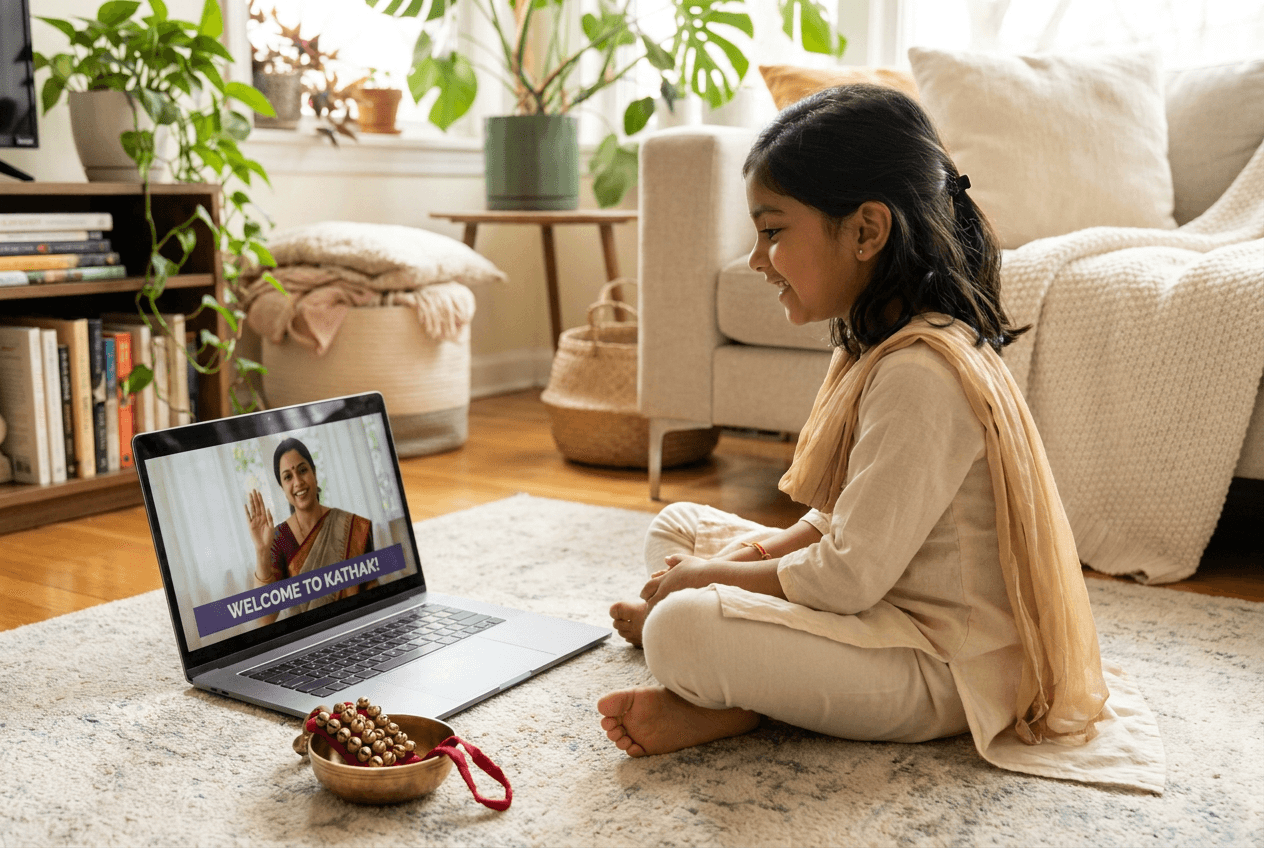
The challenge for US families has historically been access. In New Jersey and the Bay Area, there are established studios and teachers, but quality varies widely, schedules are often rigid and the one to one format that produces the best results for individual children is rare. Across most of the country, local Kathak teachers simply do not exist. Art Gharana's live online programme brings certified Kathak classes for kids in the USA to every family nationwide, scheduled in your time zone, from your home.
What Is Kathak and Why Does It Matter?
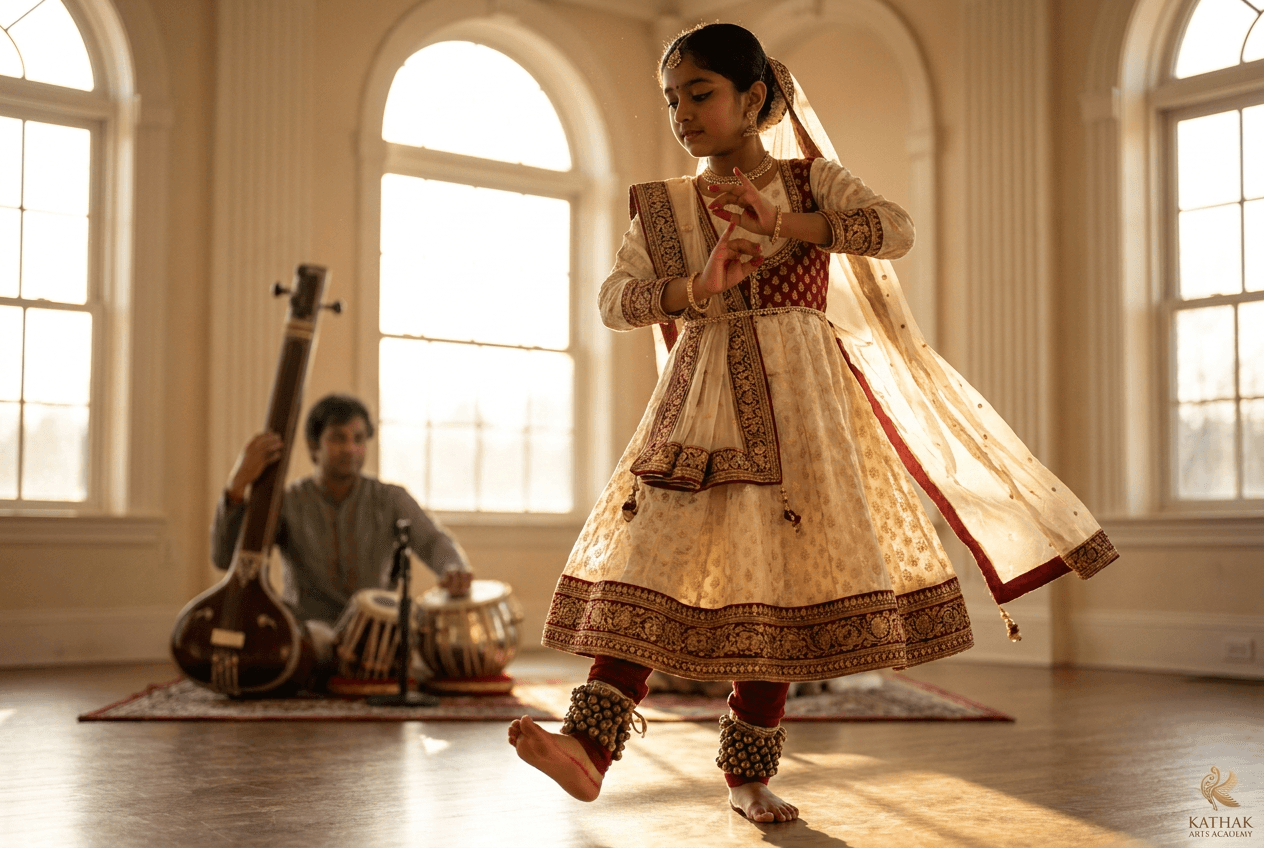 The name Kathak derives from the Sanskrit katha, meaning story. Kathak originated among the Kathaka storytellers of North India who used movement, expression and music to bring to life the devotional tales of Hindu mythology, particularly the stories of Krishna. Over centuries, the form developed into two distinct artistic lineages: the Lucknow gharana, which flourished under Nawabi patronage in Awadh and developed a lyrical, elegant style emphasising expressive refinement; and the Jaipur gharana, shaped by Rajput martial culture and celebrated for its powerful, complex footwork.
Today, Kathak is performed and taught worldwide, and it is one of the most widely sought classical dance forms among Indian diaspora families. Its combination of precise technical demands, expressive depth and cultural significance makes it uniquely valuable as an education for children growing up between two cultures.
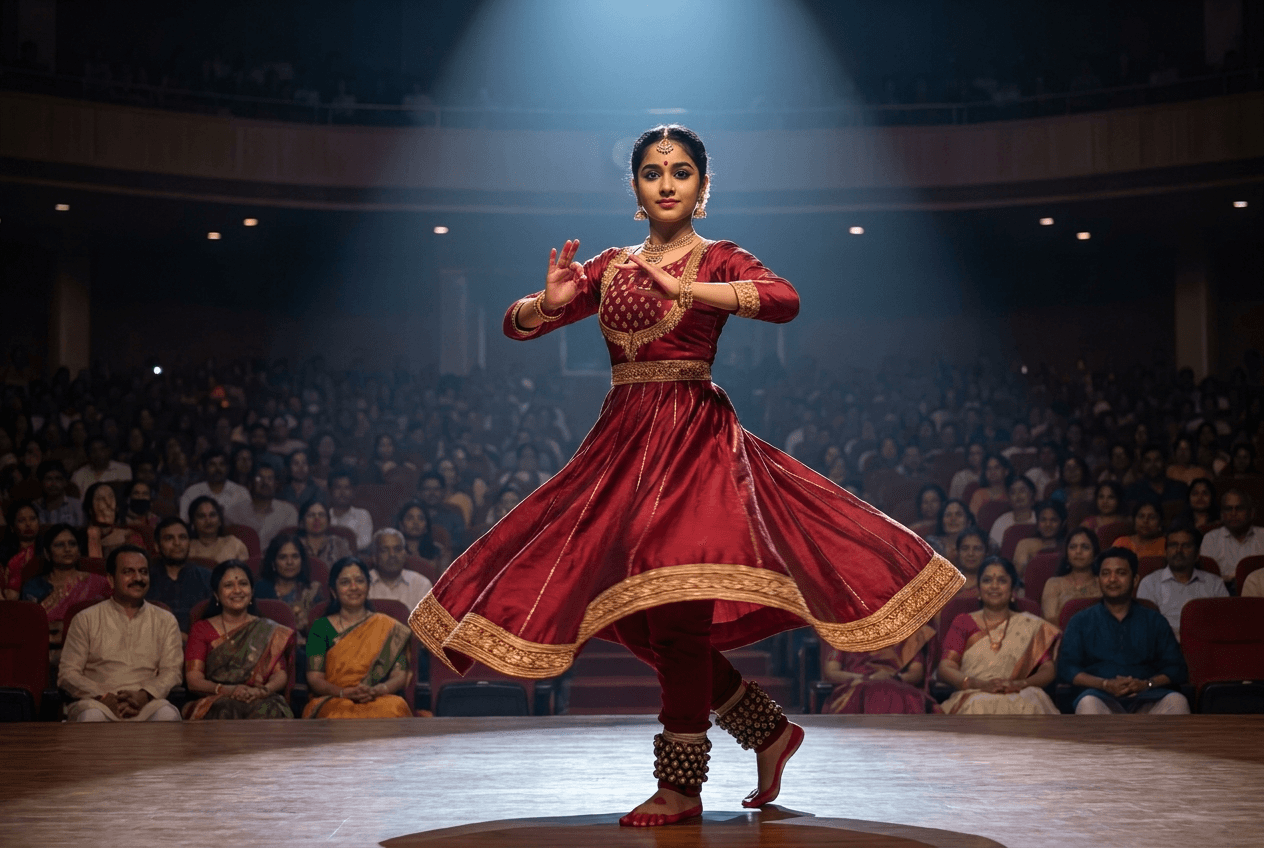
What makes Kathak immediately captivating for children and parents alike is the ghungroo, the small brass bells worn around the ankles that turn every footwork sequence into a musical event. Hearing a skilled Kathak dancer's ghungroos in conversation with the tabla is one of the most distinctive and beautiful sounds in all of Indian performance, and children respond to it with an instinctive excitement that makes the first encounter with the instrument unforgettable.
Kathak in the USA: New Jersey, California and Texas
New Jersey: The Heartland of US Kathak
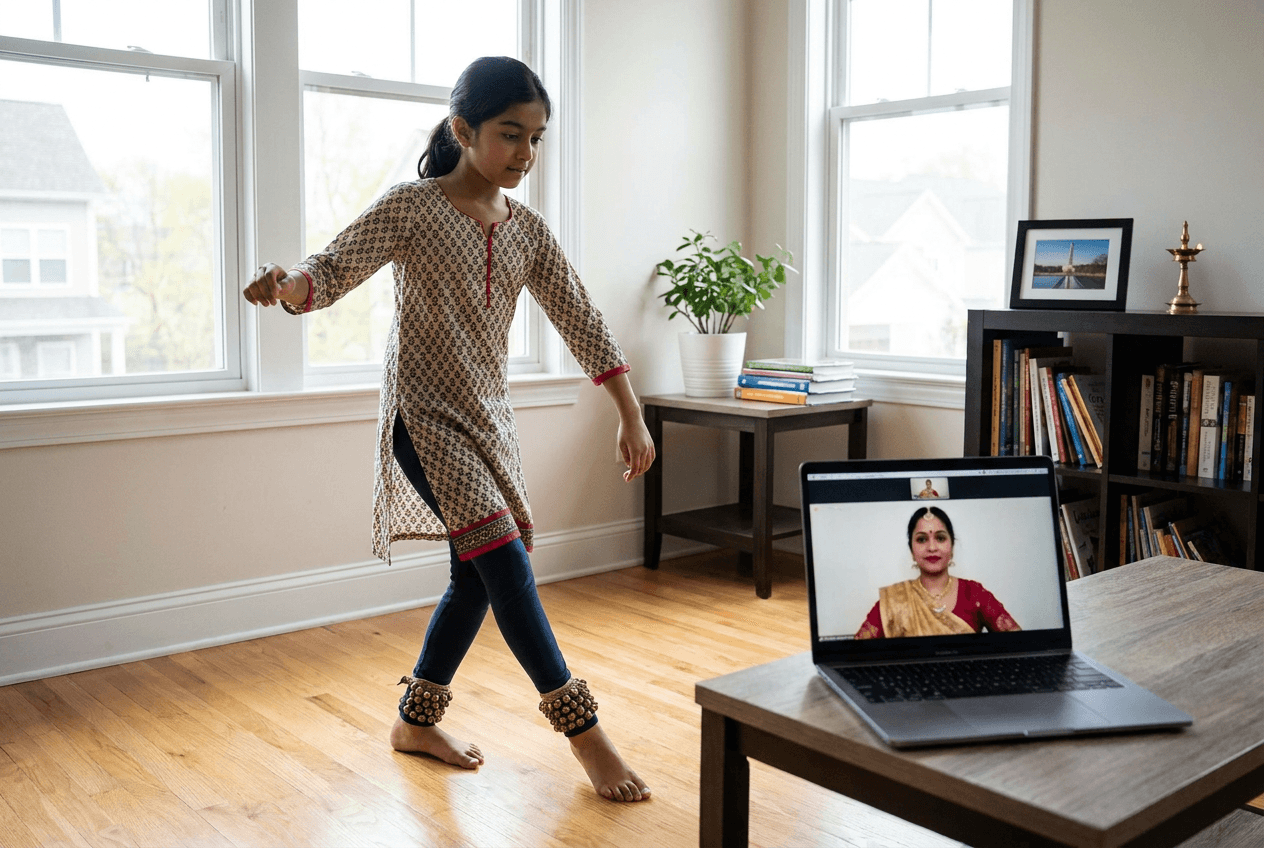
New Jersey has a deeper and more established Kathak tradition than almost any other US state. The concentration of Indian-American families in Edison, Iselin, Parsippany, South Brunswick and surrounding areas has supported a network of dance studios, cultural organisations and individual teachers whose quality ranges from outstanding to very ordinary. The Samved Conservatory of Indian Classical Music and Dance, which conducts exams for Kathak students across North America, is based in New Jersey and reflects the seriousness with which the NJ Indian community approaches classical dance education.
For NJ families who want the flexibility and individual attention of online one to one instruction, or for those whose schedules do not align with local studio hours, Art Gharana's programme delivers certified teaching in your time zone with full scheduling flexibility.
California: Bay Area and Los Angeles
California's Indian-American population is enormous and culturally sophisticated, but the geography of the state means that many families are far from quality Kathak instruction. The Bay Area's Fremont and Cupertino communities have several established Kathak teachers, but families in Pleasanton, Livermore, the East Bay hills, the Peninsula or the South Bay suburbs often find local options limited. Los Angeles's Indian community, spread across Artesia, Cerritos, Diamond Bar and the San Fernando Valley, faces similar challenges.
Art Gharana's online programme serves California families across the entire state with Pacific Time Zone scheduling and full day availability, from morning practice sessions for motivated early risers to late evening slots for families with packed after-school schedules.
Texas and the Rest of the USA
For the millions of Indian-Americans living outside NJ and California, whether in Texas, Georgia, Illinois, Washington, North Carolina or any other state, local Kathak instruction is often simply unavailable. Art Gharana's nationwide online programme is frequently the only route to genuinely qualified classical Kathak teaching for families in these locations, and our students in Texas, Georgia, Washington and Illinois consistently report that the quality of online instruction has exceeded what they had hoped to find.
The Real Benefits of Kathak Training for Children
Bilateral Coordination and Physical Intelligence
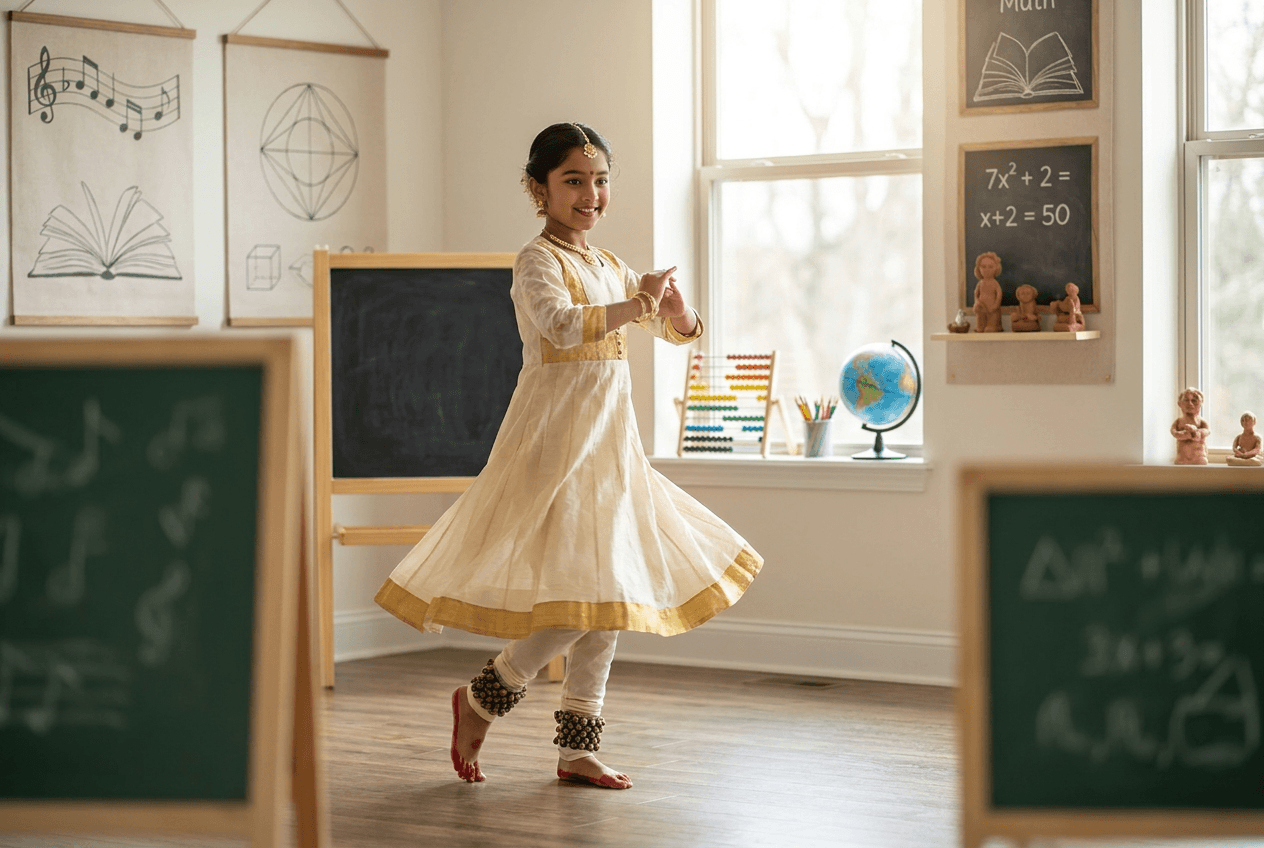
Kathak's demands on the body are extraordinary. The precise synchronisation of complex footwork patterns with equally precise arm and hand movements, all executed while maintaining correct spinal alignment and stable chakkar technique, develops a quality of bilateral coordination and physical intelligence that very few activities match. Children who train seriously in Kathak develop a physical awareness and control that is immediately visible in how they carry themselves.
Rhythmic Mathematics
The tala structures of Kathak, from the sixteen-beat Teen Taal to the asymmetric cycles of more advanced compositions, are a practical education in mathematics. The counting, division, subdivision and recombination of rhythmic patterns that Kathak demands develops number sense, pattern recognition and mathematical thinking in ways that directly support academic performance. Several Art Gharana parents have reported measurable improvements in their children's school mathematics after beginning Kathak training.
Cultural Identity and Belonging
For Indian-American children growing up in US schools where their heritage is often a minority presence, Kathak training provides a source of cultural identity that is active, physical and genuinely impressive. A child who can perform Kathak has something specific, visible and beautiful to show for their Indian heritage, something that earns genuine admiration from peers and teachers rather than being invisible or unexplainable. That visible cultural pride is one of the most valuable things a parent can give a child navigating between two cultures.
Discipline and Long-Term Commitment
Kathak is not a discipline where results come quickly without effort. Progress requires patient, consistent practice over months and years. The habits of discipline, sustained concentration and patient effort that Kathak training builds are among the most valuable gifts of classical arts education, and they transfer directly to academic performance, professional work and every other area of life that rewards sustained commitment.
The Lucknow and Jaipur Gharanas Explained
 US parents frequently ask about the difference between the two main Kathak traditions and which one their child should learn. The practical answer is that for children at the beginner and elementary levels, the foundational curriculum is essentially the same across both traditions. The basic tatkaar patterns, introductory hand gestures and early compositions are consistent. The stylistic differences become meaningful at the intermediate level and above.
The Lucknow gharana, whose most celebrated twentieth-century exponent was the legendary Pandit Birju Maharaj, is characterised by lyrical grace, expressive emotional depth and the refined elegance that reflects its origins in Nawabi court culture. The Jaipur gharana, with its roots in Rajput warrior culture, is celebrated for its powerful, earth-connected footwork, complex rhythmic structures and vigorous masculine energy.
Art Gharana's teachers bring training from both traditions, and the choice of emphasis evolves naturally as a student's own artistic personality becomes clearer over the first year or two of training. The right teacher for your child is not necessarily one from a specific gharana but one whose teaching style, patience and ability to communicate with children produces genuine results.
What Your Child Will Learn: The Kathak Curriculum
Foundation Stage, Ages 5 to 8
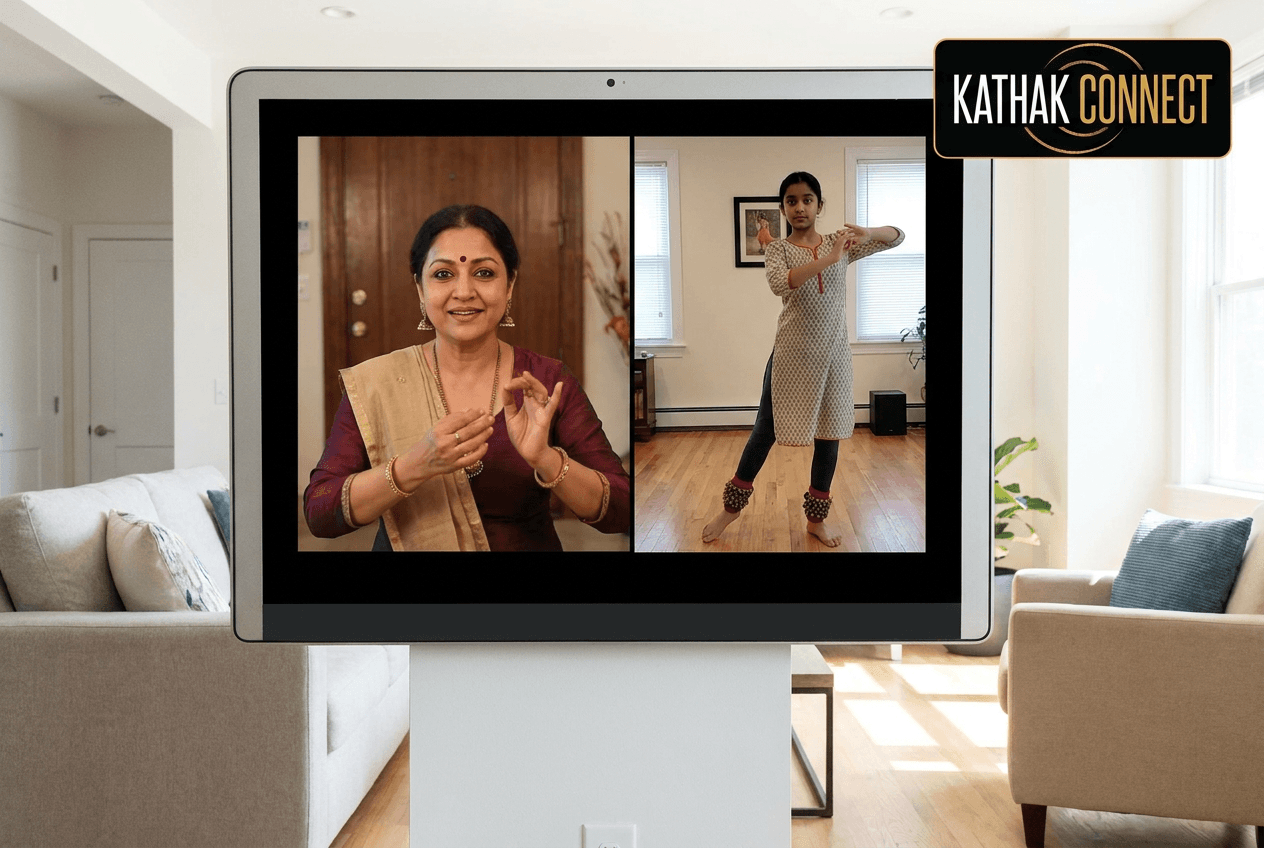
All training begins with body awareness, the correct Kathak standing posture and the first basic tatkaar footwork patterns. Students learn the foundational hand gestures, practice simple arm sequences and begin developing their ear for the rhythmic cycles that govern Kathak performance. Short, structured compositions are introduced once postural and rhythmic foundations are secure. The ghungroos are introduced when the teacher judges that the student's tatkaar is developed enough to benefit from their use.
Elementary Stage, Ages 8 to 12
Elementary students develop a broader tatkaar vocabulary, begin working on chakkar sequences, and learn their first complete compositional pieces including the tatkaar theka and introductory tukras. Abhinaya, the expressive storytelling dimension of Kathak, becomes a regular feature of training, with students learning to convey specific emotions and narratives through gesture and facial expression. Students at this level typically begin performing at community cultural events.
Intermediate Stage and Beyond
Intermediate students work on extended compositions, complex chakkar sequences, more challenging tala structures and the development of a personal performance style. Performance at a significant level becomes a regular feature of training, with students working towards recital pieces that demonstrate genuine artistic development.
How Art Gharana Compares to Other Kathak Providers
 US families evaluating online Kathak options will find a varied landscape. Here is a clear comparison of what matters most.
The females-only restriction that applies to several of the most prominent online Kathak providers is worth highlighting specifically. If you have a son, or if you are a father or grandfather who wants to experience Kathak yourself, several well-known providers are simply not available to you. Art Gharana welcomes all students regardless of gender, and our curriculum is designed to serve all young dancers equally.
Kathak Alongside Hindustani Classical Music
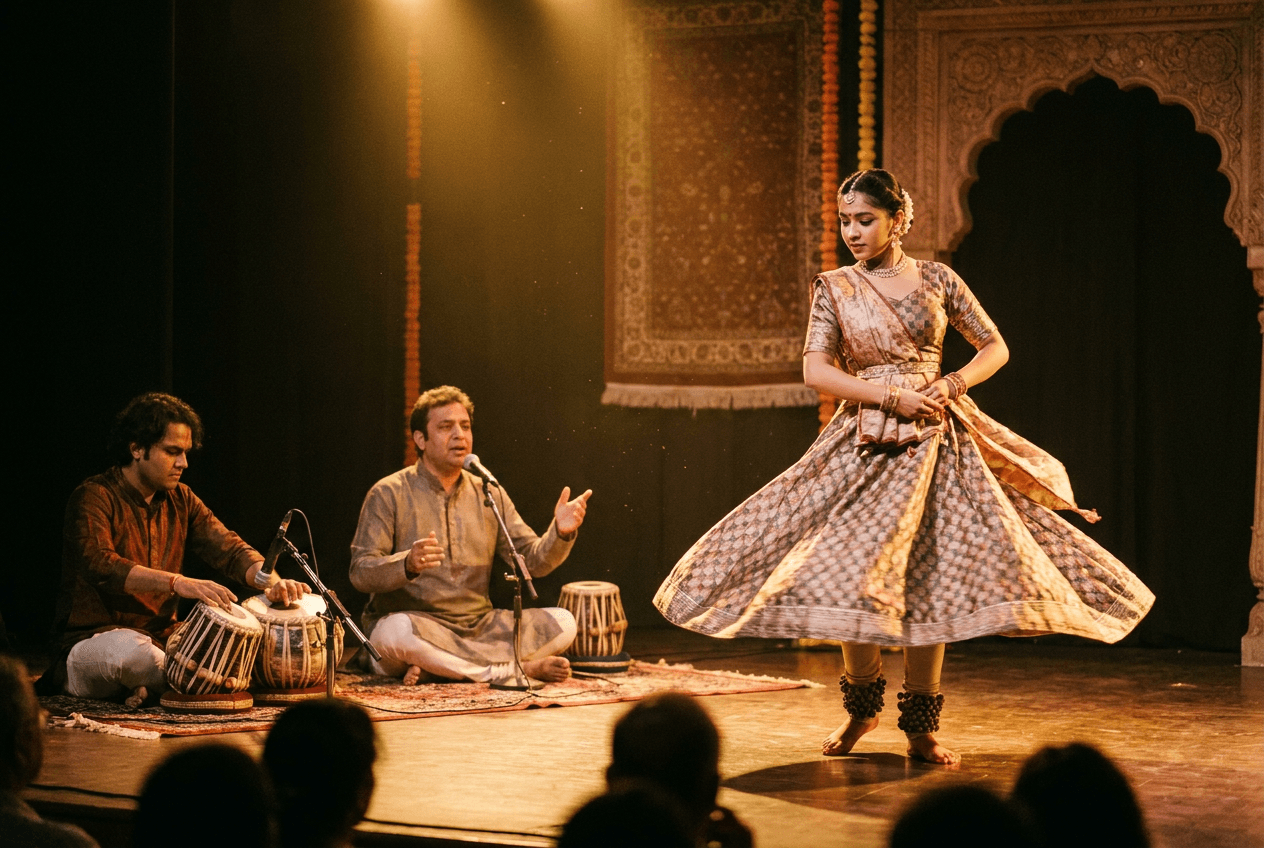 Kathak and Hindustani classical music are deeply intertwined, and children who study both simultaneously develop a much richer understanding of each. Our Hindustani vocal classes develop the understanding of raga, tala and melodic phrasing that directly enriches a Kathak dancer's performance. A student who can sing the musical composition they are dancing to brings an entirely different quality of musicality to their performance.
Our tabla classes pair even more directly with Kathak, since the rhythmic cycles of Kathak footwork are the same cycles that tabla students learn as percussion. A Kathak student who understands rhythm from the tabla player's perspective develops a quality of rhythmic precision and fluency in their footwork that is immediately audible and visible. You can explore our full range of courses to see all the options available for your family.
About Art Gharana
 Art Gharana is a specialist online Indian arts education platform with over 50 certified teachers across dance, music and vocal disciplines. We serve Indian-American families across all 50 states and Indian families in the UK, Canada, Australia and India. All classes are live, one to one and available in your time zone. Browse our teacher profiles to find the right instructor for your child, and read what our students say about their experience at Art Gharana.
Frequently Asked Questions
1. How is online Kathak different from in-person classes in NJ or California?
Live online one to one Kathak classes deliver the same quality of instruction as the best in-person studios, with the added advantages of scheduling flexibility, no travel time and access to teachers whose classical training may exceed what is locally available. Many Art Gharana parents who are close to quality local studios still choose the online format for its convenience and the depth of teacher training it provides access to.
2. What age can children start Kathak in the USA?
Children can begin Kathak from age 5. Our beginner curriculum is designed to be age-appropriate, fun and engaging for young learners who have no prior dance experience.
3. Are Kathak classes available for families outside NJ and California?
Yes. Art Gharana's online programme serves families across all 50 states. Wherever you are in the USA, live one to one Kathak instruction is available in your time zone.
4. What is the difference between the Lucknow and Jaipur gharanas?
The Lucknow gharana is characterised by lyrical grace, expressive emotional depth and elegant refinement. The Jaipur gharana is celebrated for powerful footwork and complex rhythmic compositions. Both traditions are taught at Art Gharana. Beginners encounter a consistent foundational curriculum; the stylistic emphasis evolves naturally as the student develops.
5. How long until my child is ready to perform Kathak?
Most students are ready for their first community performance within 12 to 18 months of consistent weekly training combined with regular home practice. The timeline depends significantly on practice frequency between classes.
Book Your Child's Free Trial Kathak Class Today
Whether your family is in New Jersey, California, Texas or anywhere else in the USA, Art Gharana's certified Kathak teachers are ready to welcome your child into one of the world's great dance traditions. Live one to one classes, flexible US scheduling, a structured curriculum from beginner to advanced, and a completely free first lesson. Head to our book a free trial class page and begin today.
The Guru-Shishya Tradition in the Modern Age
One of the most distinctive features of classical Indian arts education is the guru-shishya parampara, the teacher-student tradition in which knowledge is transmitted not merely as information or technique but as a living transmission from one practitioner to another. In the classical tradition, the guru is not simply a coach or an instructor but a guide who shapes the students entire relationship to the art form, passing on not just technical skills but values, aesthetic sensibility, musical understanding and a sense of the traditions history and context. This tradition has been preserved at Art Gharana in the online format. Our Kathak teachers do not simply deliver technical corrections. They build genuine long-term relationships with their students, understanding each childs strengths, challenges, learning pace and artistic personality over months and years of consistent engagement. A child who studies with the same Art Gharana teacher for three or four years is receiving something qualitatively different from a child who has worked with a series of interchangeable instructors, and that difference shows in the depth, authenticity and artistry of their dancing.
Kathak for the Stage: Performances and Recitals
Performance is an essential dimension of Kathak training and one that distinguishes serious classical arts education from recreational dance activity. The experience of preparing for, executing and reflecting on a performance is where much of the deepest learning in Kathak happens. The discipline of perfecting a specific piece for a specific occasion, the management of performance nerves, the ability to project to an audience with genuine presence and conviction: these are skills that develop through performance and cannot be developed any other way. Art Gharana teachers actively support their students performance aspirations. Whether your child is preparing for a cultural event at their school, a Diwali celebration in their community, a family gathering or a formal recital, their teacher can help them prepare an appropriate piece, advise on costume and presentation, and guide them through the performance preparation process. Many NJ and California families have reported that their childs first Kathak performance at a local cultural event was a defining experience for the entire family.
Home Practice: Making Progress Between Classes
The pace of progress in Kathak training depends significantly on what happens between classes. A student who practises daily for even twenty to thirty minutes will advance at two to three times the rate of a student who only does the work during the class session itself. The physical patterns of tatkaar footwork and the muscle memory required for clean chakkar sequences develop through repetition, and repetition requires daily practice.
Art Gharana teachers provide specific, actionable practice plans after each class, covering exactly which tatkaar patterns, compositions or chakkar sequences to work on and for how long. Following this plan consistently is the single most effective thing a student and family can do to accelerate progress. Many families find it helpful to build a short daily practice session into the after-school routine, treating it with the same regularity as homework or instrument practice. Even a cleared area of the living room, large enough to take a few steps and turn a chakkar without obstruction, is a sufficient practice space.
For Indian-American families in New Jersey and California who are comparing Art Gharana with local studio options, it is worth noting that the one-to-one format consistently produces faster and deeper results than group instruction at any level. A child in a group class of eight receives approximately five to six minutes of direct teacher attention per hour of instruction. A child in a one-to-one Art Gharana class receives all forty-five minutes of direct, personalised attention from a certified classical teacher. The compound effect of that difference, sustained over a year of weekly classes, is measured and visible in the quality and depth of what the student has developed.
The certificate and examination pathway is also worth highlighting for NJ families specifically. The Samved Conservatory of Indian Classical Music and Dance, based in New Jersey and recognised across North America, conducts Kathak examinations twice yearly that provide students with formal, nationally recognised credentials for their classical dance achievement. Art Gharanas Kathak curriculum is aligned with this examination pathway, and students who wish to pursue formal certification have a clear and supported route to do so through their Art Gharana training.
The investment required to begin Kathak training is modest by the standards of most American extracurricular activities. The main costs are the weekly class fee, which is clearly laid out on Art Gharanas plans and pricing page, and a set of ghungroos once the teacher judges that the students tatkaar is sufficiently developed. There are no studio rental fees, no costume requirements until performance level, no travel costs, and no equipment purchases beyond a clear practice space and a device with a camera for the live class. For the level of cultural, developmental and artistic value that sustained Kathak training provides, it is one of the most cost-effective educational investments an Indian-American family can make. Art Gharana families across New Jersey, California and Texas consistently describe the investment as one of the best decisions they made for their children.
Art Gharana has been serving Indian-American families across New Jersey, California and Texas since its founding, and the feedback from Kathak families is consistent: the quality of the one-to-one instruction, the cultural depth of the teaching, and the genuine warmth of the relationship between teacher and student are what make the programme exceptional. Parents describe watching their children grow not just as dancers but as culturally grounded, self-assured young people who carry the Kathak tradition with them as a source of pride and identity throughout their American lives. That is the real measure of a successful arts education, and it is what Art Gharana is committed to delivering for every family we serve.