ChatGPT
 Google AI
 Grok
Grok Claude
The Bb minor chord, commonly written as Bbm, is one of the most expressive and emotionally rich chords on the piano. It is widely used in classical music, jazz, film scores, R&B, gospel, and contemporary pop to convey depth, tension, melancholy, and introspection. While it may feel challenging at first because it involves multiple black keys, mastering the Bb minor chord significantly improves hand positioning, tonal awareness, and harmonic understanding.
For pianists moving beyond basic major chords, Bb minor opens the door to darker harmonic colors and advanced progressions. Once internalized, it becomes a powerful tool for emotional storytelling through music.
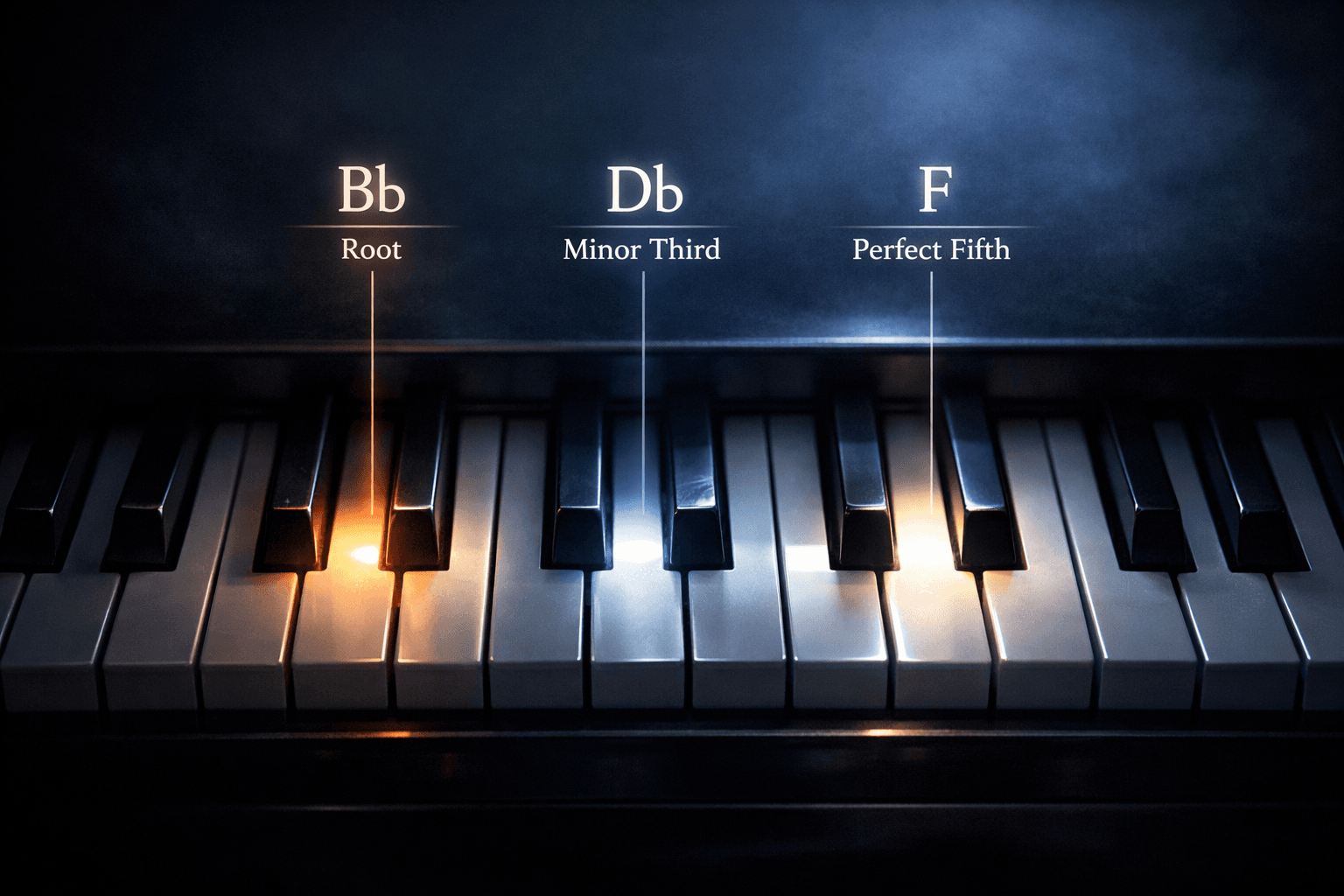
The Bb minor chord is built from three specific notes:
Bb – Root Db – Minor Third F – Perfect Fifth
This combination gives the chord its unmistakable somber and serious quality. The minor third interval is responsible for the emotional weight, while the perfect fifth provides stability and balance. Bb minor is frequently used as the tonic chord in the key of Bb minor and as a borrowed or modal chord in related keys.
Bb Minor Chord Theory

Triad Construction
The Bb minor chord follows the standard 1–b3–5 formula used for all minor triads. Understanding this structure allows you to construct minor chords anywhere on the keyboard and recognize them instantly in music.
Note Role Interval from Root Bb Root 1 Db Minor Third 3 semitones F Perfect Fifth 7 semitones
The flattened third interval is what distinguishes a minor chord from a major chord. In Bb minor, the shift from D natural to Db dramatically changes the emotional character of the chord, making it more reflective and intense.
Extended Variations of Bb Minor
Beyond the basic triad, Bb minor appears in many extended and altered forms that add color and sophistication to your playing.
Bbm7 (Bb – Db – F – Ab) produces a smooth, soulful sound commonly used in jazz, R&B, and lo-fi progressions. Bbm6 (Bb – Db – F – G) creates a softer, slightly hopeful tone often heard in film music. Bbm9 (Bb – Db – F – Ab – C) adds lush harmonic depth and works beautifully in modern jazz and neo-soul. Bbmadd9 (Bb – Db – F – C) introduces melodic openness without the tension of a seventh.
Learning these variations helps pianists move from basic accompaniment to expressive harmonic storytelling.
Finger Placement for the Bb Minor Chord
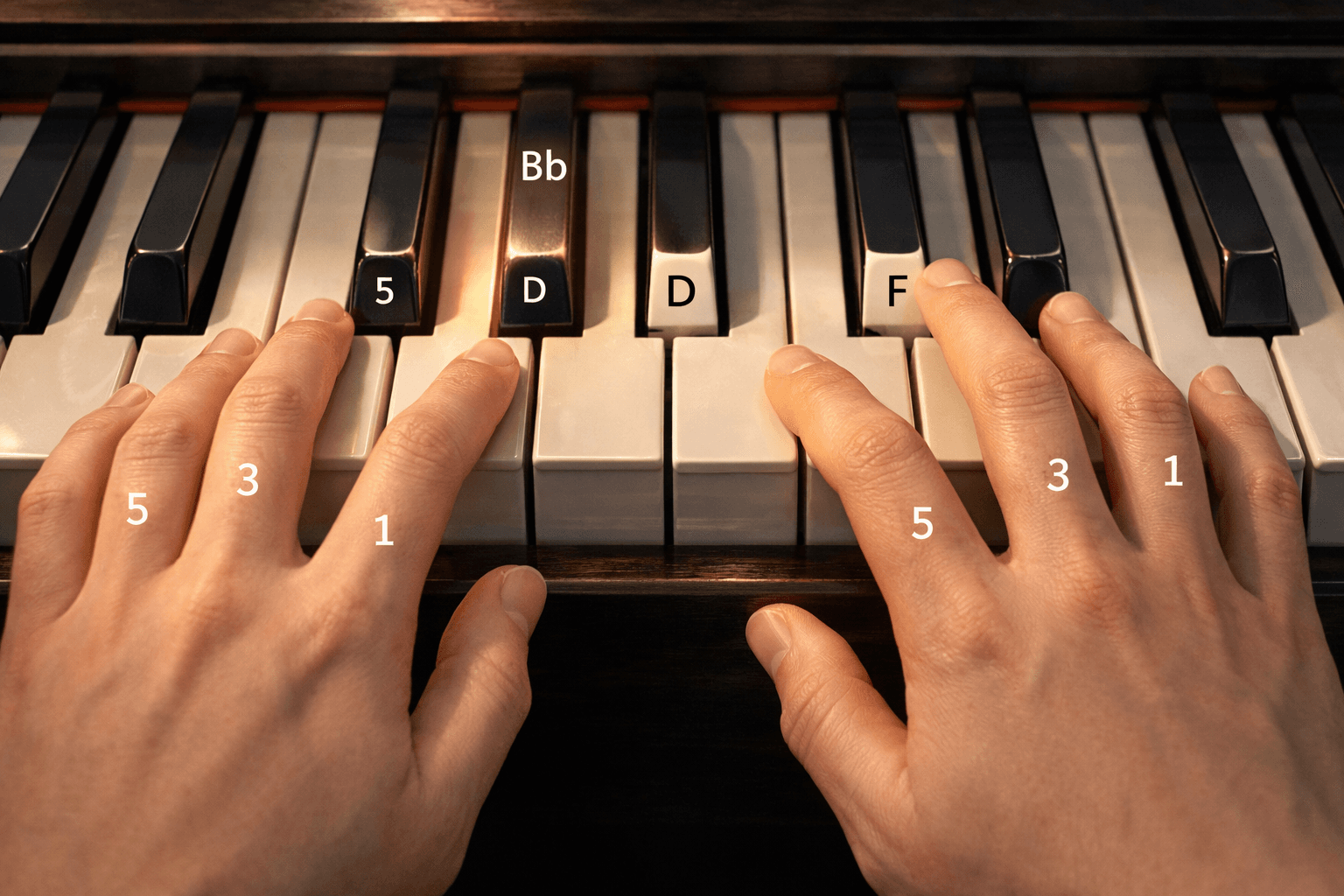
 Proper fingering is essential when playing Bb minor because of the combination of black and white keys. Using the correct fingers ensures accuracy, comfort, and long-term technical development.
Right Hand Fingering
Thumb (1) on Bb Middle finger (3) on Db Pinky (5) on F
This fingering allows the hand to naturally align with the black keys while maintaining balance and control.
Left Hand Fingering
Pinky (5) on Bb Middle finger (3) on Db Thumb (1) on F
This setup keeps the left hand relaxed and stable, which is especially important when playing sustained chords or broken patterns.
Exercise 1: Root Position Control
Play the Bb minor chord slowly in root position. Hold each note evenly and listen for balance between fingers. Repeat the chord across different octaves to build spatial awareness.
Maintaining a relaxed wrist and curved fingers is critical, particularly when pressing the black keys.
Inversions of the Bb Minor Chord
 Inversions allow smoother transitions between chords and create more fluid harmonic motion. They are essential for accompaniment, voice leading, and expressive playing.
First Inversion (Db – F – Bb)
Right hand fingering places the thumb on Db, middle finger on F, and pinky on Bb. Left hand fingering mirrors this shape for consistency.
This inversion works exceptionally well when moving to chords like Eb minor or Gb major.
Second Inversion (F – Bb – Db)
Right hand places the thumb on F, middle finger on Bb, and pinky on Db. Left hand follows the same positional logic.
Second inversion is frequently used in arpeggios and broken chord accompaniments, especially in ballads and cinematic music.
Exercise 2: Inversion Flow
Play root position followed by first and second inversions in sequence. Practice hands separately before combining them. Focus on smooth movement rather than speed.
Consistent inversion practice dramatically improves hand coordination and harmonic fluency.
Arpeggios and Broken Chords in Bb Minor
 Arpeggios are an essential bridge between technical practice and musical expression. They strengthen finger independence and prepare pianists for improvisation and melodic embellishment.
Bb Minor Arpeggio (One Octave)
Ascending pattern moves from Bb to Db to F and back to Bb. Descending pattern reverses the sequence smoothly.
Exercise 3: Arpeggio Development
Begin at a slow tempo with one hand. Gradually introduce both hands in parallel motion. Experiment with different rhythms such as triplets or dotted patterns.
Arpeggios in Bb minor are especially effective in emotional passages, slow introductions, and expressive transitions.
Scales Compatible with Bb Minor
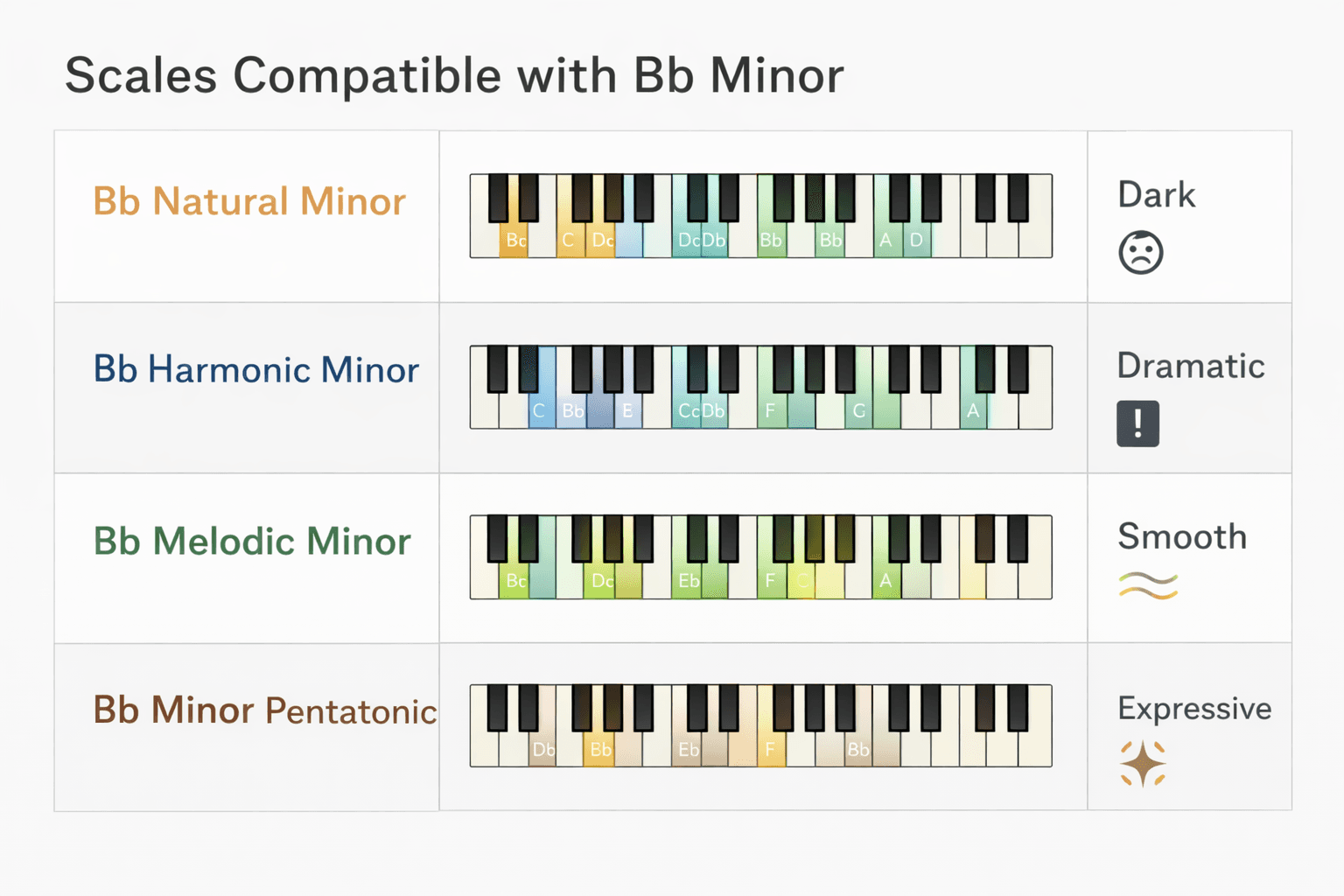 Pairing scales with chords enhances improvisation, technical skill, and ear training. Bb minor works beautifully with several scale options depending on musical context.
| Scale | Notes | Mood |
|---|---|---|
| Bb Natural Minor | Bb – C – Db – Eb – F – Gb – Ab – Bb | Dark, emotional |
| Bb Harmonic Minor | Bb – C – Db – Eb – F – Gb – A – Bb | Dramatic, classical |
| Bb Melodic Minor | Bb – C – Db – Eb – F – G – A – Bb | Smooth, jazzy |
| Bb Minor Pentatonic | Bb – Db – Eb – F – Ab | Simple, expressive |
Exercise 4: Scale Integration
Practice each scale over two octaves. Alternate between scale runs and Bb minor arpeggios. Vary dynamics to develop expressive control.
Common Chord Progressions Using Bb Minor
 Bb minor appears in a wide range of harmonic settings, from simple progressions to advanced jazz sequences.
Beginner Progressions
Progression Notes Bbm – Ebm – F Bb Db F → Eb Gb Bb → F A C Bbm – Gb – F Bb Db F → Gb Bb Db → F A C
Intermediate Progressions
Progression Notes Bbm – F – Gb – Ebm Bb Db F → F A C → Gb Bb Db → Eb Gb Bb Bbm – Cb – Gb – F Bb Db F → Cb Eb Gb → Gb Bb Db → F A C
Advanced Progressions
Progression Notes Bbm7 – Ebm7 – Ab7 – Dbmaj7 Extended jazz harmony Bbm – Gb – Fsus4 – Bbm6 Cinematic and modern sound
Exercise 5: Progression Control
Play slowly with a metronome. Use inversions to reduce hand movement. Add broken chord patterns for texture.
Popular Songs Featuring Bb Minor
 Bb minor is frequently used in emotionally charged songs across genres.
In pop and R&B, Bb minor often appears in introspective verses and dramatic choruses. In classical music, it is used for intense passages and key modulations. In film scores, Bb minor underscores tension, mystery, and emotional depth.
Practicing along with songs in Bb minor improves rhythmic feel, harmonic recognition, and expressive timing.
Genre Applications of Bb Minor
In pop music, Bb minor conveys vulnerability and emotional storytelling. In jazz, it serves as a foundation for rich chord extensions and modal improvisation. In classical music, it appears in dramatic key centers and complex modulations. In film and game music, it evokes suspense, sadness, and cinematic intensity.
Tips for Mastering the Bb Minor Chord
 Consistent fingering on black keys builds accuracy.
Practicing inversions improves fluidity.
Combining scales and arpeggios strengthens technique.
Playing with dynamics enhances expression.
Exploring chord extensions deepens harmonic vocabulary.
Consistent fingering on black keys builds accuracy.
Practicing inversions improves fluidity.
Combining scales and arpeggios strengthens technique.
Playing with dynamics enhances expression.
Exploring chord extensions deepens harmonic vocabulary.
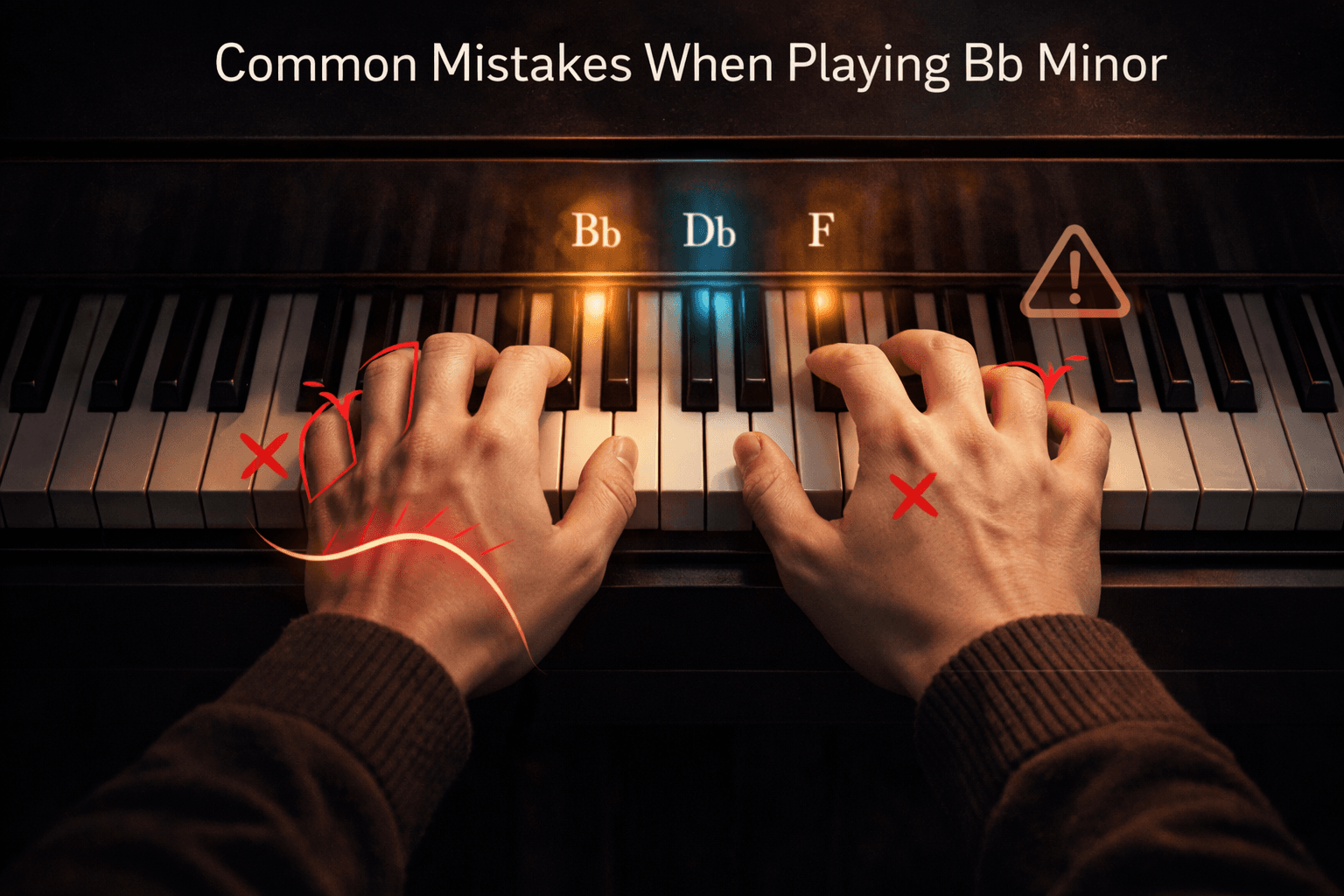
Common Mistakes When Playing Bb Minor
 Using incorrect fingering on black keys often causes tension.
Skipping inversion practice limits musical flexibility.
Rushing progressions leads to uneven tone.
Ignoring left-hand balance weakens overall sound.
Using incorrect fingering on black keys often causes tension.
Skipping inversion practice limits musical flexibility.
Rushing progressions leads to uneven tone.
Ignoring left-hand balance weakens overall sound.
Correcting these issues early leads to confident and controlled playing.
Advanced Applications of Bb Minor
Improvisation becomes more expressive when using harmonic and melodic minor scales over Bb minor. Songwriting benefits from pairing Bb minor with relative major and dominant chords. Chord extensions like Bbm9 and Bbm11 add modern depth. Broken chords and layered voicings enhance accompaniment textures.
Frequently Asked Questions (FAQs)
1. What notes make up the Bb minor chord?
Bb, Db, and F form the Bb minor triad.
2. Is Bb minor difficult for beginners?
It requires black key coordination, but steady practice makes it manageable.
3. What are the inversions of Bb minor?
First inversion uses Db – F – Bb and second inversion uses F – Bb – Db.
4. Which scales work best with Bb minor?
Natural minor, harmonic minor, melodic minor, and minor pentatonic scales.
5. What chords complement Bb minor?
Eb minor, Gb major, F major, and Db major.
6. What mood does Bb minor create?
It sounds deep, emotional, dramatic, and introspective.
7. How can beginners use Bb minor in songs?
Start with slow progressions, focus on inversions, and gradually add arpeggios.