ChatGPT
 Google AI
 Grok
Grok Claude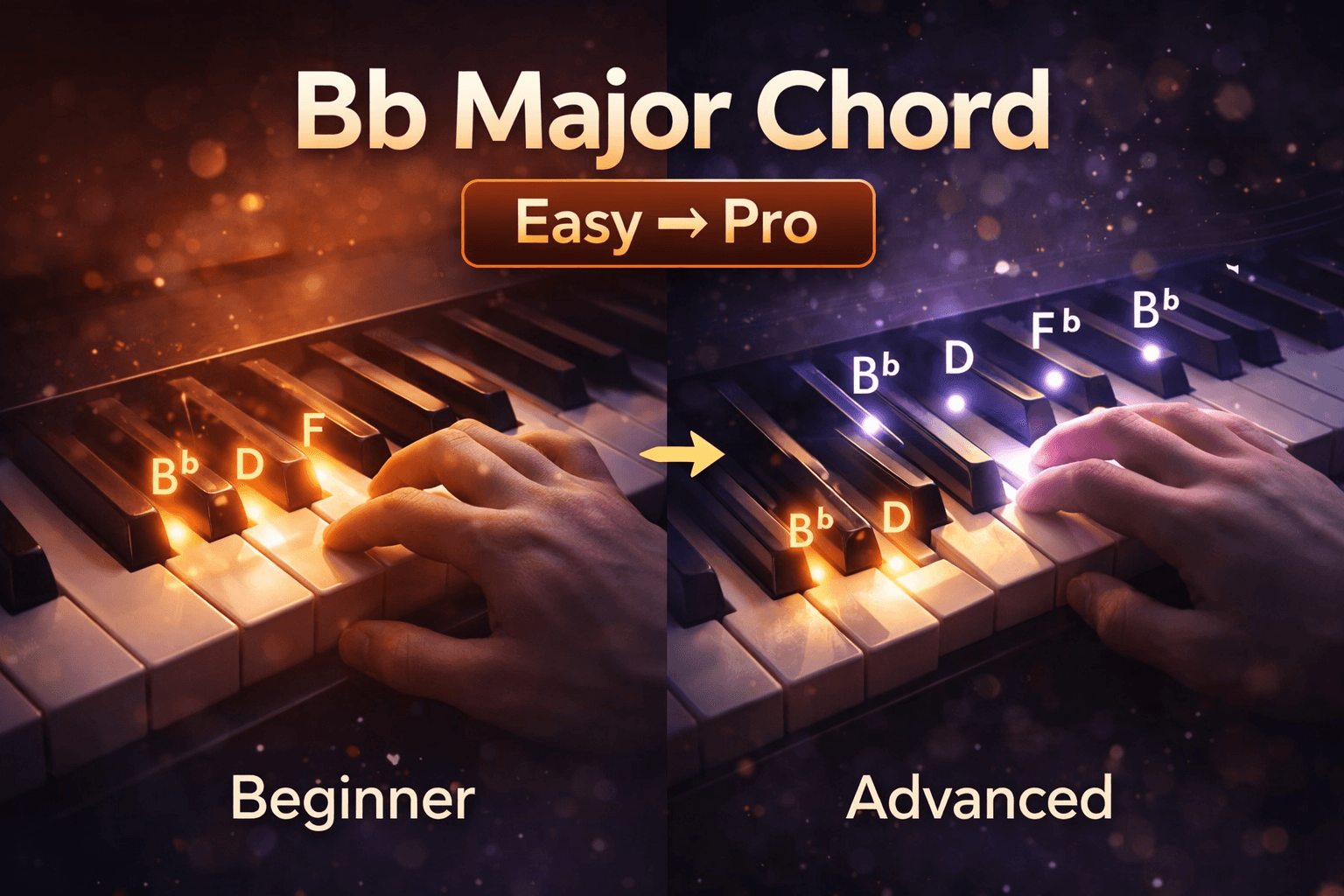
The Bb major chord is one of the most expressive and widely used chords in Western music. It appears frequently in classical compositions, jazz standards, gospel music, film scores, pop arrangements, and brass- and wind-based ensembles. While beginners may initially find Bb major challenging due to the presence of black keys, it is an essential chord for developing proper hand positioning, keyboard awareness, and harmonic understanding.
Unlike C major, which uses only white keys, the Bb major chord introduces pianists to flat notes and black-key-centered fingering. Mastering this chord builds confidence across the keyboard and prepares players for advanced keys such as Eb major, Ab major, and Db major. It also plays a vital role in jazz harmony, where Bb major often functions as a tonic or pivot key.
In this complete guide, you will learn Bb major chord theory, correct finger placement, inversions, arpeggios, compatible scales, chord progressions, exercises, real-world song usage, and advanced applications. By the end of this article, you will be able to play the Bb major chord comfortably and use it musically in multiple styles.
Understanding the Bb Major Chord
 The Bb major chord is built from three specific notes that define its sound and function.
The notes of the Bb major chord are:
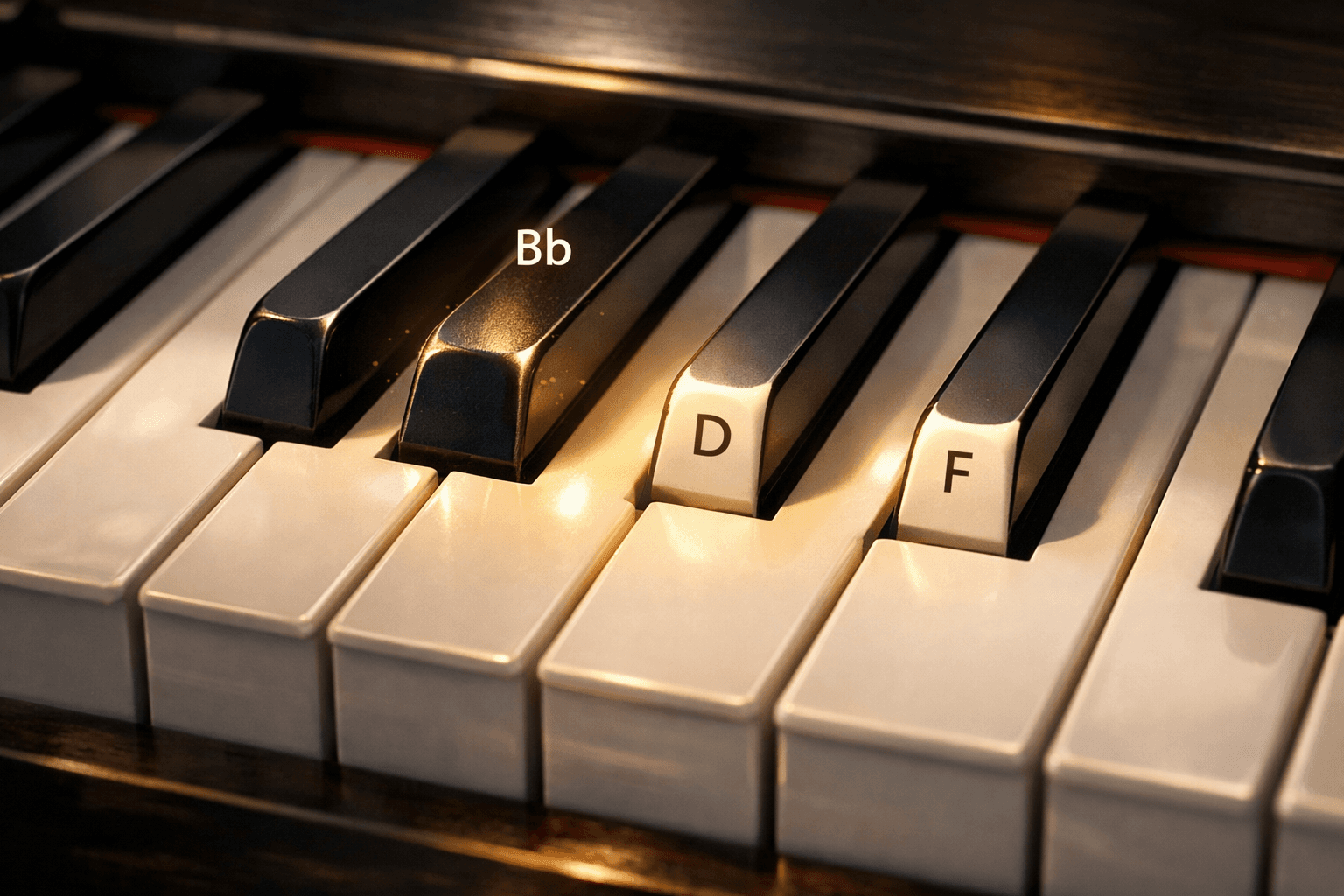
Bb – Root D – Major Third F – Perfect Fifth
This chord produces a warm, confident, and balanced sound. It is often described as noble, stable, and resonant, making it popular in orchestral music, jazz ballads, and gospel progressions. The interval between Bb and D creates the characteristic major brightness, while the fifth, F, provides harmonic strength and stability.
Bb major frequently appears as the tonic chord in the key of Bb major and also functions as a subdominant or dominant substitute in related keys. Because Bb is a black key, playing this chord encourages correct hand alignment and natural finger curvature, which are critical for long-term piano technique.
Bb Major Chord Theory
Triad Construction
| Note | Role | Interval from Root |
|---|---|---|
| Bb | Root | 1 |
| D | Major Third | 4 semitones |
| F | Perfect Fifth | 7 semitones |
The Bb major chord follows the universal major chord formula of root, major third, and perfect fifth. Understanding this structure allows pianists to build major chords starting from any key on the keyboard. Once this pattern is internalized, chord recognition and transposition become significantly easier.
Extended Variations
Beyond the basic triad, the Bb major chord can be expanded to create richer harmonic colors.
Bbmaj7, consisting of Bb, D, F, and A, produces a smooth and jazzy tone commonly used in jazz standards and contemporary ballads.
Bb6, formed by adding G to the triad, creates a soft and vintage sound often heard in swing and pop music.
Bbadd9, which adds C to the chord, introduces brightness and melodic openness, making it popular in modern songwriting and film music.
These variations allow pianists to move beyond simple harmony and explore expressive chord voicings.
Finger Placement for Bb Major Chord
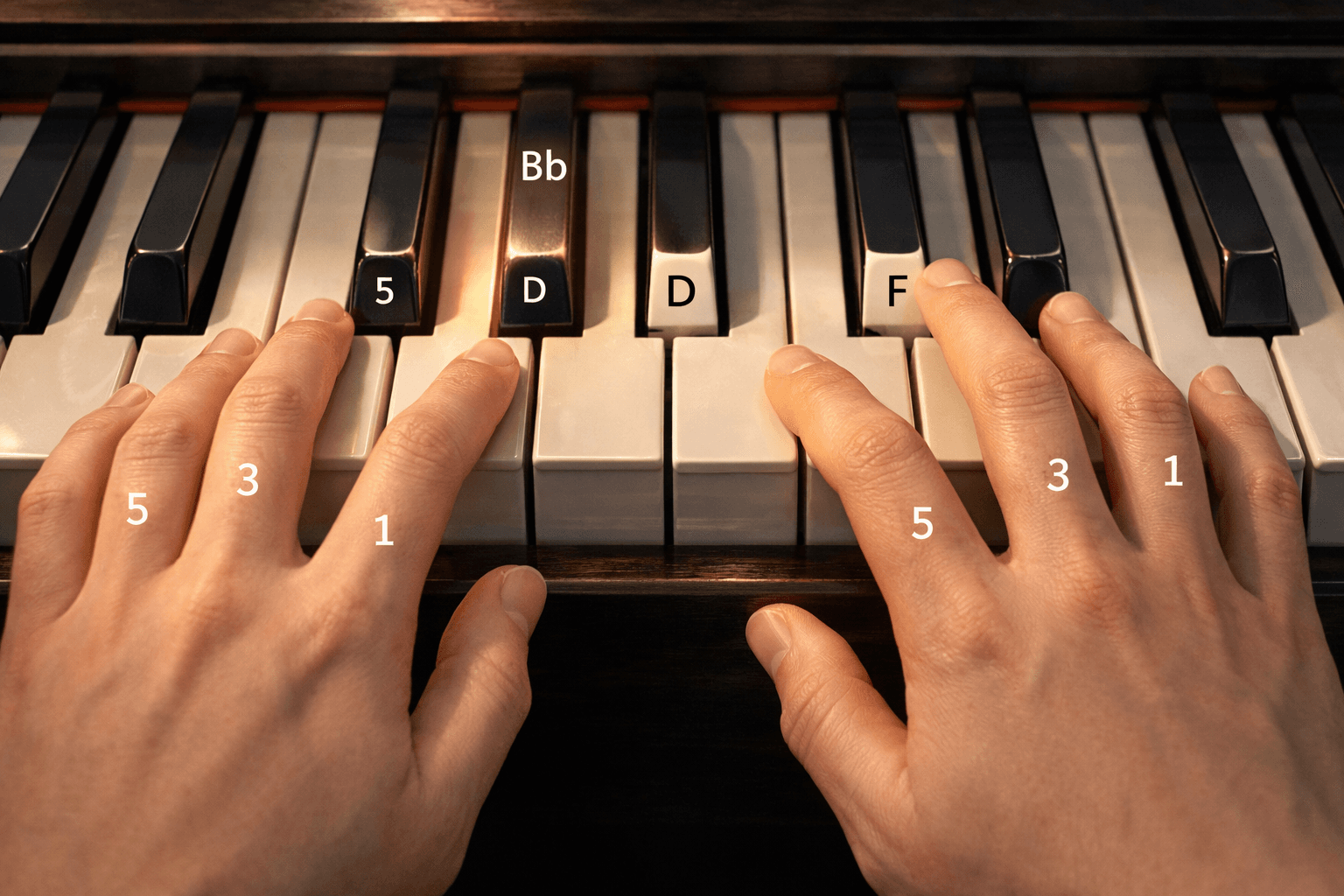 Correct fingering is essential for comfort and control, especially when black keys are involved.
Right Hand Fingering
The right hand places the thumb on Bb, the middle finger on D, and the pinky on F. This fingering keeps the hand naturally aligned and avoids unnecessary stretching.
Left Hand Fingering
The left hand places the pinky on Bb, the middle finger on D, and the thumb on F. This position provides balance and allows for smooth movement into inversions and bass patterns.
Exercise 1: Root Position Practice
Begin by playing the Bb major chord slowly in root position. Focus on producing an even sound across all three notes and ensure that no finger is overpowering the others. Repeat the chord in different octaves to strengthen muscle memory and improve hand independence.
Maintaining a relaxed wrist and curved fingers is especially important when playing black keys, as tension can lead to inaccurate playing and fatigue.
Inversions of the Bb Major Chord
Chord inversions allow smoother transitions between chords and reduce excessive hand movement. They are essential for accompaniment, chord progressions, and advanced harmonic playing.
First Inversion (D – F – Bb)
In the first inversion, D becomes the lowest note. The right hand places the thumb on D, the middle finger on F, and the pinky on Bb. The left hand mirrors this structure with appropriate fingering adjustments.
This inversion is particularly useful when moving between Bb major and chords like G minor or Eb major.
Second Inversion (F – Bb – D)
In the second inversion, F is the lowest note. The right hand plays F with the thumb, Bb with the middle finger, and D with the pinky. The left hand follows a similar layout.
Second inversion is commonly used in arpeggios, cadences, and broken chord patterns, creating a sense of forward motion and harmonic flow.
Exercise 2: Inversion Drill
Practice moving from root position to first inversion, then to second inversion, and back to root position. Begin slowly with each hand separately before combining both hands. Focus on minimizing hand movement and maintaining consistent tone quality.
Arpeggios and Broken Chords
Arpeggios transform chords into melodic sequences and are essential for developing technique, coordination, and musical expression.
Bb Major Arpeggio (One Octave)
Ascending arpeggio follows the pattern Bb, D, F, Bb. Descending arpeggio follows the reverse order Bb, F, D, Bb.
Exercise 3: Arpeggio Flow
Start by playing the arpeggio slowly with one hand, ensuring even timing and clarity. Once comfortable, practice hands together and gradually increase tempo. Introducing rhythmic variations such as triplets or syncopated patterns enhances musical control and prepares pianists for improvisation.
Scales Compatible with Bb Major
 Practicing scales alongside chords improves ear training, finger strength, and improvisational ability.
| Scale | Notes | Mood |
|---|---|---|
| Bb Major | Bb – C – D – Eb – F – G – A – Bb | Bright, stable |
| Bb Major Pentatonic | Bb – C – D – F – G | Simple, melodic |
| Bb Lydian | Bb – C – D – E – F – G – A | Dreamy, modern |
| Bb Mixolydian | Bb – C – D – Eb – F – G – Ab | Bluesy, jazzy |
Exercise 4: Scale Integration
Practice these scales over two octaves while maintaining even tone and consistent fingering. Combine scale practice with Bb major arpeggios to reinforce harmonic awareness and melodic creativity.
Common Chord Progressions with Bb Major
 Bb major appears in a wide range of progressions across musical genres.
Beginner-Friendly Progressions
| Progression | Notes |
|---|---|
| Bb – Eb – F | Bb D F → Eb G Bb → F A C |
| Bb – Gm – Eb – F | Bb D F → G Bb D → Eb G Bb → F A C |
Intermediate Progressions
| Progression | Notes |
|---|---|
| Bb – F – Gm – Eb | Bb D F → F A C → G Bb D → Eb G Bb |
| Bb – Cm – F – Bb | Bb D F → C Eb G → F A C → Bb D F |
Advanced Progressions
| Progression | Notes |
|---|---|
| Bbmaj7 – Cm7 – Eb – F | Bb D F A → C Eb G Bb → Eb G Bb → F A C |
| Bb – Gm – Fsus4 – Bb6 | Bb D F → G Bb D → F Bb C → Bb D F G |
Exercise 5: Progression Mastery
Practice these progressions slowly, focusing on smooth chord transitions and consistent rhythm. Use inversions to reduce hand movement and experiment with broken chord patterns for added texture.
Popular Songs Featuring Bb Major
 Bb major is frequently used in well-known music across styles.
In pop and rock music, many horn-driven and piano-based songs rely on Bb major for its warm and powerful tone.
In jazz, Bb major is one of the most common keys for standards, making it essential for improvisation and ensemble playing.
In film and orchestral music, Bb major often underscores heroic, uplifting, and emotional moments.
Playing along with songs in this key strengthens rhythm, timing, and harmonic recognition.
Genre Applications of Bb Major
In pop and rock music, Bb major provides strong harmonic support and works well with vocal ranges.
In jazz, it serves as a foundational key for ii–V–I progressions and extended harmonies.
In classical music, Bb major is associated with warmth and balance, often used in symphonies and chamber works.
In film scoring, it conveys optimism, triumph, and emotional depth.
Tips for Mastering the Bb Major Chord
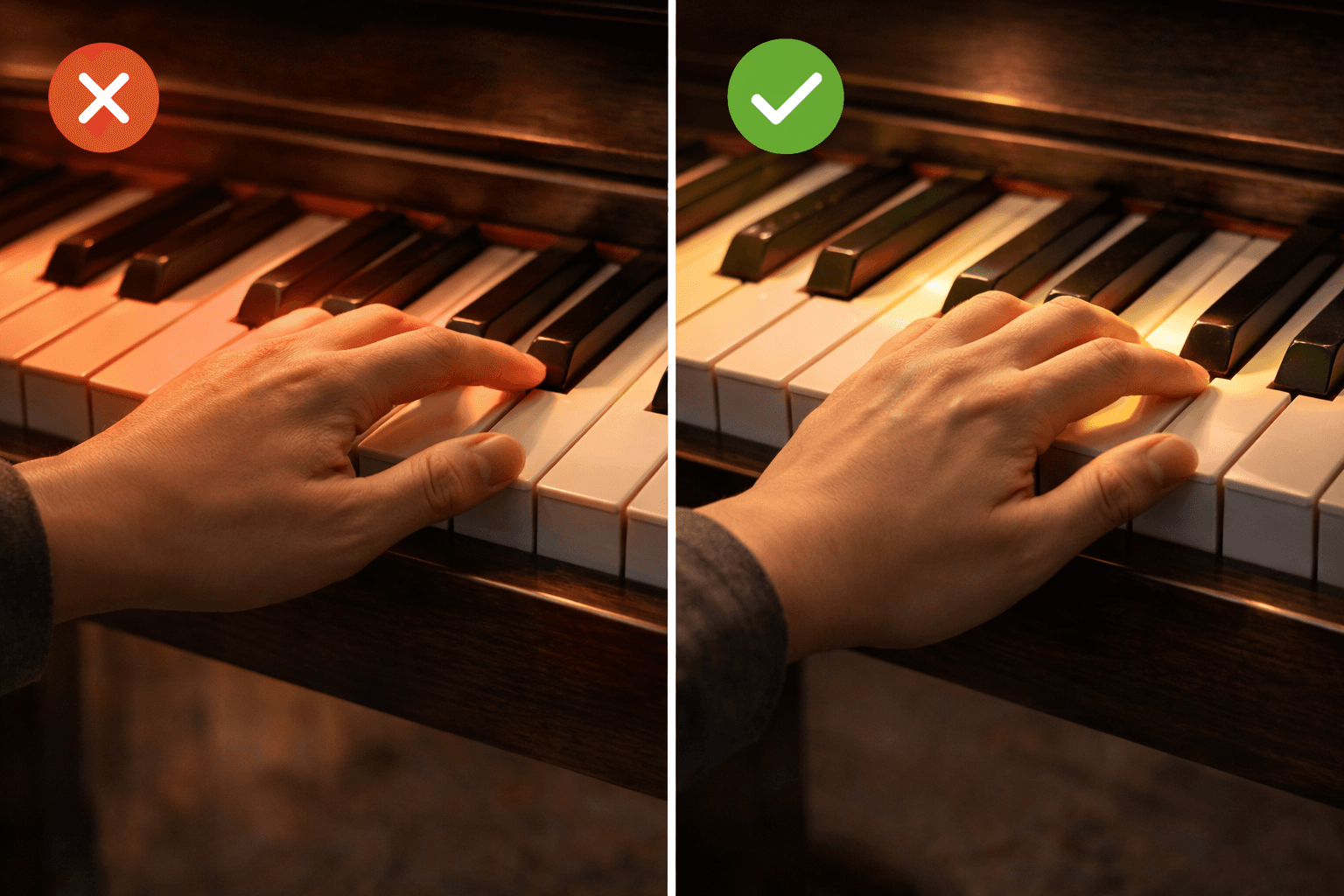 Consistent fingering helps develop muscle memory and accuracy.
Practicing inversions ensures smooth chord transitions.
Combining chords with scales and arpeggios enhances musicality.
Playing with dynamics improves expressive control.
Exploring chord extensions adds harmonic richness and creativity.
Common Mistakes with Bb Major
 Many beginners avoid black keys or use incorrect fingering, leading to tension. Others rush through progressions without accuracy or neglect left-hand coordination. Addressing these issues early results in cleaner technique and greater confidence.
Advanced Applications
Improvisation over Bb major uses the major scale and pentatonic for melodic solos.
Songwriting benefits from pairing Bb major with relative minor chords like G minor and C minor.
Chord extensions such as Bbmaj7 and Bbadd9 enhance harmonic sophistication.
Arpeggios and broken chords enrich accompaniment and melodic lines.
Frequently Asked Questions (FAQs)
1. What notes are in the Bb major chord?
The Bb major chord consists of Bb, D, and F.
2. Is Bb major difficult for beginners?
It can be challenging initially due to the black key, but regular practice builds comfort quickly.
3. How do I play Bb major inversions?
First inversion uses D, F, and Bb. Second inversion uses F, Bb, and D.
4. Which scales fit Bb major?
Bb major, Bb pentatonic, Bb Lydian, and Bb Mixolydian.
5. What chords complement Bb major?
Eb, F, G minor, C minor, and D minor.
6. What mood does Bb major convey?
Warm, confident, uplifting, and balanced.
7. How can beginners use Bb major in songs?
Start with simple progressions such as Bb – Eb – F and gradually introduce inversions and arpeggios.