ChatGPT
 Google AI
 Grok
Grok Claude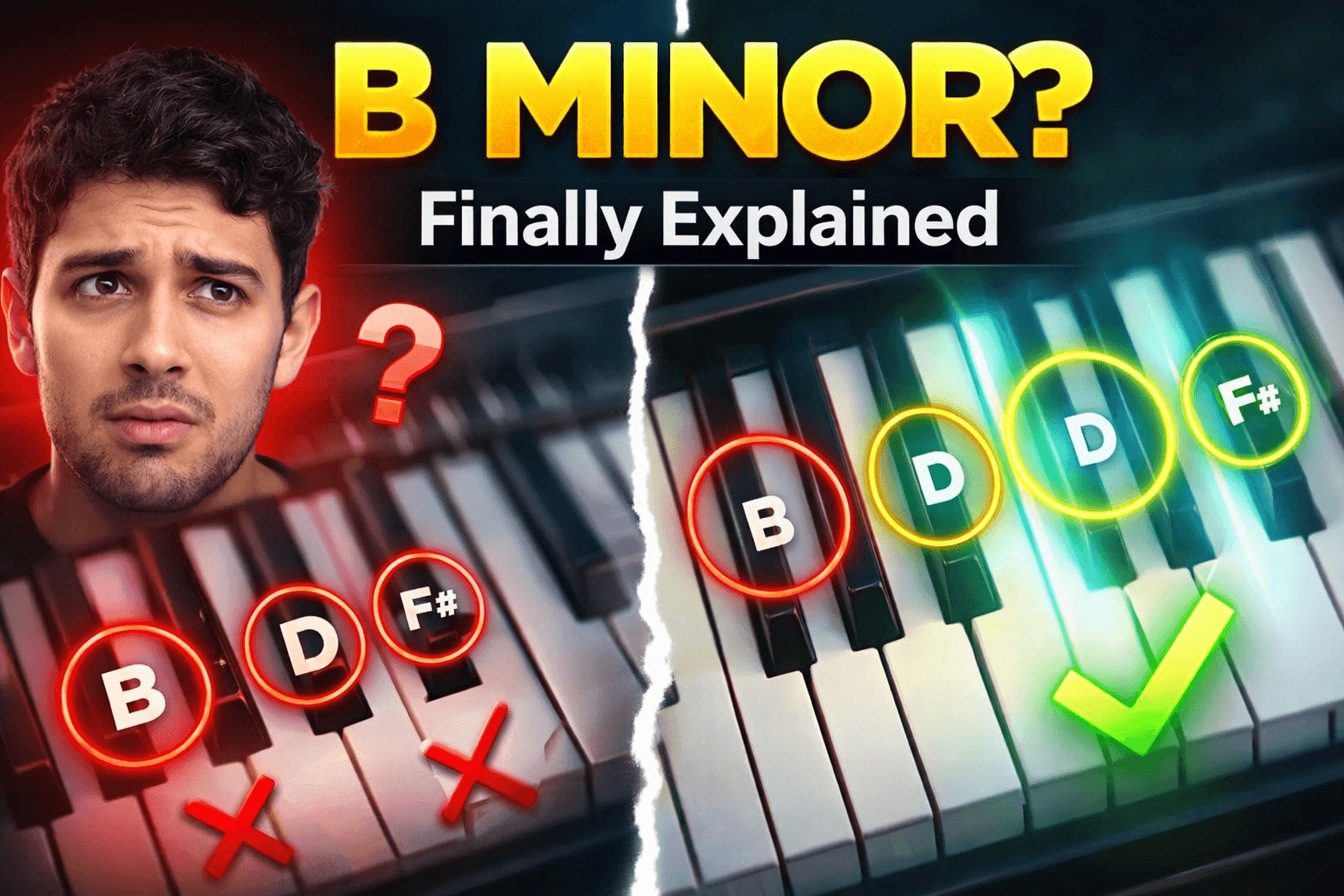
The B minor chord on piano is one of the most expressive and emotionally rich chords beginners encounter when learning minor chords. Built from the notes B, D, and F#, this triad produces a dark, introspective, and slightly dramatic sound, making it extremely popular in pop, rock, classical, soundtrack music, and emotional piano ballads.
Compared to many minor chords made entirely of white keys, the Bm chord requires a mix of white and black keys, giving it a unique feel under the fingers. This makes it an important chord as students begin exploring minor keys that go beyond basic beginner chords. The B minor piano chord teaches finger control, helps with chromatic awareness, and strengthens hand positioning across black-key combinations.
Understanding the B minor chord also expands your ability to learn piano chords online effectively. With its combination of black and white keys, B minor encourages better hand posture, precise finger placement, and early exposure to advanced musical textures. By learning root position, first inversion, second inversion, and common B minor chord progressions, pianists can navigate songs more confidently and achieve smoother chord transitions.
Introduction to the B Minor Chord
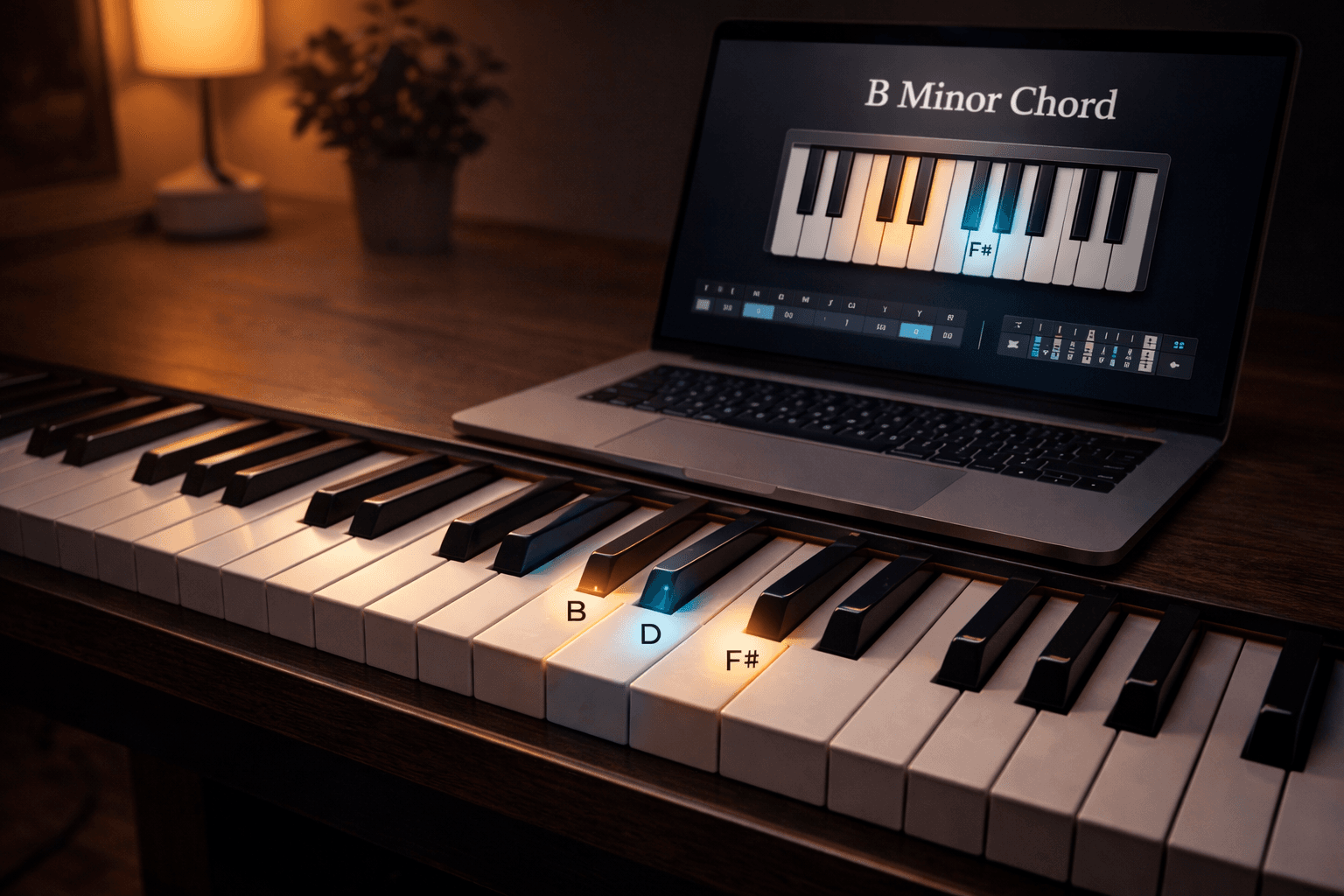 The B minor chord is a three-note triad formed using the notes B, D, and F#. It contains:
- B – Root
- D – Minor Third
- F# – Perfect Fifth
These three notes together create a sad, reflective, and deep sound that appears in thousands of compositions. Because B minor contains one sharp and involves black keys, it is an essential step in developing your comfort with intermediate-level piano chords.
The B minor chord is commonly written as:
- Bm
- Bmin
- B-
This chord is especially popular in:
- Pop and emotional ballads
- Rock and alternative music
- Film scores
- EDM / electronic music
- Classical and orchestral compositions
It is the relative minor of D major, which means both keys share the same key signature: F# and C#. This connection explains why the B minor chord fits seamlessly into many songs written in D major.
Below is a quick reference table for the B minor triad:
Note Role B Root D Minor Third F# Perfect Fifth
Learning to recognize these notes visually and aurally strengthens your musical understanding and prepares you for smooth chord transitions and inversions later in this guide.
How to Play the B Minor Chord in Root Position
 The root position places B as the lowest note, followed by D and F#. This is the standard way beginners first learn the chord.
Right Hand Fingering
- Thumb (1) on B
- Middle finger (3) on D
- Pinky (5) on F#
** Left Hand Fingering**
- Pinky (5) on B
- Middle finger (3) on D
- Thumb (1) on F#
Placing fingers this way ensures stability and control when incorporating B minor into simple or complex chord progressions.
When first practicing this chord:
- Press all keys together evenly
- Keep your wrist relaxed
- Curve your fingers naturally
- Avoid collapsing joints, especially on black keys
Because the F# sits on a black key, beginners sometimes struggle with balance. Practicing slowly helps develop confidence and build muscle memory.
Playing root position B minor prepares you for exploring inversions, which allow smoother transitions between chords and help reduce hand movement.
Inversions of the B Minor Chord
 Chord inversions rearrange the order of notes while keeping the chord quality the same. They add fluidity, texture, and musical variety.
The B minor chord has two inversions:
- First Inversion – D at the bottom (D–F#–B) 2.Second Inversion – F# at the bottom (F#–B–D)
Inversions are essential for:
- Moving smoothly between chords
- Avoiding large hand jumps
- Creating softer or more expressive textures
- Playing professional-sounding progressions
When learning piano chords online or through structured lessons, mastering inversions is considered one of the biggest milestones in sound improvement.
How to Play B Minor 1st Inversion
The first inversion places D as the lowest note.
Notes:
D → F# → B
Right Hand Fingering:
- Thumb (1) on D
- Index or middle finger (2 or 3) on F#
- Pinky (5) on B
Left Hand Fingering:
- Pinky (5) on D
- Index/middle finger (2 or 3) on F#
- Thumb (1) on B
This inversion is extremely useful for transitions to:
- G major
- D major
- F# minor
- A major
Because the notes are grouped closer, shifting between chords becomes effortless. First inversion is often used in ballads, emotional pop songs, and smooth left-hand accompaniment patterns.
How to Play B Minor 2nd Inversion
The second inversion begins with F# as the lowest note.
Notes:
F# → B → D
Right Hand Fingering:
- Thumb (1) on F#
- Middle finger (3) on B
- Pinky (5) on D
Left Hand Fingering:
- Pinky (5) on F#
- Middle finger (3) on B
- Thumb (1) on D
This inversion is commonly used in:
- Arpeggiated patterns
- Pop progressions
- Film music
- Left-hand broken-chord accompaniments
The second inversion of B minor is especially smooth when transitioning to chords like:
- G major (root position or 1st inversion)
- D major (root position)
- E minor
The spacing between notes creates a light, open, and resonant tone.
Common Chord Progressions in the Key of B Minor
 Because the B minor chord belongs to the key of B minor / D major, it appears naturally in many progressions. These chord sequences form the harmonic foundation of countless songs across multiple genres.
Here are the most useful and beginner-friendly progressions involving B minor:
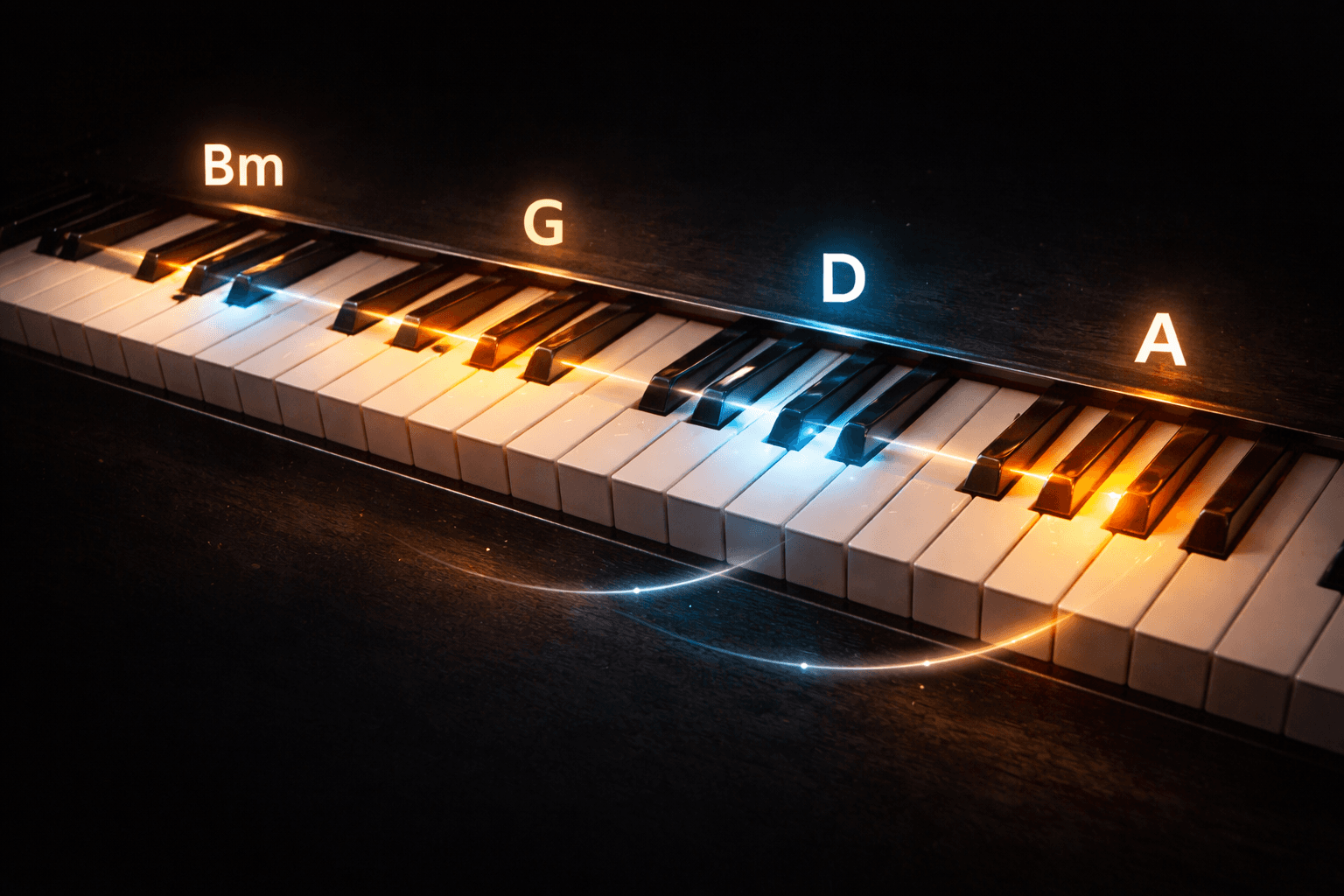
Progression Notes Bm – G – D – A B D F# – G B D – D F# A – A C# E Bm – A – G – F#m B D F# – A C# E – G B D – F# A C# Bm – D – A – E B D F# – D F# A – A C# E – E G# B Bm – F#m – G – Em B D F# – F# A C# – G B D – E G B Bm – G – Em – F# B D F# – G B D – E G B – F# A C#
These progressions help train your ear to recognize minor chord movement, and practicing them improves: Timing
- Hand coordination
- Smooth transitions
- Voice leading
- Inversion control
Try practicing these sequences using root position first, then begin switching to first and second inversions for seamless performance.
Popular Songs to Play with the B Minor Chord
 The B minor chord appears in a huge number of modern and classic songs due to its emotional depth. Here are some beginner-friendly and intermediate songs where B minor plays a central role.
Coldplay – "The Scientist"
This song relies heavily on emotional minor-based progressions, with B minor serving as a grounding chord. Playing it helps beginners understand dynamic control and slow tempo phrasing.
What you learn:
- Expressive chord playing
- Balanced hand technique
- Smooth transition between Bm → G → D → A
Adele – "Someone Like You"
Although the original key varies, B minor-related progressions are heavily used in the left-hand patterns. Practicing this song develops strength in chord inversion usage.
What you learn:
- First and second inversion control
- Arpeggiated accompaniment
- Soft, controlled touch
- Repetitive chord timing
- Right-hand rhythm consistency
- Transition discipline between chords
- Layering chords with melody
- Playing sustained minor tones
- Smooth upper-register chord transitions
- Virtual piano chord generators
- Real-time feedback apps like Flowkey or Simply Piano
- Digital sheet music platforms
- Play-along backing track apps
- Triad structure awareness
- B minor chord recognition
- Bm chord inversions
- Smooth chord transitions
- **1st inversion**: D–F#–B
- **2nd inversion**: F#–B–D
- Coldplay – The Scientist
- Adele – Someone Like You
- Linkin Park – Numb
- Ed Sheeran – Photograph
Linkin Park – "Numb"
The B minor chord serves as a fundamental part of the progression. Playing this song helps with rhythmic stability when practicing chords in repeated patterns.
What you learn:
Ed Sheeran – "Photograph"
This track uses progressions related to B minor and teaches proper hand balancing between melody and harmony.
What you learn:
Tools to Learn and Generate B Minor Chords
 Learning piano chords online has become easier thanks to interactive tools, chord generator apps, and guided video tutorials. These platforms help beginners visualize the keyboard, practice hand positions, and master chord inversions.
Helpful tools include:
Using these tools helps reinforce:
Technology accelerates learning by allowing repeated practice with visual and audio feedback.
Tips and Tricks for Mastering the B Minor Chord
To fully master the B minor chord on piano, follow these essential practice tips:
1. Practice Slowly with Proper Finger Position
Start with the root position and ensure your fingers fall naturally on B–D–F#. Avoid unnecessary tension.
2. Master Both Hands Separately
Play B minor slowly with each hand before practicing hands together.
3. Practice Inversions Daily
Switch between root → 1st inversion → 2nd inversion smoothly to build confidence.
4. Use Simple Progressions
Work with common B minor progressions to train your ears and fingers.
5. Incorporate Arpeggios
Break the chord into patterns to improve control and musicality.
6. Play Along with Songs
This helps develop real chord timing and rhythm.
7. Practice Dynamics
Try soft (p), medium (mp), and loud (f) dynamics for expressive control.
8. Keep Your Wrist Relaxed
Avoid strain by allowing flexible wrist movement, especially on black keys.
Frequently Asked Questions (FAQs)
1. What notes are in the B minor chord?
The B minor chord contains B, D, and F#, forming the root, minor third, and perfect fifth.
2. How do I play the B minor chord on piano?
Right-hand fingering: 1–3–5 on B–D–F#. Left-hand fingering: 5–3–1 on B–D–F#. This ensures proper balance and stability when playing.
3. What inversions does B minor have?
B minor has two inversions:
These inversions create smoother transitions in progressions.
4. Which songs can I play using the B minor chord?
Popular songs include:
These provide real-world practice using the Bm chord.
5. Is B minor a difficult chord for beginners?
It’s slightly more challenging than white-key minor chords due to the F# black key, but with proper finger placement and slow practice, it becomes easy and intuitive.
6. What key is associated with B minor?
B minor is the relative minor of D major, sharing the key signature F# and C#.
7. Can I practice B minor with chord apps?
Yes. Chord generator tools and piano learning apps greatly help with fingering, inversions, and timing.