ChatGPT
 Google AI
 Grok
Grok Claude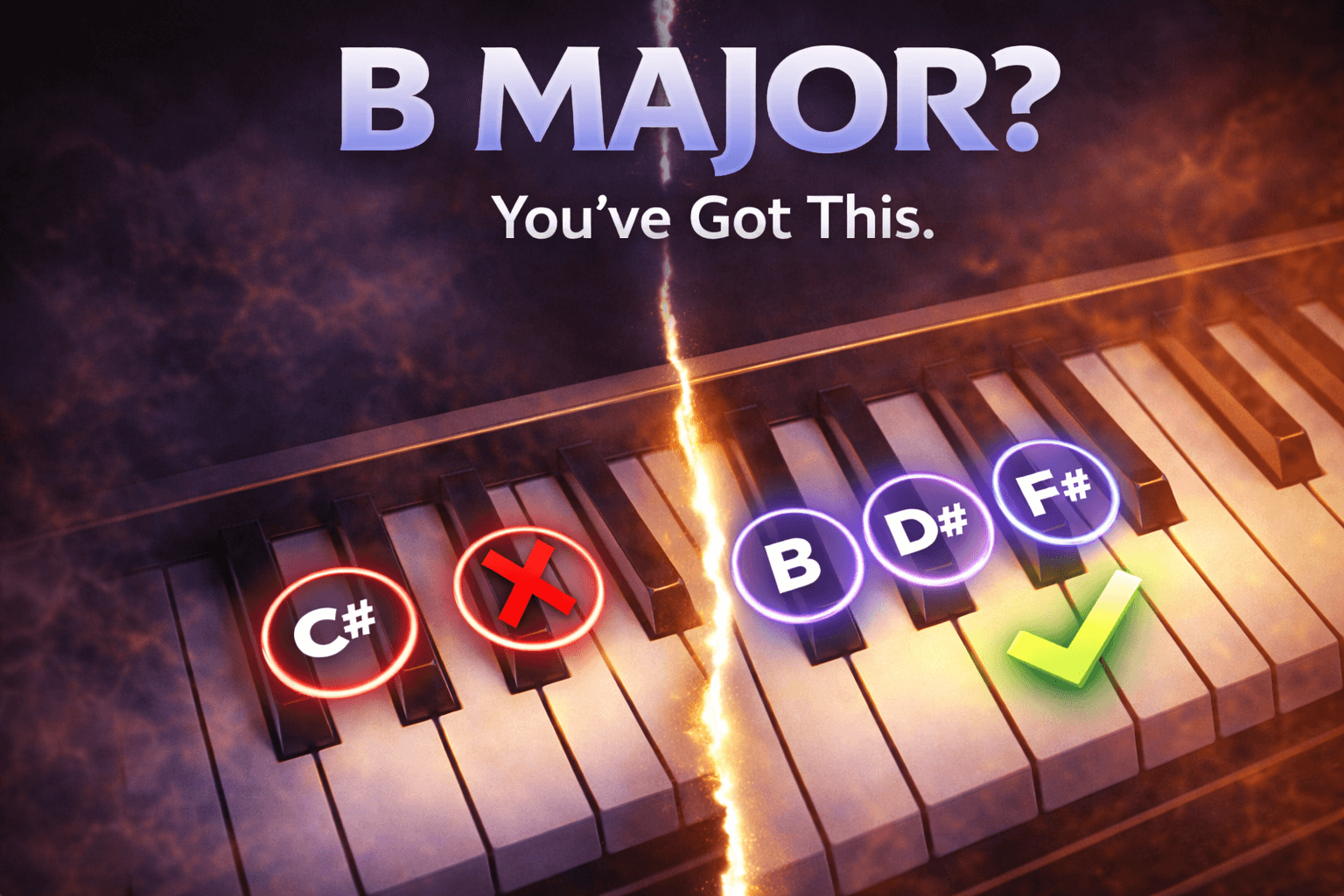
The B major chord on piano is one of the essential chords every pianist must master. Its bright, uplifting sound makes it a staple in countless musical genres, from pop and rock to classical and jazz. Understanding this chord deeply is crucial not only for beginners learning piano chords but also for intermediate and advanced players exploring improvisation, arpeggios, and chord voicings.
This guide covers everything you need to know about the B major chord, including its theory, note structure, inversions, scales, arpeggios, chord progressions, popular songs, practice tips, and common mistakes. By the end, you’ll be able to play B major confidently, integrate it into your music, and explore advanced applications for your compositions.
What is B Major Chord?
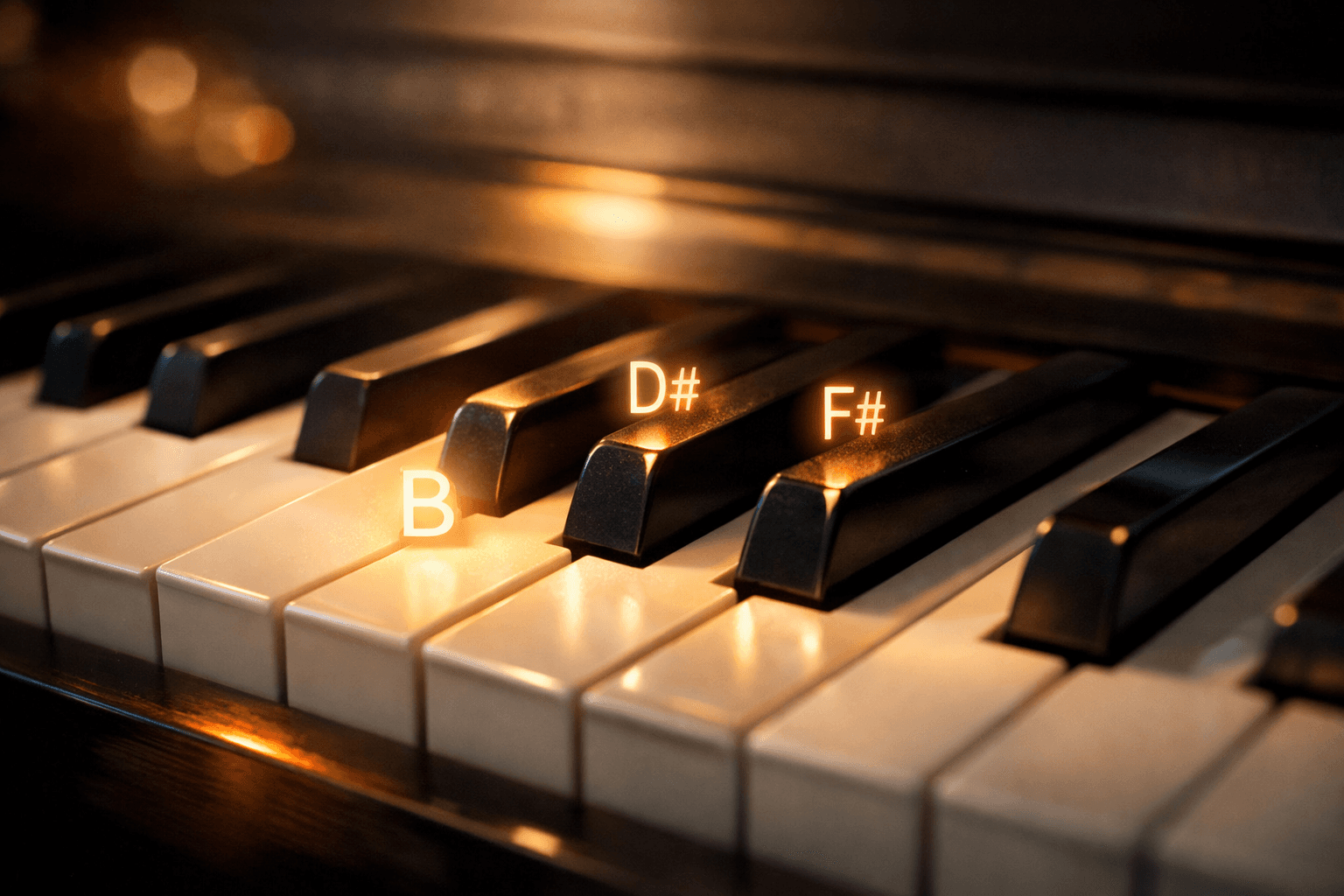 The B major chord is a triad, meaning it consists of three notes. Specifically:
- B – Root
- D# – Major Third
- F# – Perfect Fifth
This combination of notes gives the B major chord a strong, bright, and resolved sound, in contrast to minor chords, which carry a more melancholic or emotional tone. While simple in theory, the chord’s inclusion of D#, a black key, makes it a bit challenging for beginners, especially those accustomed to playing only white keys.
The B major chord is widely used in:
- **Pop and rock music**: Often forming the harmonic foundation of choruses and riffs.
- **Jazz**: Used in extended chords like Bmaj7, B6, B9.
- **Classical compositions**: As a pivot chord for key modulation.
- **Film scores and modern compositions**: To evoke happiness, triumph, or energy.
Mastering the B major chord also gives you the ability to play songs in the key of B major, which contains chords like B, C#m, D#m, E, F#, G#m, and A#dim, expanding your harmonic knowledge.
B Major Chord Notes and Theory
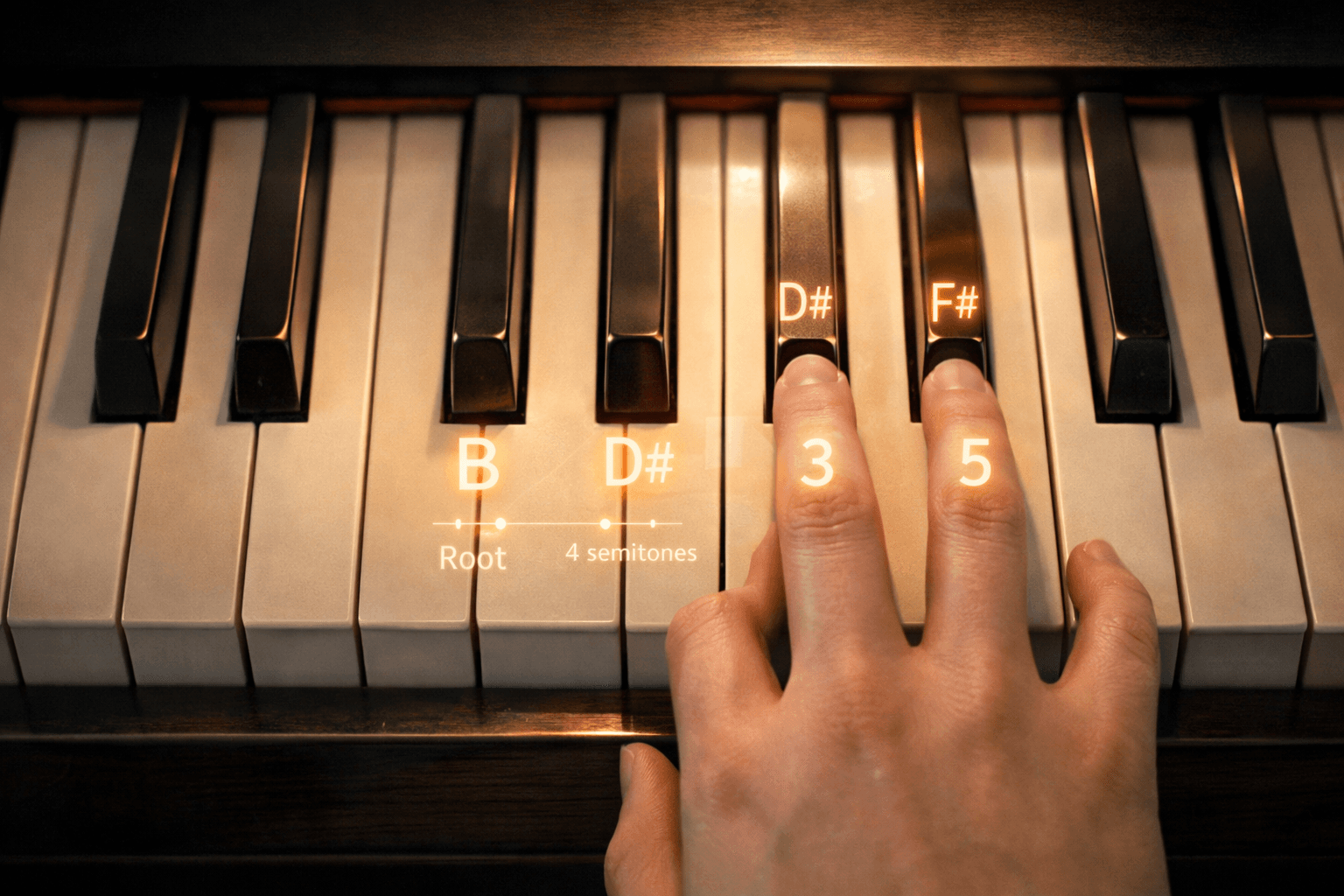 Understanding the theory behind the B major chord will help you apply it in different musical contexts.
Triad Structure
Understanding the theory behind the B major chord will help you apply it in different musical contexts.
Triad Structure
Note Role Interval from Root
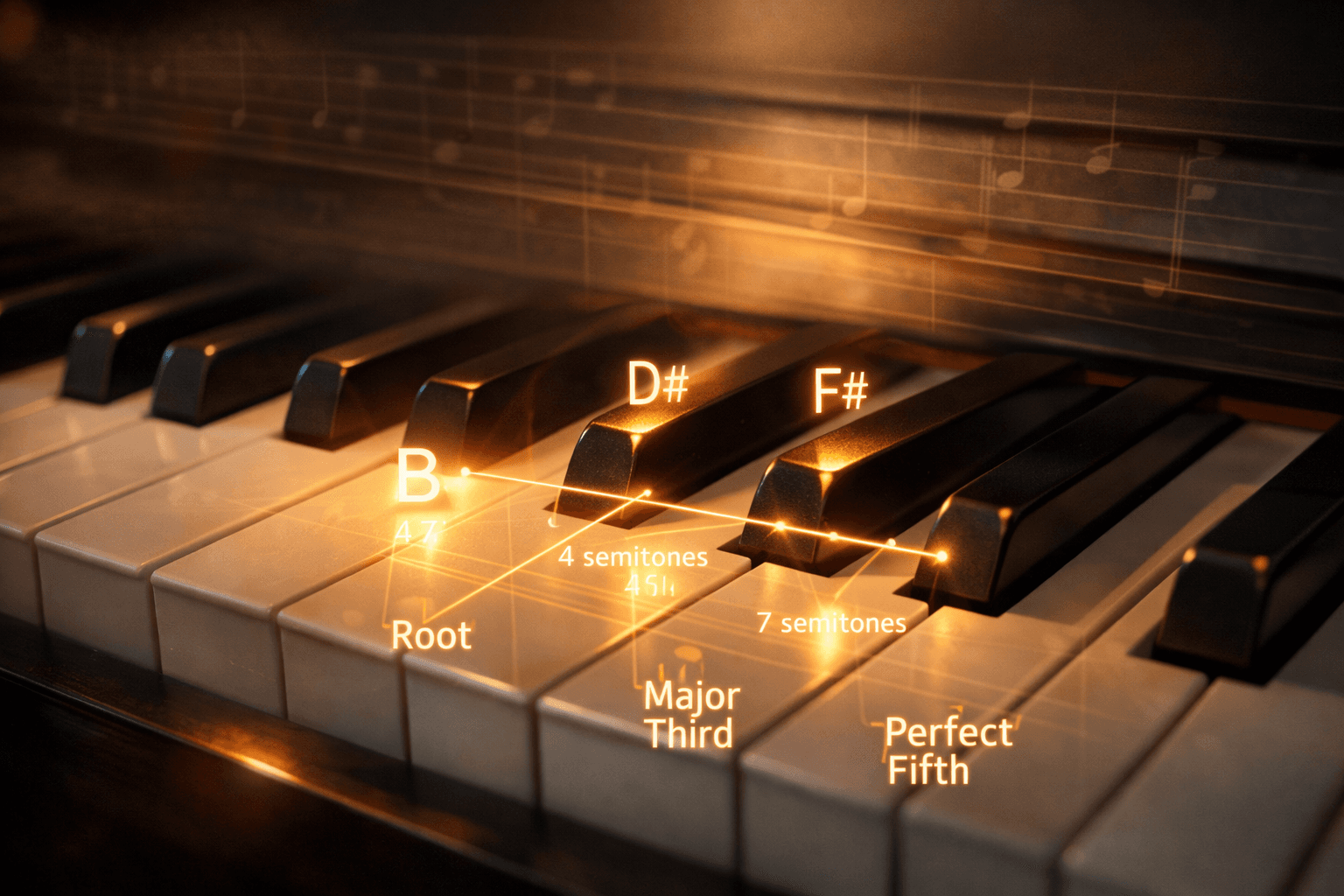
B Root 1 D# Major Third 4 semitones F# Perfect Fifth 7 semitones
The root–major third–perfect fifth formula is the blueprint for all major chords. The distance between B and D# (4 semitones) creates the major third, which defines the chord’s bright tonality. The interval from B to F# (7 semitones) gives stability and completeness.
Extended Chords and Variations
Beyond the basic triad, B major can be expanded to include:
- **Bmaj7 (B – D# – F# – A#)**: Adds richness and sophistication.
- **B6 (B – D# – F# – G#)**: Offers a smooth, jazzy tone.
- **B9 (B – D# – F# – A# – C#)**: Creates tension suitable for jazz and pop.
These extensions are especially useful for improvisation, songwriting, and jazz chord progressions.
Playing the B Major Chord in Root Position
 The root position places B as the lowest note, followed by D# and F#.
Right Hand Fingering
- Thumb (1) on B
- Middle finger (3) on D#
- Pinky (5) on F#
Left Hand Fingering
- Pinky (5) on B
- Middle finger (3) on D#
- Thumb (1) on F#
Tips:
- Keep your fingers curved and relaxed.
- Press each key evenly for a clear, resonant sound.
- Use the metronome to practice timing and accuracy.
Exercise 1: Root Position Repetition
-
<
- Play B major in root position 20 times in a row.
- Focus on even pressure and clarity.
- Gradually increase tempo.
Inversions of the B Major Chord
Inversions allow smoother transitions between chords by changing the bass note.
1st Inversion: D# – F# – B
- **Right hand**: Thumb on D#, middle finger on F#, pinky on B
- **Left hand**: Pinky on D#, middle finger on F#, thumb on B
This inversion is ideal for smooth progressions like B → G#m → E.
2nd Inversion: F# – B – D#
- **Right hand**: Thumb on F#, middle finger on B, pinky on D#
- **Left hand**: Pinky on F#, middle finger on B, thumb on D#
Second inversion is useful in arpeggios, broken chords, and creating flowing harmonic movement in your music.
Exercise 2: Inversion Practice
- Play B major in root, 1st, and 2nd inversions consecutively.
- Focus on smooth transitions with minimal hand movement.
Arpeggios and Broken Chords
 Arpeggios are piano chord notes played individually rather than simultaneously. Practicing arpeggios:
- Improves finger strength and dexterity
- Trains ear for chord tones
- Enhances improvisation skills
- Ascending: B → D# → F# → B
- Descending: B → F# → D# → B
- Play ascending and descending arpeggios with right hand.
- Mirror the pattern with left hand.
- Combine hands for two-octave arpeggios.
- Play each progression slowly.
- Use root, 1st inversion, and 2nd inversion.
- Focus on smooth transitions and consistent tempo.
- Ed Sheeran – Perfect
- Adele – Rolling in the Deep
- AC/DC – Thunderstruck
- Guns N’ Roses – Sweet Child O’ Mine
- Songs featuring Bmaj7 and B6
- Piano sonatas modulating to B major
- **Classical**: Bright key for modulations and resolutions.
- **Jazz**: Basis for extended chords and harmonic exploration.
- **Pop & Rock**: Frequently used in riffs, choruses, and bridges.
- **Electronic & Film Scoring**: Evokes energy, triumph, and positivity.
- Flowkey – Interactive chord learning
- Simply Piano – Step-by-step piano tutorials
- Piano Marvel – Exercises for chord transitions
- Chordify & Chord Generator Apps – Practice inversions and arpeggios
- Start with root position before exploring inversions.
- Focus on black key D# for clear tones.
- Use metronome for timing and rhythm.
- Practice arpeggios and broken chords daily.
- Incorporate B major into chord progressions and songs.
- Transition between inversions for smooth hand movement.
- Avoid tension in wrists and fingers.
- Misplacing fingers on black keys
- Uneven pressure causing muted notes
- Skipping inversions practice
- Ignoring arpeggios
- Rushing progressions without accuracy
- **Improvisation**: Use scales like B major, B Lydian, B Mixolydian over B major chord.
- **Songwriting**: Combine B major with relative minors (G#m, C#m) for dynamic progressions.
- **Arpeggios**: Create flowing melodies in classical and contemporary pieces.
- **Chord Extensions**: Bmaj7, B6, B9 for jazz and pop sophistication.
B Major Arpeggio Notes (One Octave)
Exercise 3: Arpeggio Patterns
This builds independence between hands and strengthens coordination.
Scales Compatible with B Major Playing scales over B major chord enhances improvisation and ear training.
Scale Notes Mood
B Major B C# D# E F# G# A# B Bright, energetic B Major Pentatonic B C# D# F# G# Simple, melodic B Lydian B C# D# E# F# G# A# B Airy, dreamy B Mixolydian B C# D# E F# G# A B Bluesy, modern
Practicing these scales along with chord exercises develops targeted note placement and improvisational skills.
Common Chord Progressions with B Major
Using the B major chord in progressions strengthens your harmonic understanding.
Beginner-Friendly Progressions
Progression Notes B – E – F# B D# F# → E G# B → F# A# C# B – G#m – E – F# B D# F# → G# B D# → E G# B → F# A# C#
Intermediate Progressions
Progression Notes B – F# – G#m – E B D# F# → F# A# C# → G# B D# → E G# B B – C#m – E – G#m B D# F# → C# E G# → E G# B → G# B D#
Advanced Progressions
Progression Notes B – C#m – D#m – E – F# B D# F# → C# E G# → D# F# A# → E G# B → F# A# C# B – G#m – E – F# – B B D# F# → G# B D# → E G# B → F# A# C# → B D# F#
Exercise 4: Progression Practice
Popular Songs Featuring B Major
Pop
Rock
Jazz
Classical
Practicing with songs helps you apply theoretical knowledge in real musical contexts.
Genre Applications
Tools and Apps for Learning B Major Chord
Using apps alongside practice accelerates learning and improves accuracy in finger placement.
Tips to Master B Major Chord
Common Mistakes
Correcting these mistakes early builds solid technical foundation.
Advanced Applications
Frequently Asked Questions (FAQs)
1. What notes are in the B major chord?
B, D#, and F# form the root, major third, and perfect fifth.
2. Is B major difficult for beginners?
It is slightly more challenging due to D#, but practice makes it manageable.
3. How do I play B major in inversions?
1st inversion: D# – F# – B 2nd inversion: F# – B – D#
4. What scales pair well with B major?
B major, B pentatonic, B Lydian, B Mixolydian.
5. Which chords go well with B major?
E, F#, G#m, C#m, and D#m.
6. What mood does B major convey?
Bright, energetic, and uplifting.
7. Can beginners play B major in songs?
Yes, many pop, rock, and classical pieces use B major.