ChatGPT
 Google AI
 Grok
Grok Claude
The B major chord is a bright, assertive, and versatile chord that appears in numerous genres, from pop and rock to jazz and classical compositions. While not as beginner-friendly as C major due to the involvement of black keys, mastering the B major chord is essential for pianists who want to expand their repertoire, improve hand coordination, and explore advanced chord techniques.
In this guide, we cover B major chord theory, finger placement, inversions, scales, arpeggios, chord progressions, exercises, popular songs, and advanced playing tips. By the end, you’ll be able to play B major confidently and integrate it into musical compositions.
Understanding the B Major Chord
 The B major chord is composed of three notes:
- B – Root
- D# – Major Third
- F# – Perfect Fifth
This chord is considered bright, powerful, and stable. It is often used as a tonic in the key of B major or as a dominant chord in related keys. The major third interval (B to D#) creates a happy and uplifting sound, while the perfect fifth (B to F#) provides harmonic strength.
Unlike C major, B major uses two black keys (D# and F#), which requires careful finger placement and hand coordination. However, mastering it opens doors to advanced progressions and dynamic compositions.
B Major Chord Theory
 Triad Construction
Note Role Interval from Root
B Root 1 D# Major Third 4 semitones F# Perfect Fifth 7 semitones
B major follows the 1–3–5 formula of major chords. Knowing this formula allows you to construct other major chords anywhere on the keyboard and understand how chords function harmonically.
Extended Variations
- Bmaj7 (B – D# – F# – A#): Smooth, jazzy, and modern
- B6 (B – D# – F# – G#): Soft and sophisticated
- Badd9 (B – D# – F# – C#): Adds melodic interest and color
Using these variations helps diversify chord voicings and adds expressiveness in improvisation, songwriting, and composition.
Finger Placement for B Major Chord
Proper technique is critical due to the involvement of black keys.
Right Hand Fingering
- Thumb (1) on B
- Middle finger (3) on D#
- Pinky (5) on F#
Left Hand Fingering
- Pinky (5) on B
- Middle finger (3) on D#
- Thumb (1) on F#
Exercise 1: Root Position Practice
- Play B major in root position slowly.
- Ensure all three notes sound clear and even.
- Repeat in octaves to strengthen finger memory.
Tip: Keep your fingers curved and wrist relaxed to avoid strain while pressing the black keys.
Inversions of B Major Chord
Inversions are crucial for smooth transitions, dynamic voicings, and expressive playing.
First Inversion (D# – F# – B)
- Right hand: Thumb on D#, middle finger on F#, pinky on B
- Left hand: Pinky on D#, middle finger on F#, thumb on B
This inversion connects smoothly to chords like E major or F# major in common progressions.
Second Inversion (F# – B – D#)
- Right hand: Thumb on F#, middle finger on B, pinky on D#
- Left hand: Pinky on F#, middle finger on B, thumb on D#
Second inversion is often used in arpeggios, accompaniment, and chord embellishments, adding smoothness to transitions between chords.
Exercise 2: Inversion Drill
- Play root → first inversion → second inversion → root
- Use both hands separately, then together
- Focus on fluid movement across black keys
Arpeggios and Broken Chords
Practicing arpeggios develops dexterity, timing, and melodic improvisation skills.
B Major Arpeggio (One Octave)
- Ascending: B → D# → F# → B
- Descending: B → F# → D# → B
Exercise 3: Arpeggio Flow
- Start slowly with one hand, then combine both hands.
- Practice ascending and descending sequences.
- Use rhythmic variations like triplets or syncopation.
Arpeggio practice prepares pianists for jazz improvisation and melodic embellishments.
Scales Compatible with B Major
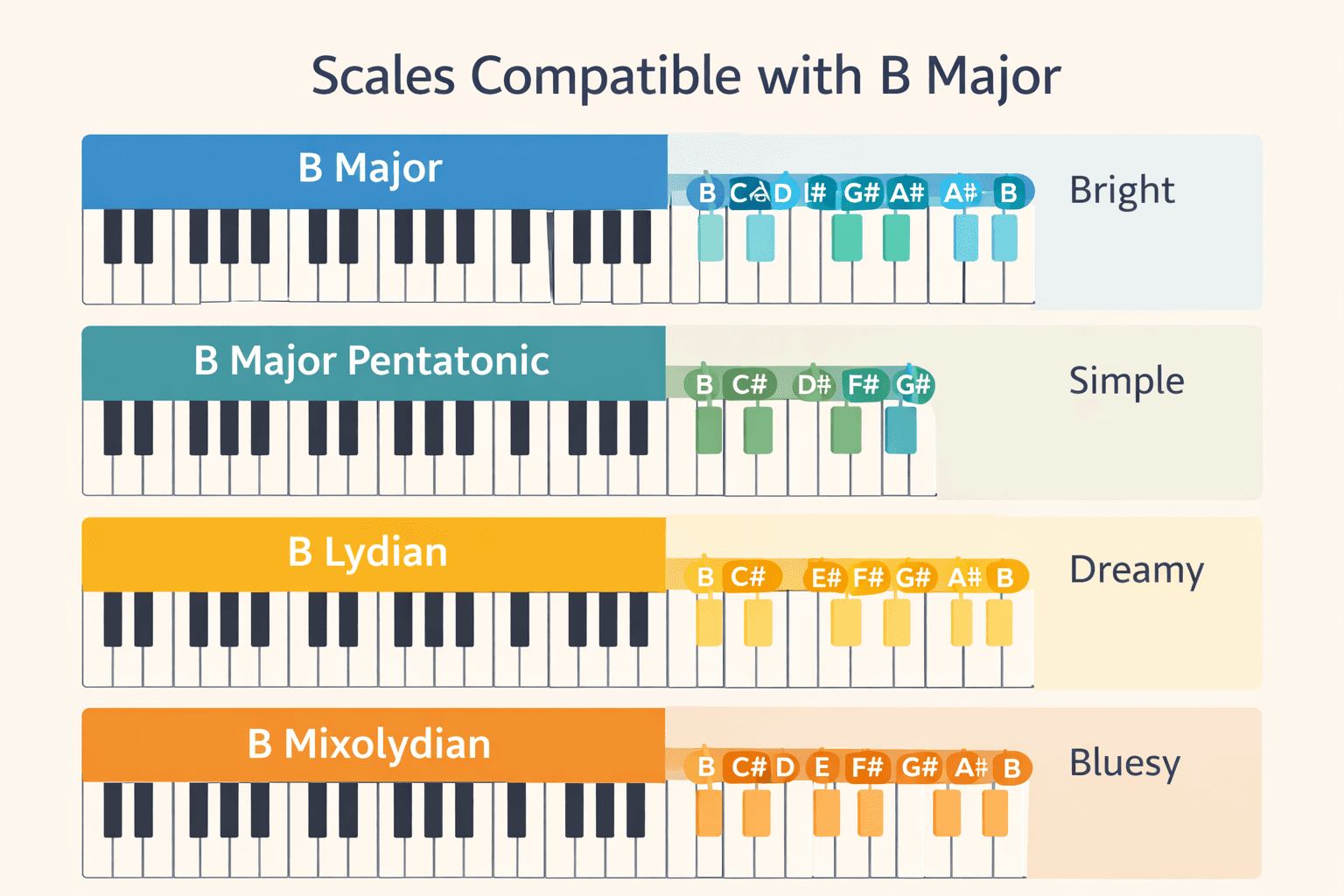 Playing scales alongside B major chords improves improvisation, ear training, and technical skill.
Scale Notes Mood
B Major B C# D# E F# G# A# B Bright, uplifting B Major Pentatonic B C# D# F# G# Simple, melodic B Lydian B C# D# E# F# G# A# Dreamy, modern B Mixolydian B C# D# E F# G# A Bluesy, jazzy
Exercise 4: Scale Integration
- Practice scales ascending and descending over two octaves.
- Combine with arpeggios of B major chord.
- Explore dynamics and phrasing for expressive play.
Common Chord Progressions with B Major
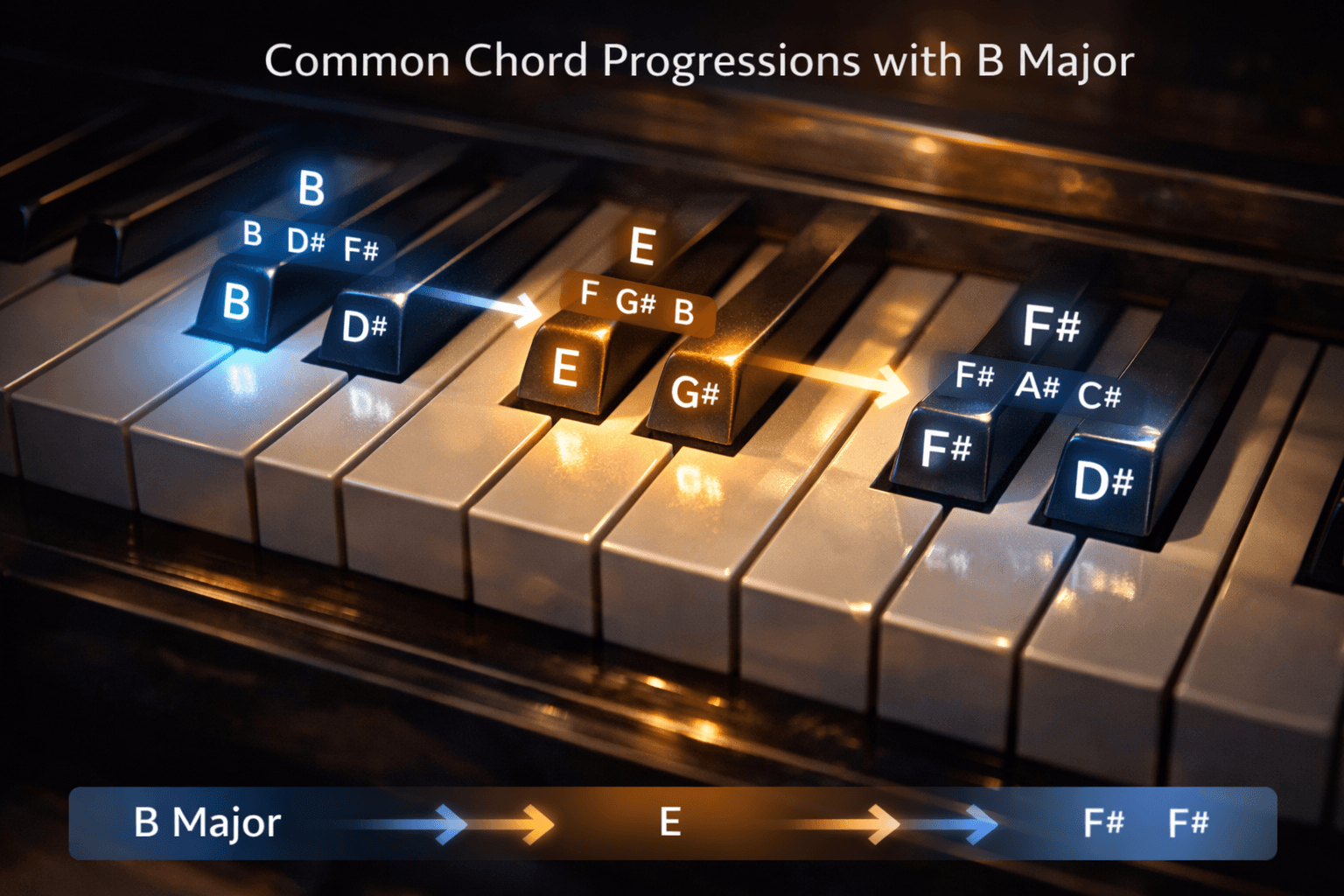 B major is versatile in many musical contexts.
Beginner-Friendly
Progression Notes B – E – F# B D# F# → E G# B → F# A# C# B – G#m – E – F# B D# F# → G# B D# → E G# B → F# A# C#
Intermediate
Progression Notes B – F# – G#m – E B D# F# → F# A# C# → G# B D# → E G# B B – C#m – F# – B B D# F# → C# E G# → F# A# C# → B D# F#
Advanced
Progression Notes Bmaj7 – C#m7 – E – F# B D# F# A# → C# E G# B → E G# B → F# A# C# B – G#m – F#sus4 – B6 B D# F# → G# B D# → F# B C# → B D# F# G#
Exercise 5: Progression Mastery
- Play slowly at first, focus on smooth transitions
- Use inversions for connecting chords
- Incorporate arpeggios or broken chord patterns for texture
Popular Songs Featuring B Major
B major is widely used in songs across genres:
Pop & Rock
- Coldplay – Viva La Vida (B major in verse)
- The Beatles – While My Guitar Gently Weeps (B major chord sequence)
Jazz & Contemporary
- Jazz standards often use Bmaj7 as tonic or pivot chord for modulation.
Film and Media
- Bright, triumphant moments often feature B major as the primary key, providing energy and drive.
Playing along with these songs improves musicality, rhythm, and hand coordination.
Genre Applications of B Major
- Pop & Rock: Versatile chord in upbeat and emotive progressions
- Jazz: Foundation for major 7th and 9th chords, modulations
- Classical: Used in key changes, enharmonic relations, and harmonic resolution
- Film Music: Evokes triumph, brightness, and confidence
Tips for Mastering the B Major Chord
- Use correct fingering for black keys (middle finger and pinky)
- Start with root position, then practice inversions
- Integrate arpeggios, broken chords, and scales
- Play along with songs in B major for real-world application
- Gradually increase tempo and experiment with dynamics
- Explore chord extensions (Bmaj7, B6, Badd9)
- Use apps or chord generators to reinforce learning
Common Mistakes with B Major
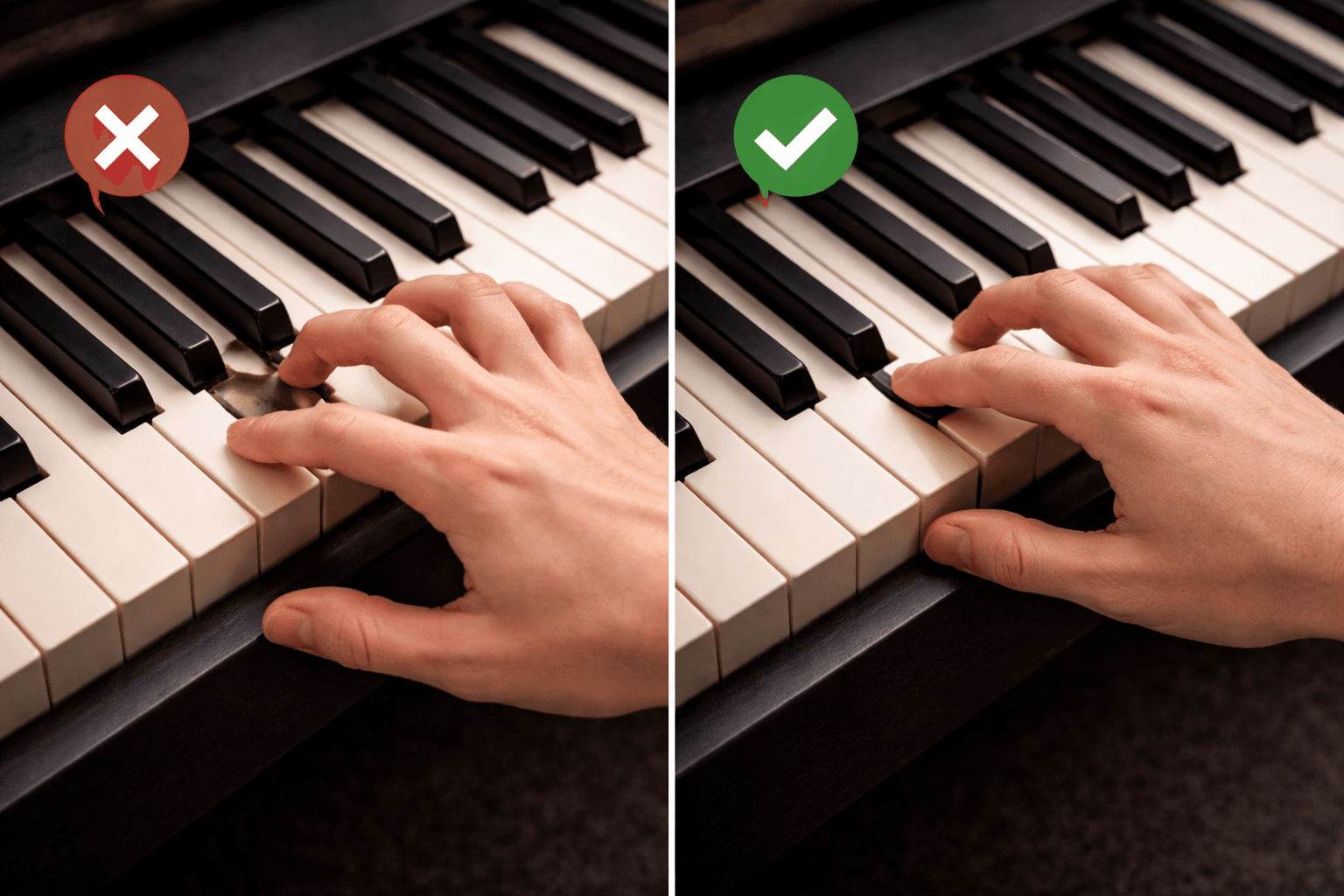
- Pressing black keys with incorrect fingers
- Skipping inversions and arpeggio practice
- Playing too quickly without accuracy
- Neglecting left-hand coordination
Correcting these errors builds technique, dexterity, and confidence.
Advanced Applications
- Improvisation: Play B major scale or pentatonic over chord for melodic solos
- Songwriting: Combine with relative minor chords (G#m, C#m) for dynamic harmonic flow
- Chord Extensions: Incorporate Bmaj7, B6, Badd9 for sophisticated sound
- Arpeggios & Broken Chords: Enhance texture in accompaniment or lead lines
Frequently Asked Questions (FAQs)
1. What notes are in the B major chord?
B, D#, and F# form the root, major third, and perfect fifth.
2. Is B major difficult for beginners?
Yes, due to black keys, but consistent practice builds accuracy and comfort.
3. How do I play B major inversions?
1st inversion: D# – F# – B 2nd inversion: F# – B – D#
4. Which scales fit B major?
B major, B major pentatonic, B Lydian, B Mixolydian.
5. What chords complement B major?
E, F#, G#m, C#m, D#m.
6. What mood does B major convey?
Bright, energetic, assertive, and uplifting.
7. How can beginners integrate B major in songs?
Start with simple progressions (B – E – F#) and practice slowly, then combine with inversions and arpeggios.