ChatGPT
 Google AI
 Grok
Grok Claude
The Aeolian mode on piano is a cornerstone of minor-key music, often evoking a dark, emotional, and introspective tone. This mode is widely used in classical compositions, modern pop, and rock ballads because it emphasizes the natural minor scale with its flattened third, sixth, and seventh scale degrees. Understanding the Aeolian mode music theory helps pianists recognize the subtle differences between minor and major scales while exploring modal music in a structured way.
Mastering the Aeolian mode piano scale provides essential insight into musical modes, scale degrees, and diatonic scale construction. Pianists who understand this mode can easily analyze melodic structure, harmonic structure, and Aeolian mode chord progressions, making improvisation and composition more intuitive. Learning the Aeolian mode also strengthens a player’s ability to navigate the keyboard confidently across multiple keys.
Introduction to the Aeolian Mode
 The Aeolian mode in music is the sixth mode of the major scale and is commonly referred to as the natural minor scale. Its distinct emotional character comes from the minor third, minor sixth, and minor seventh intervals, which give it a melancholy and reflective sound.
Understanding the Aeolian mode piano scale helps beginners identify minor tonalities in music. This mode creates an expressive foundation for writing, improvising, and performing pieces that convey sadness, tension, or depth, making it indispensable for any serious piano student.
What is the Aeolian Mode in Music
The Aeolian mode is a seven-note diatonic scale starting from the sixth degree of the major scale, creating a series of intervals: major second, minor third, perfect fourth, perfect fifth, minor sixth, and minor seventh above the tonic note. These intervals define the characteristic minor sound of the scale.
Why the Aeolian Mode Feels Minor and Emotional
Unlike the Ionian or Mixolydian modes, the Aeolian scale includes three minor intervals, which soften the pull of the leading tone and give melodies and chords a naturally somber or introspective quality that resonates in many genres, from classical piano pieces to pop ballads.
Why Pianists Should Learn the Aeolian Mode
Learning the Aeolian mode on piano expands a student’s understanding of modal music, allowing them to recognize minor tonalities and Aeolian mode melodies in real compositions. This knowledge strengthens their ability to play, improvise, and compose with emotional depth.
What the Aeolian Mode Means in Music Theory
 In Aeolian mode music theory, this mode represents the natural minor form derived from the major scale. Each scale degree interacts uniquely, producing characteristic harmonic structure and melodic tendencies that differ from major or dominant modes.
The Aeolian mode piano scale serves as the foundation for minor key music in both classical and contemporary traditions. Understanding its structure helps musicians recognize patterns in diatonic scale systems and explore the rich world of modal harmony.
Definition of the Aeolian Mode
The Aeolian mode is defined as the natural minor scale, consisting of the intervals: whole–half–whole–whole–half–whole–whole, producing a minor third, minor sixth, and minor seventh above the tonic note.
Relationship Between Aeolian Mode and Natural Minor Scale
The Aeolian mode piano scale is essentially the same as the natural minor scale, meaning that starting on the sixth degree of the major scale produces the Aeolian pattern in any key.
Historical Origins in Greek Modes
The Aeolian mode originated from ancient Greek modes, later adopted in medieval music theory and eventually influencing western music theory. Its minor tonal quality made it ideal for modal compositions that convey emotion and depth.
Why the Aeolian Mode is Called the Natural Minor
Musicians call it the natural minor scale because it does not alter any notes in the scale with accidentals, preserving the natural sequence of whole and half steps, unlike the harmonic or melodic minor scales.
Aeolian Mode Formula Table
Step Interval Pattern 1 → 2 Whole step 2 → 3 Half step 3 → 4 Whole step 4 → 5 Whole step 5 → 6 Half step 6 → 7 Whole step 7 → 8 Whole step
This Aeolian mode formula helps pianists visualize the step pattern and understand how the minor intervals create its characteristic emotional sound.
Structure and Formula of the Aeolian Scale
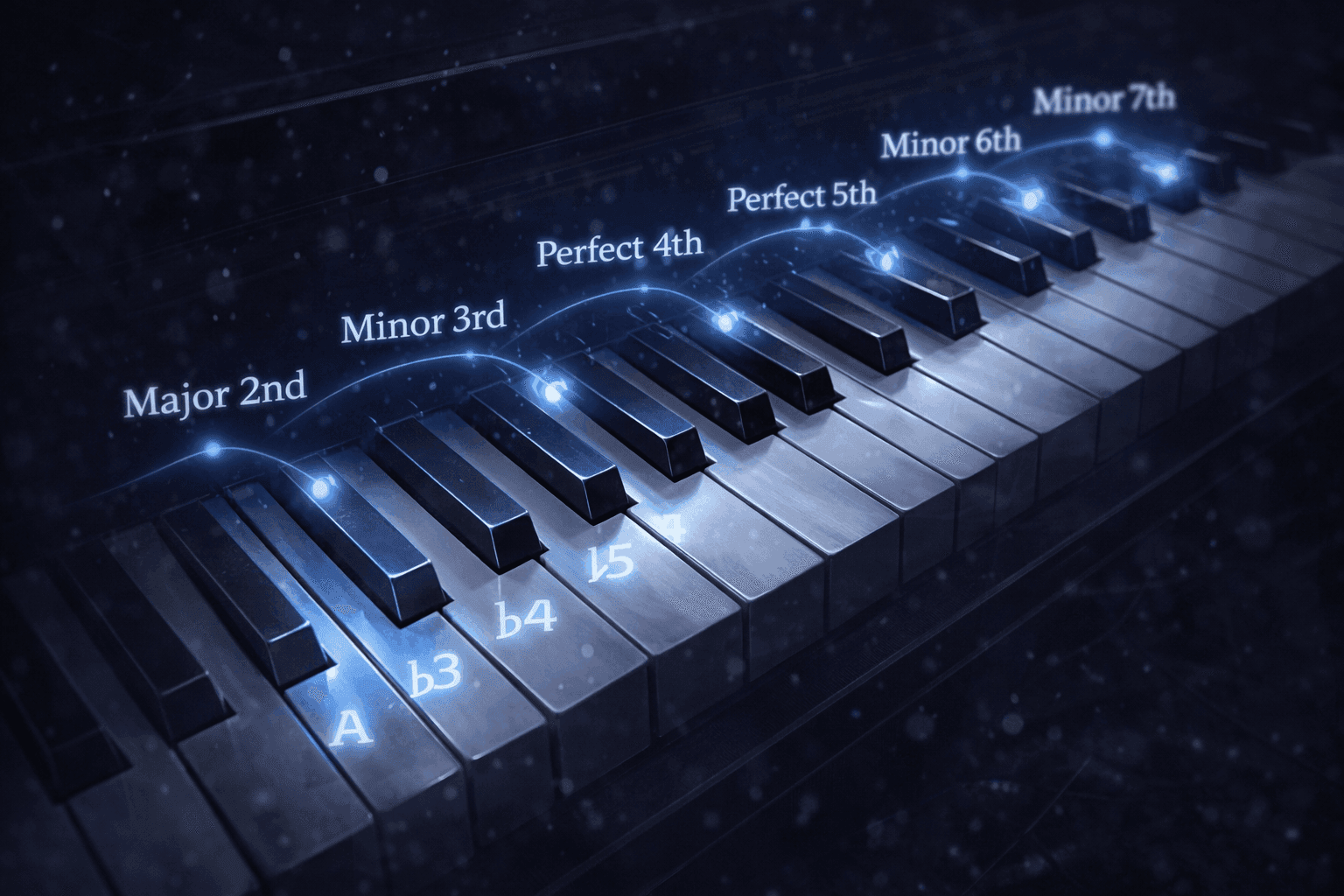 The Aeolian mode on piano follows a clear pattern of whole and half steps that define its minor tonality. Its structure differentiates it from the major scale because the third, sixth, and seventh scale degrees are lowered, giving the scale a dark and introspective sound.
Understanding the Aeolian mode formula allows pianists to build the scale from any root note. By mastering the formula, musicians can quickly recognize Aeolian mode melodies, chord patterns, and diatonic scale relationships in classical, pop, and jazz music.
Whole Step and Half Step Pattern
The Aeolian mode step pattern is Whole–Half–Whole–Whole–Half–Whole–Whole. This arrangement creates the natural minor scale structure, producing a minor third, minor sixth, and minor seventh, which are the defining intervals of the Aeolian mode.
Aeolian Mode Formula Explained
The Aeolian mode formula can be expressed as 1–2–♭3–4–5–♭6–♭7. Each scale degree contributes to the minor sound: the root note establishes the tonal center, while the minor third and minor seventh give the characteristic emotional depth.
Semitone Pattern in the Aeolian Mode
The placement of semitones between the 2nd and 3rd notes and the 5th and 6th notes forms the melodic contour of the Aeolian scale. This subtle spacing is what gives minor-key compositions their reflective and sometimes haunting quality.
Understanding the Dark and Emotional Sound
The Aeolian mode piano scale feels melancholic and dramatic because the lowered third, sixth, and seventh scale degrees prevent the strong pull toward the tonic note found in major scales. This allows modal music to convey emotional nuance naturally.
Intervals Found in the Aeolian Mode
 Intervals define the character of the Aeolian mode in music. By understanding the relationships between notes, pianists can interpret melodies, harmonies, and chord progressions that rely on minor scale intervals.
Practicing Aeolian mode intervals improves improvisation and composition skills. Knowing how each scale degree interacts allows musicians to predict tension and resolution in tonal music.
Understanding Musical Intervals in Piano Theory
An interval is the distance between two notes. In the Aeolian mode piano scale, these include major second, minor third, perfect fourth, perfect fifth, minor sixth, and minor seventh, all of which shape the melodic and harmonic structure.
Aeolian Mode Interval Pattern
The Aeolian mode interval pattern 1–2–♭3–4–5–♭6–♭7 defines its minor tonality. The flattened third and seventh notes give the scale its characteristic somber, introspective sound, making it distinct from Ionian or Mixolydian modes.
How Intervals Create the Characteristic Minor Sound
The minor third, minor sixth, and minor seventh intervals prevent the scale from sounding bright or resolved. Instead, these intervals generate a reflective, often moody atmosphere suitable for expressive piano music.
Visualizing Aeolian Intervals on the Piano Keyboard
Pianists can locate Aeolian intervals by observing the whole and half-step patterns. For example, A Aeolian contains A, B, C, D, E, F, and G, where C (minor third), F (minor sixth), and G (minor seventh) are highlighted for interval recognition.
Aeolian Interval Example (A Aeolian)
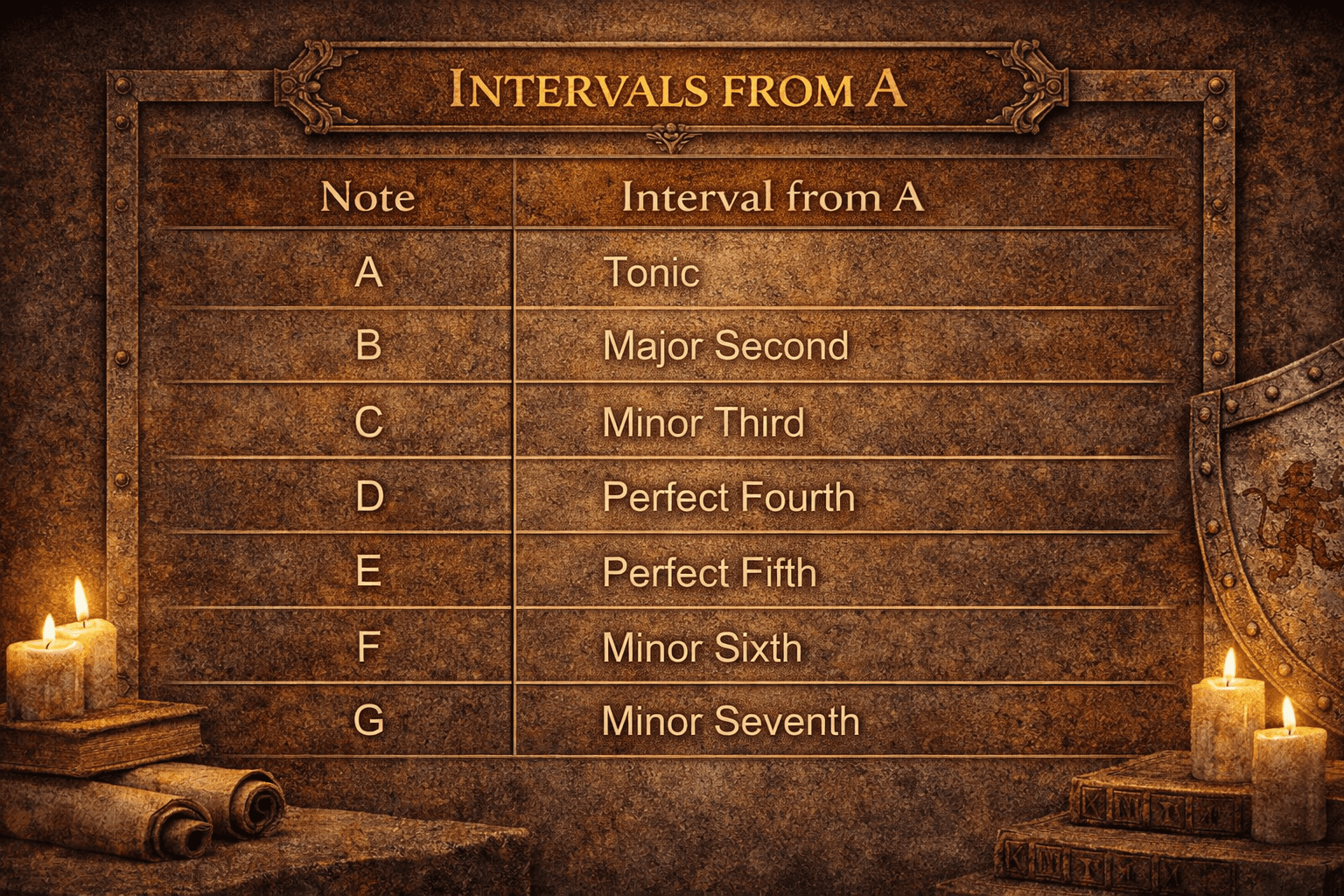
This table shows how each Aeolian mode interval is positioned on the piano, helping beginners visualize the scale.
Aeolian Mode Scales in Different Keys
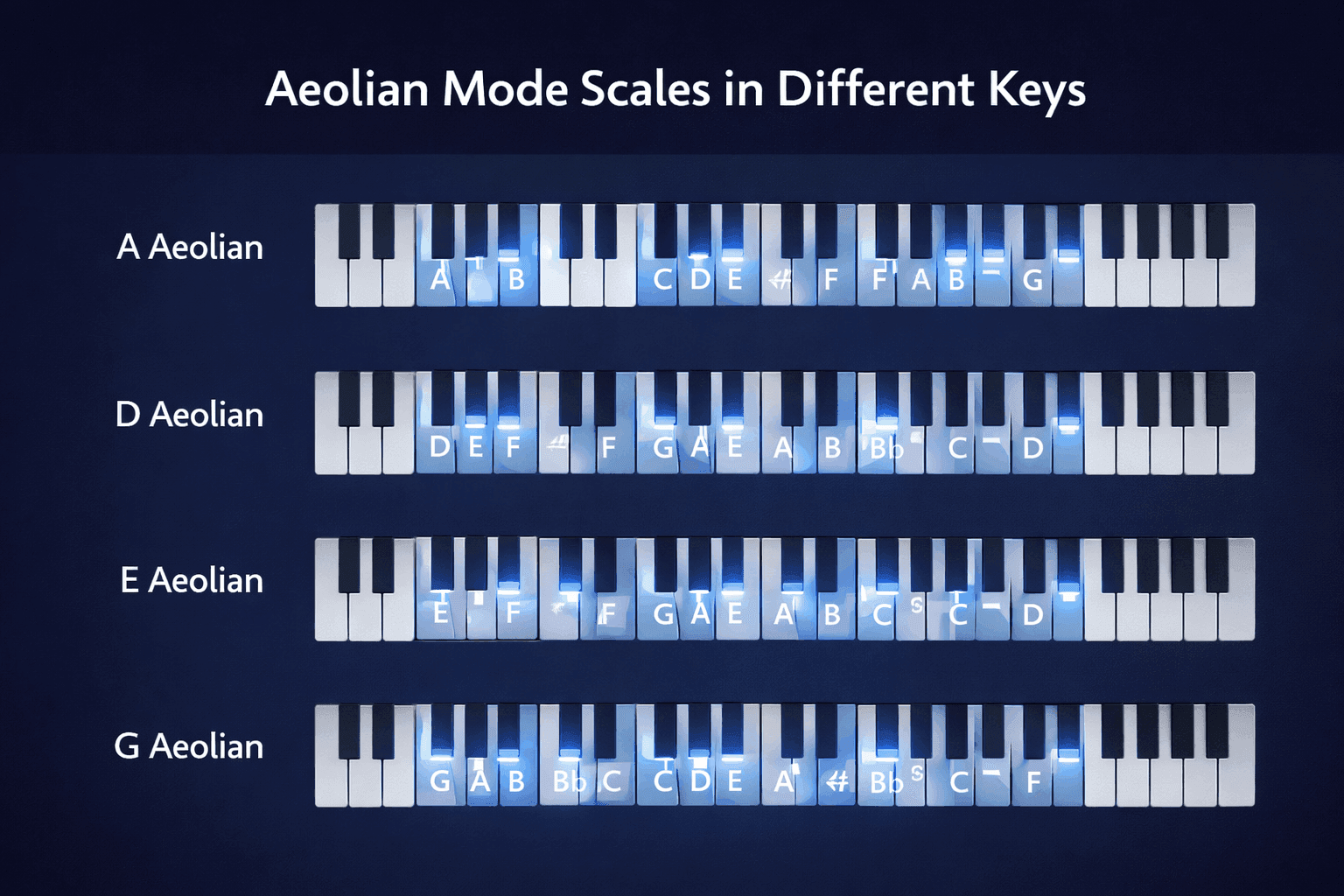 The Aeolian mode on piano can be played in any key by applying the same formula pattern. Each key preserves the flattened third, sixth, and seventh, ensuring the same minor tonality across all scales.
Practicing Aeolian scale exercises in multiple keys improves finger strength, hand coordination, and the ability to recognize scale degrees anywhere on the keyboard, preparing pianists for improvisation and advanced theory.
A Aeolian Mode
The A Aeolian scale (A, B, C, D, E, F, G) is the simplest example for beginners. It aligns with the natural minor scale, making it easy to understand Aeolian mode music theory and chord building.
D Aeolian Mode
The D Aeolian scale includes D, E, F, G, A, B♭, C. The flattened sixth (B♭) and minor seventh (C) maintain the scale’s minor sound while introducing key signature awareness.
E Aeolian Mode
The E Aeolian scale (E, F♯, G, A, B, C, D) shows how sharps in the key signature adjust the pattern, keeping the diatonic scale intact while maintaining the flattened intervals characteristic of Aeolian.
G Aeolian Mode
The G Aeolian scale (G, A, B♭, C, D, E♭, F) illustrates the mode in a key with multiple flats, helping students navigate accidentals while applying the Aeolian mode formula.
Understanding Key Signatures in Aeolian Scales
Key signatures indicate which notes are naturally flattened or sharpened in each Aeolian mode piano scale, aiding musicians in locating tonic notes, root notes, and scale degrees across the keyboard.
Aeolian Mode Key Table
Key Aeolian Notes A A B C D E F G D D E F G A B♭ C E E F♯ G A B C D G G A B♭ C D E♭ F
This table helps beginners visualize Aeolian mode scales in multiple keys, supporting practice and improvisation.
Chords Built from the Aeolian Mode
 The Aeolian mode on piano forms a unique set of chords because its diatonic scale includes the minor third, minor sixth, and minor seventh intervals. These intervals give Aeolian chords a naturally dark, melancholic sound, making them ideal for minor key music in classical, rock, and contemporary genres.
Understanding Aeolian mode chords allows pianists to harmonize melodies and construct Aeolian mode chord progressions. These chords support expressive improvisation while reinforcing the tonic note and root note of the minor key, creating emotional depth in compositions.
Triads in the Aeolian Mode
Triads are formed by stacking every other note of the Aeolian mode piano scale, producing a combination of major, minor, and diminished triads. For example, in A Aeolian: A minor (A–C–E), B diminished (B–D–F), C major (C–E–G), and so on, forming the harmonic foundation for Aeolian mode harmony.
The Seven Diatonic Chords Explained
The seven diatonic chords in Aeolian correspond to each scale degree: the tonic forms a minor chord, the second a diminished chord, and the other chords alternate between major and minor, reflecting the flattened intervals in the scale.
Scale Degree Chord Type Example in A Aeolian i Minor A Minor ii Diminished B Diminished III Major C Major iv Minor D Minor v Minor E Minor VI Major F Major VII Major G Major
Common Chord Progressions in Aeolian
Typical Aeolian mode chord progressions emphasize the i–VII–VI sequence, creating a moody, reflective sound. The interplay between the minor tonic and the flattened seventh supports expressive melodies.
How These Chords Support Melody and Harmony
The combination of Aeolian mode chords and scale degrees provides tension and release. Minor and diminished chords produce introspection, while major chords within the mode offer contrast, shaping the melodic structure in piano compositions.
Step-by-Step Guide to Playing the Aeolian Mode on Piano
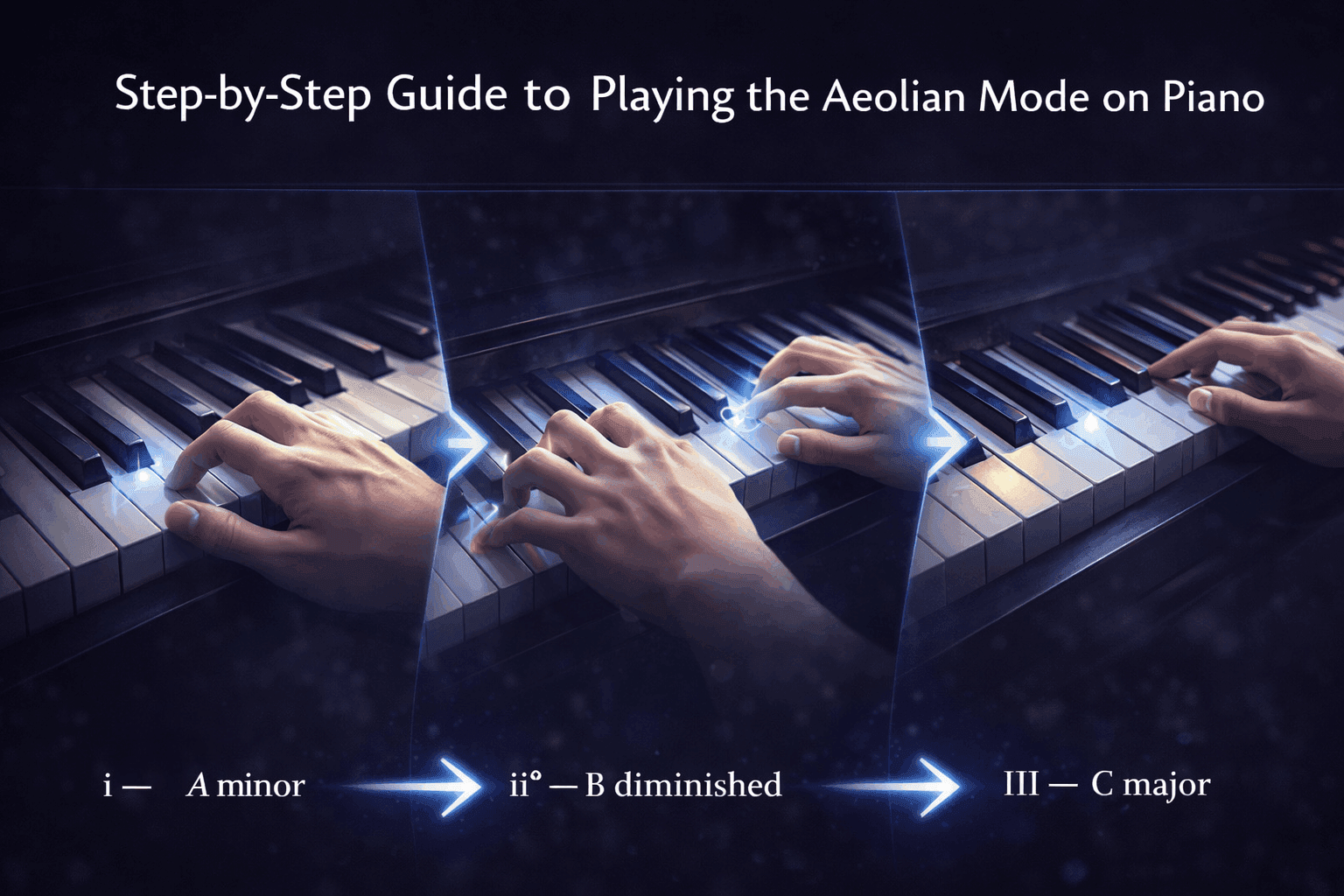 Learning how to play Aeolian mode on piano requires mastering finger placement, scale patterns, and hand coordination. Practicing systematically ensures musicians internalize the Aeolian mode interval pattern and recognize minor tonalities in all keys.
Regular practice of Aeolian scale exercises strengthens hand independence and builds confidence in improvisation and modal music performance.
Begin with the A Aeolian Scale
Start with the A Aeolian mode piano scale (A, B, C, D, E, F, G). This scale is the simplest natural minor example, ideal for beginners to grasp scale degrees, tonic notes, and the flattened intervals.
Correct Finger Position and Hand Technique
Maintain curved fingers and relaxed wrists to play each Aeolian scale note evenly. Proper Aeolian mode fingering piano technique improves speed, accuracy, and tonal consistency.
Practicing the Scale with the Right Hand
Right-hand practice isolates melody lines and builds familiarity with the Aeolian mode step pattern, emphasizing minor third, sixth, and seventh intervals.
Adding the Left Hand
Once the right hand is comfortable, introduce the left hand to reinforce hand coordination and strengthen the harmonic understanding of Aeolian mode chords.
Playing Hands Together Smoothly
Combining hands allows pianists to integrate melody and harmony. Practicing hands together helps internalize the melodic structure and the harmonic structure unique to Aeolian.
Practicing the Mode in Multiple Keys
After mastering A Aeolian, practice the Aeolian mode piano scale in D, E, G, and other keys to understand key signatures and apply modal music theory across the keyboard.
Example Aeolian Fingering
Hand Finger Pattern (A Aeolian) Right Hand 1 2 3 1 2 3 4 5 Left Hand 5 4 3 2 1 3 2 1
This fingering chart helps beginners practice smoothly and maintain correct hand positioning while learning the Aeolian mode.
How Musicians Use the Aeolian Mode in Real Music
 The Aeolian mode in music is widely used to create emotional, melancholic, or dramatic pieces. Its characteristic minor intervals allow composers to write expressive melodies and harmonies that feel reflective or somber.
From classical compositions to contemporary pop and rock, understanding the Aeolian mode piano scale enables musicians to apply the mode in both improvisation and structured compositions.
Aeolian Mode in Classical Music
Classical composers often used the Aeolian mode to convey solemn or pensive moods. For example, the natural minor scale forms the basis of many piano sonatas and orchestral works that rely on minor tonalities.
Aeolian Mode in Rock and Pop
Rock and pop musicians frequently employ Aeolian mode melodies because the minor sound conveys intensity, tension, or emotional depth, which resonates strongly with listeners.
Why the Aeolian Mode Feels Sad and Emotional
The flattened third, sixth, and seventh scale degrees remove the bright qualities of the major scale, giving the Aeolian mode a naturally introspective and melancholic quality.
Using Aeolian for Melody Writing and Improvisation
Musicians often use the Aeolian scale for beginners as a foundation for improvisation. Its consistent interval pattern allows players to explore Aeolian mode melodies freely over minor-key chord progressions.
Case Study: Famous Aeolian Songs
Song Artist Key Mode Moonlight Sonata Beethoven C# C# Aeolian Hurt Nine Inch Nails A A Aeolian Rolling in the Deep Adele C C Aeolian Boulevard of Broken Dreams Green Day F# F# Aeolian
These examples show how the Aeolian mode piano scale creates emotional depth in both classical and contemporary music.
Popular Songs That Use the Aeolian Mode
 The Aeolian mode on piano is a favorite for composers who want to evoke deep emotion or drama. Its natural minor intervals create tension and melancholy that fit perfectly in classical, rock, and pop music. Pianists can study these songs to understand how the Aeolian mode melodies interact with chords and harmonic structure.
Learning songs in Aeolian mode helps students connect theory with practice. Playing well-known compositions reinforces Aeolian mode intervals, develops finger coordination, and shows how minor tonalities convey mood and expression.
Moonlight Sonata – Musical Analysis
Beethoven’s Moonlight Sonata uses the Aeolian scale to create a haunting, reflective melody. The flattened third, sixth, and seventh scale degrees give the piece its melancholic tone while supporting the tonic note and minor chord harmony.
Hurt – Harmonic Structure
The Nine Inch Nails song “Hurt” demonstrates the Aeolian mode piano scale in a modern context. Its chord progressions emphasize the minor third and minor seventh, reinforcing the song’s emotional depth and reflective character.
Rolling in the Deep – Aeolian Sound in Pop Music
Adele’s hit “Rolling in the Deep” incorporates Aeolian mode melodies within its piano accompaniment. The minor intervals create tension and drama, giving the song its powerful, evocative sound.
How to Practice These Songs on Piano
To practice Aeolian mode examples, start by isolating the melody, then add chords and harmonies. Focus on Aeolian mode interval patterns, scale degrees, and the tonic note to internalize the sound of the natural minor scale.
Learning the Aeolian Mode with Art Gharana
 Art Gharana provides a structured, beginner-friendly approach to learning the Aeolian mode on piano. By combining Aeolian scale exercises, chord progressions, and songs, students quickly understand both Aeolian mode music theory and practical keyboard application.
With guidance, beginners can grasp scale degrees, identify the tonic note, and practice Aeolian mode melodies, preparing them for improvisation and deeper study of modal music.
Final Thoughts on Mastering the Aeolian Mode
 Mastering the Aeolian mode on piano equips pianists with the tools to play, improvise, and compose emotionally powerful music. Its minor intervals—minor third, minor sixth, and minor seventh—give it a unique tonal color distinct from other modes.
By practicing Aeolian scale exercises, analyzing Aeolian mode chord progressions, and learning real songs, students gain confidence in both theory and performance. Understanding this mode lays a foundation for exploring all musical modes, improving creativity, and developing a deep command of modal piano techniques.