ChatGPT
 Google AI
 Grok
Grok Claude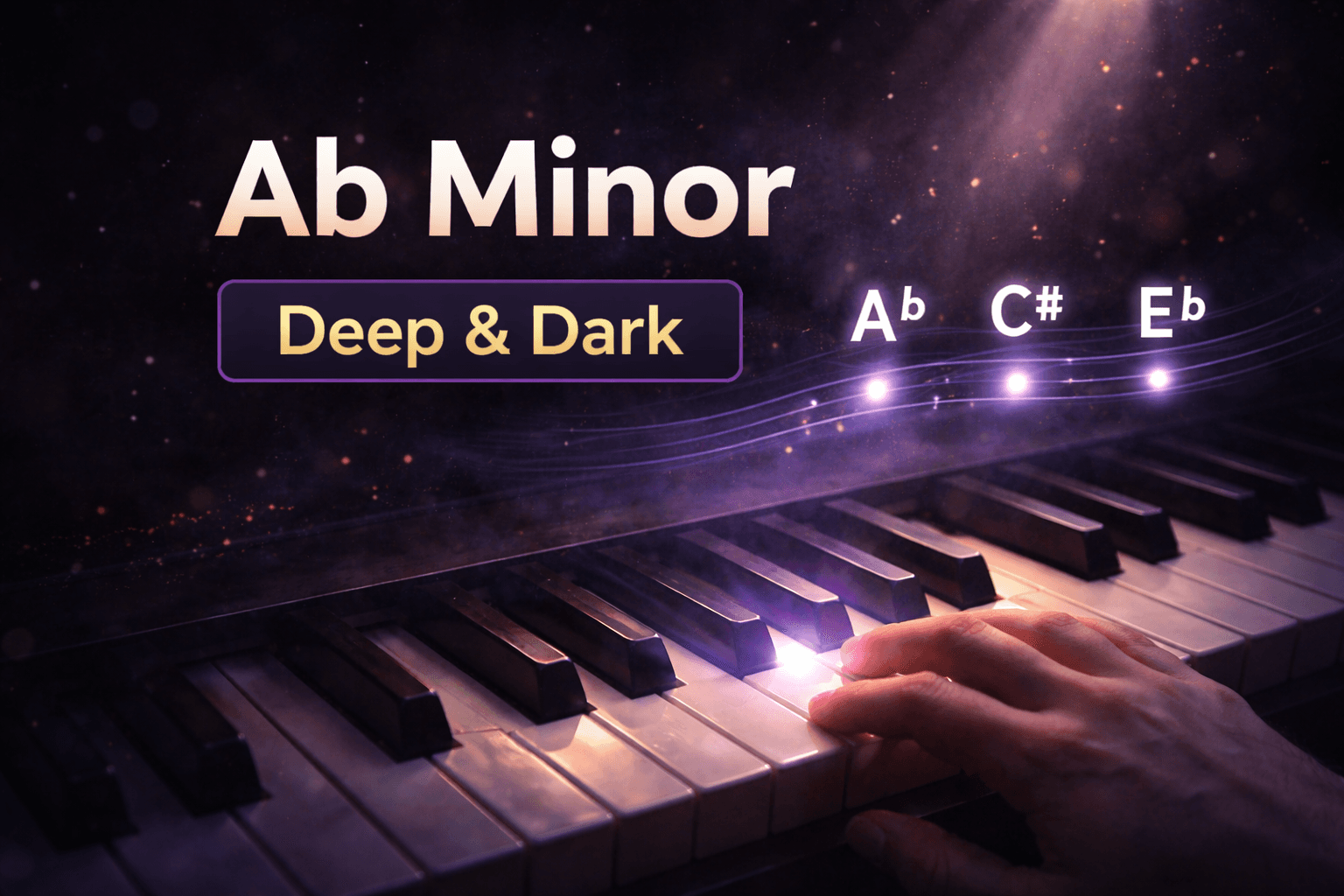
The Ab minor chord is one of the most emotional, intense, and expressive chords on the piano. Known for its dark, mysterious, and deeply reflective sound, Ab minor is commonly used to convey sadness, tension, longing, or dramatic depth in music. While it is not the most beginner-friendly chord due to its heavy use of black keys, mastering the Ab minor chord is an important milestone for pianists aiming to develop advanced harmonic understanding and expressive control.
The Ab minor chord appears across genres such as classical music, film scoring, modern pop ballads, jazz compositions, and cinematic soundtracks. Because it contains five black-key notes when expanded into scales and progressions, it challenges hand positioning and finger independence. However, once mastered, it significantly improves a pianist’s confidence on the keyboard and unlocks access to more complex keys and emotional storytelling.
In this complete guide, you will learn Ab minor chord theory, note construction, correct finger placement, inversions, arpeggios, compatible scales, chord progressions, exercises, common mistakes, genre usage, songwriting applications, and advanced performance techniques. By the end of this article, you will be able to play the Ab minor chord smoothly, confidently, and musically in real-world playing situations.
Understanding the Ab Minor Chord
 The Ab minor chord is built from three essential notes that define its tonal quality and emotional character.
Notes of the Ab Minor Chord
| Note | Role | Interval from Root |
|---|---|---|
| Ab | Root | 1 |
| Cb | Minor Third | 3 semitones |
| Eb | Perfect Fifth | 7 semitones |
The minor third interval between Ab and Cb gives the chord its sad, moody, and introspective sound. The perfect fifth between Ab and Eb adds stability and harmonic balance. Together, these notes create a chord that feels unresolved, emotional, and expressive.
Unlike Ab major, which sounds bright and warm, Ab minor leans toward darker emotional colors. It is commonly used as a tonic chord in the key of Ab minor or as a minor chord borrowed from parallel keys for dramatic effect. Because Cb is enharmonically equivalent to B natural, understanding enharmonic spelling is essential when reading music in Ab minor.
Ab Minor Chord Theory
 Triad Construction
Ab minor follows the standard minor chord formula of 1–b3–5. This formula allows pianists to build any minor chord on the keyboard by adjusting the third down by one semitone from the major form.
| Scale Degree | Note | Function |
|---|---|---|
| 1 | Ab | Root |
| ♭3 | Cb | Minor Third |
| 5 | Eb | Perfect Fifth |
Understanding this structure helps pianists analyze chord progressions, recognize chord functions, and transpose music into other keys effortlessly.
Extended Variations of Ab Minor
Ab minor is frequently expanded into richer harmonies, especially in jazz, film music, and contemporary compositions.
Abm7 consists of Ab, Cb, Eb, and Gb and produces a smooth, soulful, and expressive sound. Abm6 includes Ab, Cb, Eb, and F and creates a softer, melancholic color often used in ballads. Abm9 adds Bb to the chord, creating lush, cinematic textures ideal for ambient and emotional music.
These variations add depth, sophistication, and emotional nuance to harmonic progressions and improvisations.
Finger Placement for the Ab Minor Chord
Proper fingering is essential for accuracy and comfort, especially because the Ab minor chord is played entirely on black keys in its root position.
Right Hand Fingering
The thumb is placed on Ab, the middle finger is placed on Cb, and the pinky is placed on Eb. This fingering allows for stability and smooth transitions between chords.
Left Hand Fingering
The pinky is placed on Ab, the middle finger on Cb, and the thumb on Eb. This setup provides balance and control in the lower register.
Exercise 1: Root Position Control
Play the Ab minor chord slowly using both hands separately, ensuring even tone and consistent pressure. Once comfortable, play both hands together in multiple octaves. Focus on relaxed wrists and curved fingers to avoid tension while playing black keys.
Inversions of the Ab Minor Chord
 Inversions allow pianists to move smoothly between chords without large jumps across the keyboard. They are essential for accompaniment, voice leading, and expressive performance.
First Inversion (Cb – Eb – Ab)
In first inversion, Cb becomes the lowest note. This inversion creates smoother transitions in chord progressions and works well when resolving from dominant or borrowed chords.
Right hand fingering places the thumb on Cb, middle finger on Eb, and pinky on Ab. Left hand fingering places the pinky on Cb, middle finger on Eb, and thumb on Ab.
Second Inversion (Eb – Ab – Cb)
Second inversion places Eb in the bass and is commonly used in broken chord patterns and arpeggiated accompaniments.
Right hand fingering places the thumb on Eb, middle finger on Ab, and pinky on Cb. Left hand fingering places the pinky on Eb, middle finger on Ab, and thumb on Cb.
Exercise 2: Inversion Flow
Play root position, first inversion, second inversion, and return to root position in a continuous cycle. Practice slowly with a metronome and focus on minimizing hand movement.
Arpeggios and Broken Chords in Ab Minor
 Arpeggios help pianists develop finger independence, rhythmic control, and melodic fluency.
Ab Minor Arpeggio (One Octave)
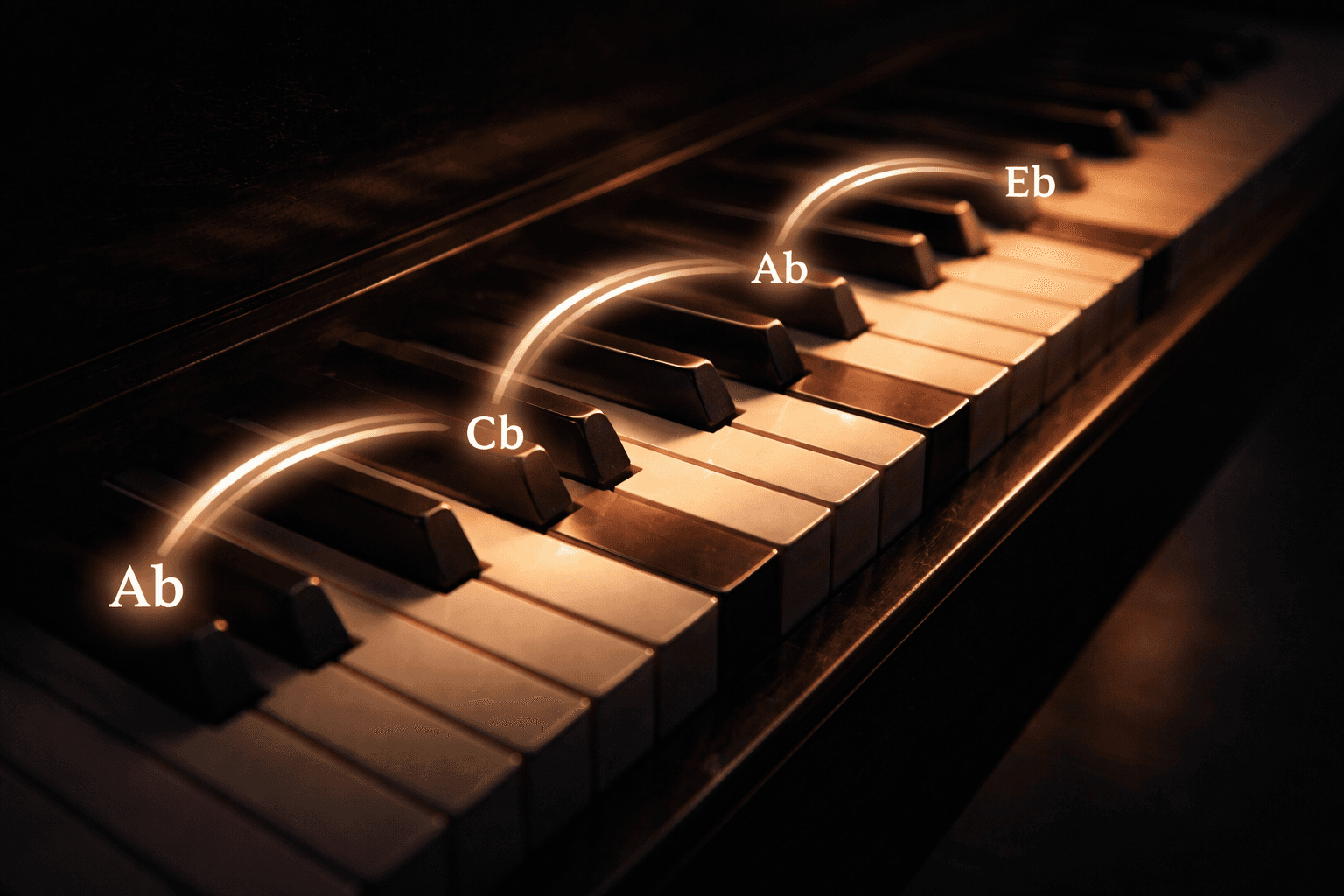
Ascending motion follows Ab, Cb, Eb, and Ab. Descending motion follows Ab, Eb, Cb, and Ab.
Exercise 3: Arpeggio Expression
Begin at a slow tempo and gradually increase speed. Practice arpeggios legato and staccato, and experiment with rhythmic groupings such as triplets and sixteenth notes. This prepares pianists for expressive improvisation and accompaniment patterns.
Scales Compatible with Ab Minor
 Practicing scales alongside the Ab minor chord strengthens tonal awareness and improvisational confidence.
Scale
Practicing scales alongside the Ab minor chord strengthens tonal awareness and improvisational confidence.
Scale
| Scale | Notes | Emotional Character |
|---|---|---|
| Ab Natural Minor | Ab Bb Cb Db Eb Fb Gb Ab | Dark, emotional |
| Ab Harmonic Minor | Ab Bb Cb Db Eb Fb G Ab | Dramatic, tense |
| Ab Melodic Minor | Ab Bb Cb Db Eb F G Ab | Smooth, expressive |
| Ab Minor Pentatonic | Ab Cb Db Eb Gb | Bluesy, modern |
Exercise 4: Scale Integration
Practice scales over two octaves with both hands. Alternate between scales and Ab minor arpeggios to build fluidity and harmonic awareness.
Common Chord Progressions with Ab Minor
 Ab minor is often used in emotionally rich progressions that emphasize tension and release.
Beginner Progressions
Ab minor is often used in emotionally rich progressions that emphasize tension and release.
Beginner Progressions
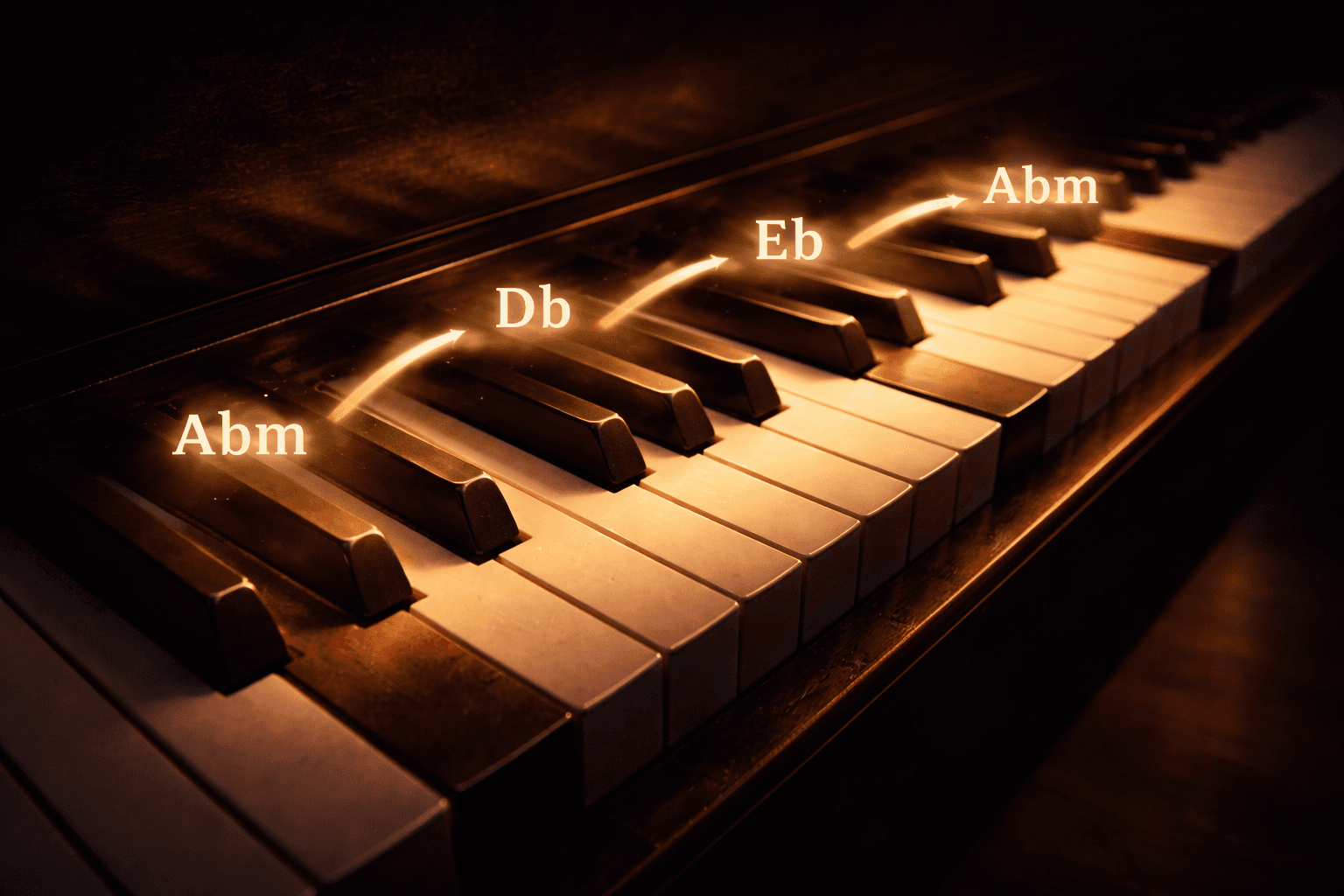
Progression Notes Abm – Db – Eb Ab Cb Eb → Db Fb Ab → Eb G Bb Abm – Eb – Db Ab Cb Eb → Eb G Bb → Db Fb Ab
Intermediate Progressions
Progression Notes Abm – Fm – Db – Eb Ab Cb Eb → F Ab C → Db Fb Ab → Eb G Bb Abm – B – Eb Ab Cb Eb → B D♯ F♯ → Eb G Bb
Advanced Progressions
Progression Notes Abm7 – Dbmaj7 – Ebsus4 – Eb Rich, cinematic Abm – Fb – Eb7 – Abm Dark resolution
Exercise 5: Progression Mastery
Play each progression slowly using inversions. Focus on smooth voice leading and consistent rhythm before increasing tempo.
Popular Songs Featuring Ab Minor
Ab minor frequently appears in emotionally driven music, particularly in ballads and cinematic compositions.
Modern pop and R&B songs often use Ab minor to emphasize vulnerability and emotional tension. Film scores rely on Ab minor for dramatic scenes, emotional climaxes, and introspective moments. Classical music employs Ab minor sparingly due to its complexity, but when used, it delivers profound emotional impact.
Playing along with recordings in Ab minor improves rhythmic precision, phrasing, and expressive timing.
Genre Applications of Ab Minor
In pop music, Ab minor is used for emotional depth and introspective songwriting. In jazz, it serves as a foundation for minor seventh and altered chords. In classical music, it appears in modulations and dramatic harmonic shifts. In film and game music, Ab minor conveys tension, sorrow, mystery, and emotional gravity.
Tips for Mastering the Ab Minor Chord
Consistent fingering is essential for black-key control. Practicing slowly builds muscle memory and confidence. Using inversions improves fluidity between chords. Combining scales, arpeggios, and chord progressions strengthens musical understanding. Playing with dynamics and phrasing enhances emotional expression.
Common Mistakes with Ab Minor
Many pianists avoid enharmonic spellings like Cb and Fb, leading to confusion when reading sheet music. Rushing practice without accuracy causes tension and mistakes. Ignoring left-hand coordination limits musical balance. Correcting these issues results in cleaner, more confident playing.
Advanced Applications
Improvisation over Ab minor scales allows expressive melodic solos. Songwriting benefits from pairing Ab minor with its relative major and borrowed chords. Chord extensions like Abm7 and Abm9 add sophistication. Broken chord patterns enrich accompaniment textures.
Frequently Asked Questions (FAQs)
1 What notes are in the Ab minor chord?
Ab, Cb, and Eb.
2 Is Ab minor difficult for beginners?
Yes, due to black keys and enharmonic spelling, but regular practice makes it manageable.
3 How do I play Ab minor inversions?
First inversion uses Cb, Eb, Ab. Second inversion uses Eb, Ab, Cb.
4 Which scales work with Ab minor?
Natural minor, harmonic minor, melodic minor, and minor pentatonic.
5 What mood does Ab minor convey?
Dark, emotional, introspective, and dramatic.
6 How can beginners use Ab minor in songs?
Start with slow progressions and simple inversions, then gradually add arpeggios.