ChatGPT
 Google AI
 Grok
Grok Claude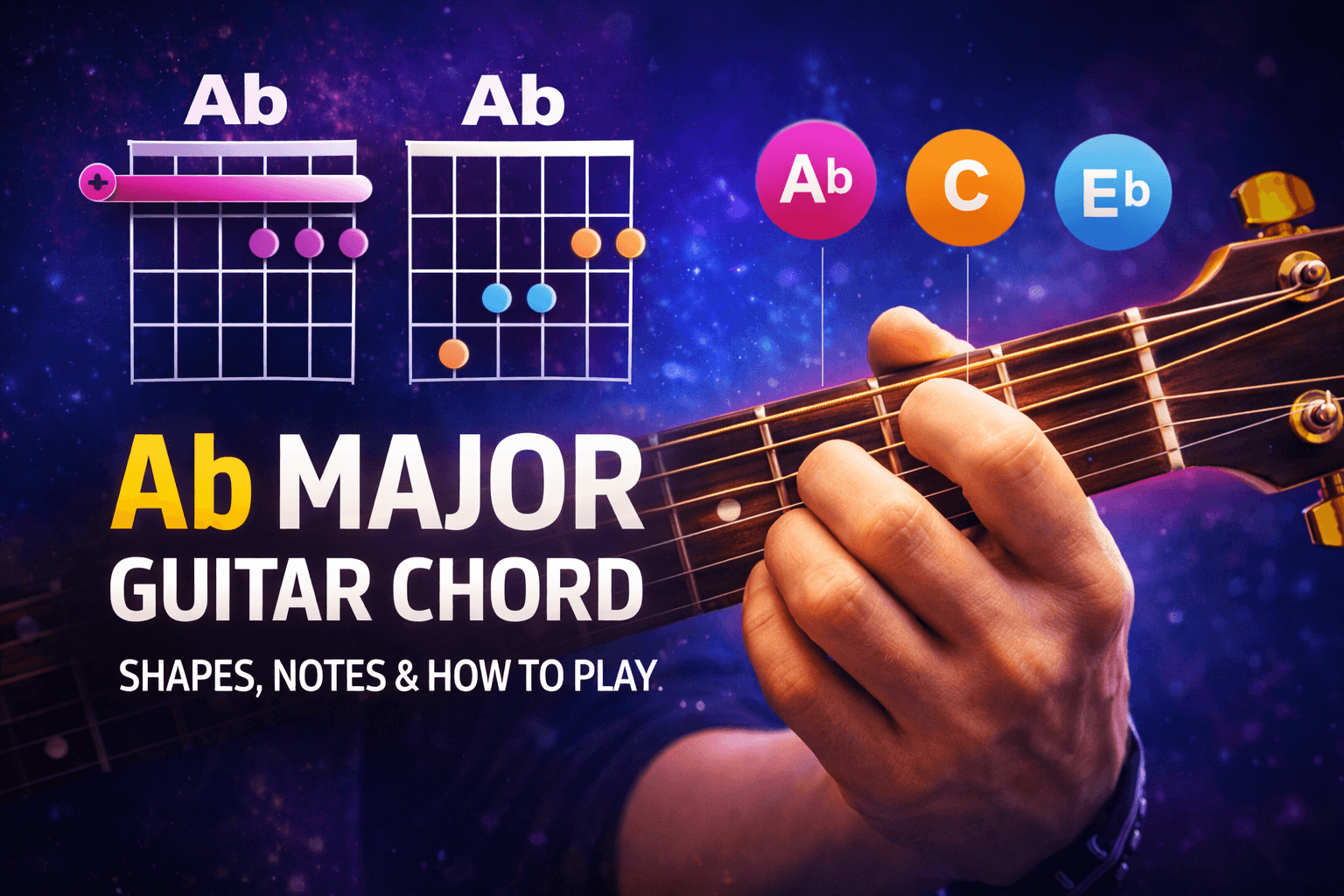
The Ab major guitar chord is a bright, melodic, and harmonically rich major triad built from the notes Ab–C–Eb. Like other major chords, it follows the 1–3–5 interval pattern, which produces a stable and uplifting sound. While it is less common in open-position playing due to the lack of open strings supporting the Ab chord tones, it appears frequently in barre-chord progressions, jazz harmony, R&B arrangements, gospel music, soul, neo-soul, pop ballads, and many modern productions.
Because Ab major has no traditional open shape, guitarists usually learn it first as an E-shape barre chord or an A-shape barre chord, both of which occur naturally in movable chord systems. Understanding the Ab major chord structure is essential for navigating the upper register of the fretboard and building confidence with chords that rely on barre technique, finger stamina, and fretboard awareness.
Learning the chord also gives guitarists access to keys commonly used in piano-based genres—Gospel, R&B, pop, soul, ballads—where Ab major is a foundational tonal center.
What Makes the Ab Chord Special
 The Ab major chord stands apart due to its warm, resonant, slightly mellow brightness. Unlike sharper-sounding chords such as A or B major, the Ab major chord produces a smoother, more rounded tone. This character makes it ideal for genres that rely on lush vocal harmonies, slow rhythmic grooves, or dense chord textures.
Ab major is also harmonically significant because:
- It appears in romantic and melodic progressions frequently.
- It is a central chord in the key of Ab major, a key favored in horn arrangements and vocal music.
- It works effectively as a pivot chord in modulation due to its enharmonic proximity to G# major in theoretical contexts.
- It unlocks barre-chord mastery since every shape is movable.
- **Root (Ab) defines the chord’s tonal center.
- ** Major Third (C) gives the chord its bright and major quality.
- ** Perfect Fifth (Eb) stabilizes the harmony and completes the triad.
Understanding these tones makes it easy to identify where Ab, C, and Eb appear across the fretboard, enabling the creation of new chord shapes and fingerings.
How the Major Chord Is Built
The Ab major chord is constructed by selecting the 1st, 3rd, and 5th degrees of the **Ab major scale:
Ab Major Scale** Ab – Bb – C – Db – Eb – F – G Select:
- 1 (Ab)
- 3 (C)
- 5 (Eb)
This yields the Ab major triad: Ab–C–Eb.
This structure is foundational in chord building because:
- It explains voicing variations.
- It supports triad inversion understanding.
- It enables transposition using barre shapes.
- It transitions smoothly to extended chords (Abmaj7, Ab6, Abadd9, etc.).
Understanding the scale degrees also allows you to visualize chord tones and embed triads into pentatonic, modal, or arpeggio-based improvisation patterns.
Ab Major Chord on Guitar
Because it has no natural open-position version, the Ab major chord is typically taught as a barre chord, either on the 4th fret (E-shape) or 11th fret (A-shape).
Both versions offer full, rich voicings ideal for rhythm guitar.
The Basic Barre Ab Major Shape (E-Shape)
This is the most common version and sits on the 4th fret, requiring a full barre.
Key details:
- Full barre on the 4th fret
- Root on the low E string (Ab)
- Strong, bright, and resonant voicing
- Perfect for pop, rock, gospel, and R&B
The A-Shape Ab Major Barre Chord
Found on the 11th fret of the A string, this version is higher in pitch and more compact.
Benefits include:
- Lighter pressure required
- Warmer mid-range tone
- Great for stylistic rhythm playing
- Useful for tight, funk-inspired guitar parts
Both shapes give you complete control of the chord’s tonal characteristics because they exist within the CAGED system.
Keys Where You’ll Find the Ab Major Chord
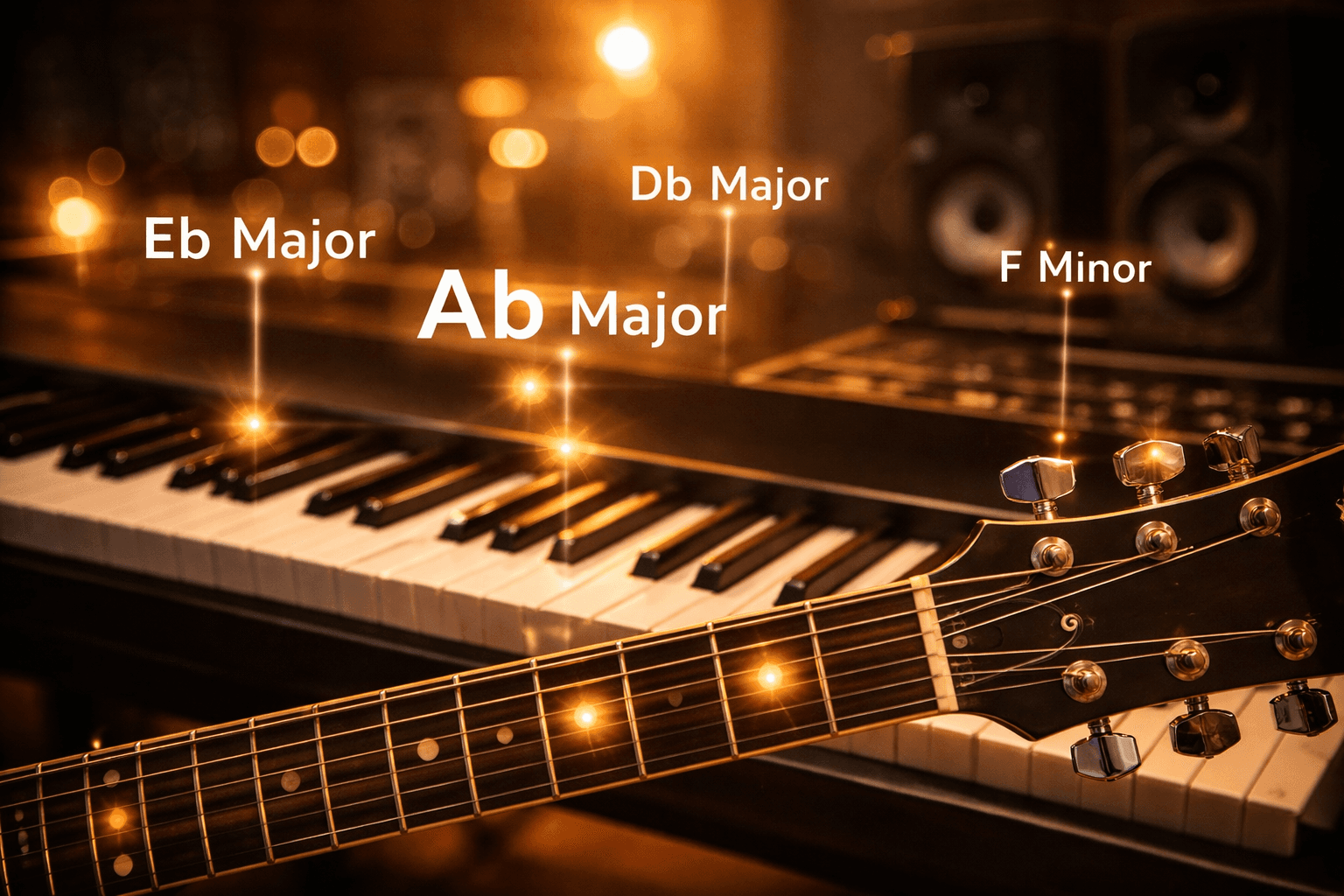
 Ab Major appears in multiple keys, functioning either as the I chord or a supporting chord in closely related keys.
Key I ii iii IV V vi vii° Ab Major Ab Bb Cm Db Eb Fm G° Eb Major Eb Fm Gm Ab Bb Cm D° Db Major Db Ebm Fm Gb Ab Bbm C° F Minor Fm G° Ab Bbm Cm Db Eb Bb Minor Bbm C° Db Ebm Fm Gb Ab
Understanding these relationships makes it easier to compose, transpose, and improvise in keys where Ab major is harmonically connected.
Common Chord Progressions With Ab Major
Ab major appears in several smooth and popular progressions:
Very Common Progressions
- Ab – Db – Eb (I–IV–V)
- Fm – Db – Ab – Eb (vi–IV–I–V)
- Ab – Fm – Db – Eb (I–vi–IV–V)
- Ab – Cm – Db – Eb (I–iii–IV–V)
Smooth R&B/Gospel-Friendly Progressions
- Ab – Db – Fm – Eb
- Ab – Gb – Db – Eb
- Ab – Db – Bbm – Eb
Ballad Style Progressions
- Ab – Fm – Bbm – Eb
- Ab – Db – Eb – Fm<.li>
Ab major thrives in expressive, smooth progressions thanks to its rounded and mellow brightness.
Scales to Play Over an Ab Major Chord
 Improvisation over Ab major is best supported by several compatible scales.
Scale Notes Mood Ab Major Scale Ab Bb C Db Eb F G Bright, melodic F Minor Scale F G Ab Bb C Db Eb Emotional, warm Ab Major Pentatonic Ab Bb C Eb F Smooth, clean Ab Lydian Ab Bb C D Eb F G Airy, modern Ab Mixolydian Ab Bb C Db Eb F Gb Bluesy, relaxed
Memorizing chord tones and overlaying scale degrees is key to melodic improvisation.
Popular Songs That Use the Ab Major Chord
 Many songs in pop, R&B, soul, and gospel revolve around Ab major because it is comfortable for singers and keyboardists.
Examples include:
- “Ordinary People” – John Legend
- “All of Me” (in live versions with transposition)
- “Halo” – Beyoncé
- “If I Ain’t Got You” – Alicia Keys
- “Unforgettable” – Nat King Cole
- Numerous gospel arrangements in Ab major
These examples show how often Ab major appears in vocal-centered music.
How to Play the Ab Major Chord: Shapes & Positions
Here are the key positions across the neck:
Scale Notes Mood Ab Major Scale Ab Bb C Db Eb F G Bright, melodic F Minor Scale F G Ab Bb C Db Eb Emotional, warm Ab Major Pentatonic Ab Bb C Eb F Smooth, clean Ab Lydian Ab Bb C D Eb F G Airy, modern Ab Mixolydian Ab Bb C Db Eb F Gb Bluesy, relaxed
These shapes allow guitarists to build complete familiarity with the CAGED pathway.
Alternate Voicings and Extensions
More expressive options include:
- Abmaj7
- Ab6
- Absus2
- Absus4
- Abadd9
- Abmaj9
Each voicing expands harmonic color and supports different musical moods.
Play This Chord With Other Roots
Once you master the Ab shape, you can move it up or down the neck to create:
- A major
- Bb major
- B major
- C major
- C# major
- D major
- Eb major
- E major
- F major
- F# major
- G major
This is the foundation of movable chord systems.
How to Build the Ab Major Chord on Guitar
This involves identifying Ab, C, and Eb notes across strings, applying:
- Stacked thirds
- Triad mapping
- Fretboard interval recognition
- Shape-based construction (CAGED)
Mastery of this enables advanced chord design and arrangement skills.
Tips to Master the Ab Major Chord
Exercise Duration Goal Barre grip training 5 mins Strength & stability Ab–Db–Eb progression 10 mins Smooth transitions Triad mapping (Ab–C–Eb) 10 mins Fretboard awareness
Consistency leads to effortless playing.
Troubleshooting Common Problems
- Muted strings from weak barre pressure
- Wrist strain from incorrect thumb placement
- Buzzing on higher frets due to finger angle
- Fatigue during long progressions
Small corrections in technique resolve these issues quickly.
Advanced Applications of the Ab Major Chord
- Use Ab major arpeggios for melodic phrasing
- Apply chord-tone targeting for lead playing
- Use diatonic substitutions for harmonic color
- Add chord-melody textures for solo guitar
FAQ About the Ab Major Guitar Chord
Is Ab Major difficult to play?
It requires a full barre, so beginners may find it challenging. With proper technique, the chord becomes comfortable quickly.
What notes make up the Ab Major chord?
Ab (root), C (major third), and Eb (perfect fifth).
Which chords go well with Ab Major?
Db, Eb, Fm, Bbm, and Cm are common partners in standard progressions.
Is there an easy version of Ab Major?
Yes. You can play simplified triads or partial chords higher on the neck without a full barre.
What is the difference between Ab Major and Ab Minor?
Ab major uses a major third (C). Ab minor lowers the third to Cb, producing a darker tone.
Understanding the Ab major chord also expands a player’s ability to interpret lead sheets, transpose songs into comfortable vocal ranges, and navigate chords used by keyboard-focused artists.
Ab Major Chord Notes and Formula
The Ab major chord contains three essential tones that form a major triad:
Notes of Ab Major
Note Interval Ab Root C Major Third Eb Perfect Fifth
This combination follows the traditional 1–3–5 major chord formula. Mastering these intervals helps guitarists recognize how the chord is formed, locate chord tones across the neck, and build alternate voicings such as major 7th, suspended, and extended shapes.
Interval Breakdown