ChatGPT
 Google AI
 Grok
Grok Claude
The A# major chord is a powerful and expressive harmony that plays a unique role in advanced piano music. Although it is enharmonically equivalent to B♭ major, understanding A# major as its own theoretical structure is essential for musicians exploring complex key signatures, modulation, and advanced harmonic analysis. This chord appears frequently in jazz theory, film scoring, and classical compositions where enharmonic spelling matters.
For beginners, A# major may feel challenging due to the number of black keys and accidentals involved. However, with proper technique and a structured approach, it becomes an excellent tool for improving finger accuracy, hand positioning, and musical awareness. For advanced players, mastering A# major unlocks deeper insight into chord relationships, transposition, and sophisticated progressions.
In this guide, we explore A# major chord theory, note structure, finger placement, inversions, arpeggios, compatible scales, chord progressions, exercises, genre applications, and advanced performance tips. By the end, you will be able to play the A# major chord confidently and apply it musically across different styles and compositions.
Understanding the A# Major Chord
 The A# major chord is built from three specific notes that define its harmonic identity.
A# – Root C𝄪 – Major Third E# – Perfect Fifth
Although these note names may appear complex, they follow strict theoretical rules that preserve interval accuracy. In practical playing, many pianists recognize A# major as the enharmonic equivalent of B♭ major, but learning the correct spelling is crucial for reading advanced sheet music and understanding harmony.
The sound of the A# major chord is bright, confident, and assertive. It carries a strong sense of resolution and stability, making it suitable for climactic moments, key changes, and bold harmonic statements. The major third interval creates an uplifting quality, while the perfect fifth provides balance and strength.
Because A# major uses multiple accidentals, it is less common in beginner-level repertoire. However, mastering it improves theoretical fluency and prepares pianists for advanced musical contexts.
A# Major Chord Theory

Triad Construction
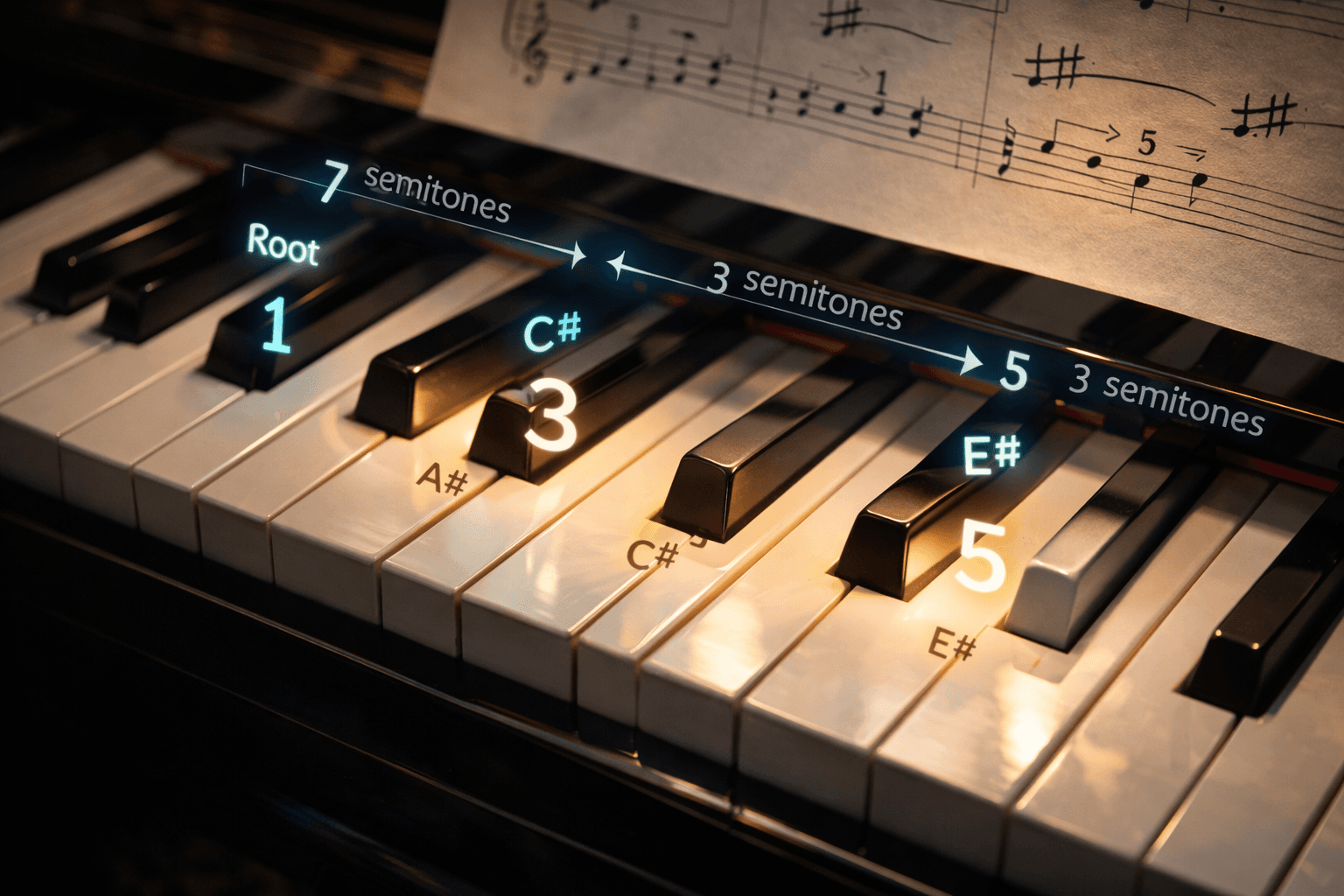
The A# major chord follows the standard major chord formula based on intervals from the root.
Note Role Interval from Root
A# Root 1
C𝄪 Major Third 4 semitones
E# Perfect Fifth 7 semitones
The major chord structure always follows the 1–3–5 pattern. In A# major, this results in double sharps, which are essential for maintaining correct interval relationships. Understanding this construction helps pianists build any major chord logically rather than memorizing shapes.
Enharmonic Understanding
While A# major sounds identical to B♭ major on the piano, the notation differs significantly. A# major is often used in theoretical discussions, advanced harmony, and modulation where accurate interval spelling is required. Recognizing this distinction is especially important in jazz improvisation, orchestration, and composition.
Extended Variations
Extended versions of the A# major chord add depth and emotional color.
A#maj7 consists of A#, C𝄪, E#, and G𝄪 and produces a smooth, sophisticated sound commonly used in jazz and contemporary music. A#6 includes A#, C𝄪, E#, and F𝄪 and offers a warm, elegant tone. A#add9 adds B# to the triad, creating melodic openness and harmonic interest.
These variations are essential for expressive voicing, songwriting, and advanced chord progressions.
Finger Placement for A# Major Chord
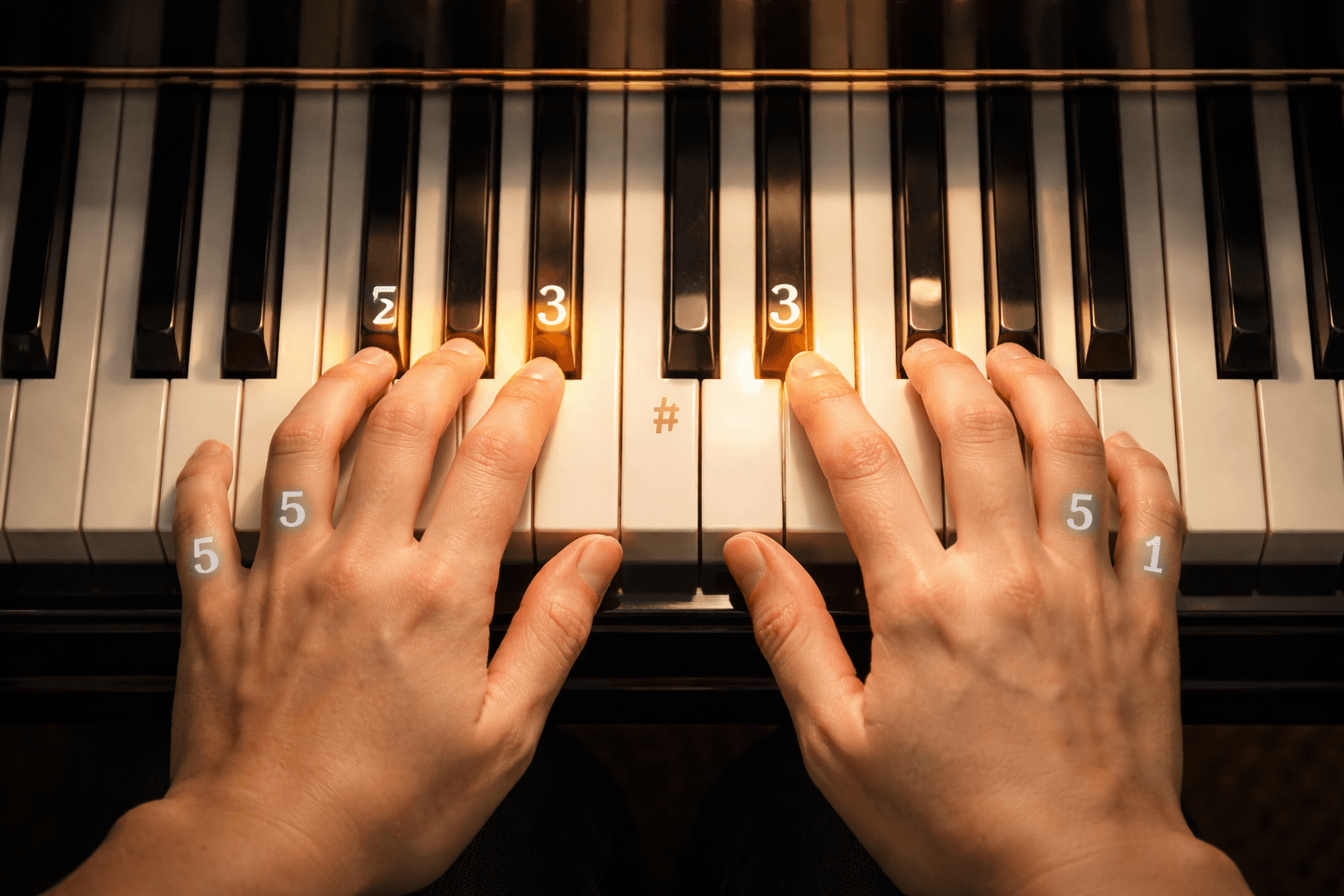 Because the A# major chord involves primarily black keys, proper finger placement is critical for comfort, accuracy, and speed.
Right Hand Fingering
The thumb rests on A#. The middle finger plays C𝄪. The pinky plays E#.
This fingering allows the hand to sit naturally over the black keys while maintaining balance and control.
Left Hand Fingering
The pinky plays A#. The middle finger plays C𝄪. The thumb plays E#.
Maintaining curved fingers and a relaxed wrist is essential to avoid tension, especially when navigating accidentals.
Exercise 1: Root Position Practice
Begin by playing the A# major chord slowly in root position. Ensure that all notes sound evenly and clearly. Repeat the chord across different octaves to strengthen muscle memory and spatial awareness.
Consistent slow practice builds confidence and accuracy when working with complex chord spellings.
Inversions of the A# Major Chord
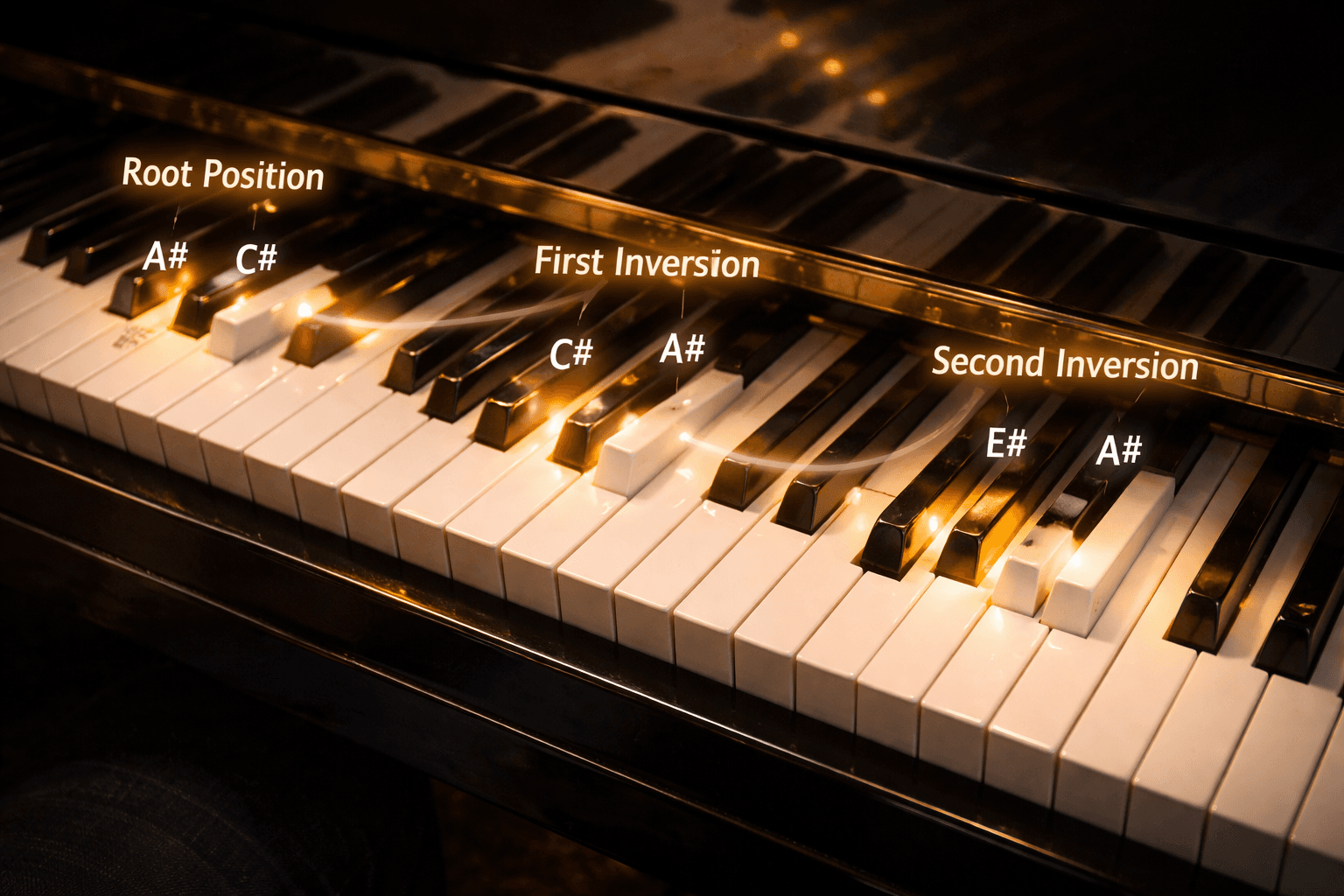
 Chord inversions allow smoother transitions between harmonies and improve voice leading.
First Inversion (C𝄪 – E# – A#)
In the right hand, the thumb plays C𝄪, the middle finger plays E#, and the pinky plays A#. In the left hand, the pinky plays C𝄪, the middle finger plays E#, and the thumb plays A#. This inversion is useful for connecting to chords such as D# minor or F# major.
Second Inversion (E# – A# – C𝄪)
In the right hand, the thumb plays E#, the middle finger plays A#, and the pinky plays C𝄪. In the left hand, the pinky plays E#, the middle finger plays A#, and the thumb plays C𝄪.
Second inversion works well in arpeggios, accompaniment patterns, and harmonic transitions.
Exercise 2: Inversion Flow
Practice moving from root position to first inversion, then second inversion, and back to root. Play each inversion slowly and smoothly. Use both hands separately before combining them.
This exercise strengthens finger independence and improves chord awareness.
Arpeggios and Broken Chords
 Arpeggios transform chords into flowing melodic patterns and are essential for expressive piano playing.
A# Major Arpeggio (One Octave)
Ascending sequence follows A#, C𝄪, E#, and A#. Descending sequence follows A#, E#, C𝄪, and A#.
Exercise 3: Arpeggio Development
Start slowly with one hand and focus on even tone. Gradually combine both hands once accuracy improves. Experiment with different rhythmic patterns to enhance musicality.
Arpeggio practice improves coordination, timing, and improvisational fluency.
Scales Compatible with A# Major
 Practicing scales alongside chords enhances ear training and harmonic understanding.
Scale Notes Mood
A# Major A# – B# – C𝄪 – D# – E# – F𝄪 – G𝄪 – A# Bright and triumphant
A# Major Pentatonic A# – C𝄪 – D# – E# – G𝄪 Clean and melodic
A# Lydian A# – B# – C𝄪 – D𝄪 – E# – F𝄪 – G𝄪 Dreamy and modern
A# Mixolydian A# – B# – C𝄪 – D# – E# – F𝄪 – G# Jazzy and expressive
Exercise 4: Scale Integration
Practice each scale slowly over two octaves. Combine scale runs with A# major arpeggios. Focus on phrasing, dynamics, and tone control.
Common Chord Progressions with A# Major
Although enharmonically rare, A# major progressions are important in advanced harmonic contexts.
Beginner-Level Progressions
Progression Notes A# – D# – F𝄪 A# C𝄪 E# → D# F𝄪 A# → F𝄪 A# C𝄪 A# – G𝄪m – D# – F𝄪 Smooth tonal movement
Intermediate Progressions
Progression Notes A# – F𝄪 – G𝄪m – D# Balanced and expressive A# – C𝄪m – F𝄪 – A# Strong resolution
Advanced Progressions
Progression Notes A#maj7 – C𝄪m7 – D# – F𝄪 Jazz-influenced A# – G𝄪m – F𝄪sus4 – A#6 Rich harmonic color
Exercise 5: Progression Practice
Play progressions slowly and focus on smooth voice leading. Use inversions to minimize hand movement. Experiment with broken chords and arpeggios for texture.
Genre Applications of A# Major
 A# major appears most often in advanced theoretical and compositional settings.
In jazz, it is used for enharmonic modulation and sophisticated chord substitutions. In classical music, it appears in harmonic analysis and enharmonic key changes. In film scoring, it creates bold, triumphant emotional peaks. In contemporary music, it supports expressive chord extensions and modern harmony.
Tips for Mastering the A# Major Chord
Correct fingering is essential due to dense accidentals. Practice slowly and prioritize accuracy over speed. Focus on inversions and arpeggios for flexibility. Use scales to reinforce tonal understanding. Experiment with chord extensions for expressive depth.
Common Mistakes with A# Major
Relying only on enharmonic equivalents without understanding theory. Ignoring proper finger placement on black keys. Skipping inversion practice. Playing too fast without tonal clarity.
Correcting these habits improves long-term technique and musical confidence.
Advanced Applications
 Improvisation becomes richer when using A# major scales and arpeggios.
Songwriting benefits from combining A# major with its relative minor and extended harmonies.
Chord extensions add sophistication and emotional nuance.
Broken chords enhance accompaniment patterns and lead lines.
Improvisation becomes richer when using A# major scales and arpeggios.
Songwriting benefits from combining A# major with its relative minor and extended harmonies.
Chord extensions add sophistication and emotional nuance.
Broken chords enhance accompaniment patterns and lead lines.
Frequently Asked Questions (FAQs)
1. What notes are in the A# major chord?
A#, C𝄪, and E# form the root, major third, and perfect fifth.
2. Is A# major the same as B♭ major?
Yes, they sound the same on piano but differ in notation and theoretical function.
3. Is A# major difficult for beginners?
It is challenging due to accidentals but valuable for advancing technique and theory.
4. How do I play A# major inversions?
First inversion uses C𝄪, E#, and A#. Second inversion uses E#, A#, and C𝄪.
5. Which scales work with A# major?
A# major, A# pentatonic, A# Lydian, and A# Mixolydian.
6. What mood does A# major convey?
Bright, confident, bold, and triumphant.
7. How should beginners practice A# major?
Start slowly with root position, then add inversions, arpeggios, and simple progressions.