ChatGPT
 Google AI
 Grok
Grok Claude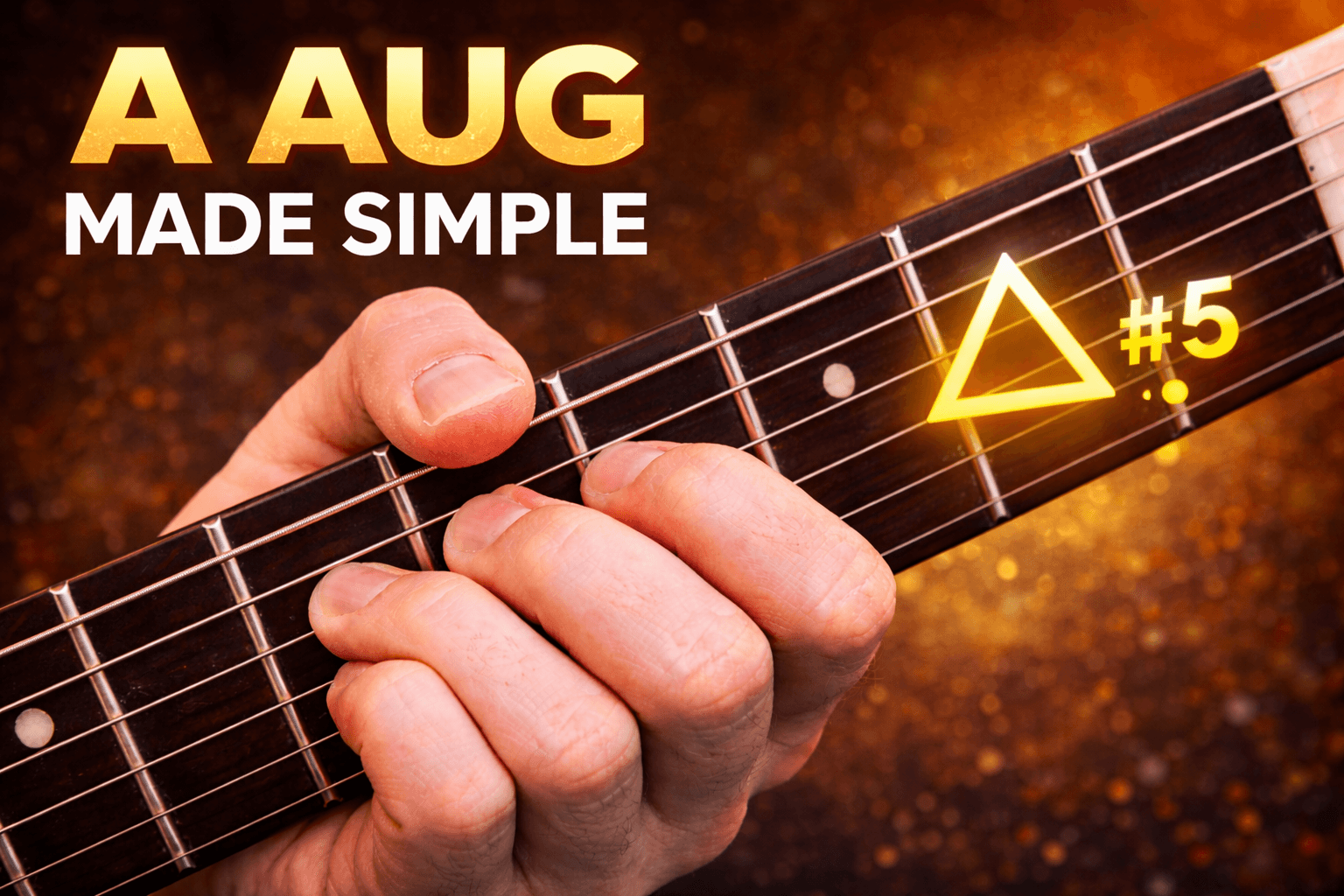
What Is the A Augmented Guitar Chord?
 The A augmented chord on guitar, often written as A aug, A+, or A(#5), is a distinctive and expressive chord used to create tension, drama, and forward motion in music. Unlike standard major and minor chords, the augmented chord has an unstable, unresolved quality that naturally wants to move to another chord. This makes it especially powerful in genres such as jazz, blues, classical, film music, progressive rock, and modern pop.
The A augmented chord is built from three notes: A, C#, and E#. While E# may look unusual, it is enharmonically the same as F, and its theoretical spelling is important for understanding chord construction. Together, these notes form an augmented triad, characterized by its raised fifth interval.
On the guitar, the A augmented chord is not usually one of the first chords beginners learn, but it becomes extremely valuable as players progress. Learning A aug helps guitarists understand chord alteration, voice leading, and how tension chords function within progressions. It also opens the door to advanced harmony, chromatic movement, and expressive songwriting techniques.
Understanding how to play and use the A augmented chord builds fretboard awareness, strengthens theoretical knowledge, and adds a sophisticated sound to both rhythm and lead playing.
What Makes the A Augmented Chord Special
 The A augmented chord stands out because of its symmetrical and unresolved sound. Unlike major chords, which feel complete and stable, augmented chords feel suspended, bright, and slightly mysterious. This quality comes from the augmented fifth interval, which stretches the harmony beyond the natural major scale.
In practical music use, the A augmented chord is often employed as a passing chord, a transitional harmony, or a dramatic color chord. It frequently appears between a major chord and another chord a half step above or below. For example, A major can move to A augmented and then resolve smoothly to D major or F major, depending on the musical context.
Another reason the A augmented chord is special is its symmetry. Augmented chords divide the octave evenly, meaning the same shape can repeat every four frets on the guitar. This makes them especially useful for movable shapes and creative fretboard exploration.
Because of its tension-rich sound, A aug is often used to heighten emotional impact, create cinematic progressions, and add harmonic sophistication. Learning to recognize and control this sound allows guitarists to move beyond basic chords and into more expressive musical territory.
A Augmented Chord Notes and Formula
 The A augmented chord consists of three essential notes that form an augmented triad.
The notes in the A augmented chord are:
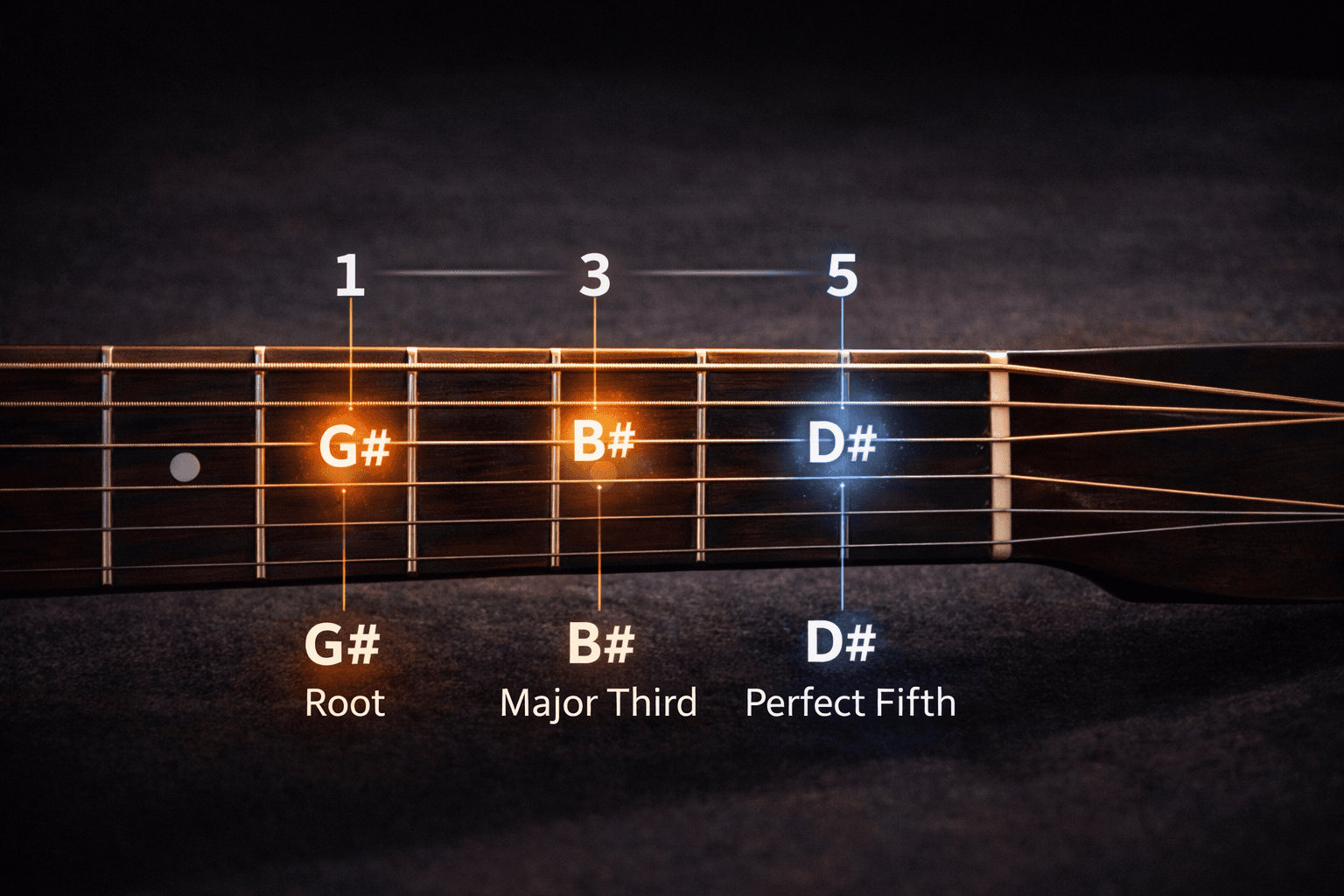
A as the root C# as the major third E# as the augmented fifth
These notes follow the augmented chord formula of 1–3–#5.
A Augmented Chord Tone Breakdown
Note Interval A Root C# Major Third E# Augmented Fifth
Understanding this formula is critical for identifying augmented chords across the fretboard. Once guitarists recognize the 1–3–#5 structure, they can build augmented chords from any root note. This knowledge is especially helpful for improvisation, chord substitution, and advanced rhythm playing.
How the Augmented Chord Is Built
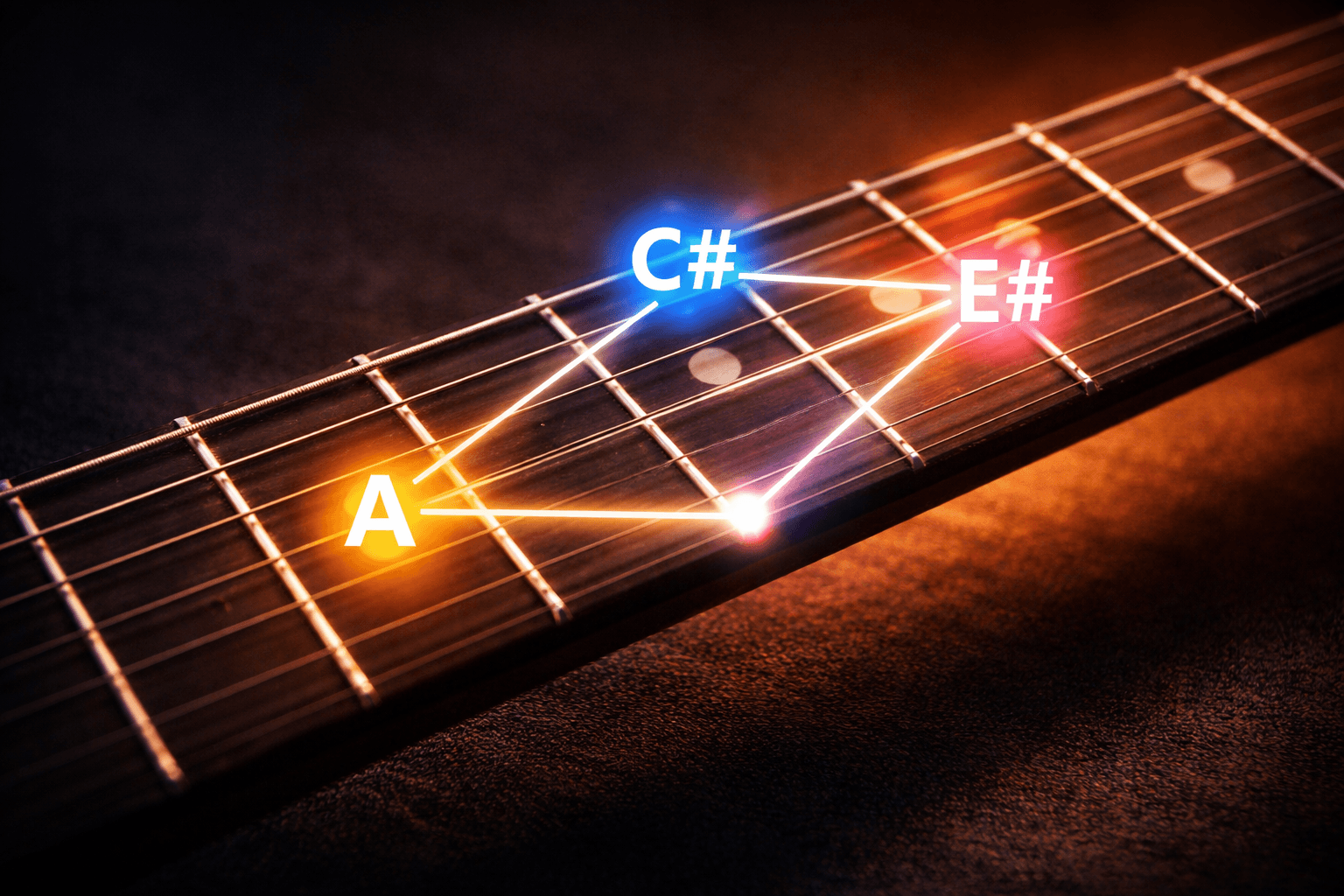 An augmented chord is created by starting with a major triad and raising the fifth by one semitone. In the case of A major, the chord tones are A, C#, and E. By raising the fifth from E to E#, the chord becomes A augmented.
This small change dramatically alters the sound of the chord. The augmented fifth creates a wide, tense interval that lacks resolution. This is why augmented chords often feel as though they are “leaning forward,” pulling the music toward the next harmony.
From a scale perspective, the A augmented chord does not naturally occur within the A major scale. Instead, it is considered an altered chord, commonly borrowed from harmonic movement, chromatic passing chords, or melodic minor contexts.
Understanding how augmented chords are built allows guitarists to intentionally use them rather than stumbling upon them accidentally. This control is essential for advanced songwriting, arranging, and improvisation.
A Augmented Chord on Guitar
 The A augmented chord can be played in several positions on the guitar, including open-position shapes, barre chords, and movable forms. Each shape produces a slightly different tonal color depending on string choice, register, and voicing.
Because augmented chords are less common in open position, many guitarists first encounter A aug as a movable shape higher on the neck. Learning multiple shapes allows players to insert the chord naturally into progressions without disrupting flow or tone.
The A augmented chord is especially useful for voice leading, as one note often moves by a half step to resolve into the next chord. Recognizing these movements across the fretboard helps guitarists connect chords smoothly and musically.
The Basic A Augmented Shape
 A commonly used A augmented shape is played near the open position and introduces players to the unique sound of the chord.
In a typical fingering, the root A is played on the fifth string, while the raised fifth appears on a higher string, creating immediate tension. This shape is compact and effective, making it useful for rhythm parts and transitional moments.
Because augmented chords are sensitive to intonation and clarity, clean finger placement is essential. Each note should ring clearly to fully express the chord’s color. Practicing slow, deliberate strums helps ensure the augmented interval is heard distinctly.
Keys Where You’ll Find the A Augmented Chord
 The A augmented chord most commonly appears as a borrowed or passing chord rather than a diatonic chord. However, it frequently shows up in certain harmonic contexts.
Keys and Contexts Featuring A Augmented
| Key or Context | Harmonic Role |
|---|---|
| A Major | Passing chord between A and D |
| F# Minor | Chromatic leading chord |
| Jazz Progressions | Altered dominant or color chord |
| Classical Harmony | Voice-leading enhancement |
| Film and Pop Music | Tension and drama |
Understanding where augmented chords appear helps guitarists recognize them in real music and apply them intentionally rather than randomly.
Common Chord Progressions Using A Augmented
 The A augmented chord is rarely used as a static chord. Instead, it shines in motion-based progressions where its tension resolves smoothly.
Some common progressions include:
A major moving to A augmented and resolving to D major A major moving to A augmented and resolving to F major A augmented leading into D minor in cinematic or modal contexts
These progressions rely on half-step motion, which creates a strong sense of direction. Learning how A aug resolves in different ways gives guitarists creative freedom and harmonic confidence.
Scales to Play Over an A Augmented Chord
Improvising over an A augmented chord requires scales that accommodate the raised fifth. Targeting the chord tones A, C#, and E# is essential for melodic clarity.
Scales Compatible With A Augmented
| Scale | Notes | Mood |
|---|---|---|
| A Whole Tone Scale | A B C# D# E# G | Dreamy, ambiguous |
| A Lydian Augmented | A B C# D# E# F# G# | Bright, modern |
| A Altered Scale | A Bb C Db Eb F G | Tense, jazzy |
| A Major with Chromatic Passing | A B C# D E F# G# | Expressive, controlled tension |
The whole tone scale is particularly effective over augmented chords because it naturally contains augmented intervals. Learning to hear how these scales interact with the chord greatly improves soloing and melodic phrasing.
Popular Songs and Styles That Use Augmented Chords
While the A augmented chord may not always be explicitly labeled in songbooks, augmented harmony appears frequently across genres.
Classical compositions often use augmented chords to intensify modulation and harmonic movement. Jazz standards rely on augmented chords for altered dominants and chromatic transitions. Film scores and modern pop use augmented harmony to evoke mystery, anticipation, and emotional depth.
Listening for these sounds trains the ear to recognize augmented tension and understand how it resolves within a musical context.
How to Play the A Augmented Chord Across the Fretboard
Using movable shapes, guitarists can play the A augmented chord in multiple positions. Because augmented chords repeat every four frets, a single shape can unlock the entire neck.
A Augmented Chord Positions
| Position | Root Location | Shape Type |
|---|---|---|
| Open Area | A string | Open or partial shape |
| 5th Fret | E string | Barre-based movable shape |
| 9th Fret | A string | Inversion |
| 13th Fret | E string | High voicing |
| 17th Fret | A string | Upper inversion |
Learning these positions allows players to seamlessly insert A aug wherever needed, improving rhythmic flow and tonal variety.
Alternate Voicings and Extensions
Although augmented chords are triads, they can be expanded into richer harmonies. Adding sevenths or extensions creates complex textures useful in jazz and contemporary music.
Examples include A augmented major seventh and A augmented dominant variations. These sounds are advanced but rewarding, adding depth and sophistication to chord progressions.
Exploring alternate voicings also helps guitarists develop chord melody skills and creative arranging techniques.
Playing the A Augmented Shape With Other Roots
The A augmented chord shape is fully movable. By shifting the shape up or down the neck, players can create augmented chords from any root.
For example, moving the A augmented shape up two frets creates a B augmented chord. Moving it to the third fret creates a C augmented chord. This symmetry makes augmented chords one of the easiest altered chords to transpose once the shape is understood.
This concept strengthens fretboard logic and builds confidence in key changes and chromatic harmony.
How to Build the A Augmented Chord on Guitar
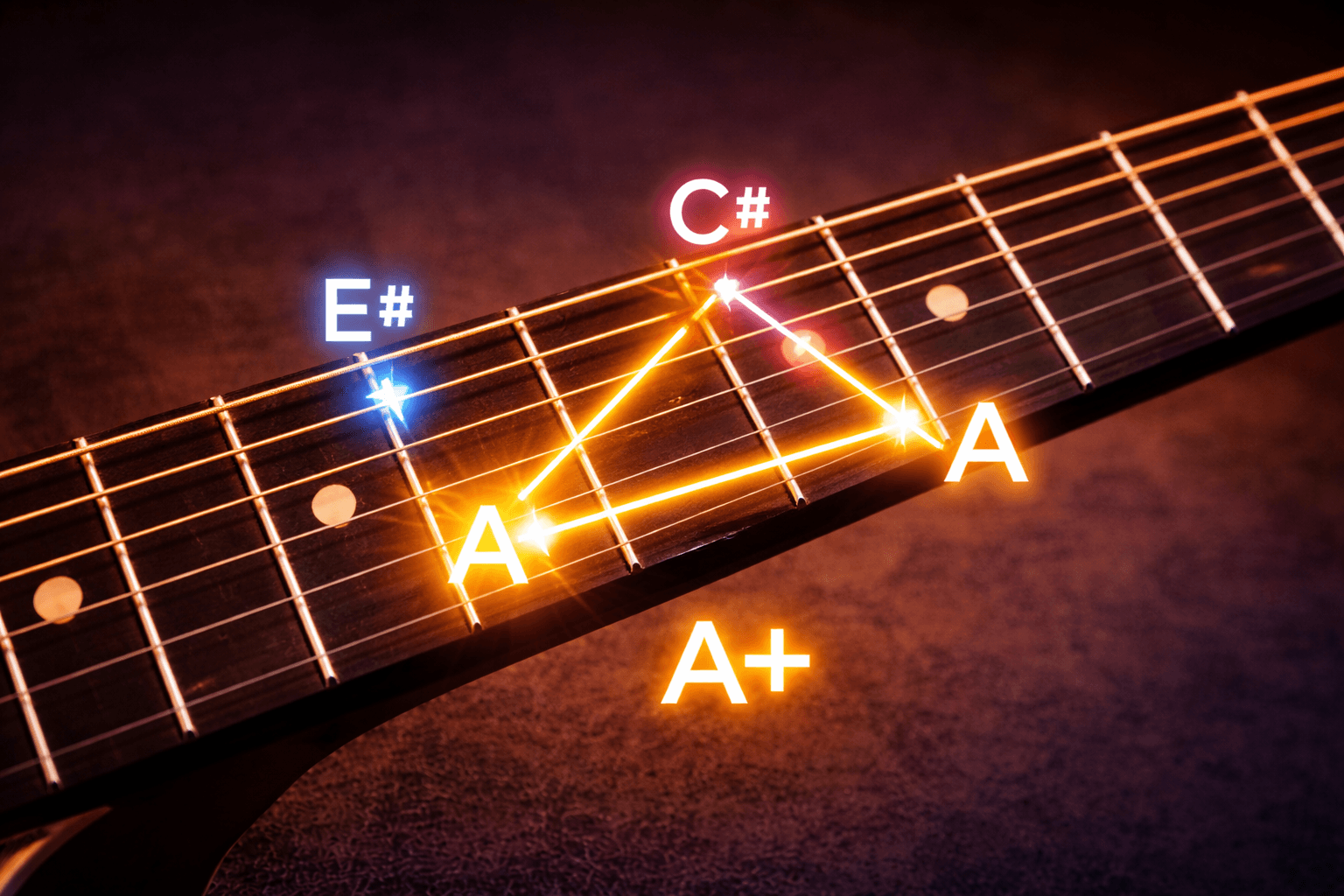 Building the A augmented chord from scratch involves locating A, C#, and E# across the fretboard. Mapping these notes on each string helps guitarists visualize the chord beyond memorized shapes.
Chord tone visualization allows players to create custom voicings, triads, and inversions. This approach is especially valuable for advanced rhythm guitar, arpeggio-based playing, and melodic accompaniment.
Understanding how to build the chord rather than just play it deepens theoretical fluency and musical control.
Tips to Master the A Augmented Chord
 Clean execution of the A augmented chord requires precision and relaxed technique. Proper finger curvature ensures that each note rings clearly. Light pressure prevents fatigue, especially when holding augmented shapes higher on the neck.
Practicing slow transitions between A major and A augmented helps the ear internalize the tension and resolution. This awareness is essential for expressive playing.
Practice Routine for A Augmented
| Exercise | Duration | Goal |
|---|---|---|
| A augmented finger placement | 5 mins | Clean tone |
| A to A aug transitions | 10 mins | Smooth voice leading |
| Progression practice with resolution | 10 mins | Musical application |
Consistent practice builds confidence and makes augmented chords feel natural rather than awkward.
Troubleshooting Common Problems
Some players struggle with muted strings or unclear tension when first learning augmented chords. This is often due to finger crowding or insufficient pressure on the raised fifth.
Adjusting finger angles, practicing slowly, and listening carefully to each note helps resolve these issues. Over time, the augmented sound becomes easier to control and more expressive.
Advanced Applications of the A Augmented Chord
In advanced harmony, the A augmented chord is a powerful tool for modulation and chromatic movement. In lead guitar, outlining A augmented arpeggios creates dramatic melodic lines. In rhythm playing, using augmented passing chords adds color and sophistication.
Understanding how A augmented interacts with scales, keys, and resolutions transforms it from a theoretical concept into a practical musical tool. It becomes a gateway to jazz harmony, cinematic composition, and expressive songwriting.
FAQ About the A Augmented Guitar Chord
1 Is the A augmented chord hard to play on guitar?
The A augmented chord is slightly more advanced than basic major and minor chords, but with practice it becomes comfortable. Movable shapes make it easier once learned.
2 What notes are in the A augmented chord?
The A augmented chord consists of A, C#, and E#.
3 How is A augmented different from A major?
A major uses A, C#, and E, while A augmented raises the fifth to E#, creating more tension and instability.
4 When should I use the A augmented chord?
A augmented is best used as a passing or tension chord that resolves into another harmony, rather than as a static chord.
5 Can augmented chords be moved across the fretboard?
Yes, augmented chord shapes are fully movable and repeat every four frets, making them highly versatile.