ChatGPT
 Google AI
 Grok
Grok Claude
"The best songs come all at once. You don't have time to think. You just feel." — Paul McCartney
Music has an uncanny way of arriving without warning. One moment a musician is riding the bus, soaking in a bathtub, or waking from a dream. The next moment, a song that will shape generations is already fully formed. This article digs deep into the fast songwriting stories behind some of the most beloved tracks in music history. These are songs created in a short time — often in under thirty minutes — that went on to define careers, dominate charts, and embed themselves permanently in the cultural memory of America and the world.
If you've ever wondered how hit songs are written, or whether legendary music creation stories are real or embellished, you're in the right place. The truth is even more extraordinary than the myth. Let's walk through each story carefully, understand the creative songwriting flow behind each one, and draw lessons that every aspiring musician can use today.
Introduction: When Musical Genius Happens Instantly
Some of the most iconic famous songs written fast weren't the result of months in a studio. They erupted. They arrived like a storm — sudden, total, and transformative. The fast songwriting process behind these tracks reveals something profound about human creativity: when emotion is raw enough and the musician is skilled enough, a song doesn't need to be built. It simply needs to be received.
Neurologically, this happens during a state of deep creative flow. Psychologist Mihaly Csikszentmihalyi describes flow as a mental condition where challenge and skill are perfectly balanced, dissolving self-consciousness and accelerating output dramatically. When a songwriter enters flow, the inner critic goes quiet. What replaces it is pure, unfiltered creative expression. Songs written quickly aren't inferior to labored ones. In many cases, they're superior — because they carry the undiluted heat of genuine emotional truth. The rawness stays. The hesitation doesn't.
Why Some Songs Are Written Extremely Fast
The spontaneous songwriting phenomenon is more common than most people realize. Artists across every genre — rock, pop, soul, R&B, country, holiday — have described the experience of a song arriving complete and fully formed. The common thread isn't genre or era. It's emotional intensity. When a musician is experiencing something powerfully — grief, rage, ecstatic joy, overwhelming love — the creative output accelerates. The brain doesn't have room to second-guess. It can only express.
There's also a skills dimension. The songwriting techniques used by artists who write fast aren't mysterious. They've spent thousands of hours building musical vocabulary. They know dozens of chord progressions, melodic shapes, and lyrical structures. When inspiration strikes, they're not starting from zero. They're drawing instantly from a vast internal library. Speed becomes possible only because preparation is deep. Think of it like a surgeon who performs a complex procedure in under an hour — not because they rushed, but because they've done it ten thousand times before.
The Role of Inspiration in Songwriting
Musical inspiration moments don't operate on schedule. Every great songwriter will tell you that. Inspiration doesn't knock politely at 9 a.m. on a Tuesday. It arrives at 3 a.m., or in the middle of a breakup, or while staring out the window of a moving train. The unexpected song inspirations behind many classics share one quality: they arrived uninvited and demanded immediate attention.
This is why the most practical songwriting advice isn't about technique. It's about readiness. Keep a recorder nearby. Keep a notebook open. Keep your instrument accessible. The music composition inspiration for songs like "Yesterday," "Satisfaction," and "Careless Whisper" survived their creation only because their composers acted immediately. Hesitation would have erased them. The world almost lost Paul McCartney's most famous melody because he couldn't decide if he'd accidentally stolen it from somewhere else. He spent weeks checking. He hadn't. But the song survived only because he played it into a piano before the dream dissolved.
How Spontaneous Creativity Creates Timeless Music
Paradoxically, spontaneity breeds longevity. Songs created instantly carry an authenticity that painstakingly over-crafted tracks frequently lack. There's no over-polishing. No second-guessing every syllable. The rawness stays intact. And listeners feel that realness the moment a song begins — it's visceral, instinctive, almost pre-verbal.
Timeless music often contains imperfections woven deliberately into its fabric: a slightly cracked vocal note, an unresolved chord that leaves the listener leaning forward, a lyric that chooses honesty over elegance. Those imperfections are the fingerprints of genuine human emotion. They're what make classic songs written quickly so enduringly magnetic across decades and demographics. The world keeps returning to honesty because honesty is rare — and when a song is built entirely from it, listeners know without being told.
Elton John's Classic Ballad That Came Together in Minutes
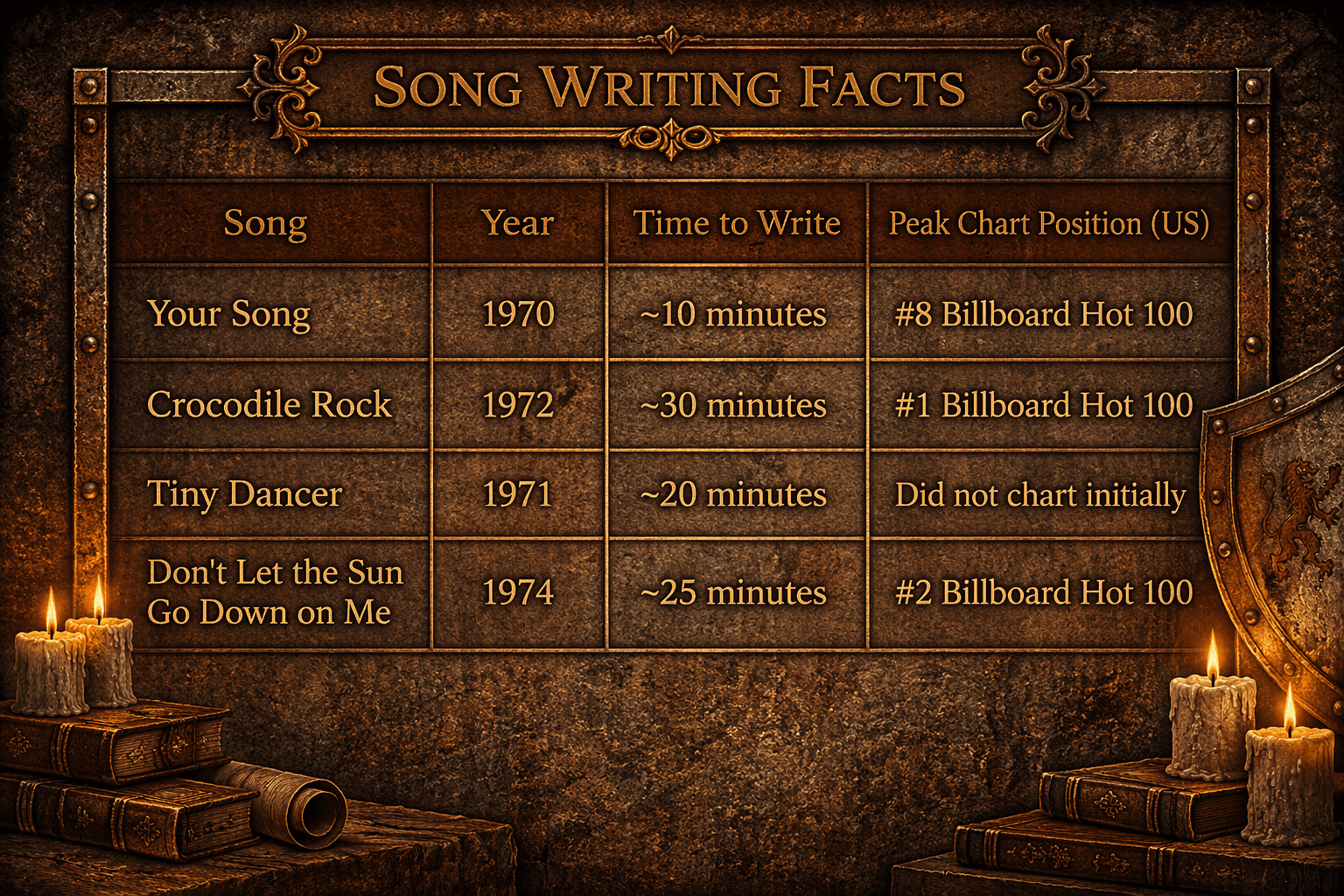
Elton John songwriting is legendary for its speed and emotional precision, and nowhere is that more evident than in the creation of Your Song (1970). Elton sat at the piano and composed the music in roughly ten minutes. His longtime lyricist Bernie Taupin had already written the words even faster — scribbling them at the breakfast table before Elton touched a key. Their creative shorthand was extraordinary: Taupin wrote lyrics independently, Elton set them to music without Taupin present. No back-and-forth. No negotiation. Just two men with complete trust in each other's genius operating at full speed.
What emerged is one of the most tender, emotionally direct love songs in the entire history of pop music. The piano intro is warm and unhurried. The melody avoids drama, choosing sincerity instead. The lyric's self-aware imperfection — "I hope you don't mind that I put down in words" — creates an intimacy rarely achieved in popular music. Your Song didn't perform emotion; it was emotion. It reshaped what a piano ballad could accomplish. It proved that vulnerability is commercially powerful. It influenced singer-songwriter culture throughout the 1970s and beyond, its DNA detectable in everything from Carole King to John Legend. Learn more about the most iconic singers in music history and how Elton John fits into that extraordinary lineage.
How Queen Created a Rockabilly Hit in Less Than Half an Hour
Queen band songwriting has produced some of the most musically ambitious recordings in rock history — Bohemian Rhapsody, We Will Rock You, Somebody to Love. But Freddie Mercury songwriting at its most spontaneous produced something completely different: Crazy Little Thing Called Love (1979), a stripped-back rockabilly romp that Freddie wrote in a Munich hotel bathtub in under thirty minutes. He picked up an acoustic guitar — an instrument he openly admitted he couldn't play well — and found the song precisely because of that limitation. The chords stayed simple. The structure stayed lean. He couldn't overcomplicate it even if he wanted to.
This is a quick songwriting example that teaches a vital creative lesson: constraints liberate. Freddie's technical limitation on guitar prevented him from overwriting the song. The result was Queen's first American number one single, reaching the top of the Billboard Hot 100 in 1980. The song's infectious simplicity made it universally accessible — rock fans loved the swagger, pop fans loved the melody, and casual listeners loved the pure kinetic energy. Brian May played a Telecaster instead of his signature Red Special guitar, lending the track its authentic twangy character. The recording session matched the spontaneity of composition: brief, punchy, and alive.
The Rapid Creation of George Michael's Iconic Saxophone Ballad
The George Michael music career launched on the back of a melody he hummed into a cassette recorder on a bus in London — at age seventeen, on his way to a part-time job. That melody became the saxophone line of Careless Whisper (1984), arguably the most recognizable saxophone hook in the history of popular music. George told interviewers he knew immediately, in that bus seat, that the melody was extraordinary. The instinctive recognition of a great idea is itself a skill — one that separates artists who capitalize on inspiration from those who let it pass.
The lyrics followed quickly, drawing on George's genuine guilt over infidelity in a teenage relationship. Co-written with Andrew Ridgeley, the song structured itself around that saxophone hook with remarkable ease. Songs written in minutes by famous artists often carry this quality of emotional autobiography — the songwriter isn't crafting a narrative, they're confessing one, and confession moves fast. Careless Whisper reached number one in over twenty countries and entered pop culture's permanent vocabulary. The saxophone hook is referenced, parodied, and sampled to this day. It launched George Michael's solo identity while technically still a Wham! release and proved that a teenage emotional memory — captured on a bus in twenty minutes — could become a global cultural landmark.
Adele's Early Songwriting Breakthrough
Adele's debut song Chasing Pavements (2008) grew from personal devastation at age nineteen. Adele discovered her boyfriend was cheating, left a nightclub in tears and fury, sat alone, and wrote the song in roughly twenty minutes. The title emerged from her thought that chasing someone who doesn't want you is as futile as chasing a pavement — running after something that leads nowhere. That metaphor didn't require crafting; it arrived whole, because the emotion generating it was total and immediate.
The song's creative songwriting flow is evident in every line. There's no padding, no filler, no lyric included for rhyme's sake alone. Every word earns its place. The piano arrangement breathes underneath her voice without crowding it. The production by Eg White understood exactly what the song needed: space. Chasing Pavements reached number two on the UK Singles Chart, earned Adele a Grammy nomination for Best Female Pop Vocal Performance, and introduced the world to her searing emotional directness. It established the template for her entire subsequent career — unflinching personal honesty, soulful vocal restraint, and songs so specific they feel universal. If you're looking to develop your own vocal abilities, Art Gharana offers world-class training that can help you channel emotion into music the way Adele does.
The Ed Sheeran Song Written During a Creative Burst
Ed Sheeran songwriting style is built on emotional urgency and stream-of-consciousness capture — and The A Team (2011) exemplifies both. Ed wrote the song after volunteering at a homeless shelter in London, where he met a young woman caught in addiction and street life. He went home and wrote the entire song in a single sitting, driven by the feeling that he needed to tell her story accurately and immediately, before the emotion cooled. That urgency preserved the song's documentary-like precision. Every detail is specific because it's real.
Ed's creative process relies on not stopping mid-flow to evaluate lines. He writes everything down, then edits. This approach captures emotion before the analytical brain sanitizes it. His acoustic guitar style — percussive fingerpicking, loop-based arrangements — also accelerates composition. He can construct a full sonic landscape solo, without waiting on collaborators. The A Team reached the top ten in multiple countries, earned Ed his first Grammy nomination, and proved to American audiences that raw acoustic vulnerability — a single guitar, a simple voice, a true story — could compete with polished pop production. Songs written in one sitting don't get more honest than this one.
The Holiday Classic Written in Minutes
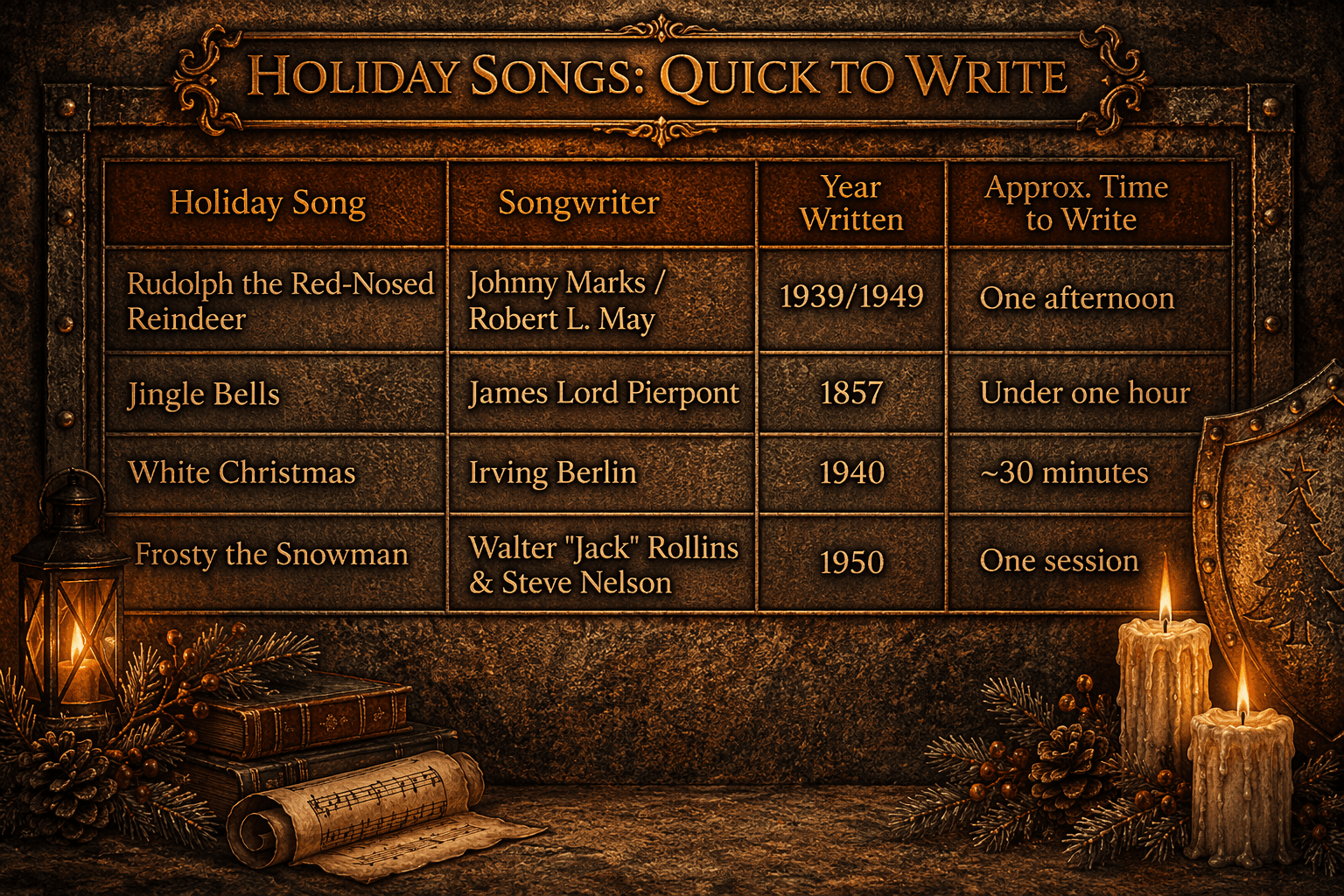
Rudolph the Red-Nosed Reindeer, written as a song by Johnny Marks in 1949, began even earlier as a poem by Robert L. May — composed in a single afternoon in 1939 as a children's giveaway booklet for a Montgomery Ward department store promotion. May drew on his own childhood experience of feeling different and being bullied. That personal resonance poured onto the page with extraordinary speed. The narrative structure was already perfect: underdog protagonist, clear conflict, triumphant resolution. It practically composed itself.
Johnny Marks adapted the poem into song form with remarkable ease because the bones were already structurally flawless. Gene Autry initially passed on recording it but changed his mind after his wife insisted — a reminder that sometimes the people closest to a song recognize its power before its creator does. The recording became one of the best-selling singles of all time, with over 25 million copies sold according to RIAA data. Its themes — difference as strength, vindication, belonging — resonate across every age group simultaneously. The instant music composition of a retail marketing poem accidentally became an immortal piece of American folklore.
The Rolling Stones Song That Defined Rock Attitude
Rolling Stones classic rock song history has no more dramatic origin story than (I Can't Get No) Satisfaction (1965). Keith Richards woke in the middle of the night, grabbed the cassette recorder he kept beside his bed out of habit, and laid down the guitar riff half-asleep. Then he went back to sleep. The next morning, he nearly erased it — he didn't remember recording it at all. He found a few seconds of the riff followed by forty minutes of his own snoring. Mick Jagger wrote the lyrics in about twenty minutes by a pool in Clearwater, Florida. Together, they'd created what Rolling Stone magazine would later rank as the second greatest song of all time.
The songwriting creativity in music industry context makes this story even more remarkable: neither Mick nor Keith initially thought the song was worthy of a single. They considered it a rough idea. Producer Andrew Loog Oldham overruled their skepticism entirely. The fuzz-pedal riff — deliberately primitive, almost aggressively unpolished — became the defining sound of rock guitar attitude. The lyric's exasperated repetition perfectly mirrors how frustration actually feels. You don't say "I can't get no satisfaction" once and move on. You say it again and again, louder each time. That instinct, born in twenty frenzied minutes, is why rock fans fifty years later still pump their fists to the same three notes.
Billy Joel's Piano-Driven Song Created in a Flash
Billy Joel songwriting inspiration for Piano Man (1973) came from his real life — specifically from his months playing piano at a Los Angeles bar called the Executive Room while his recording career was stalled. He observed the regulars with empathy and specificity: the waitress dreaming of acting, the old man nursing his loneliness, the businessman performing cheerfulness. He wrote their portraits in a single extended session. The waltz-time melody arrived naturally, mirroring the unhurried, slightly melancholy rhythm of a bar on a slow Tuesday evening. If you want to understand the classic music songwriting history of piano-based popular music, Piano Man is essential study — and these 6 famous pianists who shaped music history provide extraordinary context for where Billy Joel fits in that tradition.
Producer Michael Stewart kept the arrangement centered on piano and voice, resisting the temptation to add layers that would undermine the song's barroom intimacy. The harmonica intro — wheezy, nostalgic, slightly world-weary — sets the mood perfectly before a single word arrives. Piano Man didn't perform spectacularly on initial release, reaching only number twenty-five on the Billboard Hot 100. Yet it became one of the most beloved American songs of the entire twentieth century through cumulative cultural exposure. It's played at last calls, at sporting arenas where tens of thousands sing every word, at retirement parties and memorial services. Some songs don't peak; they simply grow deeper with time. The communal singalong quality of those la-la-la refrains makes it a participatory experience unlike almost anything else in pop.
The Beatles Song That Came From a Dream
The Beatles songwriting process produced many extraordinary moments, but none more mythologically perfect than Paul McCartney song inspiration for Yesterday (1965). Paul woke one morning with the entire melody already complete in his head, scrambled to a piano before the dream dissolved, and played it from memory. His initial working lyric was "Scrambled eggs / Oh, my baby, how I love your legs" — a placeholder while he figured out what the song was actually about. For weeks, he played it for friends, for fellow Beatles, for anyone who would listen, convinced he must have unconsciously stolen it from somewhere. No one recognized it. It was entirely original.
Paul McCartney song inspiration stories don't get more remarkable than this. The subconscious delivered a complete masterpiece, and Paul's instinct was to distrust it — which is itself a fascinating window into creative insecurity at the highest level. The song marks a dramatic departure for The Beatles: recorded with only Paul's acoustic guitar and a string quartet, no other band members participated. Producer George Martin arranged the strings in a single session. The recording took one afternoon. Yesterday now holds the Guinness World Record for the most covered song in history, with over 2,200 recorded versions across jazz, country, reggae, classical, and hip-hop. Its seven-bar verse structure — subtly irregular, creating a barely perceptible sense of incompleteness — perfectly mirrors the lyric's theme of loss. The structure and the feeling are one. That unity arrived in a dream.
Ray Charles' Rhythm and Blues Classic Born in a Moment
Ray Charles rhythm and blues mastery produced one of music history's most joyful origin stories. What'd I Say (1959) wasn't written at all — it was discovered live, in real time, in front of an audience. Ray and his band finished their set early and needed to fill time. Ray started improvising at the piano. His orchestra followed. The audience began clapping, calling back, singing responses. The electric communion in that room became the song. Ray's team recorded it afterward, capturing that same improvisational electricity in the studio.
Ray was operating at the intersection of gospel, blues, and early rock and roll — a synthesis some religious communities considered scandalous. The call-and-response structure in What'd I Say borrowed directly from Black church tradition, then wrapped it in an irresistibly physical rhythm. The song was initially banned by several radio stations, which — as always — only amplified its cultural power. It reached number six on the Billboard Hot 100 in 1959 despite those restrictions. Rolling Stone magazine includes it among the greatest songs ever recorded. James Brown, Aretha Franklin, and Otis Redding all drew structural lessons from the template Ray Charles discovered that night by accident. When improvisation and genius collide with a live audience, the results can be eternal. Explore more legends like Ray Charles in this deep dive into famous Carnatic musicians and the broader world of music heritage.
Why Some of the Greatest Songs Are Written So Quickly
The fast songwriting process is not magical — though it can feel that way. It's the intersection of emotional intensity, accumulated skill, and prepared capture. When all three align, time compresses. A songwriter in genuine creative flow doesn't experience thirty minutes as thirty minutes. They experience it as a single continuous burst of clarity where every decision feels obvious and correct. The analytical brain, which normally slows creation with doubt and revision, has gone temporarily quiet.
Research in cognitive science supports this. Studies on improvisation among trained musicians — including a notable Johns Hopkins University study — show that during spontaneous musical creation, the prefrontal cortex (responsible for self-monitoring and critical evaluation) shows dramatically reduced activity. Meanwhile, regions associated with self-expression become more active. Songs created instantly aren't the output of recklessness. They're the output of a brain that has temporarily freed itself from its own editorial interference. Training creates the skill. Emotion creates the urgency. Flow creates the speed.
The Psychology of Creative Flow
Creative songwriting flow has been studied extensively since Csikszentmihalyi's foundational research in the 1990s. In flow, challenge and skill are perfectly matched. The task is neither too easy (which causes boredom) nor too difficult (which causes anxiety). It sits in a sweet spot where total absorption becomes possible. For a trained musician experiencing genuine emotional urgency, songwriting frequently hits this sweet spot. The emotional challenge is real and immediate. The musical skill is sufficient to meet it. Flow follows naturally.
What's fascinating about the legendary songs written quickly in this article is that many of them emerged from negative emotional states — heartbreak (Adele), frustration (Rolling Stones), grief (Ed Sheeran), guilt (George Michael). Negative emotion, counterintuitively, often produces more powerful creative output than positive emotion. This is because negative emotion demands expression. It insists on an outlet. And when a trained musician is the outlet, the result can be extraordinary.
How Musicians Capture Inspiration Instantly
The practical methods for capturing music written in one sitting vary across eras and personalities, but the underlying principle never changes: act immediately, without judgment. Keith Richards kept a cassette recorder by his bed. Paul McCartney ran to the piano before his dream dissolved. George Michael hummed into a recorder on a bus. Adele wrote on whatever paper was nearby. Ed Sheeran voice-memos constantly. The technology changes with each generation; the urgency is identical across all of them.
Modern musicians have unprecedented capture tools available. Voice memo apps on smartphones record CD-quality audio instantly. GarageBand and similar apps allow immediate multi-track recording on a phone. Notation apps convert hummed melodies to sheet music in real time. The democratization of capture technology means that songs written in minutes by famous artists are increasingly the norm rather than the exception in contemporary music production. The barrier between inspiration and recording has essentially collapsed. What remains constant is the need to act on inspiration the moment it arrives — because the moment after is often already too late.
Examples of Fast Songwriting in Modern Music
Fast songwriting stories aren't confined to the classic era. Billie Eilish and her brother Finneas O'Connell have described writing and recording tracks in their childhood bedroom within single sessions. Taylor Swift routinely writes and demos songs the same day an idea arrives, maintaining a songwriting pace that has produced multiple albums' worth of material in relatively short periods. Kendrick Lamar has discussed writing verses in single focused sessions when the conceptual clarity is present. Bruno Mars, Ed Sheeran, and Lizzo all cite spontaneous composition as central to their creative practice.
The popular song creation stories of the modern era confirm that quick songwriting examples remain as relevant as ever. Technology has changed. Genre boundaries have blurred. But the fundamental truth — that the greatest songs emerge when emotional truth, accumulated skill, and immediate capture align — has not changed since Ray Charles improvised his way into history in front of a live audience in 1959.
Learn Music and Songwriting with Art Gharana
The stories in this article all point to the same conclusion: behind every song written in thirty minutes is a musician who spent thousands of hours preparing for that thirty minutes. Speed is the reward for preparation. Spontaneity is the dividend of discipline. You cannot shortcut the skill-building phase. But once you've built the skills, creativity can move at extraordinary speed. Art Gharana understands this relationship between training and spontaneous expression deeply, and its programs are designed to build exactly the kind of musical fluency that makes fast, authentic creation possible.
Great songwriting begins with great musical understanding. When you understand harmony — why certain chords create tension and others create resolution — your creative choices accelerate. When you've internalized rhythm, your melodic instincts sharpen. When your voice is trained to respond without strain or hesitation, emotion flows directly into sound. Songwriting techniques used by artists like Elton John, Paul McCartney, and Adele all rested on deep foundational musical knowledge. That knowledge didn't constrain their creativity; it liberated it. Book a trial class at Art Gharana and begin building the musical foundation that transforms inspiration into creation.
How Music Training Improves Creativity
Formal music training doesn't stifle spontaneity — it deepens it. This is a common misconception among aspiring musicians who fear that learning theory will make their playing feel mechanical. The opposite is consistently true. A musician who understands chord progressions can recognize a great one instantly and develop it without fumbling. A singer who has trained their breath control can sustain a phrase that an untrained singer would cut short. Theory is not a cage. It's a map — and with a map, you explore further and faster than you ever could without one.
The music composition inspiration behind all the songs in this article was amplified, not limited, by the technical skill of the musicians who created them. Elton John's ability to instantly harmonize a set of lyrics came from years of classical piano training. Paul McCartney's understanding of melodic structure allowed him to develop a dream-melody into a complete song in days. Training creates speed. Speed enables spontaneity. The virtuous cycle is real and well-documented in music education research.
Courses Available for Singing, Piano, and Instruments
Art Gharana offers comprehensive curricula in vocal training, piano, guitar, tabla, violin, and music production. Whether you're a complete beginner who has never played a note or an intermediate musician looking to accelerate your songwriting, structured programs match your current level and build systematically toward your goals. Small group and one-on-one formats ensure personalized attention and pacing. Online and in-person options provide flexibility for busy schedules. The faculty includes working professional musicians who bring real-world creative experience into every lesson — because learning from practitioners, not just theorists, makes an enormous difference in developing authentic musical instincts.
The approach at Art Gharana connects classical musical heritage with contemporary creative practice. Whether your goal is to sing soulful ballads in the tradition of Adele, compose piano-driven confessionals like Billy Joel, or develop the improvisational spontaneity of Ray Charles, the foundational skills are the same. They're teachable, learnable, and within reach of anyone with genuine curiosity and commitment.
Benefits of Learning Music from Professional Mentors
A professional mentor collapses years of expensive trial and error into months of guided, purposeful discovery. They can hear exactly where your voice or playing needs development before you can identify it yourself. They introduce repertoire and technique calibrated precisely to your growth stage, preventing both boredom and overwhelm. Most importantly, they model the creative mindset — showing by living example what fearless, joyful musicianship looks and sounds like in practice.
Every musician profiled in this article had mentors, influences, and teachers. Elton John studied at the Royal Academy of Music. Ray Charles learned from gospel musicians and jazz bandleaders. Paul McCartney was shaped by skiffle, Buddy Holly, and countless late-night listening sessions with John Lennon. Famous musicians songwriting process stories invariably include the names of those who came before and who gave generously of their knowledge. The chain of musical learning is ancient, unbroken, and available to you right now.
How Students Can Start Their Musical Journey
Starting is simpler than most people believe. Art Gharana offers introductory sessions with zero prerequisites — just curiosity and willingness to show up. Students begin with foundational skills and progress at their own pace within a supportive, encouraging community of fellow learners. Music education research consistently shows that students who begin with personalized, supportive instruction develop both faster and with greater long-term passion than those who struggle through self-teaching alone. The journey from first note to first song is shorter than you think. Every musician you've read about in this article started exactly where you are right now: at the beginning, with nothing but potential and the desire to make something that matters. Book your first trial class today and take the first step toward your own musical story.
Conclusion: Creativity Can Strike at Any Moment
The popular song creation stories in this article span more than seventy years of music history, crossing genres, generations, and continents. A bathtub in Munich. A bus in London. A cassette recorder beside a sleeping man's bed. A teenage heartbreak outside a nightclub. A dream that dissolved the moment morning came. Famous songs written in just 30 minutes don't come from extraordinary circumstances. They come from ordinary moments charged with extraordinary feeling and met by musicians who were ready, willing, and deeply prepared.
The lesson isn't that you need to write fast. The lesson is that you need to be ready when inspiration comes, because it comes on its own schedule and it doesn't wait. Build your skills every day. Develop your emotional vocabulary. Keep your instrument nearby. Press record without hesitation. And trust — as Paul McCartney trusted, as Adele trusted, as Keith Richards trusted — that what arrives in thirty minutes of genuine creative fire can outlast anything produced in thirty months of calculated effort.
Lessons Aspiring Musicians Can Learn from These Songs
Songwriting inspiration stories like the ones in this article offer several clear, actionable lessons for musicians at every level. First: don't wait for the perfect moment. It doesn't exist. Second: capture immediately. An idea not recorded within minutes is often gone forever. Third: emotional honesty is more powerful than technical perfection. Every song in this article succeeded because it told the truth about something real. Fourth: constraints are gifts. Freddie Mercury's limited guitar playing produced one of Queen's greatest hits. Fifth: preparation is everything. The speed of creation reflects the depth of preparation underneath it.
Songwriting techniques used by artists in this article are learnable. The emotional honesty can be cultivated. The capture habits can be built. The musical vocabulary can be developed through consistent, joyful practice. None of this requires extraordinary talent as a starting condition. It requires commitment and the right guidance.
Why Inspiration Matters More Than Time
Time is a resource. Inspiration is a gift. The songs explored throughout this piece took thirty minutes or less to write not because their creators rushed but because inspiration compressed the work. When emotional clarity is fully present, craft follows naturally. The world doesn't need more perfectly engineered songs. It needs more honest ones. Honesty moves fast. It doesn't deliberate; it declares. Songs written quickly by artists who were emotionally present and technically prepared have consistently proven more durable than songs that took years to construct.
This is the creative process of famous musicians distilled to its simplest form: feel something real, have the skills to express it, and act before the feeling cools. That formula hasn't changed since the first musician picked up the first instrument and decided that silence was insufficient. It won't change as long as human beings need music to understand what they can't otherwise say.
Encouraging Young Musicians to Start Creating Music
Don't wait to be great. Start to be present. Every musician in this article began writing before they were famous, before anyone was listening, before they had permission to believe their ideas mattered. Paul McCartney wrote Yesterday as a scrambled-egg joke. Adele wrote Chasing Pavements in heartbroken fury on a sidewalk at nineteen. Ed Sheeran wrote The A Team with compassionate urgency in a tiny apartment. None of them asked whether they were ready. They simply started.
The song you write today — imperfect, rough, maybe twenty minutes old — could be the one that changes everything. Not because of luck, but because genuine emotion, properly captured, has a power that transcends the conditions of its creation. Pick up your instrument. Open a voice memo. Sit at the piano. Begin. The world is patiently, eagerly waiting for what only you can say. And when inspiration arrives — as it will, unexpectedly, in a bathtub or on a bus or in the last hazy moment before you fall asleep — be ready for it. That moment of readiness is where all great music begins.
Frequently Asked Questions
1. Can a hit song really be written in 30 minutes?
Yes, many famous songs have been written very quickly when inspiration strikes. Experienced musicians often capture melodies, lyrics, and chords within minutes, especially when they are in a strong creative flow.
2. Why do some musicians write songs so quickly?
Songwriters sometimes experience a creative burst where ideas come naturally. When emotions, melody, and lyrics align perfectly, a song can be completed in a very short time.
3. Are quickly written songs less meaningful?
Not at all. Many timeless songs were written quickly but became extremely popular because the emotions and ideas behind them were genuine and powerful.
4. What helps musicians write songs faster?
Strong musical knowledge, regular practice, and emotional inspiration help musicians write songs faster. Many artists also develop a personal songwriting process that makes creativity flow easily.
5. Can beginners learn to write songs quickly?
Yes, beginners can improve their songwriting speed with practice and proper guidance. Learning music theory, instruments, and composition through institutions like Art Gharana can help aspiring musicians develop songwriting skills effectively.