The UK has one of the world's most developed school music education systems, yet Indian classical music, Hindustani vocals, Carnatic music, Bharatanatyam, and other South Asian arts have been largely absent from it. This is changing. This comprehensive guide examines how UK school music education is structured, where the gaps for Indian classical music have existed, what recent policy and cultural changes are beginning to shift the landscape, how British-Indian families can navigate the current system, and what parents can do to ensure their children receive meaningful Indian classical arts education alongside their mainstream schooling.
The UK School Music Education Framework
How Music Is Taught in British Schools
Music is a compulsory subject in the National Curriculum for England from Key Stage 1 (ages 5-7) through to the end of Key Stage 3 (ages 11-14). At Key Stage 4 (GCSE level) and Key Stage 5 (A-Level), music becomes optional.
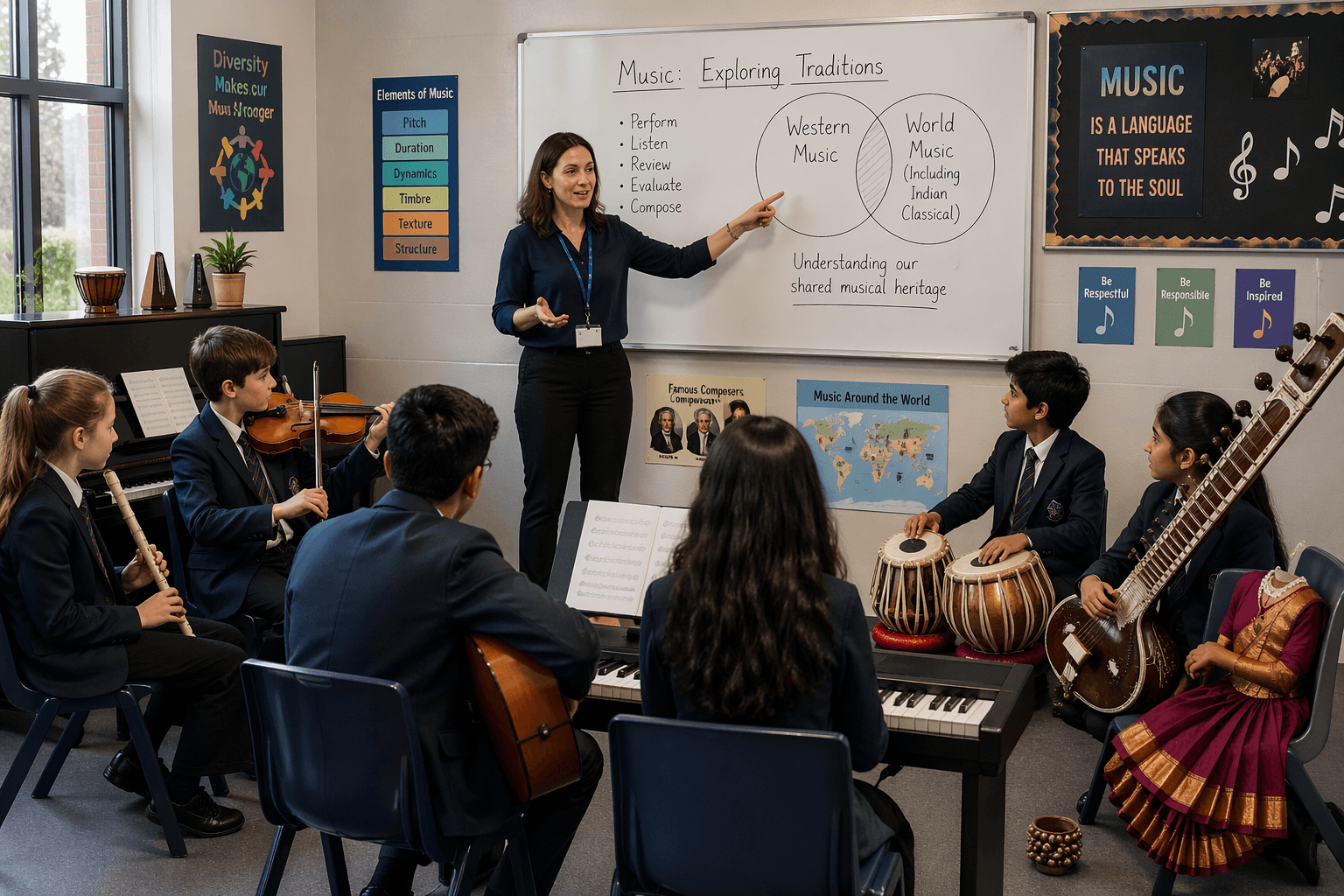
The National Curriculum for music aims to ensure pupils can perform, listen to, review, and evaluate music across a range of historical periods, genres, styles, and traditions, including the works of the great composers and musicians, and to learn to play a musical instrument.
Key Stage 1 and 2 (Ages 5-11)
In primary schools, music typically involves:
- Singing and vocal development
- Playing instruments (percussion, recorders, glockenspiels in most schools)
- Listening and appraising a range of musical styles
- Basic music notation introduction in KS2
The range of musical traditions covered varies significantly between schools. Some primary schools offer excellent world music exposure including Indian, West African, and Latin American traditions. Many cover only Western classical and popular music.
Key Stage 3 (Ages 11-14)
Secondary school music at KS3 typically involves composition, performance, and listening across multiple genres. The National Curriculum explicitly requires coverage of music from different historical periods and traditions, which in principle includes Indian classical music. In practice, South Asian musical traditions are included in some schools and almost entirely absent from others.
GCSE and A-Level Music
GCSE Music (typically ages 14-16) assesses composition, performance, and listening. A-Level Music requires significant technical knowledge, composition work, and performance capability.
Both GCSE and A-Level Music are assessed against Western classical music theory frameworks, which has historically made them less accessible for students whose musical training is in Indian classical traditions.
The Reality of Indian Classical Music in British Schools
The Gap Between Policy and Practice
The National Curriculum's reference to music from different traditions and cultures suggests a framework that could accommodate Indian classical music. In practice, the inclusion is minimal and inconsistent. A 2019 report by the Music Education Council found significant variation in how schools interpret the world music requirements, with many schools focusing primarily on Western classical and popular music traditions.
The Instrument Lesson Lottery
Many UK schools offer subsidised instrumental lessons in specific instruments (typically violin, cello, clarinet, flute, trumpet, and piano) through Music Education Hubs. Indian classical instruments — tabla, harmonium, sitar, veena — are almost never included in these subsidised programmes. For families whose children want to learn these instruments, the cost and access responsibility falls entirely on the family.
The GCSE Challenge for Indian Classical Musicians
A student with eight years of Bharatanatyam or Hindustani vocal training who takes GCSE Music faces a significant challenge: their musical training has been in a tradition whose theory, notation, and performance conventions are almost entirely different from the Western classical framework that GCSE Music assesses. Many such students end up taking Western instrument lessons specifically to access GCSE Music, rather than being able to use their existing deep classical training.
What Is Changing: Policy Developments and New Possibilities
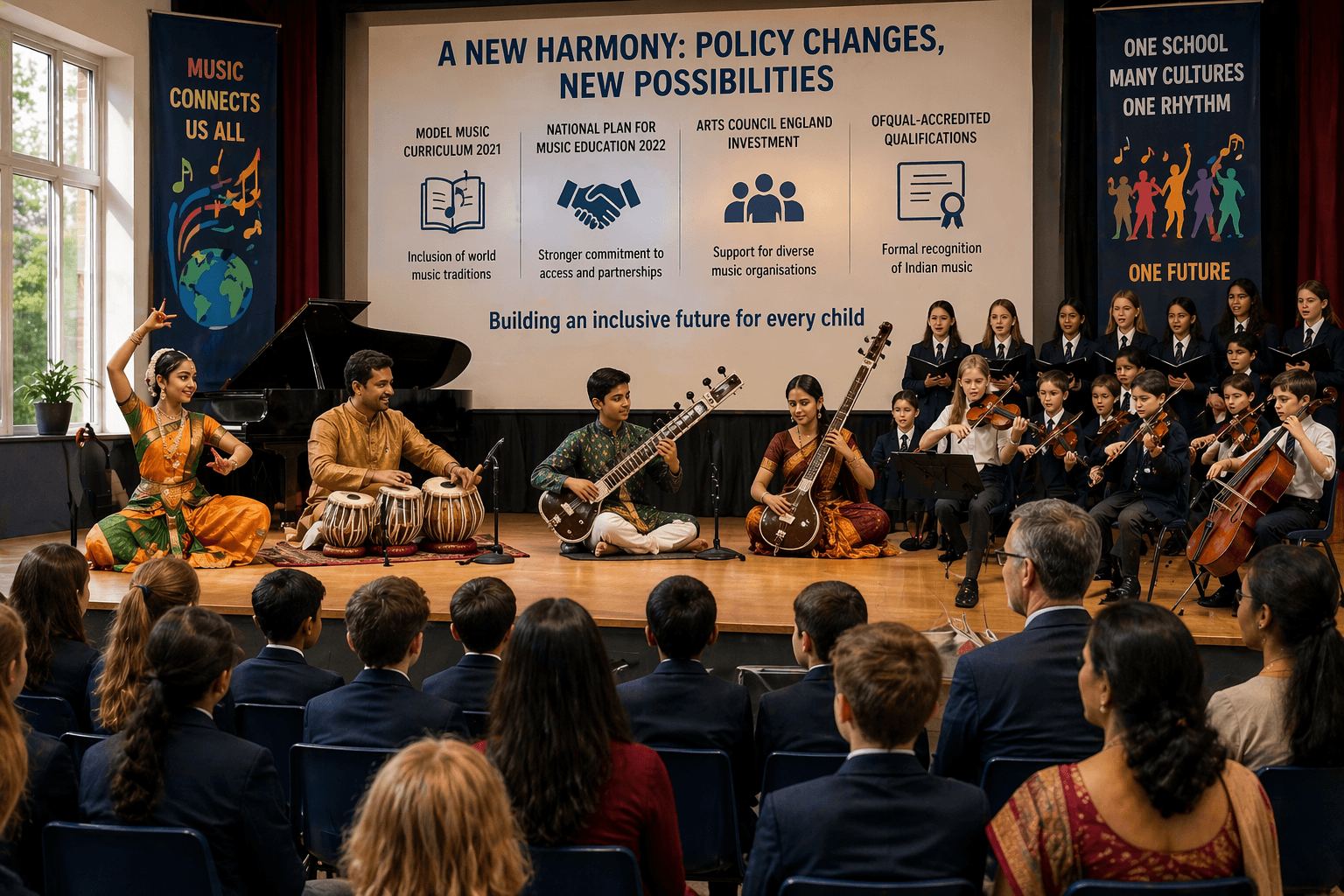
The Model Music Curriculum (2021) and Its Limitations
In 2021, the UK Department for Education published the Model Music Curriculum, a non-statutory guidance document intended to support schools in delivering high-quality music education. The document includes references to world music traditions and explicitly mentions Indian classical music as one of the traditions worth including.
However, as it is non-statutory guidance rather than a requirement, implementation varies widely. Schools with strong commitment to multicultural music education have used it as a framework for genuine expansion. Schools with less musical diversity in their leadership have largely continued as before.
The National Plan for Music Education (2022)
The refreshed National Plan for Music Education (NPME 2022-2030) makes stronger commitments to ensuring all children, regardless of background, have access to music education. It emphasises partnership between schools, Music Education Hubs, and community organisations.
For British-Indian families, the most relevant commitment is the NPME's recognition of the need for music education that reflects pupils' cultural and heritage backgrounds. This provides an advocacy framework for parents seeking to have Indian classical music recognised within their children's school music education.
The Arts Council England Investment in Diverse Music Traditions
Arts Council England has made significant investments in recent years in organisations that deliver Indian classical music education. Several National Portfolio Organisations now deliver Carnatic and Hindustani music education in school settings in areas with significant South Asian communities.
Ofqual-Accredited Indian Music Qualifications
As discussed in our dedicated Ofqual blog, the emergence of Ofqual-regulated Indian classical music qualifications from platforms like Artium Academy represents a significant bridge between Indian classical music education and the formal UK qualifications framework. As more Ofqual-regulated Indian music qualifications become available, their integration into UCAS applications and school academic records will increase the formal recognition of Indian classical music training within UK education.
How British-Indian Families Can Navigate the Current System
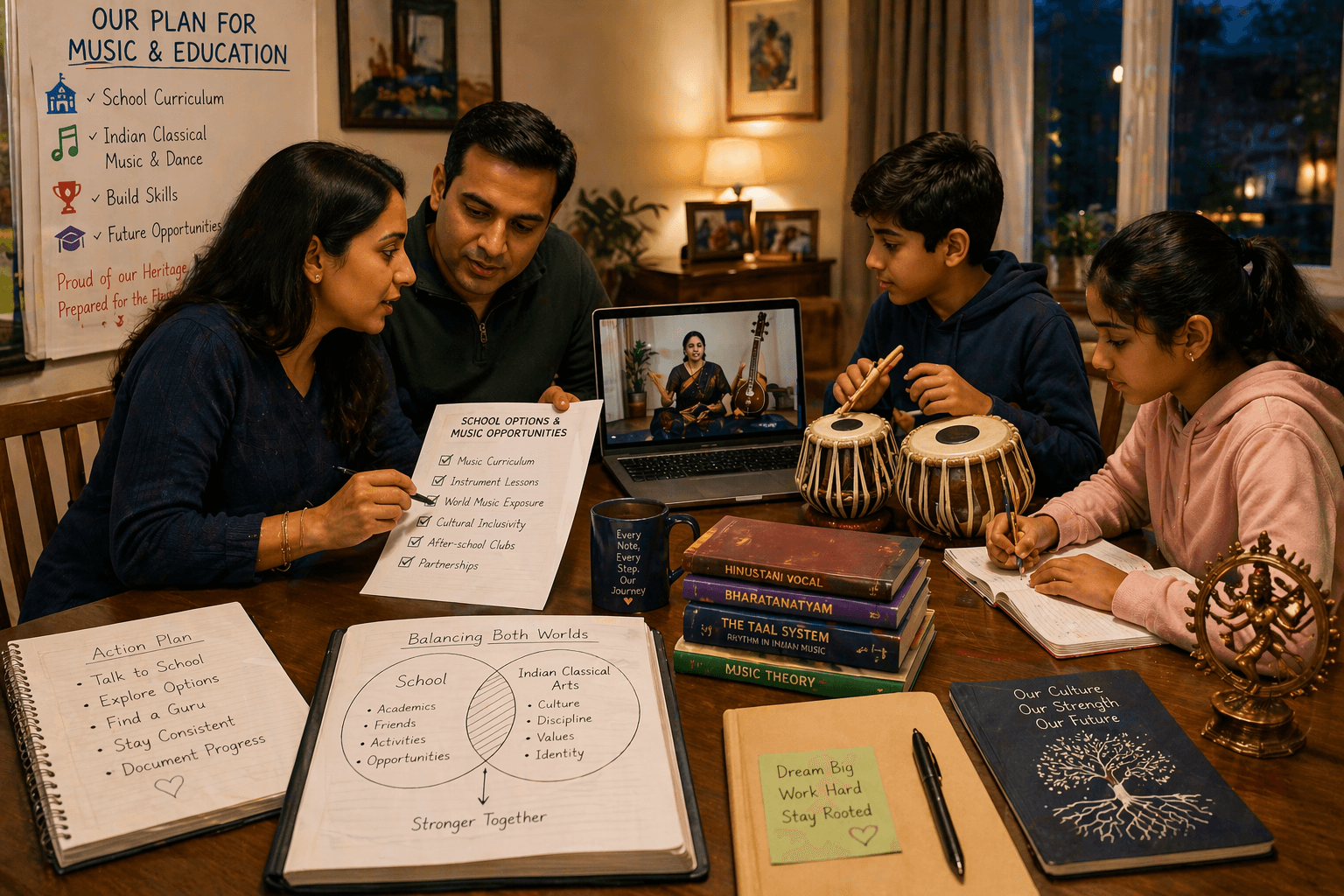
Strategy 1 — Advocate at Your Child's School
Parents have more influence over school music curriculum decisions than most realise. Schools are required to deliver the National Curriculum's breadth requirement for music, and the Model Music Curriculum explicitly endorses inclusion of Indian classical music traditions.
Talking to the Music Department
Request a meeting with your child's Head of Music. Bring examples of what Indian classical music education involves, how it develops musical skills, and how it connects to the curriculum's breadth requirement. Offer to help source resources, or introduce the school to organisations that already deliver Indian classical music education in school settings.
Proposing Cultural Music Events
Many schools are open to enrichment events such as Indian classical music assembly performances, workshop sessions, or lunchtime clubs. These are excellent entry points for introducing the tradition to the school community and demonstrating its educational value.
Strategy 2 — Pursue Indian Classical Education in Parallel
The most common and practical approach for British-Indian families is to pursue Indian classical music education outside school alongside the mainstream school curriculum.
Online Classes Filling the Gap
Live 1:1 online classes from platforms like Art Gharana provide the structured, expert-led Indian classical music and dance education that British schools cannot currently offer. British-Indian children are routinely studying Carnatic vocals, Bharatanatyam, Hindustani classical music, and tabla through online classes while attending mainstream British schools.
This parallel approach gives children the best of both educational worlds: the mainstream British educational framework through school, and deep, authentic Indian classical arts training through dedicated online classes.
Strategy 3 — Build Towards Formal Recognition
As Ofqual-regulated Indian music qualifications become more established, families who invest in Indian classical education now will be able to formally document that achievement in university applications, scholarship applications, and educational records.
The ABRSM pathways through Western instruments provide immediate UCAS-recognised qualifications. As the Ofqual landscape for Indian music develops, the gap between these two pathways is beginning to close.
Organisations Supporting Indian Classical Music in UK Education
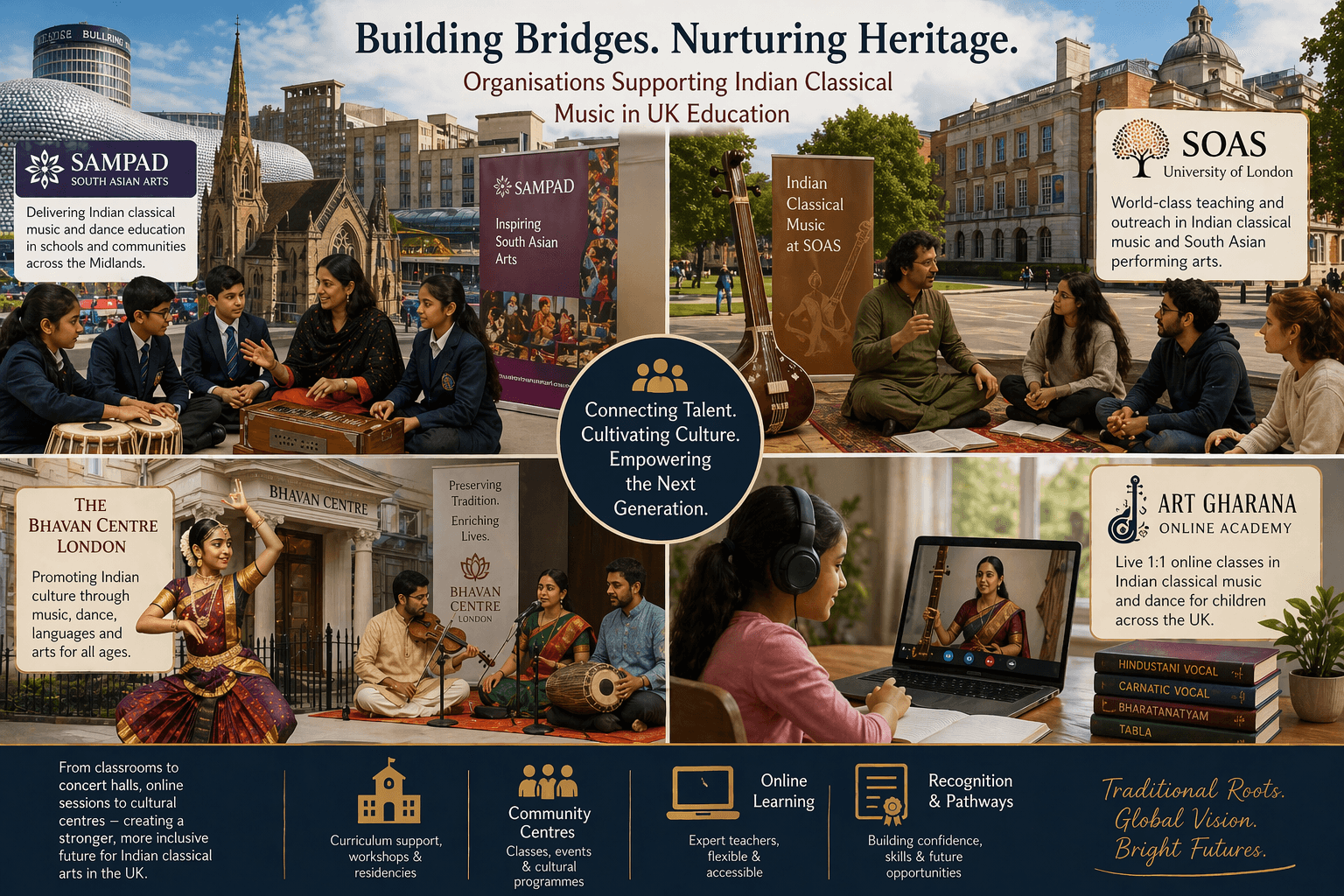
Key Organisations to Know
Sampad South Asian Arts
Based in Birmingham, Sampad is one of the UK's leading South Asian arts organisations. It delivers Indian classical music and dance education in schools and community settings across the Midlands and works with schools to develop culturally inclusive arts curricula.
SOAS University of London
SOAS has a world music department that includes Indian classical music as a significant strand. Its outreach programmes and public concerts provide exposure to high-quality Indian classical performance for British audiences.
The Bhavan Centre London
The Bharatiya Vidya Bhavan (BVB) cultural centre in London offers classes in Indian classical music, dance, languages, and arts. It is one of the most established providers of South Asian cultural education in Britain.
Art Gharana
Art Gharana offers live 1:1 online Indian classical music and dance classes for children across the UK. Our teachers are certified, experienced, and culturally aligned with the British-Indian community's educational values. Explore our vocal courses and our full range of music and dance courses to find the right fit for your child's interests.
The Case for Schools to Do More
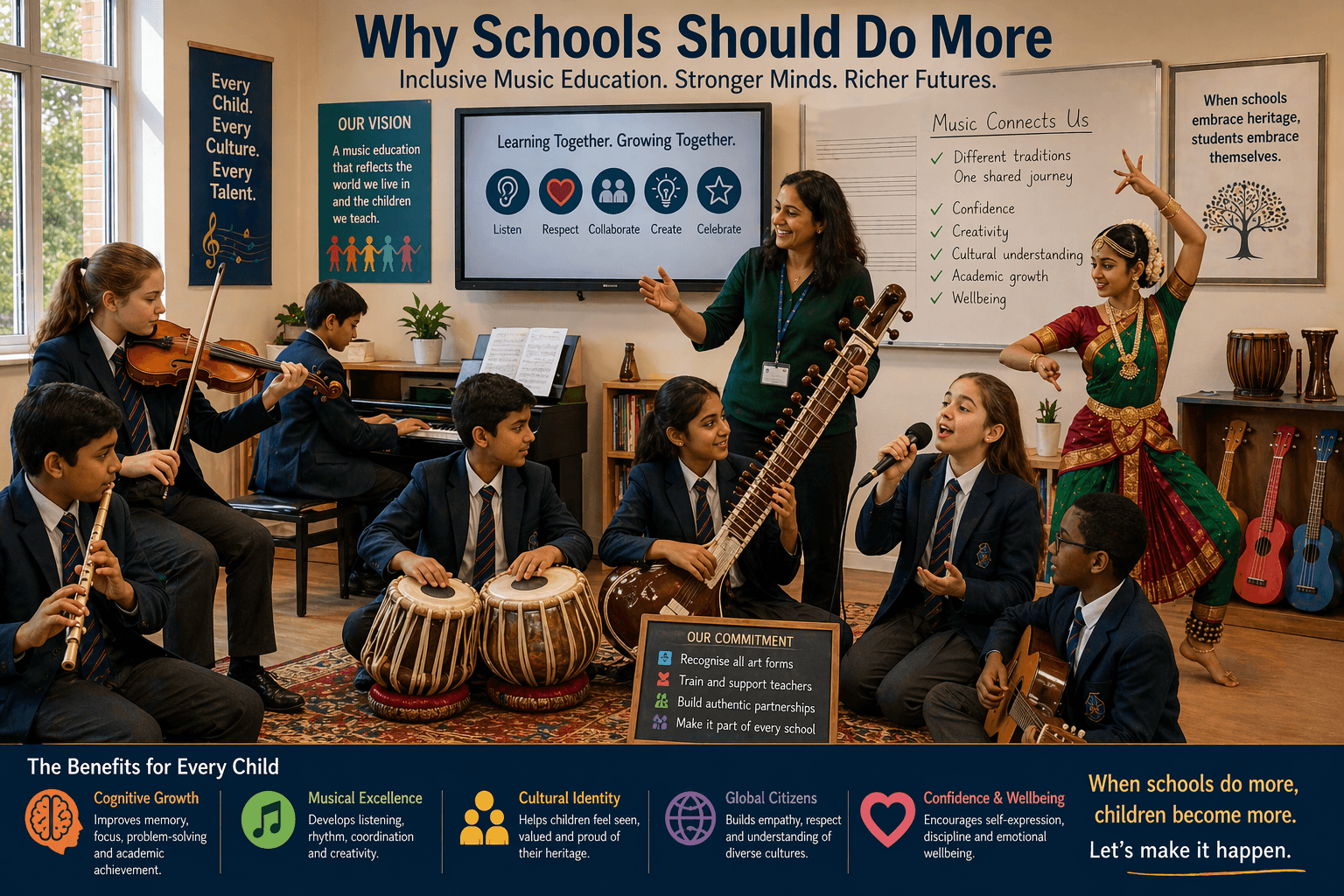
The Educational Arguments
The educational case for deeper inclusion of Indian classical music in British schools is robust. Indian classical music:
Develops exceptional musical ear training through its emphasis on precise pitch and microtonal awareness. This benefits the development of general musicianship at a level that Western popular music exposure typically doesn't reach.
Builds mathematical thinking through its complex tala systems — rhythmic cycle structures that involve sophisticated arithmetic reasoning in real time.
Provides genuine multicultural music education for all students, not just South Asian students. In a genuinely multicultural British society, encountering and engaging with the world's great musical traditions is educationally valuable for every student.
Connects South Asian students to their heritage in a formal educational context, addressing the documented cultural identity gap that many British-Indian children experience in education systems that don't reflect their backgrounds.
The Cultural Arguments
Britain is home to one of the world's largest and most successful Indian diaspora communities. The arts and music of that community deserve recognition within the mainstream cultural and educational life of the country. Indian classical music's inclusion in British schools is not only educationally sound but culturally appropriate.
The 2011 Census identified approximately 1.4 million people of Indian origin in the UK. The 2021 Census confirmed continued growth of the British Indian community. These children attend British schools. Their cultural heritage deserves space in those schools' music curricula.
Conclusion
British school music education is a genuinely strong system that is slowly, imperfectly, and unevenly beginning to make room for Indian classical music traditions. The gap between what British-Indian families need and what schools currently provide remains significant. The most effective strategy for most families is a combination of advocacy within schools and independent online Indian classical education alongside mainstream schooling.
Three things to take away. First, advocate at your child's school using the National Curriculum's breadth requirement and the Model Music Curriculum's explicit endorsement of world music traditions. Second, pursue parallel Indian classical education through qualified online teachers. Third, document your child's Indian classical music achievements formally as Ofqual-accredited pathways become available.
Book a free trial Indian classical music or dance class at Art Gharana today and give your child the cultural education they deserve and their school likely cannot yet provide.
Frequently Asked Questions
1. Is Indian classical music included in the UK National Curriculum?
The UK National Curriculum requires breadth in music education including different historical periods, genres, styles, and traditions. Indian classical music can legitimately be included under this breadth requirement. In practice, inclusion varies widely between schools, with many focusing primarily on Western classical and popular traditions.
2. Can British-Indian students use their Indian classical music training for GCSE Music?
GCSE Music is primarily assessed through a Western classical music theory framework. Students with Indian classical training can use non-Western instruments for the performance component but typically need to demonstrate theory knowledge in Western notation. This is a genuine limitation of the current GCSE framework that advocacy groups are working to address.
3. Are there after-school Indian classical music programmes in UK schools?
Some schools in areas with large South Asian communities have established enrichment clubs, lunchtime music sessions, or after-school programmes featuring Indian classical music. These are typically organised by individual teachers, community organisations, or parent groups rather than being built into the standard curriculum.
4. How can parents get Indian classical music added to their child's school curriculum?
Request a meeting with the Head of Music, bring examples of what Indian classical music education involves, reference the National Curriculum breadth requirement and Model Music Curriculum, and connect the school with organisations that already deliver Indian classical music in educational settings. Building a group of interested parents is more effective than a single-family request.
5. Do UK universities consider Indian classical music qualifications in applications?
Within the UCAS system, only Ofqual-regulated qualifications currently carry formal tariff points. Indian classical examination certificates from ABGMM or similar bodies carry community prestige but not formal UCAS weighting. This is expected to change as Ofqual-accredited Indian music qualifications become more established.