Raag Yaman is the most commonly taught introductory raga in Hindustani classical music - the entry point through which millions of students first experience the beauty, depth, and logic of the raga system. This comprehensive guide covers Raag Yaman's history and origin, its defining technical characteristics, its aroha-avaroha and characteristic phrases, the emotional quality it evokes, the famous compositions associated with it, how to practise it effectively, and how it connects to the broader Hindustani classical music system.
What Is Raag Yaman?
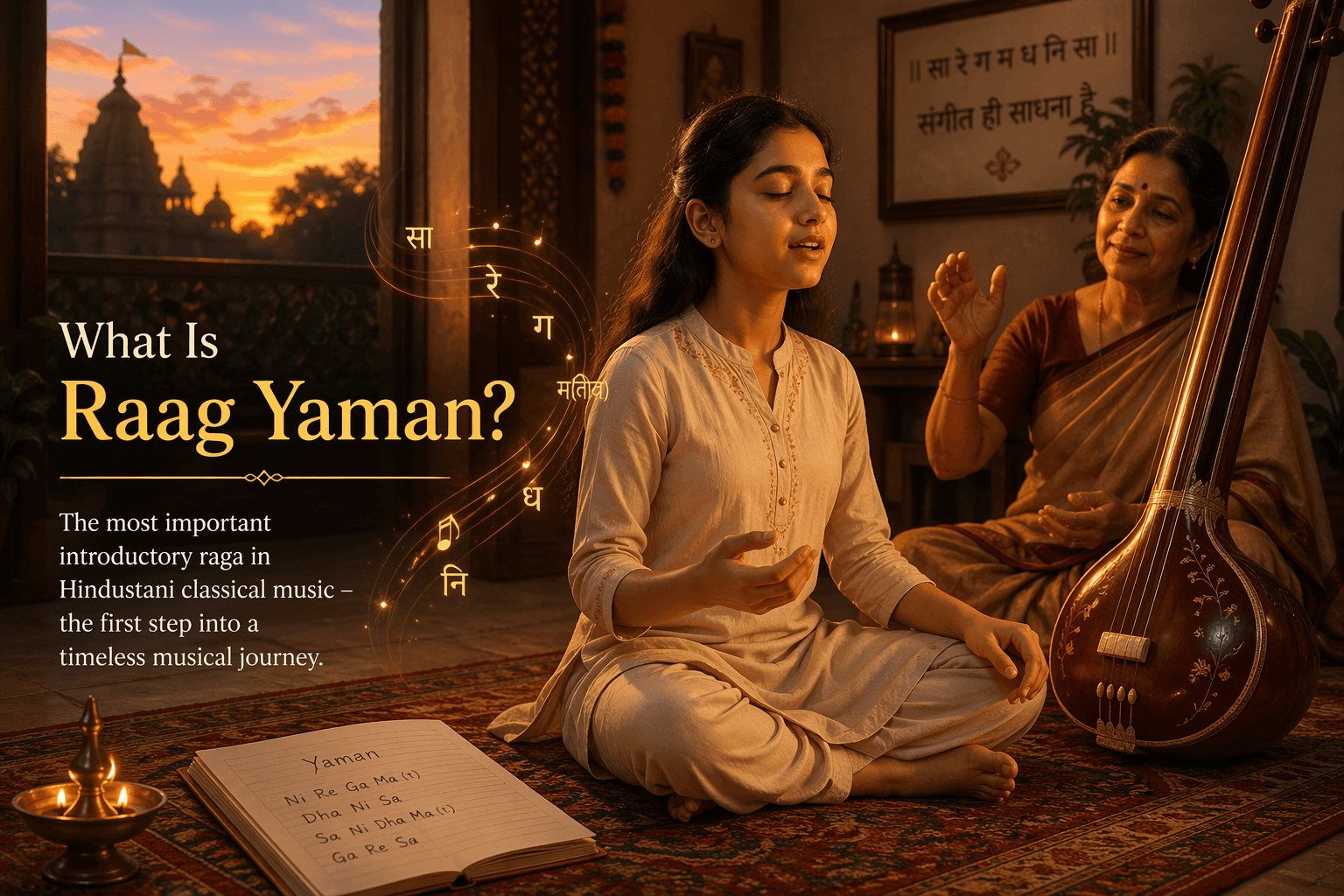
The Most Important Introductory Raga
Raag Yaman is the first raga most Hindustani music students learn in formal instruction. Its reputation as the ideal introductory raga is not arbitrary - it reflects several qualities that make it simultaneously accessible to beginners and endlessly rewarding for advanced musicians.
The Historical and Cultural Background
Yaman is believed to derive from the Kalyan thaat (parent scale). Its origins are sometimes traced to the Persian musical tradition (the name Yaman derives from the Arab musical mode Nahawand in some scholars' interpretations), though the raga has been thoroughly integrated into the Hindustani classical tradition for centuries.
Why Teachers Choose Yaman First
Raag Yaman is typically the first raga introduced to Hindustani music students for several specific reasons:
All seven swaras are present, giving students a complete palette for melodic exploration from the start.
The characteristic feature (tivra madhyam - the sharp fourth) is clear, distinctive, and easy for beginners to hear and identify.
The raga's emotional quality (veerta or heroic, sometimes described as serene, majestic, or uplifting) is accessible and immediately appealing.
The aroha-avaroha (ascending-descending scale patterns) are relatively straightforward compared to many ragas.
A rich repertoire of bandishes (compositions) exists at every level of difficulty.
The Technical Characteristics of Raag Yaman
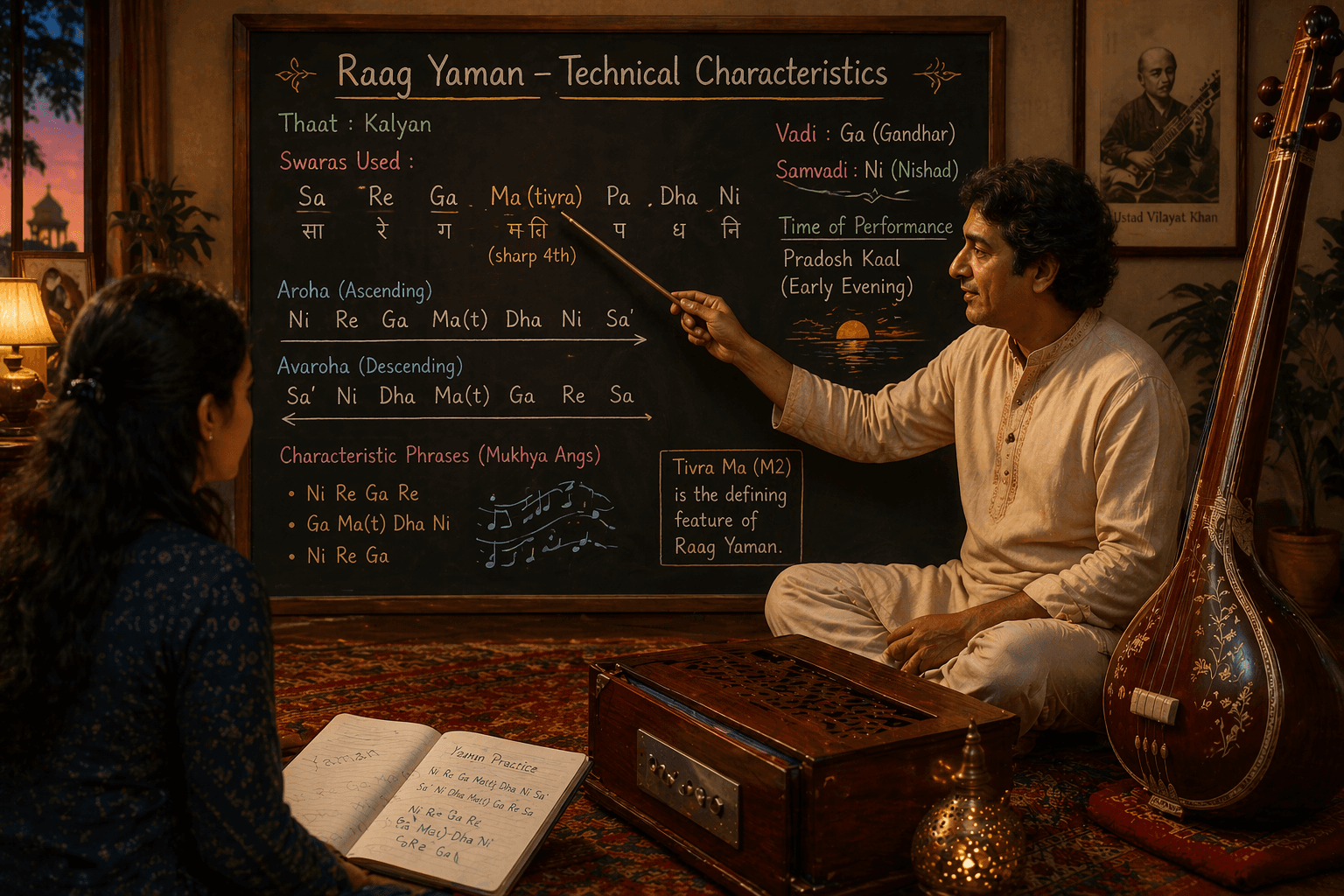
Thaat: Kalyan
Raag Yaman belongs to the Kalyan thaat, one of the ten parent scales (thaats) of Hindustani classical music as classified by Pandit Vishnu Narayan Bhatkhande. The Kalyan thaat uses all seven swaras with Tivra Ma (sharp fourth).
Swaras Used
All seven swaras are present in Raag Yaman: Sa, Re (Shuddha), Ga (Shuddha), Ma (Tivra - the defining feature), Pa, Da (Shuddha), and Ni (Shuddha).
The Critical Role of Tivra Madhyam
Tivra Ma (M2 - the sharp fourth, equivalent to F# in C reference) is the defining characteristic of Raag Yaman. This is the note that distinguishes Yaman from all other ragas using the same seven-swara scale. It is always rendered with particular care and musical emphasis.
When a Hindustani musician hears the characteristic phrase ni-re-ga-ma(t) or the approach to ma(t) from ga, they immediately recognise Yaman. The tivra ma is Yaman's musical signature.
Aroha and Avaroha
Aroha (Ascending Scale)
Ni Re Ga Ma(t) Dha Ni Sa (upper)
Note that the ascending scale typically begins from the lower Ni (Ni below Sa) rather than from Sa itself. This lower Ni approach is characteristic of Yaman and is one of its most important identifying features.
Avaroha (Descending Scale)
Sa Ni Dha Ma(t) Ga Re Sa
H4: Characteristic Phrases (Mukhya Angs)
Ni Re Ga Re - the characteristic ascending movement through the lower region Ga Ma(t) Dha Ni - the medial characteristic phrase Ni Re Ga - frequently used as a short mukhya ang
Vadi and Samvadi
Vadi
Gandhar (Ga) - the third, which is given special emphasis and from which many characteristic phrases are developed.
Samvadi
Nishad (Ni) - the seventh, which is equally important in Yaman's melodic personality and frequently appears at phrase beginnings and endings.
Time of Performance
Pradosh Kaal - Early Evening
Raag Yaman is traditionally performed in the early evening, approximately from sunset to the first quarter of the night. In Indian classical music theory, ragas are associated with specific times of day and seasons - and these associations are based on the emotional qualities that the ragas evoke.
Yaman's association with early evening reflects its emotional quality: a sense of anticipation, peaceful beauty, and dignified serenity that many listeners associate with the transition from day to night.
The Emotional Quality of Raag Yaman
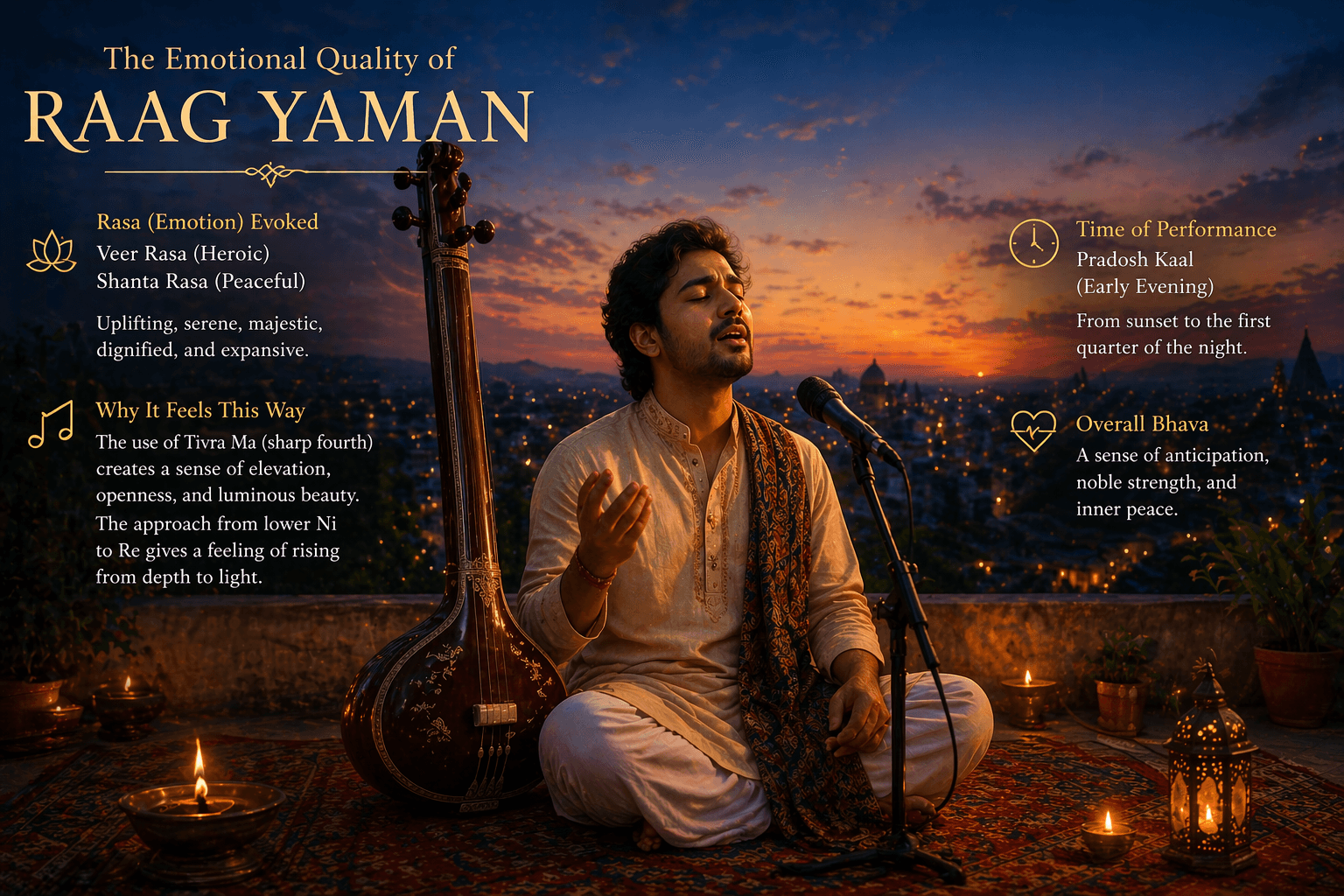
Rasa and Bhava
In the Indian aesthetic tradition, each raga evokes a specific emotional quality or rasa. Raag Yaman is primarily associated with the veer rasa (heroic sentiment) and the shanta rasa (peaceful sentiment), though different performers and different compositions within the raga can express a wide range of emotional states within this general character.
Why Yaman Feels the Way It Does
The use of tivra Ma (the raised fourth) is the primary source of Yaman's characteristic emotional quality. In Western music theory, a raised fourth creates a Lydian mode quality - a sense of floating, upward aspiration, and luminous openness. In Yaman, this same interval creates a similar quality: an elevated, expansive, somewhat majestic feeling that is immediately distinguishable from ragas using natural Ma.
The combination of this elevated fourth with the approach from lower Ni (below Sa) creates a characteristic sense of ascending from a deep foundation toward a bright, open space - an emotional arc that many listeners describe as beautiful, hopeful, or uplifting.
Famous Compositions in Raag Yaman
Khayal Compositions
Some of the most celebrated bandishes (compositions) in Raag Yaman:
Eri Ali - a classic Bada Khayal (slow composition) in Teentaal Kahe karat mora - a Chhota Khayal (medium tempo composition) Various compositions by the masters of the Gwalior, Kirana, and Jaipur gharanas
Bollywood and Popular Music Influenced by Yaman
Several iconic Hindi film songs are based on or heavily influenced by Raag Yaman:
Aaj jaane ki zid na karo - a ghazal rendered in Yaman-influenced tonality Yeh jo mohabbat hai - based closely on Yaman Tum to thehre pardesi - uses Yaman's characteristic phrases
Listening to these familiar songs with the knowledge of Yaman's characteristic phrases can dramatically accelerate ear training for students.
How to Practise Raag Yaman
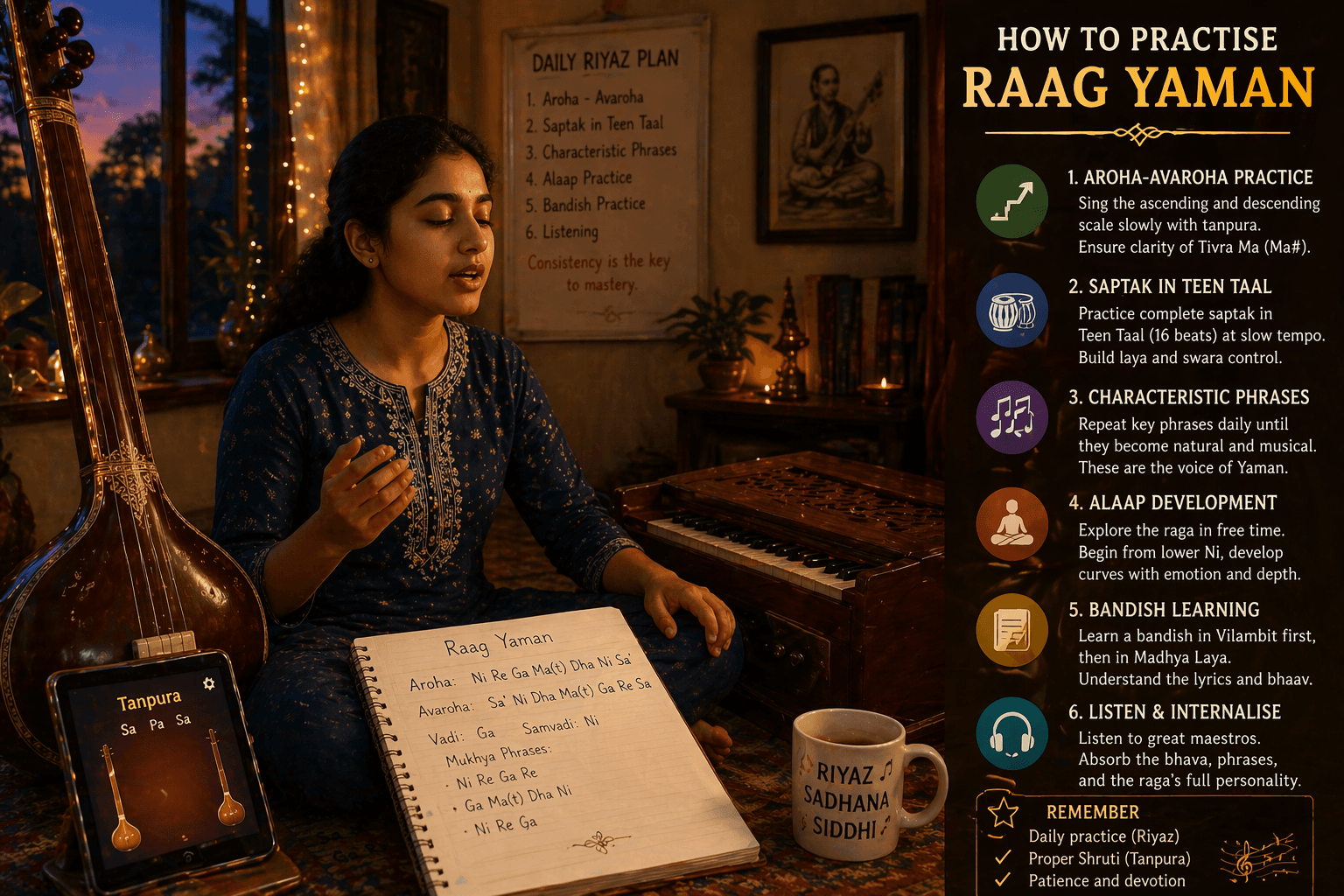
Foundation Exercises for Beginners
Aroha-Avaroha Practice
Begin with the complete aroha and avaroha at a slow tempo, with tanpura drone, ensuring that each note is clean and the tivra ma is clear and correctly placed. Practise both vocally (singing on the note names: Ni Re Ga Ma Dha Ni Sa) and with the syllable "Aa" for tonal development.
Saptak Practice in Teen Taal
Practise the complete aroha-avaroha in Teen Taal (16-beat cycle) at slow tempo, with tabla or a metronome reference. This develops the connection between melodic and rhythmic awareness that is essential for bandish performance.
Characteristic Phrase Isolation
Isolate the three or four most characteristic phrases of Yaman and practise them repeatedly until they feel natural and inevitable. These phrases, once internalised, become the entry point for improvisation and alaap.
Alaap Development
The Free-Time Exploration of Yaman
Alaap is the slow, meditative, free-time exploration of a raga. For Yaman, a beginner alaap typically:
Begins on lower Ni, lingering there before ascending Touches Re and Ga with the characteristic Ni Re Ga phrase Approaches tivra Ma from Ga with care and melodic awareness Dwells on Dha and Ni in the upper region before touching the upper Sa
Bandish Learning
Once the alaap is comfortable, learning a complete bandish in Raag Yaman - first in Vilambit Teentaal (slow cycle) then in Madhya Laya (medium tempo) - provides a complete compositional framework within which improvisation can later develop.
Raag Yaman in the Context of Hindustani Music
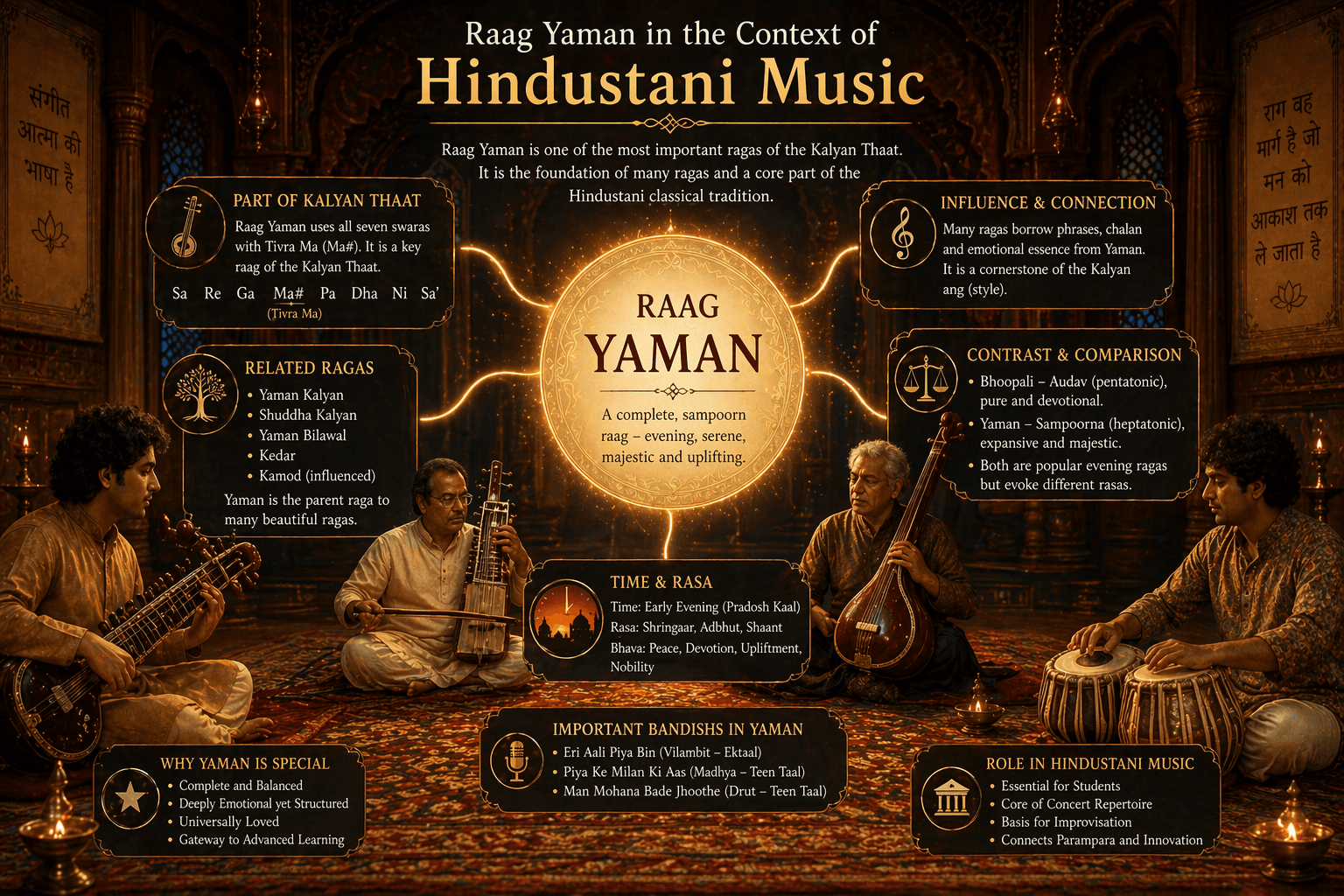
The Kalyan Thaat Family
Raag Yaman is part of the Kalyan thaat, which includes several related ragas:
Yaman Kalyan - uses both shuddha (natural) and tivra (sharp) Ma Shuddha Kalyan - uses neither shuddha nor tivra Ma in certain approaches Shyam Kalyan - uses both Ma forms with specific approaches
Understanding Yaman within its thaat family helps students understand how ragas are related, differentiated, and developed as a musical system.
Yaman vs Similar Ragas
Yaman vs Bhoopali
Both are popular introductory ragas, but Bhoopali is pentatonic (five swaras: Sa Re Ga Pa Dha) while Yaman uses all seven swaras including tivra Ma. Bhoopali's pentatonic simplicity is even more accessible for absolute beginners.
Yaman vs Bhupali Todi
Not to be confused with Bhoopali. Bhupali Todi belongs to the Todi thaat and has a completely different emotional character.
Conclusion
Raag Yaman is the perfect first raga for Hindustani music students. Its complete seven-swara palette, its clearly distinctive tivra Ma, its rich compositional tradition, and its immediately beautiful emotional quality make it simultaneously accessible and endlessly rewarding.
Three things to take away. First, practise the aroha-avaroha with tanpura every day until the sequence and the tivra ma feel completely natural. Second, learn the characteristic phrases as musical phrases, not just scale exercises - these are the musical vocabulary of Yaman. Third, listen extensively to masters' Yaman performances to internalise the raga's full emotional and musical range.
Explore Art Gharana's online Hindustani vocal classes or read our beginner's guide to Indian classical music for more on how structured Hindustani education unfolds.
Frequently Asked Questions
1. What makes Raag Yaman different from other ragas?
Raag Yaman's defining characteristic is the tivra Ma (sharp fourth) - F# in C reference. All seven swaras are present, and the approach from lower Ni is characteristic. The combination of these elements creates the raga's distinctive uplifting, majestic quality.
2. What is the best time to practise Raag Yaman?
Traditionally, Raag Yaman is an evening raga, associated with sunset and early night. Practising in the early evening is recommended. However, for students with fixed practice schedules, practising at a consistent time daily is more important than matching the traditional time.
3. How long does it take to learn Raag Yaman properly?
The aroha-avaroha and characteristic phrases can be learned in one to three months. A complete beginner bandish in Vilambit Teentaal takes another two to three months. Developing fluency in alaap and improvisation within Yaman is the work of one to two years of consistent practice.
4. Is Raag Yaman the same in Carnatic music?
Raag Yaman in Hindustani music closely corresponds to Kalyani in Carnatic music. Both use all seven swaras with a sharp fourth. They are historically related but have developed distinct characteristic phrases, gamaka patterns, and compositional traditions within their respective systems.
5. What are some Bollywood songs based on Raag Yaman?
Several Hindi film songs draw on Yaman's characteristic phrases, including Yeh jo mohabbat hai, Jab koi baat bigad jaaye, and some compositions that use the Yaman-influenced Kalyani/Lydian tonality. Listening to these while aware of Yaman's scale can significantly accelerate ear training.