ChatGPT
 Google AI
 Grok
Grok Claude
For Indian-American families across New Jersey, California, Texas, Illinois, Georgia and every other state, providing children with quality Indian music or dance education has always been a priority. The cultural, developmental and identity benefits are well understood, and the desire to give children a living connection to their heritage through the arts is one of the most universal parenting aspirations in the Indian diaspora.
The challenge has always been finding the right option from the range of online Indian music and dance classes for kids in the USA available. The landscape spans from pre-recorded video courses to tutor marketplaces to live online classes, and the quality and cultural relevance of these options vary enormously. This guide is designed to help Indian-American parents cut through the noise, understand the real options and make a confident decision about where to start.
Understanding Your Options: Dance, Instruments and Vocal
Bollywood Dance
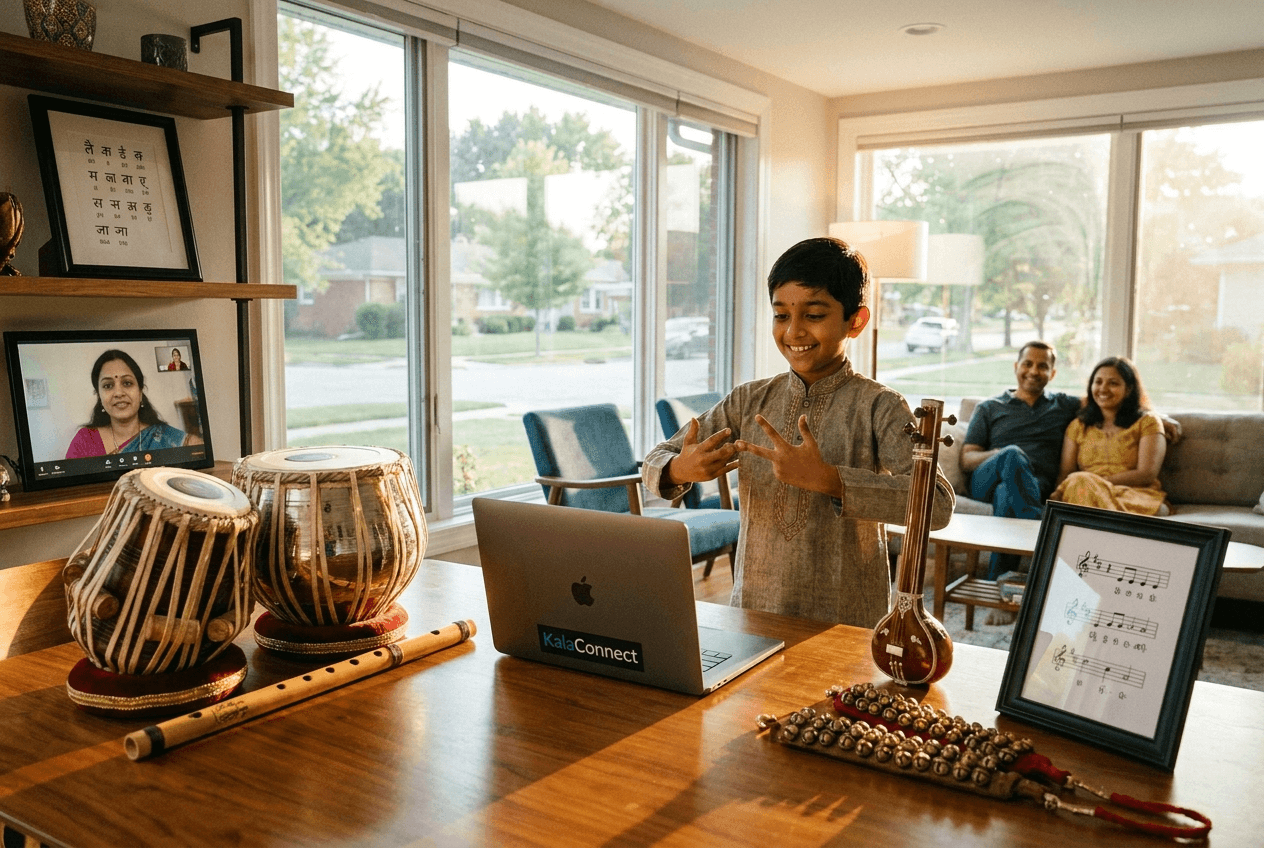
Bollywood dance is the most immediately accessible and entertaining starting point for most children. It blends the energy of Indian film choreography with elements of classical and folk dance and is set to music that children already know and love. Classes are joyful, high-energy and an excellent first introduction to Indian arts education. Best suited to children who love to move and who respond enthusiastically to music.
Kathak
Kathak is one of India's eight classical dance forms, characterised by intricate footwork, spectacular spinning sequences and expressive storytelling rooted in the devotional traditions of North India. It requires patience and genuine commitment but produces extraordinary results in terms of physical grace, rhythmic intelligence and cultural knowledge. Best suited to children who are drawn to precision and discipline. Full details on our Kathak classes page.
Bharatanatyam
Bharatanatyam is the classical dance of South India, combining powerful footwork, intricate hand gestures and expressive storytelling in a tradition rooted in ancient temple ritual. It is deeply connected to Carnatic music and Tamil and Telugu cultural heritage. Best suited to South Indian families and children drawn to the grandeur and spiritual depth of the classical tradition. Full details on our Bharatanatyam classes page.
Tabla
The tabla is the rhythm instrument of Hindustani classical music. It develops bilateral coordination, mathematical thinking and deep rhythmic awareness to a degree that few other instruments match. Best suited to children drawn to percussion and rhythm. Our tabla classes cover everything from first strokes through to classical compositions.
Flute
The bansuri is one of the most evocative instruments in Indian music and is associated with the devotional tradition of Krishna in the Hindustani tradition and with classical South Indian performance in the Carnatic tradition. It develops breath control, tone production and melodic sensitivity. Best suited to children with a natural musical ear. Our flute classes are taught by certified Hindustani and Carnatic flute teachers.
Hindustani Vocal
Hindustani vocal is the classical singing tradition of North India. It is built on the raga system and encompasses khayal, thumri and bhajan compositions. Best suited to children from North Indian families and those with a natural singing voice. Our Hindustani vocal classes are delivered by formally trained classical vocalists.
Carnatic Vocal
Carnatic vocal is the classical singing tradition of South India, closely associated with Bharatanatyam and deeply embedded in Tamil, Telugu and Kannada cultural heritage. Best suited to South Indian families and those interested in the profound melodic depth of the Carnatic tradition. Our Carnatic vocal classes are taught by certified South Indian classical vocalists.
How to Choose the Right Art Form for Your Child
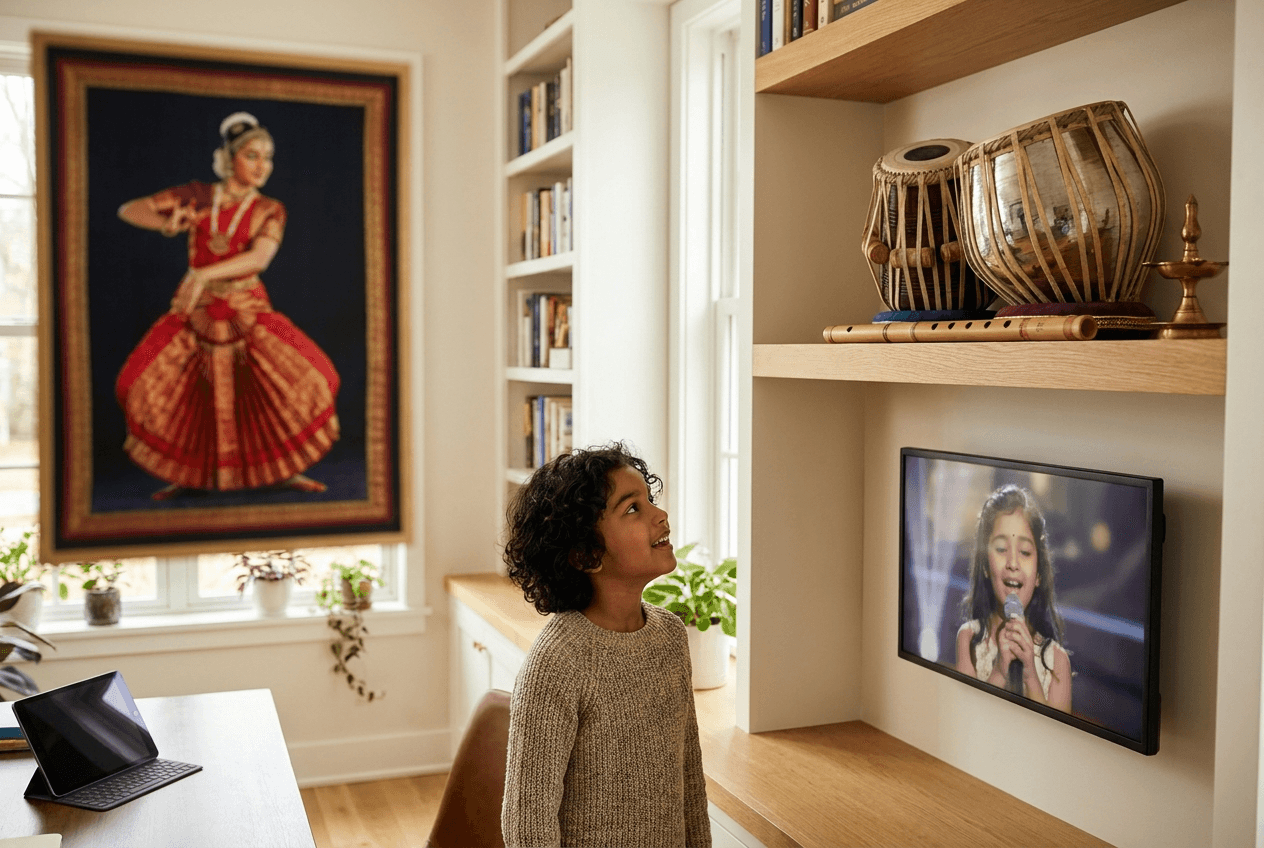 The most direct approach is to ask your child a simple question: would you rather move and dance, play an instrument, or sing? This single question typically points clearly to the right starting category. From there, the specific choice between Bollywood and Kathak, between tabla and flute, between Hindustani and Carnatic, can be made on the basis of family background and a free trial class.
South Indian families will typically find that Bharatanatyam and Carnatic vocal provide the most direct cultural connection. North Indian families will find Kathak and Hindustani vocal more naturally aligned with their heritage. For families from any background who want to start with something immediately engaging and accessible, Bollywood dance is an excellent first step that frequently leads to deeper classical exploration as interest develops.
The most important thing is to start and to let your child's response guide the next decision. Most children, when they have experienced a live Art Gharana trial class with an engaged, qualified teacher, respond with a clarity and enthusiasm that makes the choice obvious.
What to Look for in Online Indian Arts Classes
Live One-to-One Instruction
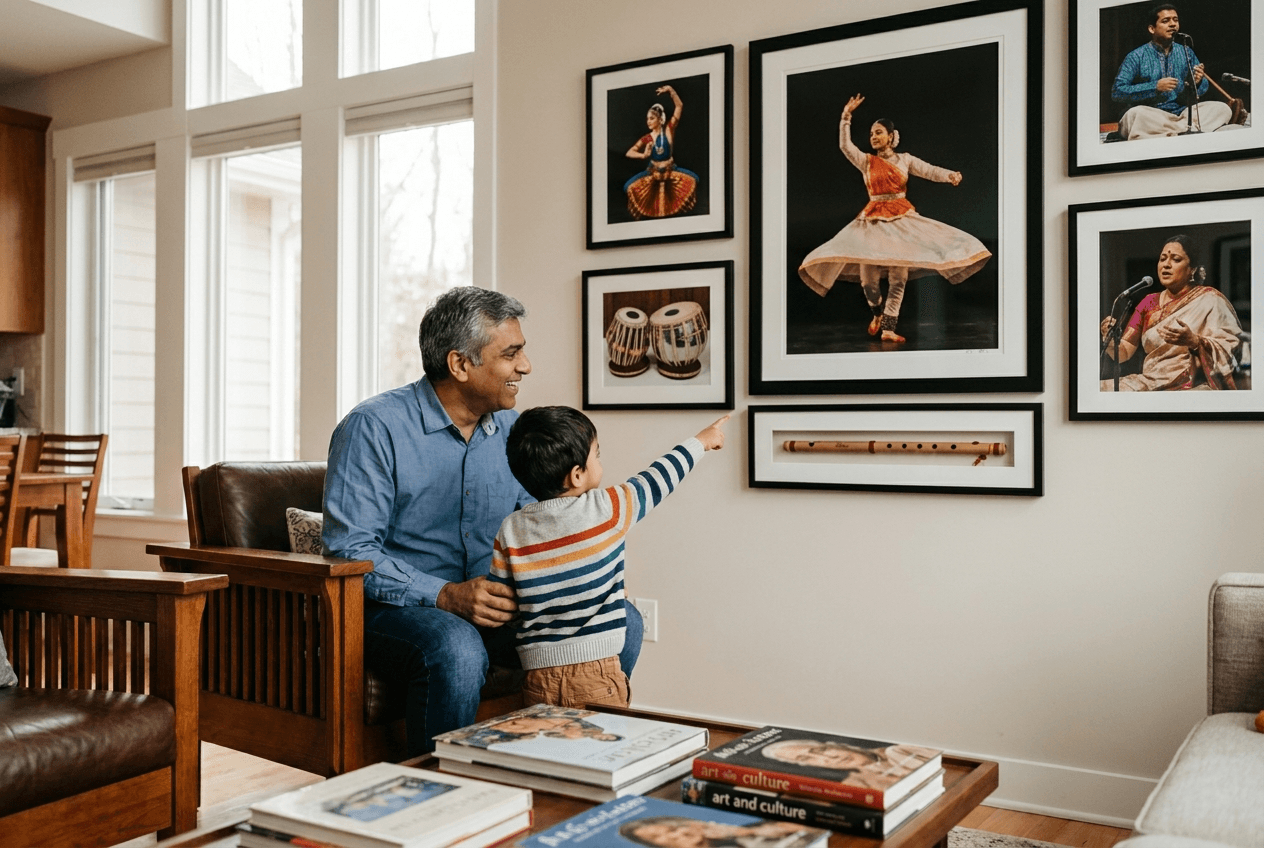
The most important differentiator in online Indian arts education is the format of instruction. Live one to one classes allow the teacher to see your child clearly throughout the session, provide real-time corrections, adapt to your child's pace and energy on any given day and build the personal relationship that motivates long-term commitment. Pre-recorded videos and group classes both have roles as supplements, but neither can replace the precision and personal responsiveness of live one to one teaching for developing a young musician or dancer effectively.
Qualified and Verifiable Teachers
In classical Indian arts, teacher qualifications matter enormously. A tabla teacher who has trained under a recognised ustad, a Bharatanatyam teacher certified by a classical institution, a Hindustani vocalist who has completed serious classical training under a recognised guru: these credentials ensure that what your child learns is authentic and not a diluted or inauthentic version of the tradition. Always ask about a teacher's training background and qualifications before enrolling.
US-Compatible Scheduling
Many online Indian arts providers operate primarily in Indian Standard Time or UAE time zones, which consistently clashes with US school hours and family schedules. Art Gharana offers full flexibility across all US time zones, including morning, after-school, evening and weekend slots across Eastern, Central, Mountain and Pacific. This flexibility is not a minor convenience. It is the difference between a class that happens consistently every week for years and one that is constantly rescheduled until it quietly stops.
A Structured Curriculum With Clear Progression
A structured curriculum with clear levels, regular assessments and certificates gives you confidence that your child is progressing purposefully rather than treading water. Review our plans and pricing to see how Art Gharana structures its programmes and what each plan includes.
The Long-Term Benefits Are Extraordinary
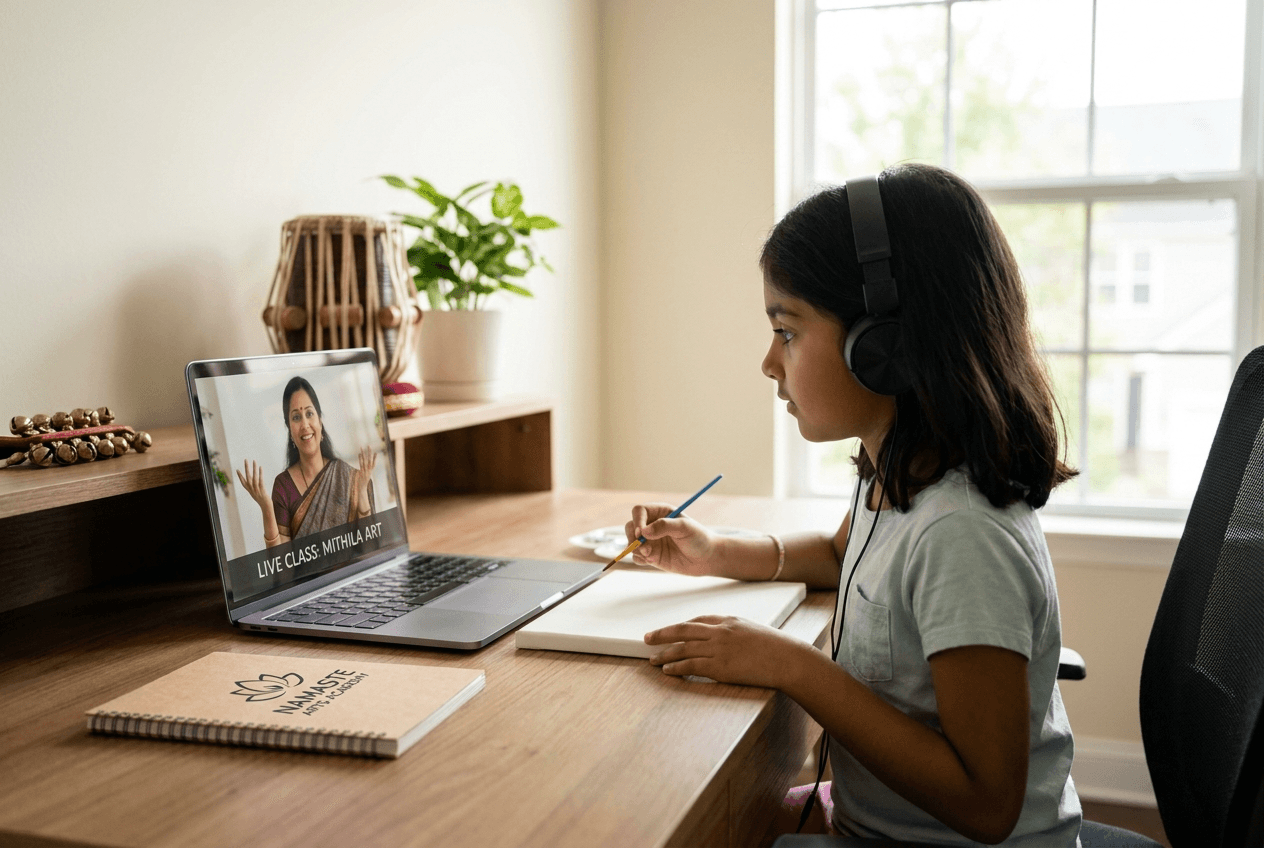 The developmental evidence for sustained Indian arts education is compelling and now well-documented. Children who receive structured music or dance training consistently perform better academically than comparable children who do not, across mathematics, language arts, working memory and executive function. The mechanisms are well understood: the memorisation demands build working memory, the rhythmic structures build mathematical thinking, the practice discipline builds the habits of sustained effort that underlie academic success.
Beyond academics, the cultural identity benefits are profound. Indian-American children who have a strong, active cultural identity are more emotionally resilient, socially confident and better equipped to navigate the complex identity challenges of growing up between two cultures. The arts are the most powerful tool available for building that identity, because they make cultural heritage something that is physically lived and actively practised rather than merely asserted.
And beyond both academics and identity, there is simply the joy of mastery. The child who has worked for three years to develop their Kathak technique, who can execute a clean chakkar sequence and feel the ghungroos respond to their footwork, has experienced something that all the screen time in the world cannot replicate: the deep, earned satisfaction of genuine skill developed through disciplined effort. That satisfaction, and the confidence it builds, is one of the most enduring gifts a parent can give.
Art Gharana: A Complete Indian Arts Education for US Families
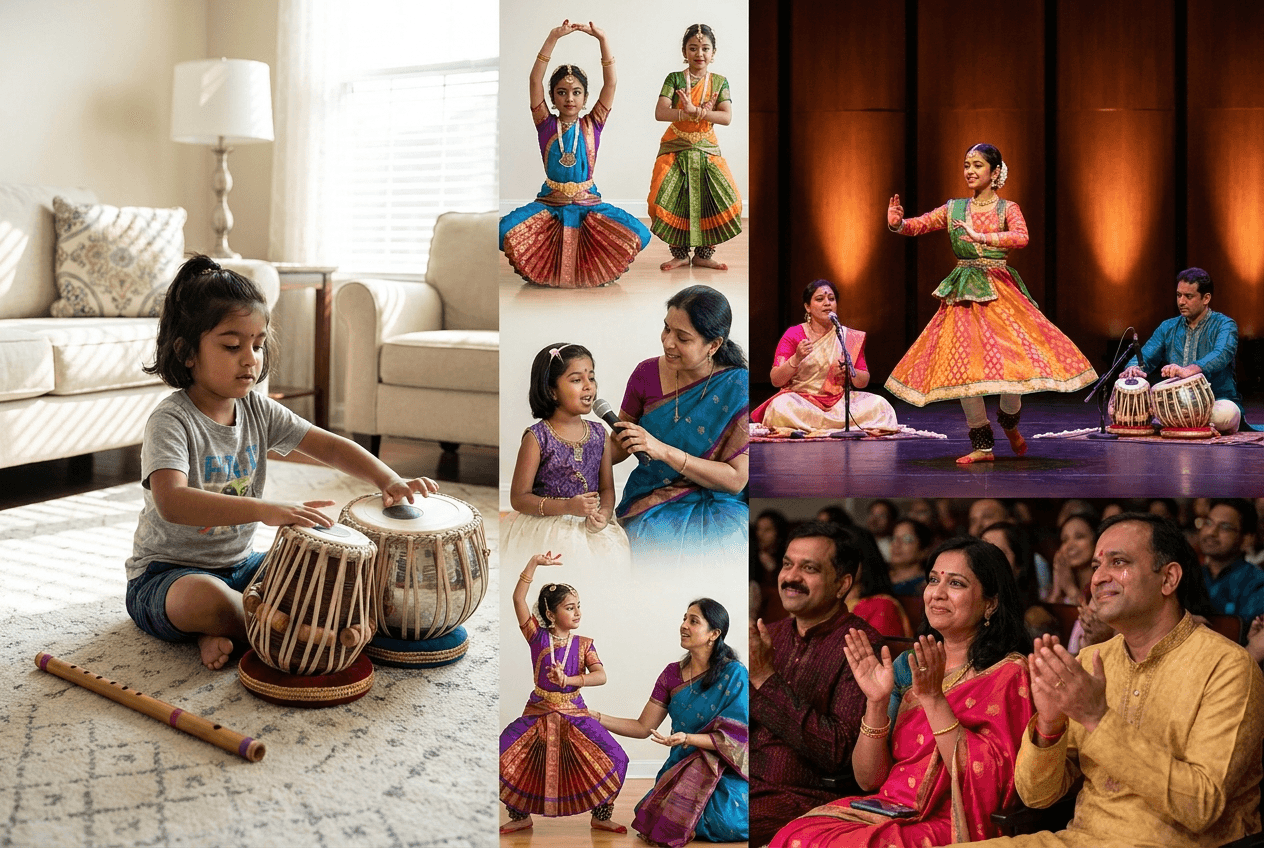 Art Gharana is a specialist online Indian arts education platform with over 50 certified teachers across dance, music and vocal disciplines. All classes are live, one to one and available in all US time zones. Every new student begins with a completely free trial class. Browse teacher biographies on our teacher profiles page to find the right instructor for your child before booking.
Frequently Asked Questions
1. Which Indian instrument is easiest for a child to start with?
Tabla is recommended for children drawn to rhythm. Flute is excellent for children with a natural melodic ear. Bollywood dance is the best starting point for most children who love to move. The right choice depends entirely on the individual child's temperament and interests.
2. Should my child learn Bollywood dance or classical Indian dance first?
Bollywood dance is typically the better starting point for most children because it is immediately fun and engaging. Classical forms like Kathak and Bharatanatyam build on that foundation with greater technical depth and cultural grounding over time. Many children begin with Bollywood and develop a serious interest in classical training as their musical understanding grows.
3. How do I know which art form is right for my child?
The simplest way is to try a class. Art Gharana offers free trial classes across all disciplines. Most children, after experiencing one live class with a genuinely engaging teacher, give you a very clear signal about whether they want to continue. Following that signal is the most reliable guide available.
4. Are all Art Gharana teachers formally qualified?
Yes. Every teacher on the Art Gharana platform holds formal qualifications in their discipline and has been vetted for teaching experience and ability to engage effectively with children in the online format.
5. Is there a free trial class?
Yes. Art Gharana offers a completely free first class in any discipline with no obligation whatsoever. Your child meets their potential teacher, experiences what a live online class feels like and tries some introductory movements or exercises before any commitment is made.
Book Your Child's Free Trial Class Today
Finding the right Indian music or dance class for your child in the USA has never been easier. With Art Gharana's full range of online courses, certified teachers, US-compatible scheduling and a completely free first lesson, you can explore all the options without any risk or obligation. Head to our book a free trial class page and take the first step today.
How to Evaluate Any Online Indian Arts Provider
With dozens of platforms, independent teachers and community programmes offering Indian arts education online for US families, a clear evaluation framework is genuinely useful. Ask these three questions first. What is the teachers training and lineage? In classical Indian arts, a teachers own training history matters enormously. A Kathak teacher who studied under a recognised guru in the Lucknow or Jaipur gharana tradition brings an authenticity and depth that a teacher who learned primarily from other online students cannot replicate. Ask specifically about the teachers guru, training institution, performance experience and any formal certifications held. Is the instruction live and one to one? The distinction between live one to one instruction and group classes or pre-recorded video courses is the single most consequential quality differentiator. Group classes and pre-recorded content have their place as supplements but cannot serve as the primary medium for developing a classical arts student effectively. Does the provider offer classes in your time zone with genuine scheduling flexibility? India Standard Time is 10.5 to 13.5 hours ahead of US time zones. A provider that only offers slots in IST is not truly serving US families.
Art Gharana for US Families
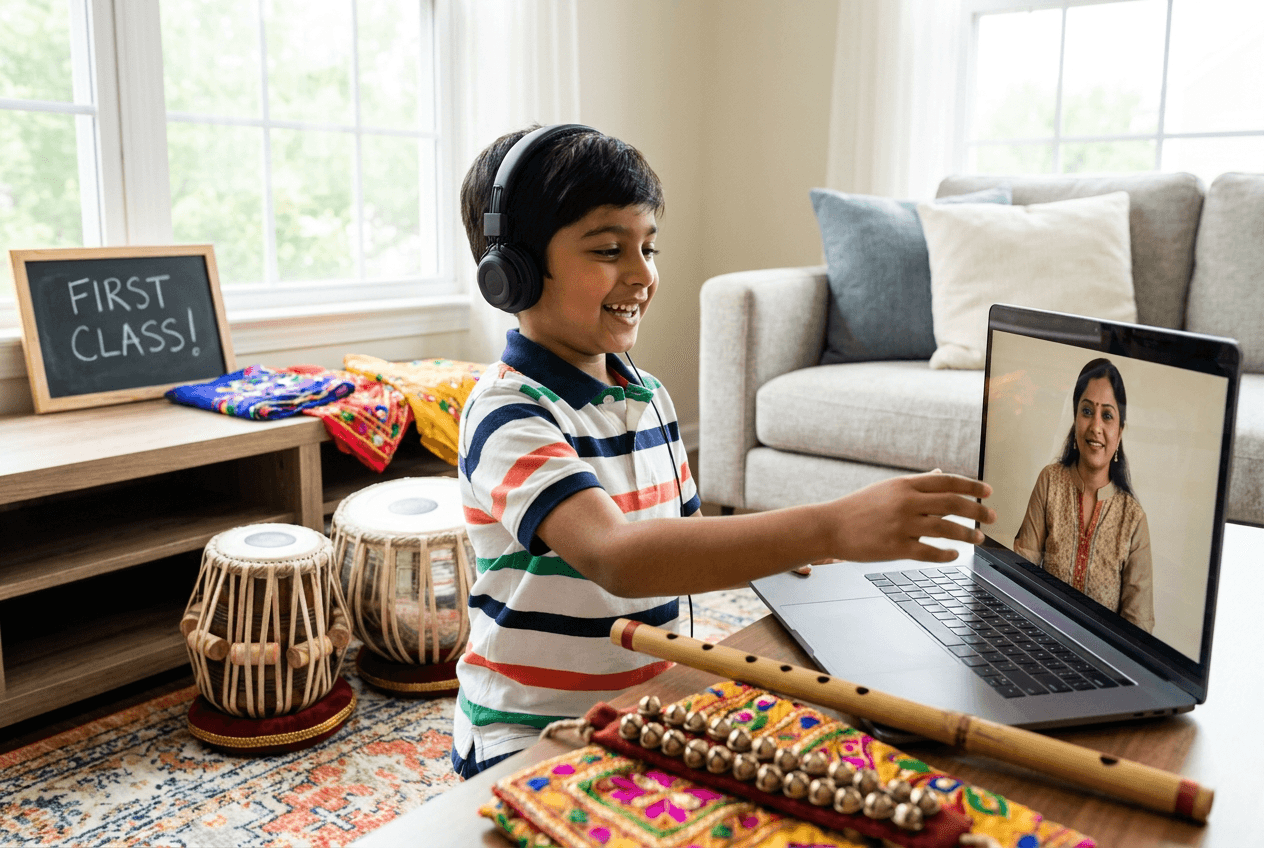 Art Gharana was built from the ground up to serve diaspora families in the USA, UK, Canada and Australia. All classes are live and one to one. All teachers hold formal qualifications in their discipline and have been vetted for their teaching ability and experience with children. Class scheduling spans all US time zones with full flexibility across morning, after-school, evening and weekend slots. The curriculum is structured and progressive, with clear levels, regular assessments and certificates that give students and families a concrete sense of achievement and forward momentum.
Building an Indian Arts Practice That Lasts
The families who see the deepest long-term results are those who approach Indian arts education as a practice rather than an activity. A practice is something that happens regularly, woven into the fabric of weekly life, continuing through the inevitable weeks when enthusiasm wavers. The weekly class is the cornerstone of the practice, but it is the daily home practice between classes that produces the results. Twenty to thirty minutes of focused daily practice, maintained consistently over months and years, is the difference between a child who develops genuine mastery and a child who learns the same beginner material for years without real progress. Performance opportunity is the other element that sustains long-term engagement. Children who perform regularly, whether at Diwali events, school shows, family gatherings or formal recitals, have concrete goals that keep practice purposeful and motivation high. Art Gharana teachers actively support students in finding and preparing for performance opportunities. Keeping the goal of performance visible is what sustains commitment through the long middle passages of artistic development and ultimately produces the moments of cultural pride and personal achievement that make the entire journey worthwhile. A question that comes up frequently in Indian-American parent communities is whether it is better to enroll a child in one Indian art form and pursue it deeply, or to expose them to several and let them develop breadth. The honest answer is that depth produces more lasting value than breadth in classical arts education, and that breadth should be sequential rather than simultaneous. A child who studies Kathak seriously for three years before adding Hindustani vocal has developed a rhythmic foundation that directly enriches the vocal training. A child who studies four things simultaneously for three years may have surface exposure to several disciplines but genuine mastery of none. The most successful path for most Indian-American families is to start with one discipline, chosen based on the childs natural inclinations, pursue it with genuine consistency for two to three years, and then consider whether to add a complementary second discipline or to continue deepening the primary one. Art Gharana teachers are experienced at giving honest guidance on this question for individual students, and the free trial class across different disciplines makes it easy to gather the information you need to make a good decision. The final consideration for families evaluating their options in 2026 is simply this: the best time to start was when your child was four or five years old. The second best time is today. Every year of delay is a year of the developmental window when learning comes most naturally that passes unretrieved. Whatever the art form, whatever the age, beginning consistently and pursuing with genuine commitment produces results that reward the family for decades. Art Gharana is ready to begin that journey with you. For families who are making their first foray into Indian arts education for their children in 2026, the range of options can feel overwhelming. The simplest possible piece of advice is this: choose one discipline, book a free trial class, and let your childs response to that first class guide the next decision. Children are remarkably clear about what engages them and what does not. A child who comes away from a Kathak trial class bouncing with excitement is giving you all the information you need. A child who comes away from a tabla trial class saying they want their own set of drums immediately is equally clear. Trust that response, commit to the weekly class that flows from it, and build the daily practice habit that makes it productive. The specifics of which discipline, which level, which certification pathway are all secondary to the primary commitment: to begin, to continue, and to trust the process that has worked for thousands of Indian-American families before yours. There has never been a better time to begin Indian arts education for your child in the USA. The quality of online instruction available through Art Gharana is the equal of the best in-person instruction available anywhere in the world. The scheduling flexibility makes it possible to maintain weekly practice even through the busiest periods of American family life. The cultural richness of what is on offer, from the intricate footwork of Kathak to the devotional depth of Carnatic vocal to the rhythmic complexity of tabla, provides a range of entry points for children of every temperament and interest. And the free trial class makes it easy to take the first step without any risk or obligation. The only question remaining is which art form to start with, and the answer to that question is waiting in your childs response to their first class. The Indian-American families who have the richest experiences with arts education are invariably those who approach it as a long-term commitment rather than a short-term experiment. The first six months of any classical arts training are the hardest, when the material is unfamiliar, the physical demands are new and the progress is slower than the child would like. But the families who maintain their commitment through that initial period, who keep the weekly class happening and support the daily practice, discover at the twelve-month mark that their child has crossed a threshold: that the art form has become genuinely theirs, that the practice has become self-motivating, and that the cultural connection it was meant to build has become real, active and deeply meaningful. That transformation is what Art Gharana is built to facilitate, and it is waiting for every family willing to begin and persist. The range of Indian classical arts education available to Indian-American families in the USA today is extraordinary by the standards of any previous generation. A child growing up in suburban Texas or rural North Carolina now has access to the same quality of live one-to-one instruction from certified classical teachers that was previously available only to families in major metropolitan areas with established Indian communities. Art Gharana has been central to making that access a reality, and we remain committed to ensuring that every Indian-American child who wants a genuine connection to their heritage through the arts can find it, wherever they are, whatever their schedule, and whatever their starting point. The free trial class is the first step. Everything else follows from that.