ChatGPT
 Google AI
 Grok
Grok Claude
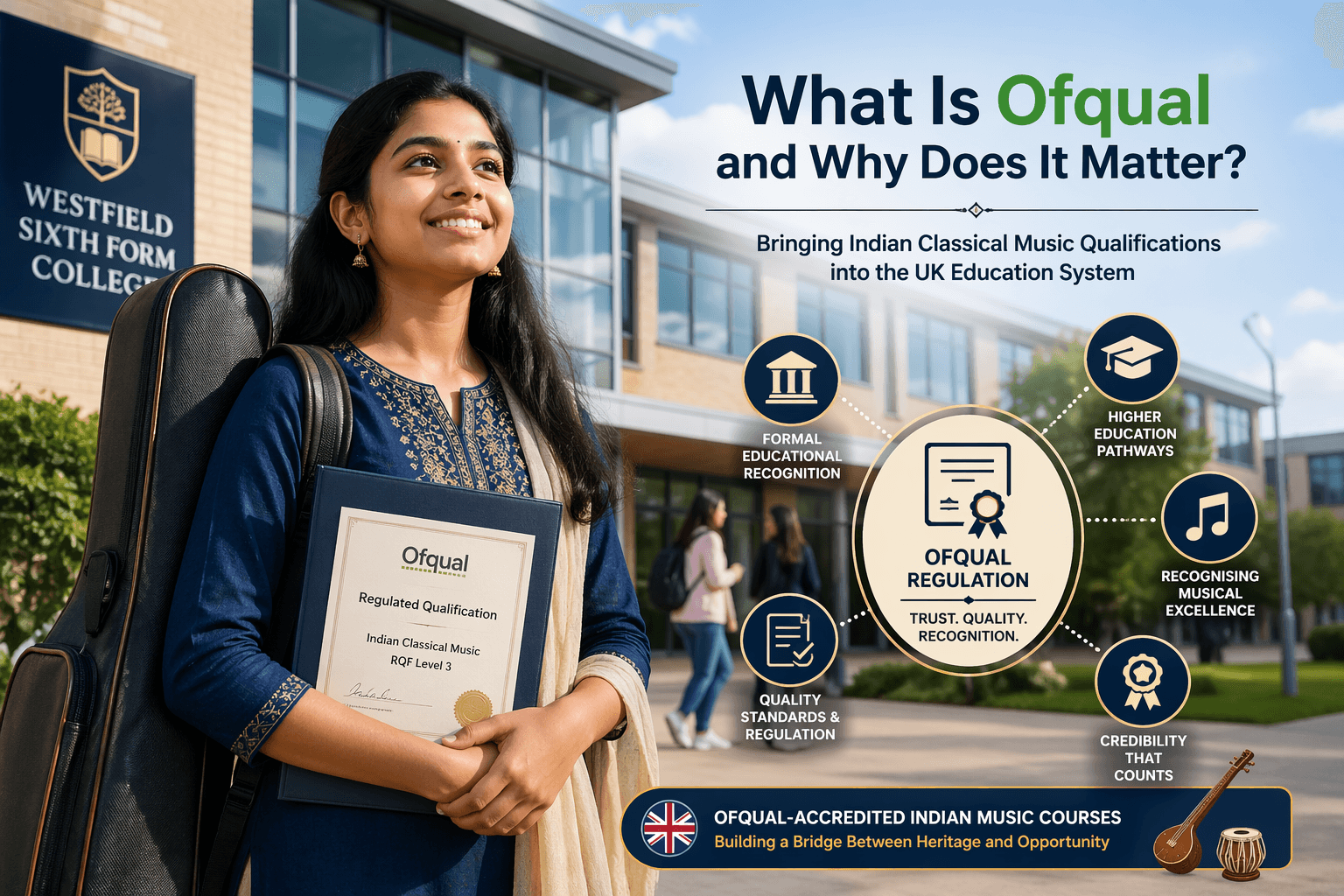
Ofqual is the UK government body that regulates qualifications. An Ofqual-accredited Indian music course places your qualification on the UK's Regulated Qualifications Framework, giving it formal educational recognition that traditional Indian examination certificates currently lack in the UK system. This comprehensive guide explains what Ofqual regulation means practically, how to verify accreditation, what it gives your child that traditional Indian music certificates don't, and how to choose a genuinely accredited course versus one that merely claims recognition.
Let's be honest about a gap that has existed for decades in British-Indian music education.
Your child studies Hindustani classical music seriously. They practise for hours each week. They take ABGMM examinations. They reach Madhyama Purna level after years of dedicated work. They're genuinely accomplished musicians.
And then they apply for a sixth form music scholarship, or their UCAS application, or a music-related programme, and the question is: what formal qualifications does your child have in music?
The ABRSM grades their classmate holds from piano lessons carry UCAS points. Their Indian classical music credentials, despite representing deeper musical knowledge and longer training commitment, carry nothing in the formal UK educational system.
That's the gap. And Ofqual-accredited Indian music courses are beginning to close it.
What Is Ofqual and Why Does It Matter?
The UK's Independent Qualification Regulator
The Office of Qualifications and Examinations Regulation (Ofqual) was established by the Apprenticeships, Skills, Children and Learning Act 2009. It is an independent UK government body that:
- Regulates qualifications, examinations, and assessments in England
- Maintains the Regulated Qualifications Framework (RQF)
- Sets and monitors standards that awarding organisations must meet
- Approves new qualifications for inclusion on the RQF
- Provides public transparency through a searchable qualifications register
The key insight is this: Ofqual doesn't create qualifications. It regulates the organisations that create and award them. Any qualification whose awarding organisation is regulated by Ofqual, and which appears on the Ofqual register, is an "Ofqual-regulated" or "Ofqual-accredited" qualification.
The Regulated Qualifications Framework (RQF)
The RQF classifies every regulated qualification at a specific level:
RQF Level Equivalent Qualification Entry Level 1-3 Foundation/Entry level qualifications Level 1 GCSE grades 3-1 (D-G equivalent) Level 2 GCSE grades 9-4 (A*-C equivalent) Level 3 A-Level / AS-Level equivalent Level 4-5 Higher Education Certificate / Diploma Level 6 Bachelor's Degree Level 7 Master's Degree Level 8 PhD equivalent
For music, ABRSM grades sit roughly at:
- Grades 1-5: Level 1-2
- Grades 6-8: Level 3 (A-Level equivalent)
This level classification is what connects music grades to UCAS points.
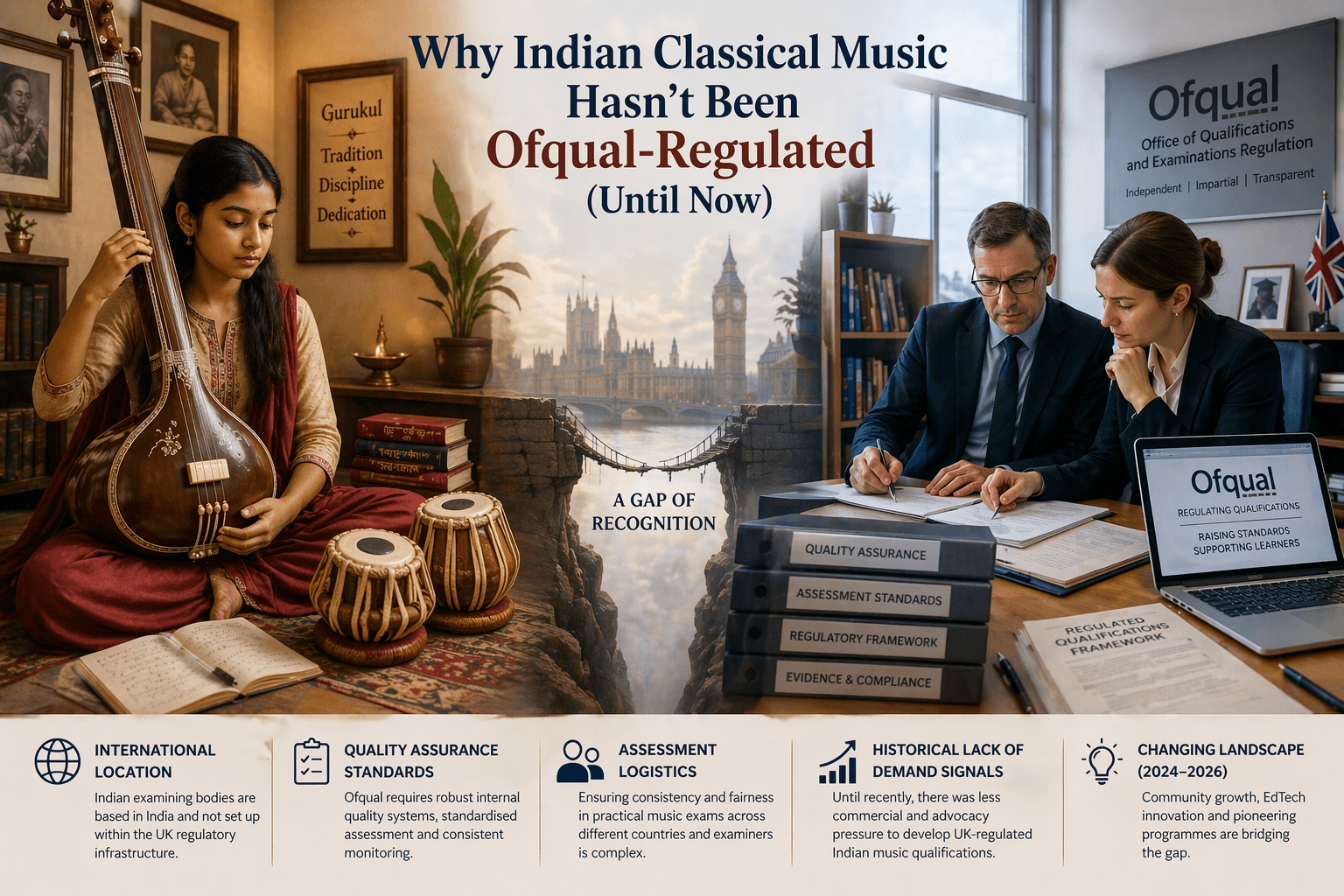
Why Indian Classical Music Hasn't Been Ofqual-Regulated (Until Now)
The Structural Reasons for the Historical Gap
The absence of Ofqual regulation for Indian classical music wasn't a deliberate policy exclusion. It was the result of structural realities:
International location of examining bodies: ABGMM, Prayag Sangeet Samiti, and other Indian music examination bodies are based in India. They were established to serve Indian music education within India and don't have the UK regulatory infrastructure that Ofqual requires.
Quality assurance standards: For Ofqual regulation, an awarding organisation must demonstrate robust internal quality assurance processes, standardised assessment methods, consistent marking criteria, and ongoing monitoring. Demonstrating this across international centres to UK regulatory standards is complex.
Assessment logistics: Ofqual-regulated qualifications require assessments that meet UK standards for consistency and fairness. Practical music examinations conducted across different countries by different examiners require specific quality controls that are non-trivial to implement.
Historical lack of demand signals: Until the British-Indian community reached its current scale and educational ambition, there was less commercial and advocacy pressure to develop UK-regulated Indian classical music qualifications.
The Changing Landscape in 2024-2026
Several developments are changing this:
The scale of the British-Indian community: With over 1.4 million British Indians in the UK and the vast majority highly engaged with Indian cultural education, the market for UK-recognised Indian classical music qualifications is now substantial.
EdTech innovation: Online music platforms have the technological infrastructure to implement consistent, assessable, documented music education that can meet Ofqual's quality assurance requirements.
Specific platform achievements: Art Gharana's launch of the Globally Recognised Music Programme (GRMP), which is Ofqual-accredited, represents the first successful bridging of this gap. It makes Indian classical music qualifications formally recognised in the UK educational system.
What Ofqual Accreditation Actually Gives Your Child

Formal UK Educational Recognition
An Ofqual-regulated Indian music qualification sits on the same regulatory framework as ABRSM grades. This means:
School record inclusion: The qualification can be formally recorded in your child's academic record and referenced in school reports.
University and college application relevance: For applications that include extracurricular achievements, an Ofqual-regulated Indian music qualification carries weight that a non-regulated Indian examination certificate doesn't.
Evidence of rigour: The Ofqual regulatory process confirms that the qualification meets government-approved quality standards. This lends credibility in any context where formal educational recognition matters.
Potential UCAS Tariff Points
Not all Ofqual-regulated qualifications automatically carry UCAS tariff points. The UCAS tariff applies to specific qualifications at specific levels with specific grade outcomes. Confirm the specific UCAS tariff status directly with the awarding organisation.
ABRSM's grades carry UCAS points at Grades 6-8. If an Ofqual-regulated Indian music qualification sits at an equivalent RQF level (Level 3), it should in principle qualify for UCAS tariff inclusion. Check the specific qualification against the UCAS tariff table.
What Ofqual Accreditation Does NOT Guarantee
It doesn't guarantee excellent teaching. Regulatory compliance confirms minimum quality standards. Evaluating the actual teaching quality, teacher qualifications, curriculum depth, and student outcomes requires additional investigation.
It doesn't make Indian classical music equivalent to Western classical music in all contexts. Western classical music's infrastructure in the UK educational system (GCSE options, A-Level Music, conservatoire pathways) is much more developed. Ofqual regulation is a meaningful step toward parity, not full equivalence.
It doesn't apply to all Indian music courses. Only courses whose awarding organisation is specifically regulated by Ofqual are genuinely "Ofqual-accredited." Many courses claim recognition that is not formally Ofqual-regulated.
How to Verify That an Indian Music Course Is Genuinely Ofqual-Accredited
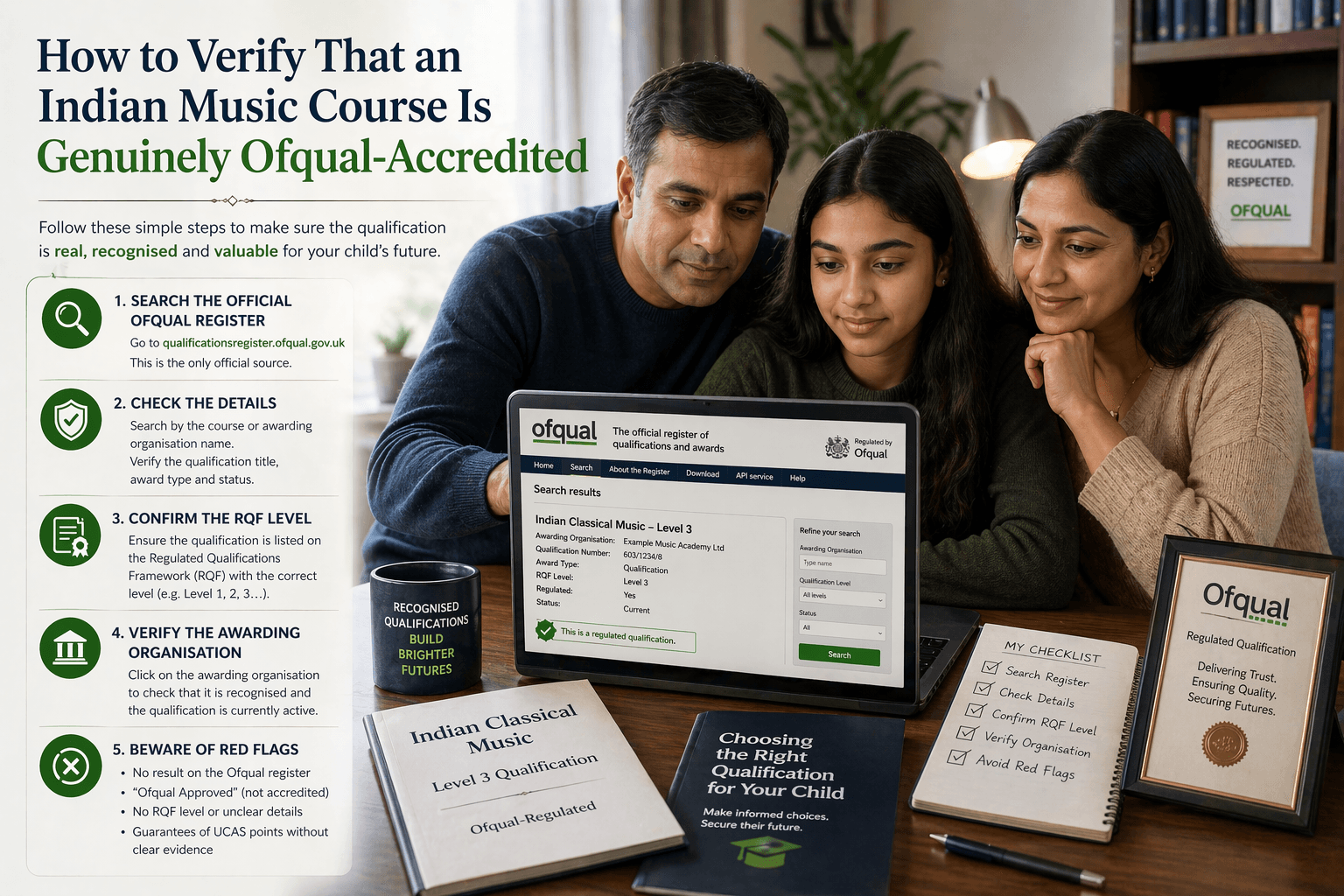
The Only Authoritative Source
The Ofqual register is the only authoritative source. It is publicly searchable at register.ofqual.gov.uk.
To verify a specific qualification:
- Go to register.ofqual.gov.uk
- Search by the awarding organisation name or the qualification title
- Any genuine Ofqual-regulated qualification will appear with its:
- Awarding organisation details
- Qualification title and reference number
- RQF level
- Accreditation start and end dates
If a qualification or awarding organisation does not appear on this register, it is not Ofqual-regulated, regardless of what the marketing says.
Common Misleading Claims to Watch For
"UK-recognised" without Ofqual regulation: A qualification that is "recognised within the UK community" is not the same as one that is Ofqual-regulated. Community recognition is genuine and valuable. Regulatory recognition is a different and more formal category.
"International certification": A qualification that carries international recognition is also not necessarily Ofqual-regulated. International recognition and UK regulatory recognition are separate concepts.
"Globally Recognised Programme" language: This describes the aspiration and scope of a qualification. It describes Ofqual regulation only if the qualification appears on the Ofqual register.
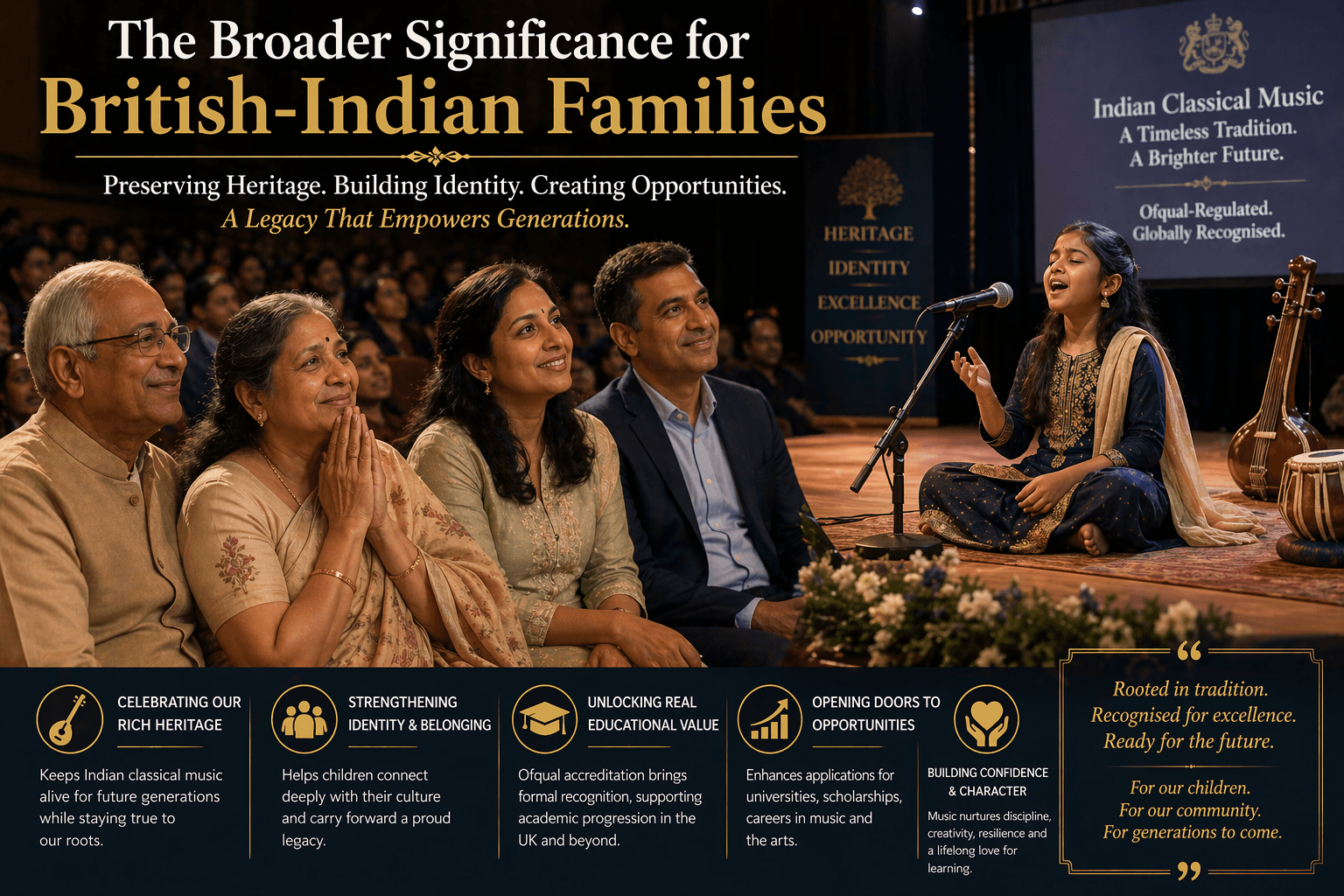
The Broader Significance for British-Indian Families
Cultural Legitimacy Within UK Education
The emergence of Ofqual-accredited Indian classical music courses represents more than a practical qualification gain. It represents a formal statement by the UK educational system that Indian classical music is a rigorous discipline deserving the same regulatory recognition as Western classical music.
For British-Indian children who grow up learning Hindustani classical vocals or Carnatic music, this matters deeply. It signals that their cultural heritage is not a parallel activity that exists outside the mainstream educational system. It is part of it.
Implications for UK School Music Departments
As Ofqual-regulated Indian music qualifications become more established, there are significant implications:
- School music departments may begin formally recognising Indian classical music qualifications alongside ABRSM grades
- Music bursaries and extracurricular music funding may become accessible to Indian classical music students
- The conversation about what "musical achievement" means within UK education may broaden
Art Gharana's Approach
Art Gharana offers structured, high-quality Indian classical music and dance education taught by certified instructors following rigorous pedagogical standards. We are committed to the highest standards of Indian classical music education.
Explore our vocal courses and read our beginner's guide to Indian classical music to understand the depth and structure of what we offer. For families interested in formal UK qualification pathways, we encourage investigating Ofqual-accredited options and confirming their register status before enrolling.
Conclusion
Ofqual accreditation for Indian music courses is a meaningful and growing development for British-Indian families. It represents the formal acknowledgment by the UK educational system that Indian classical music deserves the same regulatory recognition as Western classical music.
Three things to take away. First, always verify on the official Ofqual register. Marketing claims are easy to make; the register is authoritative. Second, understand the difference between community recognition (valuable) and regulatory recognition (formally educational). Third, Ofqual accreditation confirms regulatory compliance, not automatically excellent teaching. Evaluate both.
Book a free trial at Art Gharana today and experience the quality of our Indian classical music education firsthand.
Frequently Asked Questions
1. What is the difference between Ofqual-regulated and ABRSM qualifications?
ABRSM is an awarding organisation whose qualifications are Ofqual-regulated. In other words, ABRSM qualifications are a subset of all Ofqual-regulated music qualifications. An Ofqual-regulated Indian music qualification is regulated by the same body as ABRSM grades and sits on the same Regulated Qualifications Framework.
2. Can I check any qualification's Ofqual status for free?
Yes. The Ofqual register at register.ofqual.gov.uk is completely free and publicly accessible. Search by awarding organisation name or qualification title.
3. Do Ofqual-regulated Indian music qualifications carry UCAS points?
Some may, depending on the specific qualification's RQF level and UCAS tariff inclusion. Confirm with the specific awarding organisation and check the UCAS tariff tables directly.
4. Does Ofqual regulation mean the Indian music curriculum has been changed to fit Western standards?
No. Ofqual regulation addresses quality assurance, assessment consistency, and standards monitoring. It does not dictate curriculum content or pedagogical approach. Well-designed Ofqual-accredited Indian music courses maintain the full integrity of Indian classical traditions while meeting UK regulatory quality standards.
5. Are Indian classical dance qualifications also becoming Ofqual-regulated?
The ISTD (Imperial Society of Teachers of Dancing) offers South Asian dance qualifications, some of which are Ofqual-regulated. Check the Ofqual register and the ISTD website for current qualification details in Bharatanatyam and other classical Indian dance forms.