ChatGPT
 Google AI
 Grok
Grok Claude
Music therapy is a clinical, evidence-based health profession that uses carefully designed musical experiences to address cognitive, social, emotional, communicative, and physical goals in children. For kids with ADHD and autism spectrum disorder in American schools, the evidence base is extensive and compelling: music therapy improves attention, communication, social reciprocity, self-regulation, and emotional expression. This guide covers what music therapy is, how it differs from music lessons, what the research shows, how it's delivered in US schools, and what parents can do to access it for their children.
Every parent of a child with ADHD or autism has been there. You've tried the fidget tools, the visual schedules, the social skills groups, the behavior charts. Some things help. None of them quite reach the place you're hoping for.
Then someone mentions music therapy. Your first instinct might be to dismiss it as a soft, feel-good suggestion. You'd be wrong.
Music therapy for kids with ADHD and autism in American schools is not a feel-good idea. It is a clinically validated health profession with rigorous standards, a significant and growing evidence base, and access pathways through existing federal education law that many parents don't know exist.
What Is Music Therapy? Defining the Clinical Practice
Music Therapy vs Music Lessons: A Critical Distinction
This distinction matters enormously and is almost universally misunderstood by parents encountering music therapy for the first time.
Music lessons are educational. The goal is the development of musical skills: learning to play an instrument, improving vocal technique, understanding music theory. A music teacher designs lessons to make a student more musically capable.
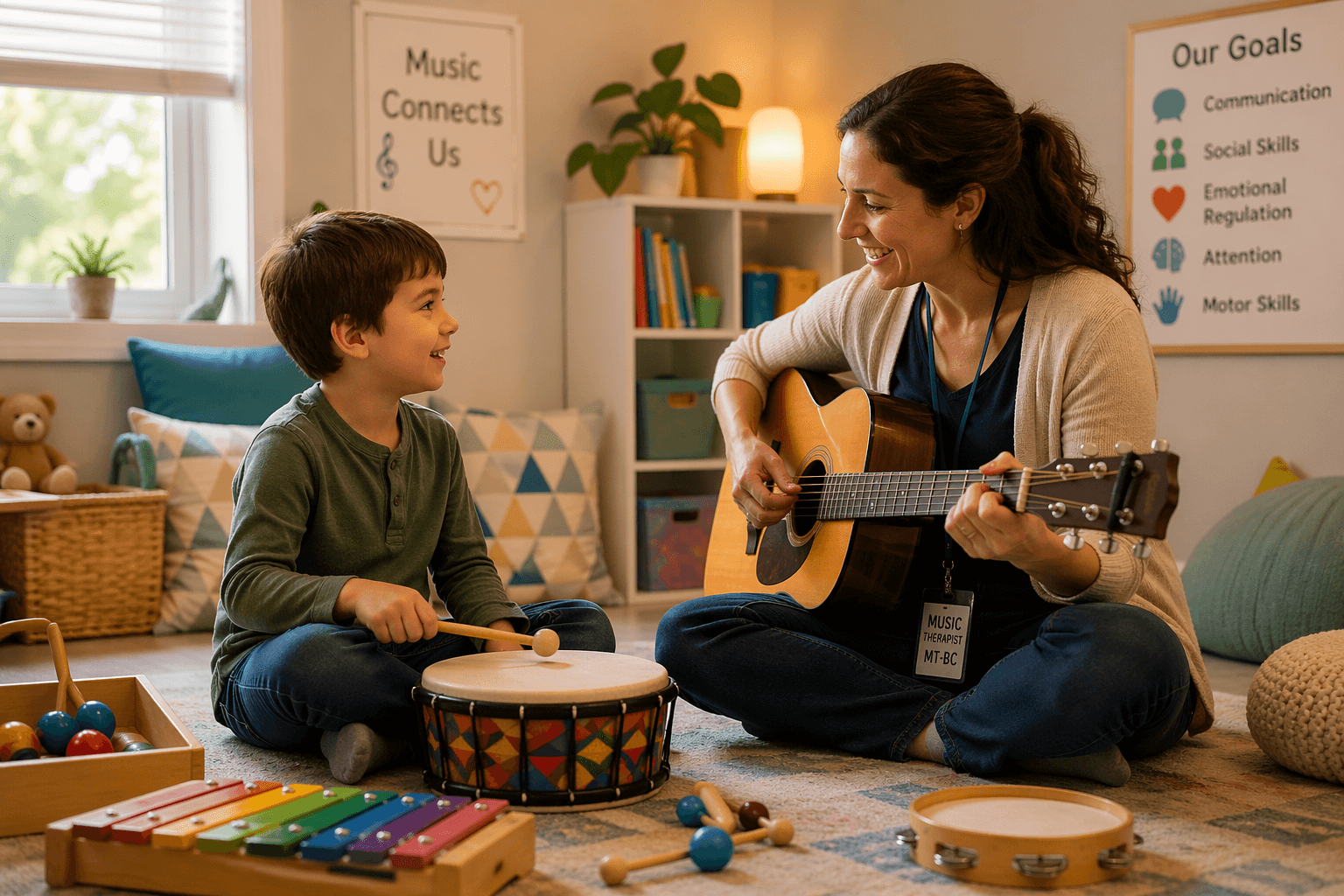
Music therapy is clinical. The goal is therapeutic progress in non-musical domains: improving communication, building social reciprocity, developing emotional regulation, reducing anxiety, improving attention and working memory. A music therapist uses musical experiences as the vehicle to achieve these therapeutic goals, not musical skill development as the end goal itself.
A child in music therapy may never become a musician. That's not the point. A child in music lessons may never address their social communication challenges. That's not the point of lessons either.
Who Provides Music Therapy?
In the United States, music therapy is provided by board-certified music therapists who hold the credential MT-BC (Music Therapist-Board Certified), awarded by the Certification Board for Music Therapists (CBMT). This credential requires:
- A bachelor's degree or higher in music therapy from an AMTA-approved university program
- 1,200 hours of supervised clinical training
- Successful completion of the national board certification examination
- Ongoing continuing education requirements
The American Music Therapy Association (AMTA) maintains standards for the profession and provides a therapist directory. A music therapist without the MT-BC credential has not met these professional standards.
What Music Therapy Sessions Look Like in Practice
Music therapy sessions are highly individualised. The therapist conducts an initial assessment of the child's strengths, challenges, communication profile, and therapeutic goals. All subsequent sessions are designed around those specific goals.
Common music therapy techniques for children with ADHD and autism include:
Rhythmic auditory stimulation (RAS): Using a steady rhythmic beat as an external regulator for movement, timing, and focused attention. Particularly effective for children with ADHD who struggle with internal self-regulation.
Orff-based music therapy: Using tuned percussion instruments (xylophones, metallophones, hand drums) in structured improvisational and composing activities to build communication, turn-taking, and collaborative engagement.
Melodic intonation therapy (MIT): A technique that uses musical speech patterns to develop language production in children who are non-verbal or minimally verbal.
Structured music-based social stories: Setting social stories, visual schedules, or behavioral expectations to familiar melodies to improve comprehension and retention.
Improvisation-based therapy: Free musical exploration that creates a non-threatening communicative space for children who find verbal communication challenging.
Music Therapy and ADHD: What the Research Tells Us
The Neurological Foundation
Attention deficit hyperactivity disorder involves differences in executive function, specifically in the regulation of attention, impulse control, and working memory. These are precisely the cognitive domains that music training has been shown to develop in multiple research paradigms.
The connection between music and ADHD management is not coincidental. It is grounded in neuroscience.
Neuroscientist Nina Kraus of Northwestern University has demonstrated extensively that structured music training strengthens the neural pathways used for attention, sound discrimination, and temporal processing. These are the same pathways that function differently in ADHD brains. Music training, through its demands for sustained attention, predictive rhythmic processing, and fine motor coordination, essentially provides targeted exercise for the attentional systems that ADHD affects.
Key Research Findings on Music Therapy and ADHD
bRhythmic Structure as External Regulation
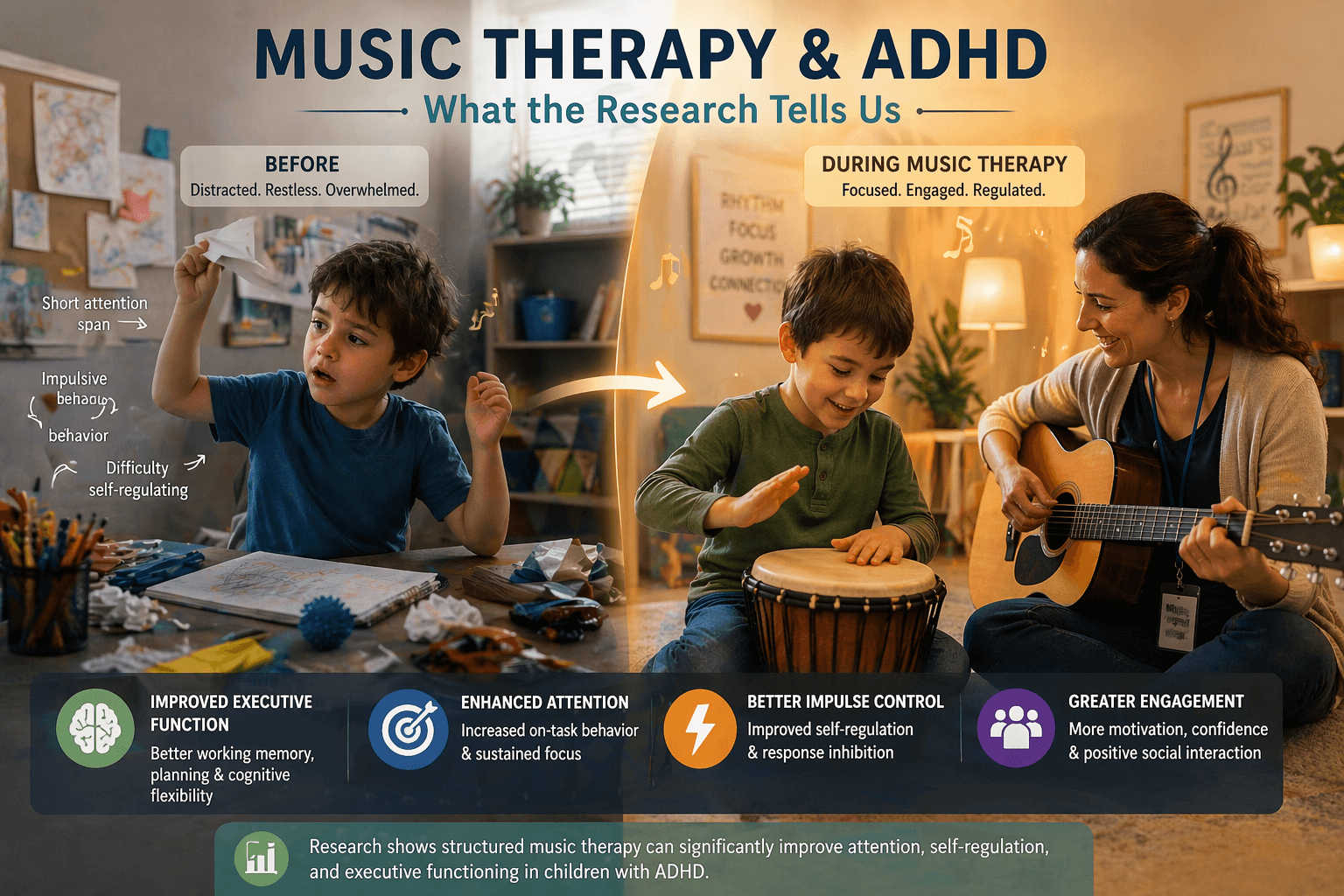
Children with ADHD struggle with internal self-regulation, meaning they find it difficult to regulate their own attention and impulse control from within. External regulatory structures help. Rhythmic music provides an external temporal structure that many ADHD children spontaneously synchronise their behaviour to.
Multiple studies have shown that ADHD children in structured rhythmic music activities demonstrate significantly reduced off-task behaviour, increased on-task engagement, and improved impulse control compared to their behaviour in non-musical structured activities.
Executive Function Improvements
A 2025 meta-analysis published in Frontiers in Psychology found that structured music training significantly improves inhibitory control, working memory, and cognitive flexibility in children aged 3-6, with the strongest effects occurring at training frequencies of at least three times per week. These are the exact executive function domains most impaired in ADHD.
Cognitive Benefits Across Subject Areas
A landmark longitudinal study published in Frontiers in Neuroscience involving 147 children found that structured music lessons significantly improved language-based reasoning, short-term memory, and planning, all areas of common challenge in ADHD. These improvements were demonstrated across academic subjects, not just in musical contexts.
ADHD-Specific Music Therapy Approaches
For children with ADHD specifically, music therapists often employ:
Drum circles and rhythm-based activities: The physical, immediate feedback of drumming combined with the social structure of a group rhythm activity provides an engaging, regulated environment that suits many ADHD children's learning styles.
Song composition: The structured creative process of composing a song within a specific length, meter, and topic gives ADHD children a contained, meaningful project that builds sustained attention over multiple sessions.
Movement-to-music: Structured movement activities (not freestyle dance) tied to specific musical cues build body awareness, improve attention-to-signal, and develop impulse control.
Music Therapy and Autism: What the Research Shows
Why Music Works Differently for Autistic Children
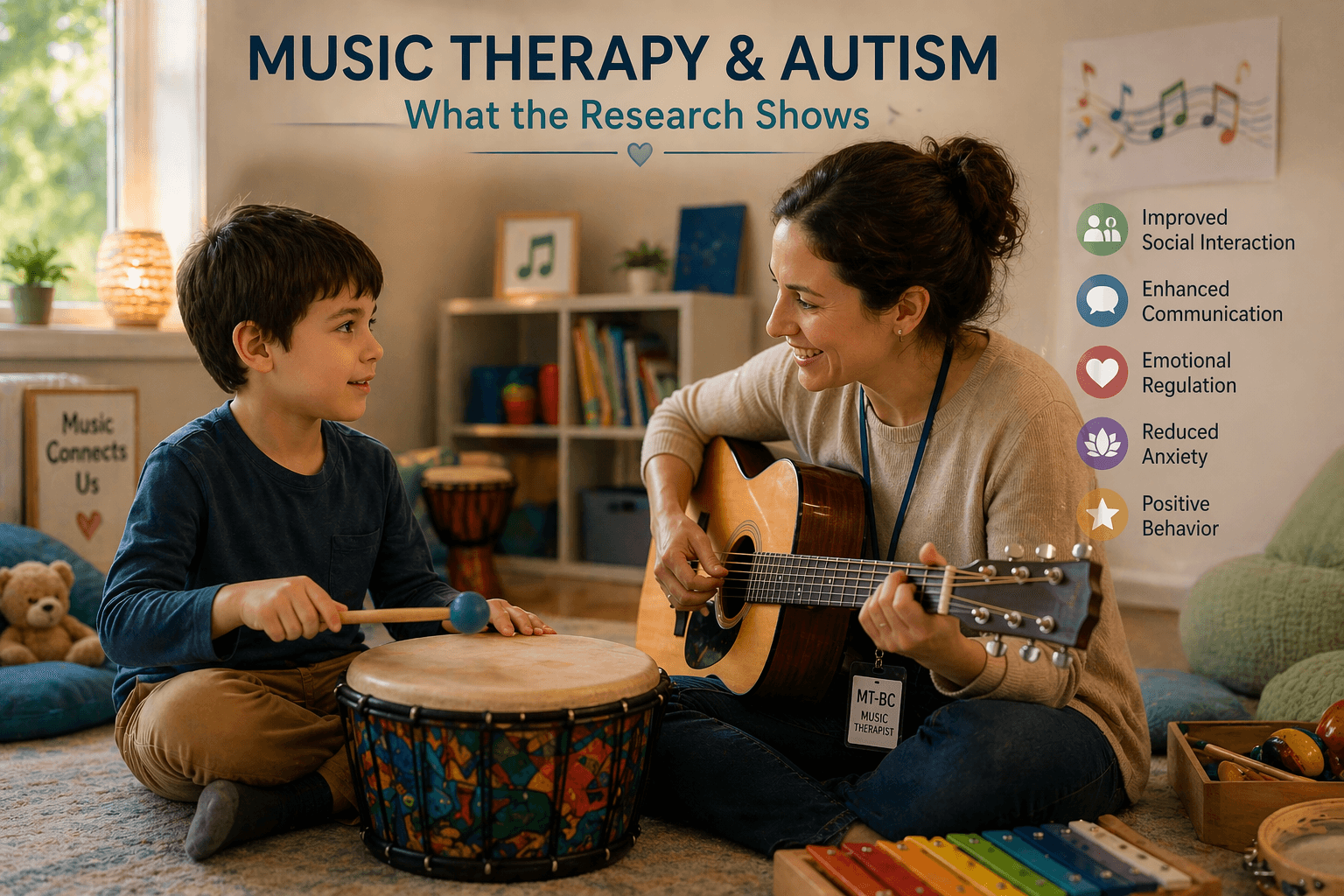
Autism spectrum disorder (ASD) involves a range of differences in social communication, sensory processing, and behaviour. Music therapy's effectiveness in ASD is one of the most robustly supported areas in child therapy research.
The Cochrane Collaboration, the gold standard for evidence-based medical research, has reviewed music therapy for autism multiple times. Their systematic reviews found significant positive effects of music therapy on social interaction, verbal communication, initiating behaviour, and social-emotional reciprocity. These improvements were sustained beyond therapy sessions.
Several mechanisms explain music therapy's effectiveness in ASD:
Non-Verbal Communication Channel
Music is fundamentally non-verbal. For children whose primary challenge is verbal communication, musical interaction offers a communication pathway that doesn't require language. A child who cannot say "I want to keep playing" can communicate this clearly through continuing to hit the drum or reaching for an instrument.
Predictability and Reduced Anxiety
Musical structures (verse-chorus forms, rhythmic cycles, melodic patterns) are predictable in ways that unstructured social interaction is not. Many autistic children find this predictability deeply reassuring, reducing the anxiety that often inhibits social engagement. Once anxiety is reduced, communication becomes more accessible.
Sensory Regulation
Music engages multiple sensory channels simultaneously (auditory, visual, kinesthetic). For children with sensory processing differences, carefully designed music therapy experiences can help them regulate and integrate sensory information more effectively. The therapist controls the sensory environment precisely, adjusting volume, tempo, complexity, and instrumental timbre based on real-time observation of the child's responses.
Intrinsic Motivation
Many autistic children are strongly drawn to music. This intrinsic motivation is a powerful therapeutic lever. When a child is genuinely excited to enter the therapy room, the therapist can use that motivation to make therapeutic goals embedded in musical activity feel natural rather than imposed.
Music Therapy Techniques Specific to Autism
Shared musical improvisation: The therapist and child improvise together on instruments, with the therapist following the child's musical choices. This creates a genuine communicative exchange where the child leads, building social initiation and reciprocity without requiring verbal language.
Music and visual supports: Pairing visual schedules, social stories, or transition cues with consistent melodies helps many autistic children build predictability and routine, reducing transition anxiety.
Song-based communication: For minimally verbal children, songs with predictable phrases that require the child to fill in the final word ("Twinkle twinkle little...") build verbal participation through musical structure.
Music and movement integration: Structured movement activities tied to specific musical themes help develop body awareness, joint attention, and coordinated social action.
How Music Therapy Is Accessed in American Schools
The IDEA Pathway: Music Therapy as a Related Service
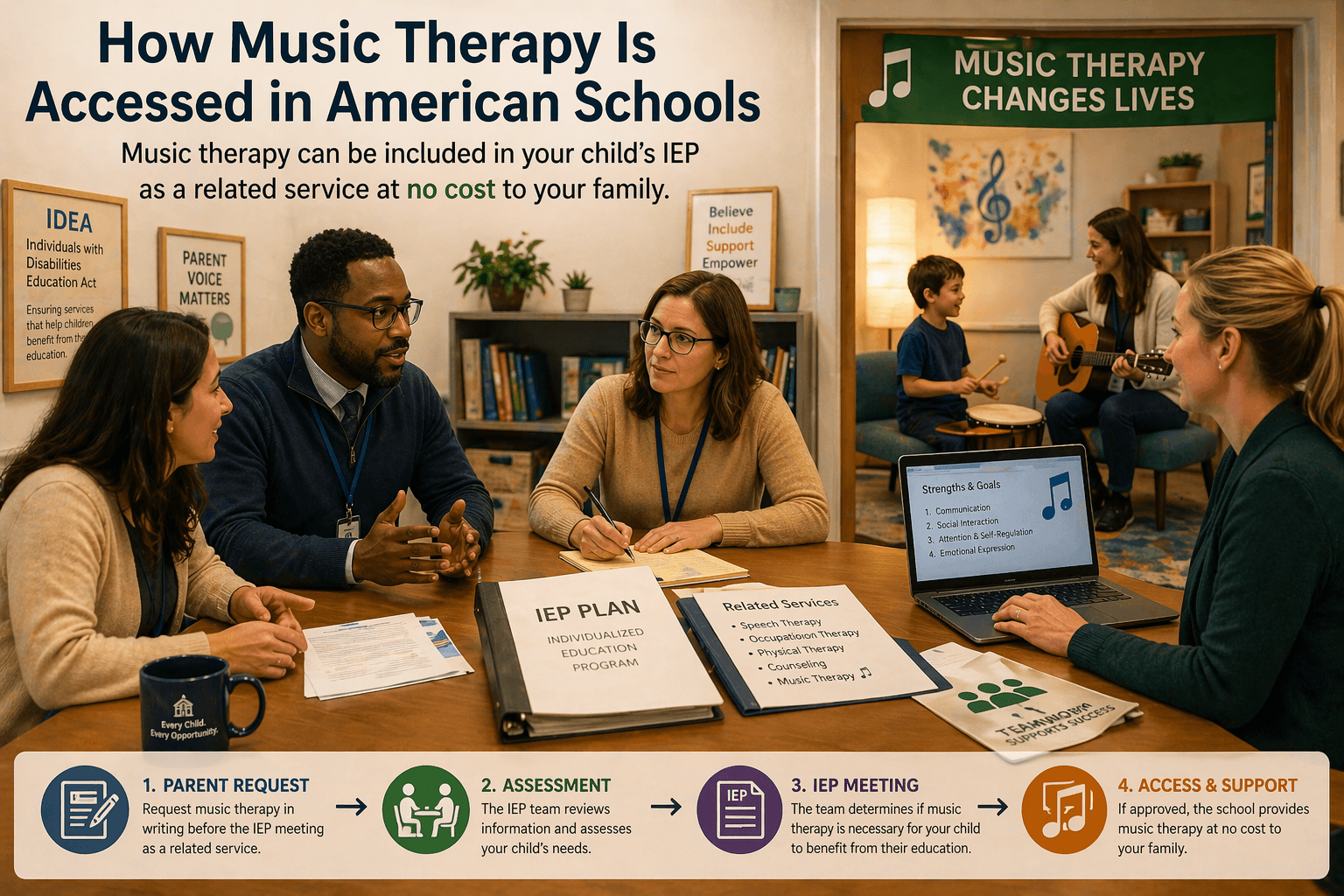
The Individuals with Disabilities Education Act (IDEA), the federal law governing special education in the US, includes music therapy as a potentially qualifying related service. Under IDEA, school districts must provide "related services" that are necessary for a child to benefit from special education.
If an IEP team determines that music therapy is necessary for a specific child to benefit from their special education program, the school district is legally required to provide it, at no cost to the family.
How to Request Music Therapy on an IEP
- Put the request in writing. At least three to five days before the IEP meeting, send a written request to the IEP team asking that music therapy be considered as a related service.
- Bring supporting documentation. Include research summaries (such as the Cochrane Review findings on music therapy and autism) and, if possible, a letter from your child's physician or psychologist indicating that music therapy would support their educational goals.
- Be specific about goals. Connect the music therapy request to specific IEP goals. For example: "Music therapy to address Goal 3 (improving peer interaction and social initiation) and Goal 7 (developing functional communication)."
- Know your rights. You can request an independent educational evaluation if you disagree with the IEP team's determination about music therapy. The district must either provide the evaluation at no cost or pay for one from an independent provider.
Private Music Therapy Options in the USA
Many families supplement school-based services with private music therapy, or use private therapy when school-based access is not available. MT-BC therapists in private practice typically charge between $50 and $120 per session depending on location and specialisation.
The AMTA provides a searchable therapist directory at amta.org where you can filter by location, population served (pediatric, autism, ADHD), and setting.
Telehealth Music Therapy
Since 2020, music therapy via telehealth (video call) has become significantly more widespread and is now considered clinically appropriate for many therapeutic goals. The AMTA has published telehealth practice guidelines for MT-BC practitioners.
For families in areas without local music therapists, telehealth sessions can make music therapy accessible for the first time. Most communication, attention, and social-emotional goals can be addressed effectively through a well-equipped video session.
Structured Music Education as a Complement to Music Therapy

How Music Lessons and Music Therapy Work Together
Music therapy and music education are different but genuinely complementary. Music therapy addresses specific therapeutic goals using music as the tool. Structured music education builds real musical skills, cultural identity, and creative expression.
For a child with ADHD or autism, having both can be extraordinarily powerful. The music therapist works on executive function, communication, and regulation. The music teacher builds the genuine musical competence (playing an instrument, singing, understanding rhythm) that gives the child real accomplishment and confidence.
Many families find that high-quality, individually tailored music lessons provide many of the same cognitive and social benefits as formal music therapy, particularly when the teacher is experienced in working with neurodiverse learners. The key is finding a teacher who understands how to adapt their approach to the specific child.
Indian Classical Music for Neurodiverse Learners
There is a growing body of practitioner evidence and anecdotal reporting from Indian-American families that Hindustani and Carnatic classical music education is particularly well-suited to children with ADHD and sensory processing differences.
The reasons align precisely with what we know about music therapy:
Structured repetition: Swara practice involves highly structured, repetitive patterns that many ADHD children find organizing rather than tedious.
The tanpura drone: The continuous, predictable drone sound of the tanpura (or digital tanpura app) provides a constant auditory anchor that many children with sensory differences find calming and regulating.
External rhythmic regulation through tala: The tala system of Indian classical music provides exactly the kind of external rhythmic structure that research shows benefits ADHD children.
Oral transmission: The guru-shishya method of learning (direct, in-relationship transmission from teacher to student) is well-matched to the learning styles of many neurodiverse children who thrive in structured one-on-one human interactions.
At Art Gharana, our teachers work with children of all learning styles and abilities. Our 1:1 live online format is particularly well-suited to neurodiverse learners because every session is adapted entirely to the individual child. Explore our courses for children or read our guide to connecting with roots through Indian classical dance for more on the broader developmental benefits of arts education.
Practical Steps for Parents of Children with ADHD and Autism

Step 1: Find a Board-Certified Music Therapist
Visit amta.org and use the therapist finder. Filter by location, specialisation (pediatric, autism, ADHD), and setting. Look specifically for therapists with ASD or ADHD listed as primary populations.
Step 2: Request a Music Therapy Assessment
Before any therapy begins, a qualified MT-BC conducts an initial assessment of your child's profile. This assessment informs the treatment plan and provides documentation for IEP discussions.
Step 3: Explore the IEP Pathway
If your child has an IEP, formally request music therapy as a related service in writing before the next IEP meeting. Bring documentation. You have the right to make this request at any IEP meeting, not only at annual reviews.
Step 4: Consider Structured Music Education Alongside Therapy
Quality structured music lessons from a teacher experienced in neurodiverse learners provide complementary developmental benefits. Even if formal music therapy is not available or accessible, a skilled, patient music teacher who adapts their approach to your child can make a meaningful difference.
Step 5 : Ask About Telehealth Options
If local MT-BC therapists are not available, telehealth music therapy is now a widely practised and clinically appropriate option. Ask specifically whether the therapist offers telehealth sessions.
Conclusion
Music therapy for children with ADHD and autism in American schools is not a marginal or experimental approach. It is a clinically validated, research-supported practice with access pathways through federal education law that many parents haven't discovered yet.
Three things to take away. First, music therapy and music lessons are different. Both can help neurodiverse children in different ways. Second, if your child has an IEP, you have the right to request music therapy as a related service. Put that request in writing. Third, structured Indian classical music education, with its built-in predictability, oral tradition, and one-on-one attention, is naturally well-matched to the needs of many neurodiverse learners.
At Art Gharana, our teachers offer compassionate, flexible, 1:1 live instruction for children of all abilities and learning styles. Book a free trial class today and discover how music can open new possibilities for your child.
Frequently Asked Questions
1. Is music therapy covered by insurance in the USA?
Coverage varies significantly. Some health insurance plans cover music therapy when it is prescribed as part of a treatment plan for autism or ADHD by a physician. Under IDEA, music therapy included in a child's IEP must be provided at the school district's expense. Contact your specific insurer and request a letter of medical necessity from your child's physician to support a coverage claim.
2. At what age can children start music therapy?
Music therapy can begin in infancy. There are established music therapy protocols specifically for babies and toddlers. There is no minimum age, and early intervention with music therapy, particularly for children with autism who are identified early, is associated with better long-term outcomes.
3. How is music therapy different from just playing music at home?
Music therapy involves a board-certified therapist who designs specific musical experiences to address individualised therapeutic goals. Simply listening to music at home has general benefits but does not constitute music therapy. The clinical assessment, goal-setting, evidence-based technique selection, and progress monitoring are what distinguish music therapy from recreational music engagement.
4. Can online music therapy be as effective as in-person sessions?
For most therapeutic goals, telehealth music therapy via video call is clinically equivalent to in-person therapy. The AMTA has published telehealth standards for MT-BC practitioners. Goals requiring physical proximity or hands-on instrument work may be better addressed in person, but communication, attention, and social-emotional regulation goals are fully addressable through well-equipped telehealth sessions.
5. Does music therapy replace other therapies like ABA or speech therapy?
No. Music therapy is used as a complementary intervention alongside other established therapies. It is not a replacement for ABA, speech-language therapy, occupational therapy, or any other evidence-based approach. Its unique contribution is providing a highly motivating, non-threatening musical context for practising communication, attention, and social skills.