ChatGPT
 Google AI
 Grok
Grok Claude
Music theory is the language of music. Understanding it transforms you from someone who can play notes into someone who understands what they're playing and why. For Canadian beginners approaching music theory for the first time - whether as adults teaching themselves, children supported by parents, or students supplementing instrumental lessons - this complete guide covers the essential foundations of music theory, how to learn it effectively online, which resources are best suited to different learning styles, and how a systematic understanding of theory accelerates progress on any instrument.
Why Music Theory Matters More Than Most Beginners Think
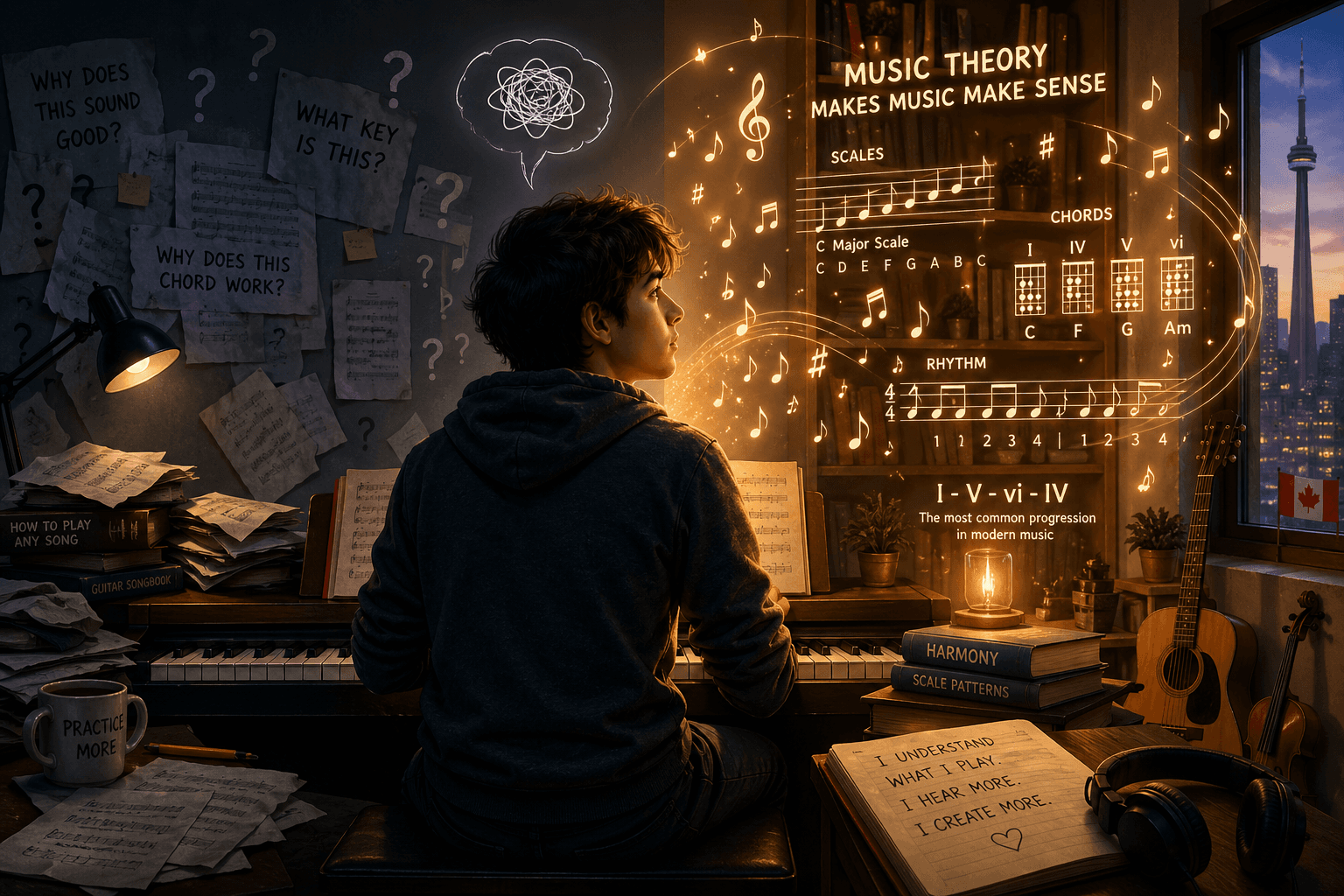
The Common Misconception About Music Theory
Many beginners - and unfortunately, many self-taught musicians - treat music theory as optional. They believe that as long as they can play the songs they want to play, theory is a dry academic exercise that has nothing to do with making music.
This is one of the most limiting beliefs in music education. Here's why theory matters practically:
Learning Songs Faster
A musician who understands that most pop songs use the I-V-vi-IV chord progression recognises that pattern immediately the next time they encounter it. What might take a non-theoretical musician three weeks of rote learning, a theoretically informed musician can learn in one session by hearing the familiar pattern.
Transposing and Playing by Ear
The ability to take a song and play it in a different key, or to hear a melody and reproduce it on your instrument, requires theoretical understanding. Without it, these skills remain mysterious - either a talent people think you're born with, or an impossibility.
Communicating With Other Musicians
Music theory is the shared language of musicians. When a bandmate says "let's take it to the five chord" or a teacher says "your alaap isn't emphasising the vadi swara correctly," you can only engage meaningfully if you understand the language.
Understanding What You're Hearing
Music theory provides the framework for conscious listening. Understanding that a specific chord creates tension because it contains a tritone, or that a raga sounds the way it does because of specific aroha-avaroha patterns, transforms passive listening into active musical engagement.
The Essential Building Blocks of Western Music Theory
Notes and the Musical Alphabet
The Twelve Pitches
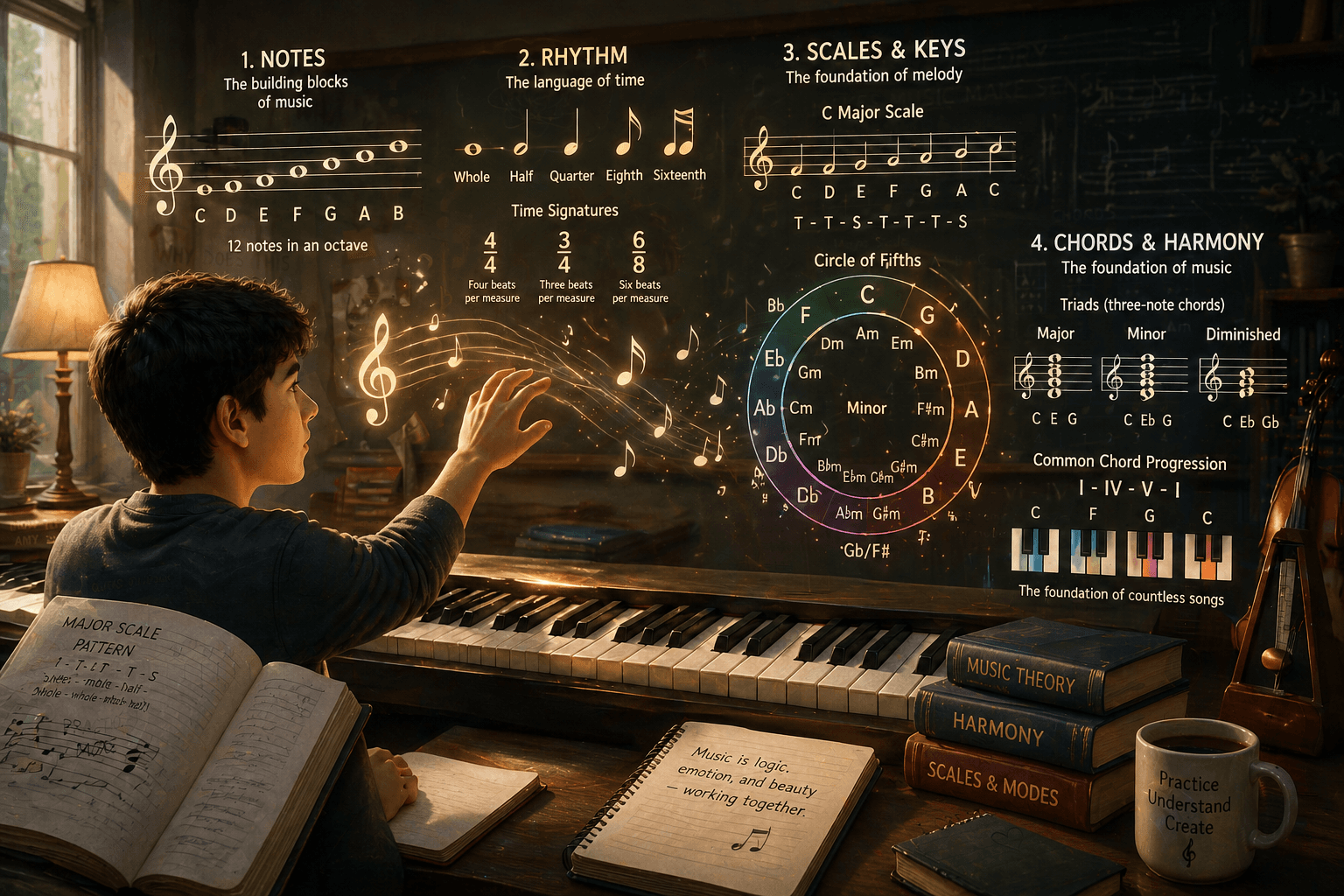
Western music uses 12 distinct pitches within each octave. These are represented by the seven letter names (A B C D E F G) and five additional pitches between some of them (represented by sharps # and flats b). Understanding these 12 pitches and their relationships is the absolute foundation of Western music theory.
The Octave and Register
An octave is the distance between two notes that have the same letter name but different pitches (for example, C4 and C5). Notes an octave apart sound remarkably similar because they share most of their overtones - this is why the musical alphabet repeats every 12 pitches.
Rhythm and Time
Note Values
Notes have specific time values: whole notes last four beats, half notes two beats, quarter notes one beat, eighth notes half a beat, and sixteenth notes a quarter beat. Understanding note values and how they fit into rhythmic patterns is the foundation of musical time.
Time Signatures
The time signature tells you how beats are grouped. 4/4 means four beats per bar with a quarter note receiving one beat. 3/4 means three beats per bar (waltz time). 6/8 means six beats per bar grouped as two groups of three. Understanding time signatures allows you to approach any piece of music with an immediate rhythmic framework.
Scales and Keys
The Major Scale
The major scale is the foundation of Western tonal music. It consists of seven notes following a specific pattern of whole steps (tones) and half steps (semitones): T-T-S-T-T-T-S (Tone-Tone-Semitone-Tone-Tone-Tone-Semitone). Every major scale starting on a different note creates a different key with its own key signature.
The Minor Scales
The natural minor scale follows the pattern T-S-T-T-S-T-T and creates the characteristic "sad" or "dark" quality associated with minor tonality. Harmonic and melodic minor variants are introduced in intermediate theory.
The Relationship to Indian Music Theory
For learners coming from an Indian classical music background, the relationship between Western scale theory and Indian raga theory is illuminating. Each raga is defined by its specific selection of swaras (notes) and the constraints on how they can be used, which is conceptually related to (but importantly different from) the Western scale concept. Many Indian classical music students find Western theory an illuminating complement to their raga knowledge.
Chords and Harmony
Triads
A triad is a three-note chord built by stacking thirds. Major triads have a major third between root and middle note, and a minor third between middle and top. Minor triads reverse this. Understanding triads and their inversions is the foundation of harmonic understanding.
Chord Progressions
The relationship between chords in a key creates chord progressions. The I-IV-V-I progression is the foundational harmonic motion of Western music, appearing in countless classical pieces, folk songs, blues, pop, and rock. Understanding why this progression feels resolved and satisfying - because it traces the strongest harmonic relationships in the key - is one of music theory's most satisfying insights.
Indian Classical Music Theory Basics
The Swara System
The Seven Swaras
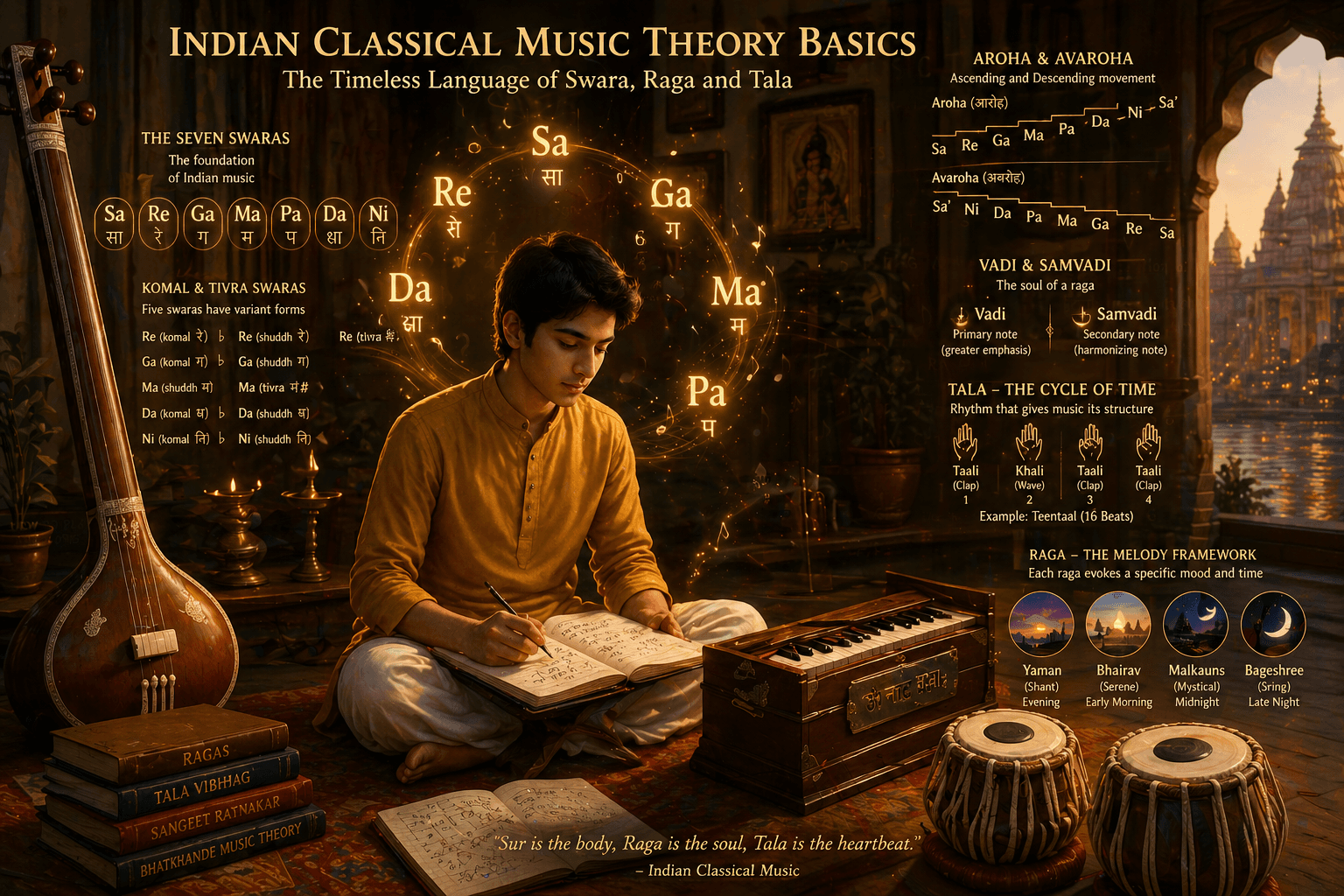
Indian classical music uses seven named notes: Sa (shadja), Re (rishabha), Ga (gandhara), Ma (madhyama), Pa (panchama), Da (dhaivata), and Ni (nishada). Unlike Western fixed-pitch notes, Sa is a moveable tonic - the entire system is transposable to any pitch.
Komal and Tivra Swaras
Five of the seven swaras (Re, Ga, Ma, Da, Ni) have variant forms: komal (flat, lower) and tivra (sharp, higher) versions. These create the 22 srutis (microtonal pitches) of Indian classical music and are the basis of raga differentiation.
The Raga System
Aroha and Avaroha
Every raga has a defined ascending scale (aroha) and descending scale (avaroha), which may use different note selections. Understanding aroha-avaroha is the first step in understanding any raga.
Vadi and Samvadi
Every raga has a characteristic note (vadi) that is given particular emphasis, and a secondary characteristic note (samvadi) that supports it. These two notes define much of a raga's identity and expressive character.
Connection to Western Theory
The parallels between raga theory and Western modal theory are fascinating. Raag Yaman corresponds closely to the Lydian mode. Raag Bhairav corresponds to the Phrygian dominant scale. Understanding both systems gives musicians a richer musical vocabulary and more interesting compositional possibilities.
How to Learn Music Theory Online as a Canadian Beginner
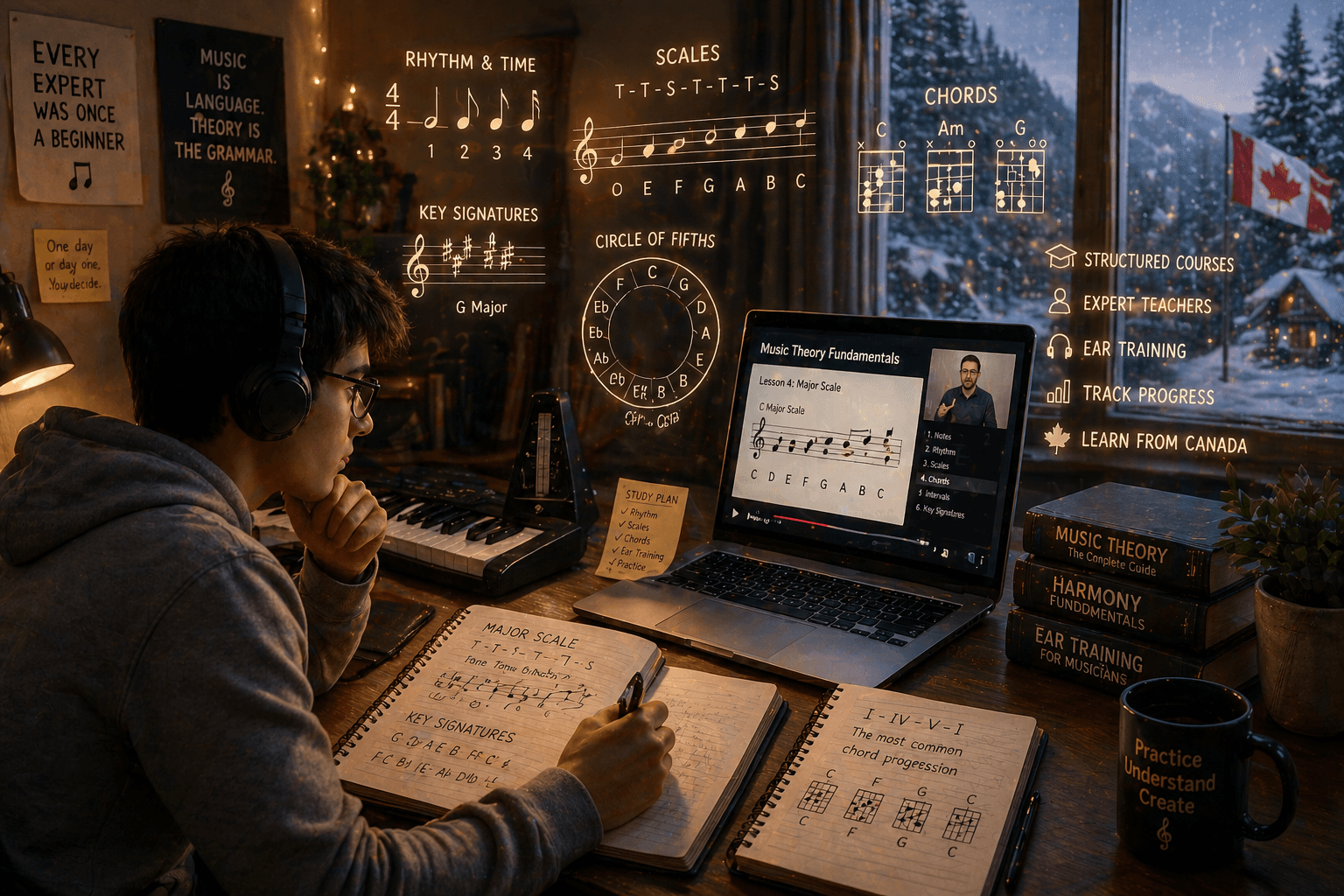
Structured Online Courses
Musictheory.net
The most widely recommended free online music theory resource. Covers all foundational Western music theory through clearly explained interactive lessons and exercises. Ideal for self-directed learners and those supplementing instrumental lessons.
Coursera and edX Music Theory Courses
Berklee College of Music and the Royal Conservatory of Music both offer music theory courses through Coursera. These paid courses provide structured, credential-backed music theory education at a higher level than free resources.
ABRSM Music Theory
For students working toward ABRSM practical examinations, ABRSM's official music theory publications (Grades 1-8 Theory) and the new ABRSM Digital Theory assessments are the appropriate study resources.
The Role of a Teacher in Theory Learning
Self-directed theory study has genuine limitations. Many concepts are initially confusing in text (particularly ear training, which is obviously difficult to teach through written explanation alone), and misconceptions that develop from independent study can be harder to correct than those caught immediately by a teacher.
The most effective approach for most Canadian beginners is theory learning integrated with instrumental instruction - a teacher who weaves relevant theory concepts into each instrumental lesson so that theory is always connected to practical music-making rather than abstract exercise.
At Art Gharana, our instrumental and vocal teachers integrate music theory throughout their instruction. Explore our instrument courses or read our beginner's guide to Indian classical music.
Conclusion
Music theory is not separate from music. It is music described in language. Learning it transforms your relationship with every aspect of music you make, listen to, and teach.
Three things to take away. First, start with rhythm theory - understanding note values and time signatures produces immediate practical benefits. Second, learn the major scale in all twelve keys as your first harmonic project - this single achievement unlocks most subsequent theory understanding. Third, integrate theory with your instrumental practice from the start, not as a separate academic exercise.
Book a free trial music lesson at Art Gharana today and work with a teacher who integrates theory naturally into every session.
Frequently Asked Questions
1. Do I need to know music theory to play an instrument?
No, but it helps enormously. Many musicians play by ear without explicit theory knowledge, but understanding theory makes learning songs faster, transposing easier, communicating with other musicians clearer, and your own musical creativity richer.
2. What is the best free resource for learning music theory online?
Musictheory.net is consistently the most recommended free online music theory resource for Western music theory fundamentals. It covers everything from basic note reading to advanced harmony through clear, interactive lessons.
3. How long does it take to learn basic music theory?
The foundational concepts of Western music theory (note names, rhythm, major and minor scales, basic chords) can be understood in approximately three to six months of consistent weekly study alongside instrumental practice. Advanced harmony, counterpoint, and composition take considerably longer.
4. Is music theory the same for Western and Indian classical music?
No. Western music theory and Indian classical music theory (which centres on the raga-tala system) are distinct theoretical frameworks with different premises, vocabulary, and analytical approaches. They have interesting parallels (the relationship between ragas and Western modes, for example) but are not the same system.
5. Can I learn music theory without an instrument?
Yes, but it is significantly harder to make theory meaningful without an instrument to immediately apply it on. The most effective approach is learning theory in direct connection with an instrument, so every theoretical concept immediately translates into physical, audible music-making.