ChatGPT
 Google AI
 Grok
Grok Claude
Have you ever finished a song and thought — what do I listen to next?
It's a question every music lover faces. You've found a sound you love, a rhythm that resonates, an artist that just gets you — and then the playlist ends, and you're left scrolling endlessly through hundreds of unfamiliar names, unsure where to turn next.
That feeling of being lost in a sea of sound is exactly why the concept of a music map exists.
A music map is more than just a list of genres arranged on a page. It's a living, visual guide to the entire landscape of musical styles — showing you not just what genres exist, but how they relate to each other, where they came from, and where they might lead you next. Think of it as your personal compass for navigating the vast, beautifully complex world of music.
And in today's streaming-driven world — where algorithms decide what you hear next — understanding that landscape yourself is more valuable than ever.
Whether you're a complete beginner trying to make sense of the difference between genres, a curious listener looking to find similar songs to the ones you already love, or a music student building a deeper understanding of musical structure and history, a genre map gives you something no playlist algorithm can: context.
It answers questions like:
- Why does blues feel so similar to early rock and roll?
- How did electronic music grow out of disco and funk?
- What makes a song genre finder more useful than a random recommendation?
- Where does the music I love sit within the bigger picture of musical history?
In this guide, we'll walk you through everything you need to know about music maps — from understanding the major genre families and how they connect, to using genre mapping as a practical tool for discovering new music and deepening your musical education.
By the end, you won't just know what music genres exist — you'll understand why they exist, how they evolved, and exactly how to use
Let's unfold the map.
What Is a Map of Music Genres and Why Does It Matter
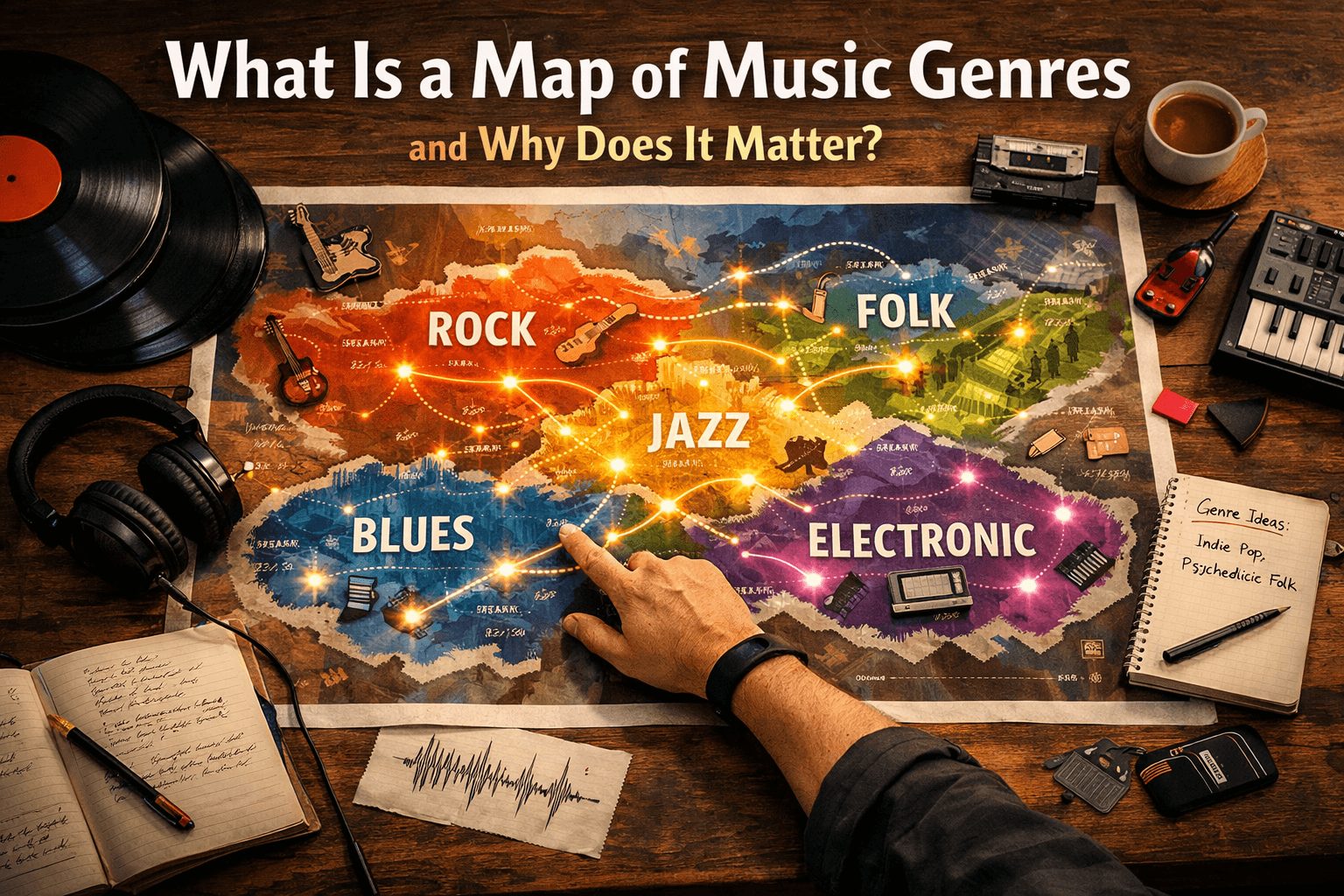 Have you ever looked at a music genre list and felt more confused than when you started? You're not alone. With hundreds of genres, subgenres, and hybrid styles existing across cultures and centuries, trying to understand music through a flat, scrollable list is like trying to understand a city by reading its street names — technically informative, but completely missing the bigger picture.
That's precisely where a music map changes everything.
Defining the Concept of a Music Genre Map
A music map is a visual or interactive representation of the relationships between different music genres. Rather than presenting genres as isolated categories, a musicmap arranges them spatially — showing which genres share common roots, which ones evolved from others, and which unexpected styles sit surprisingly close together in the musical universe.
Think of it this way: a standard genre list tells you that blues and jazz exist. A music-map shows you that they grew from the same cultural soil, developed side by side, and together gave birth to rock and roll, soul, and eventually hip hop. That's not just interesting — it's transformative for how you understand and experience music.
How a Visual Map Helps You Navigate Musical Styles
The real power of a music map lies in its ability to make the invisible visible. When you see genres represented spatially, patterns emerge that you'd never notice from a list alone.
A well-designed musicmap helps you:
- Identify genre clusters — groups of related styles that share instrumentation, tempo, or cultural origin
- Trace musical lineages — following the evolution of a sound across decades and continents
- Find similar music — understanding which genres neighbour your favourites makes it dramatically easier to find songs similar to the ones you already love
- Spot unexpected connections — discovering that two genres you thought were completely different actually share deep structural similarities
- Names of music categories
- Basic descriptions of each style
- A static, one-dimensional reference point
- Visual relationships between genres
- A dynamic, explorable landscape of musical styles
- A song genre finder framework built on genuine musical logic
- The ability to navigate from the familiar to the unfamiliar with confidence and intention
- Baroque — intricate, ornamental, and mathematically precise (Bach, Handel, Vivaldi)
- Romantic — emotionally expansive and dramatically expressive (Chopin, Brahms, Tchaikovsky)
- Contemporary classical — boundary-pushing, often intersecting with ambient and electronic styles
- Film scores — perhaps the most widely consumed form of orchestral music today
- Country and Americana — rooted in Southern US folk traditions
- Indie folk and singer-songwriter — the modern evolution of acoustic storytelling
- World music — a broad category encompassing traditional styles from every continent
- Protest music and social commentary — a direct lineage from folk's storytelling origins
- Rock and roll grew directly from electric blues
- Soul and R&B emerged from the intersection of blues, gospel, and jazz
- Hip hop sampled jazz heavily in its foundational years
- Pop music owes its melodic sensibility in large part to jazz harmony
- Classic rock — the arena-filling sound of the 1960s and 70s
- Punk rock — raw, fast, deliberately stripped of excess
- Heavy metal — amplified, aggressive, technically demanding
- Alternative and indie rock — genre-bending, often deliberately uncommercial
- Progressive rock — complex, compositionally ambitious, influenced by classical structure
- Grunge — emotionally raw, distortion-heavy, born from the Pacific Northwest
- Ambient and drone — atmospheric, textural, designed for immersive listening
- House and techno — rhythm-driven, built for movement and dance
- Drum and bass / jungle — high-tempo, percussion-forward, rooted in UK rave culture
- Synthwave and retrowave — nostalgic, cinematic, heavily influenced by 1980s aesthetics
- Experimental and glitch — deliberately challenging, deconstructing music's own conventions
- Delta blues — raw, acoustic, deeply personal — emerged from African American communities in the Mississippi Delta in the early 20th century
- Electric blues — the same emotional core, amplified and urbanised as musicians moved north to cities like Chicago
- Rock and roll — electric blues accelerated, simplified, and electrified for a new generation
- Hard rock and heavy metal — rock pushed to its most aggressive, technically demanding extreme
- Thrash and death metal — metal deconstructed and rebuilt with punk's raw energy
- The Mississippi Delta gave us the blues — born from the specific social conditions of the American South
- Jamaica gave us reggae and ska — music deeply tied to post-colonial identity and Rastafarian spirituality
- Detroit gave us Motown and techno — two radically different genres born from the same industrial city
- Brazil gave us bossa nova and samba — musical styles inseparable from Brazilian cultural identity
- Jazz fusion — jazz harmony and improvisation merged with rock's electric energy
- Reggaeton — Caribbean reggae and dancehall fused with Latin rhythms and hip hop production
- Afrobeats — West African musical traditions blended with R&B, hip hop, and electronic production
- Folk punk — the raw energy of punk combined with acoustic folk instrumentation and storytelling
- Indie electronic — the emotional intimacy of indie songwriting fused with electronic textures and production
- Escape room music — atmospheric, tension-building instrumental tracks
- Bedroom pop — lo-fi, intimate, home-recorded indie pop
- Dark academia playlist music — a mood-based category rather than a true genre
- Phonk — a blend of Memphis rap, trap, and chopped-and-screwed aesthetics
- What are the five artists or songs I keep coming back to?
- What feeling do I get from the music I love most — energy, calm, melancholy, euphoria?
- Is it the vocals, the instrumentation, the rhythm, or the production that draws me in?
- Identify your home genre — the style that best describes the music you love most
- Find its immediate neighbours — genres that share similar tempo, instrumentation, or emotional character
- Explore one neighbour at a time — resist the urge to jump too far too fast
- Note what resonates — keep a running list of new artists and songs that feel like genuine discoveries
- Repeat the process — use each new discovery as a new starting point on the map
- Mood-based exploration — if you love music that feels melancholic and introspective, follow that emotional thread across genres — from indie folk to post-rock to ambient classical
- Tempo-based exploration — if you're drawn to slow, deliberate rhythms, explore across jazz ballads, trip hop, and drone ambient
- Instrumentation-based exploration — if you love the sound of acoustic guitar, follow it from folk to flamenco to bossa nova to fingerstyle contemporary
- Start with your current favourites mapped to their genre positions
- Add discoveries as you explore adjacent genres and styles
- Note connections between new finds and existing favourites
- Set exploration goals — a new genre per month, a new cultural tradition per season
- Revisit and expand your map as your taste evolves
- Chord progressions — tracing how the same progression appears across blues, rock, and pop simultaneously
- Scales and modes — understanding why certain scales feel at home in certain genres
- Rhythm and time signatures — seeing how rhythmic complexity varies across genre families
- Harmonic language — comparing the harmonic simplicity of folk with the complexity of jazz
- Compare the verse-chorus structure of pop with the head-solos-head structure of jazz
- Explore how classical sonata form influenced the extended instrumental sections in progressive rock
- Understand why blues structure feels so natural and universal — and how it underpins everything from country to hip hop
- Curriculum navigation — helping students understand where their current lessons sit within the broader musical landscape
- Cultural context — connecting technical skills to the historical and cultural traditions they emerged from
- Motivation and curiosity — giving students a visual sense of how much musical territory lies ahead of them
- Cross-genre skill transfer — showing students how skills developed in one genre translate to others
- Introduce new styles by showing their relationship to music the student already knows
- Explain historical context without overwhelming beginners with dates and names
- Set long-term learning goals by mapping out a personalised musical journey for each student
- Celebrate progress by showing students how far they've travelled across the musical landscape
- Every Noise at Once — a staggeringly comprehensive genre map covering thousands of micro-genres, each linked to representative playlists
- Musicovery — a mood and tempo-based music discovery tool that maps songs across emotional and energy axes
- Gnod — the broader platform behind Music Map, offering similar discovery tools for film, books, and other art forms
- Spotify — use the Radio feature on any artist or song to find similar tracks; explore genre playlists through the Search browse categories for a structured genre overview
- Apple Music — the For You section uses deep genre analysis to surface recommendations; the New Music Mix updates weekly with genre-consistent discoveries
- YouTube Music — particularly strong for finding similar songs across less mainstream and regional genres; the Explore tab organises music by mood and genre effectively
- Bandcamp — the best platform for genre-based discovery in independent and underground music; tag-based browsing allows extremely precise genre navigation
- "The History of Rock Music" by Piero Scaruffi — a comprehensive, opinionated, and deeply researched mapping of rock's evolution and its connections to jazz, blues, and beyond
- "How Music Works" by David Byrne — a fascinating exploration of how context, culture, and environment shape musical styles
- "This Is Your Brain on Music" by Daniel Levitin — the neuroscience of music perception, deeply relevant to understanding why certain genres resonate with certain listeners
- "The Rough Guide to World Music" — a comprehensive exploration of traditional and folk music traditions from every corner of the globe
- They contextualise technical skills within the genre traditions they belong to
- They expose students to a range of styles rather than focusing narrowly on a single genre
- They connect musical history to current practice — showing how the past lives in the present
- They encourage active exploration rather than passive consumption
For anyone who has ever typed "find similar songs" into a search bar and felt unsatisfied with the results, a genre map offers something richer — a framework for understanding why certain music feels familiar, and how to use that familiarity to explore further.
Why Understanding Genre Relationships Deepens Music Appreciation
There's a significant difference between listening to music and truly understanding it. And that difference almost always comes down to context.
When you understand that a piece of music belongs to a specific genre — and that genre has a history, a geography, a set of cultural influences — your experience of that music deepens immediately. You stop hearing a collection of sounds and start hearing a conversation — one that's been happening across generations, borders, and traditions.
This is why understanding music genres is one of the most valuable investments any music lover or student can make. It doesn't just make you a more informed listener — it makes you a more connected one.
Genre relationships also unlock your ability to use music more intentionally — whether you're building study playlists, exploring new artists, or developing your own musical practice.
The Difference Between a Genre Map and a Simple Genre List
This distinction matters more than most people realise — especially if you're serious about music exploration or music education.
A simple genre list gives you:
A music map gives you:
Here's a practical example: imagine you love indie folk. A genre list tells you indie folk exists. A music-map shows you that indie folk sits adjacent to alternative country, chamber pop, and anti-folk — giving you an instant, curated direction for discovery that no algorithm could replicate with the same depth of musical reasoning.
The shift from list to map is the shift from passive music consumption to active, intentional music exploration. And once you make that shift, the way you engage with music — and with learning about music — will never be quite the same again.
The Major Music Genre Families You Need to Know
Before you can navigate a music map with confidence, you need to understand the foundational genre families that form its backbone. These aren't just arbitrary music categories — they're the root systems from which virtually every song you've ever loved has grown.
Think of major genre families like continents on a world map. Each one has its own landscape, its own history, and its own internal diversity. And just like continents, they share borders — places where one musical world bleeds beautifully into another.
Let's explore the five major families that anchor every comprehensive music map.
Classical and Orchestral: The Root of Western Music
If music had a family tree, classical music would sit closest to the trunk. Spanning over a thousand years of compositional history, classical and orchestral music established the foundational vocabulary of Western musical structure — melody, harmony, counterpoint, and form — that virtually every subsequent genre has drawn from in some way.
What makes classical music such a vital anchor on any music map is its extraordinary internal range. Within this single genre family you'll find:
Understanding classical music's position on a musicmap instantly illuminates why so many modern genres — from jazz to metal to cinematic ambient — carry echoes of its structure and sophistication.
Folk and Traditional: Music Rooted in Culture and Storytelling
Folk and traditional music represents something classical composition rarely captures — the unfiltered voice of everyday people. Born from oral tradition, community ritual, and cultural identity, folk music is among the most geographically diverse of all the major music families.
Every culture on earth has its own folk tradition, which is precisely what makes this genre family so expansive on a music map. From Appalachian bluegrass to Celtic folk, from African griot traditions to the deeply layered world of Indian classical and devotional music — folk and traditional styles form a rich, interconnected web of human storytelling through sound.
This genre family is also one of the most influential in terms of cross-genre evolution. Folk music gave birth to:
For anyone using a music map to explore global musical styles, the folk family is an endlessly rewarding starting point.
Blues and Jazz: The Foundations of Modern Popular Music
If you want to understand where popular music comes from — truly understand it — you have to start with blues and jazz. These two genre families, born from the African American experience in the late 19th and early 20th centuries, are arguably the most influential musical styles in modern history.
Blues laid the emotional and structural groundwork: the call-and-response pattern, the twelve-bar chord progression, the deeply personal lyrical expression of struggle and resilience. Jazz took those foundations and exploded them into something intellectually complex, spontaneous, and endlessly inventive.
Together, blues and jazz sit at the centre of almost every popular music genre map — because their influence is everywhere:
On any song genre finder or interactive music map, the blues and jazz cluster will always appear as one of the most densely connected nodes — linked outward to an extraordinary number of subsequent genres.
Rock and Its Many Branches: From Classic to Alternative
Rock music is perhaps the most internally diverse of all the major genre families — and one of the most fascinating to explore on a music map precisely because of how dramatically it has branched and evolved since its origins in the 1950s.
Starting from the electric blues-influenced rock and roll of Chuck Berry and Little Richard, the rock family tree has grown to encompass an almost staggering range of musical styles:
What makes rock so valuable on a music-map is that it serves as a bridge genre — connecting the blues and folk traditions of the past to the electronic and alternative sounds of the present. Following rock's branches on a genre map is one of the most effective ways to find similar music across wildly different eras and styles.
Electronic and Digital: The Newest Major Music Family
Electronic music is the youngest of the major genre families — and arguably the fastest evolving. Born in the mid-20th century from experiments with synthesisers and tape manipulation, electronic music has grown into one of the most expansive and internally varied categories on any modern music map.
What makes electronic music particularly fascinating from a genre mapping perspective is how deeply it has infiltrated every other genre family. Today, it's almost impossible to find a music category that hasn't been shaped in some way by electronic production techniques.
Within the electronic family itself, the range is extraordinary:
For anyone using a similar song finder or exploring an interactive musicmap, the electronic family is where some of the most surprising and rewarding discoveries happen — because its borders with every other genre family are genuinely porous, constantly shifting, and endlessly worth exploring.
Understanding these five major genre families doesn't just give you a better music vocabulary — it gives you a navigational framework. With these foundations in place, you're ready to explore how these families connect, overlap, and evolve into the rich, complex musical landscape we'll map out in the next section.
How Music Genres Connect, Overlap, and Evolve
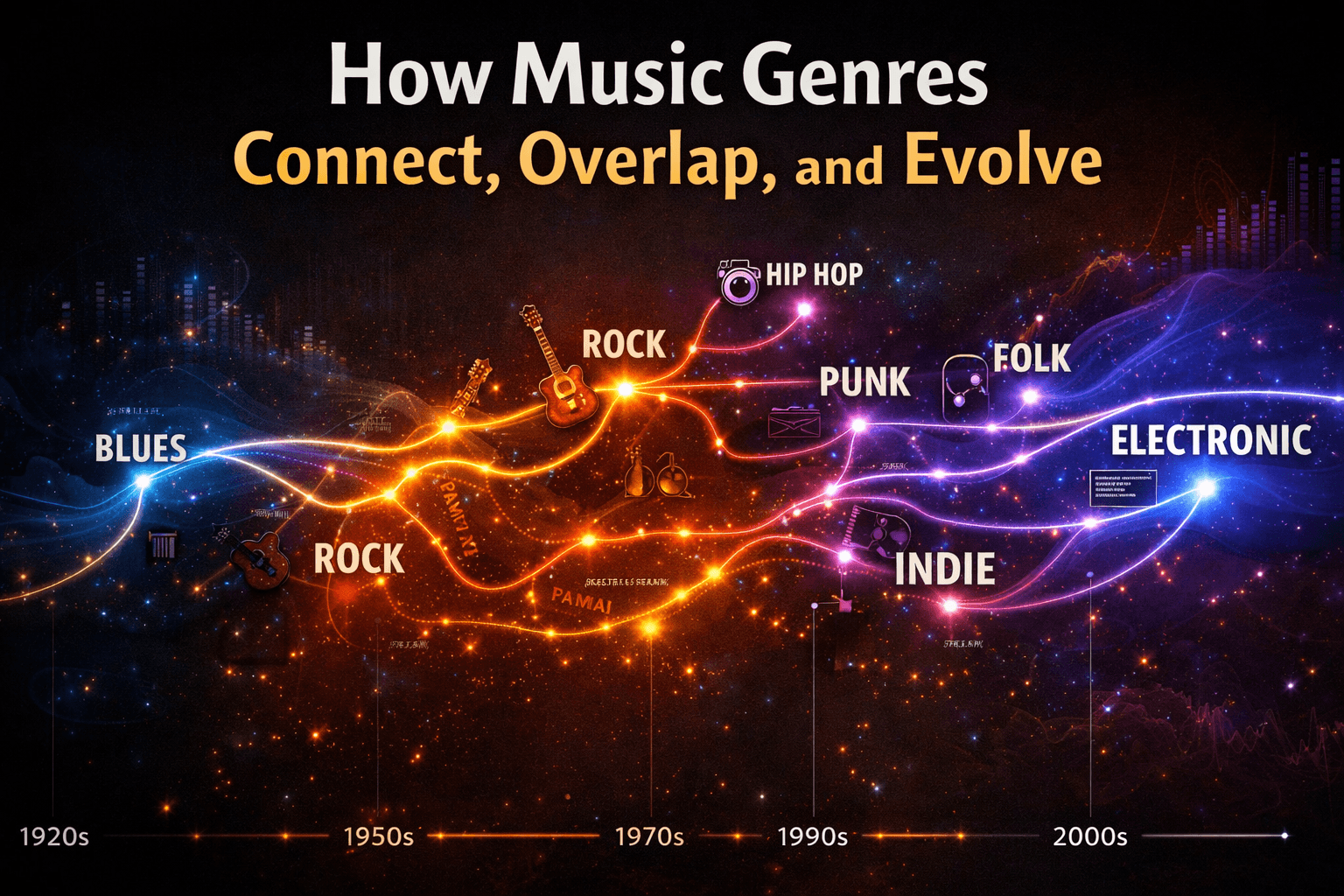 Understanding the major genre families is just the beginning. The real magic of a music map reveals itself when you start exploring the spaces between genres — the overlaps, the fusions, the unexpected connections that make the musical landscape so endlessly fascinating.
Because here's the truth: no genre of music exists in isolation. Every style you've ever loved was shaped by something that came before it, influenced by the culture around it, and destined to influence something that came after.
How One Genre of Music Gives Birth to Another
Musical evolution is rarely a clean, linear process. Genres don't simply replace each other — they transform each other. New styles emerge when musicians absorb existing influences and push them in unexpected directions, driven by technology, cultural shifts, and simple human creativity.
Consider this evolution chain:
Every step in that chain is visible on a music map — and every step helps you find similar music by understanding why certain sounds feel related even across decades.
This is why a music map is such a powerful tool for both casual listeners and serious students. It doesn't just show you what exists — it shows you the logic of how music grows.
The Role of Culture and Geography in Shaping Music Styles
Music doesn't develop in a vacuum. Every genre carries the fingerprints of the culture and geography that produced it — the available instruments, the dominant language, the social conditions, the historical moment.
Geography has shaped music in profound ways:
The rich and layered types of Indian music offer perhaps the most compelling example of geography and culture shaping an entire musical universe — from Hindustani classical traditions in the north to Carnatic music in the south, each with its own ragas, rhythmic systems, and philosophical frameworks.
Understanding this geographic dimension of music makes a music map far more than a genre organisation tool — it becomes a window into human culture itself.
Cross-Genre Fusion and Why It Matters
Some of the most exciting developments in music history have happened at the intersection of genres — when musicians from different traditions collide, collaborate, and create something entirely new.
Cross-genre fusion has given us:
On a music map, fusion genres typically appear in the spaces between established genre clusters — visually representing their hybrid nature. For anyone using a similar tracks finder or trying to find songs like the ones they already love, fusion genres are often the most rewarding discovery territory.
How Streaming Platforms Are Redrawing Genre Boundaries Today
The rise of streaming has fundamentally changed the way music genres are defined, discovered, and experienced. Algorithms on platforms like Spotify and Apple Music don't always follow traditional genre boundaries — instead, they group music by sonic characteristics, listener behaviour, and mood — effectively creating new micro-genres in real time.
This has led to a fascinating phenomenon: genre boundaries are becoming simultaneously more granular and more fluid. We now have hyper-specific micro-genres like:
For music map enthusiasts, this streaming-era genre proliferation is both exciting and challenging. It means the map is always expanding — and staying curious, rather than trying to memorise every category, is the most sustainable approach to music exploration.
How to Use a Genre Map to Discover New Music
Now we get to the part that most music lovers are truly here for — using a music map as a practical, powerful tool for discovering music you'll genuinely love.
Because a genre map isn't just an academic exercise. Used correctly, it's the most effective similar song finder available — one built not on algorithmic guesswork but on genuine musical logic and historical context.
Starting With What You Already Love
The most natural — and most effective — entry point for any music map exploration is your existing taste. What you already love is your compass. It tells you where you are on the map, which means it can show you exactly where to go next.
Start by asking yourself:
Your answers will point you toward a specific cluster on the music map — and from there, the exploration becomes genuinely exciting rather than overwhelming.
Following the Branches: From Familiar to Unfamiliar
Once you've located your starting point on the genre map, the next step is to follow the branches — moving deliberately from what's familiar toward what's adjacent, related, and ultimately new.
Here's a simple framework for branch-following:
This methodical approach to finding similar music is far more rewarding than relying on a song recommender algorithm — because you're building genuine musical knowledge with every step, not just passively consuming whatever the platform serves you next.
Using Mood, Tempo, and Instrumentation as Discovery Tools
Genre labels are useful — but they're not the only way to navigate a music map. Mood, tempo, and instrumentation are equally powerful discovery tools, and often more intuitive for listeners who don't yet have a strong genre vocabulary.
Consider these discovery pathways:
These cross-genre pathways are often invisible on a standard genre list but beautifully clear on a well-designed music map — making them one of the most valuable features of the format for music discovery.
Building a Personalised Music Exploration Roadmap
The ultimate goal of using a music map for discovery isn't just to find similar songs — it's to build a personalised roadmap for your ongoing musical journey.
Think of it as a living document:
This approach transforms music discovery from a passive, algorithm-dependent experience into an active, self-directed adventure — one that deepens your musical knowledge and your personal connection to the art form simultaneously.
Genre Maps as a Learning Tool for Music Students
For music students — whether beginners or more advanced learners — a genre map is one of the most underutilised educational tools available. Far beyond helping you find similar tracks or search similar songs, a genre map can fundamentally transform how you understand, study, and engage with music as an art form.
How Genre Maps Support Music Theory Basics
Music theory can feel abstract and disconnected from real musical experience — especially for beginners. Genre maps offer a powerful solution: they ground theory in context.
When you can see on a map that jazz and classical music share similar harmonic complexity, or that punk and early rock and roll share similar chord structures, theory stops being a set of rules on a page and becomes a living explanation of why music sounds the way it does.
Specific ways genre maps support music theory learning:
For students enrolled in beginner music lessons or online music courses, using a genre map alongside traditional theory materials accelerates comprehension dramatically — because it answers the question every student inevitably asks: "But when would I actually use this?"
Using Genre Relationships to Understand Composition and Structure
Every genre has its own compositional conventions — its own typical song structures, its own approaches to melody and harmony, its own production aesthetics. Understanding those conventions, and how they relate to other genres, is one of the most valuable things a music student can develop.
A genre map makes this comparative analysis intuitive:
This kind of structural awareness doesn't just make you a better music student — it makes you a more creative and intentional musician, regardless of which style you ultimately choose to master.
Genre Mapping in Online Music Education
The growth of music education online has made genre mapping more accessible and more valuable than ever. Where traditional music education often focused narrowly on classical or contemporary popular styles, online platforms have the freedom — and the reach — to offer genuinely comprehensive genre-based learning experiences.
Genre mapping in online music education serves several distinct purposes:
For anyone exploring music training online, understanding the genre map of their chosen instrument or style is one of the fastest ways to accelerate both technical development and musical maturity.
How Teachers Use Genre Maps in Beginner Music Lessons
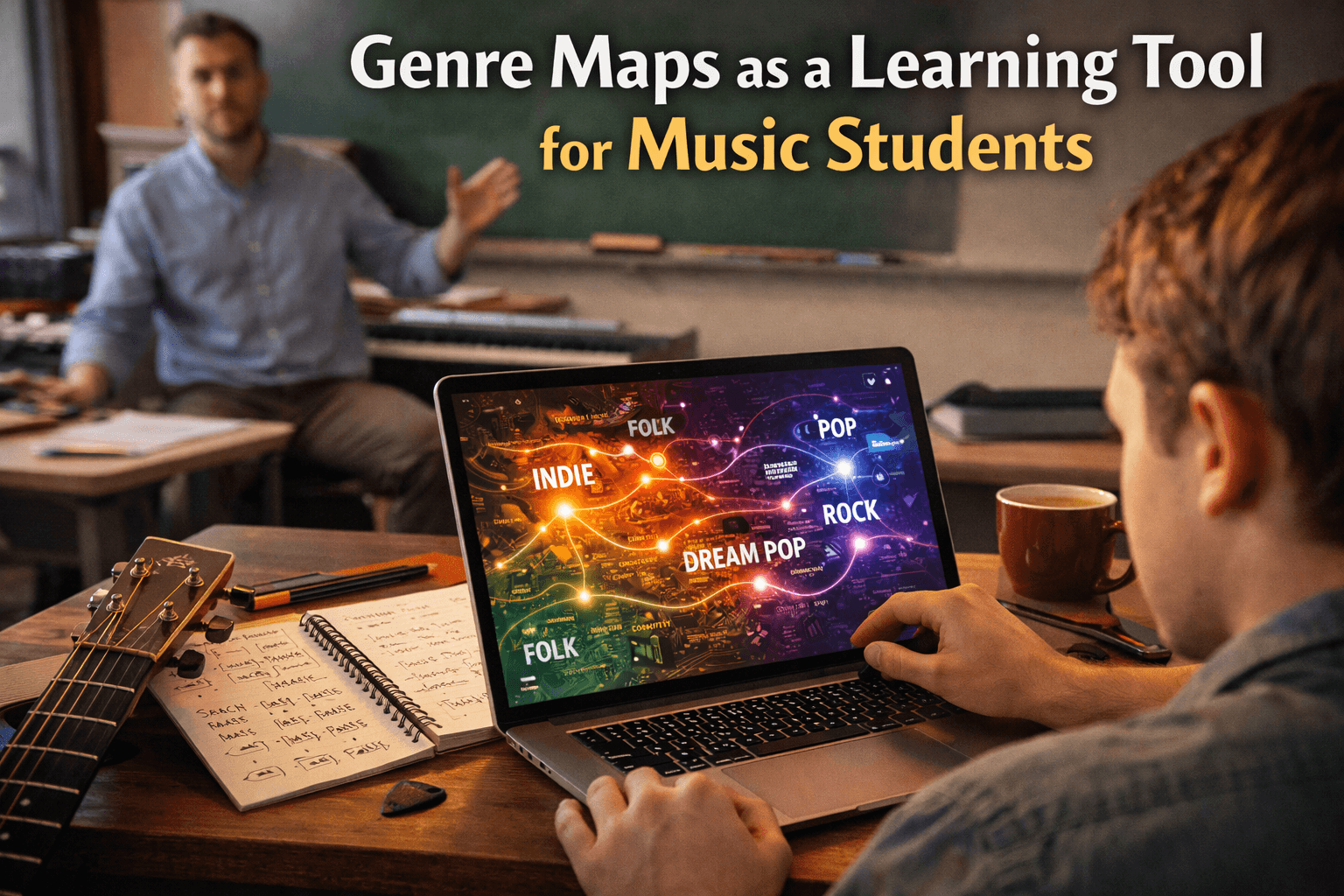 Experienced music teachers have long understood that context is one of the most powerful motivational tools in a student's early learning journey. When a beginner understands where the music they're learning comes from — and where it might lead them — their engagement deepens immediately.
Genre maps give teachers a visual, intuitive way to:
Whether used in one-on-one lessons, group classes, or self-directed online learning environments, genre maps transform music education from a series of isolated lessons into a coherent, connected, endlessly expanding musical adventure.
The Best Tools and Resources to Explore Music Genre Maps
You now understand what a music map is, why it matters, how genres connect and evolve, and how to use genre mapping for both discovery and education. Now it's time for the most practical section of all — the actual tools and resources that bring the music map to life.
Because knowing about genre maps is one thing. Having the right platforms and resources at your fingertips is what turns that knowledge into a genuine daily practice.
Top Interactive Genre Map Platforms and Websites
The best place to start your hands-on genre map exploration is with dedicated interactive platforms — tools built specifically to visualise genre relationships and help you find similar music with depth and precision.
The most powerful of these is Music Map — an elegant, artist-based discovery tool that shows you a visual cluster of artists similar to any name you search. Type in an artist you love and watch as a constellation of related musicians appears around them, organised by similarity. It's one of the most intuitive similar artists finders available online — and completely free to use.
Other notable platforms worth exploring:
Each of these platforms approaches music mapping differently — and using them in combination gives you a remarkably rich picture of the musical landscape.
Streaming Platforms With Genre-Based Discovery Features
Beyond dedicated music map tools, the major streaming platforms have developed increasingly sophisticated genre-based discovery features that complement traditional music mapping beautifully.
Here's how to use each platform's discovery tools most effectively:
Used alongside a dedicated music map tool, these streaming features become significantly more powerful — because you arrive with context, intention, and a framework for understanding what you're discovering.
Books and Guides for Deeper Music Genre Exploration
For learners who want to go beyond digital tools and develop a genuinely deep understanding of music genre history and relationships, books remain one of the most valuable resources available.
A few essential reads for serious genre explorers:
These resources add historical depth and intellectual context to the visual and interactive experience of music mapping — creating a genuinely well-rounded musical education.
Online Music Courses That Teach Genre-Based Learning
Finally, for those who want structured, guided support in their genre exploration journey, online music courses offer the most comprehensive and personalised learning experience available.
The most effective genre-based online music courses share several characteristics:
Whether you're drawn to classical composition, contemporary songwriting, traditional world music, or electronic production, the right online course doesn't just teach you how to play — it teaches you how to think musically across the entire landscape of styles and traditions the genre map reveals.
The tools are all here. The map is in your hands. All that's left is to start exploring — and let your curiosity lead you somewhere extraordinary.
Q1. What is a music map and how does it work?
A music map is a visual or interactive tool that represents the relationships between different music genres and artists. Rather than presenting genres as a flat list, a music map arranges them spatially — showing which styles share common roots, which genres evolved from others, and which artists sit closest to each other in terms of sonic similarity. Tools like Music Map allow you to type in any artist name and instantly see a visual cluster of similar artists around them, making it one of the most intuitive ways to find similar music online.
Q2. How do I use a music map to find similar songs?
Start by identifying an artist or genre you already love and enter it into an interactive music map tool. The map will display related artists and styles clustered around your search — organised by degree of similarity. From there, explore the artists closest to your search first, then gradually move outward toward less familiar territory. This method is far more effective than a standard song recommender because it's built on genuine musical relationships rather than purely algorithmic pattern matching.
Q3. What is the best tool to find similar artists and songs online?
Several excellent tools exist for finding similar artists and music. Music Map is one of the most visually intuitive similar artists finders available — simply search any artist and explore the constellation of related musicians that appears. Every Noise at Once offers the most comprehensive genre-based discovery experience, covering thousands of micro-genres. Spotify's Radio feature and Bandcamp's tag-based browsing are also highly effective for finding similar tracks across both mainstream and independent music.
Q4. What are the major music genre families on a music map?
Most comprehensive music maps are anchored by five major genre families: classical and orchestral, folk and traditional, blues and jazz, rock and its many subgenres, and electronic and digital music. These genre families form the foundational clusters of any music map — with hundreds of subgenres and fusion styles branching outward from each one. Understanding these core families gives you a reliable navigational framework for exploring the broader musical landscape.
Q5. How are music genres connected to each other?
Music genres connect through shared musical characteristics — similar chord progressions, rhythmic patterns, instrumentation, or cultural origins. For example, blues gave birth to rock and roll, which branched into dozens of rock subgenres, each of which has influenced contemporary pop and electronic music. On a music map, these connections are represented spatially — genres that share strong characteristics appear closer together, while more distantly related styles are positioned further apart.
Q6. Can a music map help me learn music theory?
Absolutely. A music map is one of the most effective contextual tools for music theory beginners. By showing you how genres relate to each other, a genre map reveals why certain chord progressions, scales, and rhythmic structures appear across multiple styles. This contextual grounding makes abstract theory concepts feel immediately relevant and applicable — accelerating comprehension for students in beginner music lessons or online music courses significantly.
Q7. What is the difference between a music map and a song recommender?
A song recommender — like those built into Spotify or Apple Music — uses algorithmic pattern matching based on listening behaviour to suggest new music. A music map, by contrast, is built on genuine musical logic — historical relationships, cultural connections, and shared sonic characteristics between genres and artists. While song recommenders are convenient, a music map gives you deeper context and more intentional discovery pathways, making it a far more educational and musically rewarding tool.
Q8. How do streaming platforms use genre maps for music discovery?
Streaming platforms like Spotify, Apple Music, and YouTube Music use genre-based algorithms to power their discovery features — including Radio stations, genre playlists, and personalised recommendation mixes. While these features don't always show you a visual genre map directly, they're built on similar underlying logic — grouping music by sonic characteristics, cultural origin, and listener behaviour. Using a dedicated music map tool alongside streaming platforms gives you the best of both worlds: visual context and convenient playback.
Q9. Are there music maps that cover world music and non-Western genres?
Yes — the most comprehensive music maps, including Every Noise at Once, cover an extraordinary range of world music and non-Western genres. From Afrobeats and Latin music to Indian classical traditions and Middle Eastern maqam music, global styles are increasingly well-represented in modern genre mapping tools. For anyone interested in exploring world music traditions in depth, combining a genre map tool with dedicated resources on specific regional traditions offers the richest possible discovery experience.
Q10. How can I use a music map to improve my online music learning journey?
A music map enhances online music learning in several important ways. It provides cultural and historical context for the styles you're studying, shows you how your chosen genre connects to the broader musical landscape, helps you identify related styles worth exploring, and gives you a visual roadmap for your long-term musical development. Whether you're taking beginner music lessons, exploring music theory, or developing performance skills in a specific genre, incorporating a music map into your learning practice deepens both your understanding and your appreciation of music as a whole.