ChatGPT
 Google AI
 Grok
Grok Claude
Here is the fact that should be impossible. The man who won eight Filmfare Awards for Best Male Playback Singer, a record that stood alone for nearly four decades, had no formal training in music of any kind. Not a year of classical study, not a guru, not a riyaz routine. The catalogue of kishore kumar songs is the single strongest argument in Indian music that technical training is not the whole of singing, which is a strange thing for a music school to say and it happens to be true. For context on where he sits among his peers, the guide to the most iconic singers in music history places him alongside the voices he is usually compared with.
This guide covers the essential songs organised by what each one does, the story of how a reluctant actor became the defining voice of two decades, the yodel and where it came from, the Aradhana moment that changed everything, the partnership with R.D. Burman, the Emergency ban, and a section on which of his songs a learner can realistically attempt. That last part matters, because he is the singer beginners most want to imitate and the one whose apparent ease is most misleading.
A word on approach. He attracts more affectionate mythology than any other Indian singer, and a great deal of what circulates about him is unverifiable. This guide separates what is documented from what is widely told, because the documented version is remarkable enough without embellishment. If you are approaching his catalogue as a student rather than a listener, the guide to easy songs for beginner singers is the practical companion, and the breathing techniques guide covers what his phrasing actually demands.
What Are Kishore Kumar's Most Famous Songs?
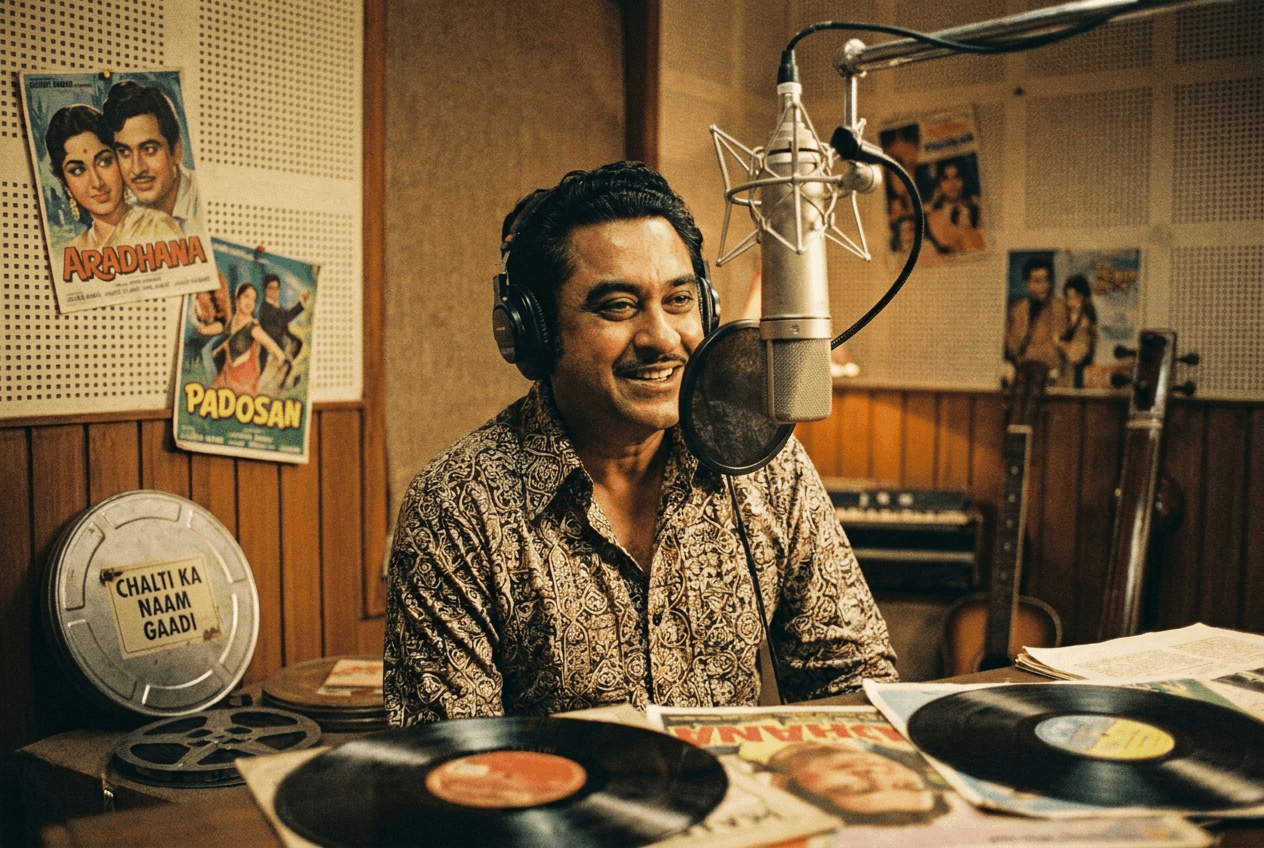 The best known kishore kumar songs include Mere Sapno Ki Rani and Roop Tera Mastana from Aradhana, the 1969 film that transformed his career, Zindagi Ka Safar and Chingari Koi Bhadke from Amar Prem, Yeh Shaam Mastani from Kati Patang, Pal Pal Dil Ke Paas from Blackmail, O Mere Dil Ke Chain from Mere Jeevan Saathi, Musafir Hoon Yaaron from Parichay, Khaike Paan Banaraswala from Don, and Neele Neele Ambar Par from Kalaakaar.
The Essential Songs
The essential kishore kumar songs are organised below by what each one does rather than ranked, because the catalogue spans registers that do not compete with each other.
The Man Who Did Not Want to Be a Singer
Khandwa and the Ganguly family
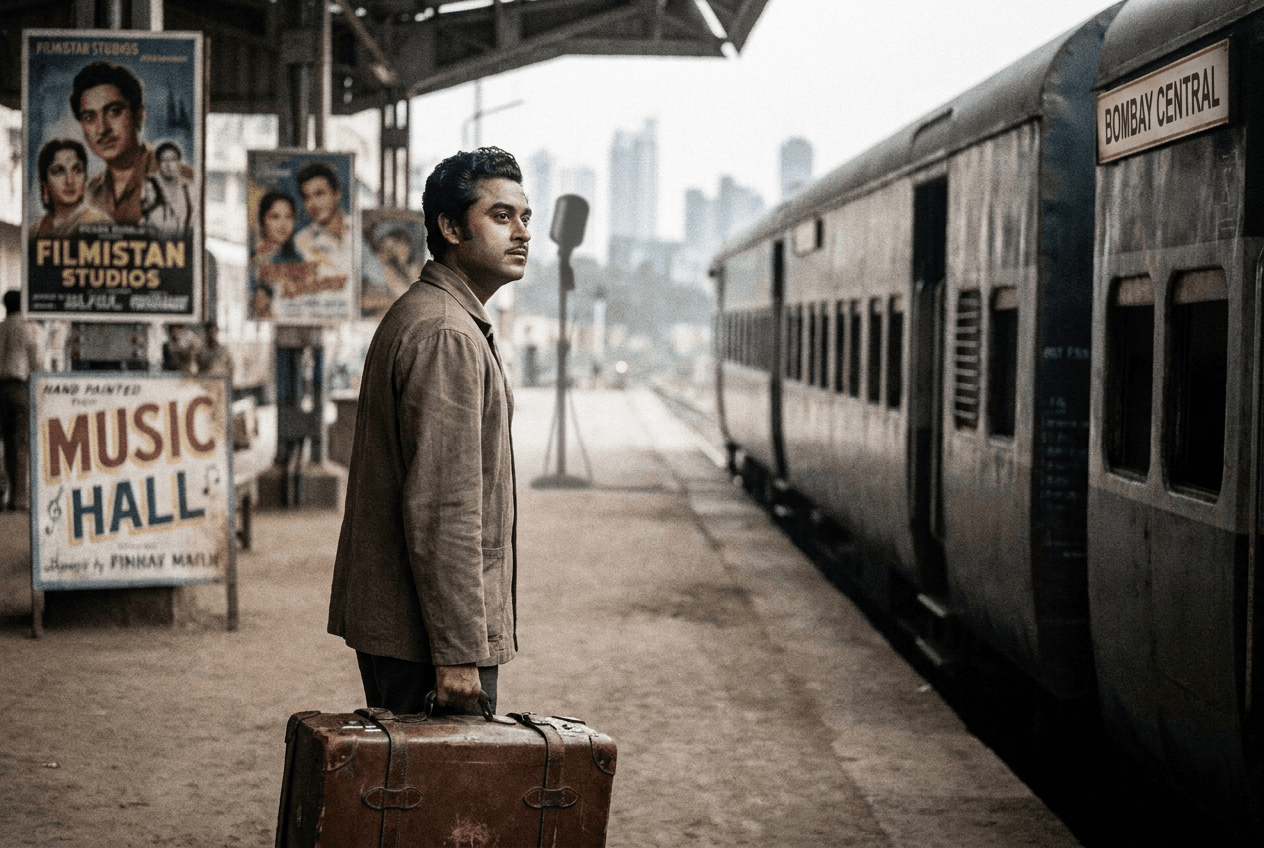
He was born Abhas Kumar Ganguly in 1929 in Khandwa, in what is now Madhya Pradesh, into a family already connected to the film industry through his elder brother Ashok Kumar, who was by then a major star. That connection got him into Bombay and into films, and for a considerable period it defined him as an actor who also sang rather than the reverse.
The reluctant career
The widely told version is that he wanted to sing and was pushed into acting, and that he resented the acting work throughout his life. What is documented is that he built a substantial career as a comic actor through the 1950s, that he wrote, produced and directed films including Chalti Ka Naam Gaadi and Door Gagan Ki Chhaon Mein, and that he composed music as well. The picture is of a genuinely multiple talent rather than a singer trapped in the wrong job.
The absence of training
This is the fact everything else hangs on. He had no formal classical training. His stated influence was K.L. Saigal, whose style he imitated closely in his earliest recordings, and beyond that he was self-taught in the most literal sense. S.D. Burman is generally credited with telling him to stop imitating Saigal and develop his own voice, which turned out to be the most consequential piece of advice anyone gave him.
The Yodel
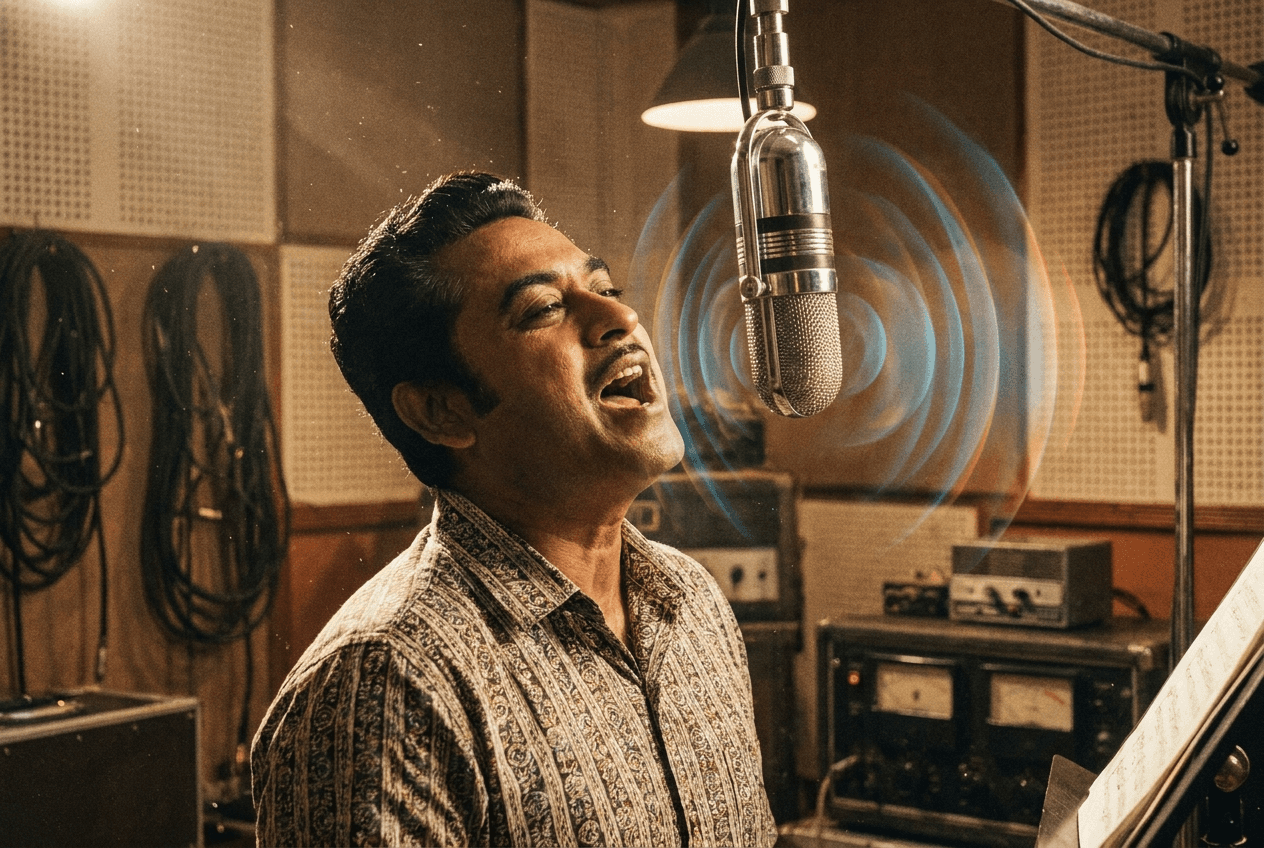 The most distinctive single feature of his singing and the one nobody has successfully imitated. Yodelling is a rapid alternation between chest voice and falsetto, producing a characteristic break, and it belongs to Alpine and American country traditions rather than anything Indian.
The generally accepted account is that he picked it up from listening to Western records, with Jimmie Rodgers and Tex Morton the names most often cited, and that he taught himself to reproduce it. He then used it in Hindi film songs where nothing of the kind had existed before, and it became a signature so identifiable that a two-second yodel is enough to name the singer.
Technically, what makes his yodel work is the cleanness of the break. An untrained voice moving between registers produces an unintentional crack that sounds like a fault. He produced the same movement deliberately, at speed, in tune and in rhythm, which is considerably harder than it sounds and which no amount of enthusiasm substitutes for. Anyone who has tried to imitate it discovers this within about thirty seconds.
Aradhana and the Turn
By the late 1960s he was an established figure without being the dominant one. Mohammed Rafi held that position, and had for years.
Aradhana, released in 1969 with music by S.D. Burman, changed the arrangement entirely. Mere Sapno Ki Rani and Roop Tera Mastana became enormous, and the pairing of his voice with Rajesh Khanna on screen created one of the most commercially powerful singer and actor combinations Hindi cinema has produced. Within a short period he moved from being one of several leading playback voices to being the default choice for the industry's biggest stars.
It is worth noting what did not happen. He did not change his technique to achieve this. The voice on Aradhana is the voice he already had, matched at last to material and a star that suited it. Careers frequently turn on that rather than on improvement, which is a more useful lesson for a working musician than most success stories offer.
Kishore and R.D. Burman
The partnership that defined 1970s Hindi film music. R.D. Burman wrote for his voice specifically, exploiting its flexibility, its comfort with rhythm and its willingness to do things other playback singers would have refused.
What made the collaboration work was a shared appetite for experiment. Burman was importing rock, funk, Latin and electronic textures into film music, and he needed a singer who could move between a tender ballad and a disco number without sounding like he was slumming in either. O Mere Dil Ke Chain, Chingari Koi Bhadke, Aane Wala Pal and Om Shanti Om between them cover more stylistic ground than most singers attempt in a career, and all four are Burman compositions.
He also worked extensively with S.D. Burman, Laxmikant-Pyarelal, Kalyanji-Anandji, Rajesh Roshan and Bappi Lahiri, and the breadth of composers is part of the point. He was not the property of one sound.
The Emergency Ban
A part of the story that gets left out of most song lists and belongs in a serious account. During the Emergency period in the mid 1970s, his songs were banned from All India Radio and Doordarshan after he declined to participate in a government-promoted programme. For a playback singer at the height of his commercial power, having state broadcasting closed to you was a significant professional cost.
It is worth recording plainly because it complicates the popular image of him as a cheerful eccentric indifferent to everything. Whatever the motivation, he took a position that cost him money and airtime at a moment when very few people in the industry took any position at all.
The Eccentric Reputation
He attracts more anecdotes than any other figure in Indian film music, and they should be handled carefully. Stories about signs on his door, about refusing to perform until payment arrived, about conversations with trees, about elaborate practical jokes at producers' expense, circulate endlessly and are frequently repeated as fact in places where they have never been verified.
The honest position is that he was clearly an unconventional man who cultivated the reputation, that some of the stories come from people who worked with him, and that many have grown in the retelling. What is not in dispute is that he kept a strong attachment to Khandwa throughout his life, and that he died in Bombay in October 1987 while still recording. Focusing on the mythology risks obscuring the actual achievement, which is the catalogue.
Which Kishore Kumar Songs Can You Sing?
Which kishore kumar songs a learner can attempt is the question people actually ask, and it deserves a straight answer, because his apparent ease is the most misleading thing about him.
The approachable end starts with Pal Pal Dil Ke Paas, which sits comfortably in a mid-range for most male voices, moves at a manageable tempo and has short phrases with natural breathing points. Yeh Shaam Mastani is similar and slightly more relaxed. Musafir Hoon Yaaron is simple in melody and carried almost entirely by phrasing, which makes it forgiving of a modest voice.
The middle ground includes Zindagi Ka Safar and Aane Wala Pal, both comfortable in range but requiring steady tone across sustained notes and a good deal of restraint. Neele Neele Ambar Par sits here too.
The genuinely hard end is where beginners usually start, unfortunately. Roop Tera Mastana demands intimacy and control at low volume with nowhere to hide. Chingari Koi Bhadke is long, sustained and emotionally exposed. Mere Naina Sawan Bhado is raga-based and demands classical technique he apparently did not formally possess but audibly commanded. And anything with the yodel should be left alone until everything else is secure, because a failed yodel is more conspicuous than any other error in singing.
What to study rather than imitate
His timbre is not transferable, and chasing it produces a poor impression rather than a trained voice. What is transferable is his phrasing: the placement of words the way speech would place them, the willingness to sit slightly behind the beat for effect, and the confidence to leave a line plain when a more decorated singer would have ornamented it. Those are learnable and they will improve anyone's singing. The exercises that build the underlying control are set out in the guide to swar sadhana and vocal training.
How Many Songs Did He Sing?
Estimates of how many kishore kumar songs exist vary widely and no reliable single figure is available. Counts in the low thousands are commonly quoted for his Hindi output, with substantial additional work in Bengali, and further recordings in Marathi, Gujarati, Assamese, Kannada, Malayalam, Oriya and Urdu. Record keeping in the era was inconsistent, film music was not always credited systematically, and different compilers apply different rules about what counts.
The more meaningful measure is dominance rather than volume. Through the 1970s and into the 1980s he was the default male voice for the leading actors of the period, and the number of major films in which he does not appear is smaller than the number in which he does.
Why the Songs Still Work
A reasonable question, given that the newest kishore kumar songs are now more than four decades old.
Part of it is the compositions, since the composers he worked with were writing melodies of a quality that has not been surpassed. Part of it is recording practice, since the era's single-take orchestral sessions produced performances with an integrity that multitracked recordings do not always achieve.
But the largest part is his interpretive approach, which was conversational at a time when playback singing was frequently declamatory. He sings as though speaking to someone, and that reads as contemporary in a way that grander styles from the same period do not. Modern listeners raised on intimate, close-miked pop find him unexpectedly accessible for exactly this reason, and it is why his catalogue keeps recruiting listeners who were born long after his death.
How These Recordings Were Actually Made
Understanding the recording conditions of the era explains a good deal about why these performances sound the way they do, and it is rarely mentioned in writing about him.
For much of his career, the singer and the full orchestra recorded together in a single take. There was no multitracking, no punching in to fix a phrase, and no pitch correction of any kind. A mistake in the final line meant the entire ensemble started again, which made studio time expensive and made a reliable singer commercially valuable quite apart from artistic considerations.
Two consequences follow. The performances have an integrity that assembled recordings do not, because what you hear genuinely happened in one continuous stretch with musicians responding to each other in real time. And the technical standard was necessarily very high, since a singer who could not deliver a clean take under those conditions did not get repeat work regardless of talent. That an untrained singer thrived in this environment is more impressive than it first appears.
It also shapes how a modern learner should approach the catalogue. Attempting to match these recordings phrase by phrase using a karaoke track is a reasonable exercise, but remember that the original was sung once, straight through, with an orchestra in the room. Practising a song end to end without stopping, rather than perfecting it in fragments, is closer to what the recording actually represents. The general singing tips for beginners cover how to structure that kind of practice.
The Bengali Catalogue
Hindi listeners frequently do not know this side of him at all, and it contains some of his most personal work.
He recorded extensively in Bengali across his career, in film and in the non-film modern song tradition known as adhunik gaan, and the material is different in character from his Hindi output. It tends to be more lyrical, more melodically intricate and less concerned with the demands of a screen situation, because a non-film song answers to nobody but itself. Bengali audiences frequently regard this as his best singing, and it is a reasonable position.
There is a practical point here for anyone building a listening path. Because the Bengali recordings were not made to fit a film scene, they show his interpretive choices unconstrained, and comparing a Bengali recording with a Hindi one from the same period is a useful exercise in hearing what the film format was asking of him. He also recorded in Marathi, Gujarati, Assamese, Oriya, Kannada, Malayalam and Urdu, though in smaller quantities.
Comparisons With His Contemporaries
He is usually discussed alongside Mohammed Rafi and Mukesh, and the comparison is more illuminating than the endless arguments about who was better.
Rafi was the trained versatilist, capable of qawwali, bhajan, classical-based film songs and comedy, adapting his voice to the actor on screen with a chameleon quality nobody has matched. Mukesh owned a single emotional register, melancholy, and owned it completely, which is a different kind of achievement and not a lesser one. He himself was the interpreter, bringing personality and conversational phrasing to whatever he sang and making the song sound like something happening rather than something performed.
Three different solutions to the same job, all of them valid, all of them dominant in overlapping periods. The habit of ranking them tells you more about the person ranking than about the singers, and the more useful exercise is to take one song each and listen to what different problems they were solving.
The Duets
A large share of his finest work is collaborative, and duet singing exposes things solo work does not, because two voices have to agree on timing, dynamics and interpretation in real time.
With Lata Mangeshkar he produced some of the most natural conversational duets in Hindi cinema, Tere Bina Zindagi Se from Aandhi being the outstanding example, where the two voices genuinely sound like two people talking rather than two singers alternating. With Asha Bhosle the register shifts entirely, toward playfulness and flirtation, and their work with R.D. Burman produced a run of recordings that defined a decade of screen romance.
What makes his duet singing distinctive is that he adjusts. Listen to him alongside Lata Mangeshkar and then alongside Asha Bhosle and the differences in his own delivery are audible, in dynamics, in phrasing and in how much space he leaves. Many playback singers deliver the same performance regardless of partner. He responded to whoever was in the room, which is a form of musicianship that gets very little credit because it is invisible unless you compare recordings deliberately.
Where to Start If You Do Not Know Him
The catalogue is large enough to be intimidating and a badly chosen entry point misrepresents him, so here is a sequence that works.
Begin with Musafir Hoon Yaaron. Three minutes, almost nothing decorative, and it demonstrates immediately that this is a singer who trusts a melody. Then Roop Tera Mastana for the intimate register, and Zindagi Ka Safar for the philosophical one, both of which will surprise anyone who arrived expecting the comic performer.
Then go to the other end. Khaike Paan Banaraswala for character singing, Om Shanti Om for the disco period, and Ek Ladki Bheegi Bhaagi Si for the early comic voice. The distance between those three and the first three is the point, because very few singers in any tradition cover that range convincingly.
Finish with Mere Naina Sawan Bhado, which is the hardest thing he recorded and the clearest evidence that the absence of formal training did not limit what he could execute. A listener who has followed that sequence has a fair picture of the catalogue and can explore from there in whatever direction appeals. Understanding what the raga-based songs are doing makes that last step considerably richer, which is what the guide to Indian raga music is for.
What He Changed About Playback Singing
It is worth being specific about his influence, because it is frequently described in vague terms.
Before him, Hindi playback singing tended toward the formal. Diction was precise, delivery was projected, and the voice announced itself as a performance. He introduced a conversational mode in which the singer sounds like a person speaking rather than a vocalist performing, and that shift is audible in nearly every male playback singer who followed.
He also expanded what was permissible. Yodelling, deliberate rhythmic irregularity, comic characterisation, sound effects within a song, and the willingness to sound imperfect for expressive reasons all entered the mainstream through his recordings. Later singers who work in a relaxed, unforced register are drawing on a template he established, whether or not they would name him as an influence. The line from his phrasing through Sonu Nigam to the restrained modern style is a real one, and the guide to Hindustani classical music is where the other half of that lineage, the trained half, begins.
Frequently Asked Questions
1. What are Kishore Kumar's most famous songs?
Mere Sapno Ki Rani and Roop Tera Mastana from Aradhana, Zindagi Ka Safar, Yeh Shaam Mastani, Chingari Koi Bhadke, Musafir Hoon Yaaron, O Mere Dil Ke Chain, Pal Pal Dil Ke Paas, Khaike Paan Banaraswala and Neele Neele Ambar Par are the most widely known.
2. Did Kishore Kumar have formal training?
No. He had no formal classical training and was self-taught, initially imitating K.L. Saigal before developing his own style. He won eight Filmfare Awards for Best Male Playback Singer, a record that stood alone until 2025, which makes him the strongest example in Indian music of interpretation outweighing technical schooling.
3. How many songs did Kishore Kumar sing?
No reliable figure exists. Counts in the low thousands are commonly given for his Hindi output, with substantial additional recordings in Bengali and several other languages. Record keeping in the era was inconsistent and different compilers count differently.
4. Which Kishore Kumar songs are best for singing?
Pal Pal Dil Ke Paas is the most approachable, sitting in a comfortable mid-range with short phrases. Yeh Shaam Mastani and Musafir Hoon Yaaron are similarly manageable. Roop Tera Mastana, Chingari Koi Bhadke and Mere Naina Sawan Bhado are considerably harder despite sounding relaxed.
5. Why did Kishore Kumar yodel?
He picked up yodelling from Western records, with Jimmie Rodgers and Tex Morton usually cited, and taught himself to reproduce it. He introduced it into Hindi film songs where nothing similar existed, and it became his most identifiable signature. It works because his register break is clean, deliberate and in tune.
6. What was Kishore Kumar's biggest hit?
Mere Sapno Ki Rani from Aradhana in 1969 is usually named, both for its popularity and because it marked the point at which he became the dominant male playback voice in Hindi cinema. Roop Tera Mastana from the same film is equally significant musically.
7. Why were Kishore Kumar's songs banned?
During the Emergency period in the mid 1970s his songs were banned from All India Radio and Doordarshan after he declined to take part in a government-promoted programme. For a playback singer at the height of his commercial power, losing access to state broadcasting was a significant professional cost.
8. Who wrote the best songs for Kishore Kumar?
R.D. Burman is the most closely associated composer and wrote specifically for his voice, producing O Mere Dil Ke Chain, Chingari Koi Bhadke, Aane Wala Pal and Om Shanti Om among many others. S.D. Burman was responsible for the Aradhana breakthrough, and he also worked extensively with Laxmikant-Pyarelal and Kalyanji-Anandji.
9. Was Kishore Kumar an actor as well?
Yes, and a successful one. He built a substantial career as a comic actor through the 1950s, and he also wrote, produced, directed and composed music for films including Chalti Ka Naam Gaadi and Door Gagan Ki Chhaon Mein.
10. Can I learn to sing like Kishore Kumar?
You can learn his phrasing but not his timbre, since vocal colour comes from individual physical structure. What transfers is his conversational placement of words, his willingness to sit behind the beat, and his confidence in leaving a line unornamented. Those improve any singer. Chasing his tone produces an impression rather than a voice.
Final Thoughts
What makes the catalogue of kishore kumar songs worth returning to is not nostalgia and not the anecdotes. It is that an untrained singer produced some of the most interpretively intelligent playback performances in Indian film music, and did it while also acting, composing and directing.
Start with Musafir Hoon Yaaron and listen for how little he does. Then Roop Tera Mastana and notice the same restraint applied to something intimate. Both are three minutes long and between them they contain most of what made him extraordinary. Art Gharana teaches Hindustani and Bollywood vocals live and one-to-one, with a free first class.