ChatGPT
 Google AI
 Grok
Grok Claude
The Indian diaspora community in Canada has grown to approximately 1.8 million people. Among this community's most distinctive parenting characteristics is a high rate of enrolment in Indian classical music and dance education for children. This isn't simply cultural nostalgia - it reflects a sophisticated understanding of what classical arts education provides developmentally, culturally, and academically. This comprehensive guide examines the real reasons Indian-Canadian parents are choosing classical music for their children, the evidence behind those decisions, and how families across Canada are making it work through a combination of online instruction and community engagement.
The Scale of the Indian-Canadian Community

Understanding the Demographic Context
According to Statistics Canada's 2021 Census data, people of South Asian origin constitute the largest visible minority group in Canada, representing approximately 7.1% of the total population. The Indian-Canadian community within this population is concentrated primarily in the Greater Toronto Area (home to over 600,000 South Asians), Metro Vancouver, Calgary, Edmonton, Ottawa, and Montreal.
This is not a small or isolated community. It is one of the most educationally attained, economically successful, and culturally engaged diaspora communities in Canadian history. The parenting choices made within it are informed, intentional, and backed by community networks that share resources, recommendations, and collective wisdom developed over decades.
The Second Generation Coming of Age
A significant portion of Indian-Canadian children today are second-generation - born in Canada to immigrant parents. These children are growing up bilingual (or multi-lingual), navigating dual cultural identities, and facing the specific challenge of maintaining meaningful connection to a cultural heritage that is not reinforced in their schools, mainstream media, or peer groups.
This context makes the question of cultural arts education for children not merely an extracurricular decision but a fundamental parenting priority.
The Real Reasons Parents Are Choosing Classical Arts Education

Reason 1 - Giving Children Something Genuinely Their Own
Many Indian-Canadian parents describe a feeling they want their children to have: the experience of excelling at something specifically Indian, of being the one person in their Canadian peer group who can perform Bharatanatyam, who understands ragas, who can play tabla fluently. In a school environment where Indian cultural knowledge is rarely celebrated or even acknowledged, developing genuine classical arts competence gives children a source of identity and pride that is both deeply personal and culturally specific.
Reason 2 - The Cognitive Benefits Are Well-Established
Indian-Canadian parents, who disproportionately work in professional fields requiring analytical thinking, are acutely aware of the research linking music education to cognitive development. They know that structured music lessons improve working memory, executive function, and spatial reasoning.
Research published in Frontiers in Neuroscience found that structured music lessons significantly improved children's cognitive abilities including language-based reasoning, short-term memory, planning, and inhibitory control. For parents who have observed the academic success patterns of children in their professional networks, many of whom received classical arts education as children, this research confirms what community experience has long suggested.
Reason 3 - Heritage Language Connection Through Music
For Indian-Canadian families where heritage language maintenance is a priority, music provides an unexpectedly powerful vehicle. Carnatic compositions in Tamil, Telugu, Sanskrit, and Kannada, Hindustani bandishes in Braj Bhasha, Sanskrit shlokas in Bharatanatyam - all these provide children with regular, structured engagement with heritage languages that language classes alone often don't achieve.
Children who learn a composition in Tamil don't just learn the notes. They learn the words, their meanings, the poetic imagery, and something of the linguistic structure. This linguistic immersion through music is one of heritage language education's most powerful allies.
Reason 4 - Building the Discipline That Academic Success Requires
The riyaaz culture of Indian classical music - the commitment to daily, systematic, purposeful practice - is one of the most valuable lessons classical arts education transmits. Indian-Canadian parents who achieved academic and professional success through consistent, disciplined effort recognise this value immediately.
A child who learns to practise their sarali varisai every morning before school is not just learning music. They are developing the habit of daily purposeful work that will serve them in academic study, athletic training, professional development, and every other domain that requires sustained effort over time.
Reason 5 - Community Connection and Network
Indian-Canadian classical arts communities provide children with peer networks that share their cultural background, values, and family priorities. Dance recitals, music competitions, temple cultural events, and community festivals create regular occasions for social connection within the South Asian community.
For children in predominantly non-South Asian school environments, this community connection can be profoundly important. The friendships formed in Bharatanatyam class, in tabla lessons, at Carnatic music competitions these often become the most enduring and meaningful social connections in a child's life.
Reason 6 - Intergenerational Connection
Perhaps the most emotionally resonant reason Indian-Canadian parents choose classical arts education for their children is the intergenerational connection it creates. Grandparents in India who receive video messages of their grandchildren performing Bharatanatyam or singing a Carnatic composition experience a specific joy that transcends geographical distance. Parents who grew up watching these art forms performed, who carry childhood memories of temple festivals and cultural programmes, find that their children's classical arts training creates a continuous thread between past and present.
This is heritage as lived experience rather than heritage as archived memory. It is one of the most profound gifts a parent can give.
Reason 7 - Preparation for Cultural Life in Canada
Canada's South Asian community is deeply culturally active. Diwali festivals, Navratri celebrations, temple cultural programmes, wedding sangeet ceremonies, South Asian heritage month events, and community galas all feature classical Indian music and dance performances. Children with classical arts training participate in this cultural life as contributors rather than spectators.
As these children grow into teenagers and adults, their classical arts background becomes a source of social currency within the community - the ability to perform, to teach, to organise cultural events, and to transmit the tradition to the next generation.
How Indian-Canadian Parents Are Making Classical Arts Education Work

The Online Revolution Has Made This Possible Canada-Wide
The online learning transformation has been particularly impactful for Indian-Canadian families outside Canada's major South Asian community hubs. Families in smaller cities and towns across Canada can now access the same quality of Hindustani vocal instruction, Carnatic music classes, Bharatanatyam teaching, and tabla lessons as families in the heart of Brampton or Surrey.
This democratisation of access to quality Indian classical arts education is one of the most significant developments in diaspora cultural life of the past five years.
Typical Weekly Schedules of Indian-Canadian Children in Classical Arts
Based on community patterns, a common weekly schedule for an Indian-Canadian child serious about their cultural arts education might include:
Two weekly Indian classical arts lessons (for example, Bharatanatyam twice per week or Carnatic vocals twice per week)
One or two weekly Western academic lessons (piano for ABRSM grades, or other Western music)
Daily practice of 20-30 minutes per art form
Participation in monthly cultural community events as performance or audience
Annual participation in competitions, examinations, or public performances
This schedule is ambitious but manageable for families committed to the investment. Many Indian-Canadian parents describe it as simply part of how their family life is structured, similar to how athletic families structure weekend tournaments and weekday training around school schedules.
The Practical Logistics
Coordinating Across Time Zones
For Canadian families whose preferred Hindustani or Carnatic teacher is based in India, time zone coordination is a practical consideration. Canadian Eastern Time is 10.5 hours behind Indian Standard Time. This means lessons at 8 AM in Toronto correspond to 6:30 PM in India - a workable evening time for Indian-based teachers.
Finding the Right Teacher
Community networks are the most reliable source of teacher recommendations in Indian-Canadian arts communities. Facebook groups, temple announcement boards, community WhatsApp groups, and South Asian cultural organisations all circulate recommendations for qualified teachers.
At Art Gharana, we offer a full range of Indian classical music and dance classes for children and adults across Canada. Explore our complete course offerings including our Hindustani vocal classes and our dance courses.
The Evidence That It Works
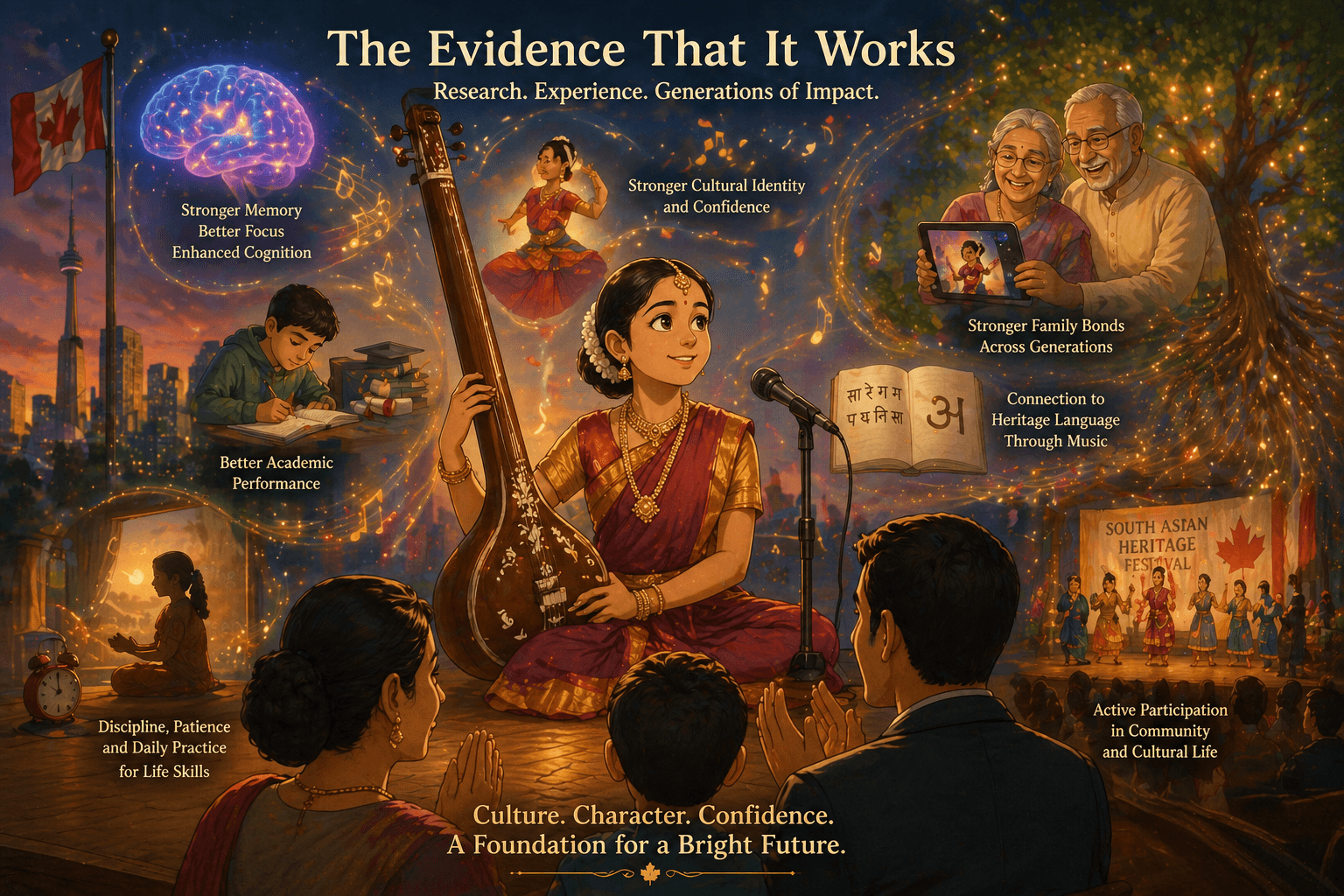
What Research Shows About Cultural Arts Education for Diaspora Children
Research on diaspora communities published in the International Social Science Journal confirms that active engagement with heritage cultural practices significantly strengthens ethnic identity in second-generation children and young adults. Children who have genuine competence in heritage arts forms - not just familiarity with them - demonstrate more confident and stable cultural identity, better mental health outcomes in bicultural contexts, and stronger intergenerational family relationships.
The research on cognitive benefits is equally compelling. Music education research consistently shows improvements in working memory, attention, and language processing. For Indian-Canadian children in competitive academic environments, these cognitive advantages compound the cultural and identity benefits of classical arts training.
Community Evidence
Within the Indian-Canadian community itself, the evidence is visible in the outcomes of young adults who received classical arts education as children. Many of Canada's most successful young Indian-Canadian professionals, academics, and community leaders cite their classical arts backgrounds as foundational to their character development, cultural confidence, and ability to engage meaningfully with both their Indian heritage and their Canadian identity.
Conclusion
Indian-Canadian parents are enrolling their children in classical music and dance education for reasons that are simultaneously practical, cognitive, cultural, and deeply personal. The evidence supports every dimension of this decision.
Three things to take away. First, the cognitive benefits of classical arts training extend far beyond music itself into academic performance and executive function. Second, the cultural identity benefits for second-generation diaspora children are among the most significant gifts classical arts education provides. Third, online instruction has made high-quality Indian classical arts education accessible to Indian-Canadian families across the entire country.
Book a free trial class at Art Gharana today and join thousands of Indian-Canadian families giving their children the gift of their heritage.
Frequently Asked Questions
1. At what age should Indian-Canadian children start classical arts education?
Most arts forms are accessible from ages five to seven. Bharatanatyam and Carnatic vocals are often begun around age five or six. Tabla, guitar, and piano are typically introduced around age seven or eight. The most important factor is genuine interest in the art form.
2. How much does Indian classical arts education typically cost in Canada?
Online 1:1 classes from qualified teachers typically range from CAD $40-$80 per session depending on teacher experience and platform. Many platforms offer monthly subscription packages that reduce the per-session cost. Annual investment for serious students including lessons and modest material costs is typically CAD $1,500-$3,000.
3. How do Indian-Canadian parents find qualified classical arts teachers in Canada?
Community networks (temple groups, South Asian cultural organisations, Facebook groups, WhatsApp groups) are the most reliable source. Platforms like Art Gharana provide access to qualified teachers regardless of Canadian geography.
4. Is it important for the teacher to also be Indian?
Cultural background is one relevant factor but not the only one. The most important qualities are formal training in the tradition, genuine pedagogical skill, experience with diaspora learners, and authentic cultural knowledge. Many excellent Indian classical arts teachers from non-Indian backgrounds have trained extensively in India under qualified gurus.
5. Can classical arts training and Western academic music training work together?
Absolutely. Many Indian-Canadian children pursue both an Indian classical art form and a Western instrument for ABRSM grades simultaneously. The traditions are complementary rather than competing, and the musical skills developed in one area often accelerate progress in the other.