ChatGPT
 Google AI
 Grok
Grok Claude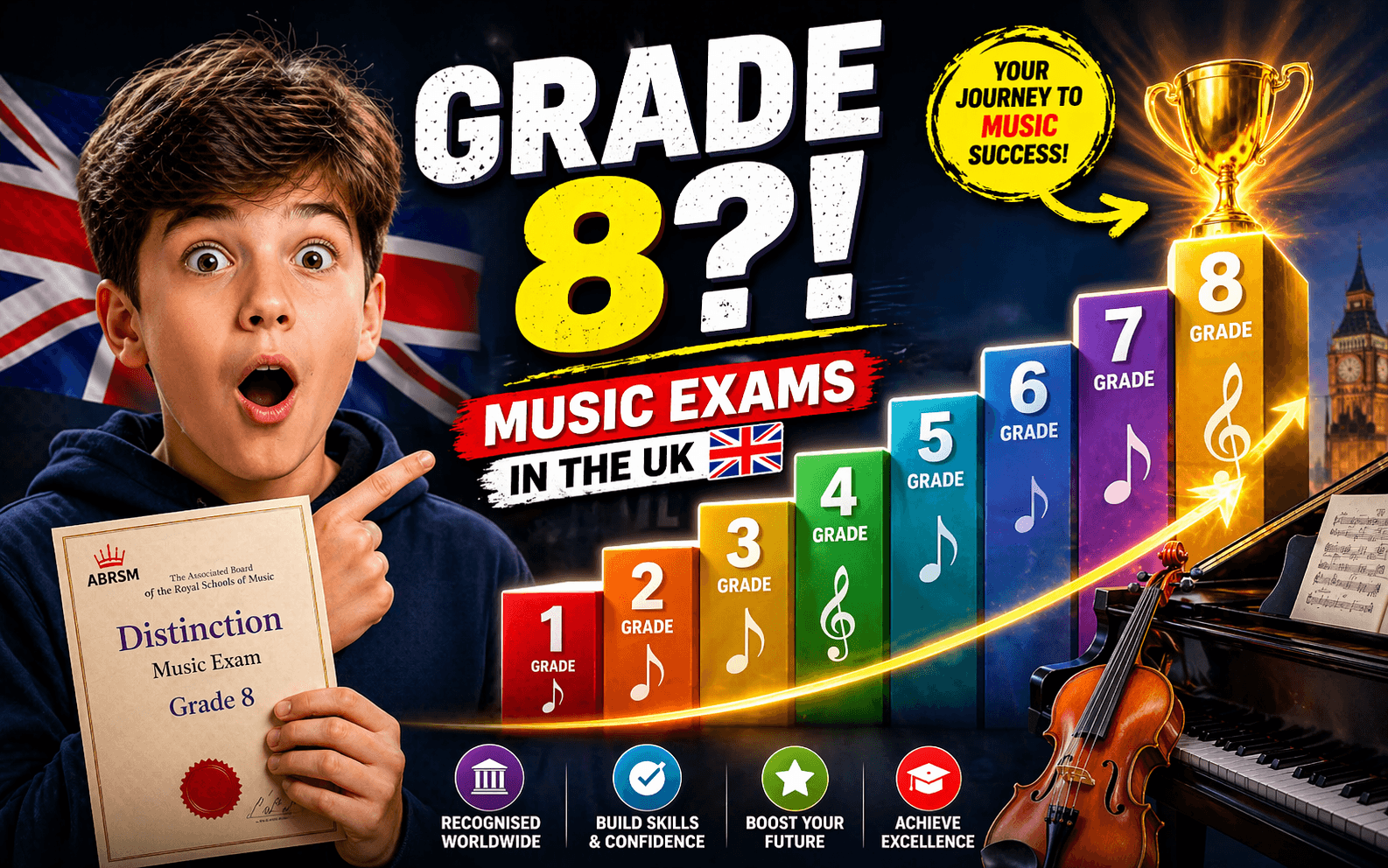
The UK has one of the world's most structured graded music examination systems, dominated by ABRSM and Trinity College London. For British-Indian families, the question is increasingly whether Indian classical music has an equivalent pathway and whether it carries any formal recognition within the UK education system. The answer is nuanced: traditional Indian examination systems carry significant community prestige, and Ofqual-accredited Indian music qualifications now exist. This comprehensive guide compares both systems across all grades, explains what Ofqual regulation actually means, and helps UK families decide the right qualification pathway for their child.
Walk into any British secondary school music department and the language is clear: what grade are you? Grade 3 violin. Grade 5 piano. Grade 8 distinction. ABRSM's graded examination system has become so embedded in British music culture that it functions almost as a universal measure of musical achievement.
For British-Indian families, this creates a genuine question. Your child is learning Hindustani classical vocals or Carnatic music or Bharatanatyam alongside their Western music studies. That learning is deep, structured, and demanding. But when their school asks "what grade are you?", there's no simple answer for Indian classical music.
The ABRSM Graded Examination System: A Complete Overview
What ABRSM Is and Why It Matters
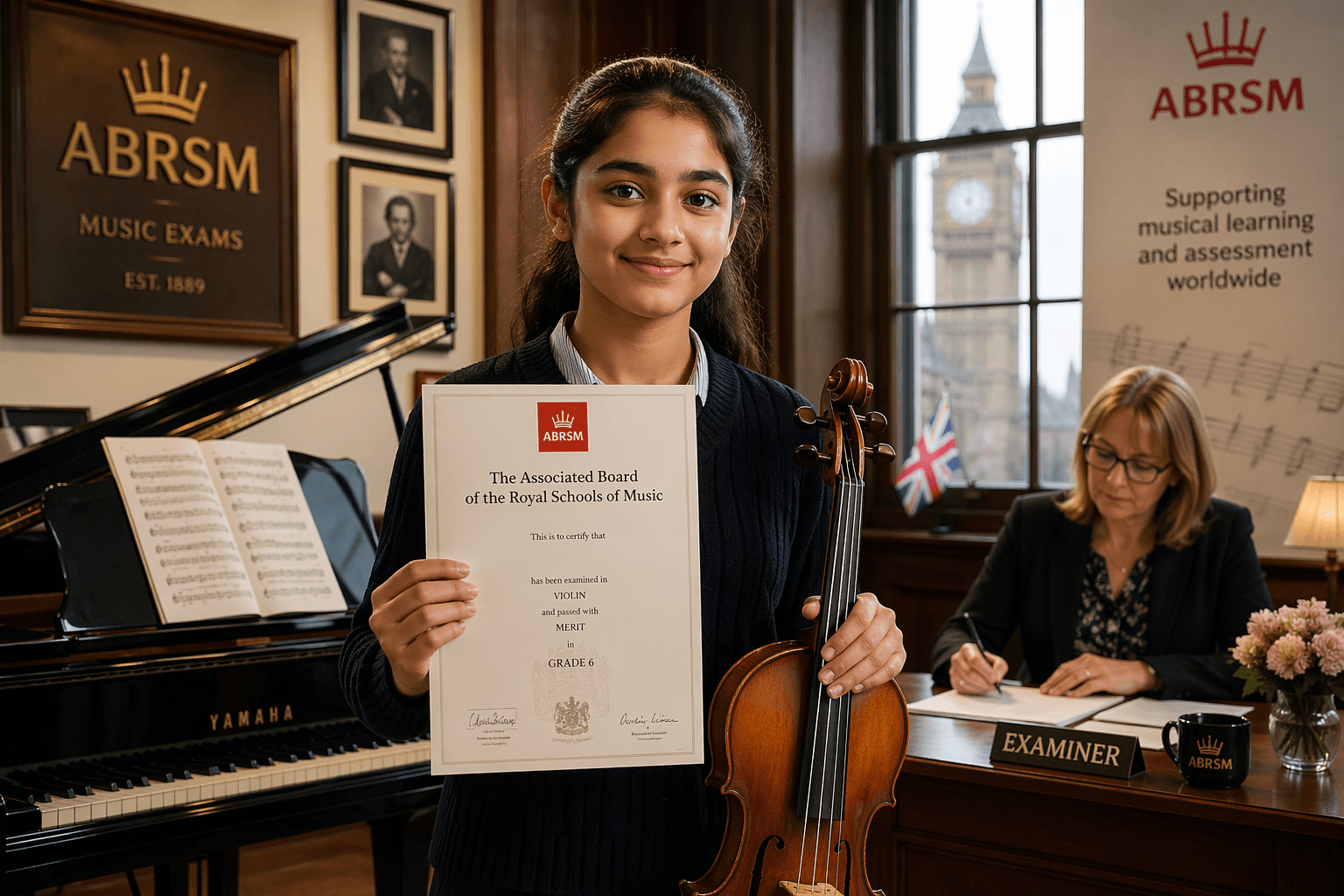
The Associated Board of the Royal Schools of Music (ABRSM) is a music examination board founded in 1889 and associated with four of the UK's leading conservatoires: the Royal Academy of Music, the Royal College of Music, the Royal Northern College of Music, and the Royal Conservatoire of Scotland.
ABRSM examinations are taken by over 650,000 students per year in more than 93 countries. Within the UK, ABRSM grades are among the most universally recognised measures of musical achievement outside of formal university degrees.
What ABRSM Examinations Test
All ABRSM practical examinations (Grade 1-8) test three components:
Pieces
The student performs three pieces selected from the official ABRSM syllabus list for that year and grade. Pieces range from baroque, classical, and romantic to contemporary styles depending on instrument. The list is updated every two years.
Technical Work
Scales, arpeggios, and other technical exercises appropriate to the grade level. At Grade 1, this might be simple one-octave major scales. By Grade 8, it includes complex scales in multiple octaves, arpeggios, broken chords, and chromatic scales.
Sight-Reading and Aural Tests
Sight-reading: The student performs a short, unseen piece appropriate to the grade. Aural tests: The examiner plays musical extracts and asks the student to respond to questions about rhythm, pitch, melody, and musical character.
The ABRSM Theory Requirement
Grade 5 Theory is a prerequisite for entering Grades 6, 7, and 8 practical examinations. This means students must demonstrate solid music theory knowledge before accessing the advanced performance grades. Grade 5 Theory covers keys, scales, intervals, basic harmony, musical terms and signs, and short-score analysis.
ABRSM Grades and the UK Regulatory Framework
The Ofqual (Office of Qualifications and Examinations Regulation) regulates ABRSM's graded examination qualifications for England, placing them on the Regulated Qualifications Framework (RQF):
ABRSM Performance Grades 1-5: RQF Entry Level to Level 2 ABRSM Performance Grades 6-8: RQF Level 3 (broadly A-Level equivalent)
UCAS Tariff Points: ABRSM Grades 6, 7, and 8 with Merit or Distinction carry UCAS tariff points for UK university applications:
- Grade 6 Merit: 10 points | Grade 6 Distinction: 13 points
- Grade 7 Merit: 16 points | Grade 7 Distinction: 20 points
- Grade 8 Merit: 26 points | Grade 8 Distinction: 33 points
The Hindustani Classical Music Examination System
How Indian Classical Music Has Its Own Graded System
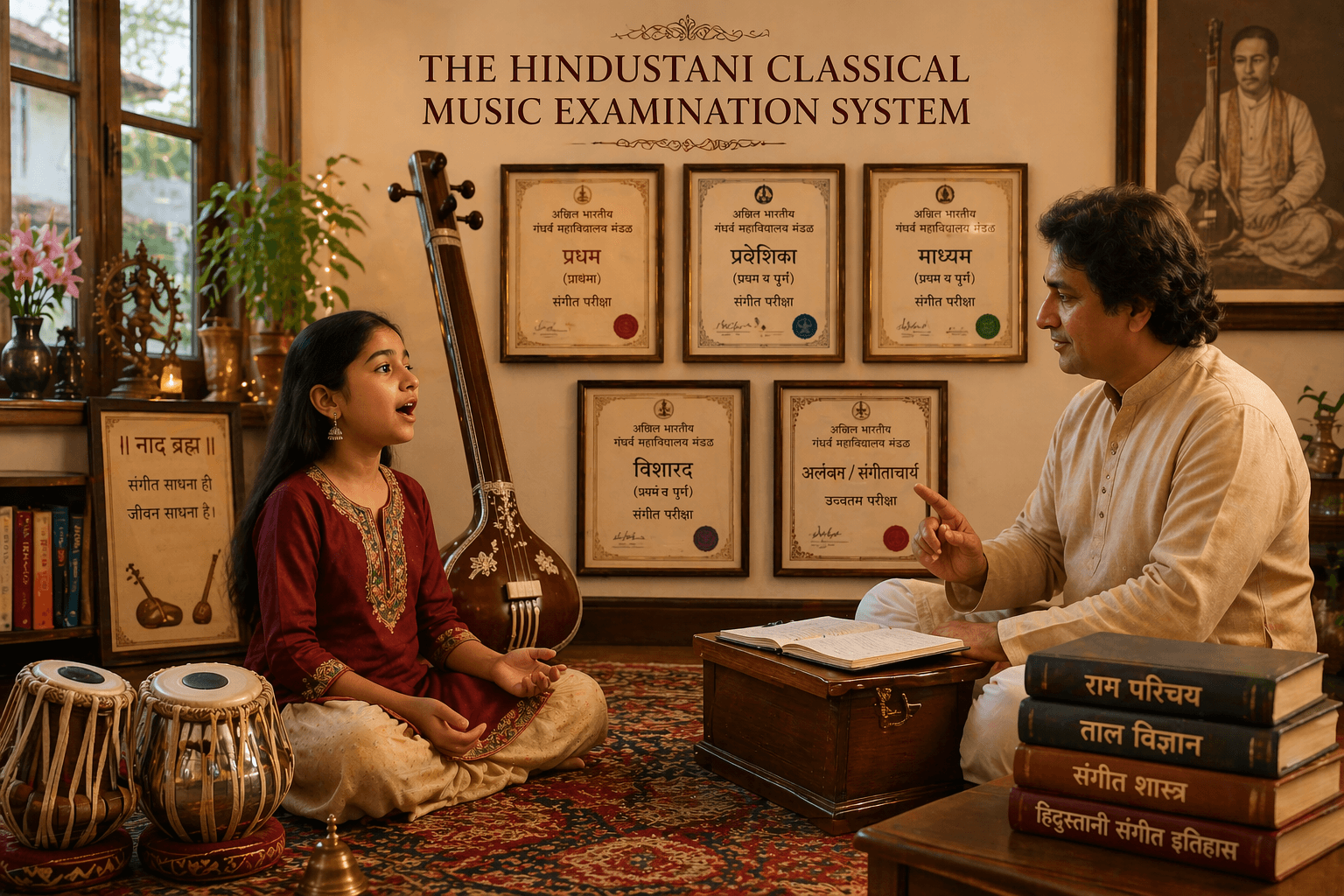
Indian classical music has had a formal graded examination system for over a century. The structures are rigorous, comprehensive, and pedagogically sophisticated. They are simply not well-known within mainstream UK educational contexts.
The primary examining bodies accessible to UK-based students:
Akhila Bharata Gandharva Mahavidyalaya Mandal (ABGMM)
Founded in 1934 in Pune, India, ABGMM is one of India's oldest and most respected music examination bodies. It offers examinations in Hindustani and Carnatic vocals, various instruments, and dance forms.
The ABGMM examination progression in Hindustani vocals:
- Prathama: Foundation level. Equivalent approximately to ABRSM Grade 1-2
- Praveshika Pratham: Lower intermediate. Approximately ABRSM Grade 3
- Praveshika Purna: Intermediate. Approximately ABRSM Grade 4-5
- Madhyama Pratham: Upper intermediate. Approximately ABRSM Grade 6-7
- Madhyama Purna: Advanced intermediate. Approximately ABRSM Grade 7-8
- Visharad Pratham: Graduate level. Approximately ABRSM DipABRSM
- Visharad Purna: Post-graduate levelM/li>
- Alankar/Sangeetacharya: Highest levels
Prayag Sangeet Samiti
Based in Allahabad (Prayagraj), India. Another highly respected examination body offering similar level progression in Hindustani music, instruments, and dance.
Gandharva Mahavidyalaya North America (GMV NA)
An official extension of the Gandharva Mahavidyalaya in Pune, making the examination system formally accessible to students in the UK, US, and Canada through affiliated teachers and examination centres.
What Each Level Requires in Hindustani Vocal Music
Prathama (Beginner Foundation)
Students demonstrate:
- Seven swaras (Sa Re Ga Ma Pa Dha Ni) in ascending and descending patterns
- Simple alankars in basic ragas
- One simple bandish (composition) in a beginner raga
- Basic knowledge of the names of ragas and talas
Praveshika (Early Intermediate)
Students demonstrate:
- Alankars in multiple ragas
- Multiple bandishes in different talas
- Understanding of aroha-avaroha (ascending-descending patterns) of 5+ ragas
- Basic theoretical knowledge including tala structures
Madhyama (Intermediate to Advanced)
Students demonstrate:
- Substantial raga repertoire with correct gamaka application
- Bada khayal and Chhota khayal compositions
- Taan patterns (rapid note sequences)
- Detailed theoretical knowledge including ragas' characteristics, their time and season associations, and similar raga pairs (jod ragas)
Visharad (Graduate Level)
Students demonstrate:
- Comprehensive raga knowledge with strong improvisation ability
- Concert-ready performance capability
- Deep theoretical understanding including the history of Hindustani music, important musicians and composers, and complex musicological concepts.
What Does Ofqual Accreditation Mean for Indian Music in the UK?
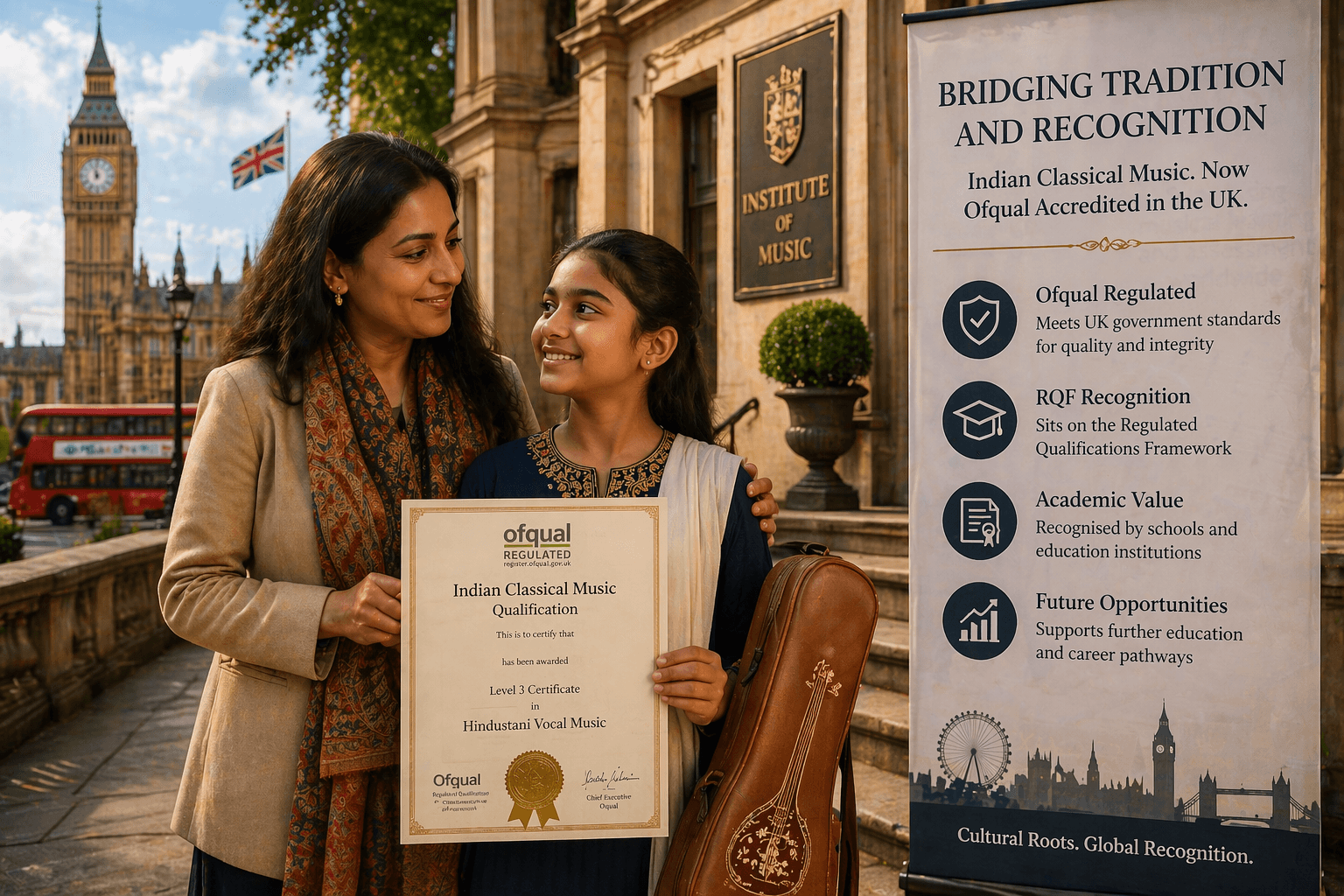
The Regulatory Context
Ofqual regulates qualifications in England. A qualification on the Regulated Qualifications Framework (RQF) meets specific government-approved standards for quality, consistency, and integrity.
For Indian classical music, this has historically been a gap: traditional Indian examination bodies are based in India and were not designed with UK regulatory frameworks in mind. Their qualifications carry enormous prestige within the Indian cultural community but have no formal standing in the UK educational system.
The Current State of Ofqual-Accredited Indian Music
Some online music platforms have now achieved Ofqual accreditation for Indian classical music courses. Art Gharana's Globally Recognised Music Programme (GRMP), for example, is Ofqual-accredited for both Indian and Western music, making it the first platform to offer UK-regulated qualifications in Hindustani and Carnatic classical music.
What Ofqual accreditation gives UK families:
Formal UK educational recognition: The qualification sits on the RQF, the same framework as ABRSM grades.
Potential UCAS contribution: Ofqual-regulated qualifications at appropriate RQF levels may contribute to UCAS tariff points. Confirm the specific qualification's tariff status with the awarding organisation.
School record recognition: These qualifications can appear on a student's formal academic record.
Quality assurance confidence: The course content and assessment have been independently reviewed and approved to UK government standards.
Verifying Ofqual Accreditation
Always verify on the official register. Claims of Ofqual accreditation are easy to make. The official Ofqual register at register.ofqual.gov.uk is the only authoritative source. Any genuine Ofqual-regulated qualification will appear there with its awarding organisation, RQF level, and accreditation details.
Practical Comparison: Which System for Which Goals?

When to Prioritise ABRSM
Choose ABRSM examination pathways when:
- UK university music applications are a goal. ABRSM Grades 6-8 contribute UCAS points that Indian classical examination grades do not.
- The child plays a Western instrument (piano, violin, flute, cello, clarinet, etc.)
- Music GCSE or A-Level is a possibility. ABRSM grades are referenced in school music qualifications.
- Conservatoire auditions are a possibility. UK conservatoires expect ABRSM or equivalent Western music credentials.
When to Prioritise Indian Classical Examination Systems
Choose Indian classical music examination pathways when:
- Cultural authenticity and depth are the primary goals. The Indian examination system provides far more comprehensive and nuanced training in Indian classical music than ABRSM has for Western music.
- The child is learning Indian classical music seriously and aims for performance capability in the tradition.
- Community recognition matters. Within South Asian cultural organisations, competitions, and scholarship programmes in the UK, Indian music examination certificates carry significant weight.
- Family heritage preservation is a motivation. The Indian examination system gives children formal credentials within their cultural tradition.
The Dual-Track Approach
The most increasingly common approach among ambitious British-Indian families is to pursue both pathways simultaneously:
- Western instrument (piano, violin, or cello) for ABRSM grades and UCAS points
- Hindustani or Carnatic music for Indian classical examination grades and cultural depth
This dual approach is challenging in terms of practice time but is manageable with good teacher coordination. The musical skills are complementary: Indian classical ear training improves pitch accuracy that benefits Western music performance, and Western music theory provides a comparative framework that enriches understanding of Indian music theory.
The Role of Art Gharana in British-Indian Music Education
 Art Gharana offers live 1:1 online Indian classical music and dance education for British-Indian families across the UK. Our teachers are certified, experienced, and understand both the cultural depth of the traditions they teach and the educational context of diaspora families.
Explore our Hindustani vocal courses or read our beginner's guide to Indian classical music to understand how the learning journey is structured from the first lesson onward.
Conclusion
The UK's music examination landscape is richer and more accommodating for Indian classical music than it has ever been. ABRSM provides formal UK-regulated credentials with UCAS value. Indian classical examination systems provide deep, comprehensive training with strong community recognition. And Ofqual-accredited Indian music courses are now beginning to bridge the formal recognition gap.
Three things to take away. First, always verify Ofqual accreditation on the official register. Second, dual-track music education (Western for ABRSM + Indian classical for cultural depth) is increasingly common and genuinely manageable. Third, within the British-Indian community, Indian classical examination certificates carry real prestige that matters for competitions, events, and cultural opportunities.
Book a free trial Indian classical music class at Art Gharana today and give your child the cultural education they deserve.
Frequently Asked Questions
1. Are ABRSM grades recognised internationally beyond the UK?
ABRSM examinations are recognised in over 93 countries. They carry strong recognition in the UK, Commonwealth countries, and internationally wherever UK educational standards are applied. Many international music schools and conservatoires accept ABRSM grades as entry criteria.
2. Can a child take both ABRSM and Indian classical music examinations simultaneously?
Yes. Many British-Indian families successfully manage both pathways. The disciplines are complementary. Good time management, good teachers for each tradition, and honest realistic scheduling are the key requirements.
3. How do I find an ABGMM-affiliated Carnatic or Hindustani teacher in the UK?
Contact ABGMM directly (abgmvm.org) to inquire about UK-based affiliated teachers. Many teachers from the Indian classical music community in the UK are affiliated with ABGMM or Prayag Sangeet Samiti and can guide students through examination preparation and entry.
4. What is the difference between ABRSM and Trinity College London grades?
Both offer graded examinations from Grade 1-8 and are Ofqual-regulated. Trinity College London is generally considered slightly more flexible in repertoire choice and more performance-focused in assessment. ABRSM is traditionally more academically rigorous and is more widely recognised in UK secondary schools. Both carry UCAS points at Grades 6-8.
5. Is there a music theory examination equivalent for Indian classical music?
Yes. Indian classical music examination systems include theory components at each level. At higher levels (Madhyama and Visharad), students sit written theory examinations covering raga grammar, tala theory, historical musicology, and composition analysis. These are far more comprehensive than ABRSM Grade 5 Theory in terms of depth within the Indian classical tradition.