ChatGPT
 Google AI
 Grok
Grok Claude
Carnatic music is South India's classical musical tradition, and for South Indian-Canadian families, ensuring children receive authentic, quality instruction requires navigating a growing but uneven landscape of online options. Choosing the right Carnatic music class for a Canadian child involves evaluating teacher qualifications, curriculum structure, pedagogical approach, technical setup, and cultural alignment. This comprehensive guide walks through every dimension of this decision, giving parents a practical framework for identifying the best Carnatic music instruction for their specific child, wherever in Canada they live.
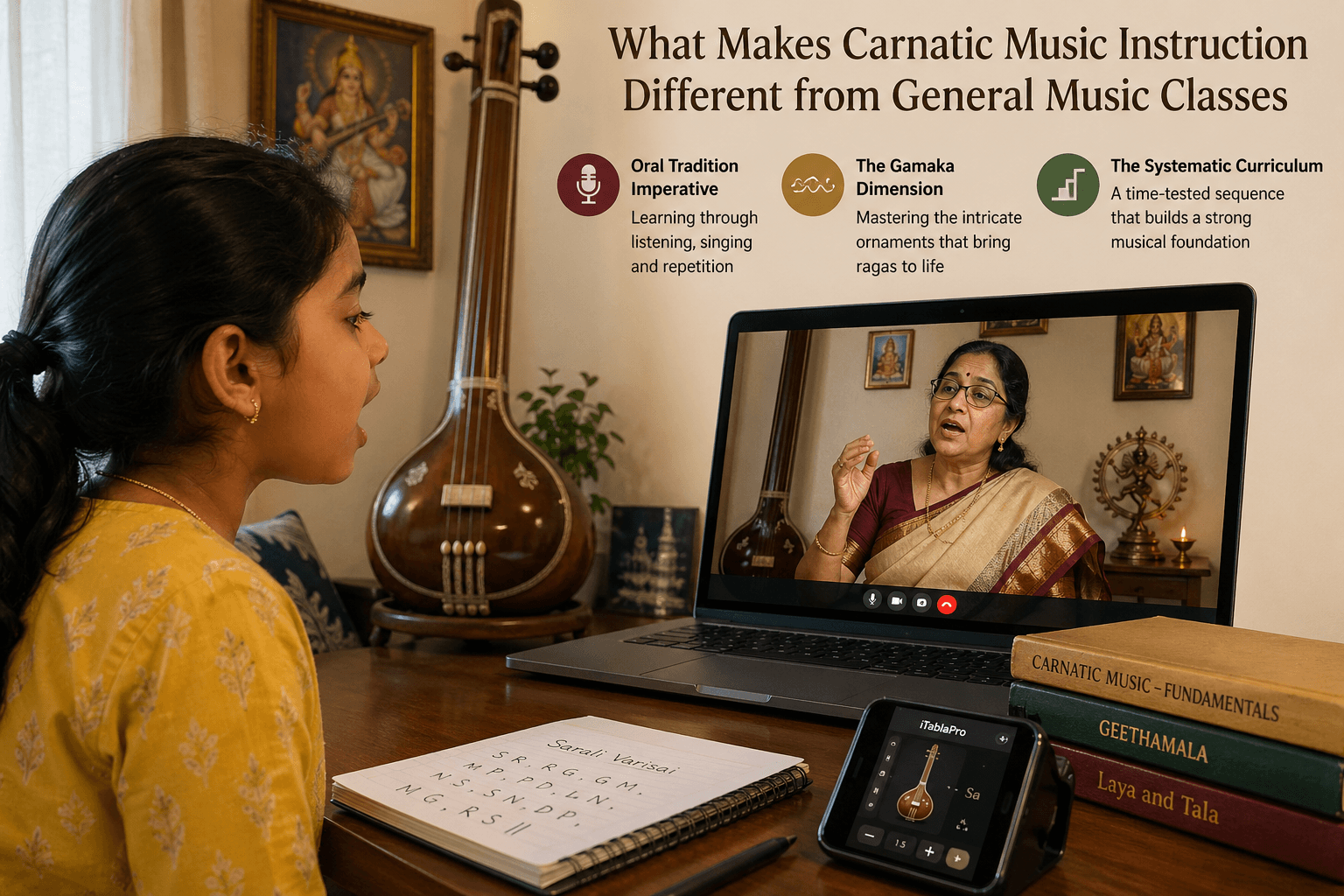
What Makes Carnatic Music Instruction Different from General Music Classes
The Oral Tradition Imperative
Carnatic music is fundamentally an oral tradition. Compositions are not primarily taught from notation. They are transmitted from teacher to student through singing, repetition, correction, and the gradual internalisation of melodic, rhythmic, and ornamental nuance that makes each composition authentic.
This oral transmission requirement means that the quality of the teacher is more important in Carnatic music than in almost any other musical tradition. A Carnatic music class where the teacher simply plays recordings and has students copy them is not authentic instruction - it is a pale shadow of what genuine Carnatic pedagogy provides.
The Gamaka Dimension
Carnatic music's characteristic ornamental inflections - gamakas - are one of the most technically demanding and culturally significant aspects of the tradition. Gamakas are not decorations added to notes. They are intrinsic to how specific notes function within specific ragas.
Many online Carnatic teachers from non-classical or lightly trained backgrounds teach compositions without gamakas or with generic ornamental patterns that don't reflect the specific raga's authentic expression. This creates a superficially acceptable sound but misses the musical heart of the tradition. A qualified Carnatic teacher teaches gamaka from early in the curriculum, adapted to the child's current level.
The Systematic Curriculum
Authentic Carnatic music education follows a specific, time-tested pedagogical sequence that cannot be safely shortcut. Attempting to teach kritis (major compositions) before students have mastered sarali varisai and geethams is like teaching complex literature to students who haven't yet mastered reading. The result is performances that lack the technical foundation for authenticity.
Ask any prospective Carnatic teacher to describe the first year of instruction in detail. A qualified teacher will immediately describe the sarali varisai-janta varisai-geetham-alankar-swarajati-varnam progression. A teacher who responds vaguely or describes jumping immediately to song learning is not providing authentic Carnatic pedagogy.
Evaluating Teacher Qualifications for Canadian Families
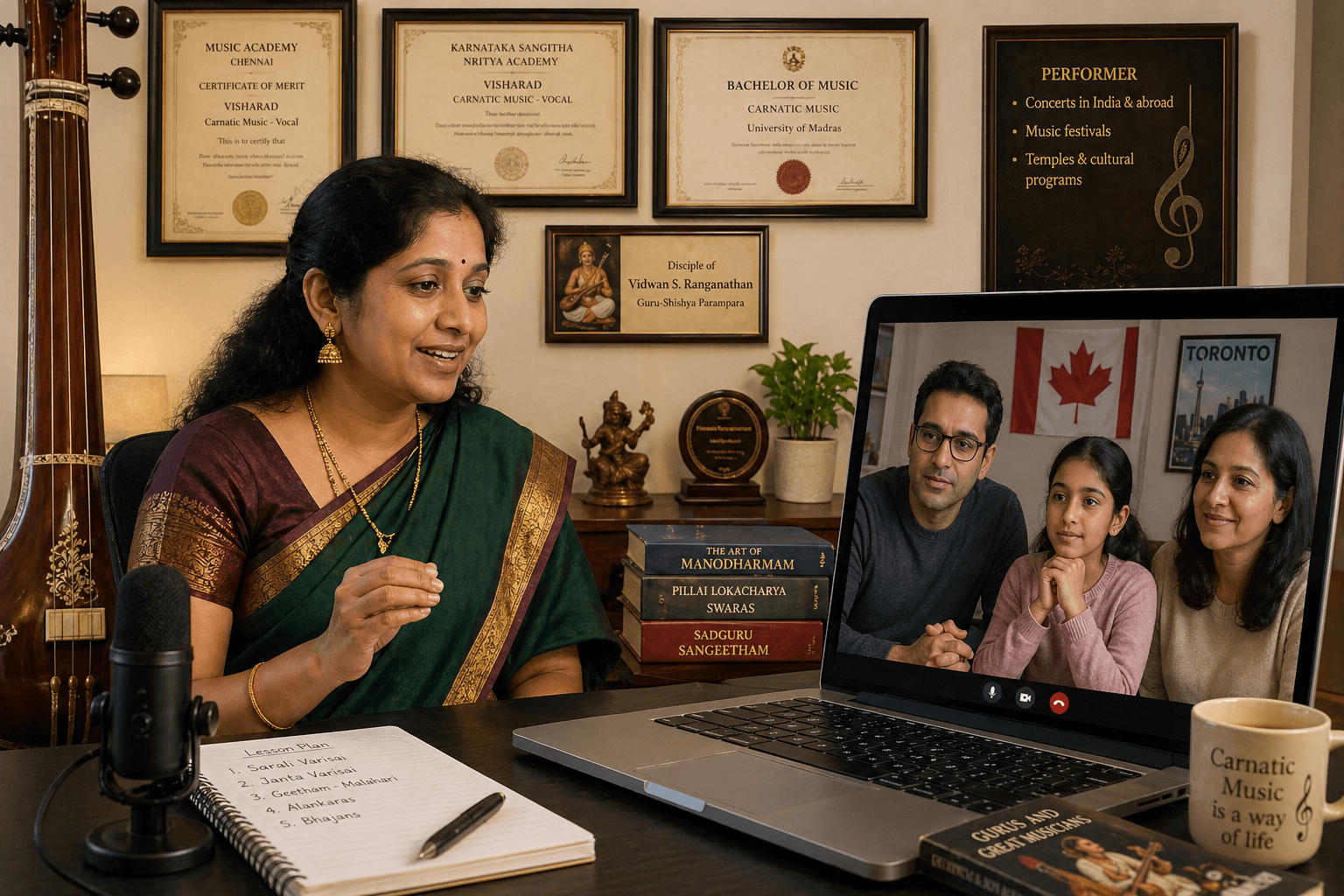
The Essential Credential Framework
Examination Credentials
A qualified Carnatic music teacher should have completed formal examination-based training. Look for:
Visharad (graduate level) or higher from Music Academy Chennai, Karnataka Sangitha Nritya Academy, or equivalent recognised institution.
A music degree from an Indian university with Carnatic music as the principal subject.
Guru Lineage
Ask the teacher who their guru was and where they trained. The guru-shishya parampara (teacher-disciple tradition) is how authentic Carnatic knowledge has been transmitted for generations. A teacher who cannot answer this question clearly has not received authentic transmission.
Performance Background
A teacher who has performed Carnatic music publicly, in concert settings or at temple events, brings a performer's knowledge to their teaching that a purely academic teacher cannot. Ask about the teacher's performance background.
Online Teaching Specific Qualifications
Experience with Diaspora Students
Teaching Indian-Canadian children who may have limited prior exposure to Carnatic music, who communicate primarily in English, and who are navigating dual cultural identities requires specific awareness and pedagogical adaptation. Ask about the teacher's experience specifically with diaspora students.
Technical Setup and Audio Quality
A Carnatic music teacher's audio quality is not optional - it is pedagogically essential. Students must be able to hear gamaka inflections, pitch accuracy, and compositional details clearly. Ask what microphone the teacher uses and request a trial session specifically to evaluate audio quality.
Availability in Canadian Time Zones
Indian Standard Time is 10.5 hours ahead of Eastern Standard Time and 13.5 hours ahead of Pacific Standard Time. This means morning classes in India correspond to late evening in western Canada. Confirm specifically that the teacher has time slots compatible with your Canadian location and family schedule.
Evaluating Curriculum Structure
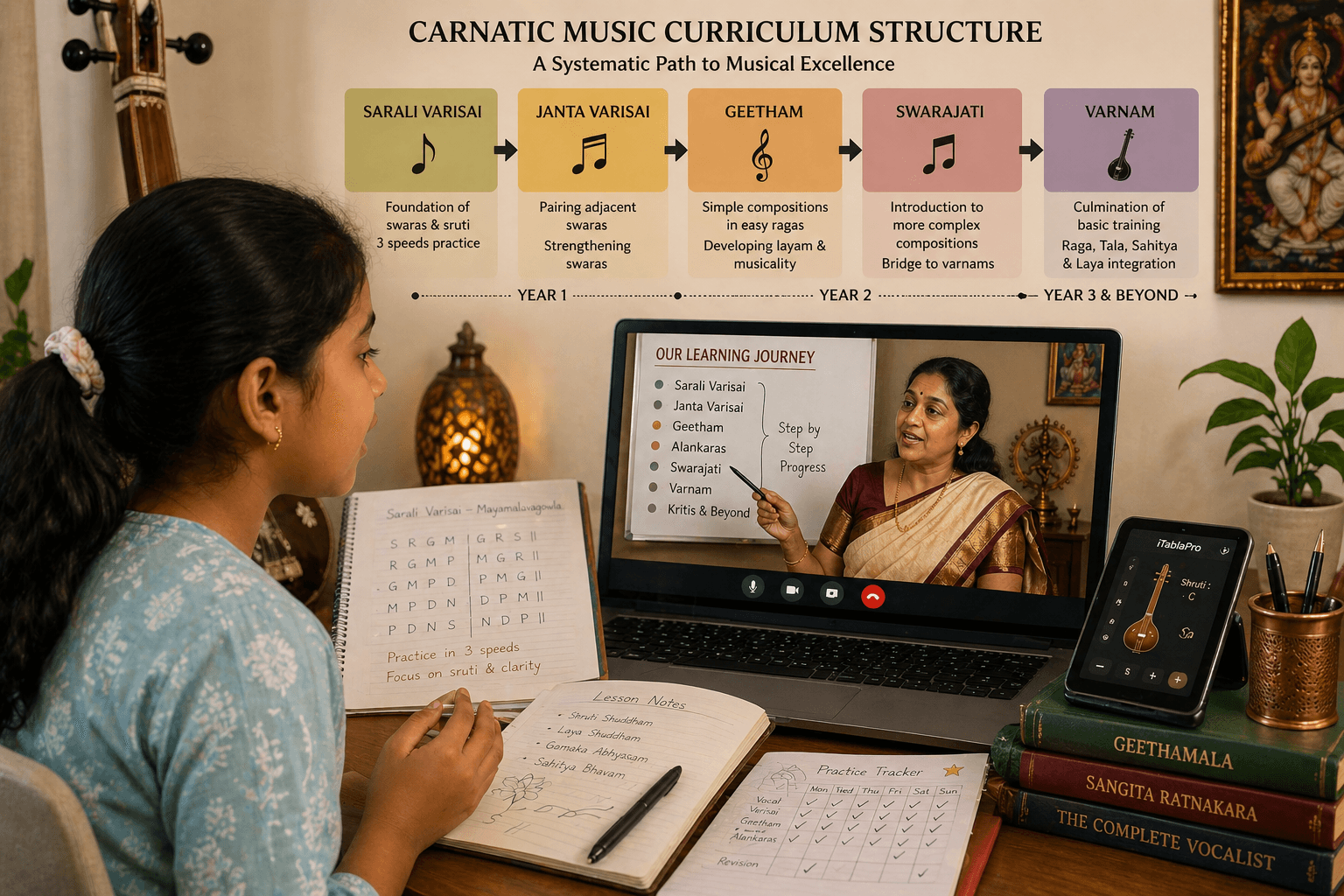
What a Well-Structured Carnatic Curriculum Looks Like
Year 1: Sarali Varisai and Basic Compositions
The first year should be primarily focused on sarali varisai (basic swara exercises) in at least three speeds, with regular assessment of pitch accuracy and tonal quality. Simple geethams in accessible ragas (Malahari, Suddha Dhanyasi) should be introduced from around months three to four.
Year 2: Janta Varisai, Alankaras, and Swarajati
The second year expands the swara vocabulary with janta varisai (exercises pairing adjacent notes), introduces systematic alankaras (scale patterns), and builds toward the swarajati, the transitional composition between geethams and varnams.
Year 3 and Beyond: Varnam and Kritis
The varnam represents the culmination of basic Carnatic training. Well-structured instruction reaches the varnam stage in approximately two to three years for a student practising daily and attending weekly lessons.
Assessment and Progress Monitoring
A well-structured Carnatic curriculum includes regular assessment of student progress - either through the teacher's systematic evaluation or through preparation for formal examinations (ABGMM, Prayag Sangeet Samiti, or equivalent).
Ask the teacher how they assess and track student progress. A vague answer suggests the absence of systematic curriculum structure.
Technical Setup Evaluation for Canadian Families
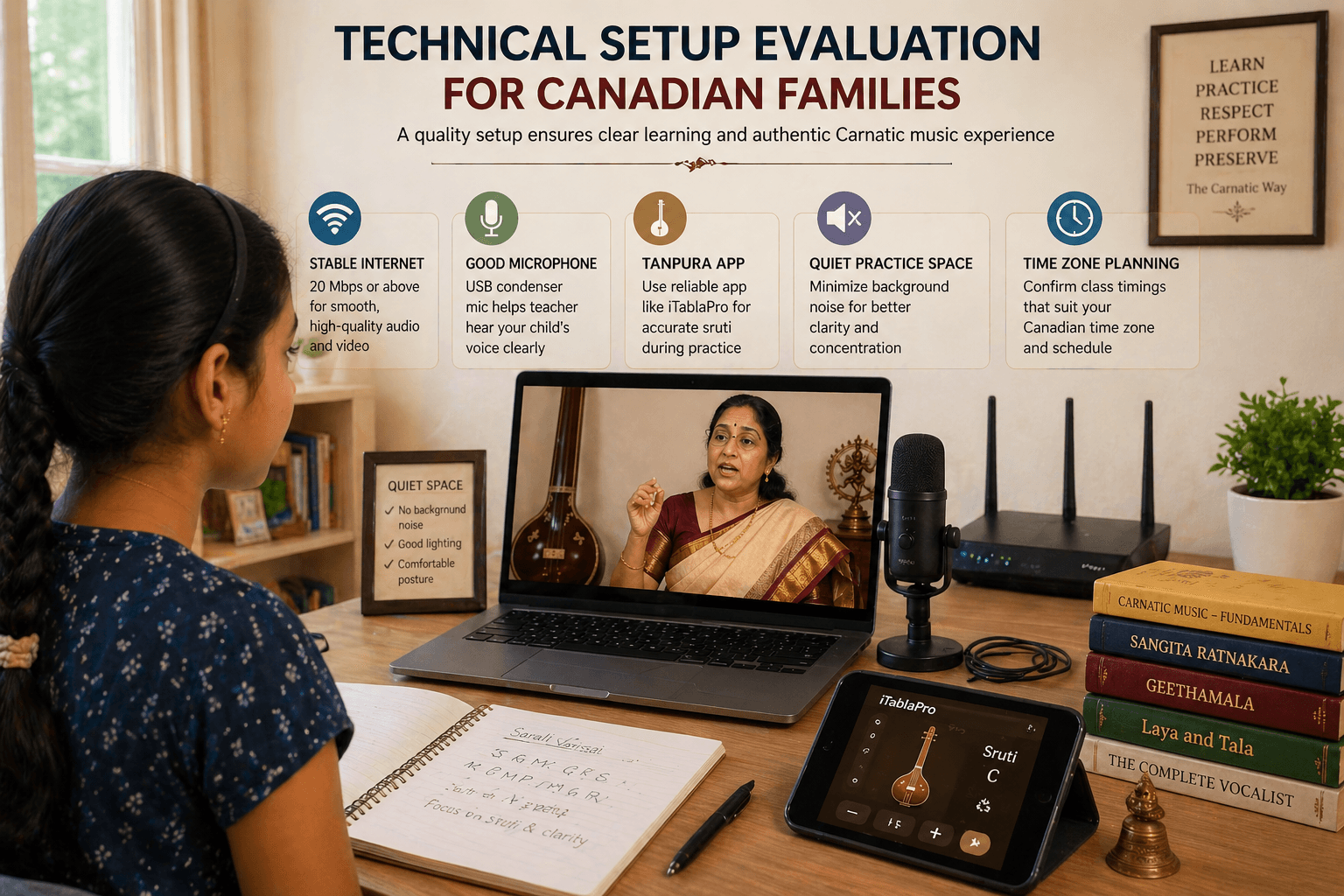
What You Need at Home
Internet Connection
Stable broadband (20 Mbps and above) is essential for the audio quality that Carnatic instruction requires. If your home internet is unreliable, address this before starting lessons.
Microphone
Your child's microphone quality matters as much as the teacher's. The teacher needs to hear your child's voice clearly to assess pitch accuracy and gamaka quality. A simple USB condenser microphone ($50-$80 CAD) is a worthwhile investment.
Tanpura Application
A reliable tanpura app is essential. iTablaPro (most widely used), iTabla Pro, or similar apps provide the drone that makes correct pitch reference possible during practice. Your teacher will advise on the correct sruti (tonic pitch) for your child's voice.
Quiet Practice Space
Carnatic practice requires a quiet space where the teacher can hear your child's voice without competing background sounds.
Cultural Alignment and Community Connection
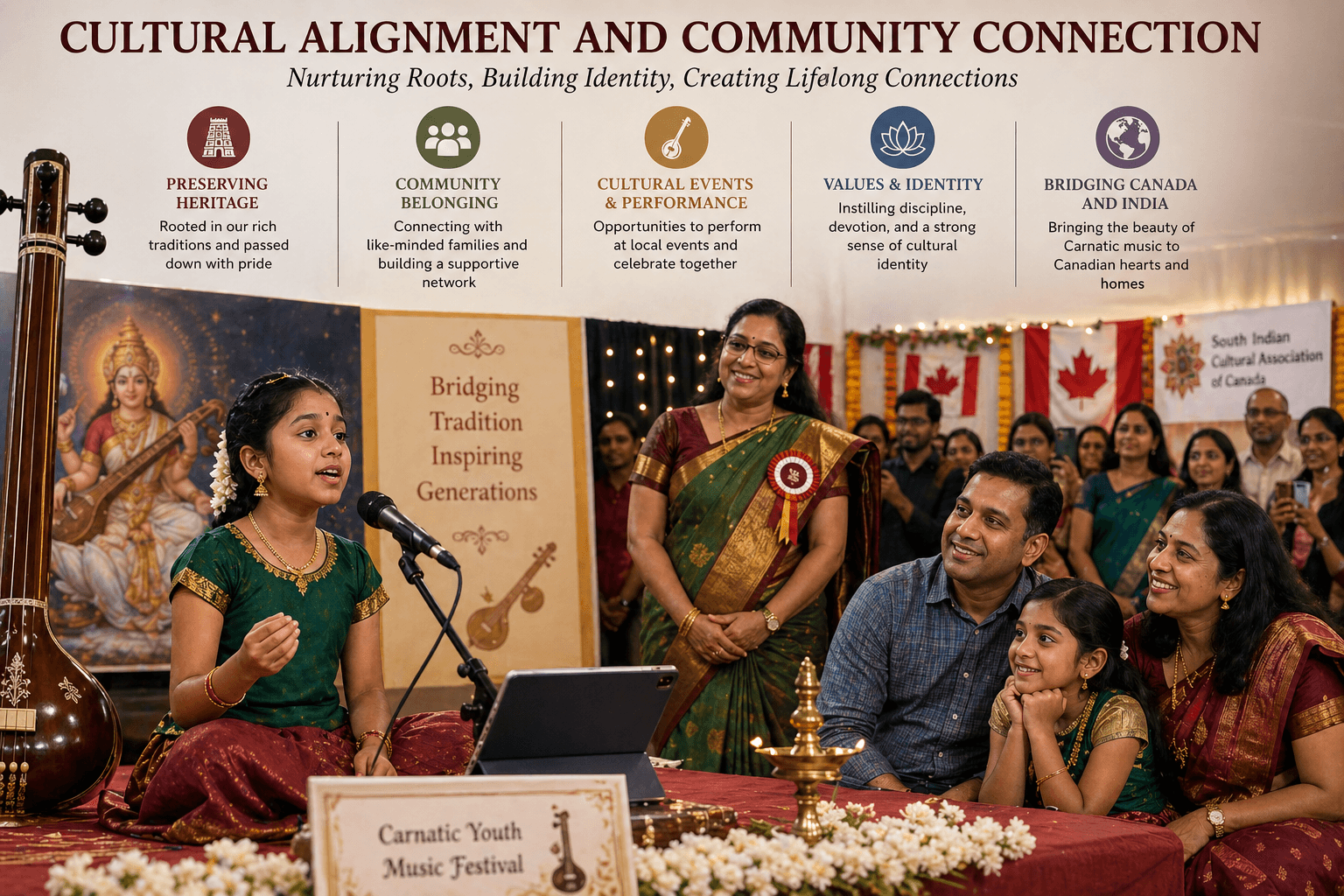
Why Cultural Alignment Matters for Canadian Children
The best Carnatic music classes for Indian-Canadian children don't just teach music. They teach cultural context: the significance of the compositions being learned, the philosophical basis of the raga system, and the connection between Carnatic music and South Indian cultural and spiritual life.
A teacher who is culturally aligned with the South Indian tradition and sensitive to the diaspora experience provides an education that is simultaneously musical and cultural - which is what most Indian-Canadian parents are seeking.
Connection to South Indian Community Events in Canada
South Indian cultural organisations across Canada's major cities - Carnatic music sabhas, Telugu, Tamil, Kannada, and Malayalam cultural associations - regularly host programmes, competitions, and cultural events. A Carnatic music teacher with connections to this community network can help students access performance opportunities and community recognition that purely academic learning cannot provide.
At Art Gharana, our Carnatic music teachers are qualified, culturally sensitive, and experienced with Canadian diaspora learners. Explore our vocal courses and our complete guide to getting started with Carnatic music.
Practical Decision Framework

The Five Questions to Ask Every Prospective Teacher
What are your formal examination credentials and who was your guru? Describe the first year of instruction in detail - what will my child learn in what order? What is your experience teaching children in the age range of my child, specifically online? What microphone and technical setup do you use, and what do you recommend for students? Do you offer a free or low-cost trial lesson?
A teacher who answers all five questions clearly, specifically, and confidently is demonstrating the qualifications and professionalism that authentic Carnatic music pedagogy requires.
Conclusion
Choosing the right Carnatic music class for a Canadian child is one of the most important decisions in their cultural arts education. Done well, it connects them to one of the world's most sophisticated musical traditions through authentic transmission with a qualified teacher. Done poorly, it provides a superficial acquaintance with Carnatic's surface features while missing its musical and cultural heart.
Three things to take away. First, always verify teacher credentials - guru lineage and formal examination qualifications are non-negotiable. Second, evaluate the curriculum structure specifically against the standard Carnatic pedagogical sequence. Third, prioritise audio quality in the technical setup.
Book a free trial Carnatic music class at Art Gharana today and give your child the authentic instruction this extraordinary tradition deserves.
Frequently Asked Questions
1. What is the best Carnatic music exam to prepare for in Canada?
ABGMM (Akhila Bharata Gandharva Mahavidyalaya Mandal) and Prayag Sangeet Samiti are the most widely recognised examination bodies accessible to Canadian students. Both have affiliated teachers who can administer examinations. Confirm your chosen teacher's affiliation with the appropriate examination body.
2. How do I know if a Carnatic teacher is truly qualified versus self-taught?
Ask directly for their examination credentials, the institution where they trained, and who their guru was. A genuinely qualified Carnatic teacher will answer these questions immediately and specifically. A self-taught teacher may give vague answers or claim qualifications that cannot be verified.
3. Can a child learn Carnatic music without knowing Tamil, Telugu, or Sanskrit?
Yes. Most Carnatic teachers working with diaspora children teach concepts in English while using the traditional Tamil, Telugu, or Sanskrit terminology for musical elements. Students learn compositions in their original languages as part of the musical education, not as a prerequisite.
4. How many children in Canada currently study Carnatic music?
Precise statistics are not publicly available, but South Indian cultural organisations in Toronto, Vancouver, Calgary, and other cities with significant South Indian populations collectively support hundreds of active Carnatic music students. The community is growing as second-generation South Indian Canadians invest in cultural arts education for their children.
5. What is the difference between Carnatic and Hindustani music, and which should my South Indian child learn?
Carnatic music is the classical tradition of South India. Hindustani music is the classical tradition of North India. For families of South Indian origin (Tamil, Telugu, Kannada, Malayalam), Carnatic music is the natural cultural connection. For families from North or Central India, Hindustani is typically more relevant. Both are extraordinary traditions, and many students eventually explore elements of both.