ChatGPT
 Google AI
 Grok
Grok Claude
Music auditions are significant milestones for young musicians, whether for school ensembles, youth orchestras, cultural competitions, or conservatory programmes. Preparing a child effectively requires far more than musical practice: it demands smart repertoire selection, performance psychology, systematic run-through training, and physical and logistical preparation. This complete guide gives US parents everything they need to help their child walk into any music audition with genuine confidence, musical readiness, and the mental tools to perform at their best.
Music auditions can be exhilarating for a prepared child. For an unprepared one, they leave a mark that lingers. The difference is almost never about raw talent. It's about preparation.
Parents of musically active children in the USA encounter auditions in many forms: school band placements, youth orchestra competitions, cultural organisation performances, temple music competitions, state-level classical music evaluations, and more. Each has its own format, expectations, and emotional weight.
What remains constant across all of them is this: how to prepare your child for a music audition comes down to four interconnected areas that must all receive attention. This guide covers all four.
Understanding What Type of Audition Your Child Is Facing

The Major Audition Formats in the US
Understanding the format shapes the preparation strategy completely. Here are the main types American children encounter.
School Music Programme Auditions
Purpose: Placement into school band, orchestra, choir, or jazz ensemble.
What they assess: Basic musicianship, tone quality, reading ability, and potential.
Format: Typically 5-10 minutes. Usually includes scales, a prepared piece, and simple sight-reading.
Emotional tone: Generally encouraging and non-threatening. The goal is placement, not elimination.
Youth Orchestra and Ensemble Auditions
Purpose: Entry into competitive youth orchestras, chamber ensembles, or advanced school ensembles.
What they assess: Technical proficiency, intonation, musical sensitivity, and sight-reading.
Format: 10-15 minutes. Prepared excerpts or a full short piece, scales, sight-reading, aural tests.
Emotional tone: More formally evaluative. Preparation level and musical maturity are visible.
Indian Classical Music and Cultural Competitions
Purpose: Cultural preservation, talent recognition, community engagement.
What they assess: Adherence to classical form, raga fidelity, rhythmic accuracy, emotional expression.
Format: 5-20 minutes depending on the competition category. Typically a complete composition or performance within a specified raga-tala framework.
Emotional tone: Celebratory but evaluative. Panel members are often senior musicians.
Conservatory and Preparatory Program Auditions
Purpose: Entry into pre-professional music education programmes.
What they assess: Advanced technique, musical depth, potential for development.
Format: 15-30 minutes or more. Full performance pieces, technical exercises, sight-reading, interviews.
Emotional tone: High stakes. Significant preparation investment required.
Part 1: Repertoire Selection - The Foundation of Every Audition

Why Repertoire Choice Is as Important as Technical Preparation
Many parents and even some teachers underestimate the importance of audition repertoire selection. The piece (or composition) your child performs communicates their musical identity, their genuine engagement, and their current developmental stage. Choosing strategically makes the entire preparation process more effective.
Principle 1 - Choose What Genuinely Moves Your Child
A child performing a piece they love always outperforms a child performing a technically superior piece they find dull or obligatory. Emotional engagement is visible, audible, and contagious. Panel members feel the difference immediately.
Ask your child: which piece makes you want to play it again and again? Which one do you find yourself humming? That piece is almost certainly the better audition choice.
Principle 2 - Show the Voice or Instrument at Its Best
The audition piece should showcase the specific qualities your child's voice or instrument does well right now. If your child has exceptional rhythmic precision, choose a piece where rhythm is central. If their sound quality in the middle register is their strongest attribute, choose a piece that features that register.
A well-chosen piece that highlights genuine strengths is worth more than an ambitious piece that exposes weaknesses under pressure.
Principle 3 - Choose Within Genuine Technical Ability
This is where most parents go wrong. Selecting a technically demanding piece to impress the panel, when the child cannot consistently execute it under performance conditions, is counterproductive. A clean, confident, musically engaged performance of a moderately challenging piece wins every time over a sloppy performance of an impressive one.
Ask your teacher: what piece can my child perform with genuine confidence and musical expression? That's almost certainly the right audition choice.
Principle 4 - Know the Audition Requirements Thoroughly
Read the audition requirements multiple times. For Indian classical music competitions, specific ragas or composition types are often required. For Western orchestral auditions, specific repertoire lists are common. For school placement auditions, the required scales and exercises must be prepared exactly as specified.
Never assume. Confirm requirements with the organisers at least three weeks before the audition date.
Part 2: Building Performance Practice Into the Routine
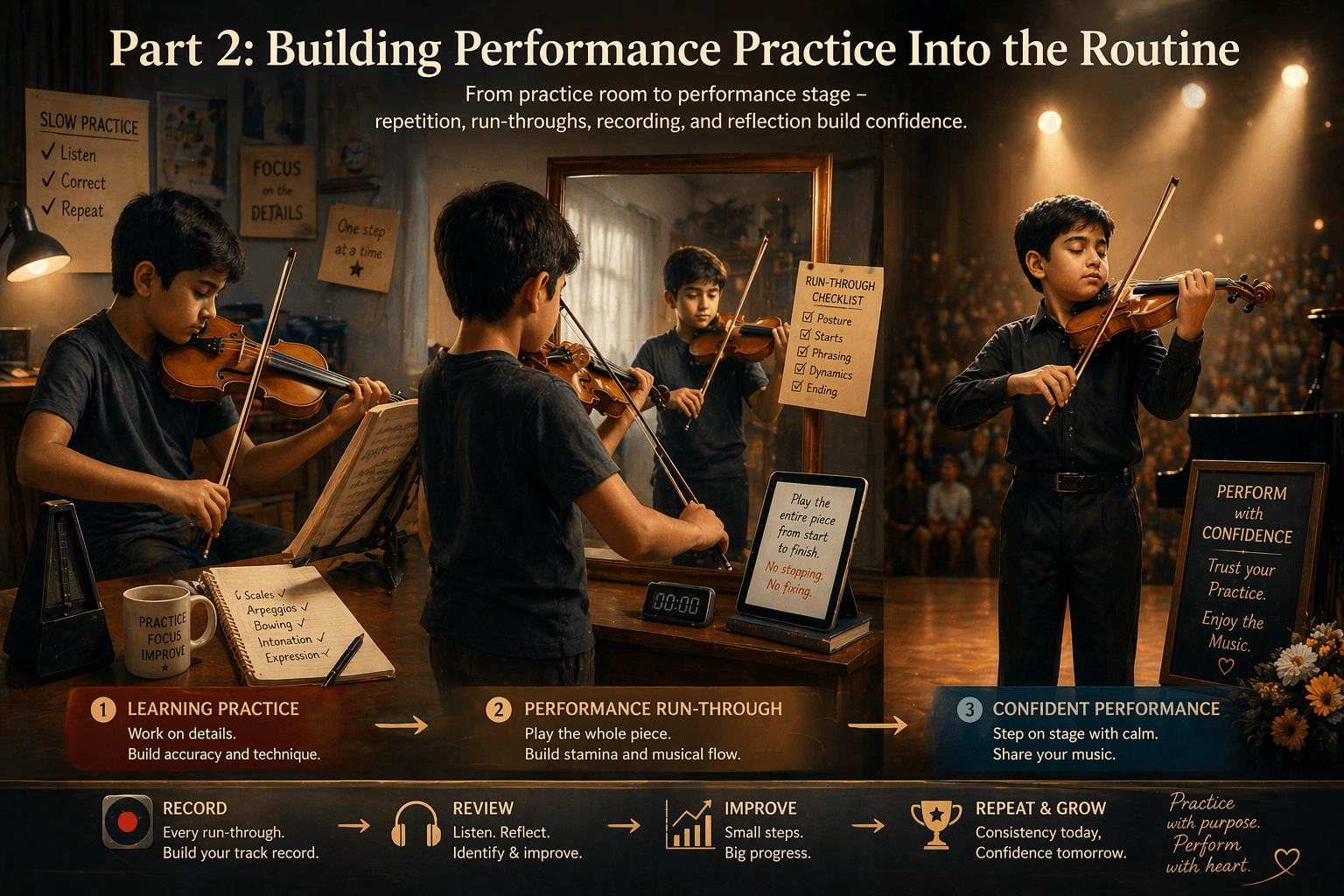
The Difference Between Learning Practice and Performance Practice
This distinction is one of the most important concepts in audition preparation and is consistently overlooked.
Learning practice involves:
- Working slowly on difficult passages
- Isolating errors and correcting them section by section
- Drilling technique exercises
- Consulting the teacher for corrections
Performance practice involves:
- Playing the entire audition programme from start to finish without stopping
- Not correcting errors mid-performance
- Playing as if in front of the panel right now
- Developing the mental and physical stamina for continuous performance
Both types of practice are necessary. But the timing matters. Most students spend almost all their practice time in learning mode and almost none in performance mode. This is a serious preparation gap.
When to Introduce Performance Practice
Six to eight weeks before the audition: Begin including at least two complete performance run-throughs per week alongside regular learning practice.
Four to six weeks before: Increase to three complete run-throughs per week. After each run-through, note what happened but do not immediately drill the problem sections. Return to learning practice for those issues, then run through the complete programme again the next day.
Two to three weeks before: Daily complete run-throughs. The piece should now be thoroughly memorised and performable without hesitation.
Final week: Consolidation, not improvement. The teacher should not introduce significant new corrections in the final week. The student consolidates what they know and builds confidence through consistent, successful complete run-throughs.
Recording Every Performance Run-Through
Research on performance preparation shows that familiarity with the performance experience significantly reduces anxiety. Recording every run-through serves two purposes:
Objective self-evaluation: Children hear things in recordings they don't hear during performance. Pitch, tempo fluctuations, and expressive inconsistencies are all more audible in playback.
Building a performance track record: By audition day, your child should have recorded at least 20-30 complete run-throughs. Each one represents a successful performance. This track record is the most powerful antidote to the thought "What if I can't do it?"
Part 3: Performance Anxiety — Managing It Effectively
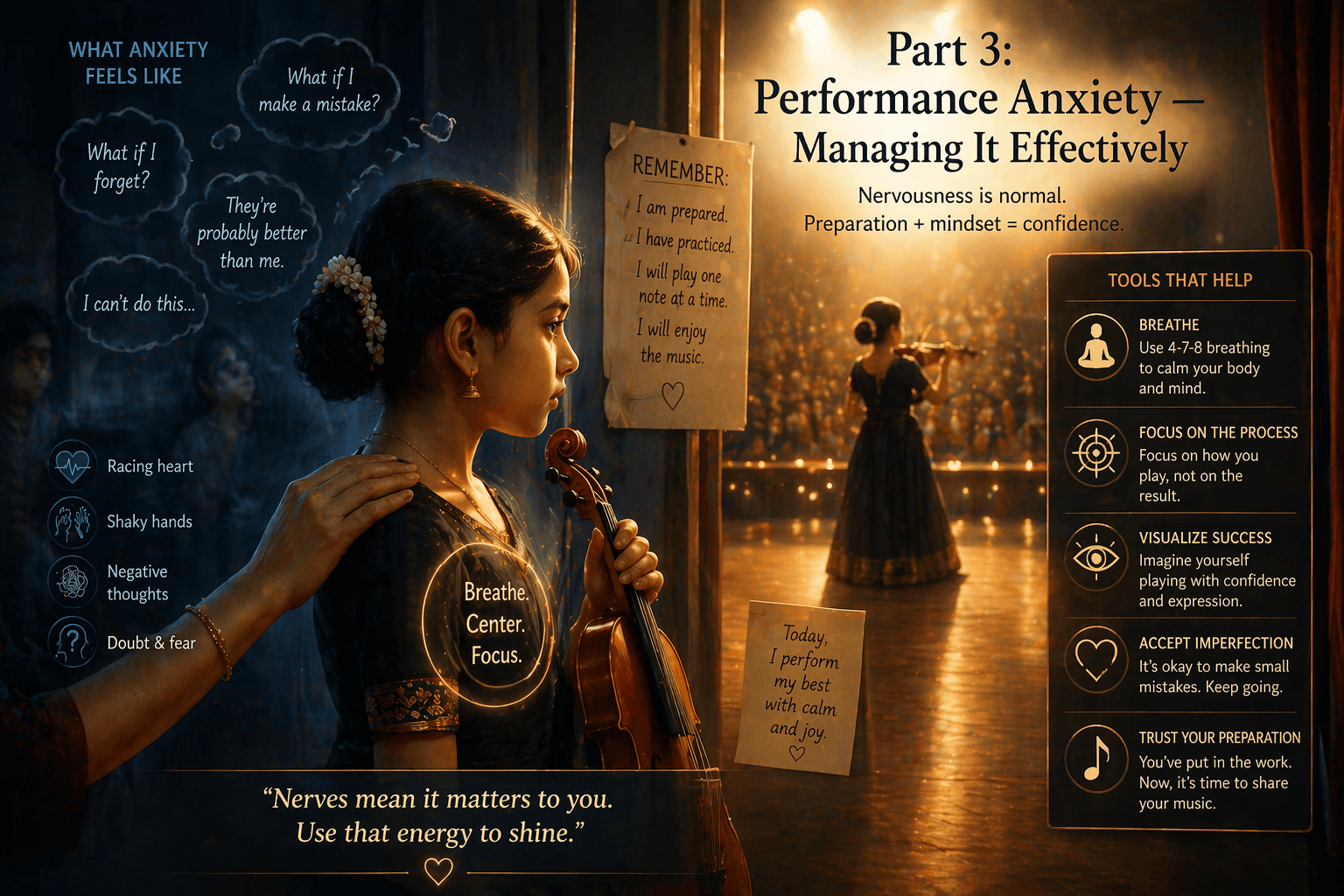
The Reality of Performance Anxiety for Children
Performance anxiety is not a weakness. It is a normal neurophysiological response to high-stakes situations. Every professional musician experiences it. The goal of preparation is not to eliminate it but to make it manageable, and at higher levels, to harness it.
For children, performance anxiety typically manifests as:
- Accelerated heart rate
- Trembling hands or voice
- Difficulty remembering material they know perfectly well in practice
- Urge to avoid the situation entirely
- Catastrophic thinking ("I'm going to forget everything")
All of these are physiologically normal responses. What varies between children is whether their preparation gives them the tools to manage them.
Practical Evidence-Based Techniques for Children
Controlled Breathing
The single most evidence-backed brief intervention for performance anxiety is controlled breathing. The 4-7-8 technique works for children aged 6 and older:
- Inhale slowly through the nose for 4 counts
- Hold for 7 counts
- Exhale completely through the mouth for 8 counts
- Repeat 3-4 times
This activates the parasympathetic nervous system (the "rest and digest" response) and reliably reduces the physical symptoms of anxiety within 2-3 minutes. Practice this technique during stressful moments at home, not just before auditions, so it becomes automatic.
Normalising the Experience
Tell your child directly and frequently: feeling nervous before a performance is normal. Even world-class musicians feel nervous. Nervousness means the performance matters to you. It's a sign of engagement, not weakness.
Do not say "There's nothing to be nervous about." This dismisses a real experience and builds disconnection rather than resilience.
Process Focus vs Outcome Focus
Children who focus on "Will I get in?" or "What if I make a mistake?" perform worse than children who focus on "I'm going to play this exactly as I've practised it."
Help your child shift their focus from outcome (result) to process (execution). Before the audition: "Your job today is to play the piece exactly as you've been practising it for the past six weeks. That's all. Can you do that?" The honest answer is almost always yes.
Identifying and Addressing the Specific Fear
Ask your child directly: what exactly worries you about the audition? Many children have one specific fear: forgetting the words, missing the high note, the panel looking bored, seeing other performers who seem better.
Once you know the specific fear, you can address it directly. If the fear is forgetting the words, practise "recovery rehearsals" where you deliberately stop your child mid-performance and have them pick up from wherever they can. This teaches them that memory lapses are survivable and recoverable.
Simulating the Audition Experience
The more familiar the audition experience feels before it happens, the lower the anxiety response on the day. In the final two to three weeks:
- Create a mini-audition at home where your child walks in, introduces themselves and their piece, performs it completely, and thanks the "panel" (you)
- Perform for different audiences: family members, a neighbour, a family friend
- Perform in different rooms to break the association with one specific practice space
- Perform at different times of day
This environmental variation training is backed by performance psychology research as one of the most effective strategies for reducing performance anxiety.
Part 4: Physical, Logistical, and Day-of Preparation
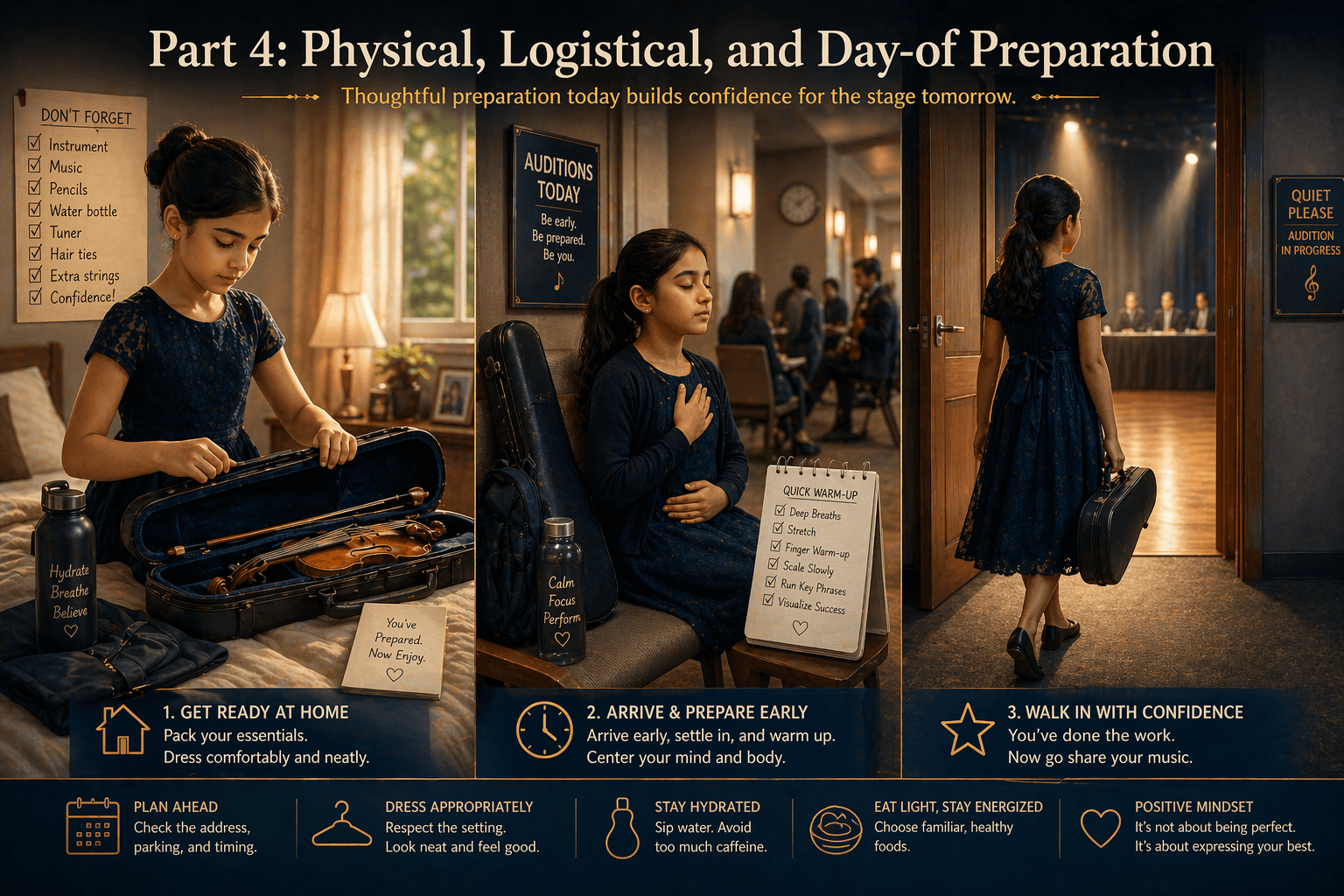
The Week Before - Consolidation, Not Improvement
In the final week before an audition:
Don't introduce new corrections. The work is done. The teacher's role in the final week is to confirm what the student already knows, not to introduce new technical objectives.
Maintain normal practice volume. Don't dramatically increase practice in the final week. This causes fatigue, not improvement.
Prioritise sleep and hydration. Vocal students especially: sleep and water are irreplaceable voice preparation tools.
Do one complete performance run-through per day. Not more. Not less.
Day-of Preparation
Physical Warm-Up
Every musician needs a physical warm-up before performing:
Vocalists: 10-15 minutes of gentle warm-up beginning at least 45 minutes before the audition. Lip trills, gentle humming, middle-range scales. Do not attempt to warm up at the extreme edges of range on audition day.
Instrumentalists: Specific instrument warm-up routine provided by the teacher. For tabla students: wrist rotations, gentle stretches, basic bol exercises at slow tempo.
Dancers: Extended warm-up of 20-30 minutes covering all major muscle groups. Slow aramandi holds, ankle and wrist circles, gentle back stretches.
Arrive Early, Stay Calm
Arrive at the venue at least 25-30 minutes before the scheduled audition time. This allows:
- Time to observe and adjust to the physical environment
- A brief additional warm-up period
- Bathroom use and any costume adjustments
- Mental settling
Rushing to an audition is one of the most avoidable performance-destroying mistakes. Build in buffer time.
Keep Technology Away
In the waiting area before an audition, scrolling social media, watching videos, or playing games is counterproductive. The mind needs to be settling into a focused, present state. Encourage quiet, calm breathing and possibly a slow, mental walk-through of the performance.
Dress for Comfort and Appropriateness
For Indian classical music competitions: traditional dress is generally expected. Ensure it fits properly and allows full movement. Try it on several days before to confirm nothing will be uncomfortable during performance. For Western music auditions: smart-casual or formal attire appropriate to the level of the audition. The clothes should not be a distraction in any direction.
Your Role as a Parent on Audition Day
Your child reads your energy on audition day. Here's how to be genuinely helpful.
Stay calm yourself. If you're visibly anxious, your child absorbs that anxiety. They watch your face for cues about how to feel. A calm, confident presence from you is one of the most powerful gifts you can give.
Focus on effort, not outcome. Before: "I'm so proud of how hard you've worked on this piece." After (regardless of result): "You performed it exactly as you've been practising. That's what matters today."
Don't over-coach in the final 48 hours. The last two days are for consolidation, confidence, and rest. Not new information.
Celebrate the experience independently of the result. The child who auditions, regardless of outcome, has practised consistently for weeks, learned to manage performance pressure, and performed publicly for evaluators. These are genuinely valuable life skills. Celebrate them explicitly.
Conclusion
Preparing a child for a music audition is one of the most rewarding collaborative projects a parent and teacher can undertake together. When done well, it builds musical skill, performance confidence, and resilience that serves a child in every area of their life.
Three things to take away. First, repertoire selection is as important as technical preparation. Choose what your child loves and what shows their genuine strengths. Second, performance practice (complete run-throughs without stopping) must begin at least six weeks before the audition. Third, performance anxiety is normal and manageable. Build your child's coping tools long before the audition day.
At Art Gharana, our teachers prepare students for cultural competitions, school auditions, and examination performances with personalised, focused coaching. Book a free trial class today and give your child the preparation they deserve.
Frequently Asked Questions
1. How many weeks before a music audition should preparation begin?
For most auditions, 8-10 weeks of focused preparation is ideal for children. This allows time for repertoire polishing, building a performance track record through repeated run-throughs, addressing anxiety, and completing all logistical preparation without rushing.
2. What should a child say and do when entering an audition room?
Teach your child this simple, confident routine: walk in calmly, make brief eye contact with each panel member, say clearly "My name is [name] and I'll be performing [piece/composition]," wait for the signal to begin, perform, and when finished, say "Thank you." This brief, professional interaction signals composure before a single note is played.
3. How do you help a child who forgets their piece mid-performance?
In advance, practise recovery rehearsals: deliberately stop your child mid-performance and have them pick up from wherever they can. Repeat this multiple times. This teaches the child that memory lapses are survivable, which dramatically reduces the fear of them occurring and the paralysis when they do.
4. Should parents watch their child's audition?
This depends on the child, the audition format, and the child's preference. Some children perform better knowing a parent is watching. Others feel increased pressure. Ask your child what they prefer and respect their answer completely. Either choice is valid.
5. Can online music lessons effectively prepare a child for a live audition?
Yes, completely. Live 1:1 online lessons allow the teacher to hear every nuance, make targeted corrections, conduct audition simulations, and coach performance psychology effectively. The preparation techniques in this guide are all fully achievable through high-quality online instruction.