ChatGPT
 Google AI
 Grok
 Claude

New Jersey is home to more than five dedicated Carnatic music schools concentrated along what amounts to an informal corridor running through Scotch Plains, Kendall Park, Parsippany and Somerset County, institutions like Anandabhairavi School of Carnatic Music, founded in 1991, and Swaradhika School of Carnatic Music, the largest Carnatic violin school in the state with more than five hundred students trained. For Tamil families fortunate enough to live within driving distance of hubs like this, or the comparably developed Carnatic infrastructure now established around Dallas-Fort Worth and Austin, access to quality classical training has never been stronger. For the many more Tamil families settled elsewhere across the country, this guide explains both what these established community schools actually offer and how live online instruction extends that same quality nationwide.
The Real Geography of Tamil American Carnatic Music
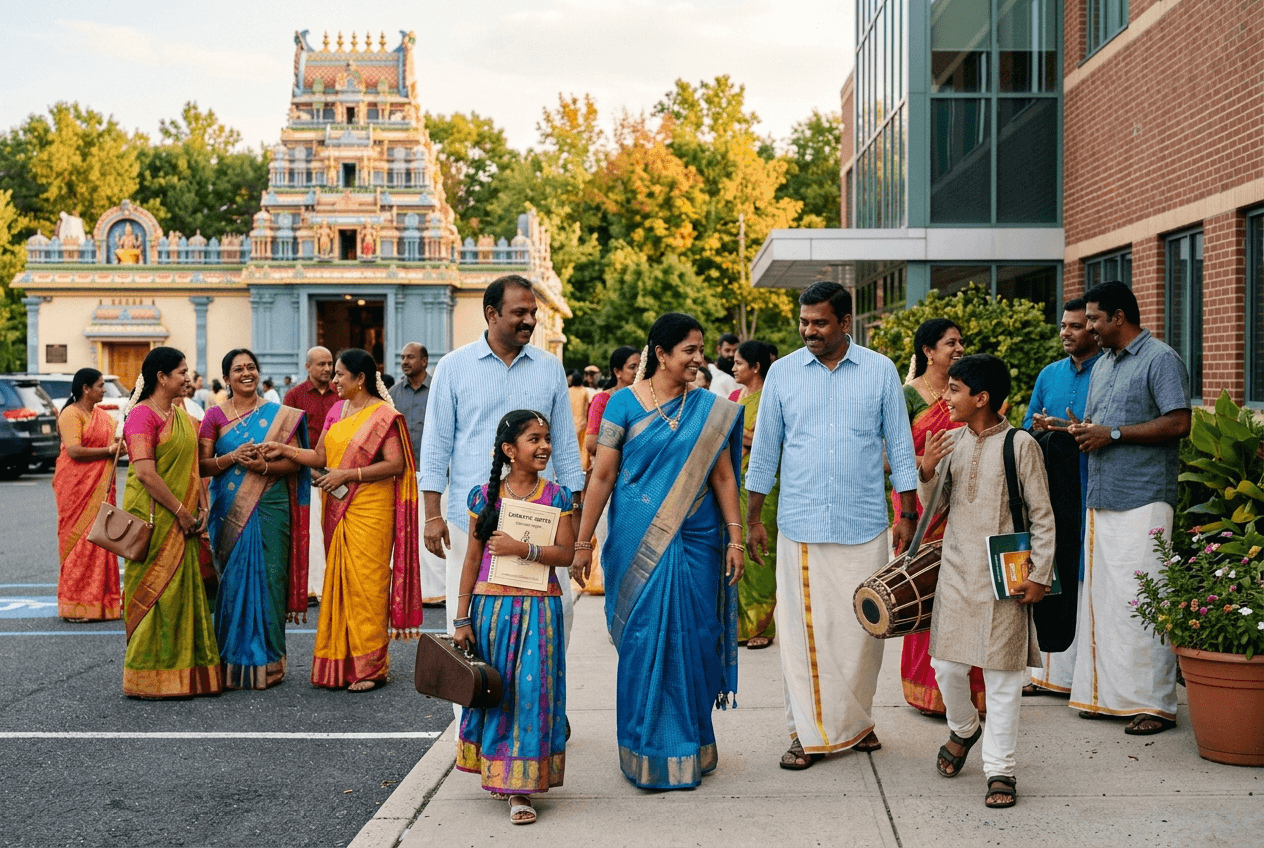 Tamil settlement in the USA clusters heavily around specific metro corridors shaped by technology and pharmaceutical industry employment. New Jersey's Tamil community, anchored by the New Jersey Tamil Sangam founded in 1989 at Rutgers University, has built over three decades of institutional depth, more than ten Tamil language schools, five or more dedicated Bharatanatyam dance schools, five or more Carnatic music schools and a dedicated Murugan temple. Texas has developed comparably dense infrastructure more recently, with the Dallas-Fort Worth Telecom Corridor and Austin's Apple, Samsung and Oracle campuses drawing thousands of Tamil engineers, supported by organizations like the Metroplex Tamil Sangam, founded around 1980 with more than two thousand member families, and dedicated Carnatic academies like Karnatic Academy serving the Plano, Frisco and McKinney area.
What Happens When You Live Outside These Corridors
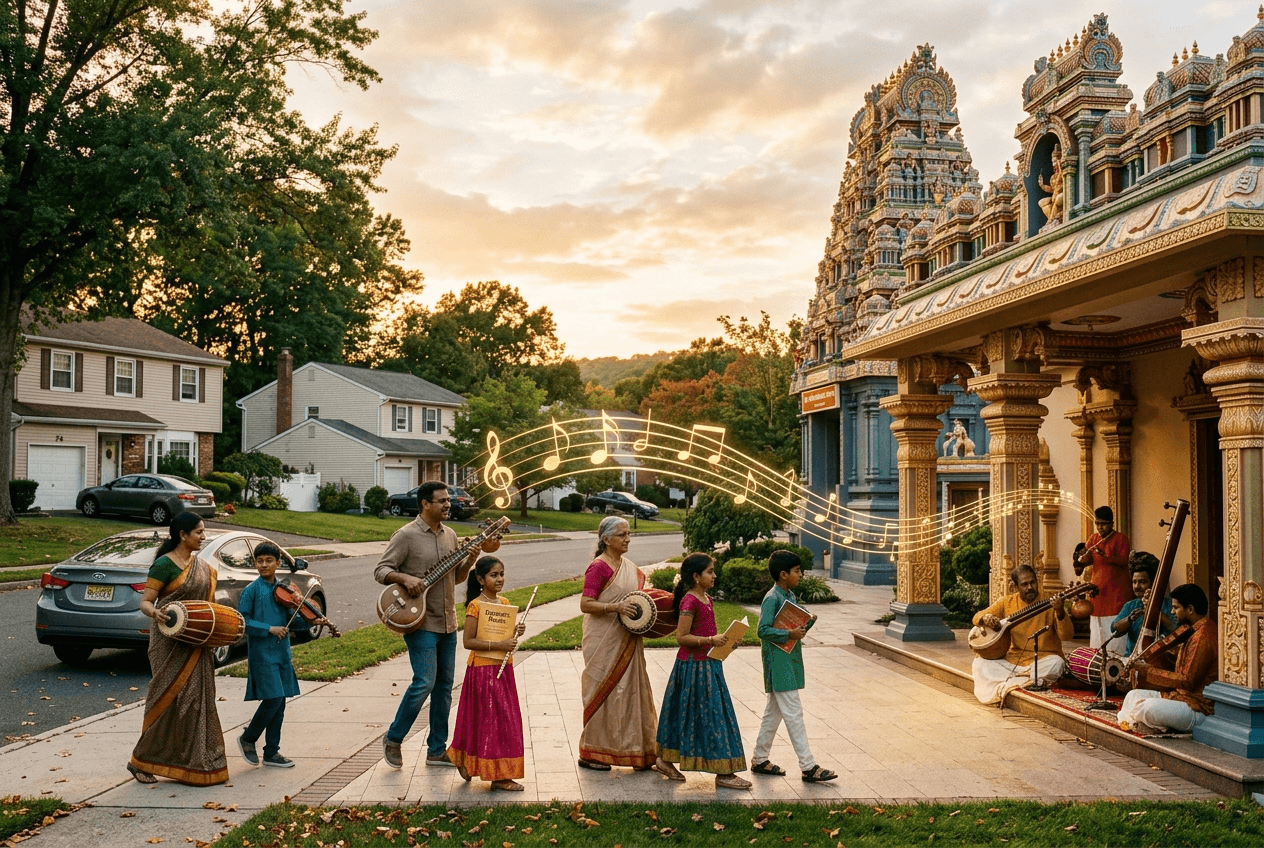 The honest reality for the majority of Tamil families in the USA, settled in smaller cities or metro areas without this concentrated institutional density, is that comparable in-person Carnatic instruction simply does not exist locally. A Tamil family in a smaller midwest or mountain west city, far from the established New Jersey or Texas corridors, faces a genuine access gap that live online instruction directly closes. Our broader Carnatic music for kids guide covers the full landscape of what quality Carnatic education for children actually involves, regardless of geographic access to a local community school.
What the Established NJ and Texas Schools Actually Teach
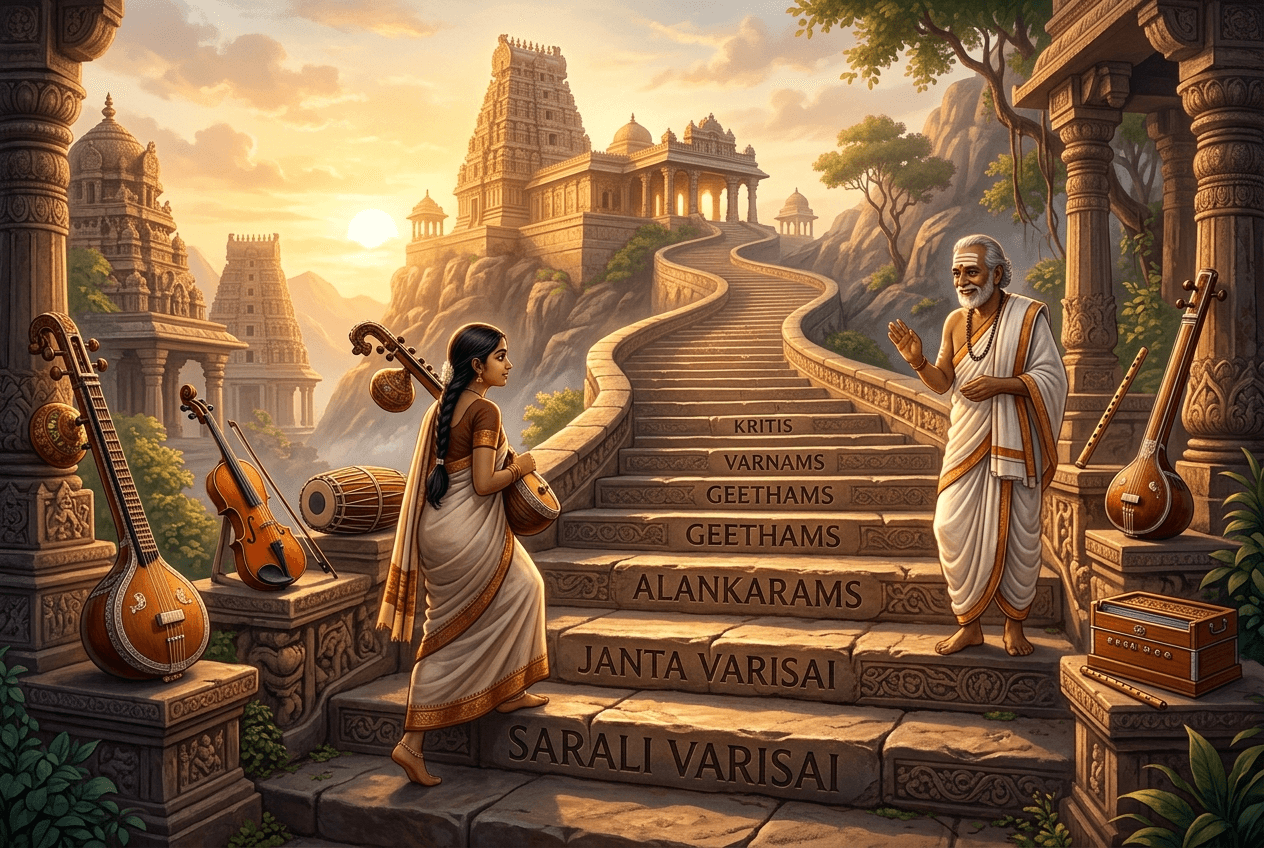
 Looking closely at what schools within these established Tamil corridors actually offer reveals a consistent curriculum structure worth understanding regardless of where a family lives. Training begins with sarali varisai, the foundational note exercises that build pitch accuracy and breath control, before progressing through janta varisai, alankarams, geethams and eventually varnams and full kritis. Vocal training pairs naturally with instrumental study, violin, veena, mridangam and flute, all taught within the broader Carnatic ecosystem these established schools maintain. Our what is Carnatic music beginners guide walks through this exact progression in detail for families unfamiliar with the structure.
The Cultural Calendar That Gives Training Its Purpose
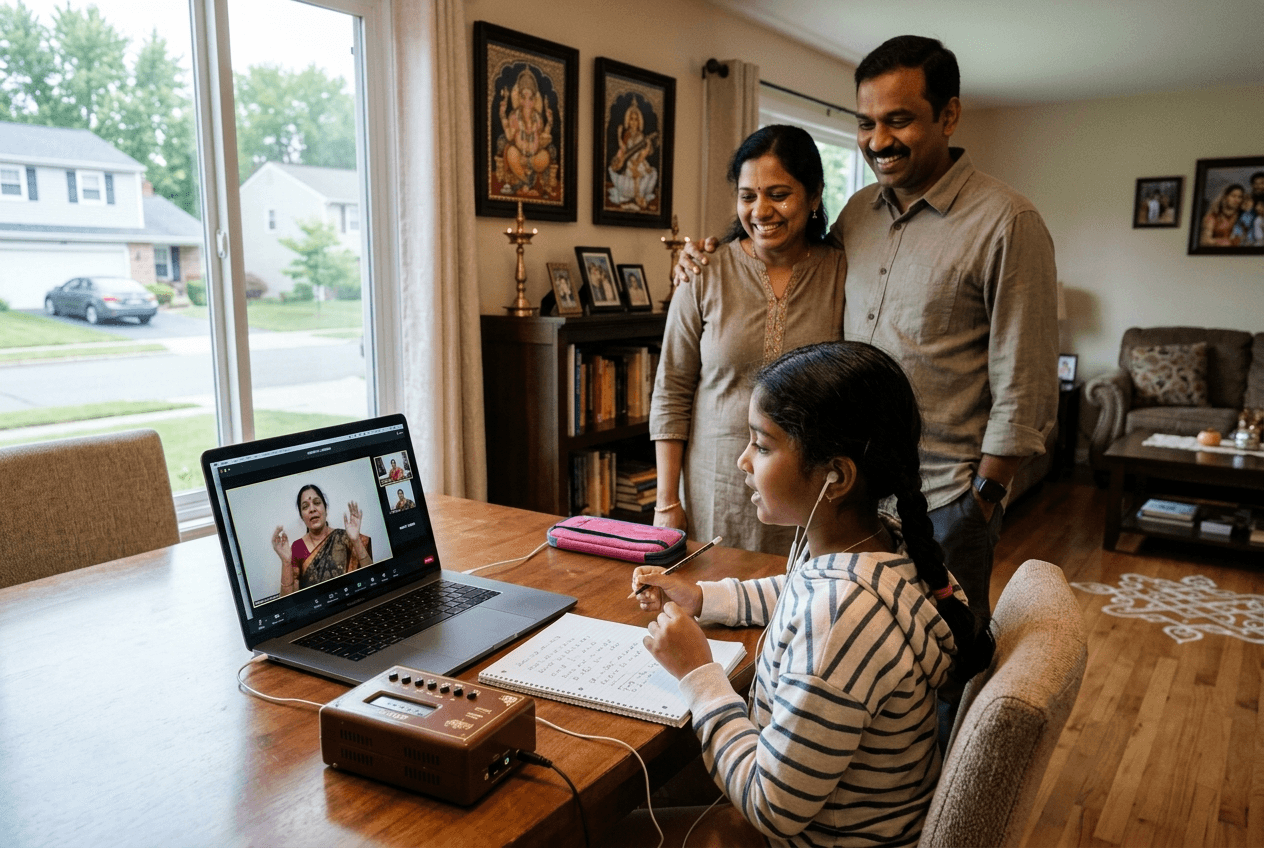 What makes the established Tamil American Carnatic schools genuinely effective is not simply curriculum quality but their embedding within a living cultural calendar. Pongal celebrations every January, Deepavali in autumn, Navratri programs at local temples, and dedicated Carnatic concert series tied to events like the Cleveland Thyagaraja festival's traveling programs all give students regular, meaningful performance opportunities throughout the year. A child training at a New Jersey or Texas Carnatic school is not learning in isolation. They are preparing, continuously, for the next community performance moment that gives their developing skill genuine social and cultural purpose.
Recreating This Purpose for Families Without Local Community Access
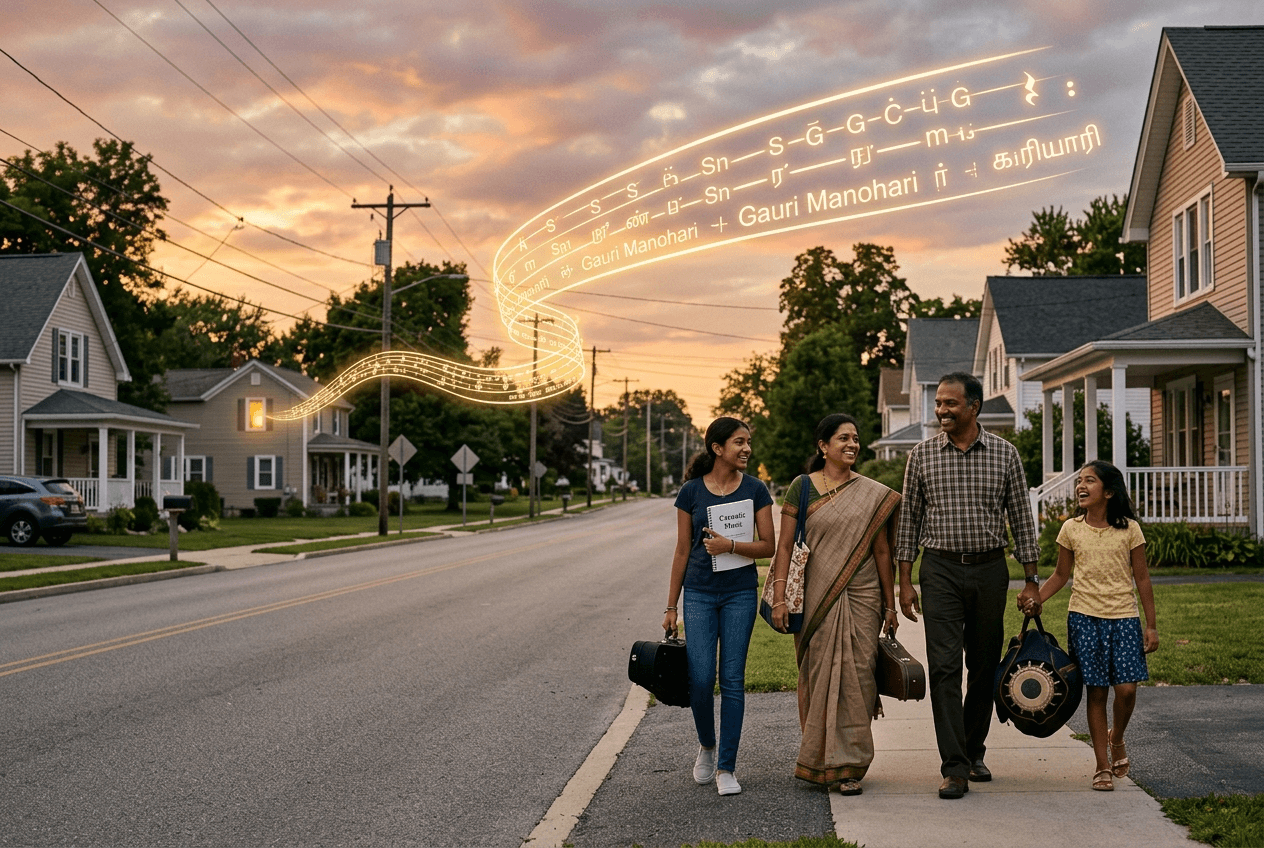 For Tamil families without access to this kind of dense local infrastructure, the good news is that the cultural calendar itself, Pongal, Deepavali, regional Tamil sangam events, exists in some form in nearly every US city with even a modest Tamil population, and many smaller Tamil associations actively welcome remote or newer community members. Pairing live online Carnatic instruction through Carnatic vocal classes with active participation in whatever local Tamil cultural community does exist, however modest, recreates much of the performance purpose that denser corridors provide naturally. Explore Bharatanatyam classes as well if your family's interest extends to the closely related classical dance tradition.
What Online Instruction Adds That Geography Cannot
 Beyond simply closing the access gap for geographically isolated Tamil families, live online instruction offers a genuine advantage even for families within established corridors: the ability to select a teacher based purely on fit and quality, rather than being constrained to whichever schools happen to operate within reasonable driving distance. A Tamil family in New Jersey with a child who would benefit specifically from a Tamil pronunciation focused teacher, or one drawing from a specific regional Tamil Nadu performance tradition, can find and work with exactly that specialist online, rather than accepting whichever local option happens to be geographically convenient.
About Art Gharana
 Art Gharana serves Tamil families across every US state with live 1-on-1 Carnatic vocal instruction. Review our Carnatic vs Hindustani guide for foundational context, browse our teacher profiles for specific Tamil language and regional training background, and book a free trial class to begin.
Frequently Asked Questions
1. Are there Carnatic music schools specifically for Tamil families in New Jersey?
Yes, several, including Anandabhairavi School of Carnatic Music in Scotch Plains, founded 1991, and Swaradhika School of Carnatic Music in Kendall Park, the largest Carnatic violin school in the state.
2. What if I live in a US city without a significant Tamil community?
Live online Carnatic instruction gives families in any US city access to the same quality of certified teaching available in dense Tamil corridors like New Jersey or Dallas-Fort Worth, closing the geographic access gap directly.
3. Does Carnatic training help maintain Tamil language connection for US born children?
Yes. Carnatic compositions are sung in their original languages including Tamil, building phonological familiarity and pronunciation confidence that reinforces heritage language connection alongside the musical training itself.
FeTNA and the National Tamil Performance Circuit
The Federation of Tamil Sangams of North America, commonly known as FeTNA, holds an annual convention that rotates across major Tamil population centers, drawing thousands of attendees from across the United States and Canada for a multi day celebration of Tamil language, culture, music and dance. New Jersey hosted FeTNA's 31st annual convention in Frisco in a notable demonstration of the Dallas Fort Worth area's emergence as a major Tamil hub alongside the longer established New Jersey and New York communities. Events of this scale provide exactly the kind of large, prestigious performance context that motivates serious, sustained Carnatic training for Tamil American children across the entire country, not just within the specific host city.
For Tamil families anywhere in the US, awareness of and connection to this broader national circuit, FeTNA conventions, Cleveland's Thyagaraja festival, and the dense local programming within established corridors, provides a sense of participating in something considerably larger than an isolated individual practice, even when daily lessons happen entirely online from a living room far from any major Tamil population center.
Why Active Engagement Matters More Than Passive Cultural Exposure
Research on ethnic identity formation among second generation immigrant children consistently identifies active engagement with heritage cultural practices, as distinct from passive cultural consumption like watching Tamil films or eating Tamil food, as a particularly powerful mechanism for building genuine bicultural identity confidence. Learning Carnatic music requires exactly this kind of active engagement, sustained, effortful, skill building participation in the tradition rather than passive exposure, which is precisely why researchers and community organizations alike consistently identify it as one of the most meaningful available connections to heritage for Tamil American children navigating their bicultural identity.
This research grounded understanding gives Tamil parents a more concrete framework than vague cultural sentiment for prioritizing Carnatic training specifically, among the many activities competing for a US born child's limited time. The active, skill building nature of the engagement is precisely what distinguishes its identity building power from more passive forms of cultural connection.
Secondary Tamil Hubs Across the Country
Beyond New Jersey and Texas, smaller but genuinely active Carnatic teaching communities exist across numerous additional US metro areas with meaningful Tamil populations, including the Bay Area, Chicago, the Washington DC metro area, and parts of the Pacific Northwest, each typically anchored by one or more dedicated temples and at least a handful of individually run Carnatic teaching practices. Families in these secondary hubs often find a middle ground between the dense corridor infrastructure of New Jersey or DFW and the complete local absence faced by families in smaller markets, with some local options available but typically more limited teacher choice than online instruction provides.
Regardless of which category describes your specific US location, dense established corridor, secondary hub with modest local options, or genuine local absence, the underlying recommendation remains consistent. Evaluate available local options honestly against the verified credential and structured curriculum standards covered throughout this guide series, and supplement or replace local options with live online instruction wherever the local fit, whether due to availability, teacher specialization, or simple scheduling convenience, does not fully meet your family's specific needs.
Regional Variation Within the Tamil Carnatic Tradition
Tamil Nadu itself encompasses considerable regional and stylistic diversity within the broader Carnatic tradition, and US based Tamil families sometimes have specific preferences rooted in their own family's regional background, whether Chennai's urban Brahmin tradition, the distinctive Thanjavur style closely associated with the historic Carnatic court tradition, or other regional variations. A genuinely attentive teacher will ask about and respect these specific preferences where a family expresses them, rather than applying a single generic approach regardless of a family's particular regional and stylistic connection to the broader tradition.
Vocal Training and the Path Toward Violin
It is worth Tamil families specifically understanding the distinction between vocal training and the broader Carnatic instrumental ecosystem when planning a child's path. While vocal training remains the most common entry point, violin holds a particularly significant place within Carnatic music, having been adapted from the Western instrument and integrated so thoroughly into South Indian classical performance that it now functions as one of the tradition's primary melodic instruments, alongside vocal and veena. A Tamil child who begins with vocal foundations and later adds violin, following the same pedagogical sequence many established NJ schools recommend, develops a particularly well rounded Carnatic musical foundation.
What If My Child's Tamil Is Not Fluent
US born Tamil children sometimes arrive at Carnatic lessons with considerably less conversational Tamil fluency than their parents assume is necessary for genuine engagement with the tradition. This is rarely a genuine barrier in practice. Carnatic compositions are learned phonetically and through repeated guided practice, with meaning and grammatical context explained by the teacher as understanding develops, rather than requiring conversational fluency as a prerequisite. Many of the most accomplished young Tamil American Carnatic vocalists began their training with relatively limited spoken Tamil, building meaningful language connection through the music itself rather than the reverse.
Formal Academic Pathways Within Established Schools
Several established New Jersey and Texas Carnatic schools have built formal affiliations with accredited institutions, offering pathways toward recognized certificate, diploma and even masters level credentials through partnerships with universities in both India and the United States. While these formal academic pathways remain relevant primarily for the smaller number of students pursuing genuinely serious, potentially professional level Carnatic training, their existence within established Tamil American institutions demonstrates the seriousness and depth this community has built around classical music education over multiple decades.
The Goal Remains the Same, Wherever You Live
Whatever your family's specific situation, dense corridor resident, secondary hub family, or geographically isolated household with no nearby Tamil community at all, the fundamental goal remains identical: connecting your child to a living musical tradition that has carried Tamil culture across centuries and now across oceans, with the specific delivery mechanism, in person at an established New Jersey school or live online from anywhere in the country, mattering considerably less than the consistency, quality and genuine cultural grounding of the instruction itself.
A Well Supported Path, Wherever You Begin
Tamil American families researching Carnatic options for the first time should approach the decision with confidence that this is a genuinely well supported, well established educational pathway, regardless of which specific delivery format ultimately proves the best fit. From New Jersey's three decade old institutional infrastructure to live online instruction reaching families in every corner of the country, the tradition is alive, actively taught and genuinely accessible to Tamil American children wherever their families happen to have settled.
Your Practical Next Step
Taking that first step is straightforward. Book a free trial class, mention your family's specific regional and linguistic background if relevant to your teacher matching preferences, and experience directly what live one to one Carnatic instruction designed for Tamil American families actually delivers, regardless of how close or far your specific US city sits from the established corridors this guide has described in detail.
Decades of Deliberate Community Investment
It is worth closing with a specific acknowledgment of just how much institutional investment Tamil American communities have made in building this infrastructure over the past several decades, from a single Tamil association founded at a university campus in 1989 to today's dense network spanning dedicated temples, multiple competing Carnatic schools, language schools, and a thriving national festival and convention circuit. This investment was made deliberately, by parents and community leaders who understood precisely what this guide has tried to articulate, that active, structured engagement with classical music is one of the most reliable available mechanisms for transmitting Tamil heritage to children growing up thousands of miles from Tamil Nadu.
Our Commitment to Tamil Families
About Art Gharana's commitment to Tamil families specifically: our teacher matching process actively considers regional, linguistic and stylistic preferences where families express them, recognizing that the Tamil Carnatic tradition, while sharing common foundations with the broader South Indian classical system, carries specific cultural texture and meaning that deserves genuine respect and attentiveness from any teacher serious about doing this work well.
Thank You
Thank you for reading this guide. Whatever your family's specific circumstances, established Tamil corridor resident or geographically isolated household, we hope the concrete, specific detail covered here, from the named NJ schools to the cognitive research on heritage language and active cultural engagement, has given you genuine clarity about what Carnatic education for your Tamil American child can look like.
We look forward to being part of your family's specific journey within this much larger, much older living tradition, wherever in the United States your family happens to call home.
A Case Study in Community Embeddedness
Sruthiswara School of Music in Somerset County, New Jersey, founded in 2016 by a married couple and now operating as a registered nonprofit, offers a useful illustrative case of how seriously established Tamil and broader South Indian American institutions take performance integration into the local cultural calendar. The school's published event calendar spans dozens of annual engagements, from Navaratri celebrations at the Bridgewater Sri Venkateswara Temple to participation in the Cleveland Thyagaraja Aradhana's traveling programming, demonstrating exactly the kind of dense, continuous performance opportunity that distinguishes established corridor schools from a more isolated learning experience.
This level of community embeddedness, while difficult to fully replicate for families outside established corridors, is not entirely unavailable to them either. Many of these same organizations, including several mentioned throughout this guide, actively welcome remote participation in community events for families willing to travel for specific occasions, and the broader national Tamil festival circuit, FeTNA conventions rotating annually across different host cities, Cleveland's spring festival, provides periodic, accessible touchpoints even for families whose daily training happens entirely online far from any dense local corridor.
Begin Today
Book a free trial class today and connect your child to this living tradition, supported by certified teachers who understand both the technical demands of Carnatic music and the specific cultural context Tamil American families bring to this learning journey.
Vanakkam, and welcome to the journey.
One More Word
From a single 1989 university gathering to today's nationwide network spanning New Jersey, Texas and every other US state, the Tamil American community has built something genuinely remarkable around the preservation of this art form. Your family's participation, however it unfolds, becomes part of that same ongoing story.
Sarali varisai begins the journey, wherever in America that journey happens to start.
A Closing Note
From the established corridors of New Jersey and Texas to the quietest corners of the country with no local Tamil community at all, the music remains the same, the dedication required remains the same, and the reward, a child genuinely connected to centuries of South Indian musical heritage, remains entirely within reach.
Thank you for reading, and we look forward to welcoming your family to this tradition.
Until Then
Keep listening to the music at home, keep the cultural calendar visible and celebrated, and trust that the formal training, whenever it begins, will build naturally on whatever foundation of love and familiarity your family has already established simply through daily life.
A Final Reflection
Tamil families who have built and sustained this remarkable national infrastructure over the past several decades did so with a clear understanding that culture is not preserved through wishing alone, but through deliberate, sustained, generation by generation investment in teaching the next generation directly. Every family that books a Carnatic trial class today, in New Jersey or Texas or anywhere else in the country, becomes part of that same deliberate effort.
Book your trial today, and join the story.
Vanakkam
To every Tamil family reading this guide, wherever in America you call home, vanakkam, and welcome. The tradition is ready for your family whenever you are ready for it. Let the music begin, wherever you are.