ChatGPT
 Google AI
 Grok
Grok Claude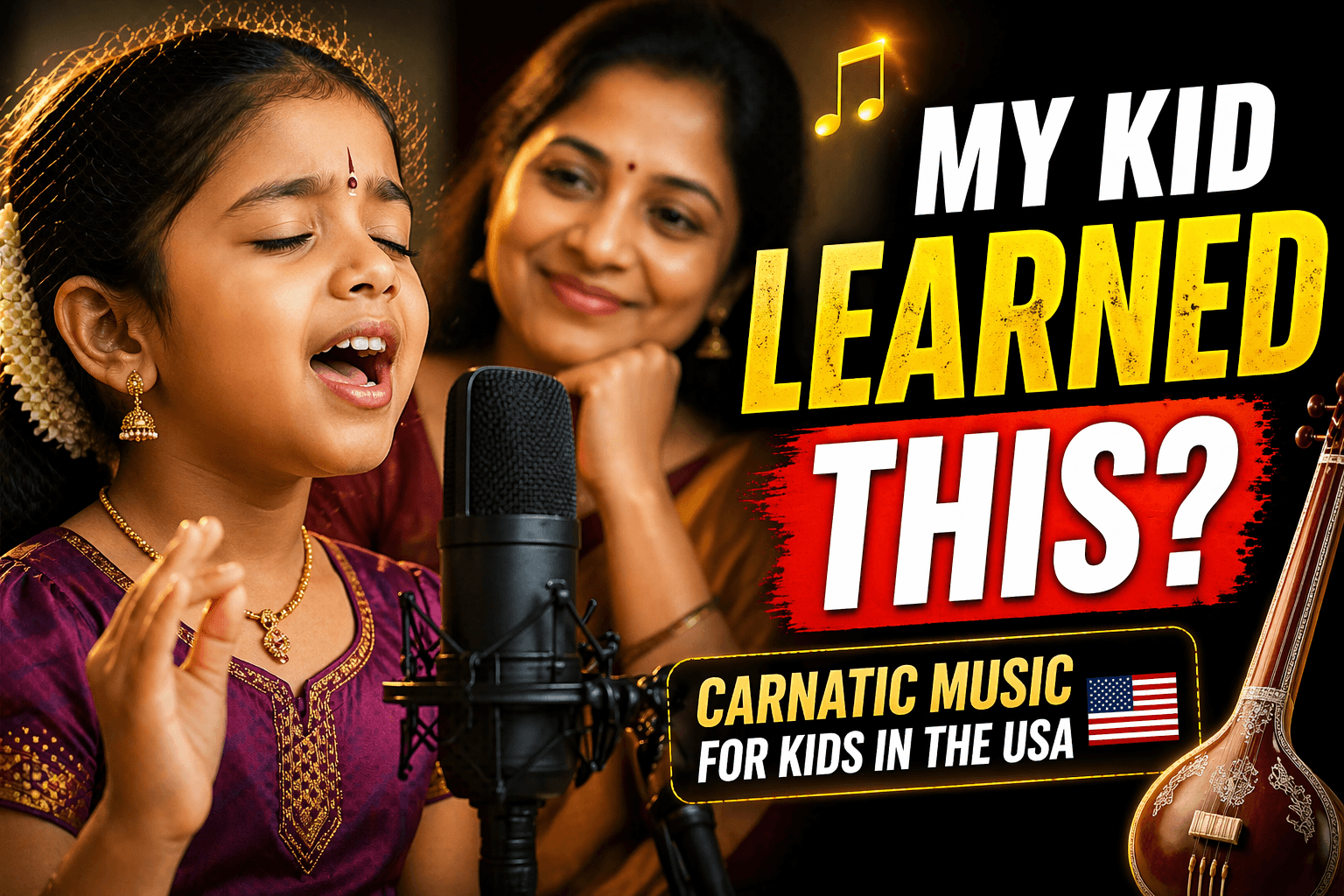
Carnatic music is the classical music tradition of South India, one of the world's most sophisticated musical systems built on ragas, talas, and a vast repertoire of compositions. For South Indian-American families in the USA and anyone drawn to this extraordinary tradition, online Carnatic music classes for children have never been more accessible. This comprehensive guide covers what Carnatic music is at its core, the cognitive and cultural benefits of early training, what a beginner child's first year looks like in detail, how to choose the right online teacher from anywhere in the US, and how to get started today.
Close your eyes and listen to a Carnatic vocal performance. Even if you've never heard it before, something in the voice pulls at something deep. The way it moves between notes with fluid grace. The way the rhythm builds under it, complex and inevitable. The way the whole thing feels both ancient and alive.
That's Carnatic music. And for South Indian-American families in the USA, teaching it to your children isn't just about music. It's about preserving something extraordinary.
The Indian-American population has reached 5.2 million in the US, with a significant South Indian community concentrated in California, Texas, New Jersey, and Georgia. For families from Tamil Nadu, Karnataka, Kerala, Andhra Pradesh, and Telangana, Carnatic music is woven into the fabric of every important occasion, from temple visits to wedding ceremonies to family celebrations.
Online Carnatic music classes for kids in the USA have transformed access. Your child no longer needs to live near a qualified Carnatic teacher. The best teacher for your child's voice, goals, and learning style might be based in Chennai, Bengaluru, or somewhere in New Jersey. With the right online platform, any of them can teach your child from your living room.
What Is Carnatic Music? A Parent's Complete Introduction
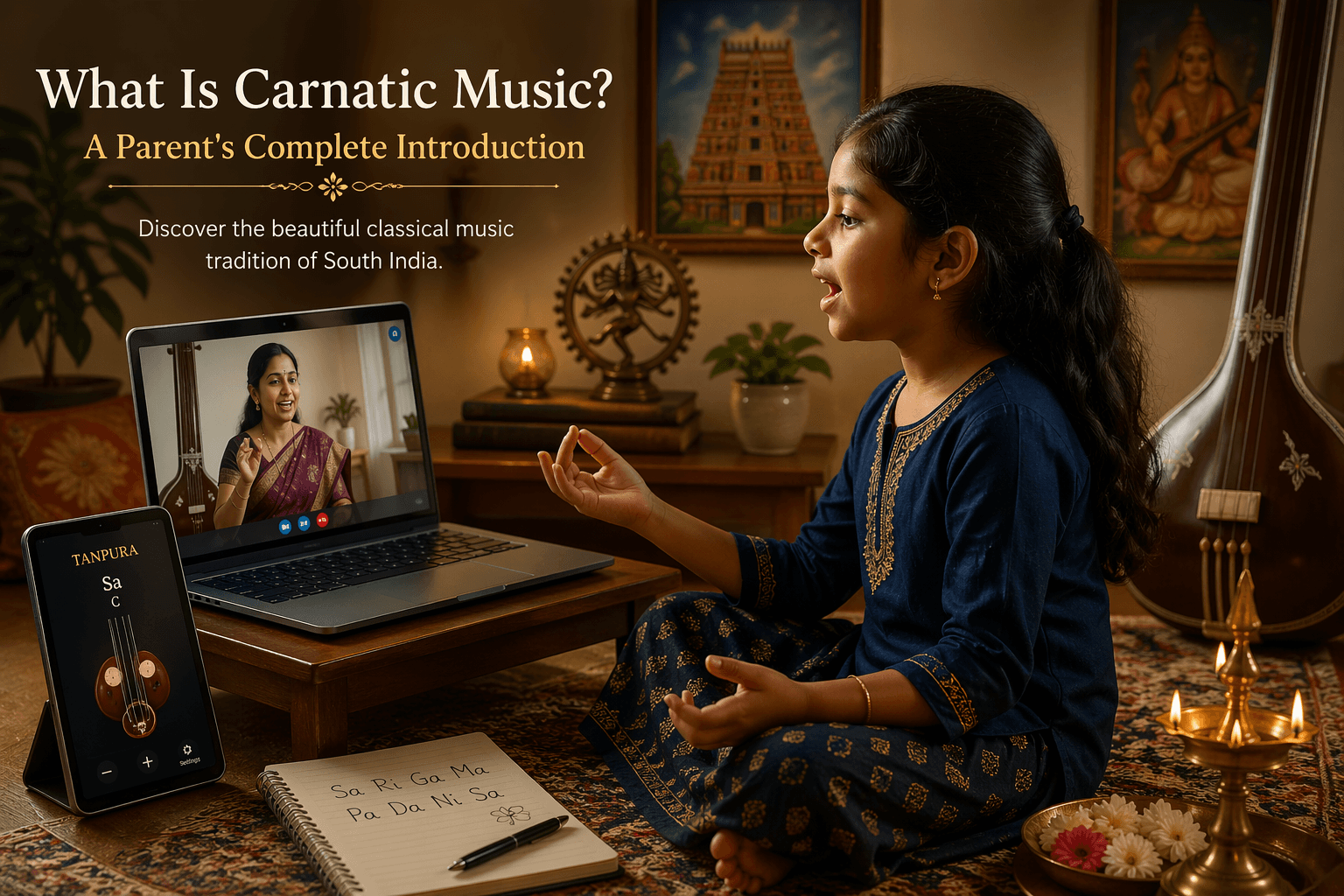
The Foundations of South Indian Classical Music
Carnatic music is the classical music tradition of South India, practiced primarily in Tamil Nadu, Karnataka, Kerala, Andhra Pradesh, and Telangana. Together with Hindustani music, it forms the two great traditions of Indian classical music, and has a documented history of over 2,000 years.
According to the Centre for Cultural Resources and Training, India, Carnatic music has its roots in the ancient musicological texts, particularly the Natya Shastra and the Silappadikaram. Its present form was significantly shaped during the Bhakti movement of the 15th through 17th centuries, and most profoundly by the three composer-saints known as the Carnatic Music Trinity: Thyagaraja, Muthuswami Dikshitar, and Syama Sastri, who lived in the 18th and 19th centuries and created the vast repertoire that forms the core of Carnatic music teaching and performance today.
The Three Pillars of Carnatic Music
Raga: A melodic framework defined by a specific set of notes (swaras), characteristic ascending (aarohana) and descending (avarohana) patterns, and signature melodic phrases (gamaka-laden phrases) that give each raga its distinctive personality and emotional colour. There are thousands of ragas in the Carnatic system, with 72 parent scales (melakarta ragas) forming the theoretical foundation.
Tala: The rhythmic structure within which all Carnatic compositions and improvisations unfold. Carnatic talas are sophisticated rhythmic cycles counted using a specific system of claps and waves (kriya). Adi tala (8 beats) is the most commonly encountered tala for beginners. Unlike Western time signatures, each tala has its own internal structure of subdivisions that musicians track simultaneously with the melody.
Swara: The seven fundamental musical notes: Sa (shadja), Ri (rishabha), Ga (gandhara), Ma (madhyama), Pa (panchama), Da (dhaivata), Ni (nishada). In Carnatic music, each note except Sa and Pa has multiple variants (shuddha, chatusruti, komal), giving the system an enormous palette of 22 srutis (microtonal pitches) within the octave.
How Carnatic Music Differs from Hindustani Music
Both are forms of Indian classical music. They share the seven swaras, the raga-tala framework, and a broad philosophical foundation. But they differ significantly in approach and practice:
Improvisation: Hindustani music places enormous emphasis on free improvisation (raga exploration through alaap, jor, jhala). Carnatic music also has improvisation (manodharma sangita) but is more composition-centric. A larger portion of a Carnatic performance consists of presenting composed kritis with their specific melodic and rhythmic structures.
Compositions: The Carnatic repertoire of composed kritis is vast and is the central pedagogical material. Students spend years learning these compositions with their specific gamakas (ornamental inflections). In Hindustani music, bandishes exist but the emphasis is more on raga exploration.
Gamaka: Carnatic music's characteristic ornamental slides, oscillations, and inflections (gamakas) are essential to authentic Carnatic sound and are taught from early in the curriculum.
Rhythm: Carnatic music uses a more complex and mathematically precise rhythmic system with more varied talas and subdivisions than Hindustani music.
Why Start Your Child in Carnatic Music Young?

Cognitive Benefits That Extend Far Beyond Music
The cognitive demands of Carnatic music training are genuinely extraordinary. Here's what the science says about early Carnatic music education.
Pitch Accuracy and Ear Training
Carnatic music places exceptional emphasis on precise pitch. Swara practice against the tanpura drone trains the ear to hear and reproduce exact microtonal differences between note variants (chatusruti rishabha versus suddha rishabha, for example). This level of pitch discrimination is neurologically demanding and highly beneficial.
Research published in Frontiers in Neuroscience confirms that structured music training significantly enhances auditory processing, particularly pitch discrimination, in children. Children who train in Carnatic music from early ages typically develop exceptional musical ears that serve them throughout their entire musical lives.
Mathematical Thinking Through Tala
Carnatic tala structures involve sophisticated mathematical reasoning: counting beat cycles, tracking subdivisions, and maintaining rhythmic awareness simultaneously with melodic performance. Neuroscientist Nina Kraus notes that the mathematical demands of structured music training overlap significantly with mathematical reasoning in ways that benefit academic performance broadly.
Children who practise Carnatic talas regularly are doing genuinely sophisticated mathematical computation through music, and the research strongly suggests this carries over into their math performance in school.
Memory Through Oral Transmission
Carnatic compositions are memorised, not read from sheet music. Students internalise the complete melodic, rhythmic, and gamaka structure of each composition through repetition and direct transmission. This oral memorisation tradition builds exceptional long-term memory. The meta-analysis published in Frontiers in Psychology (2025) confirms that this type of structured musical memorisation positively impacts working memory in children.
Language Skills and Heritage Language Connection
Carnatic compositions are sung in Sanskrit, Telugu, Tamil, Kannada, and Malayalam. For South Indian-American children growing up in English-dominant environments, learning to sing in these languages:
- Maintains phonological connection to heritage languages
- Builds recognition and basic comprehension of ancestral languages
- Develops multilingual phonological awareness with documented academic benefits
Cultural Identity for South Indian-American Children
Research consistently shows that active engagement with heritage arts forms is a powerful mechanism for ethnic identity formation. For second-generation South Indian Americans navigating bicultural identities, Carnatic music is one of the most meaningful active connections to their heritage available.
Unlike passive cultural consumption (watching movies, eating food), learning Carnatic music requires active engagement with the cultural tradition. It builds genuine competence and a real sense of belonging to the tradition.
What Does Carnatic Music Training Look Like for Beginner Children?
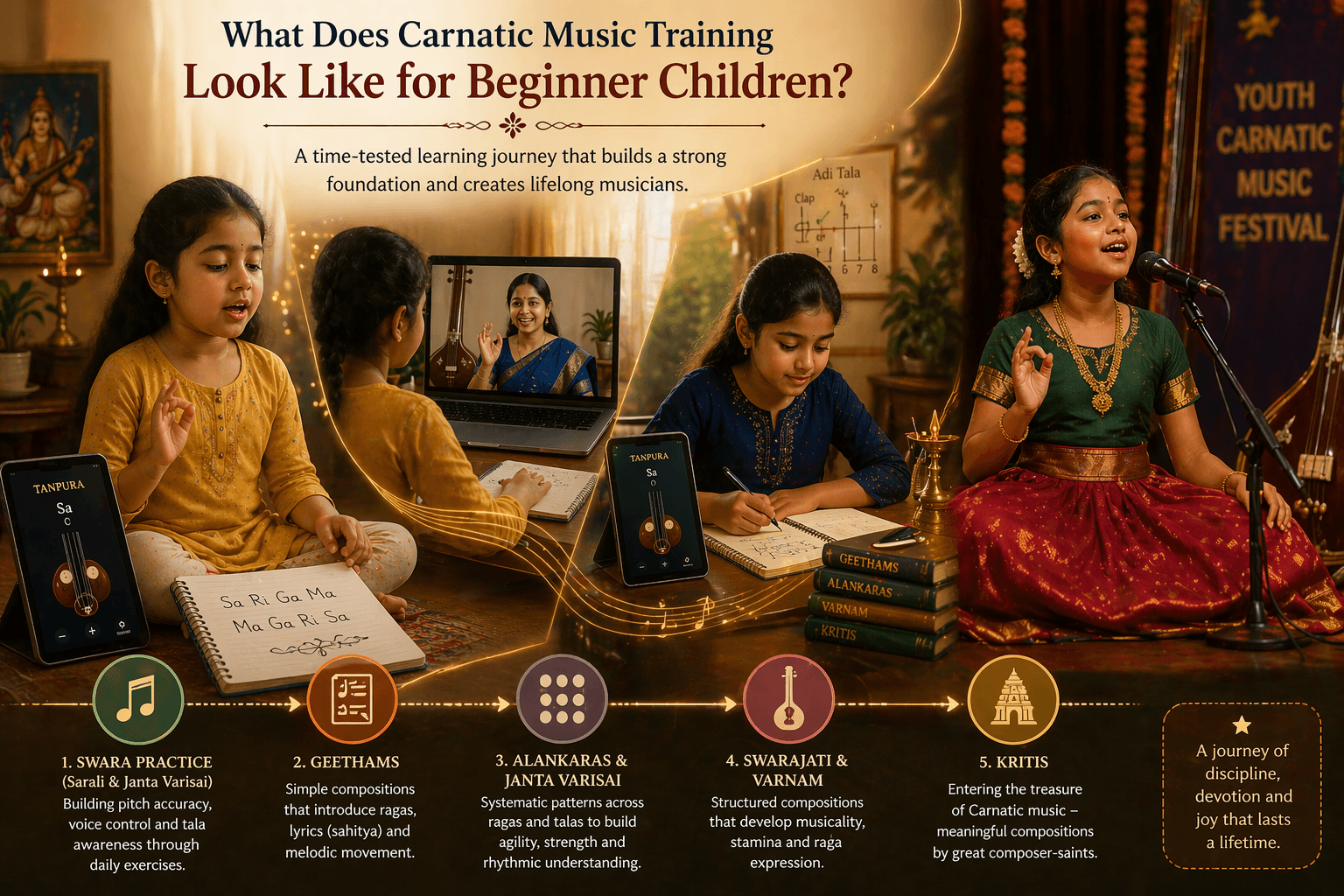
The Traditional Pedagogical Sequence
Carnatic music education follows a well-defined, time-tested pedagogical sequence. Here's what your child can expect in their first two years.
Stage 1: Swara Practice (Sarali Varisai)
Every Carnatic student begins with sarali varisai: ascending and descending swara exercises practiced at three speeds (slow, medium, fast) in different rhythmic patterns (alankaras). These exercises are practiced daily with the tanpura drone as a pitch reference.
The purpose of sarali varisai is not just to learn the seven swaras. It is to:
- Train the ear to hear and produce accurate pitch
- Develop the voice's ability to move fluidly between notes with proper gamaka
- Build rhythmic accuracy and tala awareness
- Establish the physical foundation of Carnatic vocal production
Most children spend the first three to six months primarily on sarali varisai and basic janta varisai (exercises pairing adjacent notes). This stage feels slow but is absolutely foundational. Students who rush through it to reach "real compositions" consistently have weaker foundations than those who practise it thoroughly.
Stage 2: Geethams (Simple Compositions)
After establishing solid swara practice, students learn geethams: short, simple compositions that introduce the combination of swaras within a specific raga and tala structure. Geethams have lyrics (sahitya) that the student also learns to sing, connecting the melodic and linguistic dimensions from the beginning.
Early geethams are typically in simple ragas like Malahari, Suddha Dhanyasi, or Mohanam. Students learn to sing them in both the swara notation and with the lyrics.
Stage 3: Alankaras and Janta Varisai
Alankaras are systematic exercises that combine swaras in specific sequential patterns across different ragas and talas. They build technical agility, extend gamaka ability, and deepen tala comprehension. Janta varisai exercises (exercises where each note is repeated twice) build note accuracy and vocal stamina.
Stage 4: Swarajati
The swarajati is a structured composition that combines swara passages with sahitya (lyrics) in more complex patterns than geethams. It is often described as the bridge between geethams and varnams. Learning a complete swarajati typically marks the end of the initial beginner stage.
Stage 5: Varnam
The varnam is the centerpiece of Carnatic beginner education and is often described as the graduate composition of the elementary level. A varnam combines fast-paced swara patterns, characteristic raga phrases, rhythmic variations, and structured sahitya in a way that tests and develops all the skills the student has built.
Most committed beginners aged 7-10, practising daily and attending weekly lessons, reach the varnam stage within 18 months to 2.5 years.
Stage 6: Kritis
The kriti is the heart of the Carnatic repertoire. These are the major compositions by the Carnatic Trinity and other composer-saints that form the core of all concert repertoire. Each kriti has three sections: pallavi (opening theme), anupallavi (second theme), and charanam (verse). Students begin learning kritis once they have a solid foundation through the varnam level.
The Role of the Tanpura Drone in Home Practice
The tanpura is the sine qua non of Carnatic practice. It provides the continuous tonic drone against which all pitch is calibrated. Every Carnatic practice session happens with the tanpura playing.
For children in the USA, a physical tanpura is impractical. Excellent digital alternatives include:
iTablaPro app (iOS/Android): The most widely used tanpura app among diaspora students. Adjustable pitch, reliable drone, simple interface.
Tanpura Droid (Android): A free, functional alternative with customizable pitch and string configuration. SA RE GA MA PA online tanpura tool: A free web-based tool. Slightly less nuanced than the apps but functional for practice.
Your teacher will help you set the correct sruti (tonic pitch) for your child's voice, typically in the first lesson.
How to Choose an Online Carnatic Music Teacher for Your Child in the USA
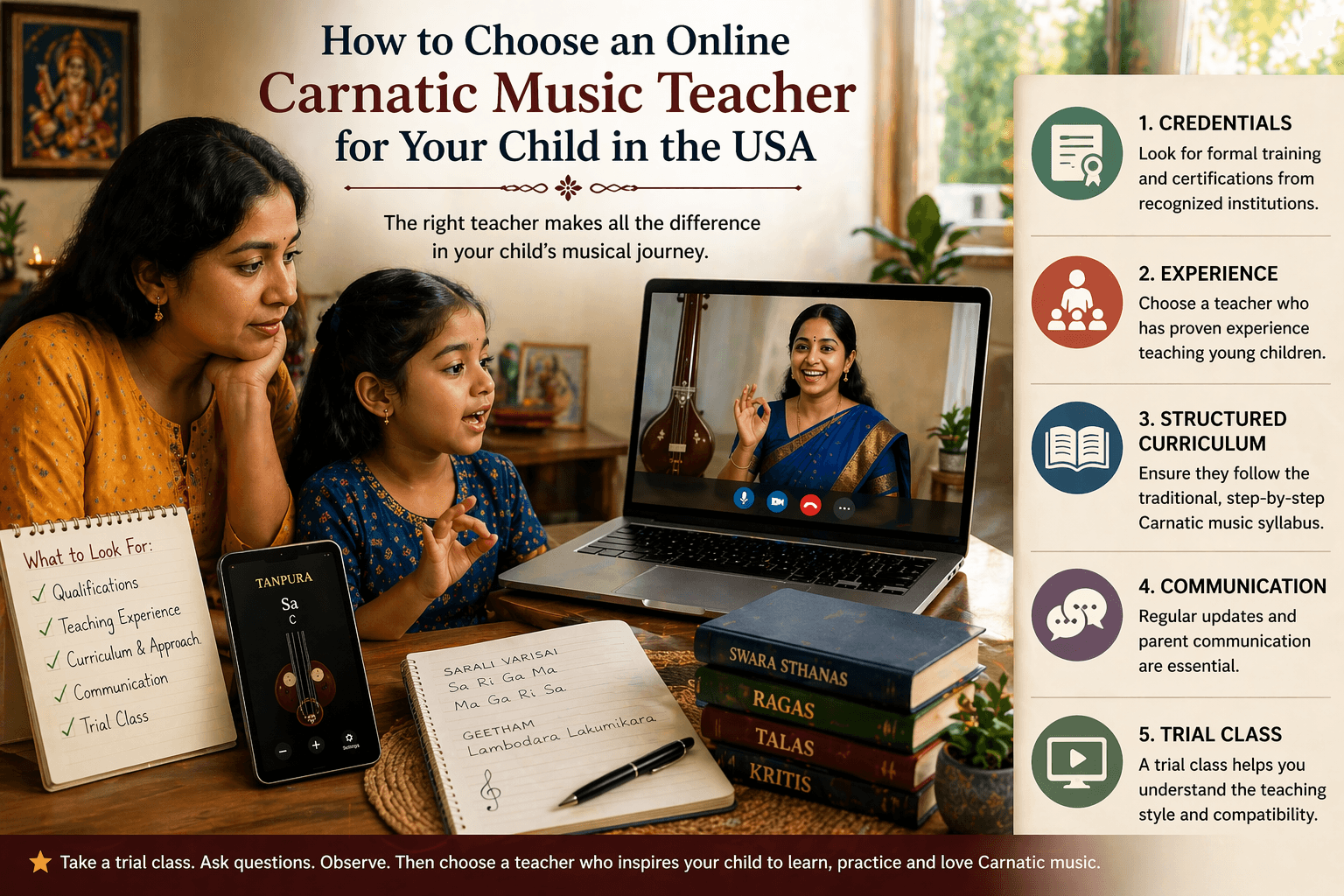
What to Look for in a Qualified Carnatic Teacher
Formal Training and Examination Credentials
A qualified Carnatic music teacher should have formal training credentials. Look for teachers who have:
- Completed the Visharad (graduate level) or higher examination from a recognised body like the Music Academy (Chennai), Karnataka Sangitha Nritya Academy, or equivalent
- A degree in music from a recognised Indian institution
- Clear training lineage: who was their guru, and where did they train?
Teaching Experience with Children
Not every accomplished Carnatic performer is an effective teacher of young children. Ask specifically about experience teaching children in the age range of your child, and ask how they adapt their teaching for young beginners online.
Structured Curriculum Adherence
A qualified Carnatic teacher follows the traditional pedagogical sequence (sarali varisai, janta varisai, geethams, alankaras, swarajati, varnam, kritis). Ask them to describe the first year of learning. A clear, structured answer indicates pedagogical clarity.
Regular Communication with Parents
For children, parents are partners in the learning process. Regular communication about lesson content, home practice assignments, and progress is the mark of a professional teacher.
A Free Trial Class
Always trial before you commit. One class tells you everything you need to know.
At Art Gharana, our Carnatic vocal teachers are formally trained, culturally sensitive, and experienced in teaching children from diaspora backgrounds. Explore our vocal courses or read our beginner's guide to Indian classical music.
Setting Up for Online Carnatic Music Classes at Home
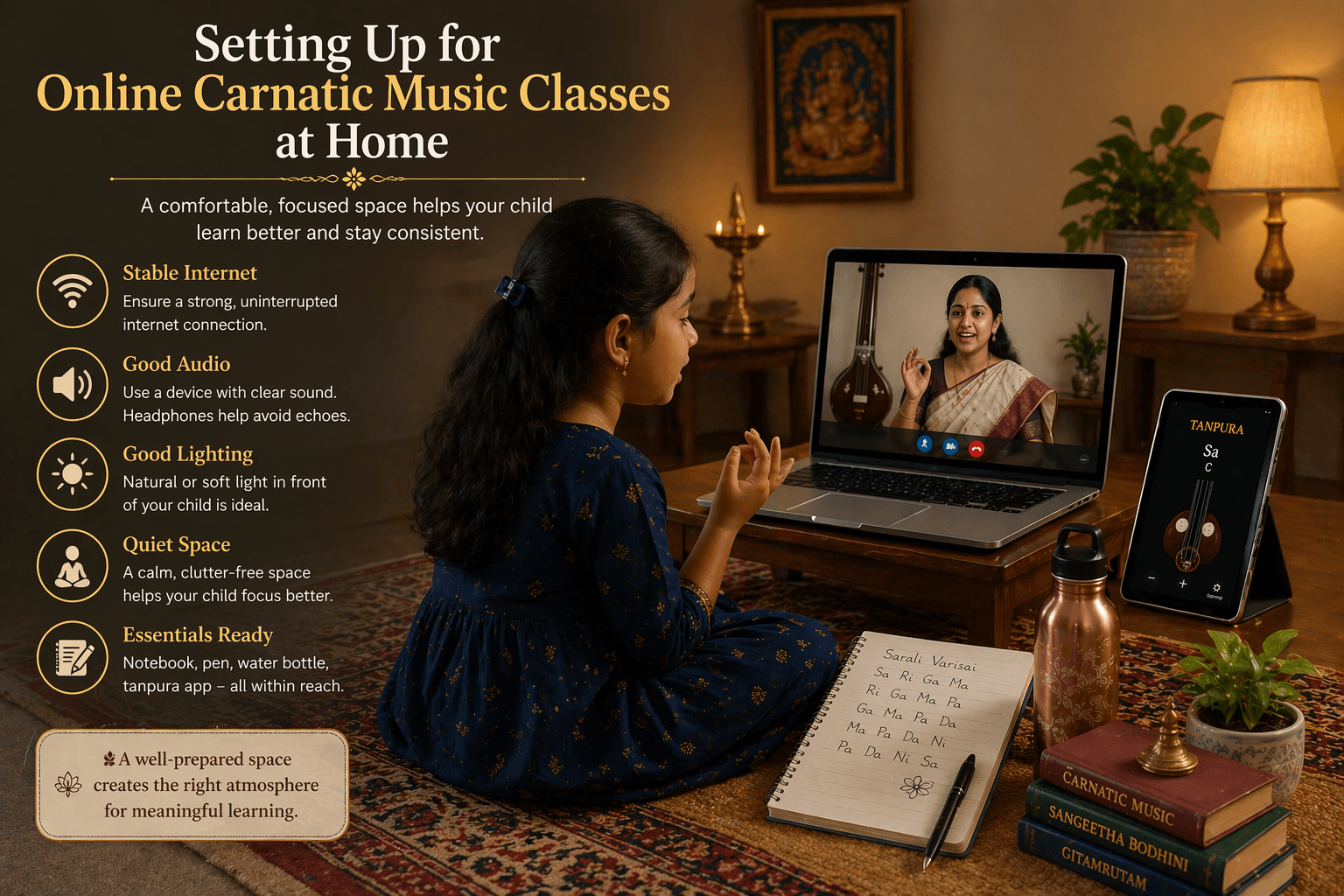
Technical and Physical Setup
Device: A laptop, tablet, or desktop computer with a built-in microphone. For older students or those with more serious goals, a simple external USB microphone ($20-$40) significantly improves the audio quality the teacher hears.
Internet: Stable broadband (10 Mbps and above) is sufficient. WiFi should be reliable in the practice space. Wired ethernet connections eliminate the occasional dropout that disrupts a live music session. Tanpura app: Installed and tested before the first lesson. Your teacher will advise on the correct pitch setting.
Quiet space: Background home sounds are generally fine. Loud ambient noise (TV in the same room, other family members talking loudly nearby) makes it harder for the teacher to hear the child's voice accurately.
A notebook: Carnatic music theory and composition details benefit from note-taking. Encourage older students to keep a dedicated practice notebook.
Creating an Effective Practice Routine
The most important factor in Carnatic music progress is daily practice consistency. Here's a practical routine for beginner children:
Days 1-3 after the lesson: Focus on reviewing what was taught. Practice sarali varisai at slow speed with tanpura drone. Review the new geetham or composition. 15-20 minutes total.
Days 4-6: Same exercises, slightly increased tempo if comfortable. Self-record one run-through of the main composition and listen back. 20-25 minutes total.
Day 7 (lesson day): A brief 10-minute warm-up before the lesson to wake the voice.
This seven-day cycle, practised consistently, is dramatically more effective than longer but sporadic practice sessions.
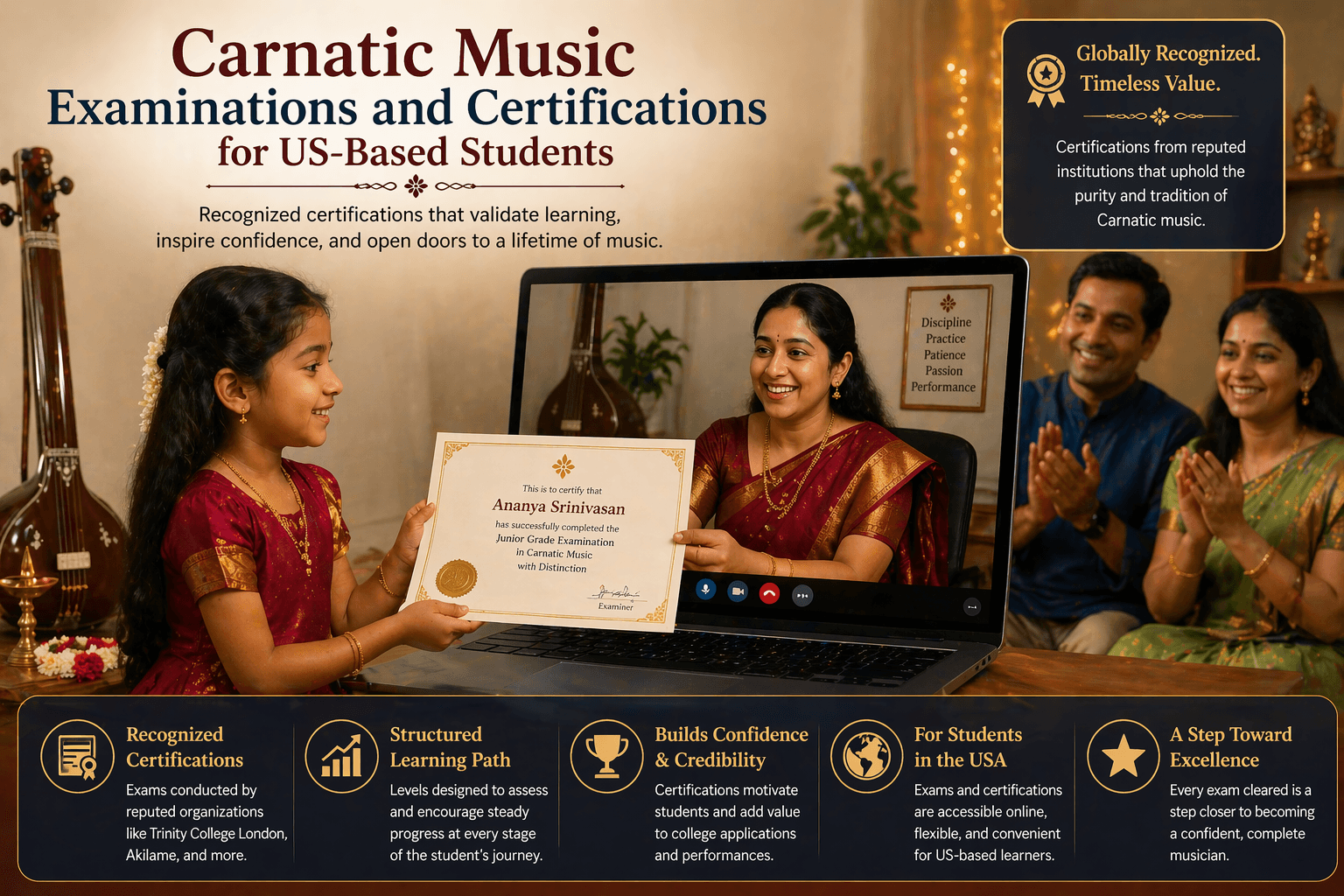
Carnatic Music Examinations and Certifications for US-Based Students
The Indian Examination System
The main bodies administering Carnatic music examinations that are accessible to US-based students include:
Akhila Bharata Gandharva Mahavidyalaya Mandal (ABGMM): One of India's oldest examination bodies. Examinations range from Prathama (beginner) through Visharad and beyond.
Prayag Sangeet Samiti: Allahabad-based body with examinations in Carnatic music and dance.
Karnataka Sangeetha Nritya Academy: For Carnatic music examinations in the Kannada-speaking tradition.
Students in the USA can appear for these examinations through affiliated teachers. Some examination centers allow remote written components and require US-based practical presentations at affiliated centers or during India visits.
What Carnatic Certification Means for US Students
Within the South Asian community in the USA:
- Carnatic music certificates from recognised Indian bodies carry significant prestige for cultural competitions, temple events, and community music programmes
- They are valued in scholarship applications from South Asian cultural organisations
- They are not equivalent to US academic music degrees
For families interested in formal accreditation within the UK's educational framework, some platforms now offer Ofqual-accredited Indian music qualifications, as discussed in our related blog for UK families.
Conclusion
Carnatic music is one of humanity's greatest musical achievements. For South Indian-American children growing up in the USA, learning it is simultaneously a cognitive investment, a cultural education, and a living connection to a tradition that has endured for thousands of years.
Three things to take away. First, start between ages 5 and 8 if possible for the optimal ear training window, but older beginners progress well too. Second, daily swara practice, even just 15 minutes, is the single most important factor in progress. Third, find a teacher with formal credentials and genuine experience with young children.
Art Gharana offers live 1:1 online Carnatic music classes for children across the USA. Book your child's free trial class today and take the first step into this extraordinary tradition.
Frequently Asked Questions
1. What age is best to start Carnatic music for kids in the USA?
Most Carnatic music teachers recommend starting children between ages 5 and 8. Age 5-6 is the optimal window for developing musical ear training. Starting between ages 8 and 12 is equally effective for musical development, and older beginners often achieve technical milestones faster due to greater cognitive maturity and focus. The most important factor is genuine interest.
2. Can children learn Carnatic music in English online?
Yes. Most online Carnatic teachers working with Indian-American families teach concepts in English while using the traditional South Indian language terminology for musical elements (swara names, raga names, tala names). Students learn the compositions in their original languages (Sanskrit, Telugu, Tamil, Kannada), which is both musically necessary and part of the cultural education.
3. How is Carnatic music different from Bollywood music?
Carnatic music is a rigorously structured classical tradition with thousands of years of development. Bollywood music blends Indian classical, folk, and Western popular music elements for film and entertainment purposes. Some Bollywood songs use Carnatic ragas as their melodic basis but adapt and simplify them for popular appeal. Learning Carnatic music gives students the foundational skills to understand and appreciate both traditions.
4. What instruments are traditionally used in Carnatic music?
The primary melodic instruments are the violin, veena (vina), and flute. The primary rhythmic instruments are the mridangam (a barrel drum), ghatam (a clay pot), and kanjira (tambourine). The tanpura (or shruti box) provides the continuous drone. Many Carnatic vocal students also learn the violin as a companion instrument.
5. Are there Carnatic music competitions for children in the USA?
Yes. Several South Asian cultural organisations across the USA organise annual Carnatic music competitions, most notably the Cleveland Thyagaraja Aradhana, which attracts participants from across the country. Various temple cultural committees, state-level South Asian associations, and dedicated music organisations also hold youth Carnatic competitions regularly.