ChatGPT
 Google AI
 Grok
 Claude
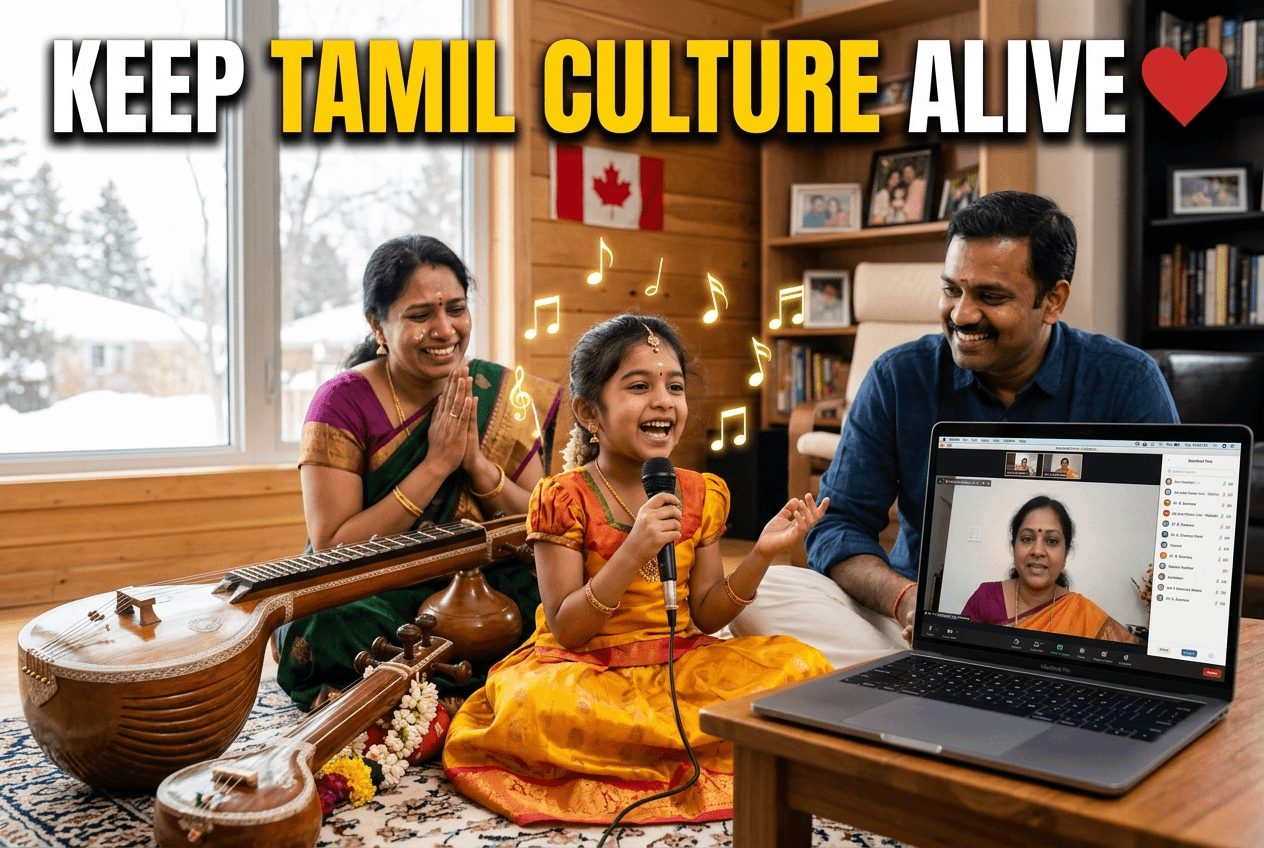
For Tamil and South Indian families across Canada, Carnatic music is far more than a hobby. It is woven into temple visits, weddings, festivals and family gatherings, a living thread of devotion, language and heritage carried from Tamil Nadu, Andhra Pradesh, Karnataka and Kerala to Toronto, Scarborough, Markham, Brampton and beyond. The challenge, far from the sabhas of Chennai, has always been access to a qualified guru. Online Carnatic classes have changed that completely, and this guide explains how Canadian families can keep this extraordinary tradition alive for the next generation.
Why Carnatic Music Matters to the Tamil Diaspora
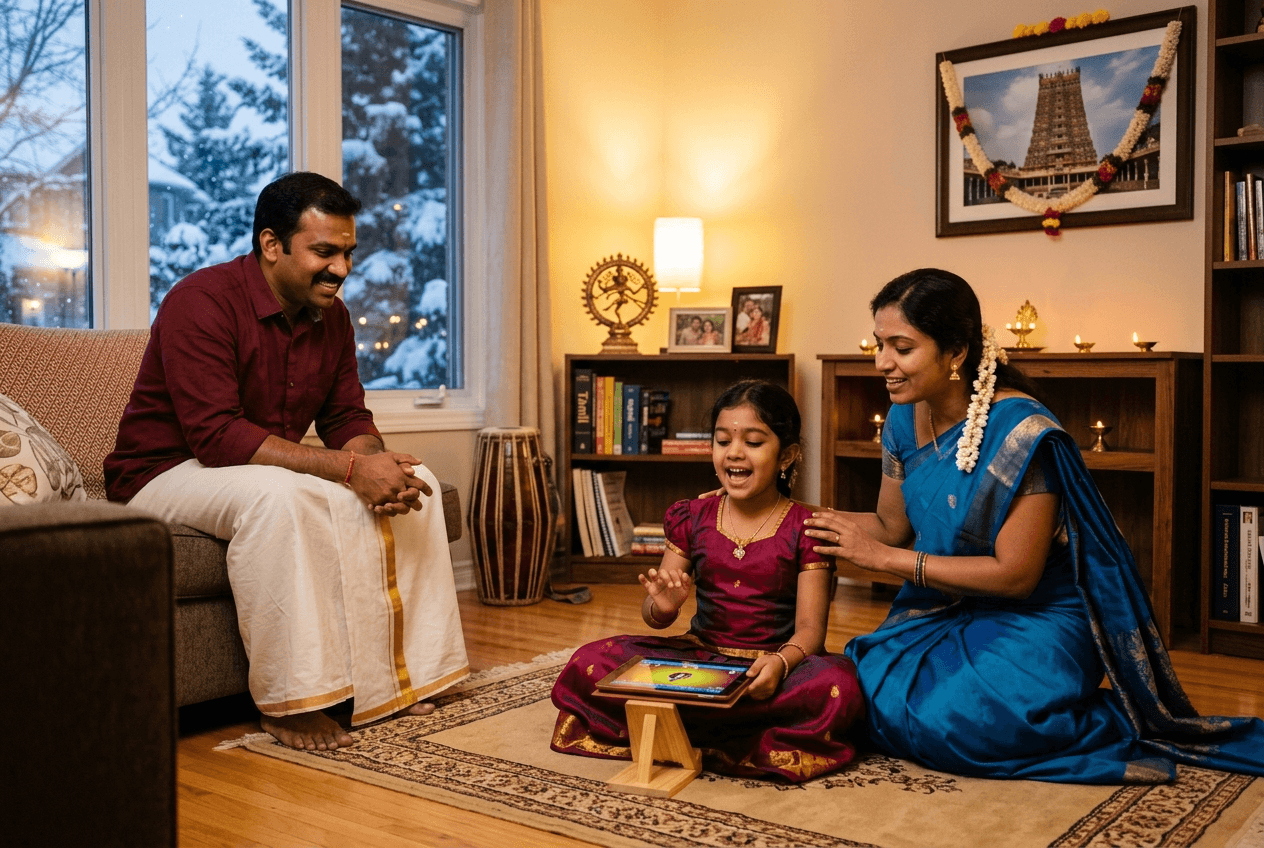 For South Indian families raising children in Canada, teaching Carnatic music is not only about melody. It is a cultural investment. The compositions, the kritis and varnams of the great composers, are steeped in devotion, mythology and the languages of home, Tamil, Telugu, Sanskrit and Kannada. Learning them gives a child a direct, personal link to a heritage that distance can otherwise loosen. Our Carnatic music for kids guide explores this cultural dimension in depth for parents weighing why it matters.
What Makes Carnatic Music Distinctive
Carnatic music, or Karnataka Sangeetham, is the classical tradition of South India, and it has its own character. It is highly structured and deeply devotional, with a strong emphasis on rhythm and on the gayaki, or singing, style, so that even instrumental music follows the voice. This sets it apart from the North Indian Hindustani tradition, which leans more toward slow improvisation. Our Carnatic vs Hindustani guide explains these differences clearly, which is helpful for families whose roots, or whose children's curiosity, span both worlds. Our overview of the types of Indian music places Carnatic music within the wider tradition.
How Carnatic Learning Is Structured
 Carnatic training follows a clear, time honoured progression that reassures parents. A student begins by fixing their sruti, the tonic pitch, and learning the swaras and the foundational sarali varisai exercises that build voice and accuracy. From there come alankarams, geethams, and eventually varnams and the kritis that form the heart of the repertoire. Improvisation, through alapana and kalpana swaram, comes later, once the foundation is secure. Live Carnatic vocal classes guide a student through this structure one careful step at a time, exactly as a traditional guru would.
Why Online Works So Well for Carnatic Families in Canada
Online learning solves the diaspora's oldest problem, the scarcity of qualified gurus nearby. A child in Ottawa or Calgary can now learn from an accomplished teacher with deep training and real diaspora experience, without a long drive or a compromise on quality. Lessons are scheduled across Canadian time zones rather than around India time, recordings allow revision, and the one to one format gives the close, personal attention that Carnatic music, with its subtle ornamentation, particularly rewards. For busy Canadian families, this flexibility is what makes consistent weekly learning genuinely sustainable.
Language, Pronunciation and Identity
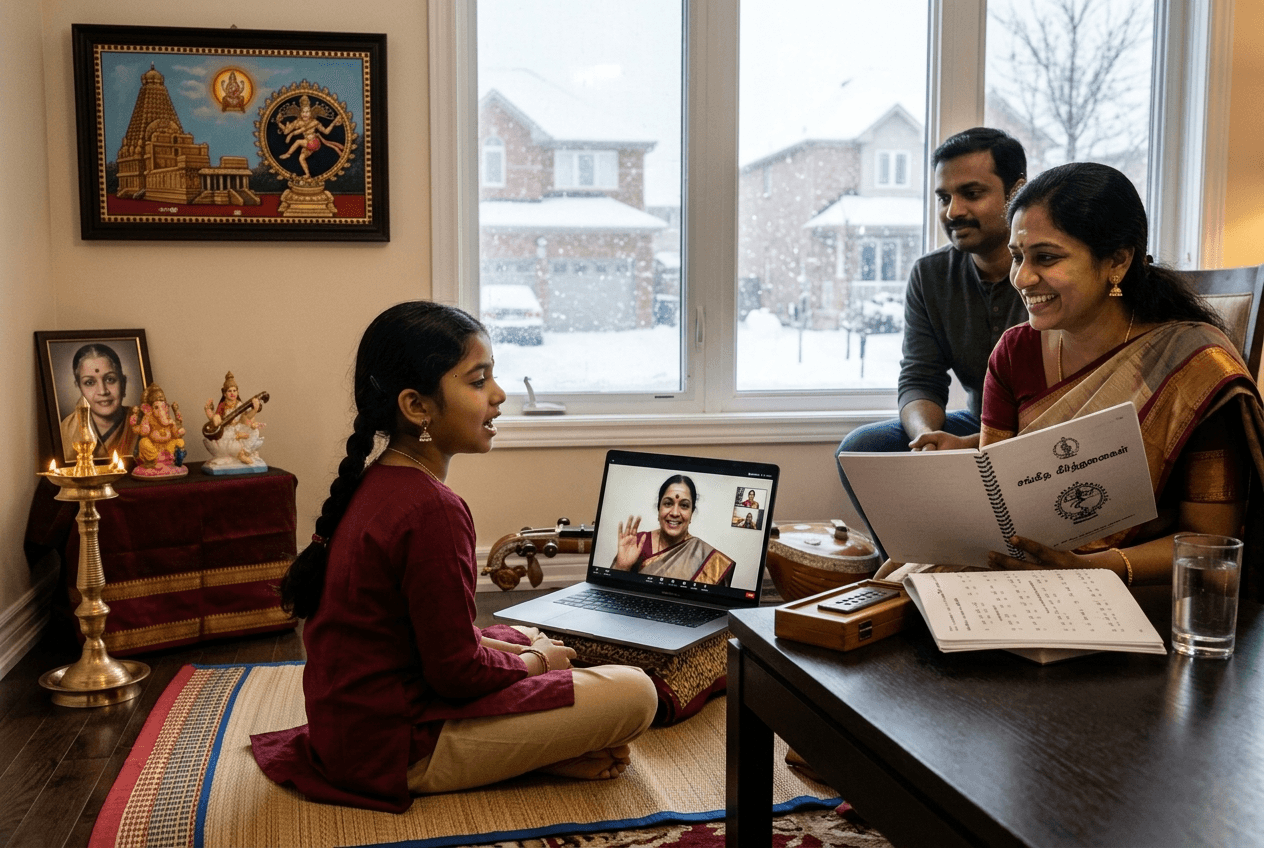 One of the quiet gifts of Carnatic training is language. Compositions are learned in their original Tamil, Telugu, Sanskrit and Kannada, which is both musically necessary and a rich cultural education. For children growing up speaking mainly English in Canada, singing these lyrics gently exercises sounds and pronunciations, including those rolling consonants, that everyday life abroad rarely demands. A skilled teacher explains concepts in English while preserving the authentic language of the songs, so a child gains both understanding and a deeper connection to their mother tongue.
One to One Versus Group Classes
Both formats have value, and the right choice depends on your family. Group classes offer a sense of community and shared motivation, while one to one lessons give undivided attention and adapt entirely to a child's pace and voice, which many parents find accelerates progress. For the subtle pitch work and ornamentation at the heart of Carnatic music, that personal feedback matters a great deal. Families whose heritage also touches the North sometimes pair Carnatic study with Hindustani vocal classes later on, though most begin firmly within their own tradition.
About Art Gharana
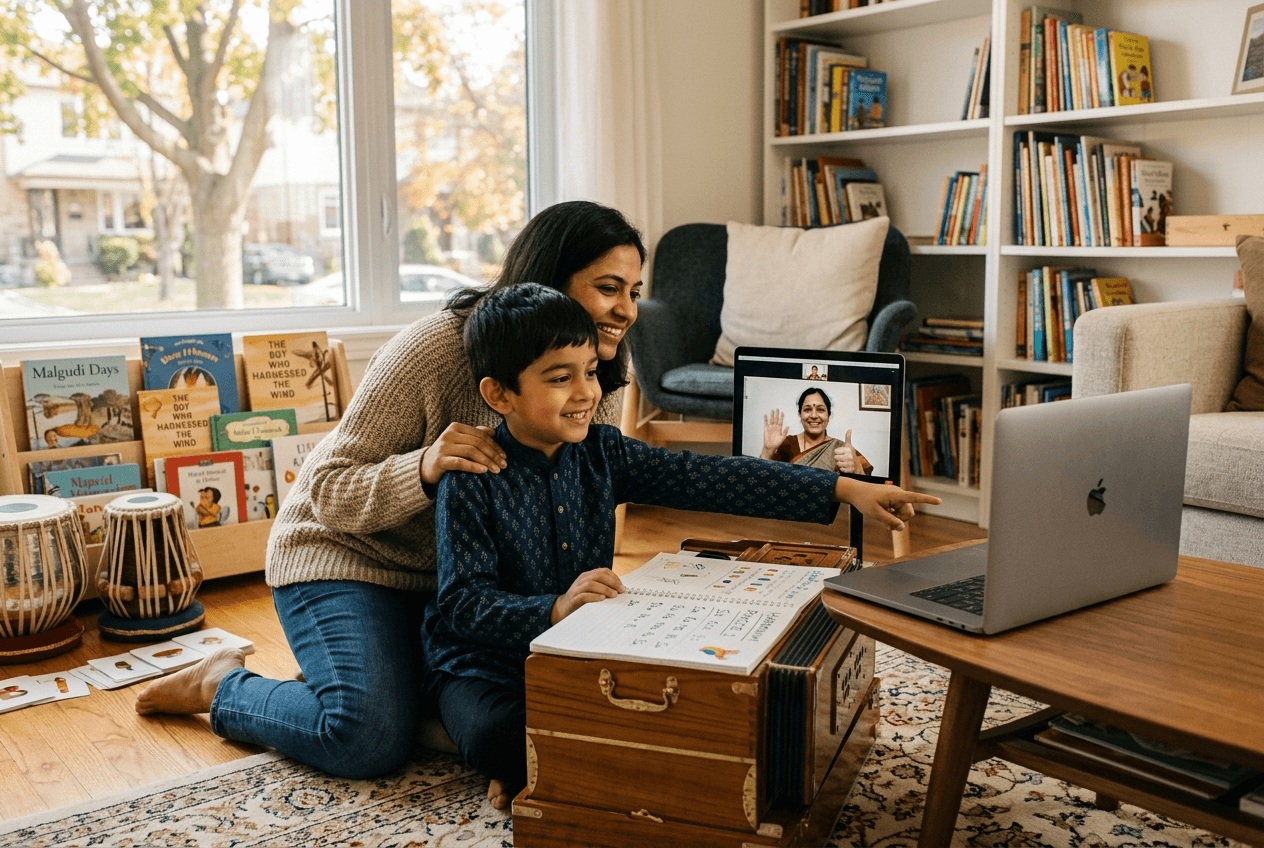 Art Gharana connects Tamil and South Indian families across Canada with certified Carnatic gurus for live one to one lessons, scheduled across all Canadian time zones and taught with genuine diaspora understanding. Review plans and pricing and book a free trial class to begin your child's Carnatic journey, or your own.
Frequently Asked Questions
1. Can my child learn Carnatic music online in Canada?
Yes. Live one to one online classes connect Canadian families with qualified gurus, teaching concepts in English while keeping compositions in their original Tamil, Telugu, Sanskrit and Kannada. Scheduling across Canadian time zones makes it sustainable.
2. What age should a child start Carnatic music?
Playful exposure can begin early, but structured Carnatic lessons usually suit children well from around five to seven, once they can fix a sruti and focus on short exercises. There is no upper age limit, and adults learn beautifully too.
3. Do we need any instruments to begin?
For vocal training, very little. A tanpura or sruti app provides the drone, and your teacher will help set the correct pitch for your child's voice in the first lesson. Otherwise, only a quiet space and a willingness to practise are needed.
The Cognitive and Emotional Benefits
Parents often begin for cultural reasons and stay for everything else Carnatic music brings. The tradition is famously demanding of memory, since students internalise many compositions and the movements of numerous ragas, which sharpens recall and concentration over years of practice. The rhythmic complexity of the tala system builds a keen sense of timing, while the breath control of singing supports calm and focus, almost in the manner of meditation. Many families notice that the discipline and patience their children develop in Carnatic lessons quietly carry over into schoolwork and daily life.
The Role of the Tanpura and Sruti
Central to Carnatic practice is the sruti, the chosen tonic pitch around which everything revolves, sounded continuously by the tanpura drone. Setting the correct sruti for a child's voice is one of the first things a teacher does, and singing the swaras against that steady drone trains the ear to hold pitch with precision. In the past this meant owning a physical tanpura, but today reliable apps provide a clear, adjustable drone on any phone or tablet, making daily home practice simple and accessible for Canadian families without specialist equipment.
Certification and Graded Learning
For families who value structure and recognition, Carnatic music offers established graded examinations through respected bodies, assessing students progressively from beginner levels through to advanced grades. These certificates carry real prestige within cultural competitions, temple events and community programmes, and they give a child clear milestones to work toward. Certification is never required to enjoy or benefit from Carnatic music, and many fine singers never sit an exam, but for goal oriented learners a graded path adds motivation and a sense of measurable progress along the journey.
Carnatic Music in Canadian Community Life
Canada is home to a large and vibrant Tamil and South Indian community, particularly across the Greater Toronto Area, and Carnatic music has a living place within it. Temple programmes, cultural associations, Thai Pongal and Navaratri celebrations, and community sabhas regularly welcome young performers, giving students real, encouraging stages on which to share what they have learned. For a child, performing a geetham or a simple kriti before a community audience is a moving milestone, and for parents it is a powerful affirmation that their heritage is being carried forward on Canadian soil.
Supporting Your Child's Practice at Home
You do not need to be a trained musician to support your child's Carnatic learning beautifully. What helps most is protecting a short, regular daily practice, setting up the tanpura app, and showing genuine interest in the compositions your child is learning. For parents who themselves grew up with Carnatic music, gently revisiting the basics alongside your child can be a joyful, bonding experience. Children mirror a parent's enthusiasm, so a household where this music is valued and shared, rather than merely scheduled, is where young learners truly flourish.
Carnatic Music for Adults and Returning Learners
This tradition is not only for children. Many Tamil and South Indian adults in Canada return to Carnatic music after years away, or take it up for the first time, drawn by heritage, devotion or simply the deep satisfaction of singing. The early exercises are designed to welcome genuine beginners, and adults often progress quickly thanks to years of informal listening and clear personal motivation. Whether you are a parent rediscovering the kritis of your childhood or a newcomer to the art, live one to one lessons meet you exactly where you are, at any age.
A Realistic Picture of Progress
Setting fair expectations helps families enjoy the journey. In the early months a beginner builds voice and accuracy through the foundational varisai exercises, with progress that is steady rather than dramatic, which is entirely normal for this carefully structured tradition. Over a year of consistent weekly lessons and short daily practice, a child grows comfortable with the basics and a small repertoire of geethams and simple kritis. Carnatic music rewards patience above all, and the depth a learner gains over years is precisely what makes it a lifelong art rather than a quick accomplishment.
The Instruments of Carnatic Music
While Carnatic music centres on the voice, it has a rich family of instruments, and some families choose an instrumental path or add one alongside vocal study. The violin, adapted beautifully to Indian music, is a mainstay, the veena is the ancient plucked string instrument of the tradition, and the mridangam provides its intricate rhythmic heartbeat. The flute, too, has a cherished place in Carnatic music, and flute classes offer a gentle, melodic way into the tradition for a child or adult drawn to a wind instrument rather than singing. A good teacher can advise which path suits a learner's temperament.
The Trinity and the Great Compositions
At the heart of the Carnatic repertoire stand the compositions of the revered Trinity, Tyagaraja, Muthuswami Dikshitar and Syama Sastri, whose kritis form much of what students aspire to sing. These works are not merely musical exercises but devotional poetry, rich with meaning, mythology and the languages of South India. As a student progresses from simple geethams toward these masterpieces, they step into a living tradition centuries deep. For diaspora families, learning even a single beloved kriti connects a child directly to the spiritual and artistic genius of their heritage, a connection that mere listening can never fully provide.
How a Typical Lesson Unfolds
Carnatic lessons follow a comforting, familiar rhythm. A session usually opens with the student settling their sruti against the tanpura drone and warming the voice through the foundational varisai exercises. The teacher then works on current material, refining a geetham, a varnam or a kriti phrase by phrase, correcting pitch, rhythm and ornamentation in real time. New material is introduced in small, learnable pieces, and the lesson often closes with guidance for the week's home practice. Because the format is live and one to one, every minute is shaped around the individual student, which is exactly what this detailed tradition requires.
Choosing the Right Guru for Your Family
The teacher matters more than any platform, and a few qualities are worth seeking. Look for genuine training and a clear lineage, real experience teaching children or beginners as well as performing, and a patient, encouraging manner that suits your child's personality. Diaspora awareness helps too, a teacher who understands the realities of raising children between cultures and can explain concepts in English while honouring the original languages. The surest way to judge fit is a trial lesson, watching how your child responds and how clearly and warmly the teacher communicates.
Balancing Carnatic Music With a Busy Canadian Schedule
Canadian children lead full lives, and parents understandably worry about adding another commitment. The reassuring truth is that Carnatic music does not demand huge blocks of time to progress. A single focused weekly lesson, supported by short daily practice of fifteen or twenty minutes with the tanpura app, fits comfortably around school and other activities and tends to improve focus and discipline elsewhere. The key, as with all music, is gentle consistency over intensity, a little and often, woven into the week rather than crammed in occasionally, which keeps both progress and enthusiasm alive.
The Devotional Heart of the Tradition
It is worth understanding that Carnatic music is, at its core, a devotional art. Most compositions are addressed to the divine, drawn from mythology and bhakti poetry, and the practice has long been considered a spiritual discipline as much as a musical one, akin in spirit to a form of yoga of sound. For many South Indian families, this devotional dimension is part of why the music matters so deeply, offering children not only artistic skill but a gentle, joyful connection to faith and philosophy. Even for less religious families, this depth lends the music a richness that purely secular forms can lack.
Final Thoughts
For Tamil and South Indian families in Canada, Carnatic music is a precious link to heritage, language and devotion, and it has never been more accessible. Live online lessons with a qualified guru remove the old barrier of distance, fit around Canadian schedules, and bring the rigour and beauty of the tradition into your living room. Whether for a curious child, a teenager building skill, or an adult reconnecting with their roots, the path begins the same gentle way, with a first lesson. Begun with patience and love, this is a gift that lasts a lifetime and beyond.
Sabha Culture and Group Performance
Carnatic music has always had a strong concert tradition, the sabha culture of South India, and something of that spirit lives on in the diaspora. Beyond solo learning, students benefit enormously from hearing and eventually performing within a community of fellow learners and rasikas, the devoted listeners who form the soul of Carnatic audiences. Canadian cultural associations and community concerts recreate this atmosphere, giving children a goal and a context for their practice. Experiencing the music as a shared, communal art, rather than a solitary lesson, deepens a child's appreciation and connects them to a tradition far larger than themselves.
The Patience the Tradition Asks, and Rewards
Carnatic music is not a tradition of quick wins, and it is worth setting that expectation warmly from the start. The foundational exercises can feel repetitive, and visible progress in the early stages is gradual rather than dramatic. Yet this very patience is part of the gift. The discipline of returning to the basics, of refining a single phrase until it is right, builds focus, perseverance and humility that serve a child far beyond music. Families who embrace the slow, steady nature of Carnatic learning, rather than chasing rapid results, find both deeper progress and a calmer, more rewarding journey.
Academic and Developmental Benefits
Research and long experience link music learning with stronger academic outcomes, and Carnatic music, with its particular demands, offers rich developmental rewards. The memorisation of compositions sharpens recall, the mathematics of the tala system nurtures pattern recognition and timing, and the discipline of regular practice cultivates focus and study habits that transfer directly to schoolwork. Add the language exposure of singing in Tamil, Telugu and Sanskrit, and the benefits multiply. Many Canadian parents observe that the qualities their children build through Carnatic training, concentration, patience and confidence, show up quietly in the classroom and beyond.
Keeping Motivation High Over the Years
Carnatic music is a long journey, and motivation naturally rises and falls along the way. The remedy is to keep the learning connected to joy and meaning, not only to exercises and exams. Performance opportunities at community events, listening together to great artists, celebrating the mastery of a beloved kriti, and connecting the music to family and festival life all keep enthusiasm alive. A thoughtful teacher weaves these moments into the curriculum, and parents who share in the music at home reinforce them. With encouragement rather than pressure, a child's early lessons can grow into a genuine, lifelong love of the art.
Why Begin Now
For families weighing whether this is the right time, the gentlest answer is that the best moment to begin is now. Children absorb music and language most readily when young, the cultural connection deepens with every year of practice, and the access that online learning provides has never been better. There is no need to wait for a perfect schedule or a nearby teacher, because a qualified guru is now only a screen away, across every Canadian time zone. A single free trial lesson is all it takes to see how your child responds and to begin a journey that can enrich their whole life.
The Joy of Singing Together as a Family
One of the quiet rewards of Carnatic music in a diaspora home is how it can become a shared family practice rather than a solitary lesson. Parents who grew up with the tradition often find deep joy in revisiting familiar kritis alongside their children, and even those new to it can sing the simple swaras together. A household where the tanpura drone hums in the background and family members hum a varisai becomes a place where heritage is lived, not just taught. These shared moments, more than any exam or certificate, are often what children remember most warmly in later years.
Addressing the Two Most Common Worries
Two worries hold many Canadian families back, and both deserve a gentle answer. The first is that without a South Indian musical environment nearby, a child cannot learn properly, when in truth a dedicated weekly lesson, daily practice and listening at home recreate that environment beautifully. The second is that the parents themselves do not know enough to help, when in fact no musical training is required of parents, only encouragement and the protection of a little practice time. Neither worry need stand in the way. With a qualified guru a screen away, the path is open to any committed family.