For many years, families in Manchester, Glasgow, Edinburgh and across the north of England and Scotland faced a frustrating reality: if they wanted their children to learn Bharatanatyam from a genuinely qualified classical teacher, they were at a significant disadvantage compared to families in London or Leicester. Specialist Indian dance teachers were concentrated in the south of England, and the cost and inconvenience of travelling for lessons was not practical for most families.
Live online Bharatanatyam classes have changed this entirely. Today, a family in Pollokshields in Glasgow, a family in Whalley Range in Manchester, or a family in Morningside in Edinburgh can access exactly the same quality of certified classical instruction as any family in London, without leaving home. This guide is written specifically for families in these cities who are exploring Bharatanatyam classes in Manchester, Glasgow and Edinburgh and want to understand what to expect and how to get started.
South Asian Communities in Manchester, Glasgow and Edinburgh
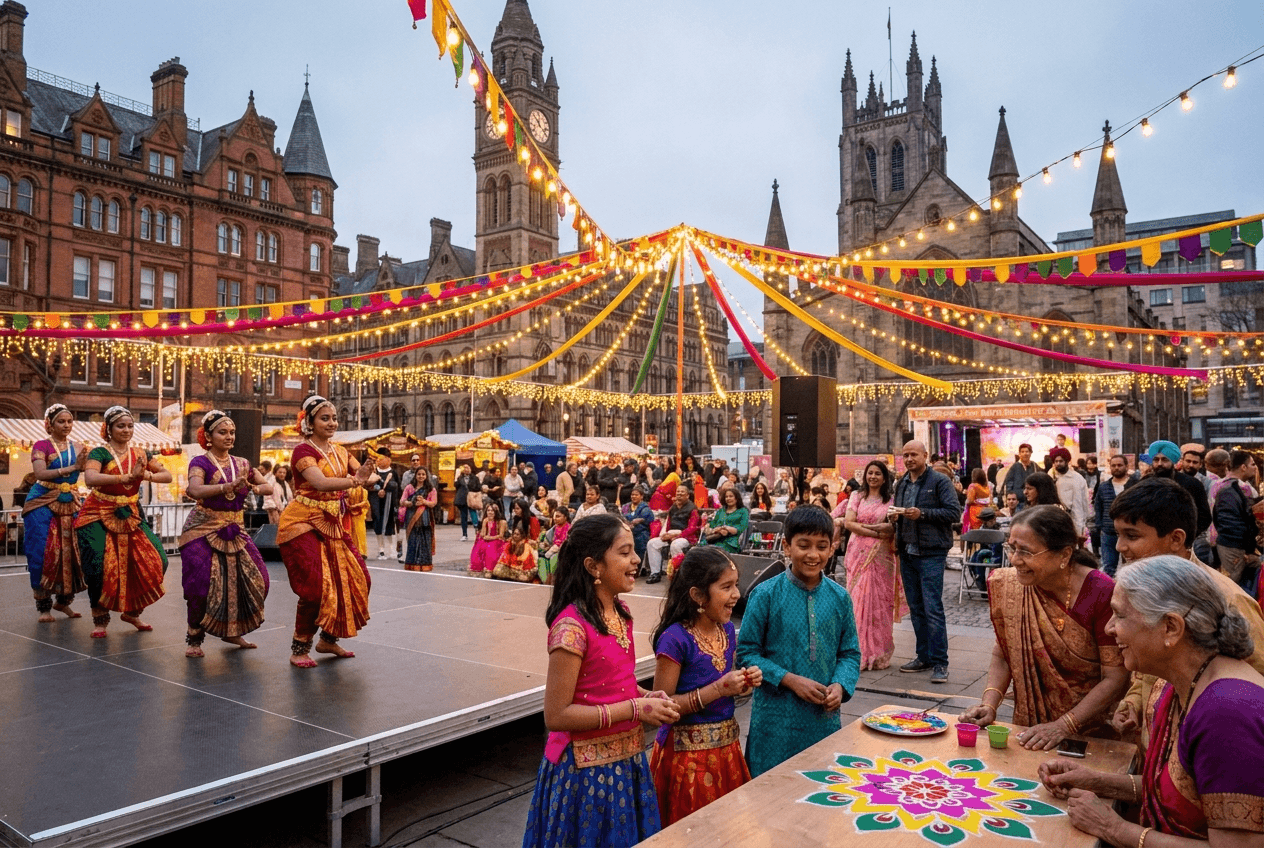 Manchester is home to one of the largest South Asian communities in northern England. Areas including Rusholme, Levenshulme, Whalley Range and Didsbury have well-established Indian communities, and the city's Tamil, Gujarati and Punjabi populations are among the most active in the north. Manchester's Diwali celebrations in Rusholme attract thousands of visitors each year, and the city's South Asian cultural organisations host events, classical music performances and community gatherings throughout the year.
Glasgow has one of the largest South Asian communities in Scotland, with significant populations in areas including Pollokshields, Govanhill and the south side more broadly. The city's temples and South Asian community organisations maintain a rich tradition of cultural events, and there is genuine and growing demand among Glasgow families for quality classical Indian arts education that their children can access from home.
Edinburgh's South Asian community is smaller but growing, with active Tamil and broader Indian populations in areas including Leith, Morningside and the south side of the city. The Edinburgh Festival brings Indian classical arts to a wider audience each year, and interest among Edinburgh families in providing children with structured classical arts training has been growing steadily.
Why Bharatanatyam Matters for Children in These Cities
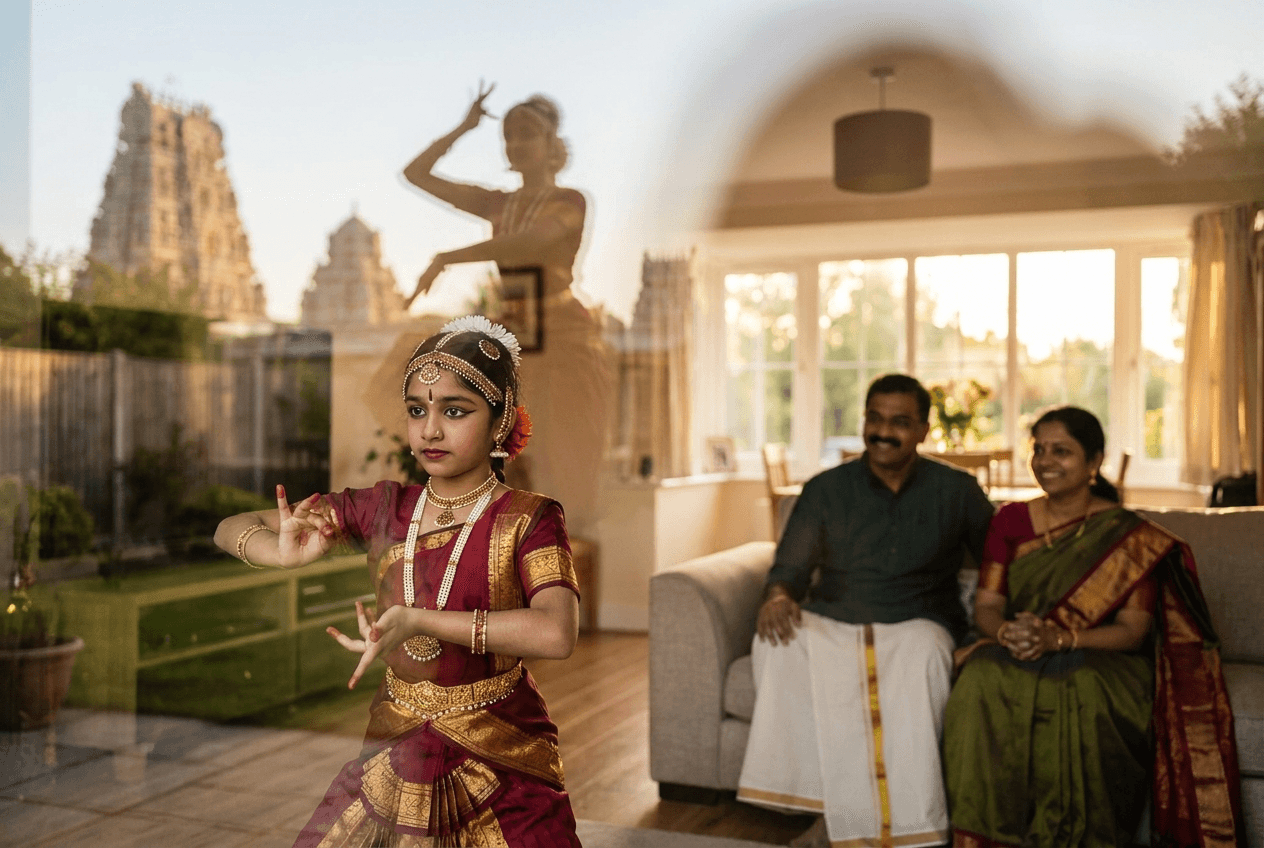 Bharatanatyam is not just a dance class. For South Indian children growing up in Manchester, Glasgow or Edinburgh, it is a direct and living connection to a cultural tradition stretching back thousands of years. In cities where Indian culture is a significant but minority presence, that connection matters enormously to the development of a child's sense of identity and belonging.
Children who learn Bharatanatyam do not just learn about South Indian tradition. They live it through the postures, the rhythms, the stories and the music that define one of humanity's great art forms. That embodied knowledge becomes a source of pride, confidence and identity that sustains children throughout their lives, particularly in the adolescent years when questions of identity become more pressing.
Beyond cultural connection, the physical and cognitive benefits of Bharatanatyam training are substantial. The demanding physical training develops strength, flexibility, coordination and stamina. The memorisation demands build focus and memory. The expressive abhinaya component develops emotional intelligence and empathy. These benefits are available to children across all cultural backgrounds, and many Art Gharana students in these cities come from non-South-Indian families who are simply drawn to the artistry and discipline of the form.
Bharatanatyam Classes in Manchester
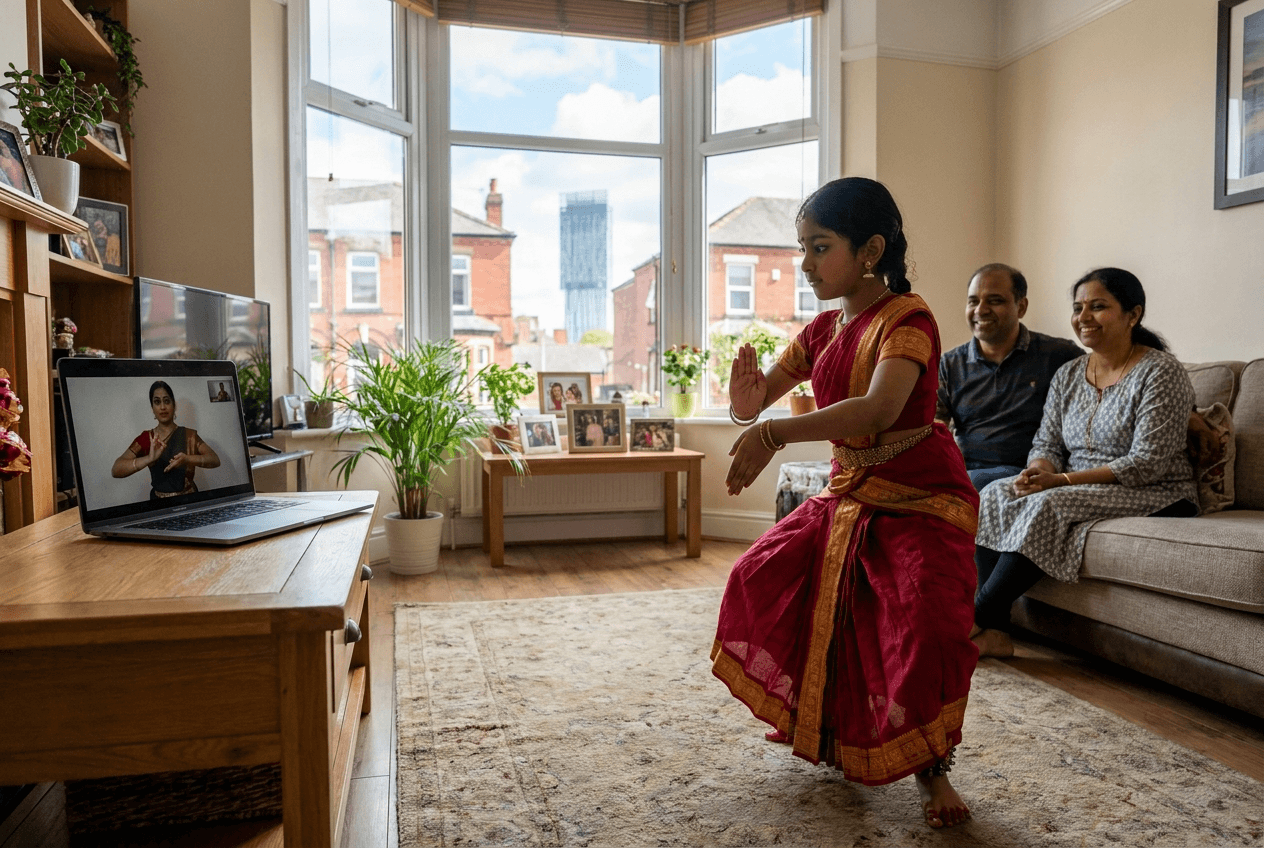 Manchester's South Asian community provides a rich context for Bharatanatyam training. Children who study the form have regular opportunities to perform at Diwali celebrations, temple events and multicultural school events throughout the year. Art Gharana's Manchester students attend live sessions with certified teachers from home, with one to one instruction and fully flexible scheduling across UK time zones.
For Manchester families, the online format resolves the practical barriers that have historically prevented many children from accessing quality classical dance training: the difficulty of finding a qualified local teacher, the time and cost of travel to studios, and the inflexibility of fixed class timetables. Art Gharana's live online programme removes all three barriers entirely.
Bharatanatyam Classes in Glasgow
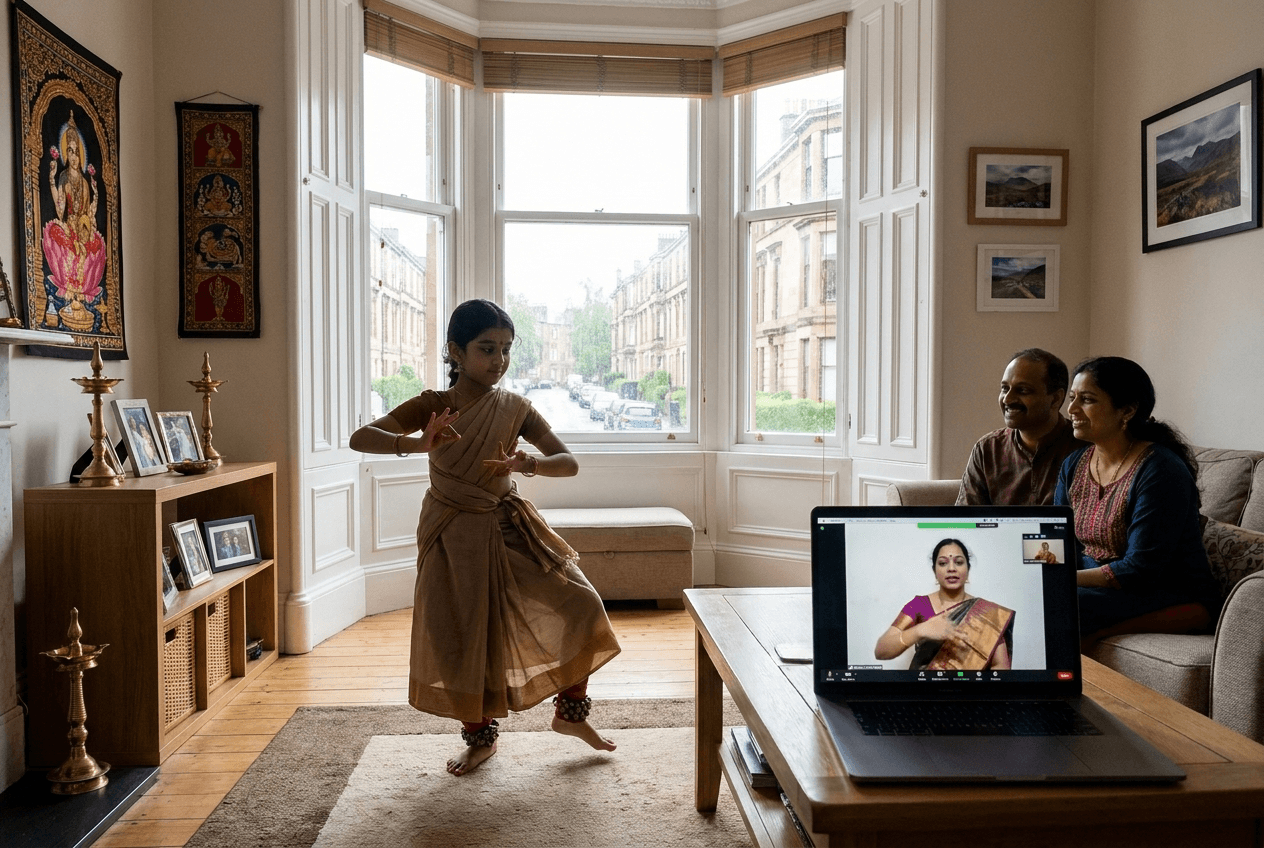 Glasgow's Pollokshields and Govanhill areas have vibrant South Indian communities, with active Tamil associations and temples that host cultural events throughout the year. For Glasgow families, Art Gharana's online Bharatanatyam programme provides access to certified teachers with genuine classical training, something that local provision in Glasgow has historically struggled to offer at the level of depth that serious classical training requires.
Glasgow students attend live online sessions with their teacher at times that fit around Scottish school hours and family life. Morning, evening and weekend slots are all available. The one to one format means every session is focused entirely on your child, and the teacher builds a genuine understanding of each student's strengths, challenges and pace of development over time.
Bharatanatyam Classes in Edinburgh
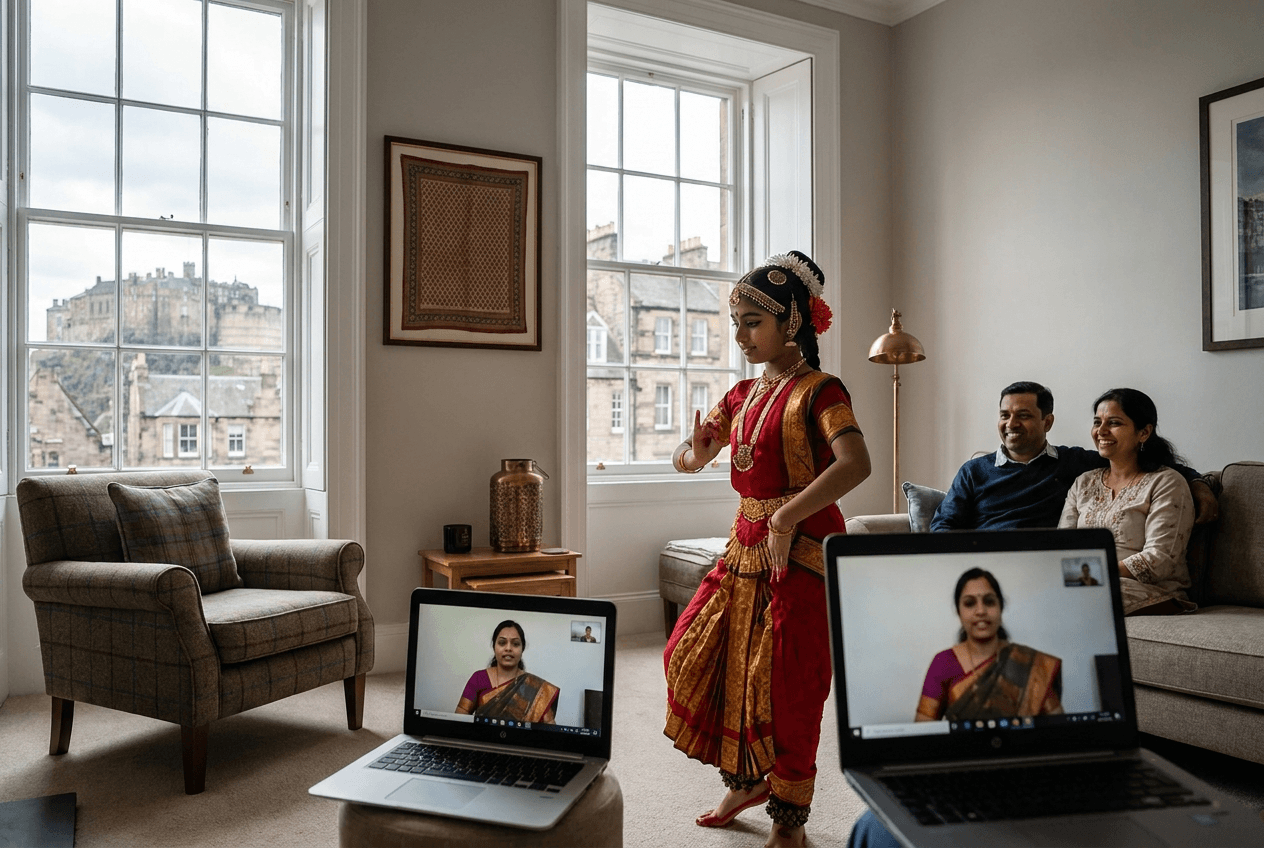 Edinburgh's growing South Asian community is increasingly looking for quality Indian classical arts education for children that goes beyond what is sporadically available through local community events. Art Gharana's live online programme gives Edinburgh families access to a level of Bharatanatyam instruction that would otherwise require significant travel or simply not be available at all.
For Edinburgh families, the online format is particularly valuable because it accommodates the realities of Scottish school and family schedules without requiring any compromise on the quality or depth of instruction. Your child learns from a certified classical teacher in a live, one to one environment, just as they would in the best dance academy in London, from your living room in Edinburgh.
What Your Child Will Learn
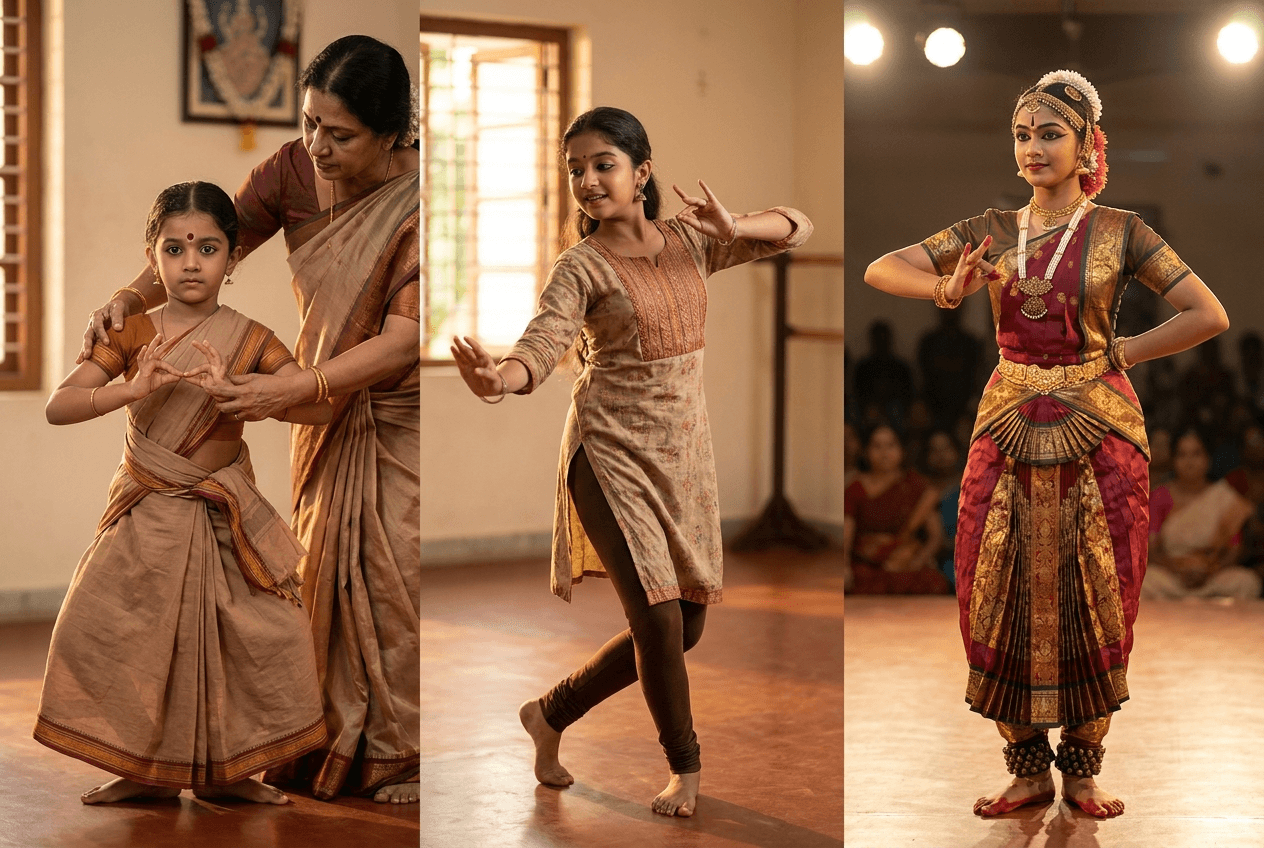
Foundation Stage, Ages 5 to 8
Students begin with the fundamental postures and movements of Bharatanatyam. The basic standing position, the aramandi bent-knee stance, the primary hand gestures and introductory adavu footwork patterns form the foundation of all subsequent training. Students develop an ear for Carnatic music and learn to recognise and move within simple rhythmic cycles. The first compositional item, the alarippu, is introduced once postural fundamentals are established.
Intermediate Stage, Ages 8 to 12
Students expand their adavu vocabulary, learn more complex compositional pieces and begin systematic abhinaya training, learning to tell stories from Indian mythology through facial expression and hand gesture with conviction and expressiveness. Physical stamina develops progressively through more demanding choreography and longer practice sessions.
Advanced Stage and Arangetram
Advanced students work towards the full performance margam and, in many cases, towards their arangetram, the formal debut solo performance. Art Gharana teachers guide students through every aspect of arangetram preparation, from repertoire selection and choreography to costume, jewellery and stage presentation.
Bharatanatyam and Carnatic Music
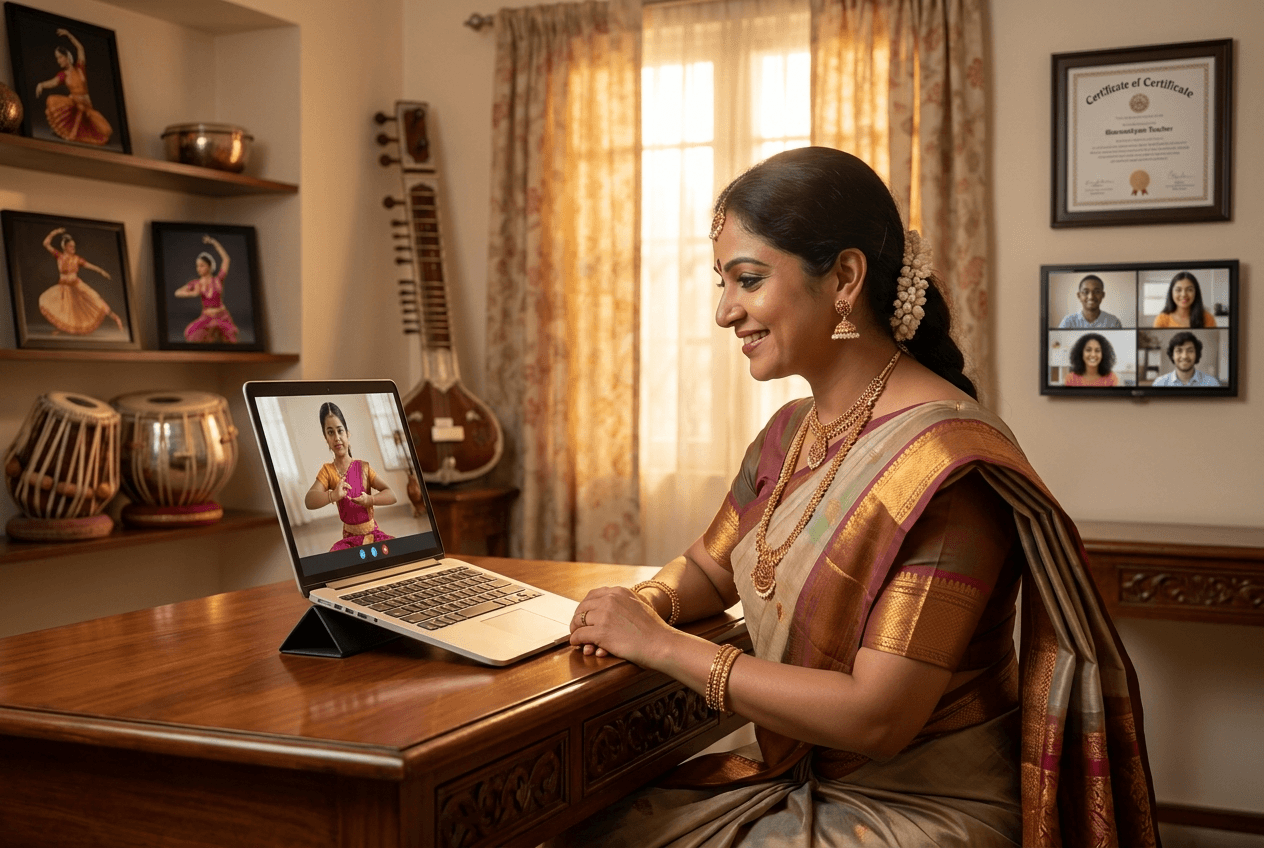 Bharatanatyam and Carnatic music are deeply intertwined, and many serious Bharatanatyam students choose to study both simultaneously. Understanding the Carnatic musical pieces they are dancing to, from the inside as singers rather than just listeners, transforms the quality of a dancer's performance. Art Gharana's Carnatic vocal classes are available in the same UK-friendly online format and pair naturally with Bharatanatyam training.
For families who want to explore a wider range of Indian arts, our Kathak classes and Bollywood dance classes are equally available to families across the north of England and Scotland. Our tabla classes also pair well with any dance training. You can explore our full range of courses to see everything available.
About Art Gharana
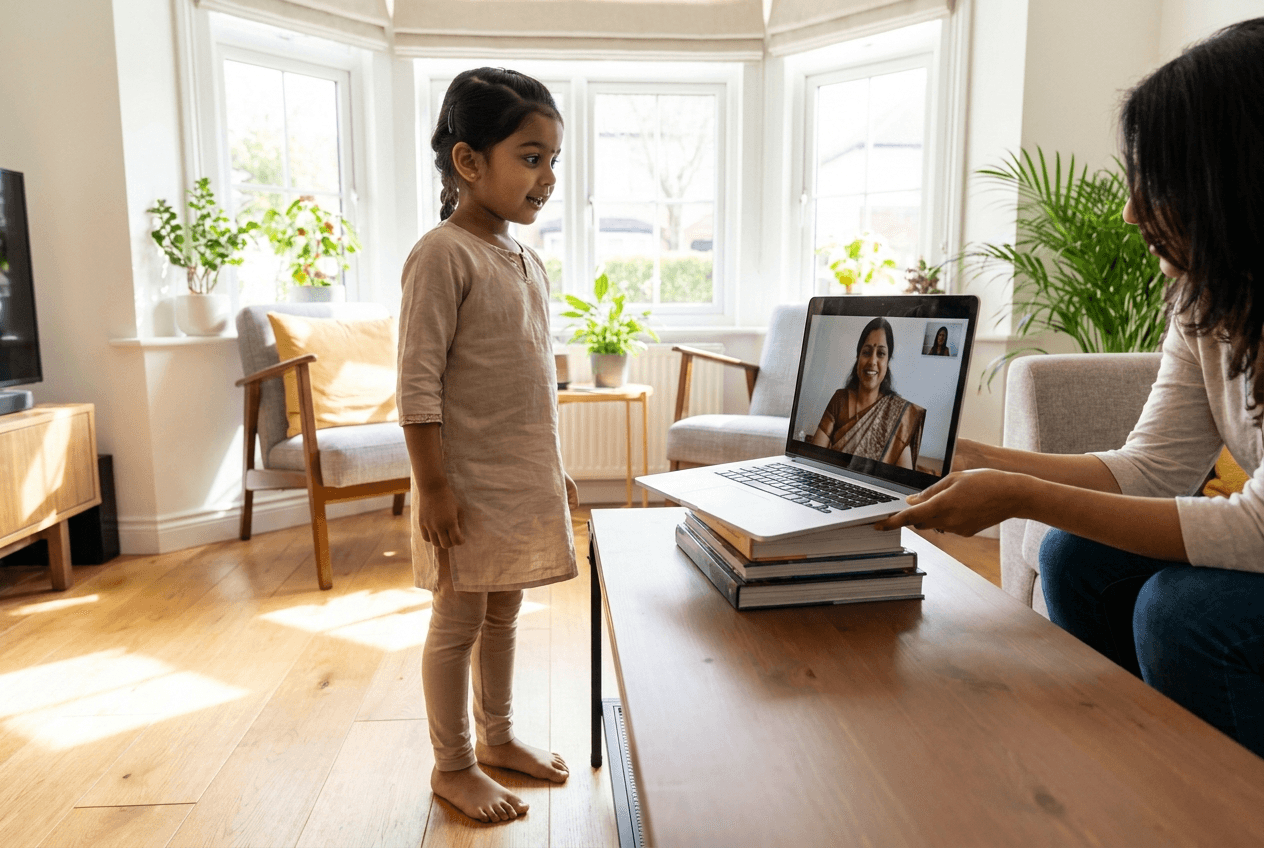 Art Gharana is a specialist online Indian arts education platform with over 50 certified teachers across dance, music and vocal disciplines. We serve South Indian and all Indian families across the UK, USA, Canada, Australia and India. Our Bharatanatyam programme delivers classical training in a live, one to one online format with UK-friendly scheduling and a completely free first lesson. Browse our our teacher profiles page to meet our teachers, and review our plans and pricing to choose the right plan for your family.
Setting Up for Your Child's First Bharatanatyam Class
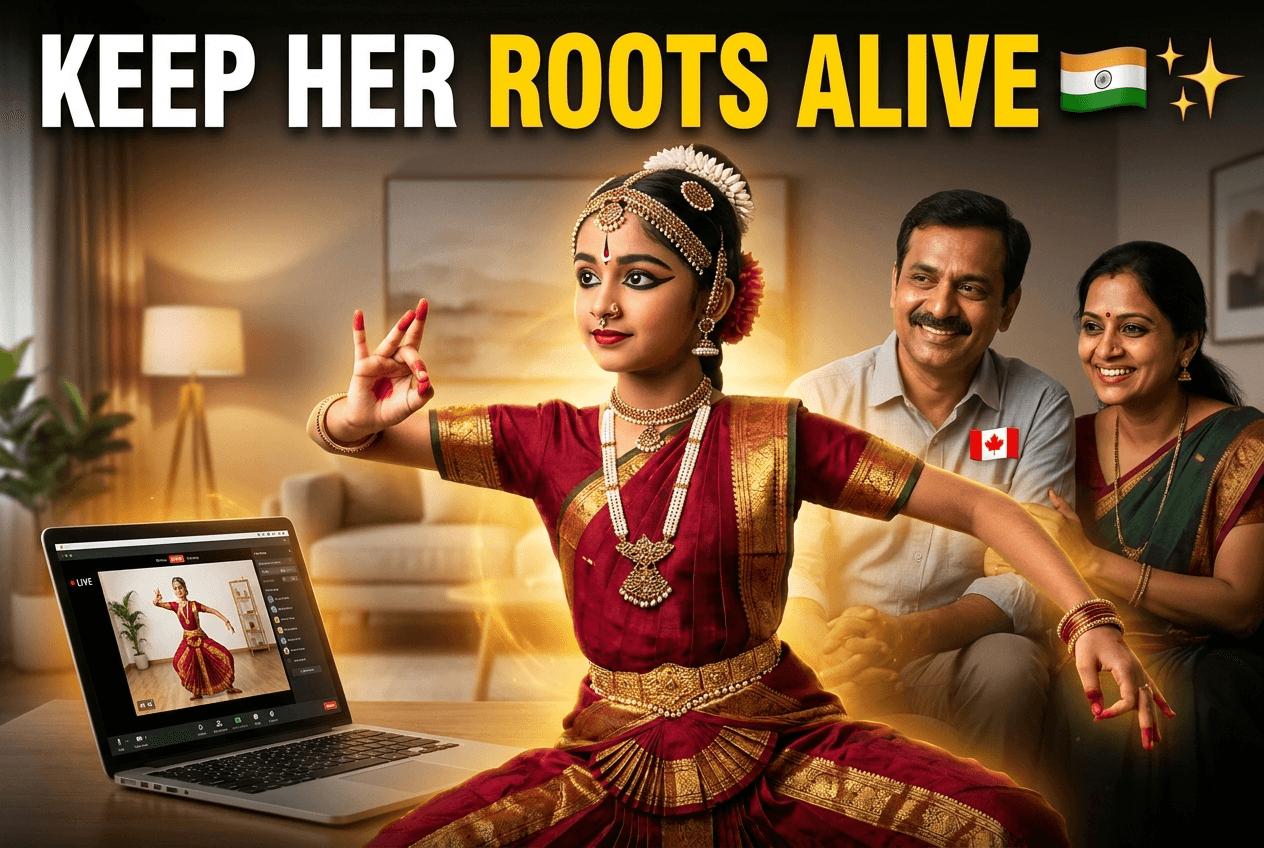
Preparing for a first Bharatanatyam class at home is straightforward. Clear enough floor space for your child to move their arms and legs freely in all directions without obstruction. Position your device so the teacher has a full-body view of your child from head to toe. Use a quiet room with good lighting, ideally without strong backlighting that would make it difficult for the teacher to see your child's facial expressions and hand positions. Dress your child in comfortable, loose-fitting clothing that allows free movement. Bare feet are standard for Bharatanatyam training.
Spend a few minutes before the class talking to your child about what to expect. Let them know that the first session is about meeting their teacher and trying some basic postures and movements. There is no pressure to perform. Curiosity and openness are the only requirements.
Performing in Manchester, Glasgow and Edinburgh
One of the most meaningful things a child can do with their Bharatanatyam training is perform in front of their community. For families in Manchester, Glasgow and Edinburgh, this means Diwali celebrations, temple events, school multicultural shows and community gatherings throughout the year. Children who have trained consistently for a year or more are typically ready to perform a short piece in a community setting, and the experience of standing in front of an audience and delivering something they have worked hard to prepare is genuinely transformative.
Art Gharana teachers actively support their students' performance aspirations. If your child is preparing for a specific performance at a community event in Manchester, Glasgow or Edinburgh, their teacher can help them prepare an appropriate piece, advise on costume and presentation, and guide them through the performance preparation process. This kind of individualised support for real-world performance goals is only possible in the one to one format that Art Gharana provides.
How Online Instruction Has Transformed Classical Arts Access in Scotland and the North
Before the widespread adoption of live online instruction, the quality of Indian classical arts education available to families in Manchester, Glasgow and Edinburgh was inconsistent at best and non-existent at worst. The handful of qualified classical teachers available in these cities were often in high demand with long waiting lists, and their teaching could be difficult to access for families in areas outside the immediate city centre.
The live online format has changed this picture completely. A family in a small town outside Manchester, a family in a rural area of Scotland, a family in a suburb of Edinburgh with no local Indian dance provision at all, all have the same access to the same certified, qualified teachers that families in central London have. The democratisation of access to classical arts education that online instruction has made possible is one of the most significant developments in Indian arts education in the UK in a generation.
Art Gharana was built specifically to serve this need. Our platform exists to make it possible for Indian families anywhere in the UK to give their children access to genuine, high-quality classical arts education from certified teachers who understand both the art form and the cultural significance it carries for diaspora families. For families in Manchester, Glasgow and Edinburgh, that mission is as relevant today as it has ever been.
What Happens If You Miss a Class
Life with children is unpredictable, and missed classes are a reality for every family. Art Gharana's rescheduling policy is designed to accommodate this reality without penalising families for the unavoidable disruptions of everyday life. If your child is unwell or a family commitment arises, you can reschedule your class through the Art Gharana platform at no extra cost, subject to teacher availability.
The one-to-one format means that a missed class is a genuinely missed learning opportunity, which is why we encourage families to maintain as consistent an attendance as possible. However, the flexibility of scheduling across UK time zones means that if your regular slot does not work in a particular week, an alternative slot can usually be found. This flexibility is one of the practical advantages of the online format that families in Manchester, Glasgow and Edinburgh particularly value.
Preparing Your Child for Their First Class
Talking to your child before their first Bharatanatyam class makes a significant difference to how they approach it. Explain what they will be doing in simple terms. Tell them they will be meeting their teacher over a video call and learning some special Indian dance poses and movements. Show them a short video of Bharatanatyam performance so they have a visual idea of where the training leads. And reassure them that the first class is just about getting to know the teacher and having fun with some basic movements. There is no pressure to be good at anything immediately.
Children who arrive at their first class with some curiosity and some sense of what Bharatanatyam looks like typically engage much more readily than those who arrive with no context at all. The teacher will take it from there, and most children come away from their first class genuinely excited about what they have experienced and eager to try again next week.
Frequently Asked Questions
1. Are there online Bharatanatyam classes for families in Manchester?
Yes. Art Gharana provides live online Bharatanatyam classes for families in Manchester and across the north of England, with all classes available in UK time zones including evening and weekend slots.
2. Can families in Scotland access online Bharatanatyam classes?
Absolutely. Art Gharana serves students across Scotland including Glasgow, Edinburgh, Dundee and Aberdeen. All classes are fully online and scheduled in UK time zones, so geography within the UK makes no difference to the quality or availability of instruction.
3. What age can my child start Bharatanatyam?
Children can begin from age 5. Our beginner curriculum is designed to be fun, gentle and age-appropriate for young learners who have had no prior dance experience.
4. Do I need to be South Indian to enrol my child in Bharatanatyam?
No. Bharatanatyam is open to children from all cultural backgrounds. Many Art Gharana students in Glasgow, Edinburgh and Manchester come from non-South-Indian and non-Indian families who are drawn to the artistry, discipline and cultural richness of the classical form.
5. How are the online classes delivered?
All Art Gharana Bharatanatyam classes are live, one to one video sessions of 45 minutes. The teacher and student connect face to face at the scheduled time, with real-time instruction, demonstrations and corrections throughout.
Book Your Child's Free Trial Class Today
Whether your family is in Manchester, Glasgow, Edinburgh or anywhere else across the north of England and Scotland, Art Gharana is ready to welcome your child into the world of Bharatanatyam. With certified teachers, flexible UK scheduling, a structured curriculum and a completely free first lesson, there is no better time to begin. Head to our book a free trial class page to reserve your child's first session today.
Preparing Your Child for Their First Class
Talking to your child before their first Bharatanatyam class makes a meaningful difference to how they approach it. Explain in simple terms that they will be meeting a teacher over a video call and learning some special Indian dance postures and movements. Show them a short Bharatanatyam performance video online so they have a vivid sense of what the training looks like at a more advanced stage and where the journey leads. Then reassure them that the first class is simply about getting to know their teacher and trying some basic movements together. There is no pressure whatsoever to be good at anything immediately. Curiosity and openness are the only requirements, and those most children bring naturally to a first class.