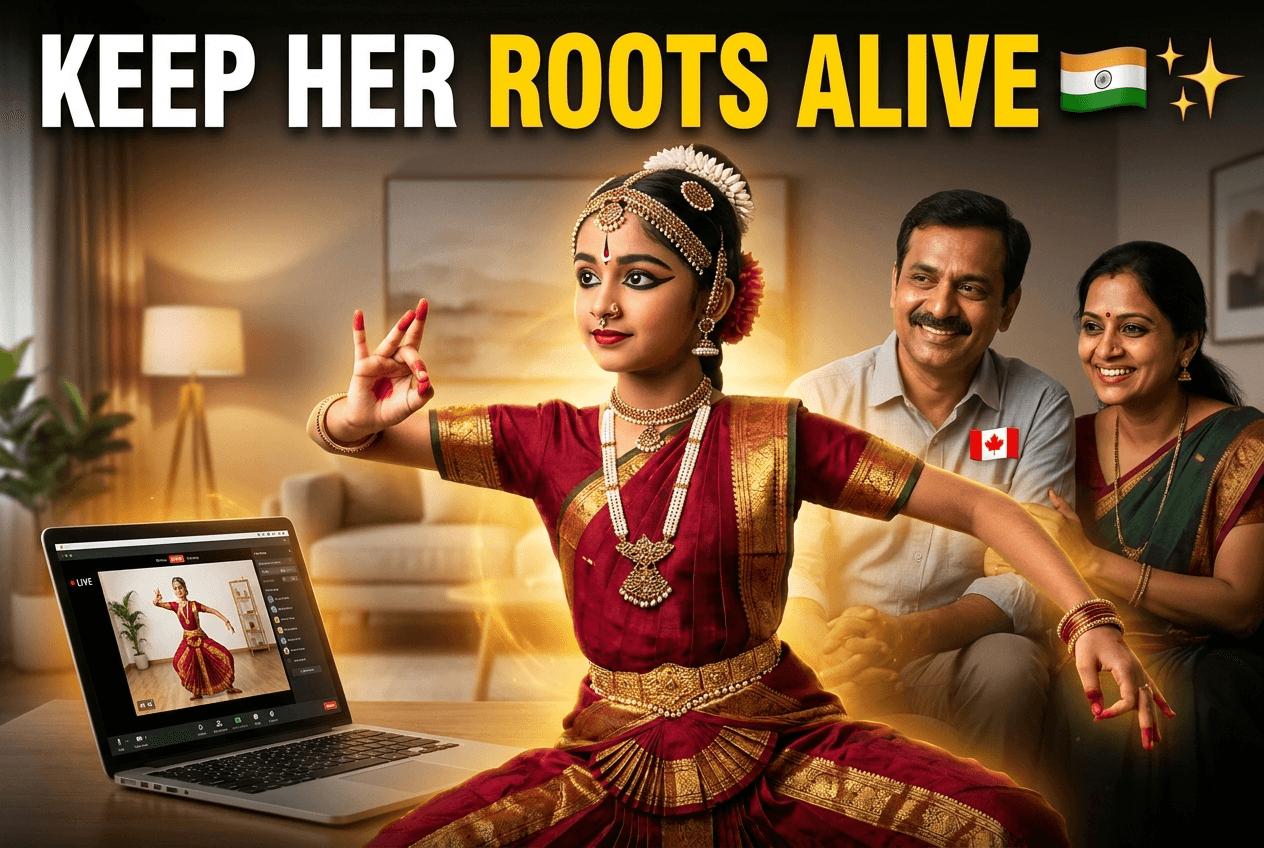
Bharatanatyam is the classical dance of South India and one of the most extraordinary performing arts traditions in the world. For Tamil, Telugu, Kannada and Malayalam families across Canada, from the vibrant South Indian communities of Scarborough, Markham and Mississauga in the GTA to the Tamil families of Vancouver, Ottawa, Calgary and Montreal, Bharatanatyam training is one of the most meaningful cultural investments a family can make. It connects children to a devotional tradition thousands of years old, develops extraordinary physical and cognitive capabilities, and provides a living cultural identity that sustains children through the challenges of growing up between two cultures in Canada. Finding a genuinely qualified Bharatanatyam teacher in Canada has historically been difficult. IndianNatya, the most prominent online provider serving Canada, restricts its classes to female students only. Local in-person teachers in the GTA vary widely in classical training. For families outside the GTA and Vancouver, instruction is essentially unavailable. Art Gharana's live online programme connects Canadian families with certified Bharatanatyam classes in Canada delivered in Canadian time zones, open to all students regardless of gender.
South Indian Communities Across Canada
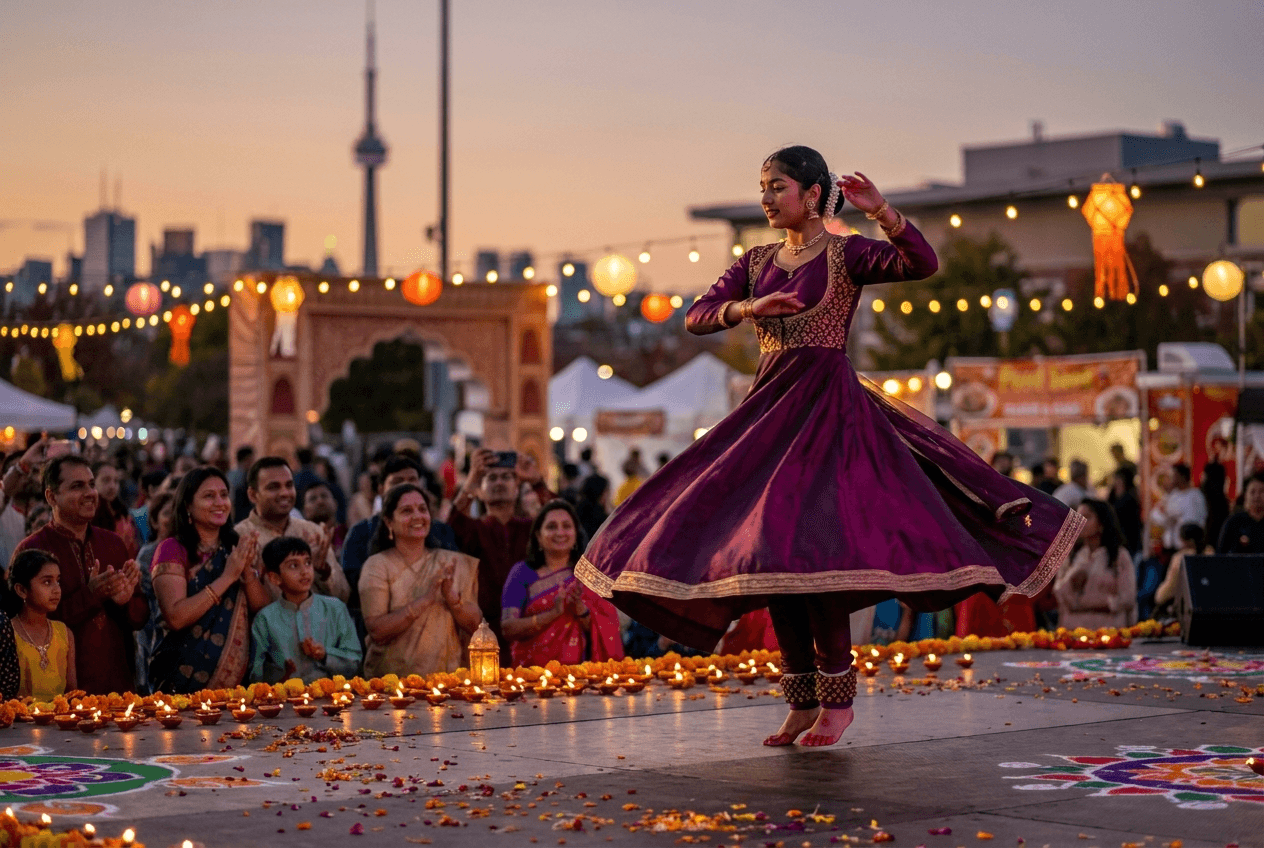
Greater Toronto Area: Scarborough, Markham, Brampton
The GTA's Tamil and South Indian communities are among the largest in the world outside of South India itself. Scarborough's Tamil community, one of the largest Tamil diaspora concentrations anywhere, is home to multiple South Indian temples, cultural organisations and community events. The Sri Murugan Temple in Scarborough, the Arasadi Vinayagar Temple in North York and dozens of other temples host regular Bharatanatyam performances, arangetrams and cultural events throughout the year. For families in this community, quality Bharatanatyam training is a cultural priority, and the range of truly qualified classical teachers available locally is limited.
Vancouver and the Lower Mainland
Vancouver's South Asian community includes significant Tamil and South Indian populations in Surrey, Burnaby and Richmond. Most local Bharatanatyam instruction available in Vancouver is adult-oriented or part-time, and the range of certified classical teachers is more limited than in the GTA. Art Gharana's Pacific Time Zone scheduling serves the entire Lower Mainland with live one-to-one classes.
Calgary, Edmonton and Nationwide
For Tamil and South Indian families in Calgary, Edmonton, Ottawa, Winnipeg and across Atlantic Canada, local Bharatanatyam instruction at a children's level with certified classical training is essentially unavailable. Art Gharana's nationwide online programme serves all of these families with the same quality of live one-to-one instruction available to GTA families.
What Bharatanatyam Means for South Indian Canadian Children
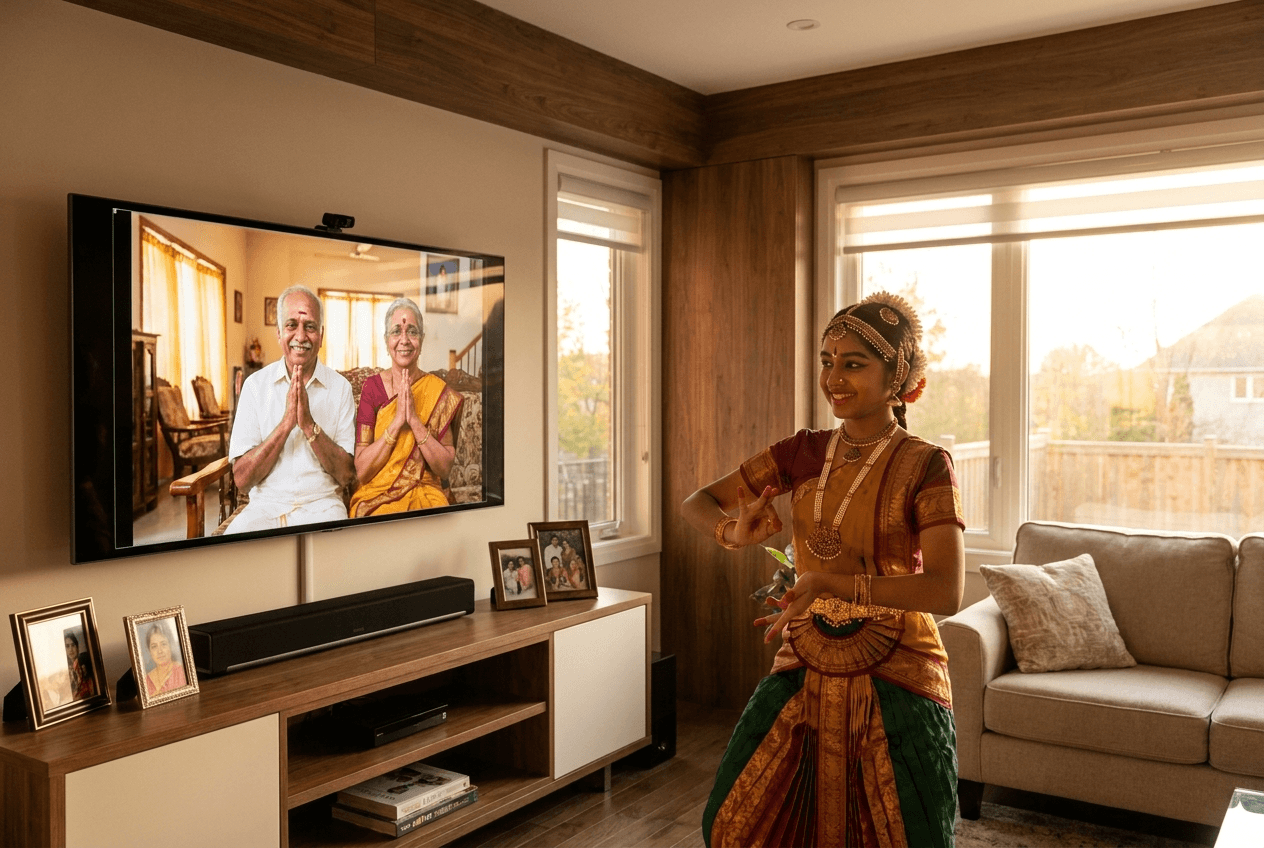 For Tamil and South Indian children growing up in Canadian cities, Bharatanatyam provides something that no Canadian school curriculum or extracurricular activity can replicate: a direct, physical, embodied connection to a cultural tradition that their grandparents and great-grandparents inhabited. The postures, the rhythms, the stories told through hand gesture and facial expression, the devotional Carnatic compositions that the dance is set to, all of these connect a child in Scarborough or Calgary to an aesthetic and spiritual tradition that stretches back thousands of years in the temples of Tamil Nadu.
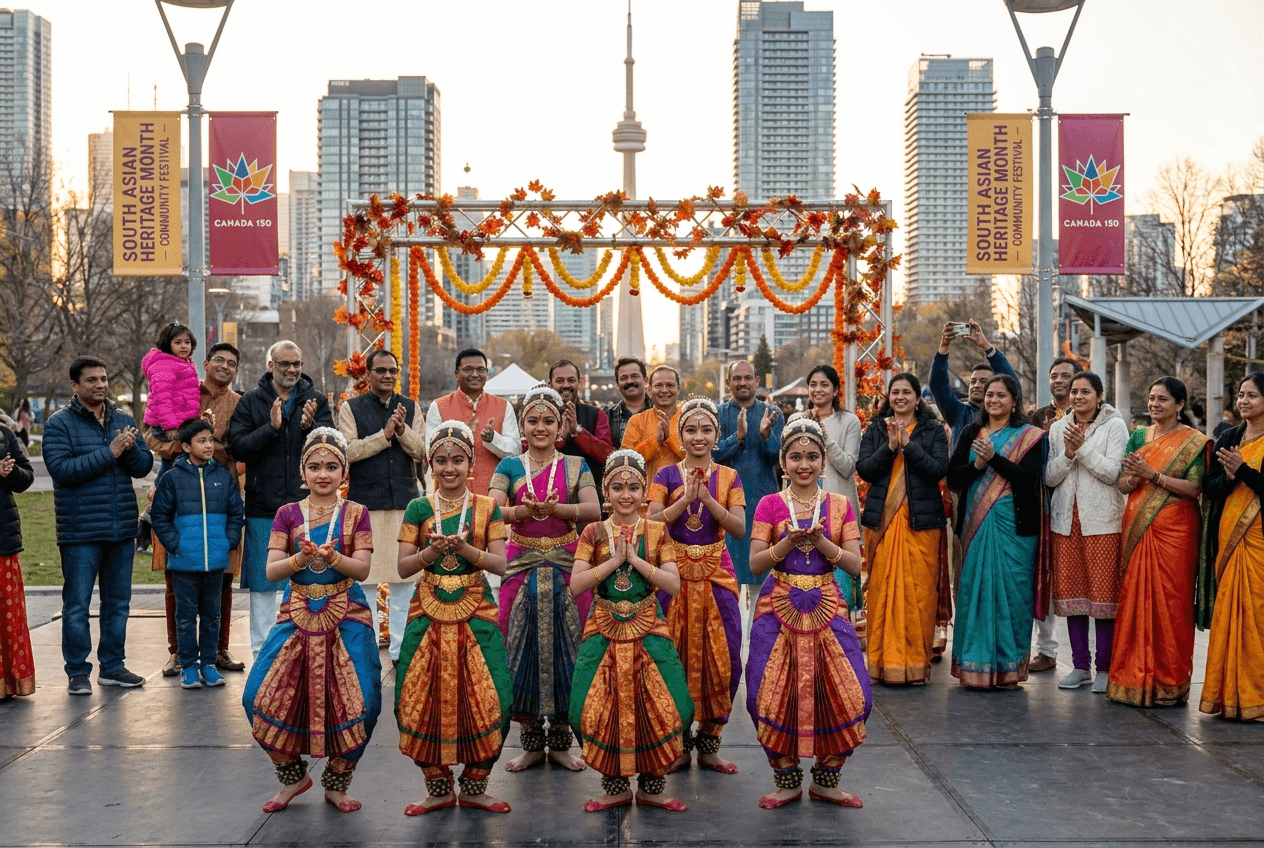
In Canada's multicultural context, this cultural connection is publicly celebrated as well as privately significant. Bharatanatyam performances at school multicultural events, at community temple festivals and at the many South Asian cultural events across Canada are met with genuine admiration and interest from audiences of all backgrounds. A child who can perform Bharatanatyam is contributing something beautiful and impressive to the shared cultural life of their school and community.
The Physical and Cognitive Benefits of Bharatanatyam
Extraordinary Physical Development
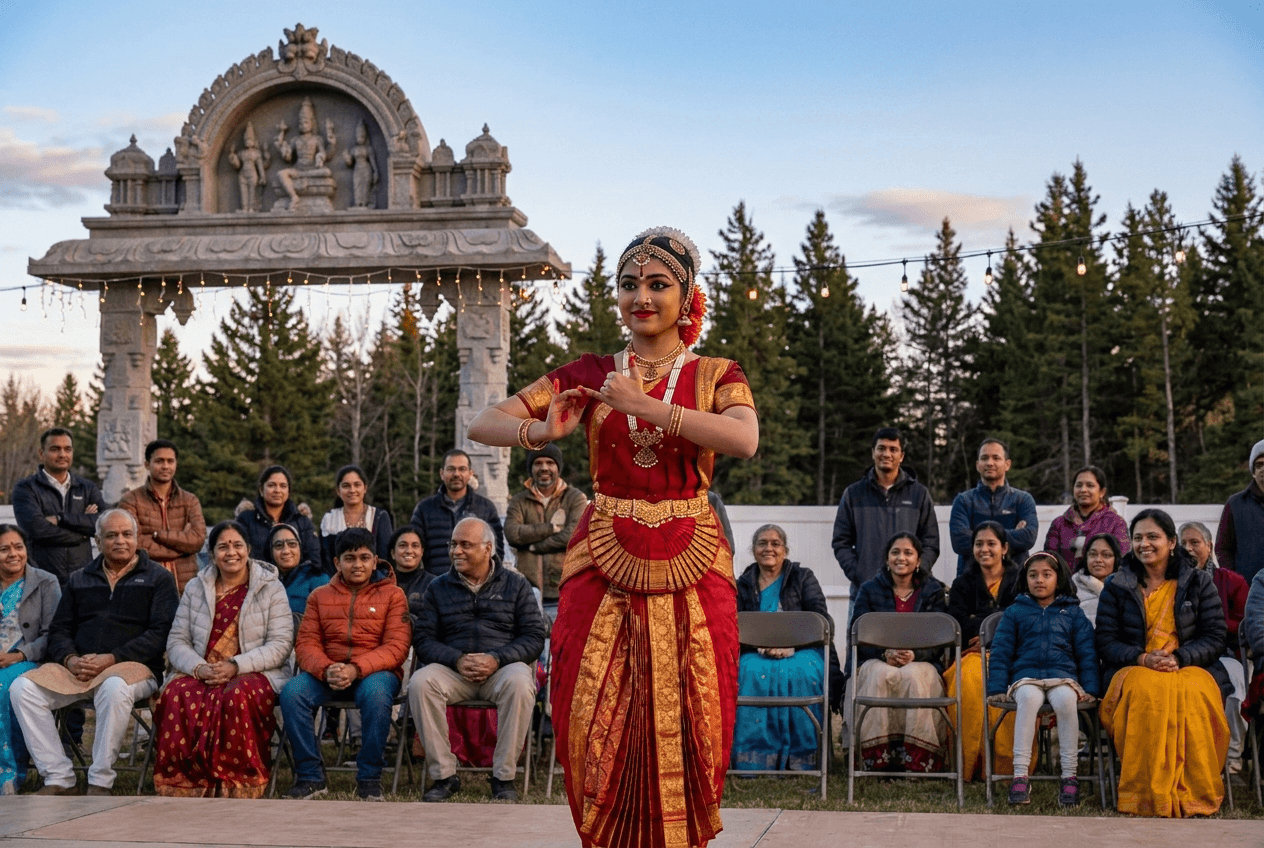
The aramandi, the characteristic deep bent-knee position that forms the foundation of Bharatanatyam movement, develops leg strength and endurance that rivals dedicated athletic training. Maintaining this position through extended practice sessions builds muscular capability that directly supports athletic performance in every other activity. The adavu patterns develop coordination, balance and proprioceptive awareness to a remarkable degree. Children who train seriously in Bharatanatyam develop a physical confidence and capability that is visible and measurable.
Memory and Cognitive Development
The memorisation demands of Bharatanatyam are extraordinary. Students must simultaneously hold choreographic sequences, musical phrases, rhythmic structures, hand gesture vocabulary and expressive narrative content in working memory and reproduce them with precision. The neurological research is clear: this kind of multidimensional memorisation develops working memory capacity, sustained attention and cognitive flexibility in ways that directly and measurably support academic performance across mathematics, language arts and science.
Emotional Intelligence Through Abhinaya
The abhinaya component of Bharatanatyam, the expressive storytelling through facial expression, gesture and body language, develops emotional intelligence and empathy to an extraordinary degree. Learning to identify, understand and authentically portray a wide range of human emotional states through precise physical means is a capacity that shapes how children understand and relate to other people throughout their lives.
The Curriculum: From Beginner to Arangetram
Foundation and Elementary Stages
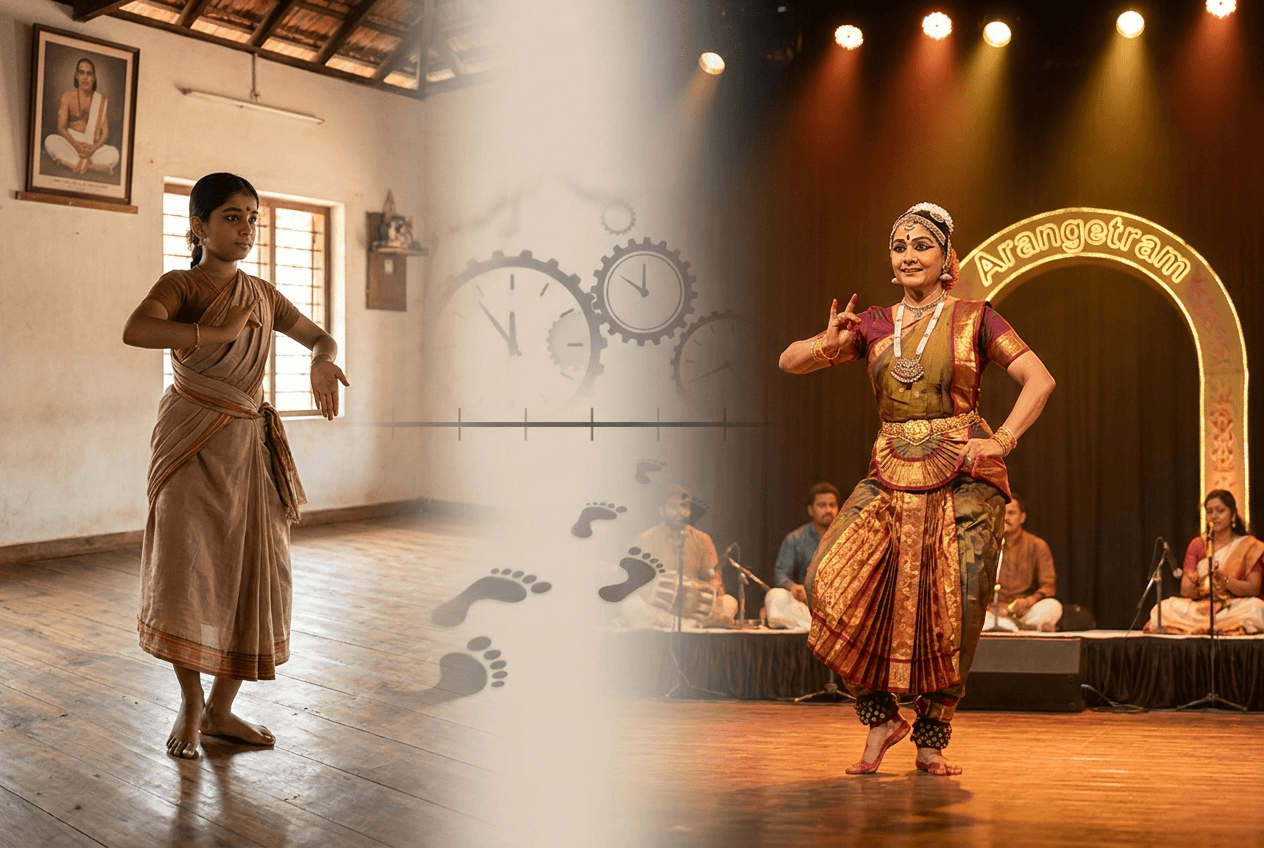
All Bharatanatyam training begins with the fundamental postures, the basic adavu vocabulary and an introduction to Carnatic music. Students learn the aramandi stance, the primary asamyuta hastas, and the basic adavu patterns that form the building blocks of all choreography. The first compositional piece, the alarippu, is introduced once postural fundamentals are established. At the elementary level, students expand their adavu vocabulary and begin systematic abhinaya training.
Intermediate Stage and the Varnam
The varnam is the centrepiece of intermediate Bharatanatyam training, combining pure rhythmic movement with expressive storytelling in a single extended composition that demands the full technical and expressive range of the dancer. Working through a varnam is the defining experience of the intermediate stage, and the development it produces is visible in every aspect of the student's performance.
The Arangetram in Canada
The arangetram, the formal debut solo performance that marks the culmination of foundational training, is one of the most significant cultural milestones in South Indian Canadian family life. Art Gharana teachers guide students through every aspect of arangetram preparation including repertoire, choreography, costume, live musician coordination and stage presentation. For Canadian families planning a Canada-based arangetram at a local temple or community hall, Art Gharana's experience supporting US and Canadian arangetrams is particularly valuable.
How Art Gharana Compares to Other Canadian Options
 Canadian families evaluating online Bharatanatyam options will primarily encounter IndianNatya, scattered individual teachers and in-person GTA and Vancouver studios. Key differences: IndianNatya restricts enrollment to females only. Most in-person studios are limited to GTA or Vancouver locations with fixed schedules. No competitor offers live one-to-one instruction, Canadian time zone flexibility and open gender access simultaneously. Art Gharana provides all three.
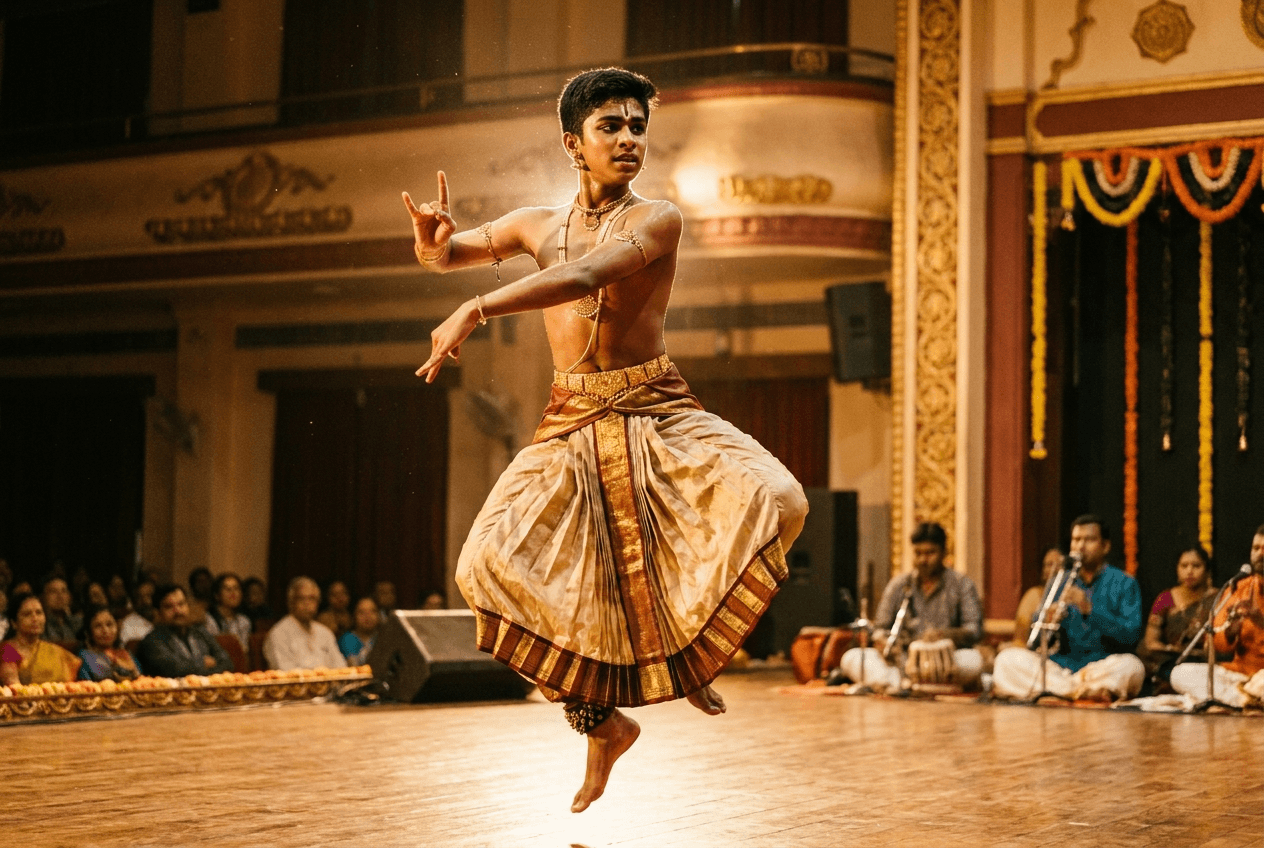
The gender restriction that IndianNatya imposes deserves specific attention. South Indian classical arts have a long history of outstanding male practitioners, and the exclusion of boys and adult males from access to classical Bharatanatyam training has no foundation in the tradition itself. Art Gharana welcomes all students regardless of gender, and our male Bharatanatyam students consistently develop with the same quality of instruction, depth of cultural engagement and performance excellence as our female students.
Bharatanatyam and Carnatic Vocal
Bharatanatyam and Carnatic music are inseparable traditions, and many of Art Gharana's most accomplished Canadian Bharatanatyam students also study Carnatic vocal classes. A dancer who can sing the compositions they are performing brings an entirely different quality of musical understanding to their abhinaya. The rhythmic structures, the raga character and the devotional meaning of each composition become personally known rather than externally imposed when the student understands the music as a singer as well as a dancer. For families interested in North Indian classical arts alongside or instead of South Indian traditions, our Kathak classes, tabla classes and full range of courses are all available with the same live one-to-one format and Canadian time zone scheduling.
South Indian Temples in Canada and the Bharatanatyam Community
 The network of South Indian temples across Canada plays a central role in sustaining Bharatanatyam culture in the diaspora. Temples in Scarborough, North York, Mississauga, Brampton, Vancouver and Ottawa host regular Bharatanatyam performances, arangetrams and cultural events. For children who have trained consistently, these temples represent the most meaningful performance contexts available. Art Gharana teachers actively encourage their Canadian students to engage with this temple performance community and help prepare them for specific temple events and cultural occasions.
The arangetram tradition is particularly active in the GTA's Tamil community. Families who began their children's Bharatanatyam training with Art Gharana have hosted arangetrams at Tamil temples and community halls across the GTA, and Art Gharana's teachers have supported every aspect of these events. If you are planning an arangetram for your child in Canada, Art Gharana is the partner you need for the artistic preparation that will make it a success.
The network of South Indian temples across Canada plays a central role in sustaining Bharatanatyam culture in the diaspora. Temples in Scarborough, North York, Mississauga, Brampton, Vancouver and Ottawa host regular Bharatanatyam performances, arangetrams and cultural events. For children who have trained consistently, these temples represent the most meaningful performance contexts available. Art Gharana teachers actively encourage their Canadian students to engage with this temple performance community and help prepare them for specific temple events and cultural occasions.
The arangetram tradition is particularly active in the GTA's Tamil community. Families who began their children's Bharatanatyam training with Art Gharana have hosted arangetrams at Tamil temples and community halls across the GTA, and Art Gharana's teachers have supported every aspect of these events. If you are planning an arangetram for your child in Canada, Art Gharana is the partner you need for the artistic preparation that will make it a success.
Boys and Bharatanatyam in Canada
One of the most persistent misconceptions about Bharatanatyam in Canada is that it is an art form for girls only. This misconception, reinforced by providers like IndianNatya that exclude male students, has discouraged many South Indian Canadian families from enrolling their sons in what would be an outstanding activity for them. The historical reality is that Bharatanatyam has always had outstanding male practitioners, and the physical demands of the form, its powerful footwork, athletic strength requirements and technical precision, are in many ways particularly well suited to boys. Art Gharana's male Bharatanatyam students in Canada consistently develop into impressive performers who carry their classical training with pride.
About Art Gharana
 Art Gharana is a specialist online Indian arts education platform with over 50 certified teachers across dance, music and vocal disciplines. We serve South Indian and all Indian families across Canada with live one-to-one classes in all Canadian time zones. Browse our teacher profiles page and review our plans and pricing to choose the right plan for your family.
Frequently Asked Questions
1. Are there certified Bharatanatyam teachers online for Canadian families?
Yes. Art Gharana connects Canadian families with certified Bharatanatyam teachers for live one-to-one classes in all Canadian time zones, with morning, evening and weekend slots available across Eastern, Central, Mountain and Pacific.
2. Can Art Gharana support arangetram preparation for Canada-based students?
Yes. Our teachers guide students through every aspect of arangetram preparation, including repertoire, choreography, costume, live musician coordination and the practical logistics of organising a performance at a Canadian temple or community hall.
3. Is Bharatanatyam open to boys in Canada?
Yes. Art Gharana has no gender restrictions. Boys are welcome and our male Bharatanatyam students develop with the same quality of instruction and performance excellence as our female students.
4. What age can children start Bharatanatyam in Canada?
Children can begin from age 5. The beginner curriculum is fun, gentle and age-appropriate for young learners with no prior dance experience.
5. How long does it take to reach arangetram level?
Most students reach arangetram readiness after five to seven years of consistent weekly training combined with regular home practice.
6. Are classes available outside the GTA?
Yes. Art Gharana's online programme serves families across all of Canada, including Calgary, Edmonton, Vancouver, Ottawa, Winnipeg, Halifax and every other province and territory.
Book Your Child's Free Trial Class Today
Whether your family is in Scarborough, Brampton, Vancouver, Calgary, Ottawa or anywhere else in Canada, Art Gharana's certified Bharatanatyam teachers are ready to begin your child's classical journey. Completely free first lesson, live one-to-one instruction, Canadian time zone scheduling, full arangetram support. Head to our book a free trial class page and take the first step today.
The Canadian Multicultural Context and Bharatanatyam
Canada's Multiculturalism Act, unique among major Western nations, actively celebrates cultural diversity rather than merely tolerating it. This creates an extraordinary context for Bharatanatyam training in Canada: a child who can perform classical South Indian dance is not demonstrating something exotic or marginal. They are contributing to the cultural mosaic that is central to Canadian national identity. At school multicultural events, at Canada Day celebrations, at heritage month events and at community temple festivals, a trained Bharatanatyam dancer is welcomed and celebrated as a contributor to Canadian cultural life. This public celebration of Indian classical arts in Canadian institutions makes the investment in Bharatanatyam training more immediately rewarding for children than in many other countries, and it creates a self-reinforcing cultural pride that sustains long-term commitment to the art form.
The Canadian Tamil community specifically has built a remarkable network of cultural institutions that support Bharatanatyam practice. The Bharatiya Vidya Bhavan cultural centres in Toronto, the Tamil cultural associations across the GTA, and the South Indian temples in Scarborough, North York and Mississauga all host regular Bharatanatyam performances, arangetrams and cultural events. A child who trains seriously with Art Gharana is not learning in isolation. They are joining a living community of South Indian Canadian Bharatanatyam practitioners whose roots stretch back to the great temple traditions of Tamil Nadu.
Bharatanatyam as a Bridge Between Generations
One of the most consistently reported benefits of Bharatanatyam training among Art Gharana families in Canada is the bridge it creates between generations. When grandparents visit from Chennai or Coimbatore or Madurai and watch their granddaughter perform an alarippu or a tillana, the response is frequently described by parents as one of the most emotionally powerful moments of their family life. The grandparent who grew up attending Bharatanatyam performances at their local Murugan temple, who recognises the postures and the gestures and the musical phrases as part of their own cultural world, sees in their grandchild's performance not the product of a foreign education system but the living continuation of their own heritage. That recognition, across the vast distance of migration and the cultural gap of two generations, is irreplaceable and profound.
For many Art Gharana families in Canada, Bharatanatyam training has become the primary medium through which grandparent-grandchild relationships across continents develop depth and intimacy. Regular video calls in which the child performs a newly learned adavu sequence for the grandparent, the grandparent responds with recognition and encouragement, and a conversation about the cultural significance of the movement develops naturally: these moments of cross-generational cultural transmission are among the most valuable outcomes of classical arts education in the diaspora context.
Practical Setup for Online Bharatanatyam Classes in Canada
Setting up for online Bharatanatyam classes at home is straightforward and requires no specialist equipment. The most important requirement is sufficient clear floor space for your child to move freely in all directions without obstruction. Bharatanatyam adavus involve steps, turns and sequences that require open space. A bare floor rather than carpet is ideal for footwork clarity. Position your device so the teacher has a clear full-body view from head to toe. Good lighting from the front, without strong backlighting from a window behind your child, ensures the teacher can see facial expressions, hand positions and foot placement clearly throughout the session. Comfortable, loose-fitting clothing that allows free movement is all that is needed for the first class. Bare feet are standard for Bharatanatyam. There is no need to purchase any equipment whatsoever before the trial class.
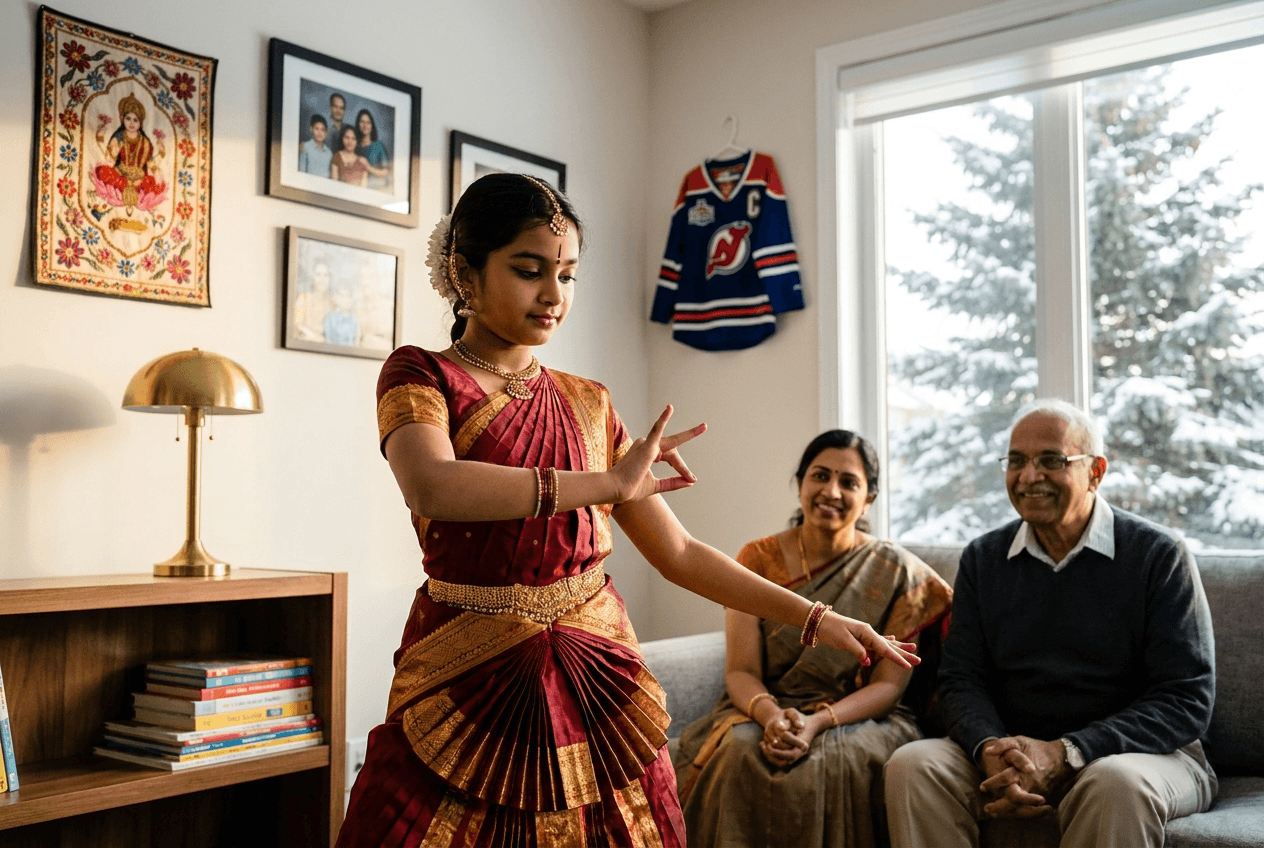
Canadian families who invest a little time in setting up an optimal practice space in their home report that it makes a significant difference to the quality of the classes and the child's engagement. Designating a specific corner of the living room or basement as the Bharatanatyam practice space, and consistently using it for both classes and home practice, helps children mentally transition into a focused, artistically engaged state when they enter that space. Small environmental cues like this, which take five minutes to establish, compound over years of practice into deeply ingrained habits of focused artistic engagement.
Home Practice and the Aramandi
The aramandi, the deep bent-knee stance that forms the foundation of all Bharatanatyam movement, is both the most important and the most physically demanding element that beginner students work on. Building the leg strength and flexibility needed to sustain the aramandi position through a full adavu sequence takes consistent daily practice in addition to the weekly class. Art Gharana teachers provide specific home practice guidance after every session, typically covering which adavus to consolidate, how long to practise them and what to pay attention to in terms of knee alignment, foot placement and upper body stillness. Parents who help their children maintain a short daily practice of 20 minutes find that progress accelerates noticeably compared with students who practise only during the class itself.
For South Indian Canadian families in the GTA, Vancouver and across the country, building the daily practice habit requires nothing more than a clear area of floor, comfortable clothing and the discipline to begin. The first few weeks are the hardest. Once the habit is established and the aramandi begins to feel natural rather than effortful, practice becomes genuinely enjoyable, and many students at the elementary level choose to practise far longer than their teachers assign because the experience of moving through adavus fluently and with control is its own reward.
Art Gharana's approach to Bharatanatyam training in Canada reflects a deep understanding of what diaspora families need from classical arts education. Qualified teachers, a structured curriculum that progresses systematically, scheduling flexibility that accommodates Canadian family life, open access regardless of gender and a genuine commitment to the cultural transmission that is the deepest purpose of classical arts education. For Tamil and South Indian Canadian families, there is no better option available in 2026. The free trial class is the place to begin.
Art Gharana is proud to be the platform that makes genuine, certified Bharatanatyam training accessible to Tamil and South Indian Canadian families wherever they are in this country. Whether you are in the heart of Scarborough's Tamil community or in a small city in Atlantic Canada where no local South Indian teacher exists, Art Gharana provides the same quality of live, personalised, culturally rich instruction. The free trial class is entirely without obligation and available immediately. Take the first step today and begin your child's journey into one of the world's great classical arts.
For South Indian Canadian families in Brampton, Scarborough, Markham, Vancouver, Surrey, Calgary, Edmonton, Ottawa, Winnipeg, Halifax and every other community across this country, Art Gharana's Bharatanatyam programme offers everything that the best in-person South Indian classical training offers, with the scheduling flexibility, nationwide accessibility and open-gender enrollment that the Canadian diaspora context demands. Our teachers are excited to welcome your child. The art form is waiting. The tradition is alive and ready to be transmitted. The first step is a single free trial class away.