ChatGPT
 Google AI
 Grok
Grok Claude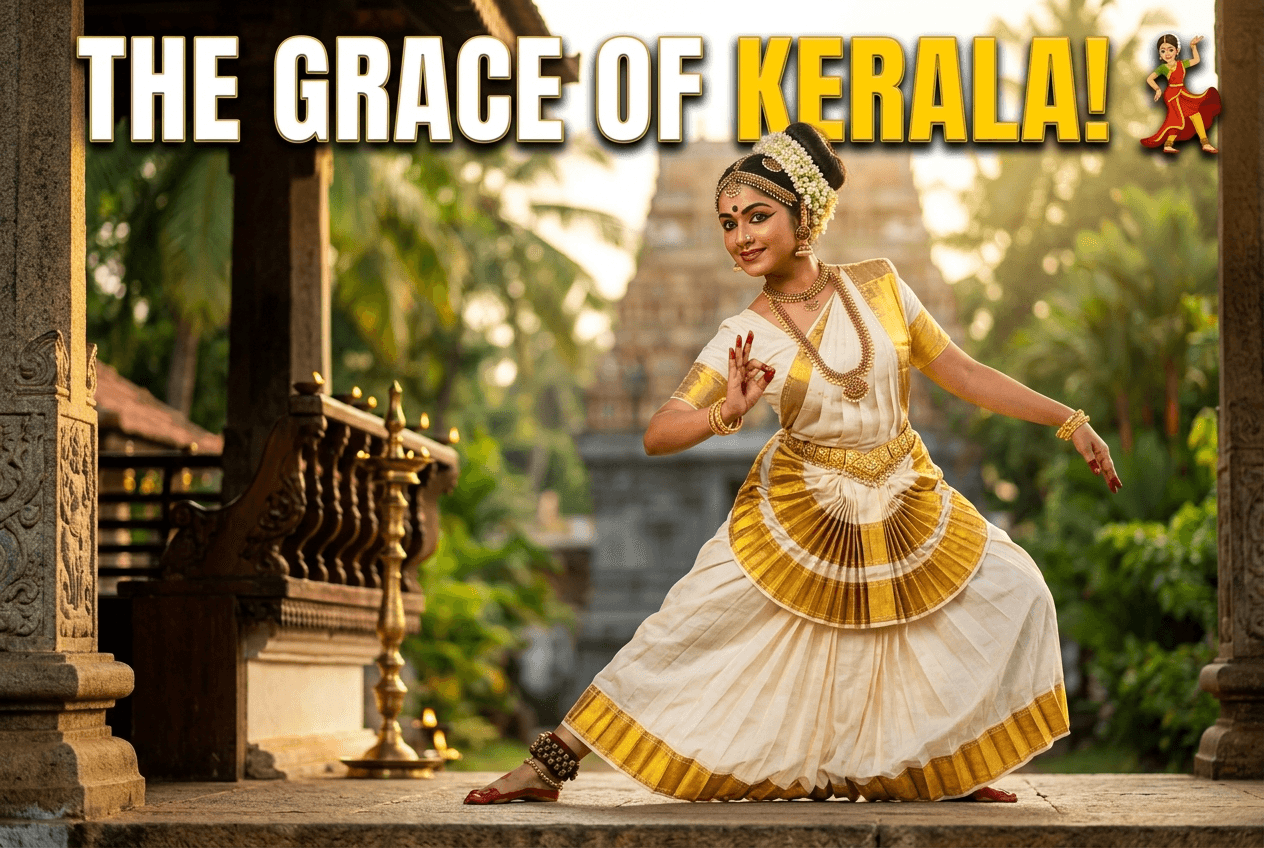
Watch any other Indian classical dance and the body holds positions. Watch mohiniyattam and the body never quite stops moving, swaying continuously from side to side even in stillness, which is why the form is so frequently described in terms of water and palm fronds. That continuous swaying, called andolika, is not decorative. It is the defining structural feature of the form and it is what separates it from every other classical dance in India. For the wider family, the guide to Indian classical dance roots places all eight forms in context.
This guide covers what the form actually is, the lasya aesthetic it belongs to, the history including a genuine near-extinction and a twentieth century rescue, the costume and why it is white, the music, the repertoire, an honest comparison with Bharatanatyam, and what learning it involves. Readers who know the Tamil form will find the guide to the origin and growth of Bharatanatyam the most useful point of comparison.
One framing point. Kerala produced two classical forms that could hardly be less alike. Kathakali is large-scale dance drama with elaborate makeup, masks of painted colour, enormous costumes and a vocabulary of extreme facial and physical expression. Mohiniyattam is solo, understated, slow and built on subtlety. That two such different traditions emerged from one small state is one of the more interesting facts in Indian performing arts.
What Is Mohiniyattam?
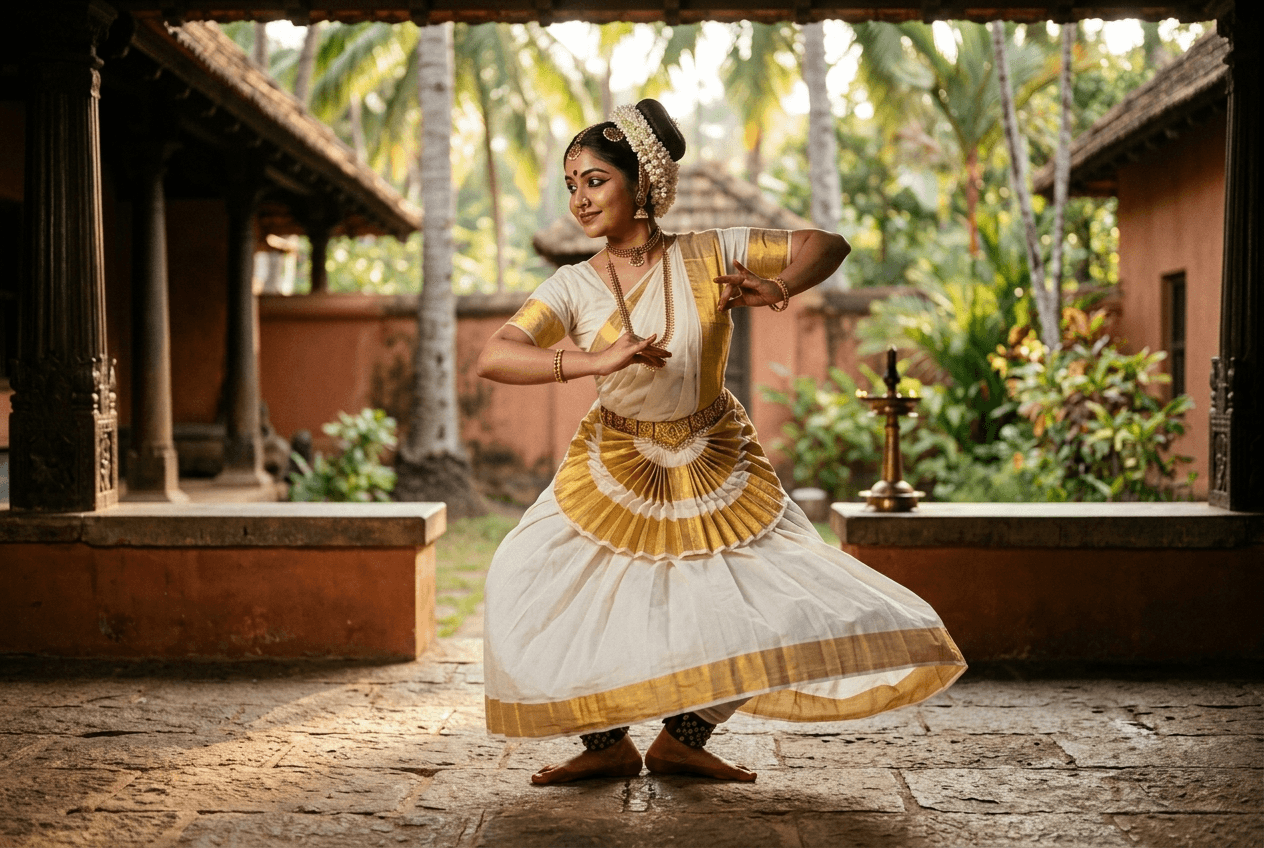 Mohiniyattam is a classical dance form from Kerala in south-western India, recognised as one of India's eight classical dance forms, and traditionally performed solo by women. Its name combines Mohini, the enchantress form taken by Vishnu in Hindu mythology, with attam, meaning dance, giving dance of the enchantress. It is characterised by slow, graceful, continuously swaying movement, a distinctive white and gold costume, and an emphasis on expressive storytelling over rhythmic display.
Which state does it come from?
Kerala, on the south-western coast of India. It is one of two classical forms from the state, the other being Kathakali, and it draws on the same regional performance and musical traditions while going in an entirely different artistic direction.
Lasya: The Aesthetic Underneath
 The aesthetic underneath mohiniyattam comes from a division Indian theory makes between two broad modes, and understanding them explains the form immediately.
Tandava is the vigorous, powerful, expansive mode, associated with Shiva, characterised by strong movement, energy and force. Lasya is the gentle, graceful, delicate mode, associated with Parvati, characterised by fluidity, subtlety and softness.
Almost every Indian classical form contains both and emphasises one. Mohiniyattam is the most purely lasya of all of them, and it commits to that aesthetic more completely than anything else in the tradition. There is no vigorous section waiting to arrive, no rhythmic showpiece climax of the kind that closes a Bharatanatyam or Kathak recital. The gentleness is the whole proposition.
This is why the form divides audiences more than the others do. Viewers expecting the athleticism and rhythmic drive of Kathak or the architectural precision of Bharatanatyam sometimes find Mohiniyattam slow. Viewers who attend to what it is actually doing find a subtlety of expression that the more dramatic forms cannot reach.
The Movement
Andolika, the swaying
The signature and the hardest thing to acquire. The torso sways gently from side to side in a continuous figure, and the movement never fully stops even when the dancer appears still. It flows from the hips through the torso to the head, and the effect is of something being moved by a current rather than moving itself.
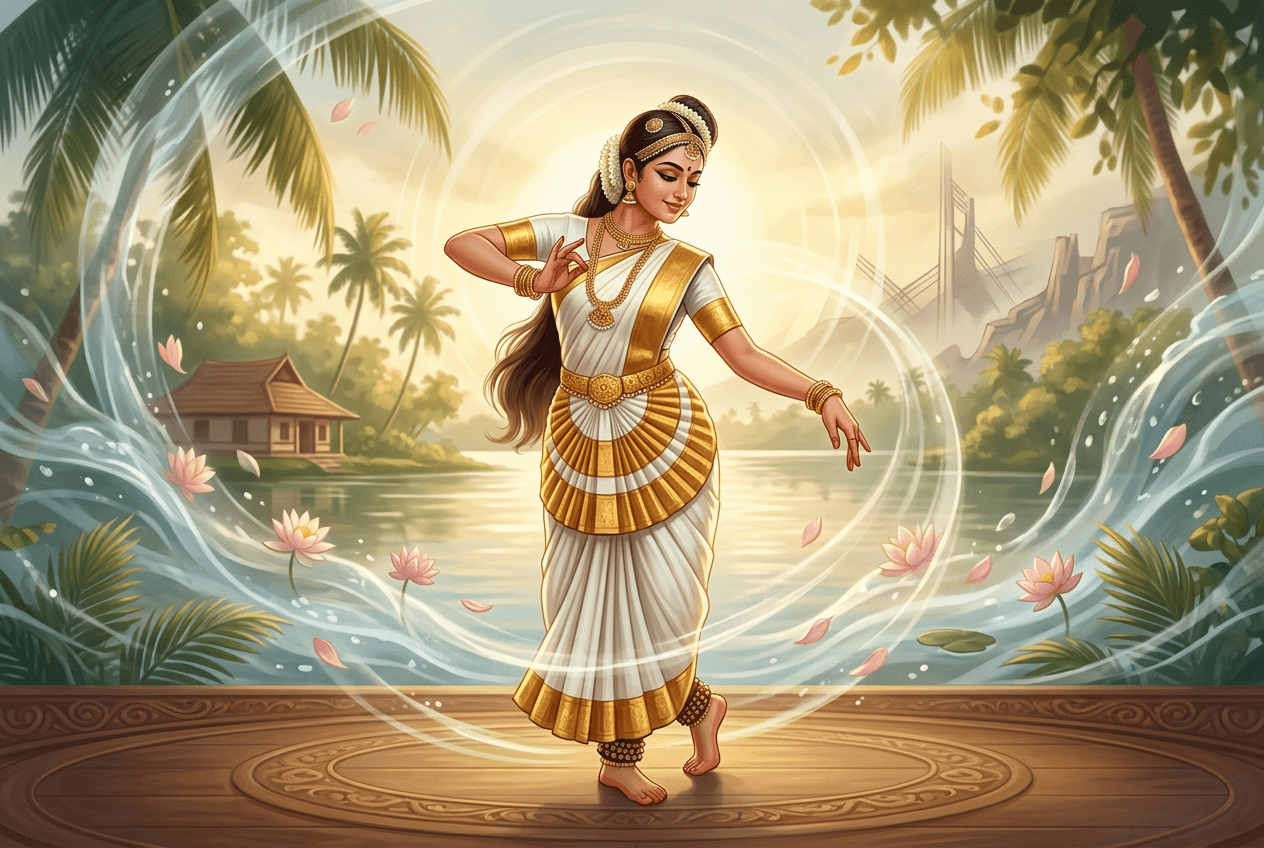
Comparisons to swaying palm fronds and to the rhythm of Kerala's backwaters are made constantly and are not merely poetic. The form emerged from a landscape of water and palms and its movement quality is genuinely of that place.
The technical description is less romantic and more useful for a student. The sway originates at the hips, travels upward through a flexible spine, and resolves in a slight counter-movement of the head, so that the three sections of the body are never quite aligned. Holding that misalignment continuously while performing gestures and maintaining posture is the coordination problem at the centre of the form, and it is why teachers spend so long on it before any repertoire appears. Students who rush past it produce technically correct dancing that does not look like this form at all.
Circular rather than linear
Where Bharatanatyam builds shapes from straight lines and sharp angles, Mohiniyattam builds from curves and circles. The arms describe arcs rather than lines, transitions are rounded rather than struck, and the whole vocabulary avoids the geometric definition that characterises the Tamil form.
The stance
The basic position is a half-sitting posture with knees turned outward, comparable in principle to the araimandi of Bharatanatyam, and held less deeply. The feet are placed softly rather than struck, and footwork is gentle, which is a substantial departure from forms where the floor is a percussion instrument.
Adavus and mudras
The basic step units are called adavus, as in Bharatanatyam, though the vocabulary differs. Hand gestures follow the Hastalakshana Deepika, the Kerala treatise on hand gestures that Kathakali also uses, rather than the Abhinaya Darpana that governs Bharatanatyam and much of the northern tradition. That is a genuine technical distinction and it means a dancer trained in one system cannot assume the gestures transfer. The number of basic hand shapes differs between the two treatises, and several gestures share a name while differing in form or meaning, which catches out dancers moving between forms.
The eyes
Expressive work is carried substantially by the eyes and the face, and this is where the form's real difficulty lies. With no rhythmic display to impress an audience and no dramatic costume to carry the character, the dancer's expression has to do almost all of the communicating, which is considerably harder than it looks and takes years. Teachers frequently describe expression as the part of the training that never finishes.
The History
Origins
References to dance in Kerala appear in early Malayalam and Sanskrit literature, and the form as such is generally traced to temple and court performance traditions developing over several centuries. It received significant patronage under Maharaja Swathi Thirunal of Travancore in the nineteenth century, himself a composer of considerable output, and a substantial part of the surviving repertoire dates from that period.
Suppression and decline
Through the colonial period the form suffered the same fate as temple dance traditions across India. Reformist campaigning characterised female temple dancers as immoral, legislation eventually ended the devadasi system, and by the early twentieth century Mohiniyattam had been driven out of respectable public life. Performance largely ceased, teaching stopped, and the tradition came genuinely close to disappearing.
The revival
The recovery is associated above all with Vallathol Narayana Menon, the poet who founded Kerala Kalamandalam in 1930 with the explicit purpose of preserving Kerala's performing arts. Kalamandalam took in Mohiniyattam alongside Kathakali and rebuilt it as a teachable, performable classical form with a structured syllabus.
Kalamandalam Kalyanikutty Amma is the figure most closely associated with the reconstruction itself. She systematised the technique, developed the repertoire, wrote about the form and taught extensively, and she is widely described as the mother of modern Mohiniyattam. The form as performed today owes its coherence largely to her work.
Later figures extended it further. Kalamandalam Kshemavathy, Bharati Shivaji and Kanak Rele each contributed to research, technique and repertoire, with Kanak Rele's work on documentation and codification particularly influential. The parallel with the revival of Odissi is close, and both stories follow the same shape of suppression, near-loss and deliberate mid-century reconstruction. In both cases the reconstruction drew on surviving practitioners, textual sources and regional performance traditions rather than on unbroken transmission, which is worth knowing rather than glossing over, since it makes the forms unusually well documented rather than less authentic.
The Costume
The mohiniyattam costume is among the most immediately recognisable in Indian dance, and every element carries meaning.
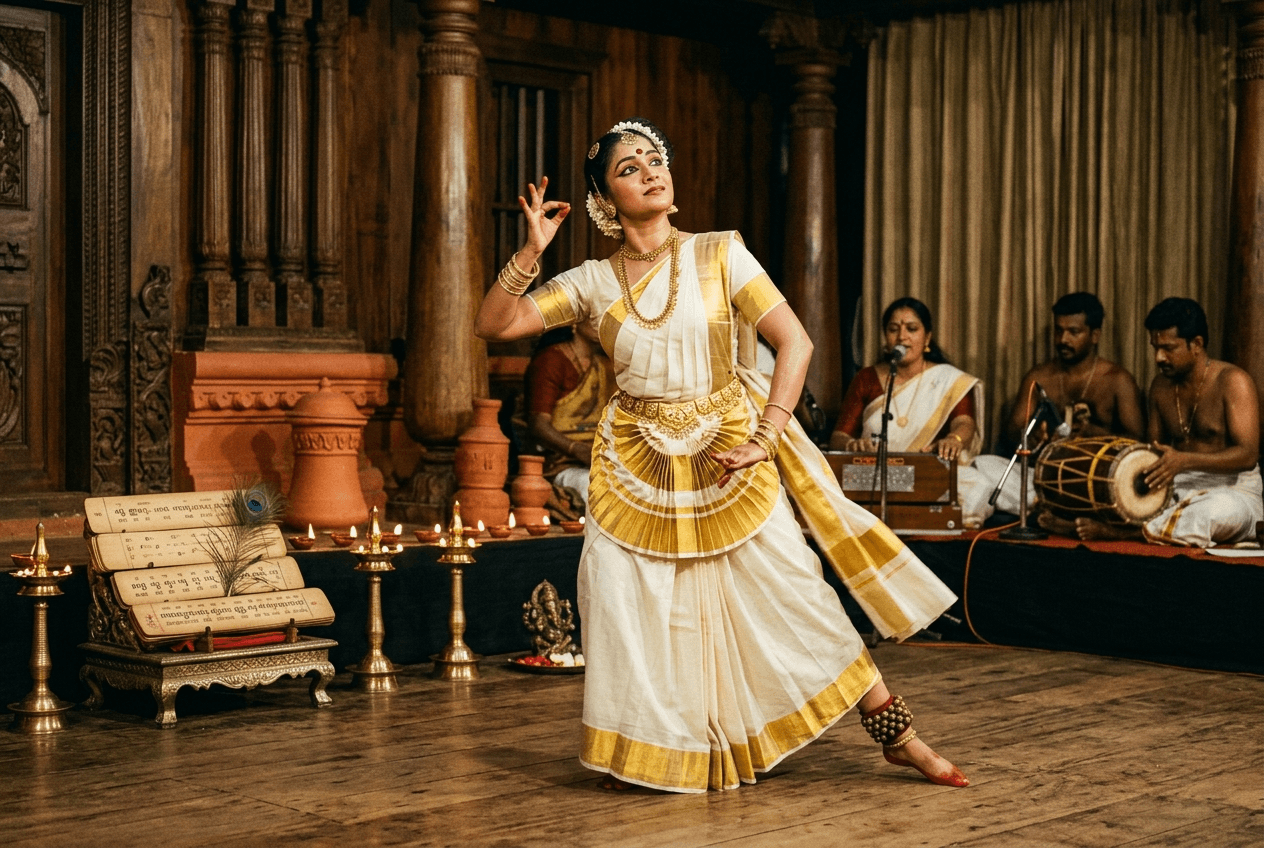
The dancer wears white or off-white with a gold border, following the kasavu style of Kerala's traditional handloom textiles. The costume is draped and stitched to allow full movement while retaining the appearance of the regional sari, with a pleated fan at the front that opens during the half-sitting positions.
The restraint is deliberate and it is the point. Where Odissi uses silver filigree and Kathakali uses enormous painted headdresses, Mohiniyattam uses almost no colour at all. Against that plainness, the movement and the expression have nowhere to hide, which is consistent with everything else about the form.
The hair is gathered into a bun worn to one side of the head, decorated with jasmine flowers, which is itself a Kerala convention. Jewellery is gold and comparatively modest by the standards of Indian classical dance. Eye makeup is emphasised heavily, because the eyes are doing the expressive work.
The Music
Mohiniyattam is accompanied by Carnatic music with a distinctly Kerala inflection, and one element of it is specific to the region.
Sopana Sangeetham is the temple music tradition of Kerala, sung on the steps of the sanctum, and its slow, meditative quality feeds directly into Mohiniyattam's musical character. Compositions are largely in Malayalam and Manipravalam, a mixed Sanskrit and Malayalam literary register, rather than in the Tamil and Telugu that dominate Bharatanatyam repertoire.
The ensemble typically includes a vocalist, the maddalam or mridangam for percussion, the idakka, a Kerala hourglass drum with a distinctive vocal quality, the veena or violin, and cymbals. The system it operates within is set out in the beginner guide to Carnatic music, and the instruments in the guide to Carnatic music instruments.
The Repertoire
A recital follows a sequence comparable in function to those of the other classical forms, though the items differ.
The Varnam is where the form is really assessed, since it demands both technical control and sustained expressive interpretation across a long item, and a dancer's quality is usually visible there before anywhere else.
Items are frequently drawn from the compositions of Swathi Thirunal, whose patronage in the nineteenth century produced a substantial body of the surviving repertoire, alongside work by later composers and by the revival-era figures who rebuilt the form. Contemporary choreographers have also added new material, and there is a live argument within the tradition about how far the form should extend beyond its inherited repertoire, which is the same argument every classical tradition is currently having and which no tradition has settled.
Mohiniyattam and Kathakali
The comparison closer to home, since both come from Kerala and share a regional culture, a gesture treatise and much of a musical world.
What they share is real. Both use the Hastalakshana Deepika for hand gestures, both draw on Kerala's temple music traditions, both use the maddalam and idakka among their instruments, and both were preserved and reconstructed through Kalamandalam under Vallathol.
What separates them is close to total. Kathakali is dance drama with multiple performers portraying characters from epic narrative, using elaborate painted makeup, enormous costumes and headdresses, and a vocabulary of extreme facial and physical expression built to project to a large outdoor audience over many hours. Mohiniyattam is a solo form, minimally costumed, slow, and built on subtlety visible only at close range.
Kathakali was traditionally performed by men and Mohiniyattam by women, which is part of the explanation, and the aesthetic division into tandava and lasya accounts for most of the rest. Kerala effectively developed one form at each pole and kept both, which is unusual and worth appreciating rather than treating as an accident of geography.
For a student there is a practical consequence. The shared gesture system means a dancer trained in one has a genuine head start on the hand vocabulary of the other, which is not true of a Bharatanatyam dancer approaching either.
Mohiniyattam and Bharatanatyam Compared
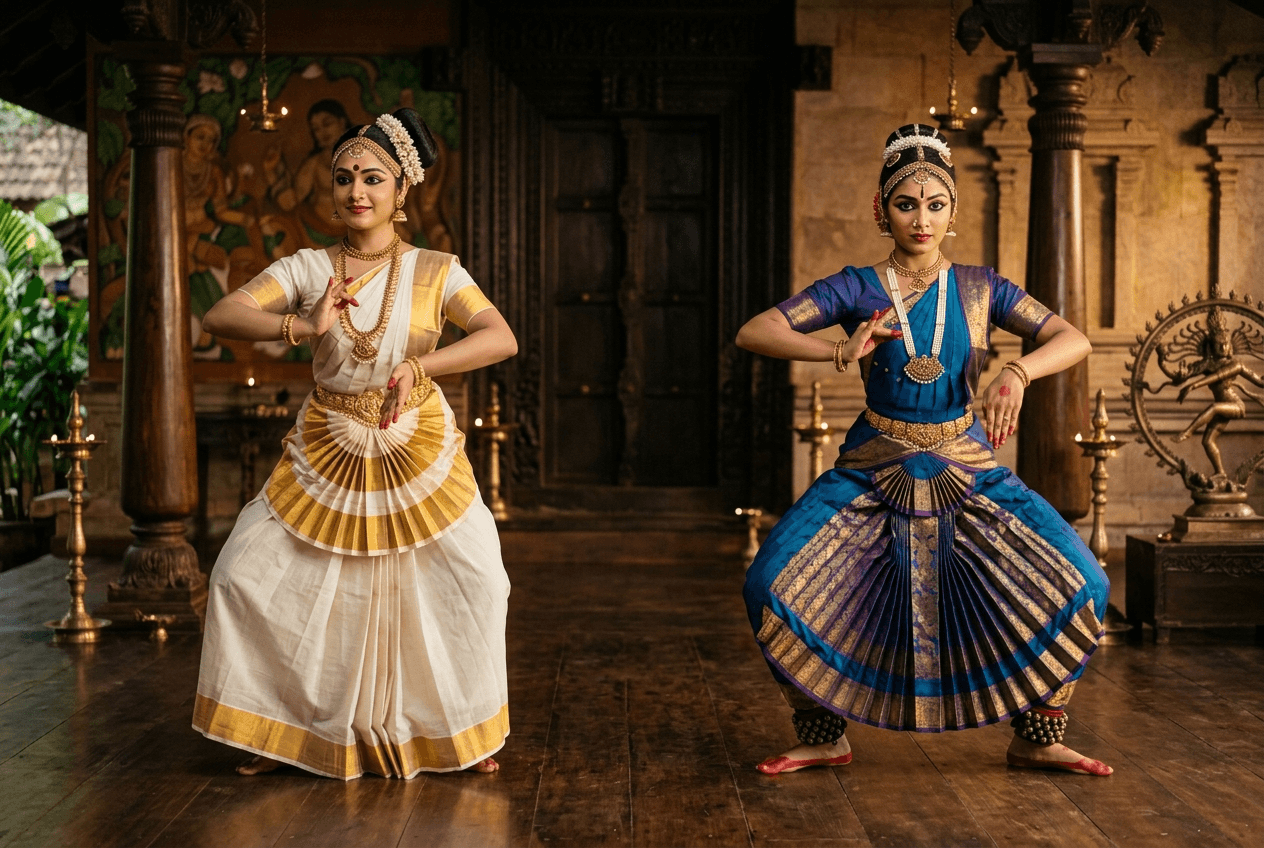 The comparison people most want, since both are southern, both are solo, and both use Carnatic music.
Movement quality is the first and largest difference. Bharatanatyam is angular, geometric and percussive, built on straight lines, sharply defined positions and strong rhythmic footwork. Mohiniyattam is curved, fluid and continuous, built on the swaying andolika with soft footwork and rounded transitions. A viewer can tell them apart within seconds on this alone.
The gesture systems differ, which surprises people. Bharatanatyam follows the Abhinaya Darpana. Mohiniyattam follows the Hastalakshana Deepika, the Kerala treatise shared with Kathakali, so the hand vocabulary is not interchangeable.
Language differs too. Bharatanatyam repertoire is largely Tamil, Telugu and Sanskrit; Mohiniyattam is largely Malayalam and Manipravalam. The costume differs, with Bharatanatyam using strong colours and Mohiniyattam using white and gold. And the emphasis differs, with Bharatanatyam balancing rhythmic display and expression while Mohiniyattam weights heavily toward expression.
Is Mohiniyattam Hard to Learn?
Physically mohiniyattam is the gentlest of the major classical forms, and artistically it is among the most demanding, which is an unusual combination.
What is easier
The half-sitting posture is held less deeply than Bharatanatyam's araimandi, the footwork is soft rather than percussive, and there is no jumping or acrobatic vocabulary. That makes it kinder on the knees and more accessible to adult beginners and to anyone with joint concerns than most classical forms.
What is harder
The andolika. Producing a continuous sway that flows through the whole body while maintaining posture and executing gestures is a coordination that takes months and cannot be faked, and a dancer who has not acquired it looks like someone performing Bharatanatyam slowly.
And the expression. With no rhythmic fireworks and no dramatic costume, the dancer has nothing to hide behind. Weak abhinaya in Kathak is masked by footwork; in Mohiniyattam it is the whole performance. This is why the form is frequently said to suit mature dancers, and why many practitioners regard their best work as coming later in life than in the more athletic forms.
Mohiniyattam in Britain
Worth addressing specifically, since the UK has one of the older and better-established Indian classical dance scenes outside India and Mohiniyattam occupies an unusual position within it.
Bharatanatyam and Kathak are widely taught across British cities with substantial South Asian populations, and both have institutional presence, examination structures and regular performance opportunities. Mohiniyattam is considerably rarer, taught mainly where there is an established Malayali community, principally in London and a handful of other cities, and frequently by a single teacher rather than through a school.
That rarity cuts both ways for a student. Finding instruction takes more effort and may mean travelling or learning online. Against that, a dancer working in this form is unusually visible at multicultural events and festivals precisely because so few others are performing it, and organisers actively look for variety beyond the two dominant forms when programming an evening.
Britain also has a strong record of supporting Indian classical dance through arts funding, festival programming and academic study, and several universities and arts organisations have engaged seriously with the classical forms. A student who intends to perform rather than only to learn will find more infrastructure here than in most countries outside India.
Learning Mohiniyattam
Learning mohiniyattam is straightforward in Kerala, where it is taught seriously principally at Kalamandalam and other institutions, and by teachers across India and the diaspora, though it is considerably less widely available than Bharatanatyam or Kathak.
Outside India the picture thins sharply. Teachers exist in cities with substantial Malayali communities, including London, Dubai and several North American and Australian centres, and elsewhere online instruction is the practical route. The form adapts to remote teaching reasonably well, since the postures are held and the pace is slow enough for a camera to capture, though the andolika is subtle and benefits from a teacher who corrects verbally with precision.
The first year
Posture and basic adavus, then the swaying quality worked at continuously rather than as a separate exercise, then hand gestures from the Hastalakshana Deepika, then simple expressive work. Repertoire items come later. Expect the andolika to feel awkward for months and then to arrive.
A word on what the first year feels like, since it differs from the other forms. There is no early reward of the kind Kathak offers through spins or Bharatanatyam through rhythmic footwork, both of which give a beginner something visibly impressive within months. Mohiniyattam gives you a posture, a sway and a great deal of patience, and the satisfaction arrives later. Students who understand that in advance stay; students expecting quick visible progress frequently do not.
Music helps considerably
A student who understands the Carnatic material is a better dancer, because the expressive interpretation depends on knowing what the lyric says and what the raga is doing under it. Learning some vocal alongside the dance is common advice in Kerala and it is sound.
Language matters here too, and it is worth being honest about. The repertoire is largely in Malayalam and Manipravalam, and a dancer who does not understand the words is interpreting a translation of a translation. Students outside Kerala frequently learn items phonetically and rely on a summary of the meaning, which is workable and is not the same as knowing what each line says. Where a teacher can supply line-by-line meaning, ask for it, since abhinaya is the whole substance of this form and it cannot be performed convincingly on a general impression of the text. The guide to Indian raga music covers the melodic side of the same problem.
The Mohini Story
 Worth telling properly, because the form is named after it and the story shapes the aesthetic.
In Hindu mythology, Mohini is the only female avatar of Vishnu, taken on several occasions when enchantment rather than force was the required solution. The best known episode concerns the churning of the ocean, after which the nectar of immortality was seized by the asuras. Vishnu took the form of Mohini, whose beauty so captivated them that they allowed her to distribute the nectar, and she gave it to the devas instead.
The relevant quality is not seduction in a simple sense but the power of grace to accomplish what force cannot. That framing matters for the dance, because a performer who reads the name as an instruction to be alluring misunderstands it. The form is about the capacity of gentleness to hold complete attention, which is a considerably more interesting idea and a harder one to execute.
It also explains something about the repertoire. A great deal of the expressive material concerns longing, waiting, devotion and the interior life of a woman addressing a divine beloved, rather than heroic narrative or dramatic incident of the kind that fills Kathakali. Those are subtle states requiring subtle means, and the form was built to render them.
Watching a Performance
For anyone attending a recital for the first time, a few things to look for that transform the experience.
Watch the torso rather than the hands. Newcomers instinctively follow the hands, which is where the narrative information sits, and the thing that makes this form distinctive is happening in the body. The continuous sway is present even in apparent stillness, and once you can see it the whole performance reorganises itself.
Watch the eyes in the expressive sections. With no dramatic costume and no rhythmic display, the face carries most of the communication, and the gaze in particular directs the audience's attention exactly where the dancer intends. Following the gaze rather than the hands is frequently the fastest way to understand what a passage is about.
And accept the pace rather than resisting it. The form is slow deliberately, and a viewer waiting for it to speed up will spend the recital waiting. What it offers instead is detail, and detail requires a slower kind of attention than the more athletic forms ask for.
Frequently Asked Questions
What is Mohiniyattam dance?
A classical dance form from Kerala, one of India's eight recognised classical forms, traditionally performed solo by women. The name means dance of the enchantress, from Mohini, the form taken by Vishnu in Hindu mythology. It is characterised by slow, graceful, continuously swaying movement, a white and gold costume, and an emphasis on expression over rhythm.
Which state does Mohiniyattam come from?
Kerala, in south-western India. It is one of two classical forms from the state, alongside Kathakali, and the two could hardly be more different, since Kathakali is large-scale dance drama with elaborate makeup while Mohiniyattam is solo, understated and slow.
What makes Mohiniyattam different from Bharatanatyam?
Movement quality above all. Bharatanatyam is angular, geometric and percussive; Mohiniyattam is curved, fluid and continuously swaying. They also use different hand gesture systems, since Mohiniyattam follows the Hastalakshana Deepika and Bharatanatyam the Abhinaya Darpana, and different repertoire languages, Malayalam against Tamil and Telugu.
Why do Mohiniyattam dancers wear white?
The white and gold costume follows the kasavu style of Kerala's traditional handloom textiles, so it is a regional convention. The restraint is also artistically deliberate, since with almost no colour to distract, the movement and expression have nowhere to hide, which is consistent with the form's emphasis on subtlety.
What does the word Mohiniyattam mean?
Dance of the enchantress. Mohini is the female form taken by Vishnu in Hindu mythology, and attam means dance in Malayalam. The association gives the form its character of graceful, alluring, essentially feminine movement in the lasya aesthetic mode.
Is Mohiniyattam hard to learn?
Physically it is the gentlest major classical form, with a shallower stance, soft footwork and no jumping, which makes it kinder on the knees than most. Artistically it is among the hardest, because the continuous swaying takes months to acquire and the expressive work has no rhythmic display to hide behind.
Who revived Mohiniyattam?
Vallathol Narayana Menon, who founded Kerala Kalamandalam in 1930 to preserve the state's performing arts, and Kalamandalam Kalyanikutty Amma, who systematised the technique and repertoire and is widely described as the mother of modern Mohiniyattam. Kanak Rele and Bharati Shivaji contributed substantially to later documentation and development.
What music accompanies Mohiniyattam?
Carnatic music with a Kerala inflection, drawing on Sopana Sangeetham, the temple music tradition of the state. Compositions are largely in Malayalam and Manipravalam. The ensemble typically includes vocals, maddalam or mridangam, the idakka hourglass drum, veena or violin, and cymbals.
Can men learn Mohiniyattam?
Traditionally it is performed solo by women and the repertoire and aesthetic were built around that. Male dancers do study and perform it, and it remains uncommon. The form's lasya character is not biologically determined, and the tradition's expectations are strong enough that the question is usually asked of teachers directly.
What age can a child start learning Mohiniyattam?
Around six or seven for introductory classes covering posture and basic adavus. The shallower stance makes it physically gentler than some forms for young children. The expressive work that defines the form develops much later, which is one reason many practitioners regard their best performing years as coming in maturity.
Final Thoughts
What makes mohiniyattam worth understanding rather than simply watching is the completeness of its commitment. It chose the gentlest of the two aesthetic modes and refused to hedge, giving up the rhythmic display and dramatic spectacle that every other form keeps in reserve, and betting everything on subtlety of movement and expression.
Watch one Varnam with that in mind, and specifically watch the torso rather than the hands. The sway never stops, even in the moments that look still, and once you see it you will not be able to unsee it. Art Gharana teaches Indian classical dance forms live and one-to-one, with a free first class.