ChatGPT
 Google AI
 Grok
Grok Claude
Kathak is one of India's eight classical dance forms, originating in North India and rooted in storytelling through expressive footwork, graceful spins, and evocative gestures. For Indian-American families in the USA, finding qualified Kathak dance classes online for kids has never been more practical or important. This guide covers what Kathak actually involves, why it's one of the most rewarding arts for children in the diaspora, what age to start, how online lessons work, what to look for in a teacher, and how to get your child started from anywhere in the US.
There's a moment in every Kathak performance that stops people cold. The ghungroo bells tied around the dancer's ankles begin their rhythmic conversation with the tabla. The feet strike the floor with mathematical precision. The eyes tell a story the audience understands without a single spoken word. And somewhere in the audience, an Indian-American child watching for the first time feels something they can't quite name but know is theirs.
That feeling is the doorway to Kathak. And for thousands of families across the USA, Kathak dance classes online for kids have made it possible to walk through that doorway from literally anywhere in the country.
This guide gives parents the full picture: what Kathak is, why it matters for your child's development, how online lessons work practically, and how to find the right teacher.
What Is Kathak? History, Origin, and Cultural Significance
The Ancient Roots of India's Storytelling Dance
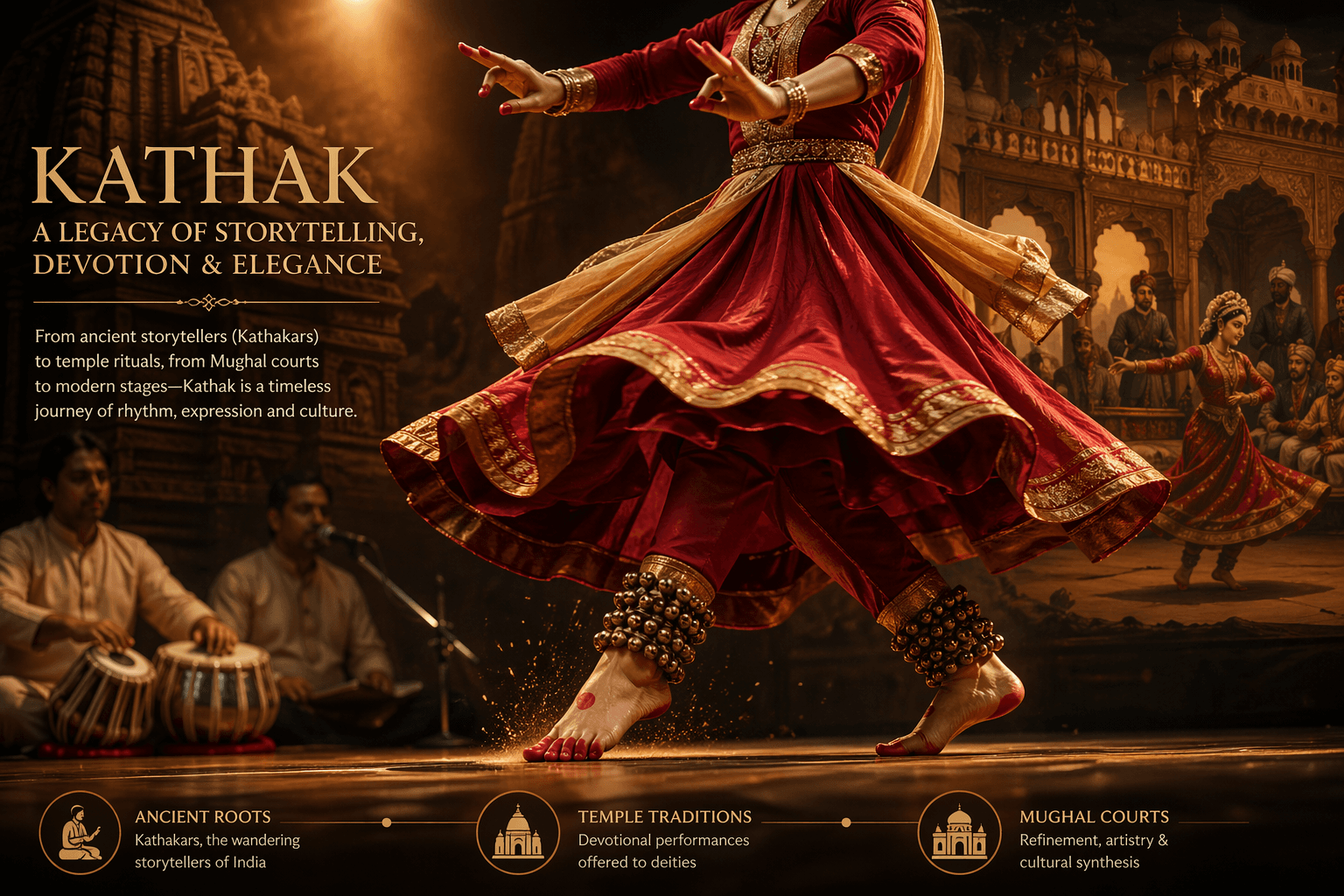
According to Britannica, Kathak traces its roots to wandering bards of ancient northern India called Kathakars, meaning storytellers. These Kathakars traveled across the Indian subcontinent, narrating stories from Hindu mythology through a combination of expressive movement, music, and dance. The tradition is traceable to as early as 400 BCE according to scholar Mary Snodgrass.
The name Kathak derives from the Sanskrit word "katha," meaning story, and "kathakar," meaning one who tells a story. Every element of Kathak, from the footwork patterns to the mudras (hand gestures) to the facial expressions, serves the purpose of narrative.
The dance form went through several transformative phases:
The Temple Phase
In ancient India, Kathak was performed in temples as a form of devotional offering to deities, particularly Lord Krishna. Compositions depicted stories from the Bhagavata Purana, Ramayana, and the divine love of Radha and Krishna.
The Mughal Court Transformation
During the Mughal era, particularly under Emperor Akbar in the 16th century, Kathak underwent a profound transformation. Persian and Islamic influences were incorporated, adding sophistication to the footwork, spins, and expressive vocabulary. The Mughal court's patronage elevated Kathak from temple ritual to refined court entertainment.
The Gharana System
Today, Kathak is practiced in three main schools called gharanas, each named after the city where it developed:
The Lucknow Gharana emphasises grace, elegance, and expressive abhinaya. It focuses on delicate emotional storytelling and refined gesture work.
The Jaipur Gharana emphasises powerful, precise footwork, dynamic rhythmic compositions, and athletic spinning technique.
The Banaras Gharana focuses on devotional storytelling, particularly around Krishna, and is known for soulful expression.
Most online Kathak programs available to Indian-American families in the USA teach either Lucknow or Jaipur style, or a blend of both.
Why Kathak Is One of the Best Arts for Indian-American Children

Physical Development and Coordination
Kathak is a serious physical discipline. Research consistently shows that Kathak training significantly improves body coordination, motor skill development, and coordination between movement and sound responses. The tatkaars (rhythmic footwork patterns) build leg strength and stamina. The chakkars (spinning sequences) develop core strength and balance. The hasta movements (hand gestures) build fine motor precision.
For growing children, this combination of physical demands produces benefits that extend well beyond the dance class itself.
Cognitive Development Through Rhythmic Complexity
Kathak's rhythmic system is extraordinarily demanding cognitively. Students learn to:
- Execute tatkaar patterns in multiple rhythmic subdivisions simultaneously
- Memorise complex compositions (tukdas, parans, kaidas) that run across multiple tala cycles
- Maintain tala awareness while performing intricate footwork and hand gestures together
A landmark study published in Frontiers in Neuroscience found that structured performing arts training significantly improves children's short-term memory, language-based reasoning, and planning. The cognitive demands of Kathak's rhythmic complexity provide exactly the type of structured, demanding engagement that drives these improvements.
Cultural Identity and Heritage Connection
For NRI children growing up in the USA, Kathak provides one of the most direct and meaningful connections to their North Indian heritage. Research on diaspora communities published in the International Social Science Journal confirms that active engagement with heritage arts forms is a powerful mechanism for ethnic identity formation and maintenance.
When a child in Columbus, Ohio learns the same Lucknow Gharana tatkaar that their grandparents knew in Lucknow, they are participating in a living tradition that spans continents and centuries.
Discipline, Focus, and Emotional Intelligence
Kathak requires students to be completely present during practice. The simultaneous coordination of rhythm, movement, and expression builds focus and sustained attention. Research published in Frontiers in Psychology (2025) confirms that structured performing arts training improves inhibitory control (the ability to focus attention and resist distraction) in children. For parents of children who struggle with focus in academic settings, this makes Kathak particularly valuable.
The abhinaya component of Kathak (expressive storytelling through facial expression and gesture) simultaneously builds emotional intelligence, giving children a sophisticated vocabulary of emotional expression.
Building Confidence Through Performance
Kathak students regularly perform in recitals, cultural events, and competition settings from early in their training. The experience of preparing for and delivering a public performance, particularly as that performance improves over time, builds a deep, earned confidence that transfers into other areas of life. Many parents report significant improvements in their child's classroom participation and social confidence within months of starting Kathak.
What Age Should Your Child Start Kathak Classes?

The Ideal Starting Age for Kathak
Most qualified Kathak teachers recommend starting children between ages 6 and 8. Katha Dance Theatre, a well-respected Kathak institution in Minnesota, specifically requests that children be at least 6 years old before beginning formal training, as this is when most children have developed the body awareness and coordination that Kathak's classical movements require.
Starting at 5 is possible with introductory programs that focus on rhythm awareness, basic body movement, and simple coordination games before formal technique is introduced. Full tatkaar technique is typically appropriate from age 6 onward.
Starting Older: What to Expect for Children Ages 8-12
Children who begin Kathak between ages 8 and 12 are excellent candidates for rapid foundational progress. Older children have greater cognitive maturity, stronger existing body coordination, and the ability to understand and internalise technique explanations more quickly. Many catch up to age-6 starters within 12-18 months of consistent training.
Boys and Kathak
Kathak has a proud tradition of male practitioners. Some of the greatest Kathak masters of the modern era, including the legendary Pandit Birju Maharaj, were men. The Jaipur Gharana's athletic, powerful style is particularly associated with male dancers. Parents of sons interested in Kathak should be warmly encouraged: there is nothing more fitting than a young Indian-American boy learning the same tradition their great-grandfathers practiced.
How Online Kathak Classes Work in Practice
The Live Video Call Format
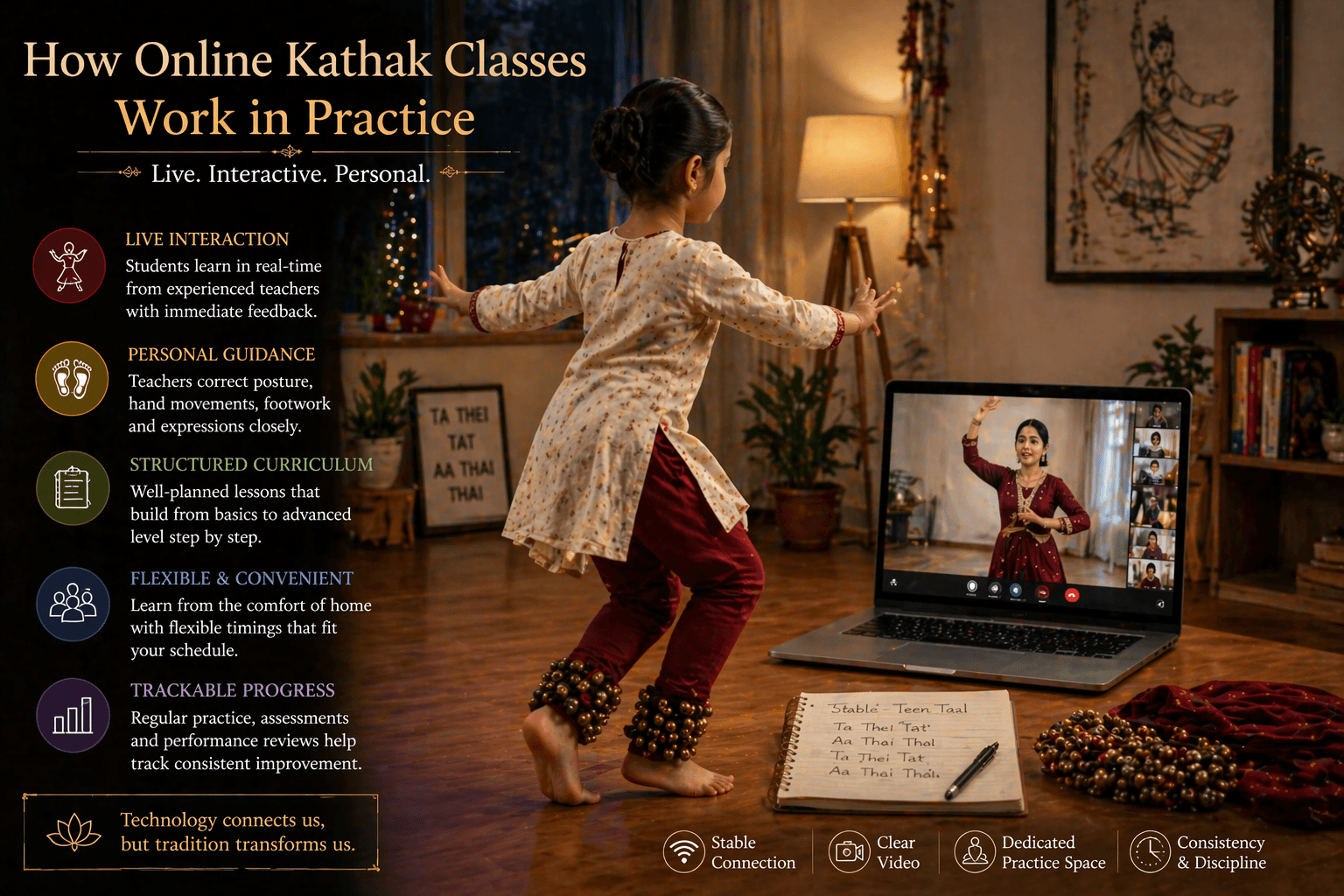
Online Kathak lessons are delivered through live video calls on platforms like Zoom or Google Meet. The format is highly effective for Kathak because:
- The teacher can clearly see the student's footwork, hand positions, and posture
- Real-time verbal corrections can be given as the student is performing
- Bol recitation (speaking the rhythmic syllables aloud) works perfectly in a video call format
- Performances can be recorded for review and self-assessment
What a Typical Beginner Session Looks Like
Opening Warm-Up (5-7 Minutes)
Gentle stretches for the ankles, knees, and lower back. Simple coordination warm-ups. The teacher may also include brief bol recitation to settle the student into rhythmic awareness before movement begins.
Tatkaar Foundations (10-15 Minutes)
The first months of Kathak training are built almost entirely on tatkaar, the rhythmic footwork that is the heartbeat of the dance. The teacher demonstrates a new tatkaar pattern or reviews a previously introduced one. The student repeats, the teacher corrects in real time.
Bol Work (5-8 Minutes)
Bol is the verbal recitation system unique to Indian classical music and dance. Kathak bols (such as ta, thei, thet, tat) are the syllables that name each rhythmic unit. Students learn to speak these aloud as they perform movements. This verbal-physical integration builds rhythmic precision at a neurological level and is one of the unique features of Kathak pedagogy.
Compositional Work (8-10 Minutes)
Once foundational tatkaars are established (typically from month 3 onward), the teacher introduces tukdas (short compositional phrases) that combine tatkaar with hasta movements and simple abhinaya. This is where Kathak begins to feel like a complete art form.
Review and Practice Assignment (3-5 Minutes)
The teacher reviews what was covered, identifies the specific elements to practise at home, and answers any questions.
Setting Up Your Home for Online Kathak
Floor space: A clear area of approximately 6 feet by 4 feet with a hard floor (wood, tile, or thin mat) is ideal. Thick carpet muffles tatkaar sounds and makes it harder to develop rhythmic precision.
Camera position: Position your device so the camera captures your child's full body from head to feet. The teacher needs to see the footwork clearly.
Clothing: Comfortable, fitted clothes in the early months. As the child progresses, a ghagra (flared skirt for girls) or fitted trousers help the teacher see body line. The teacher will advise.
Ghungroo (ankle bells): Kathak uses ghungroo tied around both ankles. Your teacher will introduce these when the child is ready, typically around months 3-6. A standard beginner set for children is typically 50-75 bells per foot.
What to Look for in an Online Kathak Teacher in the USA

Training Lineage and Gharana Affiliation
A serious Kathak teacher should be able to clearly state which gharana they trained in (Lucknow, Jaipur, or Banaras), who their guru was, and where they completed their formal training. The guru-shishya parampara (teacher-disciple tradition) is central to how Kathak knowledge has been transmitted for centuries.
Formal Examination Credentials
Look for teachers who have completed a Visharad (graduate-level) qualification or equivalent from a recognised examining body. Kathak has a formal, graded examination system with levels from Prarambhik (beginner) through Visharad and beyond.
Experience Teaching Young Children Online
Teaching a six-year-old via video call requires completely different skills from performing on stage or teaching adults in a studio. Ask specifically about the teacher's experience with young beginners and ask them to describe how they keep children engaged through online sessions.
A Free Trial Class
Without exception, trial before you commit. One 30-minute session tells you far more about a teacher's quality, warmth, and effectiveness than any profile description.
At Art Gharana, our Kathak teachers are certified, experienced, and deeply committed to the Indian-American diaspora community. Explore our dance courses or read our article on connecting with roots through Indian classical dance.
Common Challenges and How to Overcome Them
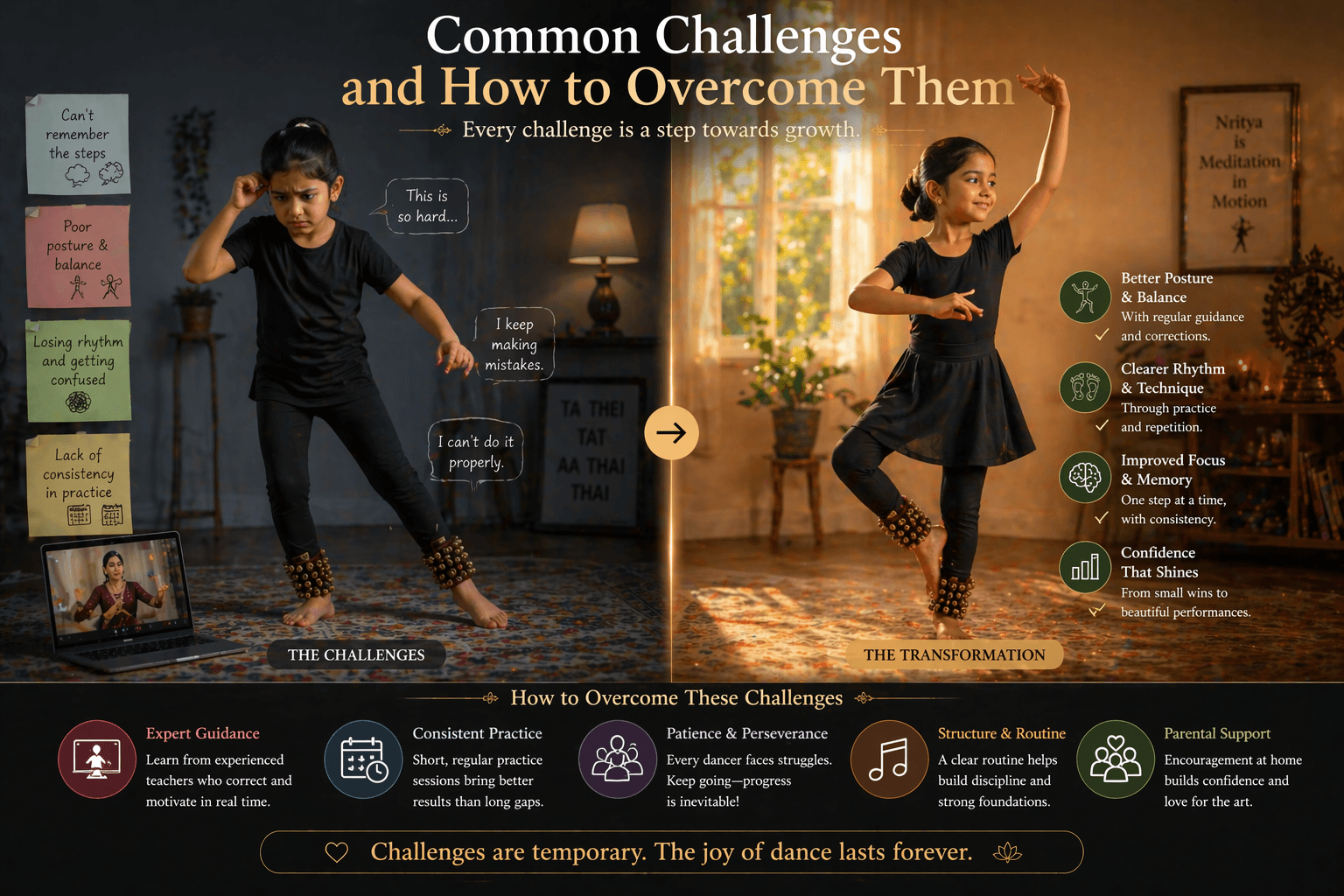
Challenge 1: Difficulty Maintaining the Aramandi Posture
The semi-seated stance (aramandi) that is the foundational Kathak posture is physically demanding for children who are new to it. Thighs burn, knees ache, and children often want to stand up straight. This is completely normal.
Solution: The teacher will prescribe specific strengthening exercises. At home, practise the aramandi for 30-second holds while watching TV, then gradually extend the duration. The muscles adapt within 4-6 weeks of consistent practice.
Challenge 2: Ghungroo Coordination
Many children find it confusing initially to hear the bells on their feet making sounds that don't always match their intentions. This self-consciousness is temporary.
Solution: Practise basic tatkaar without ghungroo for the first few months to build clean technique. Add the ghungroo only once the teacher confirms the tatkaar pattern is correct.
Challenge 3: Maintaining Practice Between Lessons
The most common reason for slow progress in any classical art form is inconsistent home practice between lessons.
Solution: Build a specific 15-20 minute daily practice routine at the same time every day. Attach it to an existing routine (after school, before dinner). Make it non-negotiable and brief. Short, consistent daily practice is dramatically more effective than longer, sporadic sessions.
Conclusion
Kathak is one of India's most extraordinary cultural treasures. For Indian-American children growing up in the USA, learning it is simultaneously a physical discipline, a cognitive challenge, a cultural homecoming, and a form of artistic expression that they can carry with them for life.
Three things to take away. First, start between ages 6 and 8 for the optimal foundation, but older beginners thrive too. Second, look for a teacher with formal gharana training, verifiable credentials, and genuine experience teaching children online. Third, set up a proper practice space at home and build a consistent daily routine from the start.
At Art Gharana, we offer live 1:1 online Kathak classes for children across the USA, taught by certified instructors who understand both the classical tradition and the needs of diaspora learners. Book a free trial class today and give your child the gift of this extraordinary tradition.
Frequently Asked Questions
1. How long does it take for a child to learn basic Kathak online?
Most children develop a solid foundation in basic tatkaar, key hasta mudras, and a simple rhythmic composition within 6-12 months of consistent weekly lessons and daily home practice. Children who practise 15-20 minutes three to four days per week typically progress significantly faster than those who only practise immediately before their lesson.
2. Do boys learn Kathak dance?
Absolutely. Kathak has a rich and celebrated tradition of male dancers. The Jaipur Gharana in particular is known for its powerful, athletic male performance style. Legendary masters including Pandit Birju Maharaj were men. Boys who study Kathak develop exceptional physical strength, rhythmic precision, and artistic expression.
3. Can a child learn Kathak online without any prior dance experience?
Yes. Online Kathak classes for complete beginners are designed specifically for children who have never danced before. The teacher starts from the very first principles: basic posture, simple tatkaar patterns, and introductory bol recitation. No prior experience of any kind is necessary.
4. What is the difference between Kathak and Bharatanatyam for a parent choosing between the two?
Kathak originates in North India and is associated with Hindustani classical music and Mughal court culture. It features flowing movements, dynamic spins, and rhythmic footwork. Bharatanatyam originates in South India (Tamil Nadu) and accompanies Carnatic music, featuring more angular postures, structured adavu sequences, and deep knee bends. The choice often follows family regional background.
5. How much do online Kathak classes for kids cost in the USA?
Private 1:1 online Kathak lessons with a certified instructor typically range from $25 to $75 per session in the US, depending on teacher experience, session length, and platform. Many platforms offer monthly subscription packages that reduce the per-session cost. Always look for a free trial before any financial commitment.