ChatGPT
 Google AI
 Grok
Grok Claude
Bharatanatyam is one of India's oldest and most revered classical dance forms, tracing its origins to the temples of Tamil Nadu over 2,000 years ago. For British-Indian families across the UK, the question of where to find qualified online Bharatanatyam classes for children is one of the most common and most important questions in South Asian arts education. This complete guide covers what Bharatanatyam is, how the learning journey unfolds year by year, what to look for in a qualified online teacher, how to set up at home, and how to get your child started from anywhere in Britain.
Somewhere in the UK right now, a young girl is preparing for her Bharatanatyam arangetram. She's been training for seven years. She knows dozens of adavus, several varnams, and a complete margam by heart. Her performance next month will be a two-hour solo showcase attended by family, community members, and teachers who have watched her grow from a shy six-year-old to a confident young artist.
What made this possible wasn't geography. She lives in Sheffield. There are no Bharatanatyam studios in walking distance. Everything she has learned, she has learned through live, 1:1 online classes.
This is the reality of online Bharatanatyam classes for children in the UK in 2026. The geographic barriers are gone. What remains is finding the right teacher.
Bharatanatyam: History, Origins, and Cultural Significance
The Ancient Temple Origins
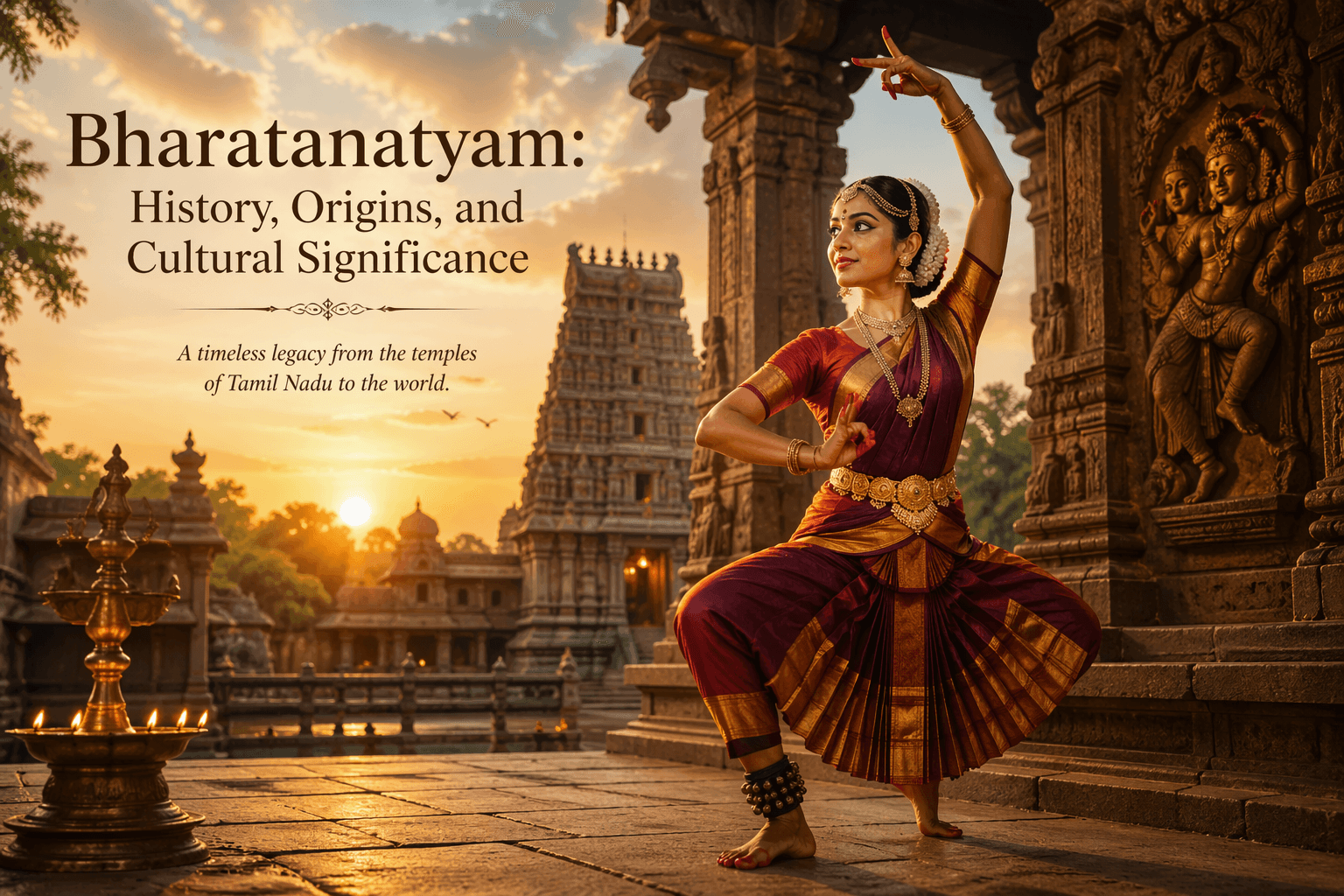
Bharatanatyam is widely regarded as the oldest of all Indian classical dance forms, with origins in the temples of Tamil Nadu in South India. According to the Centre for Cultural Resources and Training, India, the form has documented roots in the Natya Shastra, the ancient Sanskrit treatise on performance arts attributed to the sage Bharata Muni and dated to approximately 200 BCE to 200 CE.
The dance was historically performed by Devadasis, women dedicated to temple service who used dance as a form of devotion to the deity. These women were the custodians of the entire repertoire of compositions, expressions, and techniques that constitute Bharatanatyam.
The Name and Its Meaning
The name Bharatanatyam is decoded in two ways:
Compositional meaning: Bha (Bhava — expression), Ra (Raga — melody), Ta (Tala — rhythm), and Natyam (dance). The name itself describes the complete integration of expression, melody, and rhythm that defines the form.
Attributed to the sage Bharata: Some scholars trace the name to the Natya Shastra's attributed author, Bharata Muni, acknowledging the text as the foundational source of the art form's principles.
Colonial Suppression and the 20th Century Revival
During British colonial rule in India, the Devadasi system was legally abolished and Bharatanatyam was stigmatised by colonial administrators who mischaracterised its practitioners. The dance form came close to disappearing entirely.
Its survival and flourishing today is largely owed to one extraordinary woman: Rukmini Devi Arundale, an Indian dancer, activist, and cultural reformer. In 1936, she performed Bharatanatyam publicly for the first time in a non-temple setting, and in 1936 she founded Kalakshetra, a cultural academy near Chennai, establishing the systematic pedagogical structure that modern Bharatanatyam teaching worldwide is based on.
Today Bharatanatyam is performed on stages worldwide, taught in diaspora communities across six continents, and is officially recognised by the Government of India as one of the country's eight classical dance forms.
The Three Pillars of Bharatanatyam Performance
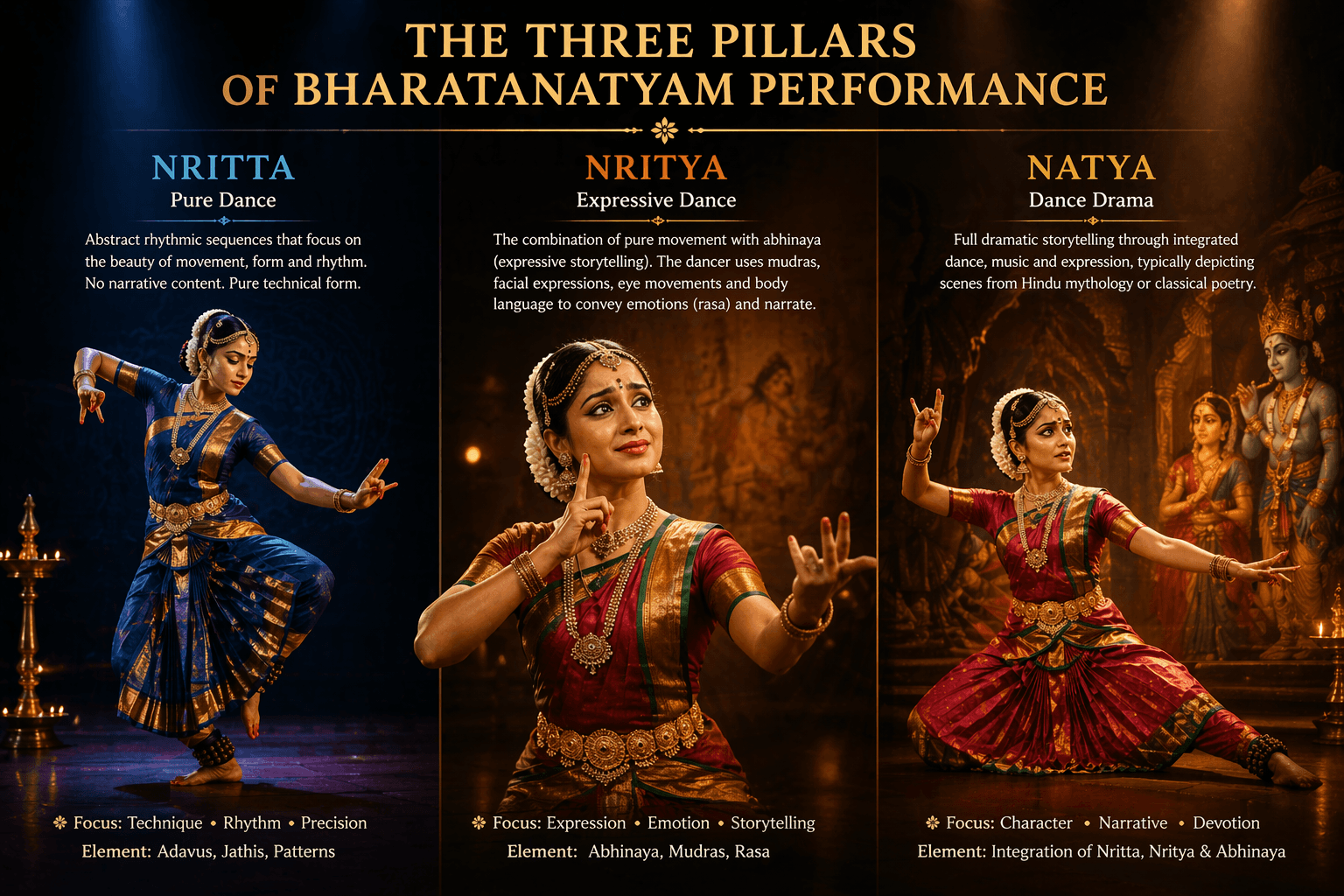 All Bharatanatyam performance integrates three distinct modes of expression:
Nritta (pure dance): Abstract rhythmic sequences that focus on the beauty of movement, form, and rhythm. No narrative content. Pure technical form. This is where students spend most of their early training years.
Nritya (expressive dance): The combination of pure movement with abhinaya (expressive storytelling). The dancer uses mudras, facial expressions, eye movements, and body language to narrate a story or convey a specific emotional state (rasa).
Natya (dance drama): Full dramatic storytelling through integrated dance, music, and expression, typically depicting scenes from Hindu mythology or classical poetry.
The Bharatanatyam Learning Journey: Year by Year
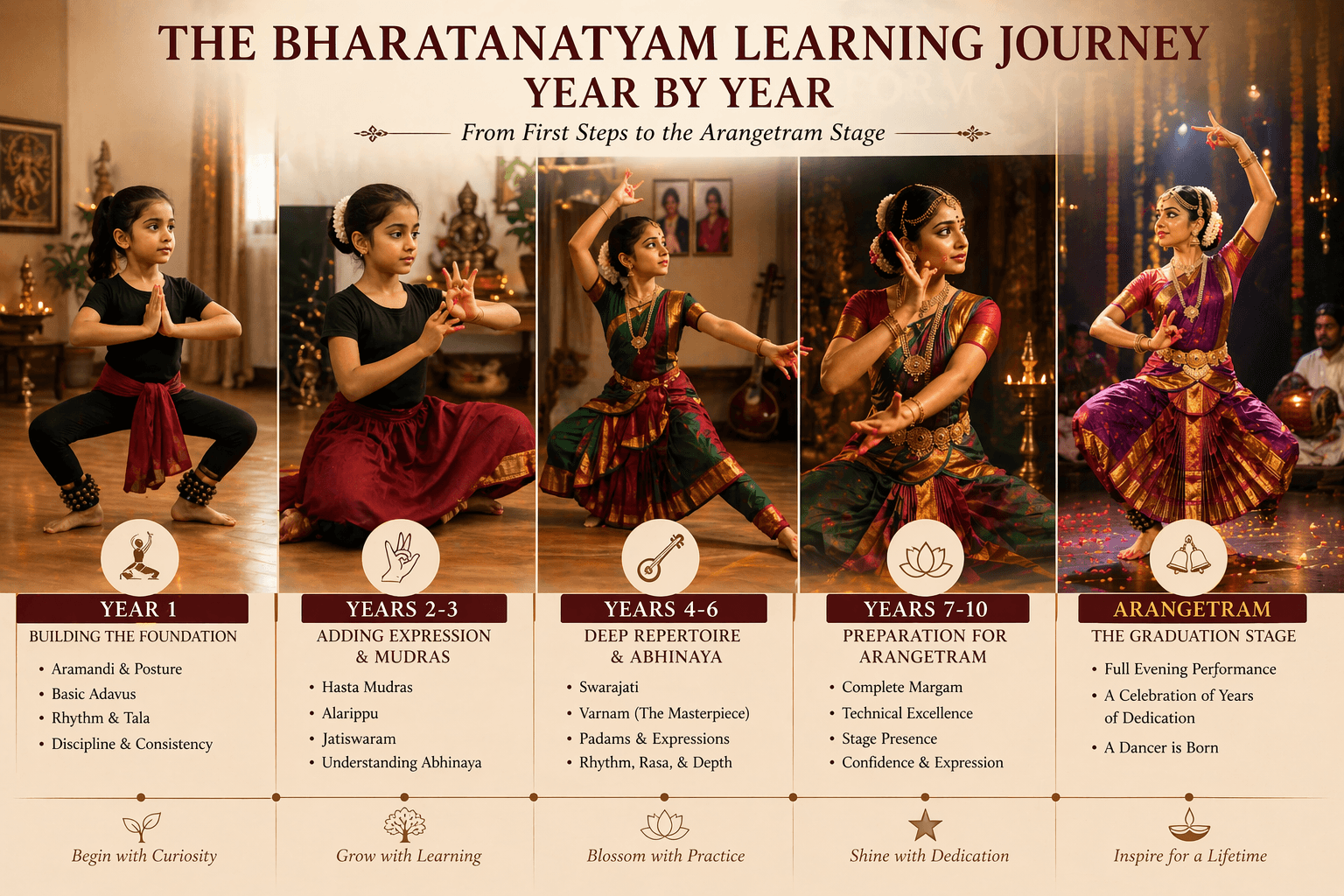
Year 1: Building the Foundation
The first year of Bharatanatyam is entirely about building the physical and rhythmic foundation. Two elements dominate:
Aramandi: The Foundation Posture
The aramandi is Bharatanatyam's defining foundational posture: heels together, toes turned out, knees bent into a plié, spine upright. It looks simple. It isn't. Maintaining proper aramandi requires significant strength in the inner thighs, quadriceps, calves, and lower back.
For most children, aramandi feels uncomfortable initially. This is normal. The muscles develop within four to six weeks of regular practice. Teachers typically introduce brief aramandi holds (30 seconds, gradually extended) before asking students to perform adavus in the posture.
Adavus: The Building Blocks of All Bharatanatyam
Adavus are the fundamental movement units of Bharatanatyam, the equivalent of scales in music. According to Raaga School of Music, there are more than 60 adavus traditionally taught in Bharatanatyam, grouped into different categories. Each adavu family consists of several variations that increase in complexity.
The first adavus a beginner learns:
Tatta Adavu: The most basic adavu. Stamps of the foot in specific rhythmic patterns while in aramandi. "Tatta" means "stamp" in Tamil. This adavu develops fundamental footwork coordination and introduces the student to tala (rhythmic cycle) practice.
Natta Adavu: Involves a stretched-leg movement (striking out with the heel) while simultaneously coordinating arm positions. More complex than tatta in its spatial demands.
Visharu Adavu: An adavu involving a sliding or spreading movement. Introduces the student to lateral weight shifting within aramandi.
Each adavu is taught with its corresponding jathi (rhythmic syllables spoken aloud by the teacher and student, equivalent to bol recitation in tabla), practiced in three speeds: slow (vilambita), medium (madhyama), and fast (druta).
According to Katha Dance Theatre, beginning students typically spend the first year primarily on adavus, with the goal of developing clean technique in 6-8 adavu families before compositions are introduced.
Year 2-3: Adding Expression and Mudras
Once the foundational adavus are established, training expands to:
Hasta Mudras (Hand Gestures)
Bharatanatyam uses a comprehensive system of hand gestures (hastas or mudras) drawn from the Abhinaya Darpana, a 10th-century treatise on dance. There are two categories:
Asamyukta Hasta (single-hand gestures): 28 gestures performed with one hand. Each has a specific name (Pataka, Tripataka, Ardha Pataka, Kartarimukha, etc.) and multiple specific meanings depending on context.
Samyukta Hasta (double-hand gestures): 24 gestures performed with both hands. These often represent specific objects, relationships, or concepts.
Students learn hastas through dedicated practice sessions that combine memorisation of the gesture shapes with understanding of their meanings. This vocabulary then becomes the expressive language of abhinaya.
Alarippu: The First Complete Composition
The alarippu is typically the first complete Bharatanatyam composition a student learns. It is an invocatory piece that begins every classical Bharatanatyam performance, gradually warming up all parts of the body systematically from head to foot. Learning the alarippu is a significant milestone: it means the student can perform a complete, structured composition from beginning to end.
Jatiswaram: Swara-Linked Dance
A composition that pairs specific swaras (musical notes) with specific adavu sequences. It develops the student's ability to connect music and movement directly.
Year 4-6: Deep Repertoire and Abhinaya
Swarajati
A structured composition that combines swara passages with sahitya (lyrics) and develops the student's abhinaya to a deeper level.
Varnam: The Masterpiece of Intermediate Training
The varnam is the centrepiece of a Bharatanatyam performance and the defining achievement of intermediate-level training. A full varnam can last 30-45 minutes in concert settings. It combines pure dance sequences (nritta), expressive passages (nritya), and all elements of the dancer's technical and expressive vocabulary. Learning a full varnam typically takes one to two years of dedicated work.
Year 7-10: Preparation for Arangetram
The arangetram is the formal graduation solo performance. An evening-length showcase of 2-3 hours covering the complete margam (programme structure) of Bharatanatyam:
- Pushpanjali (invocatory offering)
- Alarippu
- Jatiswaram
- Swarajati
- Varnam (the centrepiece)
- Padams/Javalis (expressive pieces)
- Thillana (celebratory conclusion)
- Mangalam (benediction)
The arangetram represents a significant cultural, familial, and artistic event in British-Indian communities. It is celebrated with traditional costumes, live music (or high-quality recordings), and an audience of family, friends, and community members.
How Online Bharatanatyam Classes Work in the UK
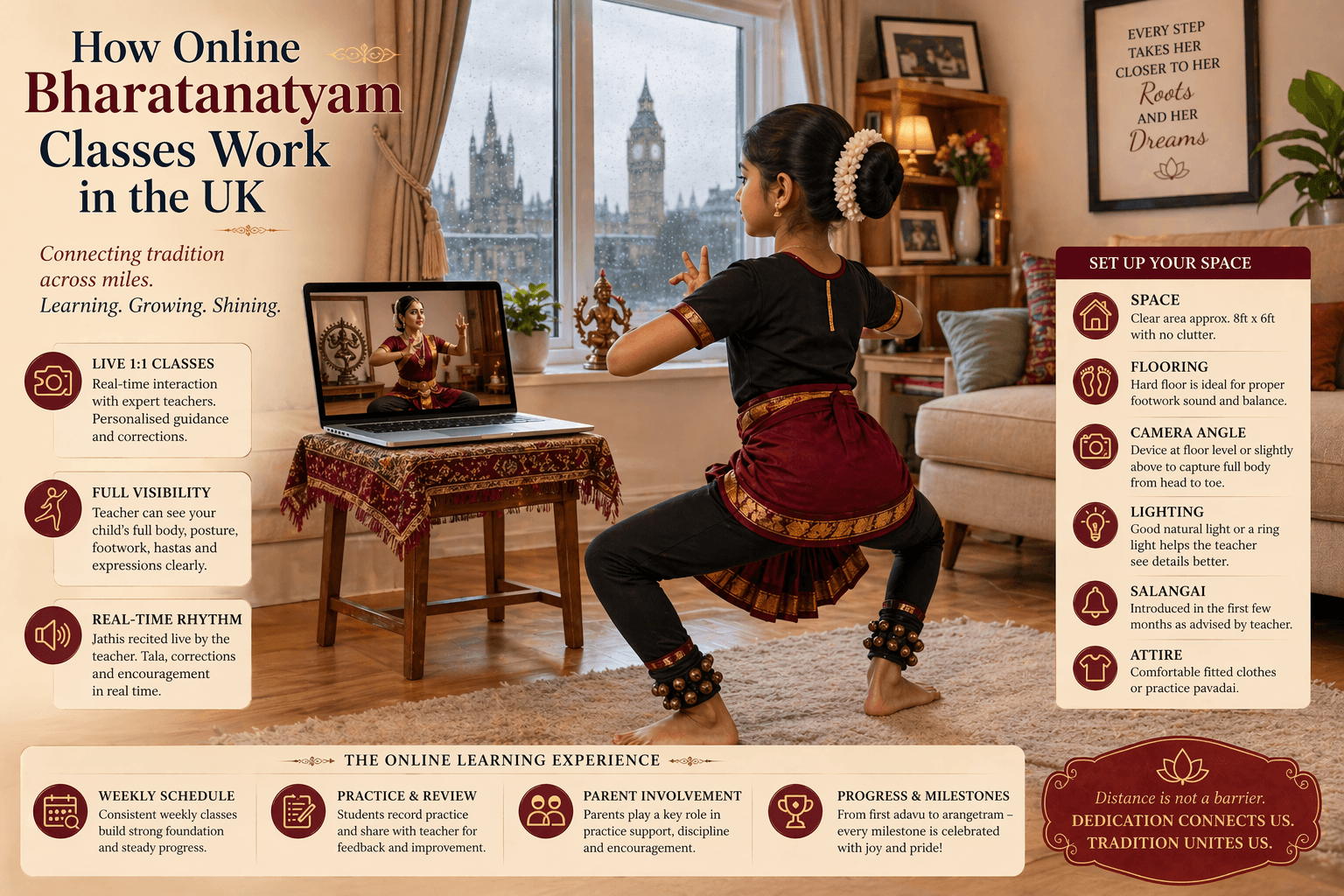
The Live Video Call Format and Why It Works
Online Bharatanatyam is delivered through live video calls (Zoom, Google Meet, or dedicated platforms). The teacher can clearly see:
- The student's full body from head to feet
- Footwork patterns and contact with the floor
- Arm positions and hasta shapes
- Facial expressions and eye movements (in close-up when needed)
- Overall posture and aramandi quality
Real-time verbal corrections, demonstrations, and jathi recitation all work effectively through a video call. Many teachers also use screen-sharing to show specific reference points from classical texts or to review recordings of students' practice.
Setting Up Your Home for Online Bharatanatyam
Floor Space Requirements
A clear area of approximately 8 feet by 6 feet minimum is ideal. Hard flooring (wood, tile, or laminate) is strongly preferred. Thick carpet:
- Muffles the sound of tatta adavus, making it harder to develop rhythmic precision
- Reduces the proprioceptive feedback that helps students feel correct foot placement
- Is genuinely problematic for developing accurate Bharatanatyam footwork
If your practice space is carpeted, consider a large hardwood or vinyl dance floor tile set (available online from £40-80) placed over the carpet.
Camera Position
Position your device (laptop, tablet, or a phone on a stand) at floor level or slightly above, angled to capture your child's complete figure from head to feet. This allows the teacher to see all essential technical elements simultaneously. A ring light or good natural lighting significantly improves the teacher's visibility of subtle movements.
Clothing
In the early months, comfortable fitted clothes (leggings, fitted t-shirt) allow the teacher to see body lines clearly. As the child progresses, a practice pavadai (traditional practice skirt) is recommended as it:
- Allows the teacher to see the leg and foot positions clearly
- Begins to feel "right" for the art form
- Develops the student's physical sense of performing in a dance context
Salangai (Ankle Bells)
Bharatanatyam uses salangai (sets of bells tied around both ankles) that produce the characteristic rhythmic sound of the footwork. Your teacher will advise on when to introduce them, typically within the first three to six months. A standard beginner set of approximately 100 bells per ankle is the traditional starting amount.
What to Look for in an Online Bharatanatyam Teacher in the UK
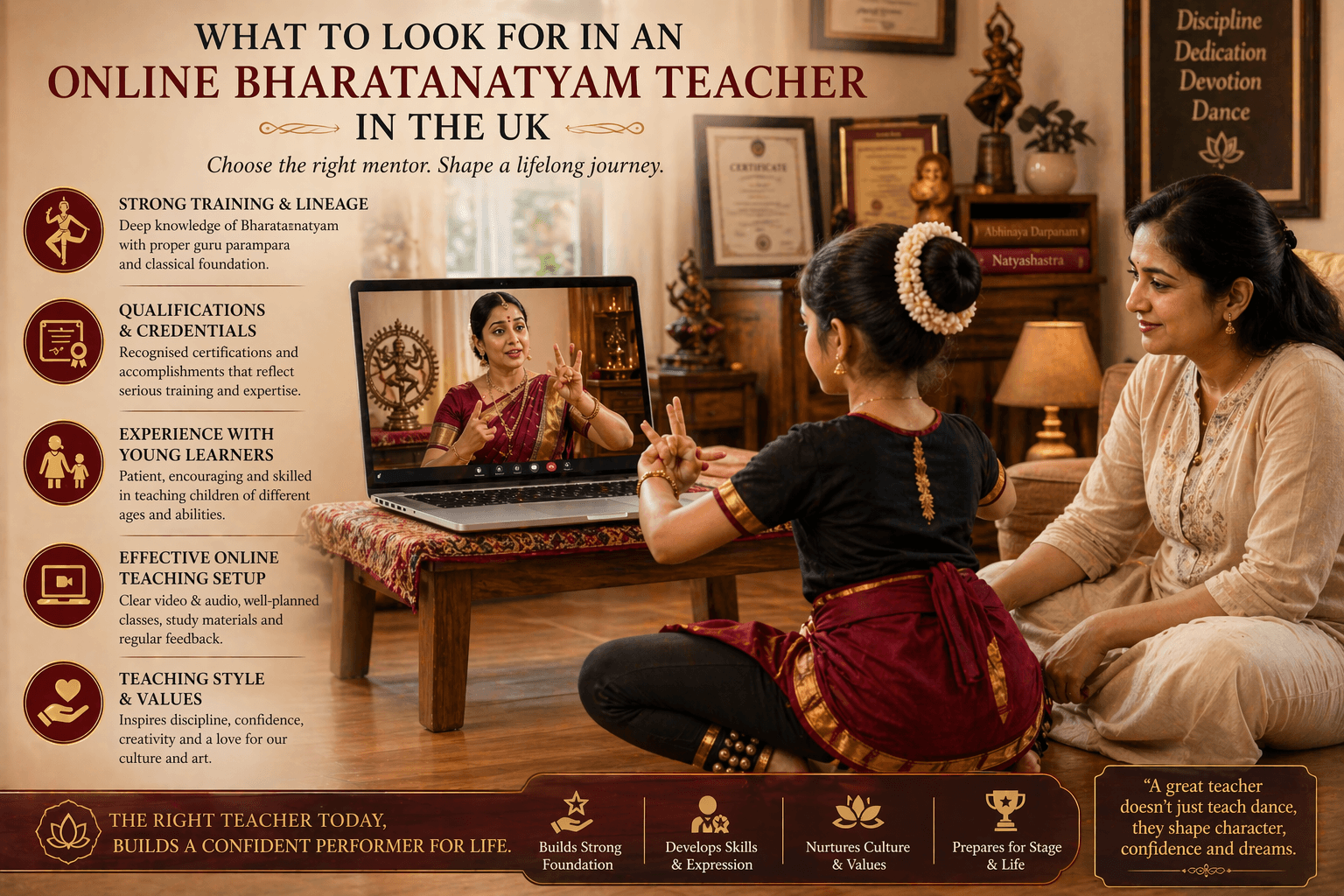
Non-Negotiable Qualifications
Training Lineage and Style (Bani)
Bharatanatyam has several distinct styles (banis), each rooted in a specific teaching lineage:
- Kalakshetra Bani: The style associated with Rukmini Devi's Kalakshetra institution. Known for pure, austere classical form.
- Pandanallur Bani: From the Thanjavur district. Slightly more energetic footwork emphasis.
- Vazhuvoor Bani: Known for lyrical grace and expressive quality.
- Mellattur Bani: Strong nritta technique with delicate abhinaya balance.
A qualified teacher should clearly state their training lineage, who their primary guru was, and which bani they transmit. This is not pedantic: it indicates they received structured, traceable training.
Formal Examination or Institutional Credentials
Look for teachers who have completed examinations at Kalakshetra, Bharatiya Vidya Bhavan, or equivalent recognised institutions, or who have completed formal diploma/degree programmes in Bharatanatyam from recognised Indian universities.
Online Teaching Experience and Methodology
Ask specifically how the teacher adapts for online format. An experienced online teacher has:
- A clear camera setup protocol for students
- Specific verbal cueing techniques for corrections without physical demonstration
- Methods for reviewing student recordings between lessons
- Experience keeping young children engaged through a video call format
Experience with Younger Children
Teaching a six-year-old on a video call is genuinely different from teaching adults in a studio. Ask specifically about the teacher's experience with young beginners and how they structure sessions for different age groups.
At Art Gharana, our Bharatanatyam teachers are certified, experienced, and dedicated to the British-Indian community. Explore our Bharatanatyam classes and read about how Bharatanatyam benefits children in the diaspora.
Bharatanatyam and UK Cultural Education
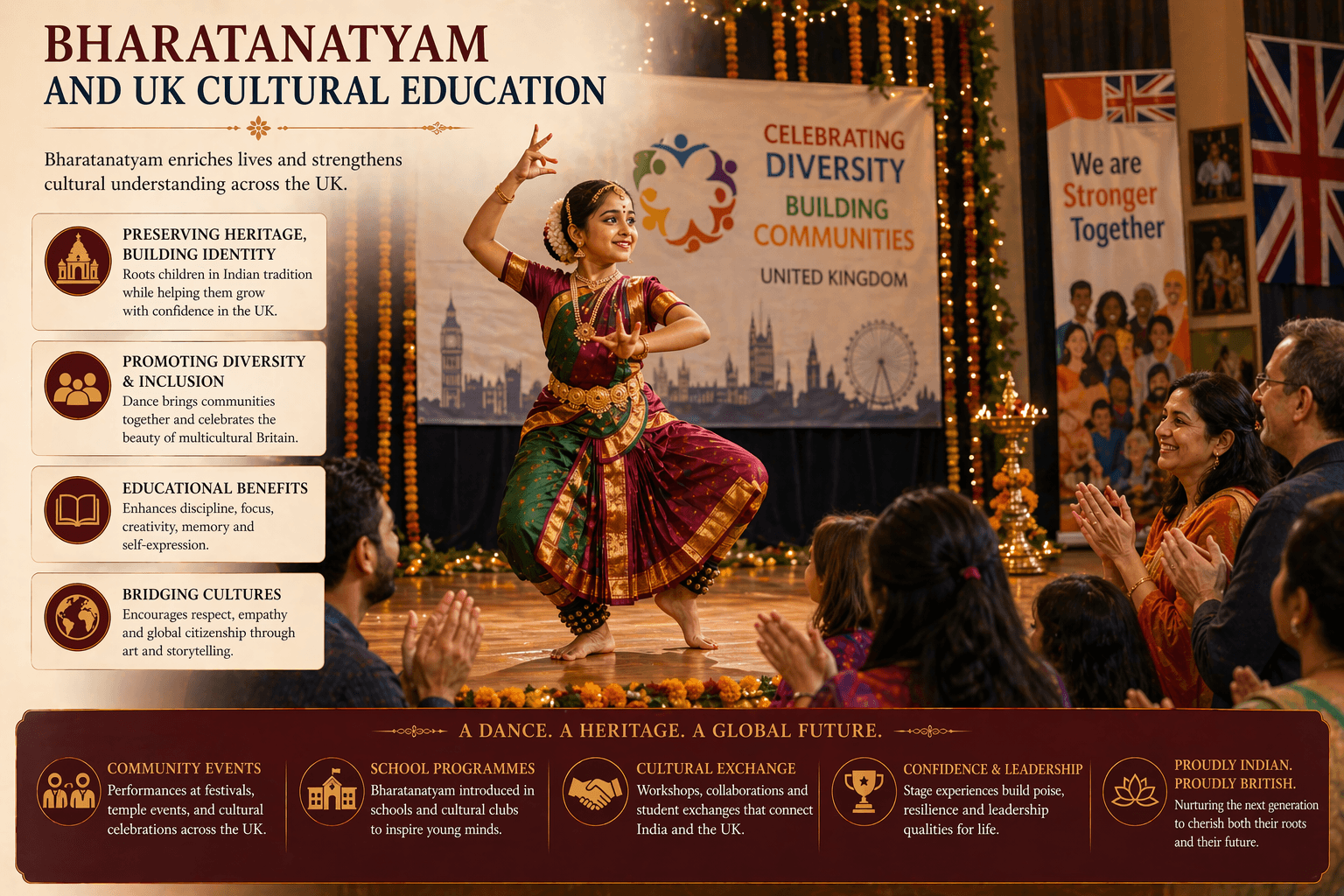
Bharatanatyam in British Schools and Cultural Settings
Bharatanatyam's presence within British education has grown significantly. The Imperial Society of Teachers of Dancing (ISTD) offers South Asian dance qualifications. Several state and independent schools with significant South Asian student populations have begun including Bharatanatyam within their arts programmes.
Within the British-Indian community, Bharatanatyam:
- Is central to cultural events at temples, community centres, and Indian cultural associations
- Is a common performance element at Diwali, Navratri, and other festival celebrations
- Is recognised by the India-UK cultural partnership as a living heritage form
UK Examinations and Competitions for Bharatanatyam
Several pathways exist for formal recognition:
ISTD South Asian Dance Faculty: Offers graded examinations in South Asian dance forms including Bharatanatyam. Some qualifications are Ofqual-regulated. Check the ISTD website for current qualification details.
UK Natyanjali and temple arts festivals: Annual performance and competition events organised by South Indian temple communities across the UK.
Dance Bharatam / British Indian cultural associations: Various regional competitions and performance showcases recognise young Bharatanatyam performers at different levels.
Conclusion
Bharatanatyam is not just a dance form. It is a living cultural heritage, a physical discipline, a spiritual practice, and an extraordinary form of artistic expression. For British-Indian children growing up in the UK, learning it is one of the most powerful acts of cultural connection available to them.
Three things to take away. First, look for a teacher with clear training lineage, formal credentials, and genuine experience with young children online. Second, hard flooring and proper camera positioning are non-negotiables for effective online learning. Third, commit to consistent weekly lessons and daily practice. Bharatanatyam rewards consistency above everything else.
Art Gharana offers live 1:1 online Bharatanatyam classes for children across the UK. Book a free trial class today and begin your child's journey into this magnificent tradition.
Frequently Asked Questions
1. What age should a child start Bharatanatyam in the UK?
Most Bharatanatyam teachers recommend starting children between ages 5 and 7. At age 5 or 6, children can manage structured 30-minute lessons and are in the optimal neurological window for developing motor skills and rhythmic coordination. Starting between ages 8 and 12 is equally effective musically and technically.
2. How long does it take to reach arangetram standard?
The arangetram (graduation solo performance) is typically performed after 6-10 years of consistent training, depending on lesson frequency (weekly versus twice weekly) and home practice consistency. Students who practise daily and have twice-weekly lessons tend to reach arangetram readiness faster.
3. Are there UK-based Bharatanatyam competitions or examinations?
Yes. The ISTD offers South Asian dance qualifications. Various South Indian cultural organisations and temple committees across the UK organise annual Bharatanatyam competitions and cultural performances.
4. Can my child learn Bharatanatyam online without any prior dance experience?
Absolutely. Online Bharatanatyam classes for complete beginners are designed for children who have never danced before. The teacher starts from absolute fundamentals: samapadam posture, aramandi, and the first tatta adavu sequences.
5. What is the difference between Bharatanatyam and Kuchipudi?
Bharatanatyam originates in Tamil Nadu and is characterised by sharp, geometric movements, strong stamping footwork, and a highly codified adavu vocabulary. Kuchipudi originates in Andhra Pradesh and typically features more fluid, circular movements and includes dance-drama elements. Both are classical dance forms but have distinct technical identities.