ChatGPT
 Google AI
 Grok
 Claude

Many Australian families reach a point in their child's dance journey where a natural question arises. Is there a way to give this learning structure and recognition, a clear marker of progress beyond the next recital piece? For Kathak and Bharatanatyam, the answer is yes, through graded certification, and it is now genuinely accessible online from anywhere in Australia. This guide explains the main certifying bodies, what the exams actually test, how online preparation works, and how to choose the right path for your family, without losing sight of what certification can and cannot do.
Why Certification Matters, and When It Does Not
 Certification gives a child's training a spine. It sets clear milestones, provides external validation from a qualified examiner, and offers a real sense of achievement that keeps motivation strong over the years. For families who value structure, or for a young dancer who thrives on goals, a graded path can transform casual classes into a purposeful journey. That said, certification is never required to enjoy or benefit from classical dance. Many wonderful dancers never sit a single exam. Think of it as a valuable option, not an obligation, and pursue it because it suits your child, not because it is expected.
The Main Certifying Bodies Explained
Several recognised bodies offer graded examinations in Indian classical dance, and understanding the landscape helps you choose. The Akhil Bharatiya Gandharva Mahavidyalaya Mandal, often called ABGMM or Gandharva Mahavidyalaya, runs a widely respected Indian graded system, beginning with early levels such as Prarambhik and Praveshika and progressing through higher grades, all assessed by an external certified examiner. The Imperial Society of Teachers of Dance, based in London and active internationally, offers recognised graded exams in both Kathak and Bharatanatyam. Newer frameworks such as Bridge Academy provide a standardised Pre Grade to Grade 8 system. Some platforms also hold affiliations with international cultural councils, adding a layer of global recognition that travels well for mobile Australian families.
What a Dance Grade Exam Actually Tests
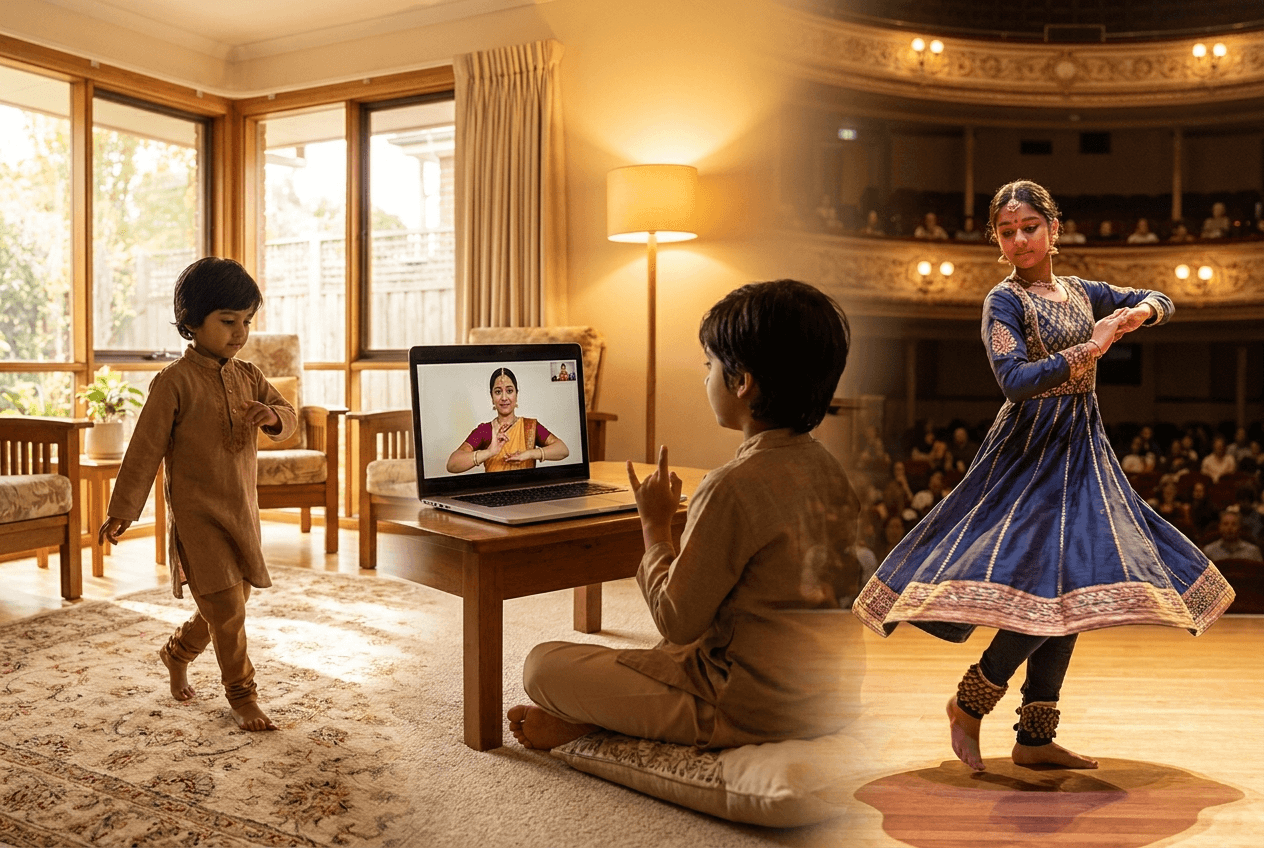 A common worry is that exams might be vague or arbitrary. In reality, graded dance exams are rigorously structured, and most assess three distinct components. The practical tests your technique and repertoire, the actual dancing. The viva, an oral examination, checks that you can name and explain what you perform, from rhythmic terms to the meaning of a piece. The theory, often written, covers history, terminology and the structure of the art form. Knowing these three pillars, practical, viva and theory, lets you and your teacher prepare with purpose rather than guesswork.
Kathak Certification: The Path
For Kathak, a graded path typically moves a student through foundational footwork, the Tatkaar, into compositions such as Todas, Chakradhar Todas, Tihais, Amad and Salami, set in Taal Teentaal, alongside expression and theory. Early ABGMM levels like Prarambhik give way to higher grades as the repertoire deepens, and students learn to perform Padhant, the recitation of rhythmic syllables. Structured Kathak classes build exactly this repertoire step by step, and our blog on learning Kathak for festivals shows how the same skills come alive in performance, which is wonderful motivation between exams.
Bharatanatyam Certification: The Path
For Bharatanatyam, grading follows the classical progression from the foundational adavus into repertoire such as Alarippu, Jatiswaram and Varnam, with expression, or abhinaya, woven throughout. Theory draws on the Abhinaya Darpana and covers hand gestures, the Navarasas and the structure of nritta, nritya and natya. Many Australian schools teach the Kalakshetra style specifically, and well structured Bharatanatyam classes prepare a student for these graded milestones. Our guide to the origin and growth of Bharatanatyam provides the historical grounding the theory papers reward.
Can You Really Prepare for Exams Online?
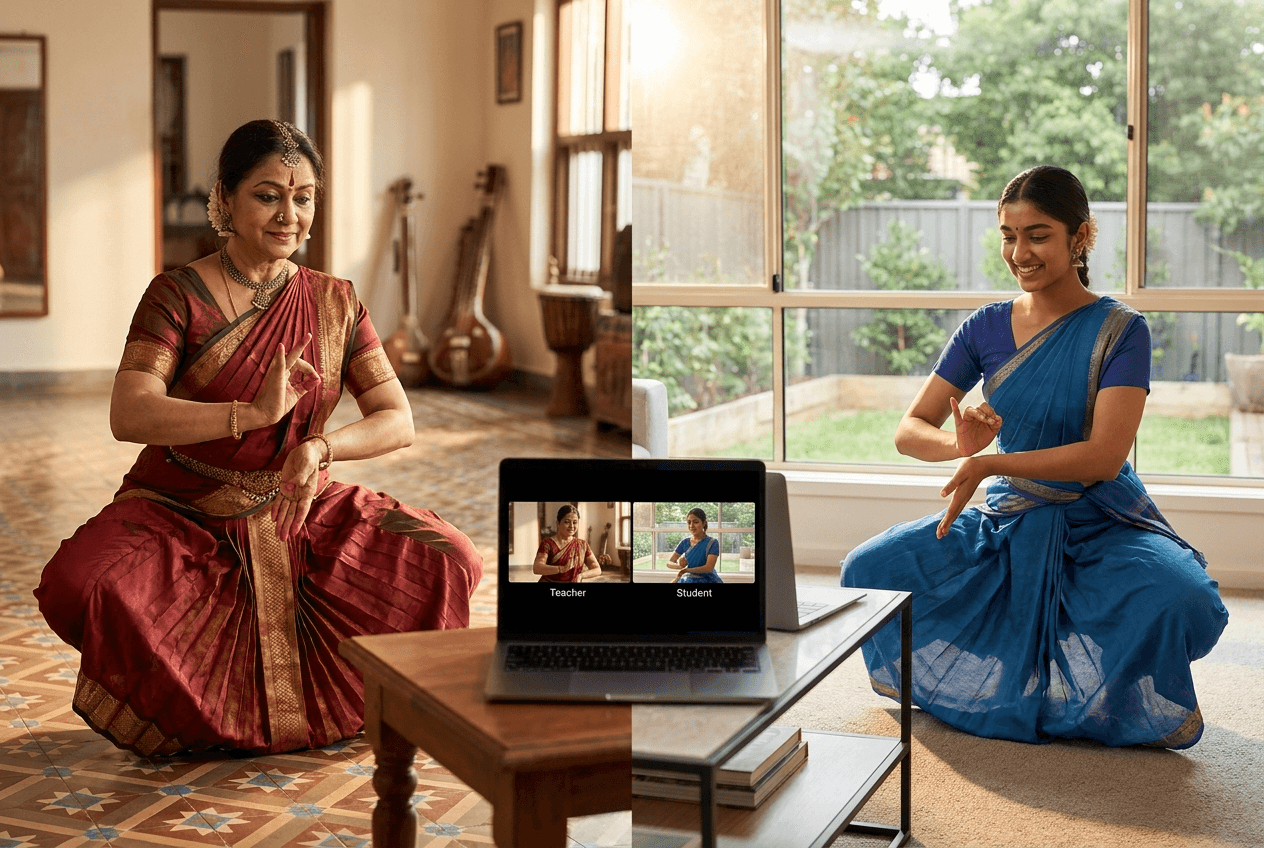
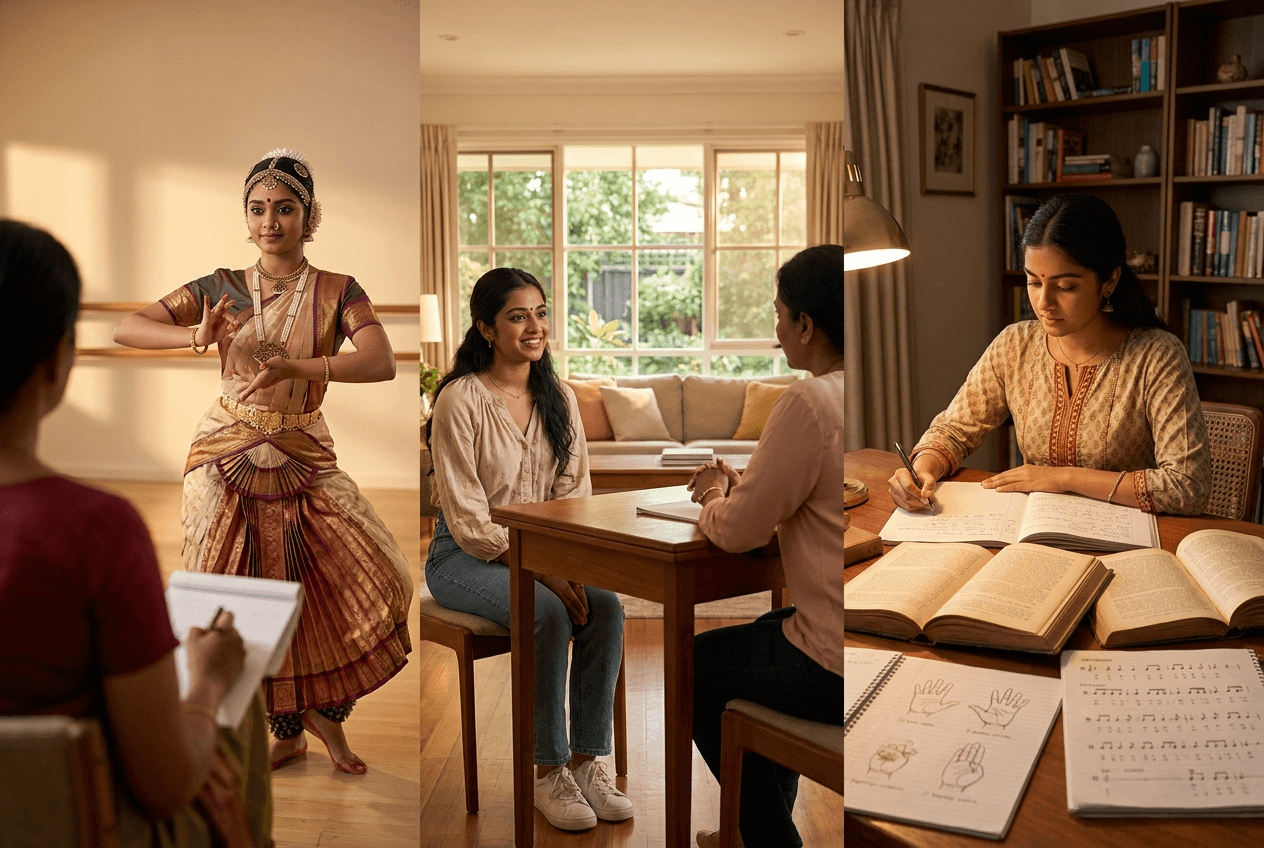 Yes, and increasingly so. With live one to one instruction, a qualified teacher can correct posture, footwork and expression in real time, prepare a student methodically for the practical, viva and theory, and guide them right up to a graded examination. Online learning also removes the geographic barrier that once limited families to whichever teacher happened to live nearby, a real benefit across Australia's distances. Our practical guidance on succeeding in online Bharatanatyam classes covers how to set up a focused practice space and routine, which makes a real difference in the months before an exam.
Age and Starting Points
Most graded systems suggest beginning formal training around the age of seven, when a child can manage the discipline and physical demands, though playful introductory classes can start a little earlier. Crucially, there is no upper age limit. Adults regularly take up Kathak or Bharatanatyam and pursue graded exams successfully, and the early grades are designed to welcome genuine beginners. Wherever your dancer starts, a good teacher will place them at the right level and build toward the first exam at a pace that suits them.
Choosing the Right Path for Your Family
 The right certification depends on your goals. If you want an internationally portable credential, an ISTD path may appeal. If you want a deeply rooted Indian graded system, ABGMM is widely respected. If your family is simply exploring which dance speaks to your child, our overview of South Indian dance forms can help you decide between styles before committing to a grading track. Discuss the options honestly with your teacher, who can recommend a path aligned with your child's level, temperament and ambitions.
What Certification Does Not Replace
It is worth holding certification in perspective. A row of certificates is not the same as a dancer who moves with joy, expression and genuine understanding. The grades are a scaffold for learning, not its purpose. The deeper goals, grace, storytelling, cultural connection and a lifelong love of the art, come from the dancing itself, whether or not an exam is ever taken. Even an energetic form like Bollywood dance reminds us that the joy of movement matters as much as any formal marker of progress.
About Art Gharana
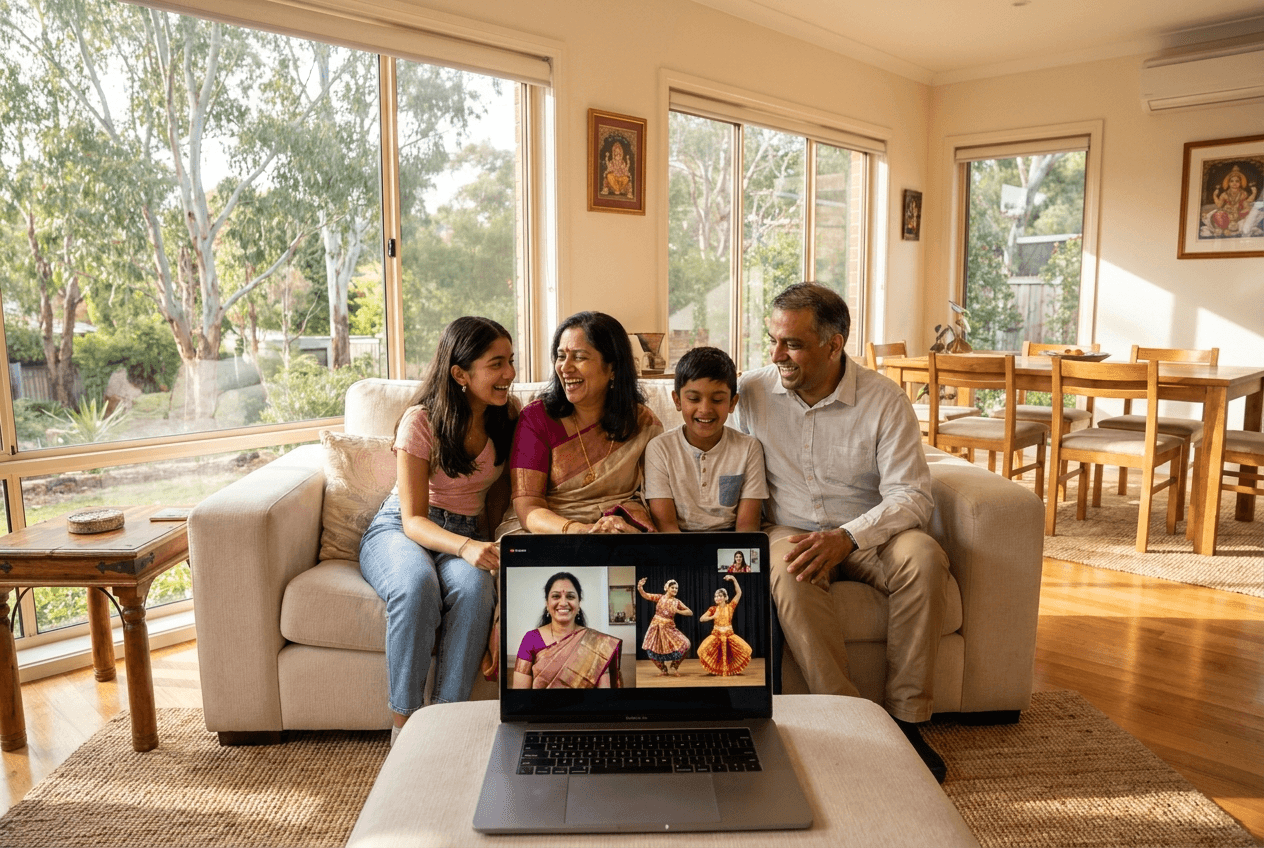 Art Gharana offers live one to one online Kathak and Bharatanatyam instruction for Australian families, with teachers who can guide students toward recognised graded examinations at a pace that suits them. Review plans and pricing and book a free trial class to discuss a certification path with a qualified teacher.
Frequently Asked Questions
1. Is online Indian classical dance certification genuinely valid?
Yes. Recognised bodies such as ABGMM and ISTD assess students through external examiners, and a student prepared online by a qualified teacher can sit the same graded examinations as one taught in person.
2. At what age should my child start working toward certification?
Formal training and the earliest grades usually suit children from around the age of seven, though younger children can begin with playful introductory classes. There is no upper age limit, and adults pursue graded exams successfully too.
3. Do we have to do exams to learn Kathak or Bharatanatyam?
Not at all. Certification is an optional structure that suits goal oriented learners and families who value external validation. Many dancers train and perform beautifully without ever sitting an exam.
How Online Exam Preparation Works in Practice
In the months before a grade exam, a good teacher shifts gradually from general learning into focused preparation. Practical sessions tighten the specific items the syllabus requires, refining footwork, posture, expression and timing until they meet the standard an examiner expects. The teacher also rehearses the viva, asking the kinds of questions the examiner might pose, so the student can name and explain each piece with confidence. Theory is studied alongside, often with shared notes and readings. Because the instruction is live and one to one, the preparation is tailored precisely to the student's strengths and gaps, which is exactly what graded success requires.
The Value of an External Examiner
One feature that gives graded certification its credibility is the external examiner. Rather than a teacher assessing their own student, an independent certified examiner evaluates the candidate against a fixed national or international syllabus. This ensures fairness and a consistent standard, so a grade earned in Australia means the same as one earned anywhere else. For parents, it offers reassurance that the certificate reflects genuine, objectively measured ability rather than a teacher's goodwill, and for the student it brings the real, motivating challenge of performing for someone new.
Theory and Viva: The Parts Families Underestimate
Families new to graded dance often focus entirely on the dancing and overlook the theory and viva, which can be a costly oversight. The viva asks a student to introduce themselves, their guru and their pieces, to define terms such as laya, sum, matra, tali and khali, and to demonstrate understanding rather than mere memorisation. The theory paper may cover the history of the form, the names and uses of hand gestures, and the structure of a performance. Preparing these alongside the practical from the beginning, rather than cramming at the end, produces calmer, more confident candidates and better results.
Certification for Adult Learners in Australia
Graded certification is not only for children. A growing number of adult learners across Australia take up Kathak or Bharatanatyam and choose to pursue grades, valuing the structure and the sense of progress as much as any child does. The early grades are designed for genuine beginners, so an adult starting from scratch can work methodically toward their first exam over a year or so. For adults balancing work and family, the milestones can be deeply motivating, turning a personal passion into a journey with visible, externally recognised markers of growth.
Performance and Recognition in Australia
Certification pairs naturally with performance, and Australia offers rich opportunities. Cultural associations, temple programs, and community Diwali, Navratri and Pongal celebrations across Sydney, Melbourne and beyond regularly welcome young dancers to perform. A graded student arrives at these stages with a tested, polished repertoire and the confidence that comes from having performed for an examiner. Over time, the combination of formal grades and genuine community performance gives a dancer both credibility and a living connection to the culture that the certificates alone could never provide.
Kathak or Bharatanatyam: Which Suits Your Child?
Families pursuing certification sometimes start by choosing between the two most popular forms. Kathak, from North India, is built on rhythmic footwork, graceful spins and storytelling, with a lighter, faster feel that many energetic children love. Bharatanatyam, from the South, is grounded in sculptural postures, precise geometry and deep expression, rewarding discipline and stillness as much as movement. Neither is harder or better, and family heritage often points the way, with North Indian families leaning toward Kathak and South Indian families toward Bharatanatyam. The surest test is a trial in each, watching which one lights up your child, since the graded path is long and enthusiasm carries it.
What Happens on Exam Day
Knowing what an exam day involves takes the mystery, and much of the nervousness, out of it. The student presents their prepared practical items to a certified external examiner, demonstrating the technique and repertoire the grade requires. The examiner then conducts the viva, asking the student to introduce themselves and their pieces and to explain key terms and concepts. A theory component, often written, may be completed separately. For an online prepared student, the format and standard are the same as for any candidate, and a well prepared dancer who has rehearsed all three components arrives calm, ready and quietly confident.
A Realistic Timeline
Parents often ask how long the journey takes, and while every child differs, a realistic picture helps. A dedicated beginner might prepare for an early grade within a year of steady weekly classes and regular home practice, with each subsequent grade typically taking a further year or more as the repertoire and theory deepen. The pace should never be rushed, because rushing undermines technique and enjoyment alike. The grades are markers along a long, rewarding road, not a race, and a patient timeline produces both better dancers and happier ones.
Why Theory Deepens the Dancing
It is easy to treat the theory papers as a hurdle to be cleared, but in truth they enrich the dancing itself. Understanding the meaning of a mudra, the structure of a rhythmic cycle or the story behind a composition transforms a sequence of steps into genuine expression. A dancer who knows what they are portraying performs with intention rather than imitation, and audiences feel the difference immediately. The graded theory, far from being a dry add on, is what turns a technically correct dancer into a storyteller, which is the entire purpose of these classical forms in the first place.
Costs and Logistics of Sitting Exams from Australia
Beyond lesson fees, families should plan for the practicalities of the exam itself. Grading bodies charge an examination fee that varies by level and organisation, and some exams are conducted at designated centres while others increasingly accommodate online or recorded submission, which suits families in Australia well. Your teacher will know the current arrangements for the body you choose and will guide you through registration, deadlines and what to prepare. Building these costs and dates into your planning well ahead of time keeps the journey smooth and lets your child focus on dancing rather than logistics in the final weeks.
Keeping Motivation High Between Grades
The gap between one grade and the next can feel long, and motivation sometimes dips in the middle. The remedy is to keep the dancing connected to joy, not only to exams. Community performances, festival programs and informal showcases give a student something to look forward to and a reason to polish their repertoire. Celebrating small milestones along the way, a clean new adavu or a confidently performed Toda, keeps momentum alive. A thoughtful teacher weaves these moments into the year, so the path between grades feels like a living practice rather than a long wait for the next test.
Recognition That Travels With Your Child
One quiet advantage of recognised certification is that it travels. A grade earned through an established body is understood wherever Indian classical dance is taught, which matters for a mobile, global generation. Should your family relocate within Australia or abroad, a graded record gives a new teacher an immediate, reliable picture of where your child stands, allowing them to continue rather than restart. For a child growing up across cultures, this portable, externally validated marker of achievement can be a genuine source of confidence and continuity, anchoring their artistic identity wherever life takes them.
Common Misconceptions About Online Certification
A few misconceptions deserve gentle correction. The first is that online preparation is somehow second rate, when in fact a qualified teacher using live one to one video can prepare a student to exactly the same standard as in person training. The second is that certification is only for prodigies, when the early grades are designed precisely for ordinary, committed beginners. The third is that exams are the point of dance, when they are simply a helpful structure around the real goal of joyful, expressive movement. Clearing away these myths lets families approach certification with realistic, confident expectations.
The Lifelong Gift of Discipline
Perhaps the most lasting benefit of a graded dance journey has little to do with the certificates themselves. The discipline of regular practice, the focus required to master a difficult sequence, the composure of performing for an examiner, and the patience to progress one grade at a time, these are qualities that serve a child far beyond the dance floor. Parents often notice improvements in concentration, confidence and resilience that ripple into schoolwork and daily life. Long after the final grade, this quiet inner discipline remains, a gift the dancing gives that no certificate could ever fully capture.
Final Thoughts
For Australian families drawn to Kathak or Bharatanatyam, online graded certification offers something valuable, a structured, externally validated path that turns years of classes into a clear journey of growth. The grading bodies are recognised, the exams are rigorous and fair, and online preparation with a qualified teacher genuinely works. Hold the certificates in perspective, remember that the dancing itself is the real prize, and let the grades serve the joy of the art rather than the other way around. Approached this way, certification becomes a steady ladder of achievement your child can be proud to climb, a path that rewards a young dancer for a lifetime.
Preparing the Whole Family for the Journey
A graded path is a commitment not only for the dancer but for the family around them, and going in with shared expectations helps enormously. Practice needs protected time, exam periods bring a little extra intensity, and motivation will rise and fall across the years. When parents understand the shape of the journey, they can offer steady encouragement without pressure, celebrate the milestones, and keep perspective during the plateaus. The families who enjoy the process most are those who treat certification as a shared adventure rather than a series of tests, supporting the dancer through each stage with patience and pride.
Beyond the Higher Grades
For dancers who progress through the full graded sequence, the journey does not simply end. The higher grades open into advanced repertoire, deeper theory and, for the truly dedicated, the possibility of formal diplomas and a lifelong relationship with the art as a performer or teacher. Many never take this route, and that is perfectly fine, but it is worth knowing the path exists. Whatever the destination, the discipline, expression and cultural grounding built through years of graded study stay with a dancer for life, long after the final certificate is framed and hung on the wall.