ChatGPT
 Google AI
 Grok
 Claude
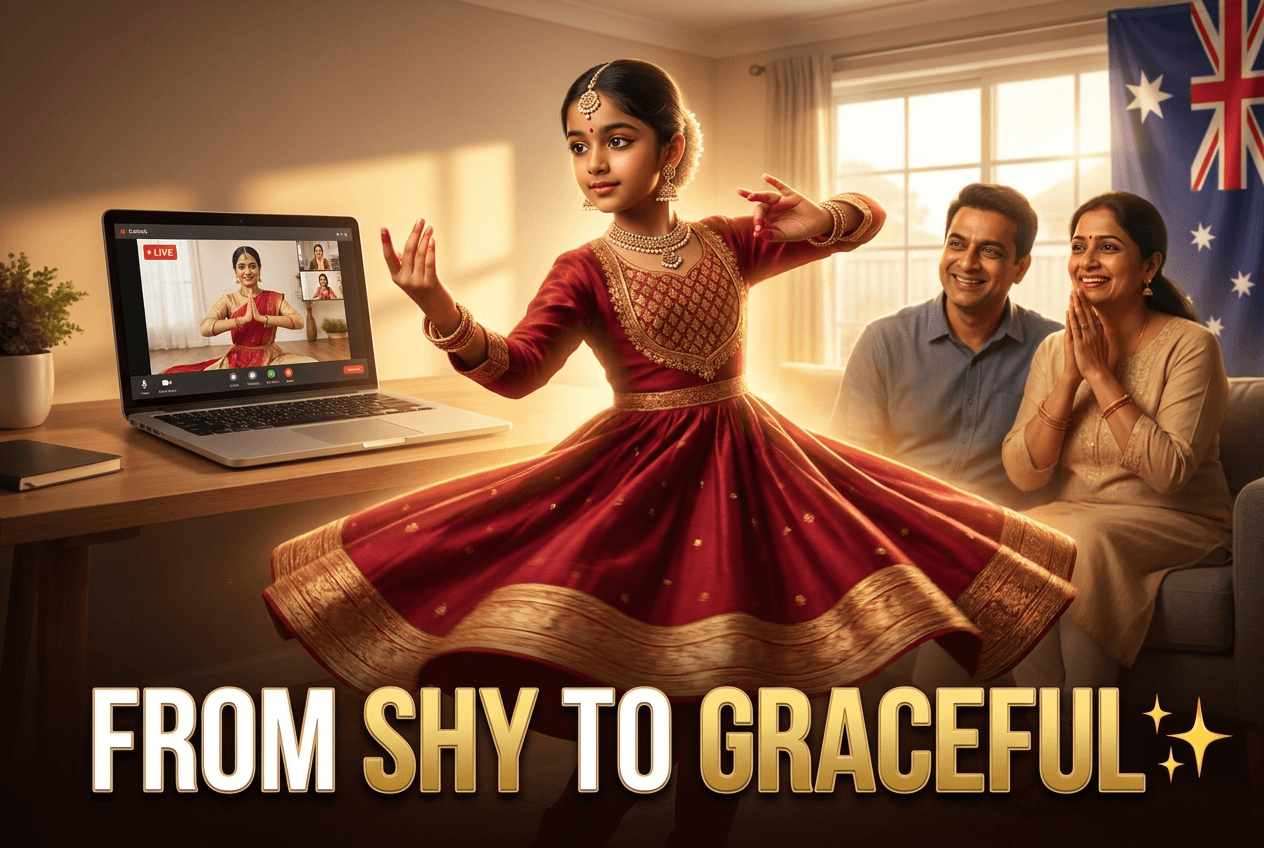
Kathak is one of India's eight classical dance forms and one of the most technically and artistically extraordinary performing arts traditions in the world. For Indian-Australian families from the Hindi-speaking communities of Parramatta and Blacktown to the Gujarati families of Melbourne's western suburbs, from the Bengali communities of South Sydney to the mixed North Indian communities of Brisbane, Perth and Adelaide, Kathak training gives children something irreplaceable: a deep, embodied connection to one of humanity's great artistic traditions.
The challenge for Australian families has been access to genuinely qualified teachers outside a handful of metropolitan suburbs. Ghungroo School of Dance in Melbourne offers in-person Kathak in Melbourne's inner suburbs. Jhankaar Academy offers group multi-style classes in Point Cook. Scattered individual teachers exist in Sydney's western suburbs and Brisbane. No provider offers live one-to-one online Kathak classes for children nationwide with Australian time zone scheduling. Art Gharana fills this gap directly with certified Kathak dance classes for kids in Australia, live and one-to-one, available in every state and territory.
Kathak in Australia's Indian Communities
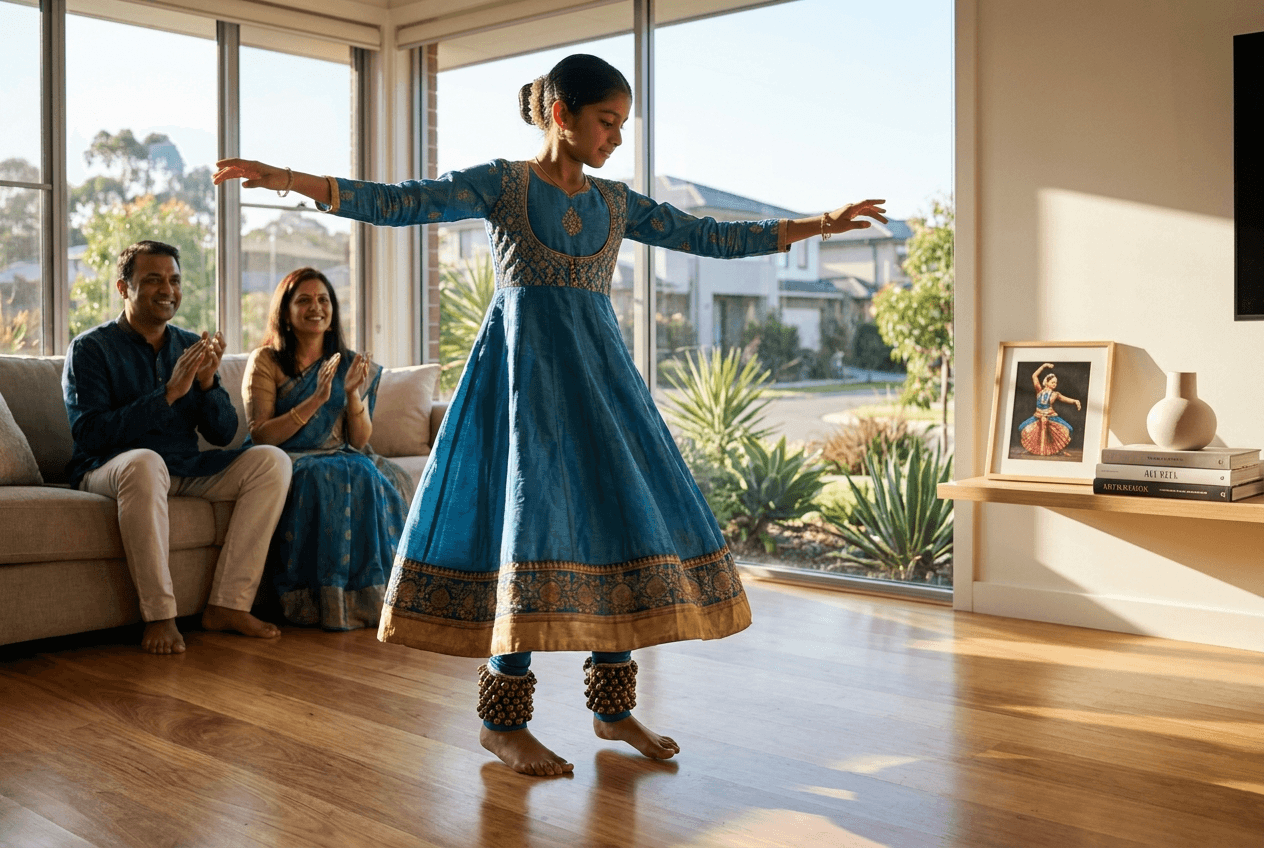
Sydney: The North Indian Diaspora
Sydney's North Indian community, spanning the Parramatta-Blacktown-Hills Shire corridor and extending through Merrylands, Guildford, Wentworthville and Seven Hills, has a strong cultural relationship with Kathak. Diwali events at Parramatta Park, Navratri celebrations at community halls across the 2145 to 2148 postcode belt, and school heritage events throughout Western Sydney provide trained Kathak students with a rich performance calendar. For families in this community, quality Kathak instruction has historically been limited to a handful of individual teachers operating from suburban homes with group classes that do not provide the individual attention to develop real classical capability.
Melbourne: West and South
Melbourne's North Indian community, concentrated in Point Cook, Hoppers Crossing, Craigieburn, Caroline Springs and the southern suburbs of Dandenong and Springvale, has increasing demand for classical Kathak instruction for children. Jhankaar Academy at Point Cook offers group classes in multiple styles, but the group format and multi-style approach means that students do not develop the specialised depth that a dedicated one-to-one Kathak programme provides. Ghungroo School of Dance in Melbourne's inner suburbs offers genuine classical Kathak but is geographically inaccessible for families in the western and northern growth corridors where most Indian-Australian families live.
Brisbane, Perth, Adelaide and Beyond
For Indian-Australian families in Brisbane, Perth, Adelaide, Canberra, Darwin and Hobart, dedicated Kathak instruction for children is essentially unavailable locally. Art Gharana's nationwide online programme serves all of these families with live, one-to-one instruction from certified classical Kathak teachers in all Australian time zones. The quality of instruction is identical regardless of whether the student is in Parramatta or Palmerston.
Why Kathak Is Exceptional for Indian-Australian Children
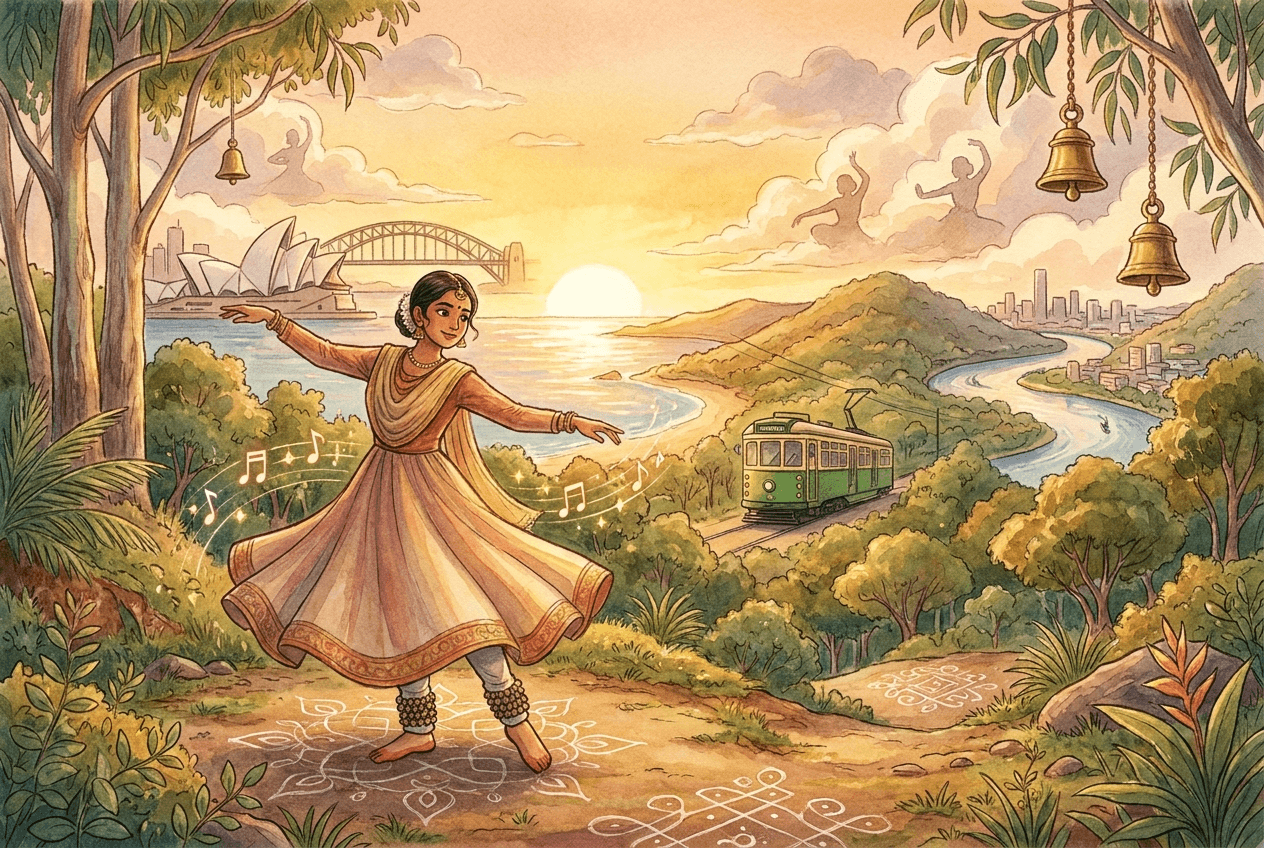
Rhythmic Intelligence
Kathak's tala structures develop a form of mathematical and rhythmic intelligence that directly supports academic performance. The counting, subdivision and pattern recognition involved in performing within rhythmic cycles of sixteen, twelve, ten and seven beats is essentially applied mathematics delivered through dance. Australian Indian families who want an extracurricular activity that develops cultural connection and cognitive capability simultaneously will find few options as efficient as Kathak.
Physical Excellence
Kathak's demands on the body are extraordinary. The bilateral coordination required to synchronise complex footwork with precise arm and hand movements, the balance required for chakkar sequences, the strength and stamina built through extended practice sessions: these physical qualities develop in Kathak students at a level that is visible and measurable, and they carry benefits across every other physical activity a child pursues, from swimming and cricket to netball and athletics.
Bicultural Confidence in Australian Schools
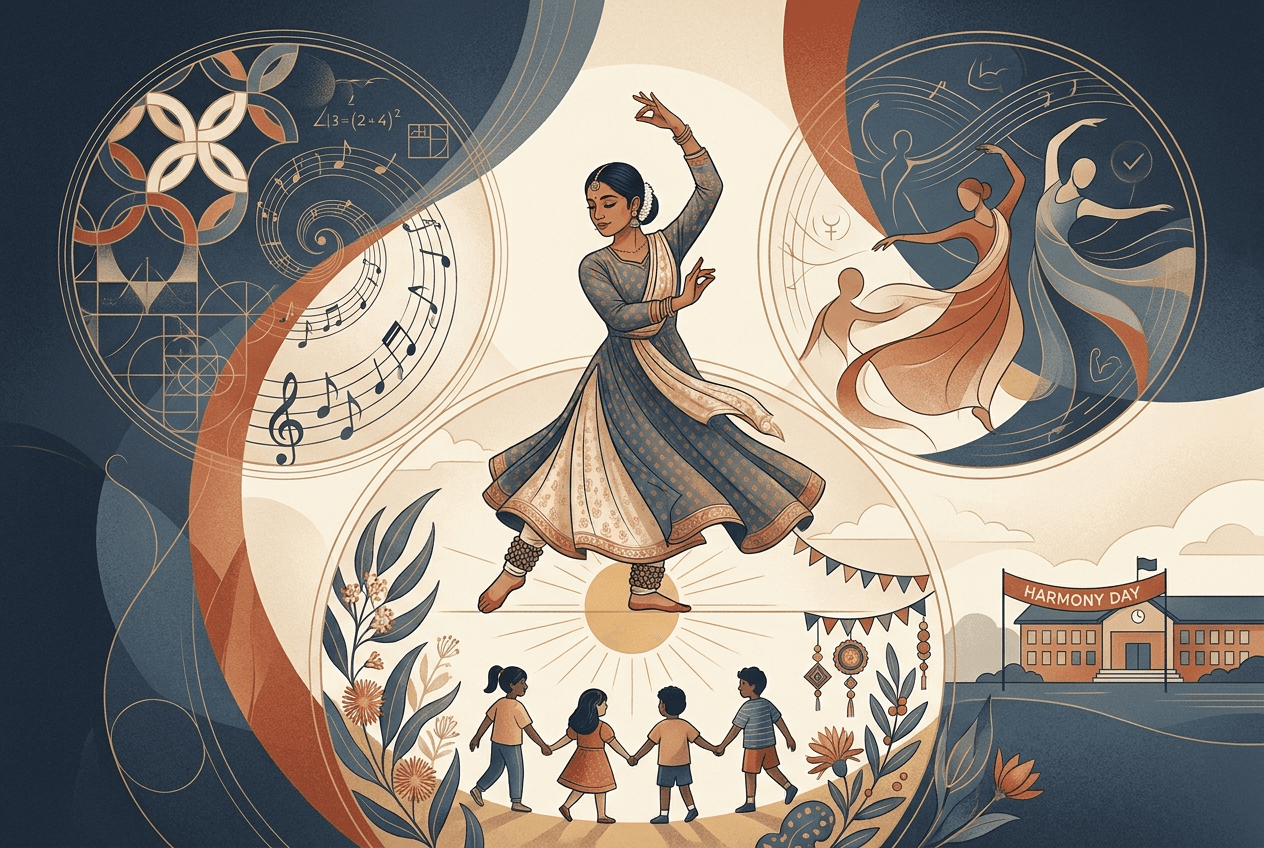
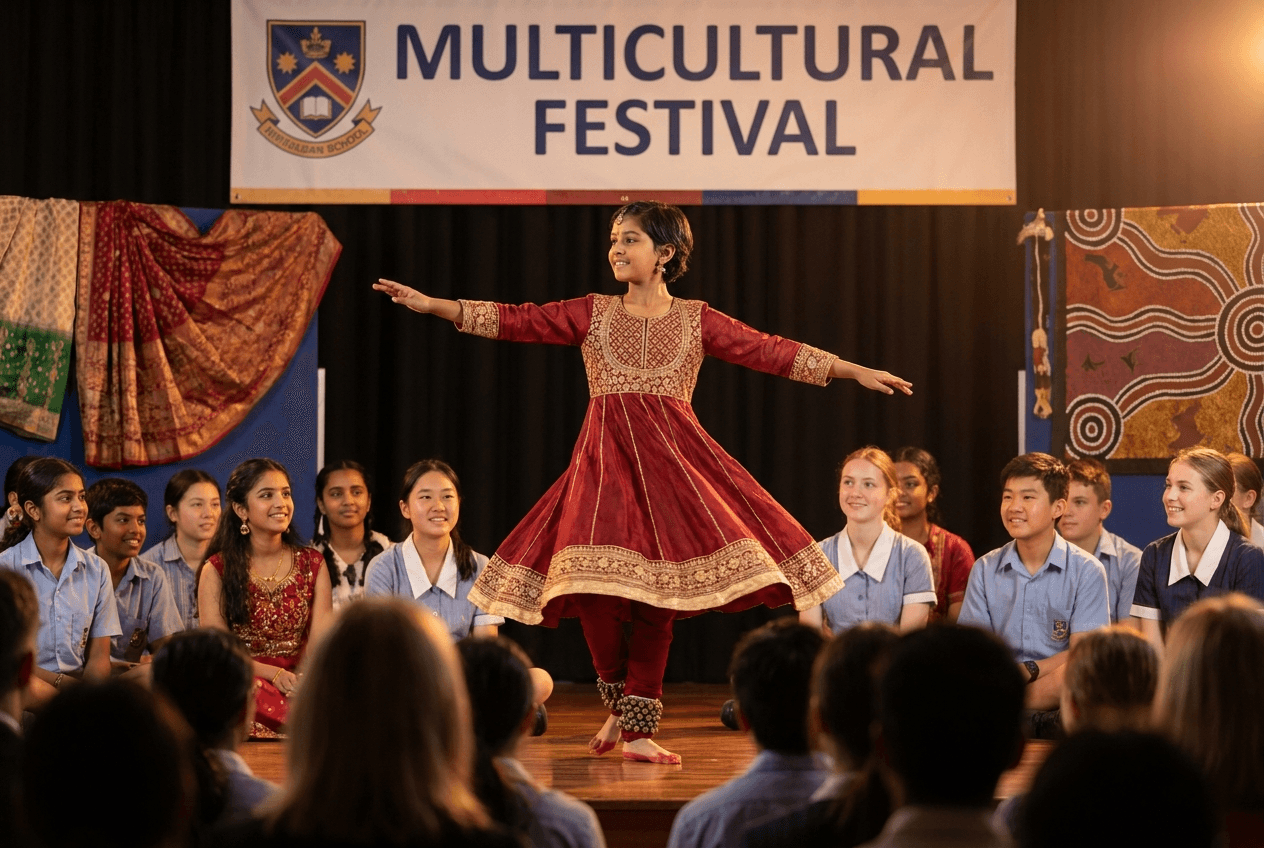
Australia's multicultural school culture provides Kathak students with regular and meaningful opportunities to demonstrate their cultural heritage publicly. School multicultural nights, Harmony Day events and cultural presentations create contexts where an Indian-Australian child who can perform a Kathak piece in ghungroos is not demonstrating something obscure. They are sharing something beautiful, impressive and admired. This experience of cultural pride, repeated and reinforced over years of performance at Australian events, is one of the most powerful foundations of bicultural identity available.
The Kathak Curriculum at Art Gharana
Foundation Stage, Ages 5 to 8
All Kathak training begins with correct posture, fundamental tatkaar footwork patterns, basic hand gestures and an introduction to rhythmic counting within taal cycles. Ghungroos are introduced when the teacher judges the student's tatkaar has developed sufficiently. Short, structured compositions introduce students to moving within a musical framework. The emphasis is on building a solid foundation and genuine love for the art form.
Elementary Stage, Ages 8 to 12
Elementary students develop a broader tatkaar vocabulary, begin working on chakkar sequences and learn their first complete compositional pieces. Abhinaya, the expressive storytelling dimension, becomes a regular feature of training. Students begin performing at Australian community events with teacher-guided performance preparation covering costume, stage presence and audience projection.
Intermediate Stage and Beyond
Intermediate students work on extended compositions, complex tala structures and the development of a personal performance style. Students at this level regularly perform at significant cultural events and often begin to develop choreography for younger students in their communities.
Kathak Alongside Other Indian Arts
 Kathak pairs beautifully with Hindustani vocal classes. The musical tradition that gives Kathak its melodic and rhythmic framework is Hindustani classical music, and students who study both develop a quality of musical intelligence that is immediately evident in their dancing. Our tabla classes pair even more directly: the tala cycles of Kathak footwork are the same rhythmic structures that tabla students master from the percussionist's perspective. Students who study both simultaneously develop much faster and deeper rhythmic intelligence than those who study either alone.
For South Indian families, our Bharatanatyam classes offer the classical South Indian alternative with the same live one-to-one format and nationwide availability. Our full range of courses covers all available disciplines. Many Australian families eventually enrol their children in two disciplines simultaneously, finding the combination richly rewarding for both cultural engagement and artistic development.
The Guru-Shishya Tradition in the Australian Context
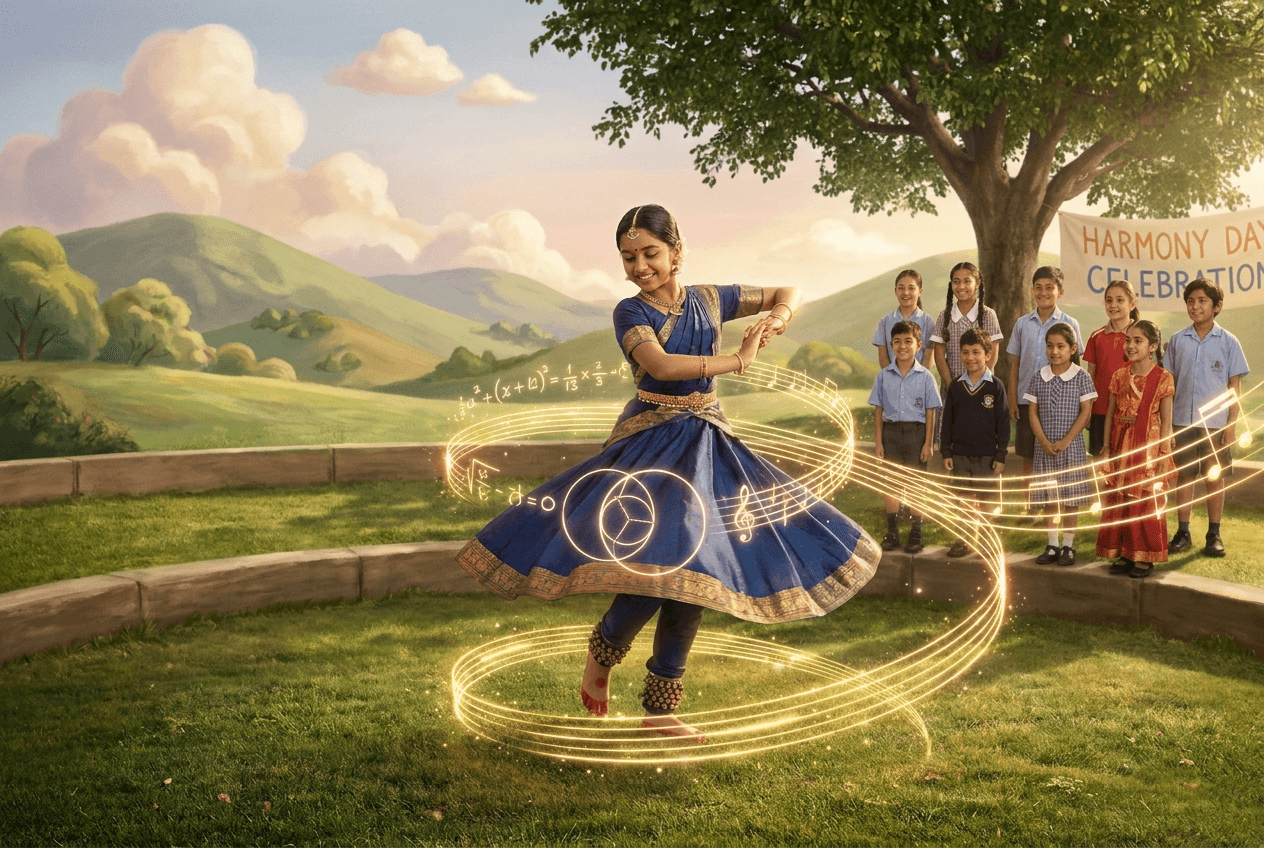 The guru-shishya parampara, the teacher-student transmission tradition that has carried Indian classical arts across generations for millennia, is not merely a historical concept at Art Gharana. It is a living reality in every Kathak class. Our teachers do not simply deliver technical corrections. They build genuine, ongoing relationships with each student, understanding each child's learning style, artistic personality and areas for development, calibrating their teaching accordingly session by session and month by month over years of consistent engagement.
For Indian-Australian families, this relationship has particular cultural resonance. When an Art Gharana Kathak teacher based in Lucknow or Jaipur forms a genuine mentoring relationship with a child growing up in Parramatta or Point Cook, they are transmitting something far more than technical skill. They are passing on a living connection to a cultural heritage that the child's parents and grandparents know and love. Many Art Gharana families in Australia describe the relationship between their child and their Kathak teacher as one of the most meaningful cultural bonds in their Australian life.
About Art Gharana
 Art Gharana is a specialist online Indian arts education platform with over 50 certified teachers across dance, music and vocal disciplines. Our Kathak programme serves Indian-Australian families across all states and territories with live one-to-one classes in all Australian time zones. Browse our teacher profiles, review our plans and pricing and head to our book a free trial class page to get started.
Frequently Asked Questions
1. Are online Kathak classes available for kids across all of Australia?
Yes. Art Gharana provides live one-to-one online Kathak classes for children in every Australian state and territory, with scheduling in AEDT, ACDT and AWST time zones.
2. Is Kathak available for boys in Australia?
Yes. Art Gharana welcomes all students regardless of gender. Several prominent online Kathak providers explicitly restrict enrollment to female students only. Art Gharana has no such restriction.
3. What age can children start Kathak in Australia?
Children can begin Kathak from age 5. The beginner curriculum is age-appropriate, engaging and fun for young learners with no prior dance experience.
4. How long until my child can perform at a community event?
Most students are ready for their first community performance after 12 to 18 months of consistent weekly training combined with regular home practice.
5. Can I find Kathak classes in Perth or Adelaide?
Yes. Art Gharana's online programme serves families across all Australian states including Western Australia, South Australia, Queensland, Tasmania, the Northern Territory and ACT.
Book Your Child's Free Trial Kathak Class Today
Whether your family is in Sydney, Melbourne, Brisbane, Perth, Adelaide, Canberra or anywhere else in Australia, Art Gharana's certified Kathak teachers are ready to begin your child's classical journey. Live one-to-one instruction, Australian time zone scheduling, a structured curriculum and a completely free first lesson. Head to our book a free trial class page and begin today.
The Lucknow and Jaipur Gharanas for Australian Parents
Australian parents who explore Kathak for their children will encounter references to the Lucknow and Jaipur gharanas, the two primary lineages of Kathak. At the beginner and elementary levels, the foundational curriculum is consistent across both traditions. The stylistic differences become meaningful only at the intermediate and advanced levels. The Lucknow gharana is characterised by lyrical grace, expressive emotional depth and the refined elegance of North Indian court culture. The Jaipur gharana is celebrated for powerful, earth-connected footwork, complex rhythmic structures and vigorous physical energy. Art Gharana teachers bring training from both traditions, and the emphasis of each student's training evolves naturally over time based on the teacher's assessment of where the student's own artistic strengths lie.
Performance Opportunities for Kathak Students in Australia
Trained Kathak students in Australia have access to a rich range of performance opportunities that make their training immediately relevant to their community lives. Diwali events at Sydney's Parramatta Park, Melbourne's Federation Square Diwali Night Market, Queensland Indian cultural festivals, Harmony Day multicultural events at schools across the country, and the regular temple events that are a feature of Indian community life in every major Australian city all provide platforms where Kathak skill is appreciated, celebrated and publicly visible.
Art Gharana teachers actively prepare their Australian Kathak students for these performance contexts. A student working toward a Kathak performance at a temple Diwali event receives specific preparation including piece selection, costume advice and the stage presence coaching that transforms a trained dancer into a confident performer. This event-specific preparation is one of the clearest advantages of the one-to-one format over group instruction.
Academic Benefits for Australian Students
The research on classical arts training and academic performance is clear and consistent. Sustained music and dance training is associated with significantly better academic performance, not the opposite. The memorisation demands of Kathak build working memory. The rhythmic and mathematical structures of tala develop numerical pattern thinking. The discipline of consistent practice builds the sustained effort habits that underlie academic success in every subject. For Indian-Australian families who prioritise both cultural engagement and academic achievement, Kathak training delivers on both dimensions simultaneously.
Several Art Gharana Kathak families in Australia have noted that beginning Kathak training coincided with improvements in their children's school performance, particularly in mathematics and concentration. The combination of cultural identity strength and cognitive development that Kathak training provides makes it one of the most efficient extracurricular investments available to Indian-Australian families.
What to Expect in the First Six Months
For Australian families who are new to Kathak, understanding what the first six months of training look like in practice helps set realistic expectations and avoid the disappointment that can come from expecting too much too quickly. In the first three months, a typical Art Gharana Kathak student learns the correct basic stance, develops the fundamental tatkaar footwork patterns, is introduced to the first set of hand gestures, gets their ghungroos and learns to produce a clean, musical tatkaar sound. By months four to six, students are working on a short complete composition, developing their first chakkar sequences, and are typically ready to show their progress at a small family performance occasion.
The first six months are the hardest in terms of patience and commitment. The physical demands are new, the musical framework is unfamiliar and the progress feels slower than the student would like. Families who maintain their commitment through this period discover at the six-month mark that something has changed: the tatkaar has become natural, the ghungroo sounds have become musical, and the child is moving within a tala cycle with genuine rhythmic confidence. That shift, from technical exercise to something that feels like real dancing, is one of the most rewarding experiences in Indian arts education.
What Art Gharana Kathak Students in Australia Achieve
The evidence of what Art Gharana Kathak students in Australia achieve over time is the most compelling argument for the programme. Students who begin as absolute beginners at age five or six and train consistently for three to four years reach a level of technical and expressive development that is genuinely impressive to observe. They perform confidently at community Diwali events, at school multicultural nights, at family weddings and at temple cultural events. They can explain the meaning of the tata thei tat compositions they are performing, demonstrate the abhinaya of a specific emotional narrative, and show the ghungroo-accompanied tatkaar patterns of the Lucknow style with clarity and musical sensitivity. That level of classical accomplishment, achieved by a child growing up in Australia, is something that earns genuine admiration from every audience and that the child themselves carries with deep personal pride.
Art Gharana's student testimonials from Australian families describe this transformation consistently: the child who was reluctant in the first few weeks, who found the tatkaar difficult and the taal structure confusing, who at the six-month mark crossed the threshold from struggling to flowing, and who by the end of the first year was performing at a Diwali event with a confidence and grace that made their parents emotional. These stories repeat across the Art Gharana community in Australia because the combination of quality teaching, consistent weekly instruction and daily home practice produces them reliably and repeatedly. The free trial class is the first step in what may become one of the most significant educational decisions your family makes for your child.
Practical Considerations for Starting Kathak in Australia
For families who have decided to explore Kathak training for their child, a few practical considerations help the process go smoothly. The first requirement is a clear space at home for the class and daily practice: an area large enough to take a few steps and turn a chakkar in both directions without obstruction. A bare floor rather than thick carpet is preferable for footwork clarity and is closer to the studio floor environment the teacher is used to seeing. Your device should be positioned so the teacher can see your child's full body from head to toe throughout the session.
Ghungroos, the small brass bells worn around the ankles that are central to Kathak training, are not needed before the first class. Your teacher will introduce them at the appropriate stage, typically after a few months of foundational tatkaar work when the student is ready to begin integrating the sound into their practice. Art Gharana teachers give specific guidance on where to purchase ghungroos in Australia: Indian music and dance supply shops in Parramatta, Dandenong and Brisbane stock them, and several online retailers in Australia carry student-grade sets. There is nothing to purchase before the trial class. Loose, comfortable clothing that allows free movement and bare feet are all that is needed to begin.
Kathak and Australia's Multicultural Education System
Australia's school system provides Indian-Australian Kathak students with regular and meaningful contexts in which their classical training becomes publicly visible and celebrated. Harmony Day in March is the most prominent of these: a national day of cultural sharing where schools across the country organise multicultural events, cultural presentations and performance showcases. A Kathak student performing for their entire school community on Harmony Day is sharing something genuinely beautiful and unusual, earning a quality of respect and curiosity from Australian peers that strengthens bicultural confidence in a way that private cultural practice alone cannot produce.
Beyond Harmony Day, CALD (Culturally and Linguistically Diverse) community arts programmes in various states, multicultural arts grants from state and federal arts bodies, and the growing presence of South Asian performing arts in mainstream Australian cultural programming all create opportunities for serious young classical dancers to find audiences beyond the Indian community. Art Gharana teachers actively encourage their Australian students to seek out these opportunities and help prepare them for the specific demands of each performance context.
Kathak Across All of Australia
One of the most distinctive features of Art Gharana's Australian Kathak programme is its genuine nationwide reach. Families in Cairns receive the same quality of live, one-to-one instruction from certified classical teachers as families in Parramatta. A child in Geraldton, Western Australia, can study Kathak with the same quality of teacher and in the same personalised format as a child in Blacktown. A family in Hobart, with no local Indian dance provision of any kind, has access to the full range of Art Gharana's Kathak curriculum in their own time zone with no travel, no commute and no compromise on teaching quality. This geographic equality is one of Art Gharana's most important contributions to Indian-Australian cultural life, and it is something that no in-person studio network can replicate in a country as geographically vast as Australia.
For the Indian-Australian families who live outside the Sydney and Melbourne corridors where most Indian arts provision is concentrated, Art Gharana is frequently the only viable option for quality classical arts education. The platform was built to serve exactly these families: the Indian-Australian family in a regional Queensland city, the Tamil family in a Perth suburb where no South Indian dance teacher exists, the Gujarati family in an Adelaide suburb where the nearest Indian cultural centre is forty minutes away. Art Gharana brings the tradition to them, wherever they are, with no reduction in quality.
The free trial class takes minutes to book and costs nothing. In that 45-minute session, every question about quality, approach and fit is answered directly. Art Gharana's confidence in its Kathak programme is complete, and the free trial class is the expression of that confidence. Indian-Australian families across the country have taken that first step and found it to be one of the best decisions of their children's upbringing. The tradition is extraordinary. The teachers are exceptional. The opportunity is right here. Begin today.
For families interested in a more accessible entry point before committing to classical training, Art Gharana also offers Bollywood dance classes with the same live one-to-one format and nationwide Australian availability.