ChatGPT
 Google AI
 Grok
 Claude
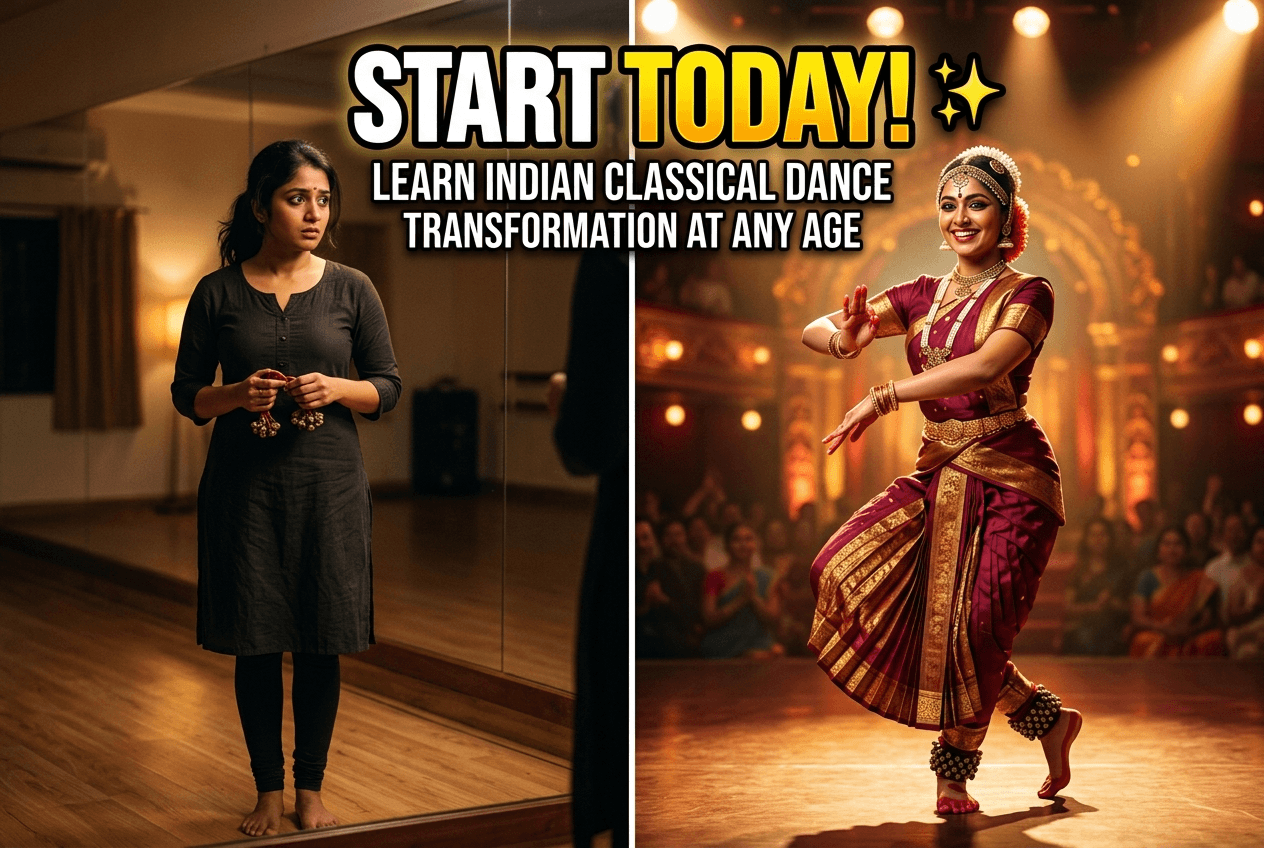
You watched it as a child and never got the chance. Or you danced years ago, life took over, and you always meant to return. Or you simply fell in love with Kathak or Bharatanatyam as an adult and now wonder, quietly and a little embarrassed, whether you have missed your window. If any of that sounds familiar, here is the short answer before we go further: yes, adults can learn Indian classical dance, and not as a watered down hobby version, but as the real thing.
This guide does not just reassure you. It shows you the proof, addresses the specific fears that hold adults back, explains what the journey actually looks like at thirty, forty or fifty, and tells you how to begin sensibly. Indian classical dance has a long tradition of welcoming dedicated learners at every age, and the modern, online way of learning has made it more accessible to busy adults than it has ever been.
The Proof That Adults Really Do This
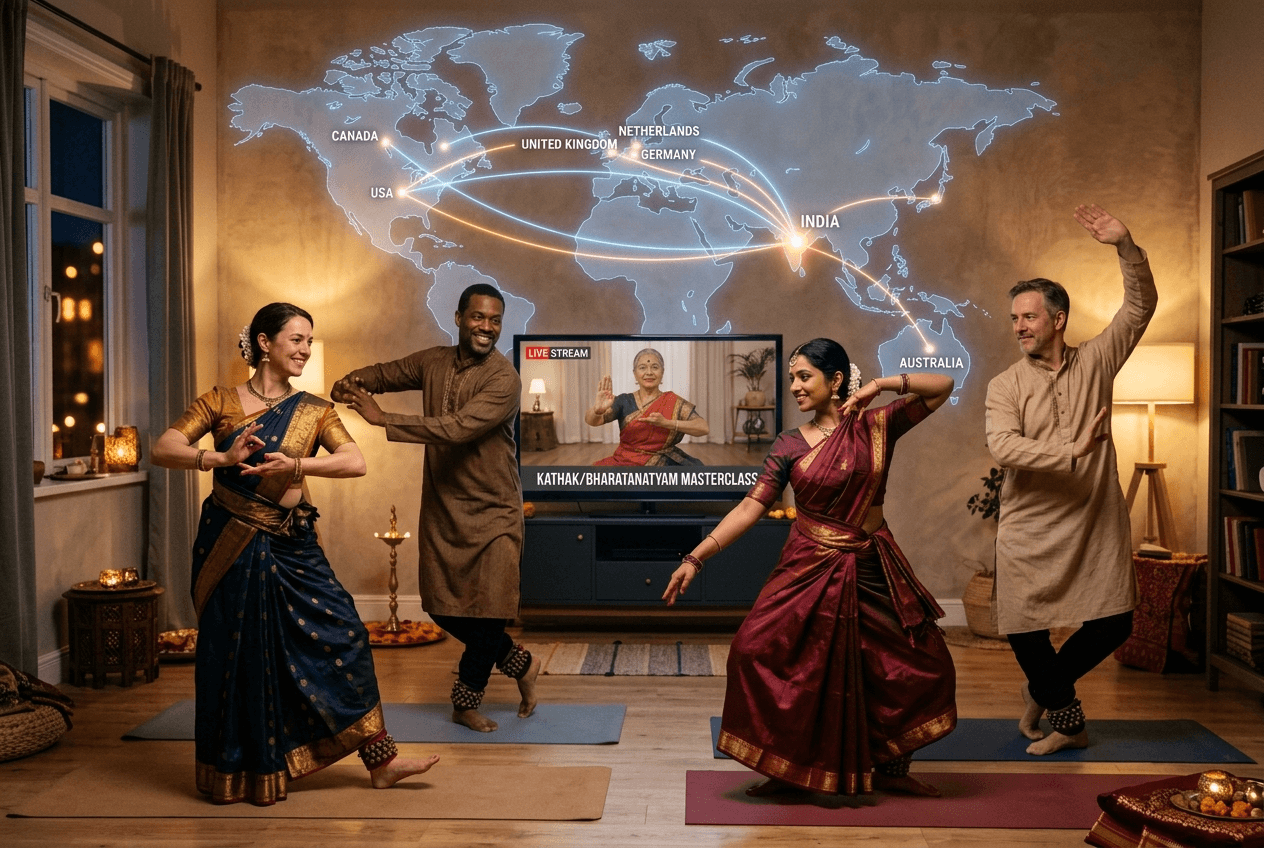
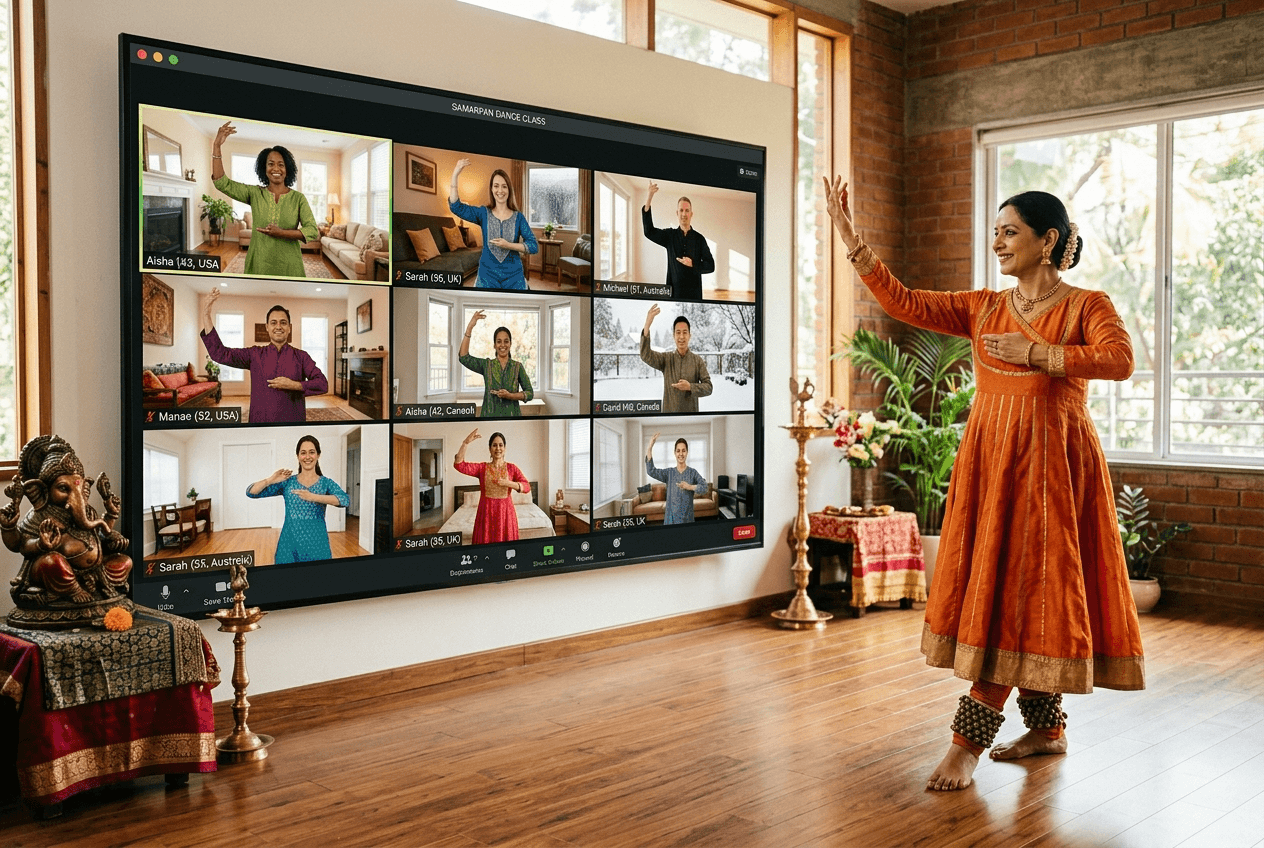 It is easy to say it is never too late. It is more convincing to point at real adults doing it. So consider what happened in 2021. A respected Kathak institution in the San Francisco Bay Area, run by an acclaimed Kathak guru, launched a distance learning program aimed specifically at adult beginners. Within a matter of months, dozens of adult students from across the United States, Canada, the United Kingdom, Australia, Germany and the Netherlands had begun learning Kathak from scratch. Within two years, that number had grown into the hundreds, drawn from cities all over the world.
Two details from that story matter. First, the program was built for adult beginners on purpose, not as an afterthought to a children class. Second, that same institution accepts adult students as its core community, directing children to its partner schools. In other words, an entire serious Kathak school organised itself around the reality that grown adults, including working professionals and new mothers, want to learn classical Indian dance and absolutely can. This is not a fringe phenomenon. It is a thriving, global, adult learning movement.
The same openness shows up across the wider field. Established Bharatanatyam teaching answers the common worry head on, stating plainly that yes, you can learn Bharatanatyam at thirty five if you are physically capable and consistent, and that there is no upper age limit, with people beginning even at fifty. The door is not closing behind you. It is wide open. To get a feel for the art itself, the beginner guide to Indian classical music and dance is a gentle place to start.
The Four Fears, Answered Honestly
Most adults who hesitate are held back by the same handful of worries. Let us take them one by one, without sugar coating.
Fear one: I am too old
 You are almost certainly not. Indian classical dance is a lifelong discipline, and its expressive heart, the storytelling and emotional depth, often deepens with the maturity an adult brings. While a professional performance career has its own demands, learning, progressing and even performing recreationally are open at thirty, forty, fifty and beyond. The schools and gurus quoted above are not being polite; they are describing what they see in their adult students every week.
Fear two: I am too stiff or unfit
Flexibility and stamina are built by the practice itself, not required before you start. A good teacher begins where your body is and progresses you safely. In fact, the training improves the very fitness you are worried about: a rigorous hour of Bharatanatyam can burn in the region of four hundred to five hundred calories, while building lower body strength, posture and stamina. You do not get fit and then learn to dance. You get fit by learning to dance.
Fear three: I have no dance background
Adult beginner programs exist precisely for people starting from zero. You do not need any prior training, any childhood foundation, or any natural talent you think you missed out on. The whole point of a structured beginner course is to build the vocabulary of the form, step by step, in a logical order. Everyone in an adult beginner class started exactly where you are.
Fear four: I have no time
This is the most legitimate worry, and it is exactly what modern learning has solved. The adult Kathak program mentioned above blended pre recorded video lessons with periodic live correction classes, designed deliberately for professionals with irregular schedules, new and expecting mothers, and people with time constraints. Live one to one online classes go a step further, fitting a single weekly lesson around your real life with no commute. With online Kathak classes or online Bharatanatyam classes, the studio comes to you.
Why Indian Classical Dance Is Especially Good for Adults
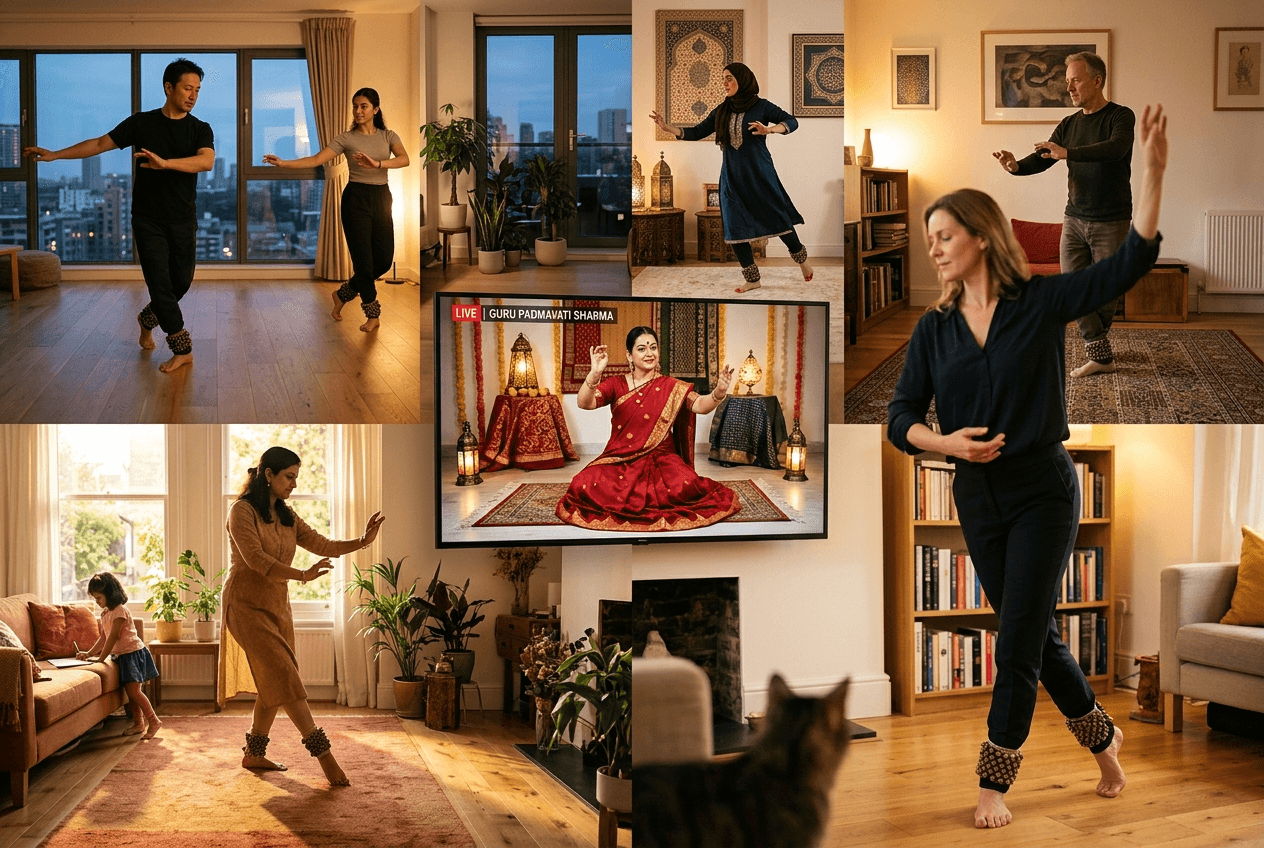 Beyond simply being possible, learning Kathak or Bharatanatyam as an adult brings benefits that are almost tailor made for the pressures of modern adult life.
- Fitness without the gym. An hour of practice is a genuine workout, burning four to five hundred calories while building strength, balance and posture, all while you are absorbed in something beautiful rather than counting reps.
- Stress relief and focus. The concentration these forms demand pulls you fully into the present, much like a moving meditation. For an adult carrying work and family pressure, that mental reset is precious.
- Cultural connection. For many adults in the diaspora, learning the dance of their heritage is a way to reconnect with roots that everyday life crowded out, and to pass that connection on to children.
- Cognitive benefits. Learning sequences, rhythm and expression keeps the mind sharp. Building new movement memory as an adult is exactly the kind of challenge that supports long term brain health.
- Community and joy. Adult learners often find a warm community of fellow beginners, and the simple, deep pleasure of finally doing the thing they always wanted to do.
What the Journey Looks Like as an Adult
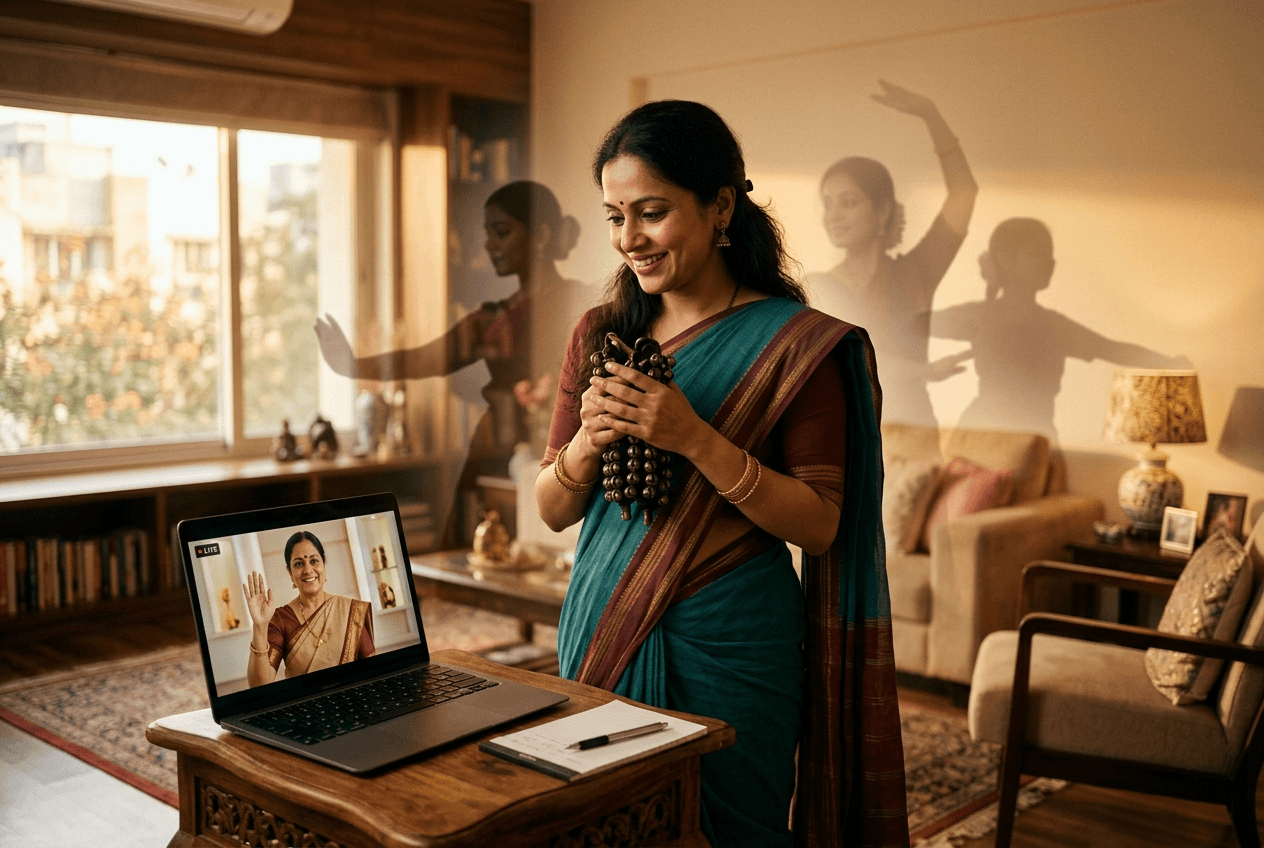 Knowing the path ahead removes a lot of anxiety. Here is a realistic picture for an adult beginner training consistently.
The first few months
You begin with foundations: posture, the basic footwork, and the first building blocks of the form. In Bharatanatyam this means the half sitting araimandi and the early adavus; in Kathak it means stance and the basic tatkar footwork and rhythm. This stage is about training your body to move correctly and your ear to follow rhythm. Progress feels steady and encouraging when the teaching is one to one and paced to you.
The first year
By the end of a consistent first year, most adult learners can perform short pieces, hold correct posture with growing ease, and feel the music in their movement rather than counting every beat. The fitness gains are tangible too, in stamina, strength and flexibility you did not have when you started.
Beyond the first year
From here the art opens up. You move into expressive storytelling, longer compositions, and the deeper emotional and rhythmic layers that make these forms so rewarding. Many adults perform recreationally at community events, and some pursue formal recitals. There is no ceiling imposed by your starting age, only the pace you choose.
A Quick Reality Check: Adults Versus Children
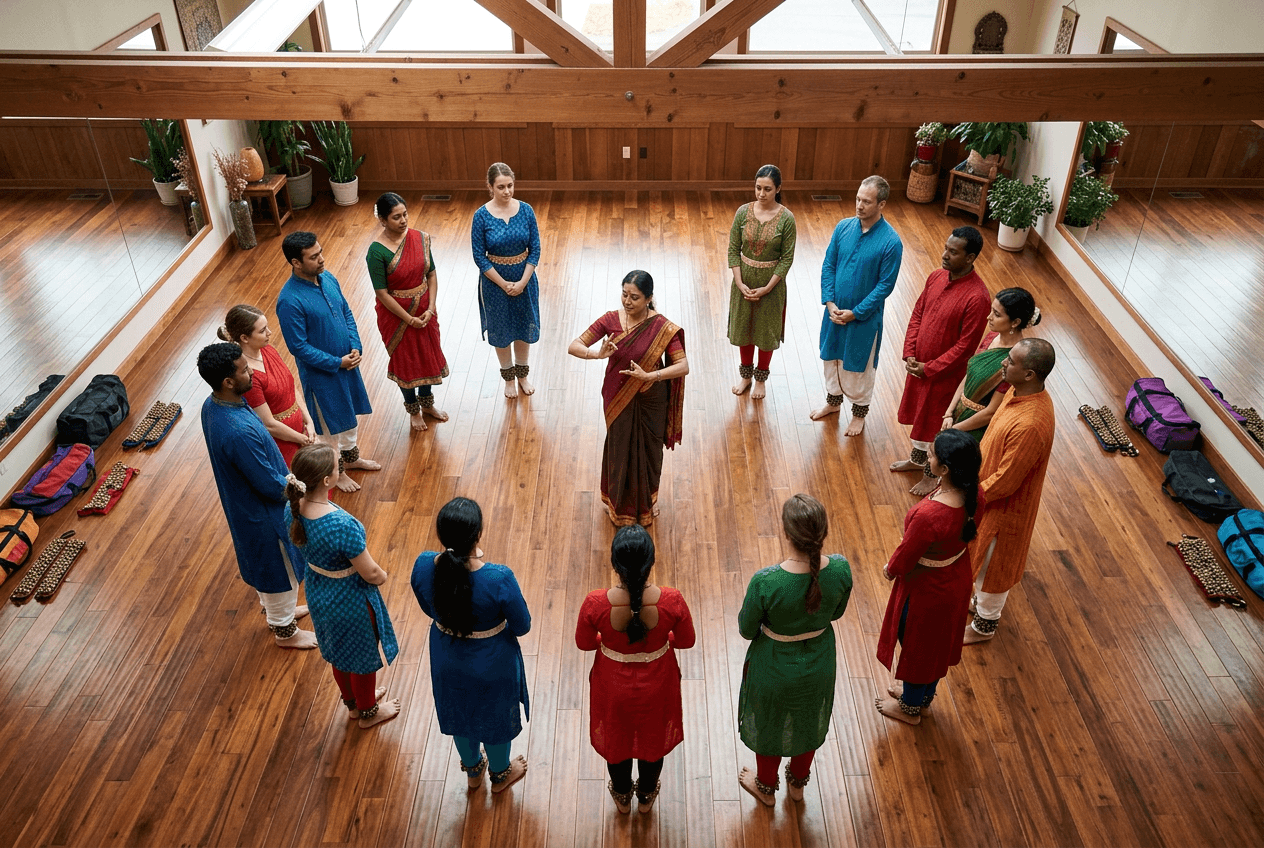
Notice that the adult column is full of genuine advantages, not just consolations. Adults often bring focus, discipline and emotional depth that children take years to develop. The one real disadvantage, time, is precisely the thing flexible online learning is designed to remove.
Kathak or Bharatanatyam: Which Suits an Adult Beginner?
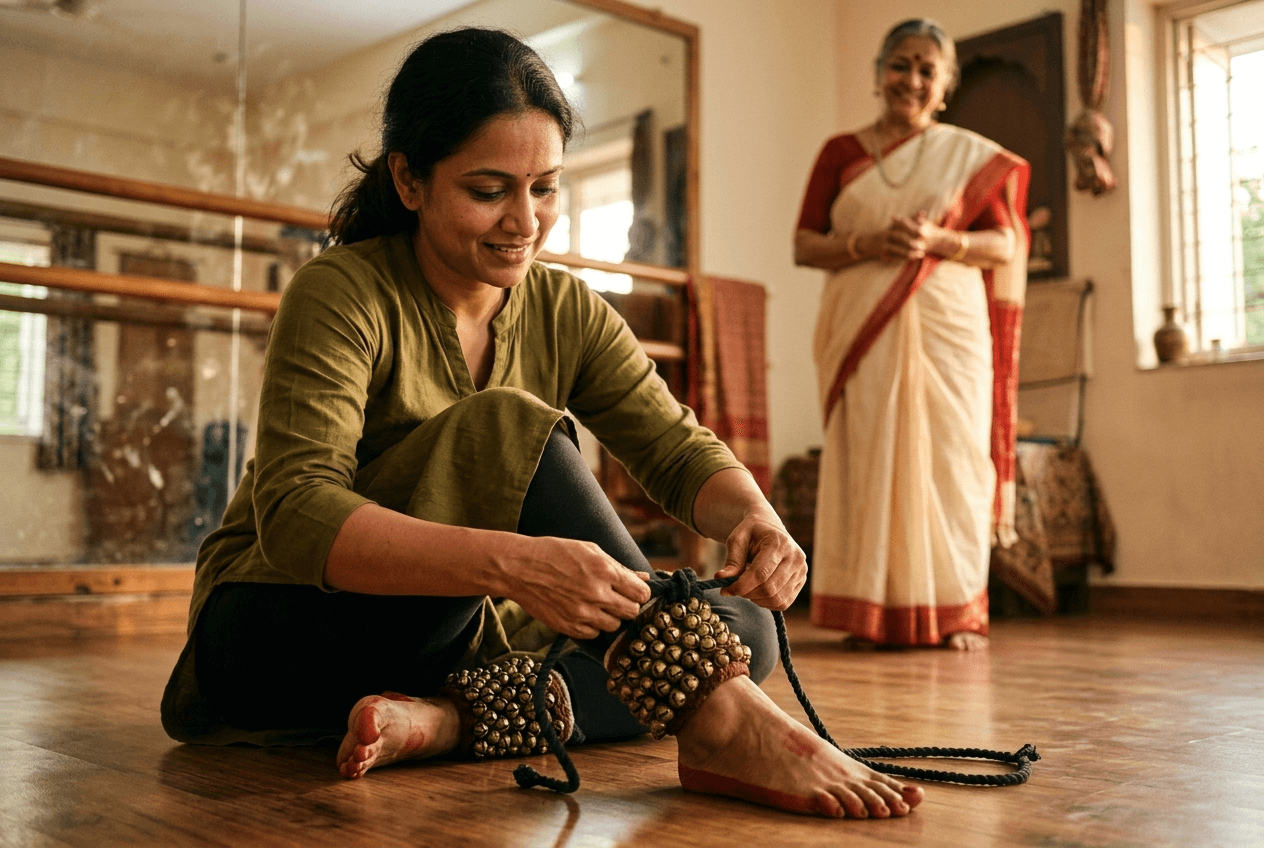 Both welcome adults, and the right choice is mostly about what moves you. Kathak, from North India, is built on intricate footwork, graceful spins and rhythmic interplay with the tabla, with a storytelling tradition drawing on both Hindu and Mughal courtly culture. Bharatanatyam, from the South, is known for its sculpted lines, geometric precision and deep expressive abhinaya. Watch a little of each, notice which one makes you want to move, and start there. You can always explore the other later. If you would like to understand the music that underpins both, the explanation of why Indian music sounds so distinctive is a lovely companion read.
Many adults also enjoy pairing dance with a little music. A grounding in rhythm through the tabla, or in melody through Hindustani or Carnatic vocals, deepens your feel for the dance and is entirely optional. The point is simply that learning as an adult can be as rich and many sided as you want it to be.
How to Start Sensibly
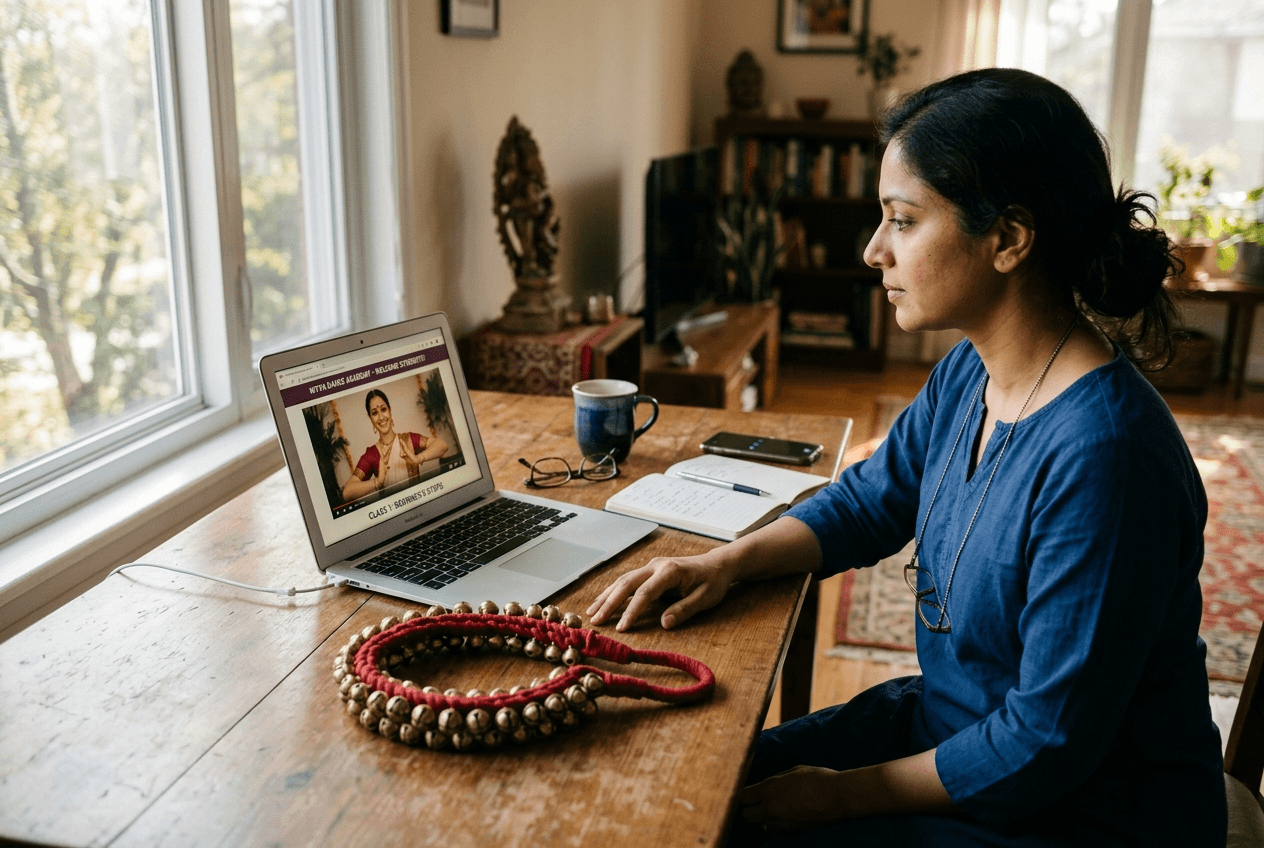 A thoughtful start makes all the difference for an adult learner. Keep it simple.
- Choose the form that genuinely draws you, Kathak or Bharatanatyam, rather than the one you think you should pick.
- Look for live, one to one teaching that can pace itself to an adult beginner body and schedule, rather than a fast group class built around children.
- Start with a single trial lesson to meet the teacher and feel the format before committing anything. Commit to consistency over intensity. One protected weekly class, attended reliably, beats sporadic bursts of effort every time.
- Be patient and kind with yourself in the early weeks. Your body is learning a new language, and a little steady practice goes a long way.
The easiest first step is to watch yourself in one real lesson. Art Gharana offers a free trial class designed exactly for this, so you can experience adult friendly, one to one teaching with no pressure and decide for yourself.
The Hidden Advantage Adults Have
There is a quiet truth that experienced teachers know but rarely advertise: in some respects, adults learn certain things faster than children. An adult can understand an instruction conceptually, ask a precise question, and apply a correction deliberately, where a child often learns purely by imitation and repetition. When a teacher explains why the weight shifts a particular way in a Kathak spin, or how a Bharatanatyam hand gesture conveys a specific meaning, an adult can grasp the reasoning and use it immediately. That conceptual understanding can shortcut weeks of trial and error.
Adults also bring life experience to the expressive side of these forms, which is where their real depth lives. Bharatanatyam and Kathak are storytelling arts, full of love, longing, devotion and grief. A child performs these emotions from the outside; an adult who has actually lived them can bring a truth to the expression that is genuinely moving. So while a child body may bend more easily, an adult heart often speaks more clearly through the dance. Neither is better. But adults should know that they are not merely tolerated in these art forms; they bring something distinctive and valuable to them.
Common Mistakes Adult Beginners Make
A few avoidable errors trip up adult learners, and knowing them in advance saves a lot of frustration.
- Comparing themselves to children or to advanced dancers online. Your only useful comparison is to yourself a month ago. Progress, not perfection, is the measure.
- Pushing too hard too soon and risking strain. Adult bodies need a sensible warm up and a gradual build. A good teacher protects you from this, which is another reason individual attention matters.
- Treating it as all or nothing. Missing the goal of daily practice and then giving up entirely. Even short, regular practice between weekly classes builds real skill.
- Choosing a class built for children and feeling out of place. Seek teaching that understands and respects the adult learner, in pace, tone and content.
- Quitting in the first awkward month before the body has begun to adapt. The early weeks always feel clumsy, for everyone. Persistence through that short phase is what unlocks the joy that follows.
A Note for Diaspora Adults
For many adults of Indian heritage living in the United States, learning Kathak or Bharatanatyam is about more than fitness or a hobby. It is a way back to something. Perhaps you grew up watching a relative dance, or always felt a pull toward the culture that busy American life never gave you time to follow. Learning the dance as an adult lets you claim that heritage in your own body, on your own terms, and often inspires the next generation when children see a parent take it seriously. The global adult Kathak community that has grown up online since 2021 is full of exactly these stories: professionals and parents in the diaspora, finally learning the art they grew up admiring. You would be in very good company.
How One to One Online Learning Changed Everything for Adults
It is worth pausing on just how recently this became easy. A decade ago, an adult who wanted to learn Kathak or Bharatanatyam had to find a teacher within driving distance, fit into a class built mostly around children, and somehow protect a fixed studio slot against the chaos of adult life. For most working adults and parents, that was simply too much, and the dream quietly died. The shift to live, one to one online learning removed every one of those barriers at once. The teacher comes to your screen, the lesson is built around you alone, and the timing bends to your week rather than the other way around.
This is precisely why adult enrolment in Indian classical dance has grown so sharply since 2021. The demand was always there; what changed was access. For an adult in the United States, often far from any in person Indian dance school, a live one to one class is frequently not just the most convenient option but the only realistic one. And because the teaching is individual, it can be paced exactly to an adult body and an adult schedule, which is the single biggest reason adult learners now succeed where they once gave up.
Frequently Asked Questions
1. Is it too late to learn Indian classical dance as an adult?
No. Schools and gurus regularly teach adult beginners, including people starting at thirty five, forty and even fifty. Indian classical dance has a long tradition of welcoming dedicated learners at any age.
2. Do I need to be fit or flexible before I start?
No. Fitness and flexibility are built by the practice itself. A good teacher starts where your body is, and an hour of dance can burn around four to five hundred calories while building strength and stamina.
3. Can I learn with no dance background at all?
Yes. Adult beginner programs are designed for people starting from zero. They build the vocabulary of the form step by step, so no prior training or natural talent is needed.
4. I am a busy professional. How can I fit it in?
Modern online learning is built for this. Live one to one classes fit a single weekly lesson around your schedule with no commute, and some adult programs blend recorded lessons with live correction for maximum flexibility. You can try a free trial class to see how it fits.
5. Will I ever be able to perform?
Many adult learners perform recreationally at community events within a year or two, and some pursue formal recitals. Your starting age does not impose a ceiling; your consistency sets your pace.
The Bottom Line
The fear that you have missed your chance is, for almost everyone, simply untrue. Adults across the world are learning Kathak and Bharatanatyam from scratch, in serious numbers, supported by schools and gurus who welcome them, and helped by a fitness, focus and cultural payoff that suits adult life beautifully. The only real barrier, time, is the one that flexible, one to one online learning was built to remove. If you have always wanted to dance, the right time is not when you were younger. It is now.
Take the first step today. Explore Art Gharana online dance classes and book a free trial, and find out how it feels to finally begin.