ChatGPT
 Google AI
 Grok
Grok Claude
Bollywood dance is one of the most vibrant, energetic, and joyful performing arts a child can learn, blending classical Indian dance techniques with contemporary choreography and the irresistible rhythms of Hindi film music. For Indian-Canadian families and anyone drawn to this colourful tradition, online Bollywood dance classes for kids have made world-class instruction accessible from coast to coast. This complete guide covers what Bollywood dance actually involves technically, why it is uniquely well-suited to children and diaspora learners, what to look for in an online platform, how lessons are structured, and how to get your child started from anywhere in Canada.
What Is Bollywood Dance? A Complete Introduction
Beyond the Stereotype
Many parents hear "Bollywood dance" and picture the flashy hand gestures and exaggerated expressions from Hindi film songs. That's part of it. But Bollywood dance is actually a sophisticated fusion art form with deep classical roots and extraordinary creative range.
The Classical Foundations
Bollywood dance draws primarily from four Indian classical traditions:
Bharatanatyam from Tamil Nadu: The angular postures, precise footwork patterns, and expressive mudras (hand gestures) that appear in countless choreographed Bollywood sequences come directly from Bharatanatyam.
Kathak from North India: The fluid spins (chakkars), intricate footwork rhythms, and expressive storytelling gestures characteristic of many Bollywood romantic sequences reflect Kathak's influence.
Manipuri from Northeastern India: The gentle, flowing quality of many devotional Bollywood sequences owes much to Manipuri's characteristic smoothness.
Folk dance traditions: Bhangra from Punjab, Garba from Gujarat, Dandiya, Lavani from Maharashtra, and folk styles from every region of India appear regularly in Bollywood choreography, giving it its remarkable regional diversity.
The Contemporary Influences
Modern Bollywood choreography also incorporates hip-hop, jazz, contemporary dance, and Western pop dance styles. This fusion quality is what makes Bollywood dance uniquely accessible to diaspora children who are navigating both Indian and Western cultural influences simultaneously.
What Bollywood Dance Involves Technically
A complete Bollywood dancer develops:
Upper body coordination: The characteristic hand and arm movements that are Bollywood's most recognisable element. These range from precise classical mudras to fluid contemporary arm sequences.
Footwork patterns: From Kathak-influenced rhythmic stamps to Bhangra-style vigorous leg movements, Bollywood footwork is diverse and technically demanding.
Facial expression (abhinaya): The ability to convey emotion through facial expression is central to authentic Bollywood performance. Students learn to connect their internal emotional state to their external expression.
Synchronisation with music: Bollywood choreography is deeply connected to the musical phrase structure of Hindi film songs. Learning to feel and respond to the musical structure is a core skill.
Spatial awareness and stage presence: How to use performance space, how to project to an audience, and how to carry themselves with the confidence and joy that characterises memorable Bollywood performance.
Why Bollywood Dance Is Particularly Well-Suited to Children
Joyful Engagement That Sustains Motivation
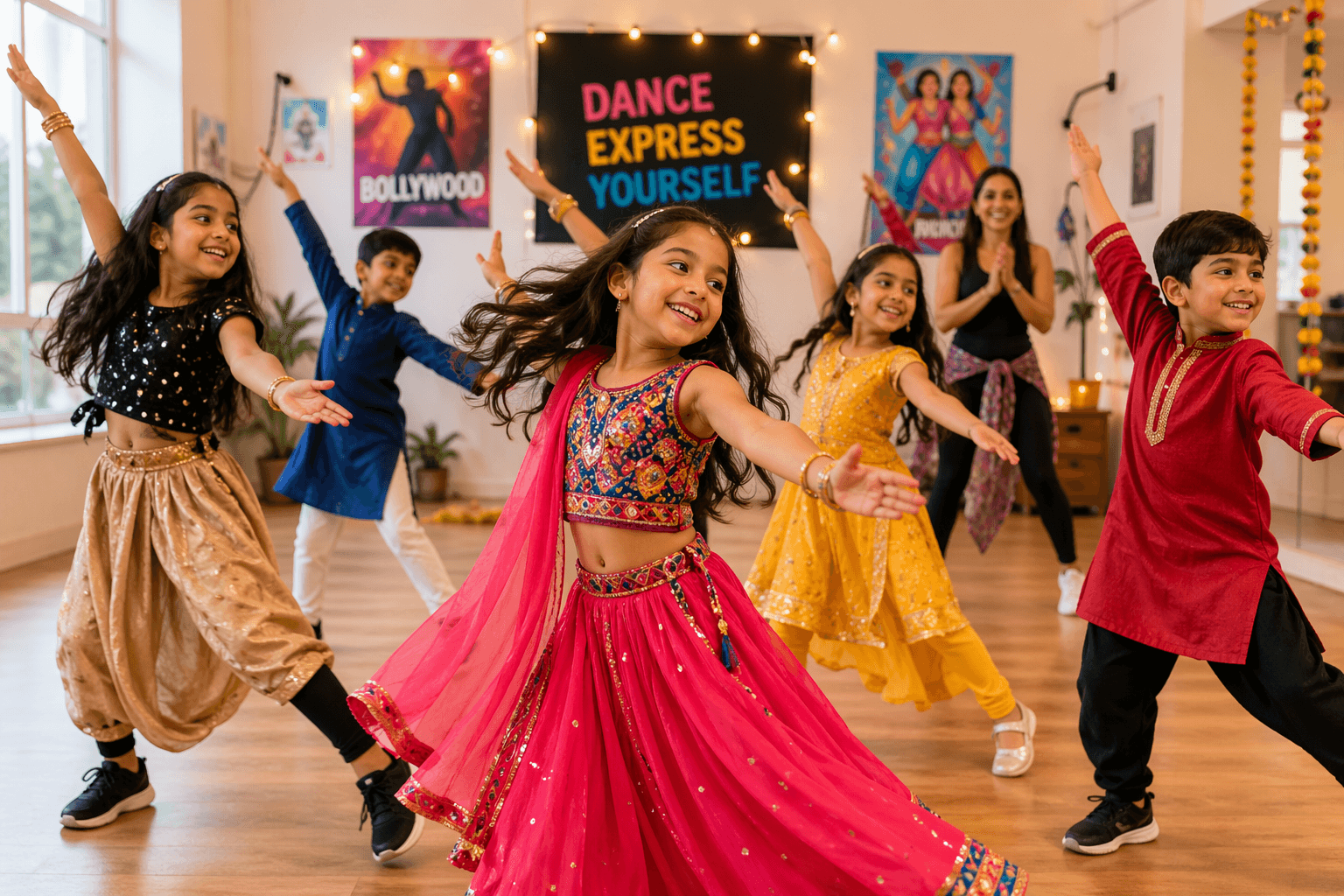
Of all the dance forms children can learn, Bollywood consistently produces the highest natural motivation. The music is familiar, the energy is infectious, and the choreography is visually spectacular in ways that children find immediately exciting. Children who are excited to go to class practise more willingly at home, persist through challenges more readily, and develop skills faster.
Cultural Bridge for Diaspora Children
For Indian-Canadian children navigating two cultural worlds, Bollywood dance is a particularly powerful bridge. It connects them to Indian cultural heritage through the medium of music and film they likely already encounter at home, making the cultural connection feel natural rather than imposed.
Research on diaspora communities consistently shows that active engagement with heritage cultural practices, as opposed to passive cultural consumption, significantly strengthens cultural identity in second-generation children. Bollywood dance, which requires active physical engagement, musical immersion, and expressive connection to Indian cultural narratives, provides exactly this type of active engagement.
Physical Development and Fitness
Bollywood dance provides outstanding cardiovascular conditioning, flexibility development, and coordination training. A full Bollywood class is aerobically demanding, with sequences designed to develop stamina while building technical skills. Children who train regularly in Bollywood develop physical fitness that carries into their general health.
Social and Performance Confidence
Bollywood dance is typically performed with energy and joy, which creates a performance culture that is celebratory rather than competitive. Children in Bollywood classes typically perform at cultural events, Diwali celebrations, school performances, and community festivals, gaining public performance experience in a supportive, high-energy environment.
How Online Bollywood Dance Classes Work for Canadian Children

The Live Video Call Format
Online Bollywood dance lessons are delivered through live video calls, typically via Zoom or Google Meet. The teacher and student see and hear each other in real time. The teacher observes the student's technique, energy, and coordination through the camera and provides real-time corrections, demonstrations, and encouragement.
What a Typical Beginner Class Looks Like
Warm-Up (5-8 Minutes)
A structured warm-up covering neck, shoulder, wrist, and hip rotations, light stretching, and simple coordination exercises. The teacher introduces the warm-up vocabulary (specific movements that will appear in the class) so the warm-up serves double duty as both physical preparation and skill preview.
Technical Foundations Work (10-12 Minutes)
For beginner children, this focuses on the foundational elements of Bollywood technique: Basic arm and hand positions and how to transition smoothly between them Simple footwork patterns (sliding steps, hip-focused movements, Bhangra-influenced jumps) Coordinate upper and lower body simultaneously — one of the most important early skills
Choreography Learning (12-15 Minutes)
The teacher teaches a segment of a choreographed piece section by section, phrase by phrase. Bollywood choreography is taught orally with the music playing, creating an immersive cultural and musical experience from early lessons.
Expression and Character Work (5 Minutes)
Even in beginner classes, teachers introduce the idea that Bollywood dance is expressive storytelling. Simple facial expression exercises (smiling, looking surprised, expressing joy) are introduced in relation to the mood of the song being danced to.
Cool-Down and Reflection (3-5 Minutes)
Gentle stretching, a brief review of what was learned, and the practice assignment for the week.
Setting Up Your Home for Online Bollywood Classes
Floor Space
A clear area of at least 6 feet by 4 feet. Hard flooring is better than thick carpet for footwork development. If your practice space is carpeted, a large yoga mat or thin exercise mat provides a better surface for quick footwork transitions.
Camera Position
Position your device so the teacher can see your child's full body from head to feet. This is essential for correcting footwork, arm positions, and overall energy. A tablet or laptop on a side table slightly in front of and above the practice space works well.
Sound System
Bollywood music is central to the experience. A Bluetooth speaker that can be placed near the practice space but connected to the same device showing the video call significantly enhances the class experience compared to the laptop's built-in speakers.
What to Look for in an Online Bollywood Dance Platform for Canadian Kids
Live, 1:1 or Small Group Classes
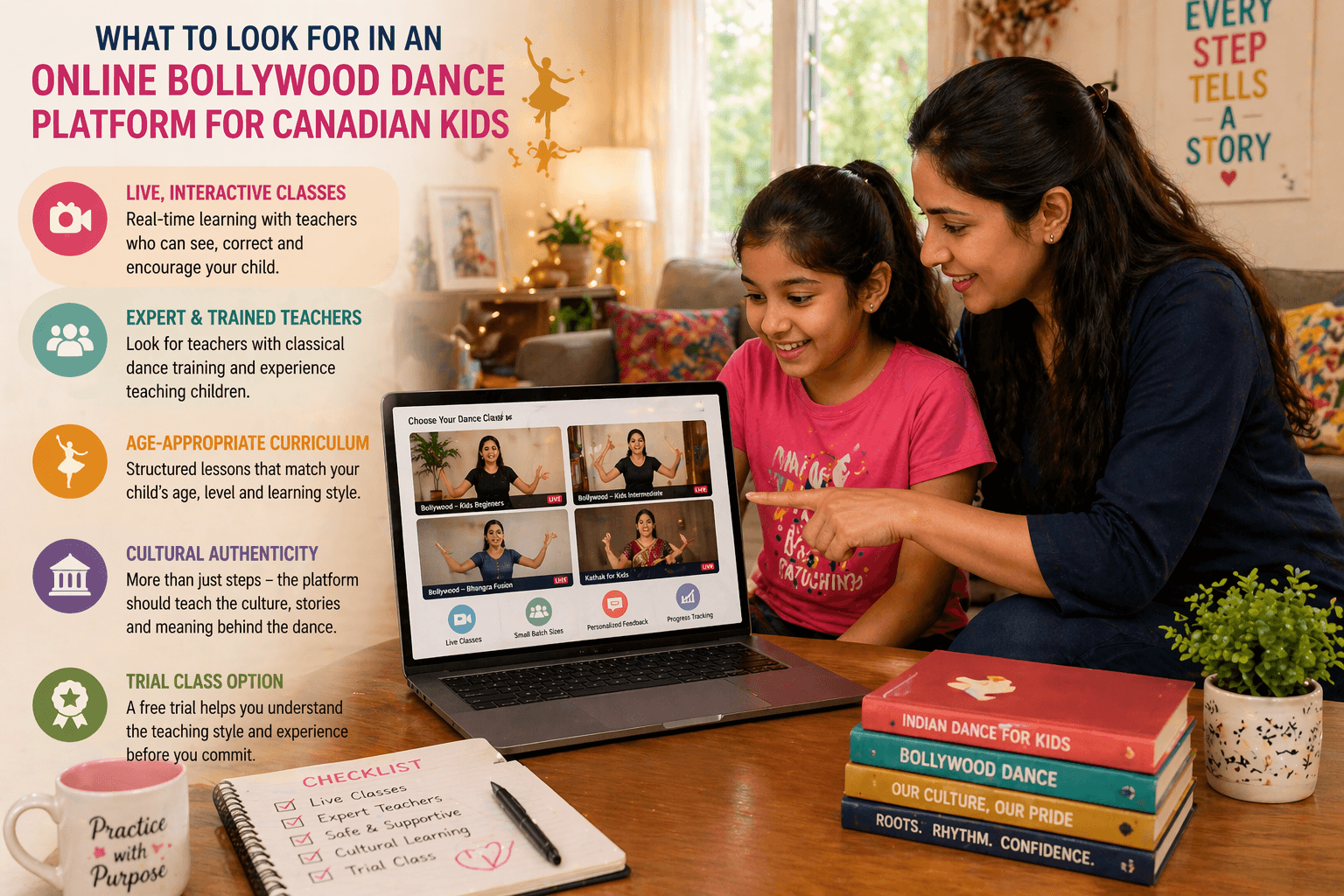
The most important distinction is between live instruction and pre-recorded video content. Pre-recorded Bollywood tutorial videos are widely available on YouTube and represent a casual introduction to the dance form. They cannot provide the real-time corrections, personalised encouragement, and individual feedback that live instruction provides. For meaningful skill development, live classes with real teachers are essential.
Teachers with Classical Training Background
The best Bollywood dance teachers are trained in one or more Indian classical dance forms. This training gives them the technical vocabulary and body awareness to teach Bollywood's classical elements accurately, rather than just the surface-level popular style.
Ask specifically: what is your dance training background? A teacher whose answer includes Bharatanatyam, Kathak, or another classical form alongside their Bollywood experience will provide significantly richer instruction than one whose background is purely in recreational Bollywood fitness classes.
Age-Appropriate Curriculum
Children at different developmental stages need different teaching approaches. A curriculum designed for a seven-year-old looks very different from one for a twelve-year-old. Ask how the platform structures its curriculum for different age groups.
Cultural Authenticity
The best Bollywood dance education doesn't just teach steps. It teaches the cultural context: the stories the songs are telling, the regional dance traditions embedded in each choreography, and the connection between movement and music. This cultural depth is what transforms Bollywood dance from an aerobic exercise into a genuine cultural education.
A Free Trial Class
Without exception, trial before committing. One class tells you more than any website description.
At Art Gharana, we offer live Bollywood and Indian classical dance classes for children across Canada. Our teachers are trained in classical Indian dance traditions and bring genuine cultural depth to every class. Explore our dance courses and our full range of offerings at Art Gharana's courses page. You can also read our guide on connecting with roots through Indian classical dance for more on the cultural significance of this training.
Bollywood Dance and Cultural Identity for Indian-Canadian Children
The Role of Dance in Diaspora Cultural Preservation
Canada's Indian population has grown to approximately 1.8 million, making it one of the largest South Asian diaspora communities in the world. For Indian-Canadian families in cities like Toronto, Vancouver, Calgary, Edmonton, and across smaller communities, maintaining cultural connection for Canadian-born children is one of the most deeply felt parenting priorities.
Bollywood dance provides one of the most accessible and joyful pathways to this cultural connection. Unlike classical dance forms that require years of foundational technique before producing a culturally meaningful performance, Bollywood dance can produce a culturally vibrant, emotionally expressive performance within months of beginning instruction. This immediacy matters for children, whose motivation responds powerfully to visible results.
Building Cultural Confidence in Canadian Schools
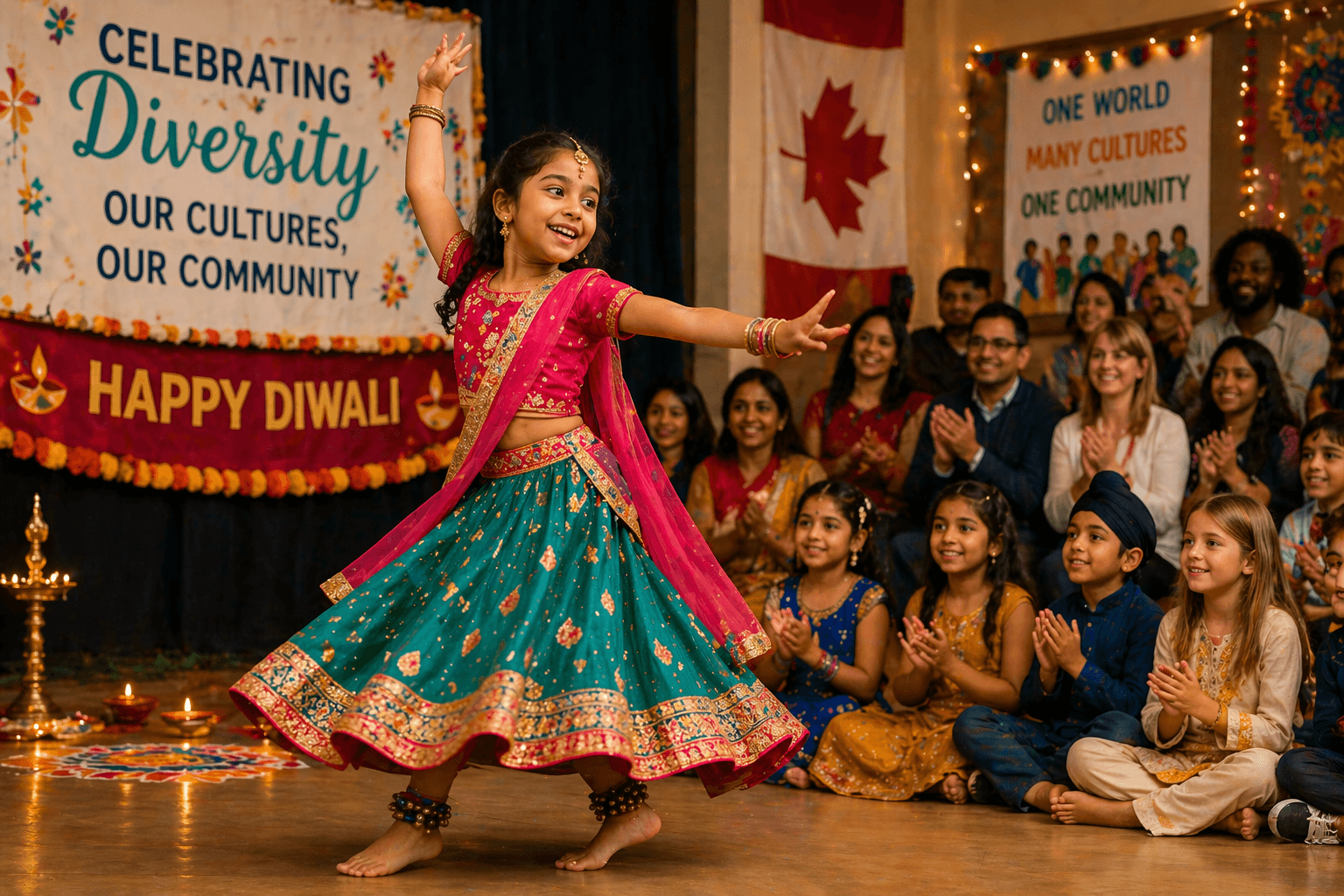
Indian-Canadian children who dance Bollywood bring something uniquely valuable to their Canadian school community. Cultural performances at school assemblies, multicultural days, and community events give these children the experience of being cultural contributors rather than cultural observers. This shift from observer to practitioner is one of the most significant gifts a cultural arts education can provide.
The Connection Between Bollywood Dance and Hindi Film Culture
For families where Hindi films are a regular part of home life, learning Bollywood dance creates a deeper engagement with the cultural material children already encounter. When a child can dance the choreography from a song they know from home, their connection to both the music and the cultural tradition deepens significantly.
Bollywood Dance Fitness for Parents and the Whole Family
Bollywood as Family Activity
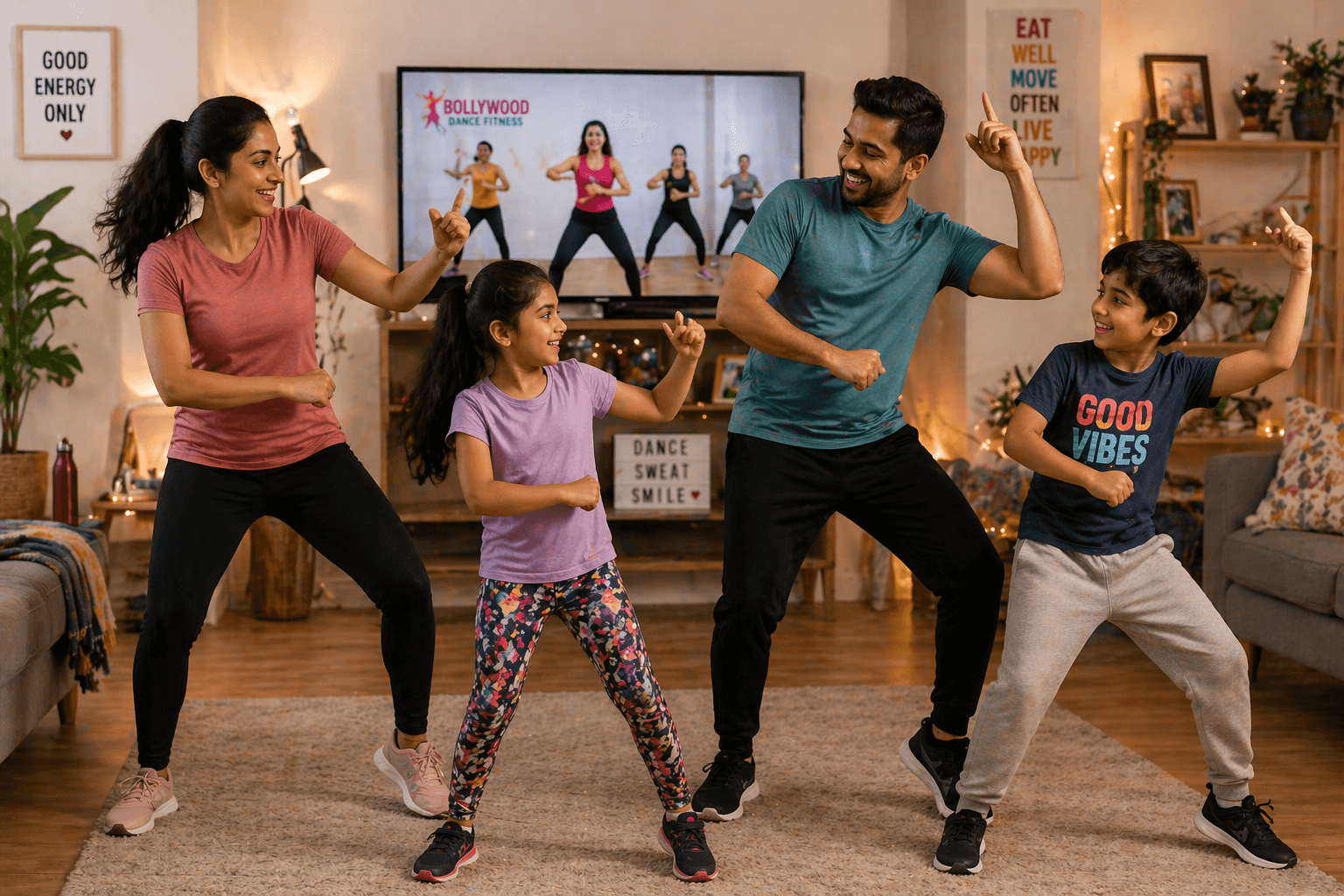
One of the unique advantages of Bollywood dance is its genuine accessibility to adults and children simultaneously. Unlike many children's activities that parents watch from the sidelines, Bollywood dance is something families can practise together. Many Canadian families enjoy learning the same choreography so they can perform together at Diwali celebrations, weddings, and family gatherings.
Art Gharana's online format makes this particularly practical: parents can join children's online classes or take their own adult Bollywood classes and practise together at home.
Conclusion
Bollywood dance is one of the most joyful, culturally rich, physically rewarding, and developmentally beneficial arts a Canadian child can learn. For Indian-Canadian families, it is simultaneously a celebration of heritage and a bridge between the two cultures their children inhabit daily.
Three things to take away. First, look for teachers with classical dance training behind their Bollywood instruction — the depth of education they provide is categorically different. Second, set up a proper practice space at home with good sound and enough floor space. Third, engage your child's enthusiasm from the beginning by choosing songs they already love and connecting the dance to music that matters to them.
Book a free trial Bollywood dance class at Art Gharana today and bring the joy of this extraordinary art form into your family's life.
Frequently Asked Questions
1. What age can children start Bollywood dance classes online in Canada?
Bollywood dance is accessible from age four or five onwards with age-appropriate teaching approaches. Children as young as four can begin learning simple rhythmic movements and basic arm positions in playful, exploratory classes. More structured technical training typically begins around ages six to seven when children can follow multi-step choreography and benefit from technique correction.
2. Does my child need any prior dance experience to start Bollywood dance?
No. Bollywood dance online classes for beginners are designed for complete beginners with no prior dance experience. The teacher starts from the most fundamental movements and builds progressively. Many of the most enthusiastic and skilled Bollywood dancers started with no dance background whatsoever.
3. Can boys learn Bollywood dance as well as girls?
Absolutely. Bollywood dance has a proud tradition of spectacular male performance, from the iconic choreography of Hrithik Roshan to the powerful Bhangra sequences that are a staple of North Indian Bollywood films. Boys who study Bollywood dance develop physical confidence, rhythmic precision, and artistic expression that serves them well across many areas of life.
4. How many classes per week do children need to progress in Bollywood dance?
One weekly live class with consistent home practice (15-20 minutes three to four times per week) produces solid progressive learning. Children who attend two classes per week progress noticeably faster. For children aiming to perform at cultural events or competitions, two classes per week is recommended.
5. Is Bollywood dance the same as Bhangra?
No. Bhangra is a specific folk dance form from Punjab in North India, characterised by energetic jumping, shoulder movements, and the beats of the dhol drum. Bollywood dance frequently incorporates Bhangra sequences, particularly in songs with Punjabi influences, but Bollywood dance as a complete form includes choreography from classical Indian dance, multiple folk traditions, and contemporary styles. Bhangra is one element within the broader Bollywood dance vocabulary.