ChatGPT
 Google AI
 Grok
 Claude
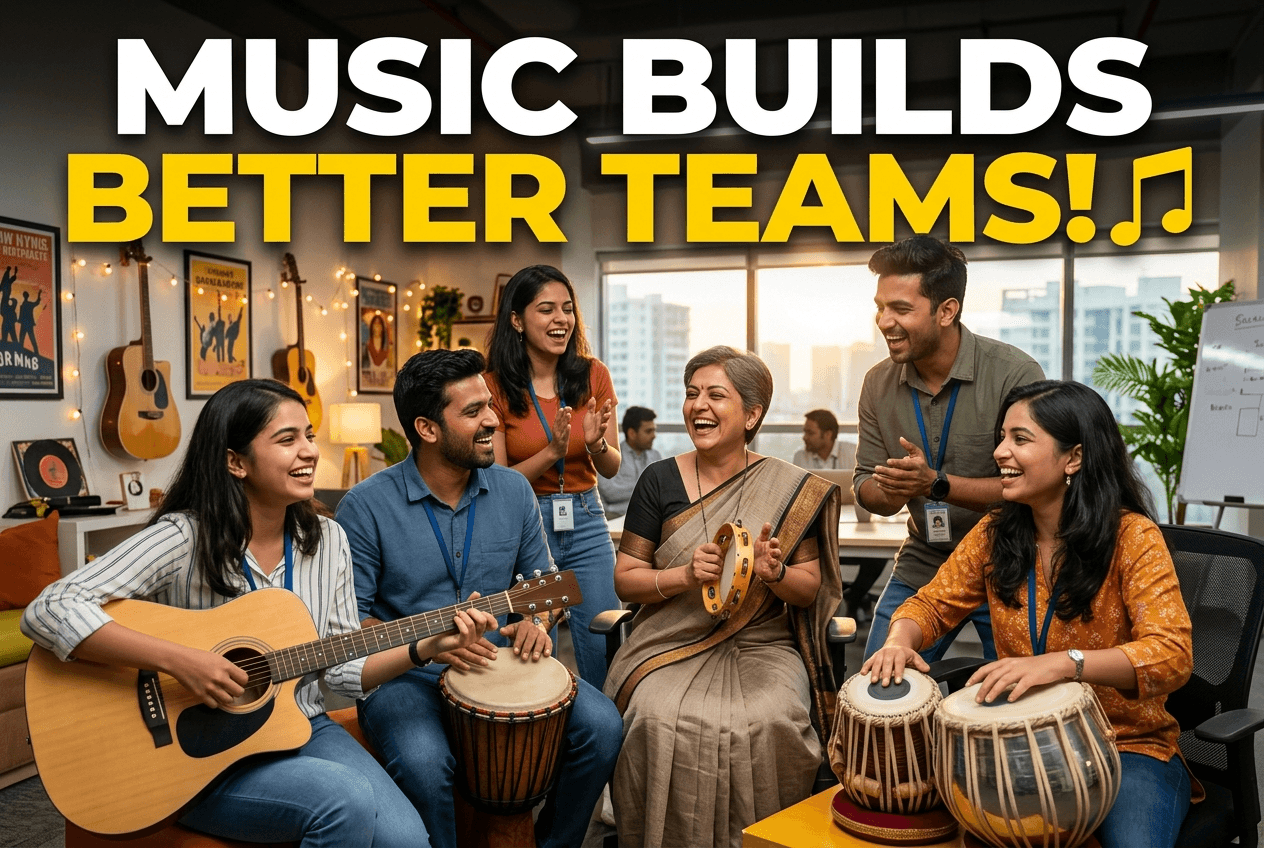
There is a reason every culture on earth makes music together, and has done for as long as there have been groups of people. From work songs to festival drumming to the national anthem before a match, humans have always used shared music to turn a collection of individuals into a unified group. Modern neuroscience now explains why: making music together synchronises us, physiologically and emotionally, in a way almost nothing else does. For Indian companies grappling with scattered hybrid teams, high attrition and the quiet erosion of belonging that follows both, this ancient truth has a very modern application.
Live group music sessions, delivered by certified instructors to corporate teams, are among the most powerful and most underused team bonding tools available in the Indian corporate market in 2026. They are not a novelty or a one off entertainment. They are a repeatable, science backed intervention that reduces stress and builds genuine connection between colleagues, every single time the team plays together. This is the HR leader's guide to how music brings teams together, and how to make it work in your organisation.
The Neuroscience of Playing Together
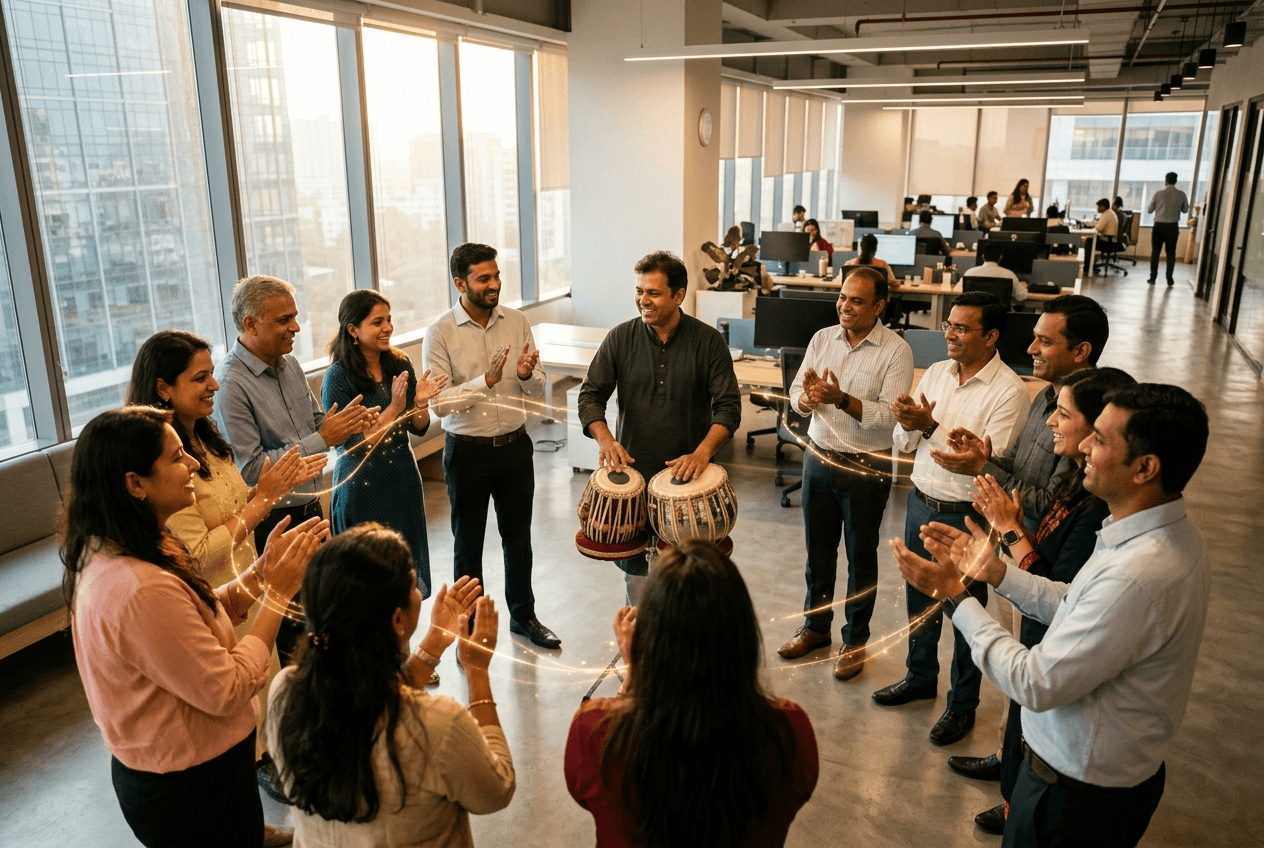 The bonding power of shared music is not a metaphor. When people make music together, their bodies literally synchronise. Studies of group music making have documented synchronisation of heart rate and breathing among participants, and research on interpersonal synchrony consistently shows that moving or making sound in time with others increases trust, cooperation and a felt sense of being one group. Making music together also triggers the release of endorphins and oxytocin, the neurochemistry of social bonding. In other words, a team that makes music together is not simply having fun. It is undergoing a measurable, shared physiological experience that draws its members closer, which is precisely what team bonding aims to achieve and so rarely does.
A 2025 scoping review published in BMC Complementary Medicine confirmed that music based interventions in workplaces show meaningful benefits for employee mood, stress levels and overall job satisfaction. Music reduces cortisol, lowers blood pressure and lifts mood by stimulating endorphin release. When a stressed, deadline driven team spends forty five minutes making music together, they emerge measurably calmer, more positive and more connected, a combination no ordinary meeting or offsite can deliver.
Why Music Works Where Other Activities Do Not
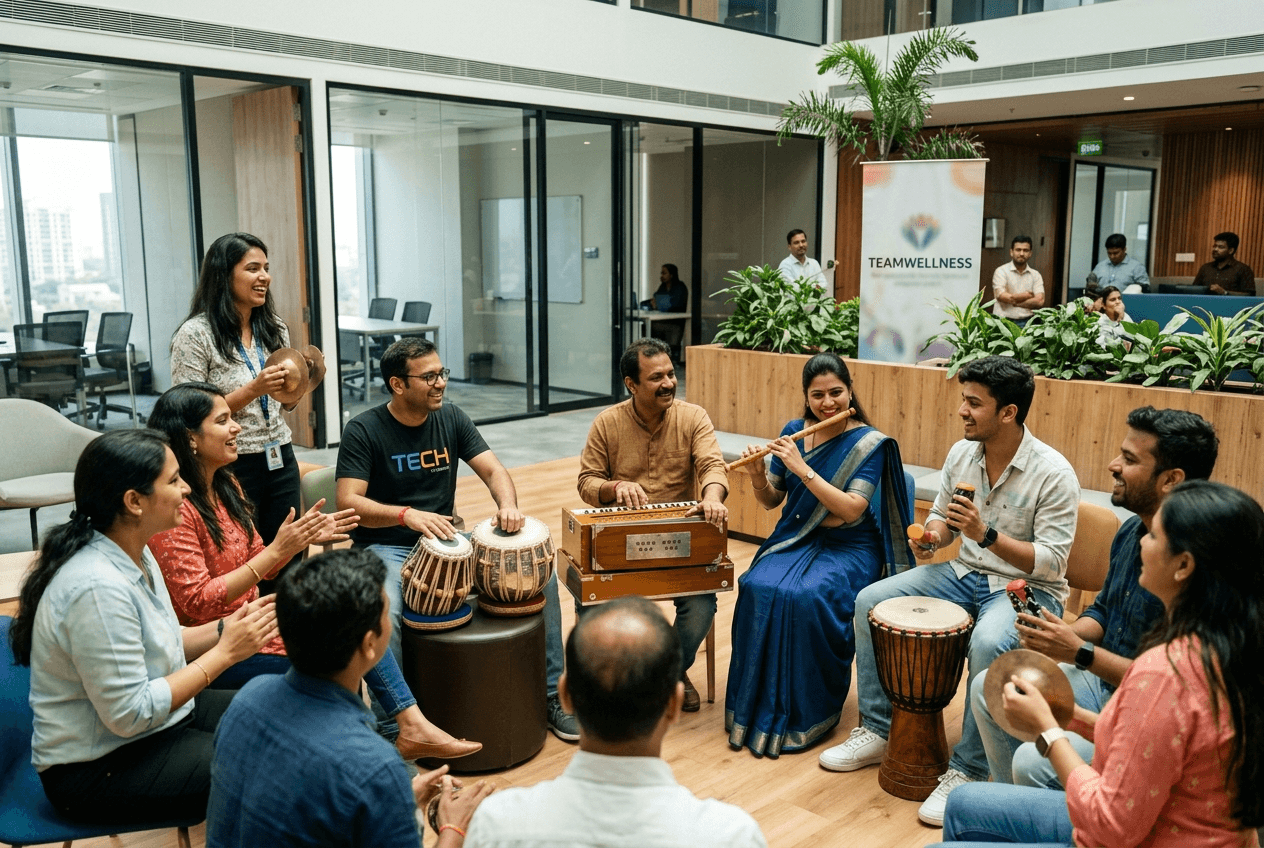 Music has three qualities that make it uniquely effective for team bonding. First, it is inherently synchronous: to play together at all, a group must listen to one another and coordinate in real time, which is the very definition of teamwork. Second, it is a great leveller: rhythm and voice do not respect job titles, and a session in which everyone is a beginner together dissolves hierarchy and lets colleagues meet as equals. Third, it is joyful and low pressure when framed well, producing the shared laughter and small triumphs that turn colleagues into friends. Few other activities combine all three, which is why music consistently outperforms both fitness benefits and generic social events on connection and belonging.
Active Music Making Versus Background Music
It is worth drawing a clear distinction. Playing background music in the office, or sharing a company playlist, is pleasant but passive, and its team bonding effect is negligible. The bonding power of music comes from active, participatory music making, a group actually clapping a rhythm, singing a phrase or playing a simple pattern together under the guidance of a skilled instructor. Active participation is what engages the body and attention fully, triggers the synchronisation effect, and produces the shared experience that builds connection. This is why a live, instructor led group session is so much more powerful than any amount of ambient or streamed music.
What Music Team Bonding Looks Like in Practice
Group Rhythm and Percussion Sessions
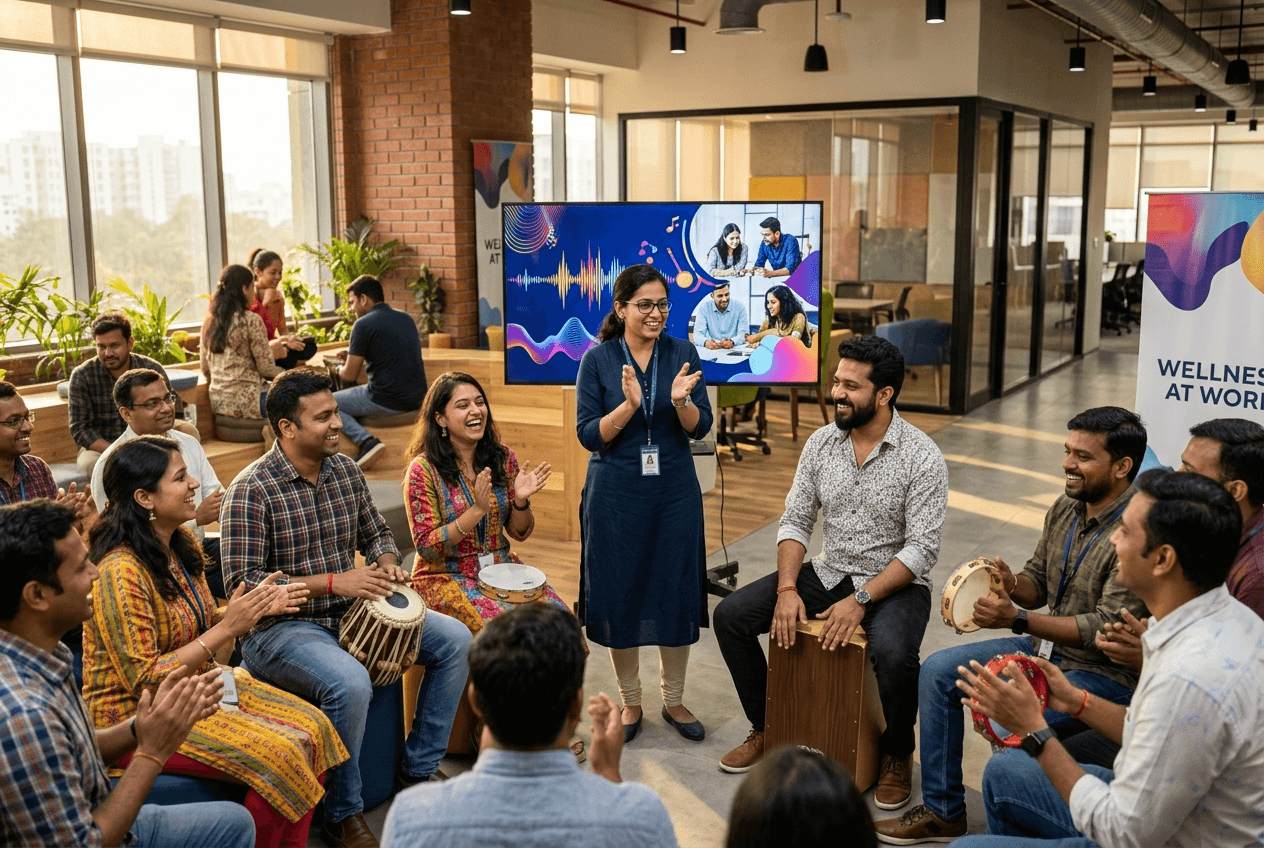
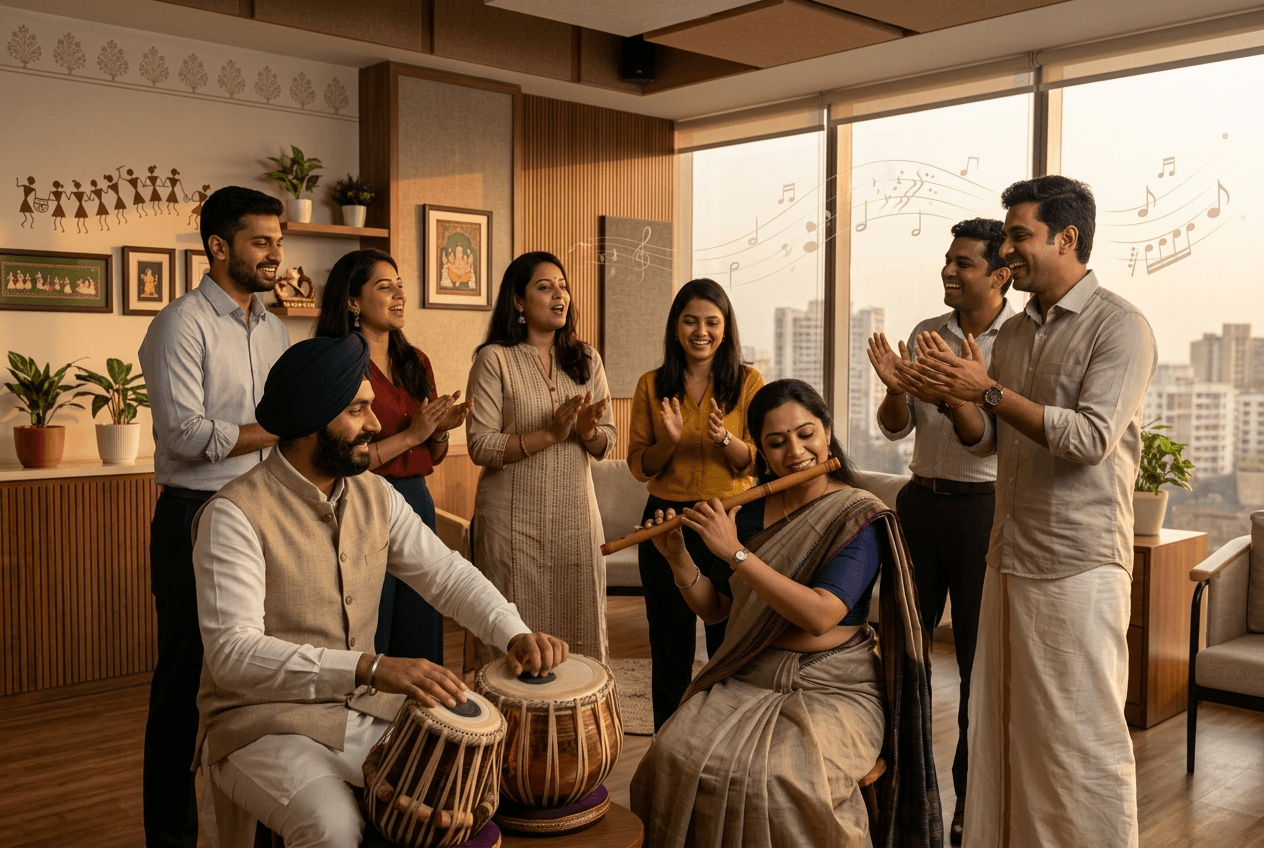
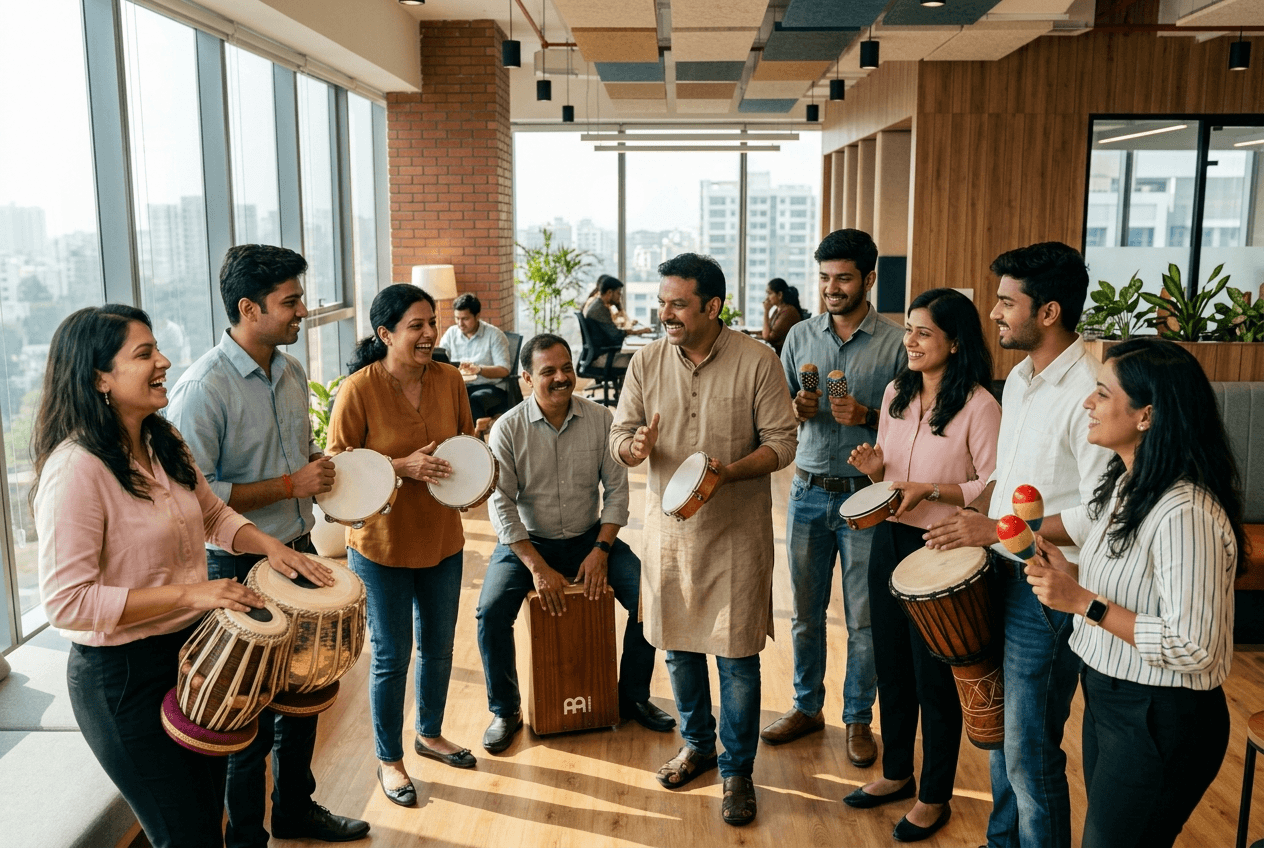
A live group tabla or percussion session is one of the fastest routes to a satisfying shared musical result. Rhythm is immediately accessible, nobody needs to read music or carry a tune, and within a single forty five minute session a team of complete beginners can lock into a simple pattern together and feel the unmistakable click of playing as one. That moment, when a group of colleagues suddenly hears itself producing a coherent rhythm, is a genuine bonding experience that people remember and talk about.
Group Vocal Sessions
Group Hindustani vocal or Carnatic vocal sessions bring their own kind of connection. Singing together is among the most ancient bonding activities humans have, and a guided session that has a team humming a simple melody or exploring the swaras together produces a warmth and unity that surprises most participants. Vocal sessions require no equipment at all, making them especially easy to run for distributed teams joining from their homes.
One to One Learning as an Individual Benefit
Alongside group bonding sessions, many companies offer individual one to one music learning as an employee benefit, an analyst learning bansuri flute, a manager taking up tabla, a designer studying vocal. This transforms the programme from a shared activity into a genuine personal investment in the employee, and the enthusiasm individual learners bring back to group sessions enriches the whole team's experience.
Music for Remote and Hybrid Teams
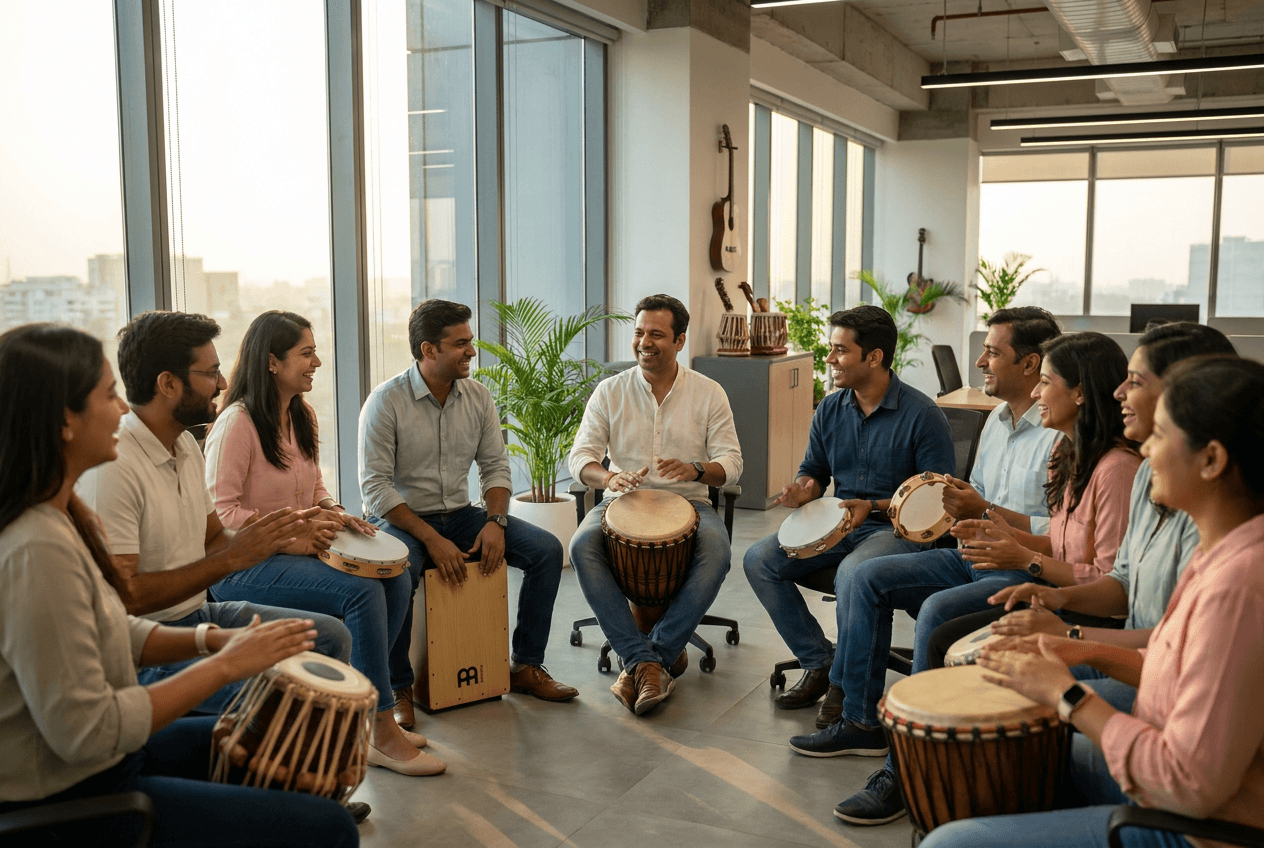 The bonding challenge is hardest for teams that rarely share a room, and music is one of the few interventions that genuinely solves it online. A distributed team joining the same live music session from Bangalore, Mumbai, Hyderabad and their homes shares a real synchronous experience, listening and playing together in the same moment, which asynchronous chat and ordinary video calls cannot replicate. For the many Indian companies operating hybrid and remote models in 2026, a recurring live music session is among the most effective ways to keep a scattered team feeling like a team, week after week rather than once a year.
Music and India's Cultural Fabric
Music carries a special resonance in the Indian workplace because it is woven so deeply into Indian life, from film songs everyone knows to the classical and devotional traditions of every region. A session set to familiar Bollywood melodies is instantly engaging for an Indian team, and a programme that moves between North Indian and South Indian musical traditions invites colleagues to share and celebrate one another's heritage. In a diverse team spanning many regions and languages, music becomes a common ground where difference is a source of curiosity and delight rather than distance, strengthening the bonds across the whole group.
The Retention and Engagement ROI
For HR leaders, the case for music team bonding rests on the link between connection and retention. Employees who feel genuinely bonded to their colleagues are markedly less likely to leave, and belonging is consistently among the strongest predictors of retention. The arithmetic is conservative. At Indian IT sector attrition rates, with replacement costs of fifty to two hundred percent of annual salary, a recurring music programme that prevents even a few departures per year from a team of fifty repays its cost many times over. Because the bonding effect of a weekly session compounds rather than fades, its impact on retention is sustained in a way that one off events cannot match.
The engagement upside is equally real. Sessions that employees look forward to lift morale and participation, and the authentic photos and clips employees share of their team making music become employer brand content of a credibility no marketing budget can buy.
How to Implement Music Team Bonding
Start with a Free Pilot
Art Gharana recommends a four to six week pilot for one team before wider rollout, generating engagement data, feedback and a business case. Book a corporate trial session to feel the bonding effect firsthand before any commitment.
Make It a Recurring Ritual
The bonding power of music compounds with repetition, so a standing weekly or fortnightly slot works far better than a single event. A regular Music Hour that becomes part of the team's rhythm turns an activity into a ritual, and rituals are what hold groups together.
Keep It Inclusive and Pressure Free
The framing matters. The goal is shared enjoyment, not performance, so a good instructor makes it clear that no skill is required and no one is being judged. When employees understand that the point is to play together rather than to play well, participation rises and the bonding effect follows.
About Art Gharana Corporate
 Art Gharana is the only platform combining live music, dance, art and vocal wellness specifically positioned for corporate teams in India. With certified instructors across tabla, bansuri flute, Hindustani vocal, Carnatic vocal, Bollywood dance, Kathak and Bharatanatyam, Art Gharana delivers genuine music based team bonding in a format designed for corporate delivery. Explore our full range of wellness courses, review our plans and pricing for companies, and browse our instructor profiles before booking your pilot through the Art Gharana corporate programme.
Frequently Asked Questions
1. How does music bring teams together?
Music brings teams together through synchrony. Making music in time with others physiologically synchronises participants and triggers the release of bonding neurochemicals, measurably increasing trust, cooperation and a sense of being one group. Active group music making is one of the most powerful and reliable team bonding activities available.
2. What kind of music activities work for corporate teams?
Group rhythm and percussion sessions such as tabla, and group vocal sessions, work best for team bonding because they are immediately accessible and inherently synchronous. Bollywood music sessions are especially engaging for Indian teams. Individual one to one learning can be offered alongside group sessions as a personal development benefit.
3. How does Art Gharana deliver music sessions for companies?
Art Gharana delivers live group and individual music sessions online, led by certified instructors across many disciplines. Sessions are customised for team size, frequency, cultural preference and scheduling across all Indian time zones, and work equally well for in office, hybrid and fully remote teams.
Why Music Belongs in the Modern Wellness Stack
Most Indian companies in 2026 have built a wellness stack around two pillars: physical wellness through fitness benefits, and mental wellness through meditation apps and employee assistance programmes. Both are valuable and both are increasingly standard, which means neither differentiates an employer or, on its own, builds team connection. Music occupies a distinct and largely unfilled place in this stack. It delivers measurable stress relief like a wellness benefit, but unlike a solitary meditation app it is social, building the connection between colleagues that sits at the heart of a healthy team. A company that adds live group music to its wellness offering is not duplicating what it already has; it is filling a genuine gap that fitness and meditation cannot reach.
Music Team Bonding Across Company Types
India's IT sector, with its young, socially connected workforce, is the most natural home for music team bonding, both because it resonates and because it generates the shareable content that strengthens employer brand. The BFSI sector benefits from balancing group sessions with individual learning options, so that quieter employees can engage through one to one instruction rather than group performance. Startups, competing for talent without the budgets of larger firms, gain disproportionate value from music bonding, which reinforces exactly the creative, close knit culture that startups depend on and which larger competitors struggle to replicate. Across all three, the common thread is that a recurring live music session builds connection continuously, at a cost that is small relative to the retention and engagement value it returns.
From Sound to Solidarity
The deepest value of music team bonding is hard to reduce to a metric, but easy to recognise. It is the shift in how a team feels about itself after it has made music together, repeatedly, over months. The shared memory of the first time the group locked into a rhythm, the in jokes born of early fumbles, the quiet pride of a team that can now perform a short piece together, all of this becomes part of the team's identity. Colleagues who have made music together relate more warmly, communicate more openly and extend one another more goodwill in the ordinary friction of work. That solidarity, built note by note, is what music uniquely gives a team, and it is why music brings teams together like nothing else.
Key Takeaways for HR Leaders
The essential points for HR leaders considering music for team bonding in India are clear. Making music together is one of the most powerful bonding activities known, because synchrony physiologically and emotionally unites participants and triggers the neurochemistry of connection. The 2025 BMC Complementary Medicine review confirms the mood, stress and satisfaction benefits of workplace music interventions. Active, instructor led group music making, not background music, is what produces these effects. For hybrid and remote teams, live online music sessions are among the few interventions that build real connection across distance. And the retention ROI is conservative and compelling. Art Gharana is ready to deliver all of this for your team. The pilot is free. Begin today.
The Global Wellness Market and Music's Place in It
The global corporate wellness market is projected to grow from $68.41 billion in 2025 to $118.21 billion by 2034. This growth is not being driven by companies adding more of the same fitness and meditation benefits, but by a widening definition of wellness that now includes emotional, creative and social dimensions the first generation of programmes ignored. Music sits squarely in this expanded definition, delivering stress relief, emotional expression and social connection in a single activity. Indian companies that recognise this shift and add live music to their wellness offering now, while it remains distinctive, position themselves ahead of competitors who will adopt it only once it becomes standard. The strategic logic is simple: when everyone offers the same wellness stack, you compete on wellness only by adding what others have not.
Building the Business Case in Five Steps
For HR leaders who must justify a music programme to finance and leadership, a simple framework works. Step one: establish the baseline cost of current attrition, using replacement costs of fifty to two hundred percent of annual salary per departure. Step two: establish the cost of the music programme for your team size and session frequency. Step three: calculate the attrition reduction required to break even, which for most Indian teams is only a few departures per year. Step four: cite the belonging and connection research that explains why bonded teams retain better. Step five: add engagement, wellbeing and employer brand value as upside beyond the break even point. Because this case is conservative, quantitative and tied to costs finance already understands, it earns approval reliably in Indian corporate contexts.
Why Art Gharana Is the Right Music Partner
Art Gharana is uniquely positioned as India's corporate music partner for three reasons. First, breadth: it is the only platform offering live sessions across tabla, bansuri flute, Hindustani and Carnatic vocal, and dance, from a single corporate subscription, so a programme can rotate to keep teams engaged. Second, authenticity: all instructors are certified performers with verified credentials and real experience delivering engaging sessions in the online corporate format. Third, delivery design: the programme is built for corporate use, with group formats, flexible IST scheduling, scalable pricing and content that works for complete beginners. The pilot is free, onboarding is immediate, and the business case builds from the data of the first few sessions.
Music and the Gen Z Workforce
For India's Gen Z and Millennial employees, who now make up the majority of the corporate workforce, music resonates in a particular way. This generation values experiences over conventional perks, prizes creativity and mental wellbeing, and expresses identity through the culture it shares online. A live music programme speaks directly to all three: it is an experience rather than a transaction, it is creative and expressive, and it produces exactly the authentic, shareable moments this generation posts and talks about. Where a gym subscription reads as a standard benefit, a team making music together reads as a culture worth joining. For companies serious about attracting and keeping young talent, music is not a frivolous addition to the wellness stack but a direct answer to what this workforce actually wants.
People Also Ask: Music and Team Bonding in India
Why does making music together bond people?
Making music together bonds people because it requires and produces synchrony. Playing or singing in time with others coordinates attention, breath and even heart rate, and triggers the release of endorphins and oxytocin, the neurochemistry of social connection. This is why shared music making reliably increases trust and a sense of belonging among participants.
Can music sessions work for remote corporate teams in India?
Yes. Live online music sessions are among the most effective bonding tools for remote and hybrid Indian teams. A distributed team playing or singing together in real time shares a genuine synchronous experience that ordinary video meetings cannot provide, and recurring sessions build connection continuously across physical distance.
What is the best music activity for team building in India?
Group rhythm sessions such as tabla are among the best music activities for team building, because rhythm is immediately accessible and produces a satisfying shared result quickly. Group vocal sessions and Bollywood music sessions are also highly effective for Indian teams, being instantly familiar and requiring no prior skill.
Do music programmes improve employee retention?
Music programmes support retention indirectly but meaningfully, by strengthening belonging, which is among the strongest predictors of whether employees stay. A recurring music programme that builds genuine connection between colleagues typically needs to prevent only a few departures per year from a team of fifty to more than repay its cost, given Indian replacement cost norms.
How much does a corporate music programme cost in India?
Corporate music programme costs in India vary by team size and session frequency. Art Gharana's corporate programme is priced flexibly, with a free pilot available before any commitment, and the per employee cost of a weekly group session is typically modest relative to the bonding and retention value delivered. HR leaders can review plans and pricing for companies.
What disciplines does Art Gharana offer for corporate music sessions?
Art Gharana offers group and individual sessions across tabla](https://www.artgharana.com/courses/instruments/online-tabla-classes), bansuri flute, Hindustani vocal and Carnatic vocal, alongside dance disciplines, all delivered live online by certified instructors and customisable for team size, frequency and scheduling.