ChatGPT
 Google AI
 Grok
Grok Claude
Salary gets people through the door. Engagement keeps them there and brings out their best. Research consistently shows that employees who feel engaged, valued, and connected to their workplace outperform their disengaged peers on every metric - and stay far longer. This post explains why engagement beats salary in the long run, what drives real engagement, and how creative programs are one of the most effective tools for building it. Book a free trial and see the difference for yourself.
Here's a question worth sitting with: if you doubled everyone's salary tomorrow, how many of your disengaged employees would suddenly start caring?
The honest answer, backed by decades of research, is: not many.
Pay matters. Fair compensation is non-negotiable. But beyond a certain threshold - once people feel financially secure - salary stops being the primary driver of engagement, performance, or retention.
Employee engagement is what fills that gap. And most organisations are leaving enormous value on the table by not understanding it well enough.
Gallup's 2023 State of the Global Workplace report found that only 23% of employees worldwide are engaged at work. The rest? Either showing up physically but checked out mentally, or actively undermining the organisation. That's not a staffing problem. It's a culture problem.
This post breaks down why engagement matters more than salary, what genuinely drives it, and how creative programs like music, dance, art, and mindfulness are among the most powerful tools available for building it sustainably.
What Is Employee Engagement, and Why Is It So Hard to Build?
 Employee engagement is the emotional commitment an employee has to their organisation and its goals. It's not about happiness, though engagement often produces happiness. It's about whether people care - whether they bring discretionary effort, creative thinking, and genuine investment to their work.
Engagement is hard to build because it can't be mandated or purchased. You can buy compliance. You can buy attendance. You can't buy the feeling that this work matters, that these colleagues are worth fighting for, and that this organisation deserves your best thinking.
Engagement is built through experience. Through moments of genuine connection, creative expression, recognition, and meaning. It's cumulative. It takes time. But the return on that investment is extraordinary.
Companies with high engagement see 23% higher profitability, 18% higher productivity, and 81% lower absenteeism, according to Gallup's meta-analysis of over 100,000 teams. These aren't soft metrics. They're the numbers that show up in quarterly results.
Why Doesn't a Higher Salary Solve the Engagement Problem?
A higher salary doesn't solve the engagement problem because the core drivers of engagement are intrinsic, not financial. They include a sense of purpose, positive relationships, autonomy, mastery, and the feeling of being genuinely valued as a person.
Psychologist Frederick Herzberg's motivation theory, which remains one of the most validated frameworks in organisational psychology, draws a clear distinction between "hygiene factors" (things like salary and working conditions that must be adequate to prevent dissatisfaction) and "motivators" (things like meaningful work, recognition, and growth that actively drive engagement).
Salary is a hygiene factor. Pay people too little and they'll be unhappy. Pay them adequately and the salary question mostly disappears. What remains is the motivational environment. And that's where most companies underinvest.
The data from exit interviews is telling. Most people who leave voluntarily don't cite salary as the primary reason. They cite feeling unvalued, disconnected from leadership, lacking growth, or simply not enjoying the day-to-day environment. These are engagement failures, and no pay rise could have solved them.
What Actually Drives Employee Engagement?
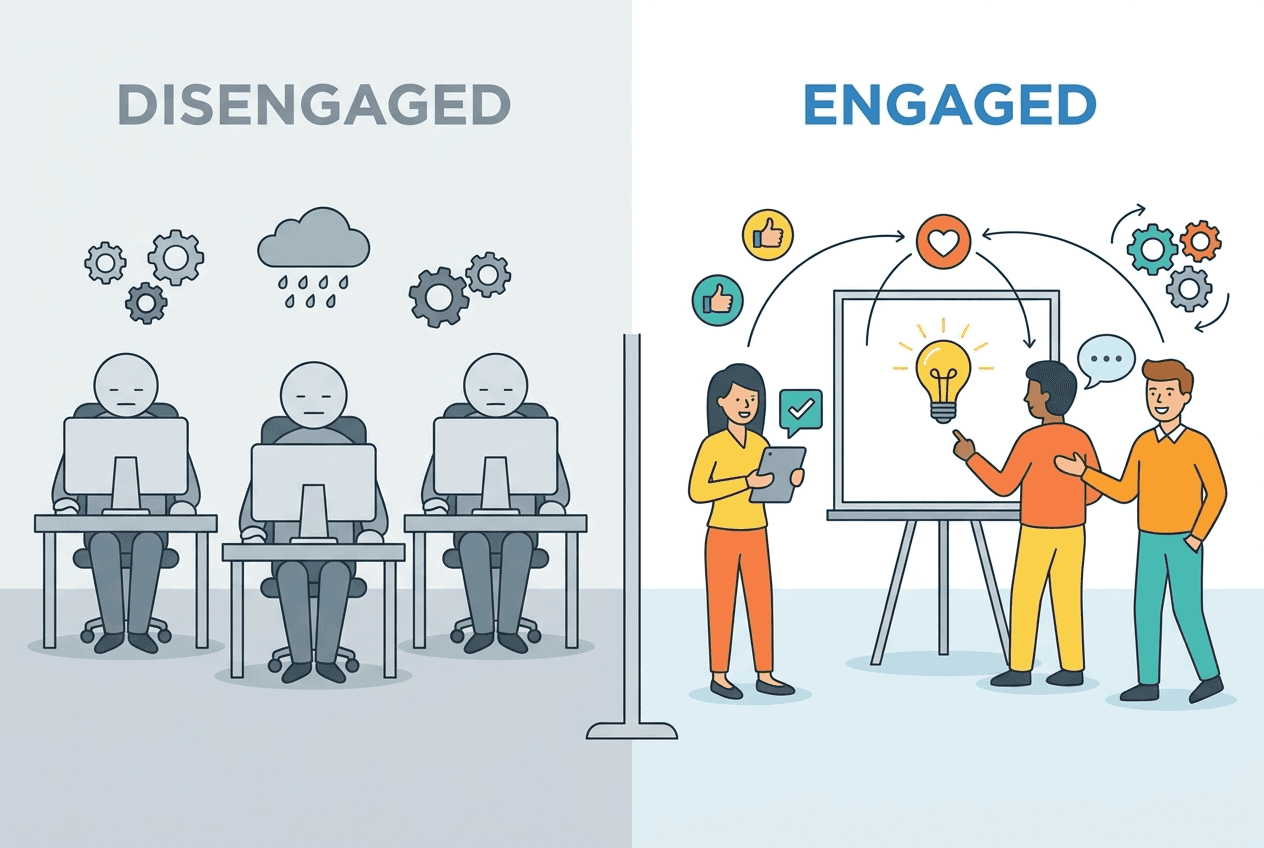 What actually drives employee engagement is a combination of feeling seen, feeling connected, feeling purposeful, and feeling creatively alive. These needs are human and universal. The specific activities that meet them vary, but the needs themselves don't.
Here are the evidence-backed drivers that matter most:
Belonging: The sense that you're genuinely part of a group that knows and values you. Not just "part of the team" on an org chart, but actually connected to the people around you.
Purpose: Believing that your work contributes to something meaningful. This doesn't require working for a charity. It can come from any environment where people feel their contribution matters.
Growth: The feeling that you're developing, learning, and becoming more capable. This includes professional skills but also personal development: creativity, emotional intelligence, cultural expression.
Positive emotion: Regular experiences of joy, laughter, pride, and genuine pleasure at work. Not manufactured fun, but authentic moments that emerge from real connection and creative engagement.
Recognition: Feeling seen and appreciated for who you are and what you contribute. Not just performance reviews, but the daily, informal acknowledgement of value.
Creative programs, specifically music, dance, art, and mindfulness, address almost all of these at once. That's what makes them such a powerful engagement tool.
How Do Creative Programs Build the Emotional Drivers of Engagement?
Creative programs build engagement by creating the experiences that drive it: belonging, growth, positive emotion, and connection. These aren't abstract benefits. They're physiological and psychological realities produced by shared creative activity.
When a team learns guitar together, they share vulnerability. They laugh at the same struggles. They celebrate the same small victories. The physiological synchrony produced by group music-making - heartbeats aligning, breathing patterns matching - creates genuine social bonds that carry back to the workspace.
When colleagues paint together or work through a dance routine, they see each other differently. The hierarchy softens. The quiet analyst who's brilliant at watercolour gets a moment of recognition she'd never get in a meeting. The manager who usually seems intimidating becomes a slightly wobbly beginner. Those shifts in perception change relationships.
And when people consistently look forward to something at work, their overall emotional baseline rises. They're more patient, more collaborative, more forgiving. That emotional uplift is the foundation of real engagement.
Art Gharana's programs are designed to produce exactly this. See the range of programs we offer and how they're structured to build engagement week by week.
What Is the Link Between Employee Engagement and Retention?
 Employee engagement is the single strongest predictor of voluntary retention. Engaged employees are not just less likely to leave. They actively choose to stay, even when they receive competing offers.
Gallup research has found that 51% of currently employed workers are watching for or actively seeking a new job. But among highly engaged employees, that number drops dramatically. Engaged employees have built emotional equity with their organisation. They have relationships, rituals, and a sense of identity tied to where they work. That equity is what keeps them when the recruiter calls.
The financial case for retention is unambiguous. The average cost of replacing an employee ranges from half their salary to twice their salary, depending on the role. For senior and specialised positions, the cost is even higher when you account for lost knowledge, team disruption, and the months of reduced productivity during onboarding.
Engagement programs, including creative programs, are one of the most cost-effective retention strategies available. They build the emotional equity that makes people choose to stay. Explore our plans and pricing to understand the investment required.
How Can Leaders Use Creative Programs to Increase Engagement Across Their Teams?
Leaders who actively participate in and champion creative programs see the highest engagement impact across their teams. The signal that leadership sends by joining a music session, taking part in a dance workshop, or sitting in a mindfulness circle is more powerful than any policy or initiative.
Here's a practical approach for leaders who want to use creative programs strategically:
Participate visibly. Attend sessions, not just the first one. Let your team see that you're a genuine participant, not an observer. Your willingness to be a beginner - to be imperfect in front of your team - builds trust faster than almost anything else.
Talk about it. Reference creative sessions in all-hands meetings. Mention the tabla class. Share a photo from the art workshop. When leaders narrate culture, it becomes culture.
Remove barriers. Protect session time from being overridden by meetings and deadlines. If creative programs are always the first thing sacrificed when pressure builds, the message is clear: this isn't really a priority. That message is deeply disengaging.
Celebrate participation, not performance. The goal is engagement, not excellence. Recognise the employee who showed up to their first guitar session just as much as the one who's naturally musical. The showing up is what matters.
Pair programs with listening. Creative sessions work best when they're part of a broader culture of care. Ask your team what they need. Listen to the answers. Creative programs are powerful, but they work best alongside genuine management attention and psychological safety. Read what our participants say about the difference these programs have made.
What Does a High-Engagement Culture Actually Look Like?
 A high-engagement culture is visible in the small things. People greet each other like they mean it. Meetings have more energy. People volunteer for projects outside their job description. They stick around after hours - not because they're overworked, but because they want to.
It's also visible in the data: low voluntary attrition, high referral rates, strong Glassdoor scores, fast recruitment conversion, and consistent productivity even during stressful periods.
Building that culture requires intentional design. You don't get there by accident, and you don't get there through salary alone. You get there by understanding what people actually need and building systems that deliver it consistently.
Creative programs are one of the most reliable systems for doing that. They're not magic. They're a structure, like any good management practice, that creates the conditions for human engagement to flourish.
When we embed music, dance, art, and mindfulness into the regular rhythm of work, we're not adding a perk. We're installing the infrastructure for genuine connection, creative expression, and sustainable wellbeing. That infrastructure is what high-engagement cultures are built on.
Book a free trial with Art Gharana and start building yours today.
Conclusion
Salary opens the door. Engagement determines what happens next.
The companies that understand this are building cultures that people genuinely don't want to leave. They're investing in creativity, connection, and the kind of human experience that no competing offer can replicate.
Creative programs are your most direct and affordable path to that kind of culture. They build engagement where it lives: in shared experience, creative expression, and authentic human connection.
You don't need to overhaul your entire HR strategy to get started. You just need to begin. Book a free trial with Art Gharana and see what changes when your team starts creating together.
Frequently Asked Questions
1. Why does employee engagement matter more than salary for retention?
Salary is a threshold factor: pay people too little and they'll leave, but once pay is adequate, it stops being the primary reason people stay or go. Engagement addresses the deeper drivers of retention: belonging, purpose, growth, and positive emotion. Engaged employees have emotional equity in their workplace that salary alone can't build or replicate.
2. What is the average cost of low employee engagement for a company?
Gallup estimates that disengaged employees cost organisations approximately $3,400 in lost productivity for every $10,000 in annual salary. Globally, the cost of low engagement is estimated at over $8 trillion in lost economic output annually. For individual companies, the impact shows up in higher attrition, lower productivity, more absenteeism, and weaker innovation.
3. How do creative programs improve employee engagement specifically?
Creative programs build engagement by delivering the experiences that drive it: shared belonging from group activities, personal growth through skill development, positive emotion from joyful creative expression, and recognition through participation and facilitation. They address multiple engagement drivers simultaneously in a way that most other HR interventions can't match.
4. How long does it take to build a high-engagement culture through creative programs?
Early effects, improved team energy, higher session attendance, more informal connection - typically appear within four to six weeks. Measurable engagement metric improvements usually become visible within three months. Sustained cultural transformation, where engagement becomes a defining characteristic of your company, typically takes six to twelve months of consistent programming and leadership support.
5. Can employee engagement be measured before and after introducing creative programs?
Yes, and it's straightforward. Use a standard engagement pulse survey with five to ten questions covering belonging, purpose, wellbeing, and connection. Run it before you launch the program, then again at three and six months. Pair survey data with attrition figures, absenteeism rates, and Glassdoor review sentiment for a comprehensive picture of impact.