ChatGPT
 Google AI
 Grok
Grok Claude
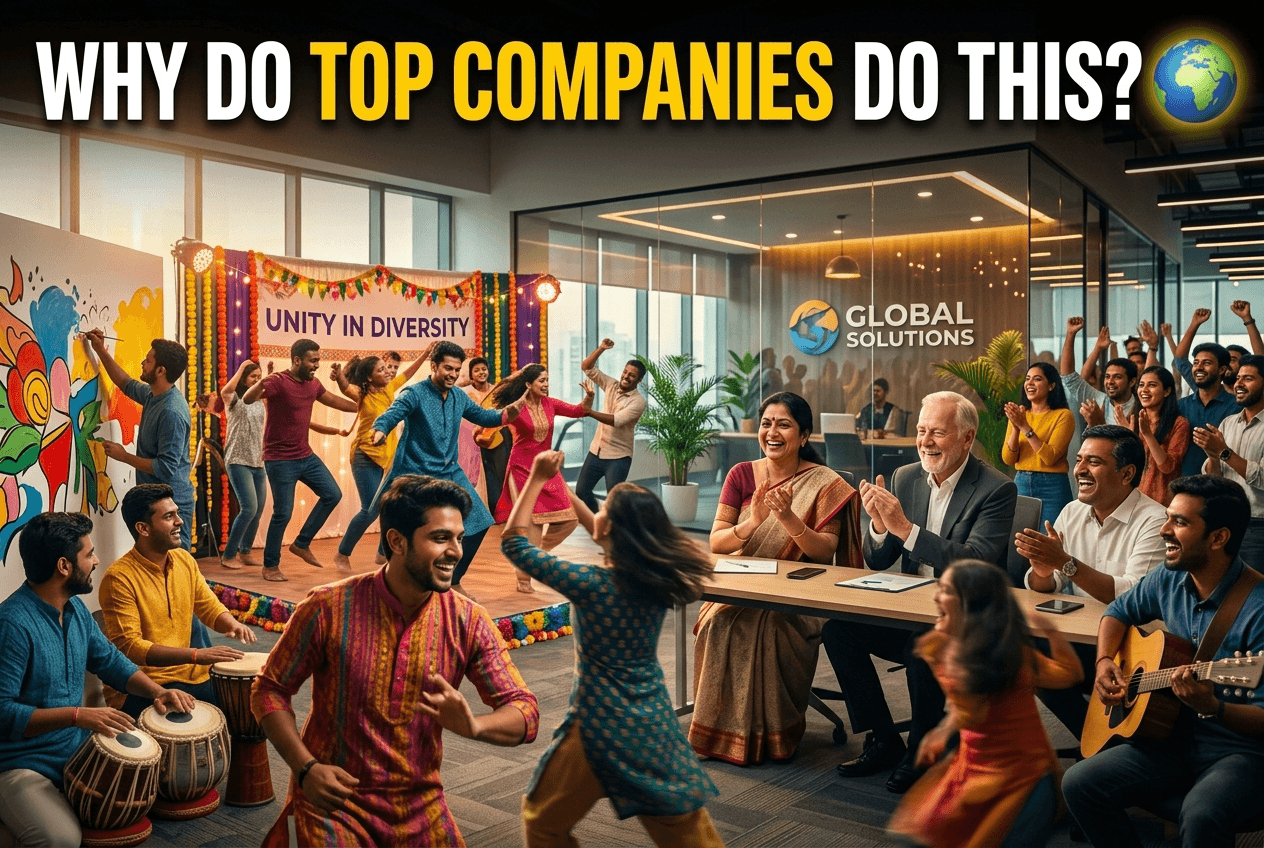
Standard perks - health insurance, gym memberships, free food - are table stakes now. The companies pulling ahead in talent attraction are offering something deeper: creative benefits like music programs, dance classes, art workshops, and mindfulness sessions that address the whole person. This post explains what creative benefits are, why they work, and how to build a benefits package that genuinely differentiates your company. Book a free trial to see creative wellness in action.
What do top candidates actually remember when they compare job offers?
Not the exact insurance premium difference. Not whether the snacks are free or subsidised. They remember the moments that made a company feel different. The interview where someone mentioned the Friday music session. The Glassdoor review that talked about the Bollywood dance class. The LinkedIn post where an employee shared their team's collaborative art piece.
Creative benefits are increasingly the thing that makes a company genuinely stand out. And yet most HR teams are still building their benefits packages from the same template: medical, dental, vision, maybe a wellness stipend.
The companies winning the talent game right now are thinking differently. They're asking: what would make someone proud to work here? What would make them stay? What would make them tell their friends?
In this post, we'll break down exactly what creative benefits are, why they're more powerful than traditional perks, and how to build a package that makes your company genuinely more attractive.
What Are Creative Benefits, and How Are They Different From Traditional Perks?
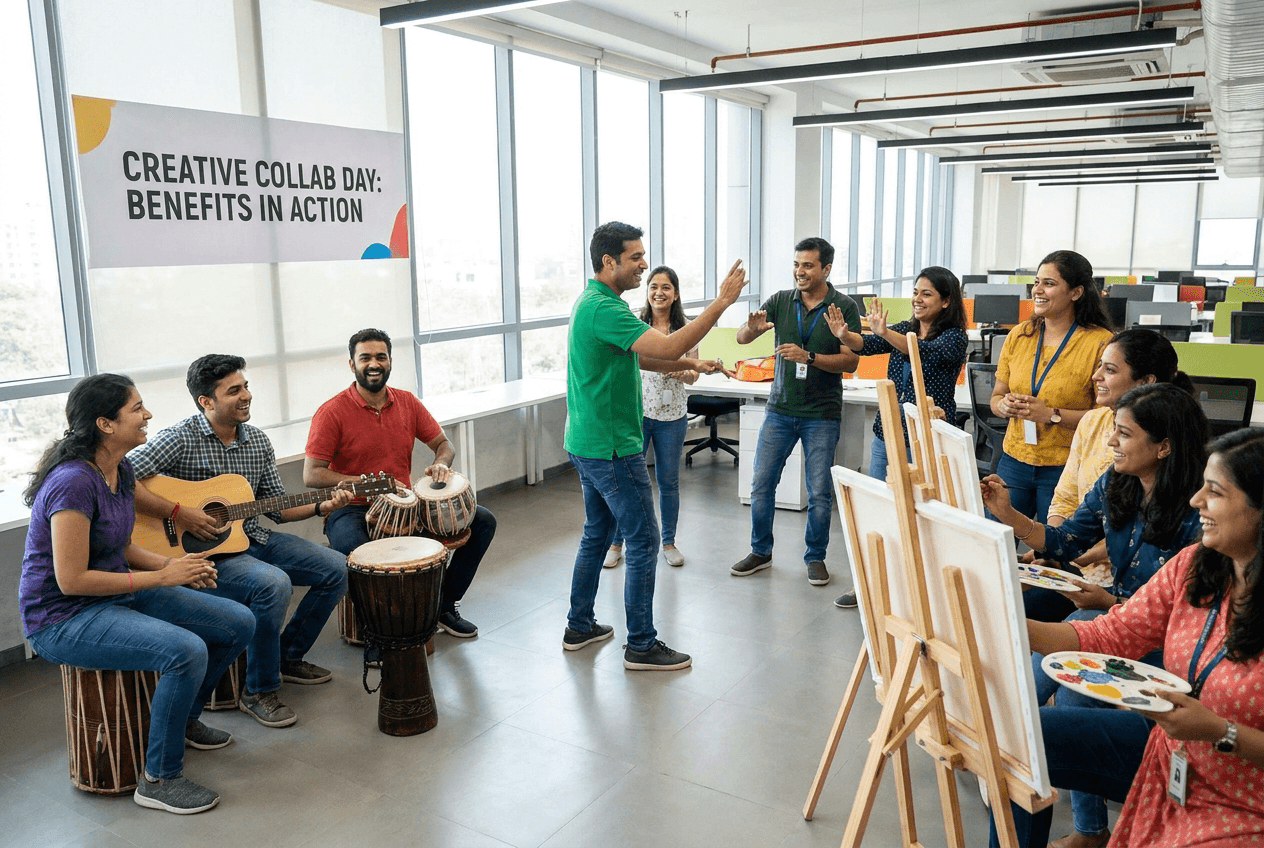 Creative benefits are structured programs that give employees access to creative expression, artistic skill-building, and culturally enriching experiences as part of their work life. They include things like company-sponsored music lessons, team dance workshops, art and craft sessions, and group mindfulness practices.
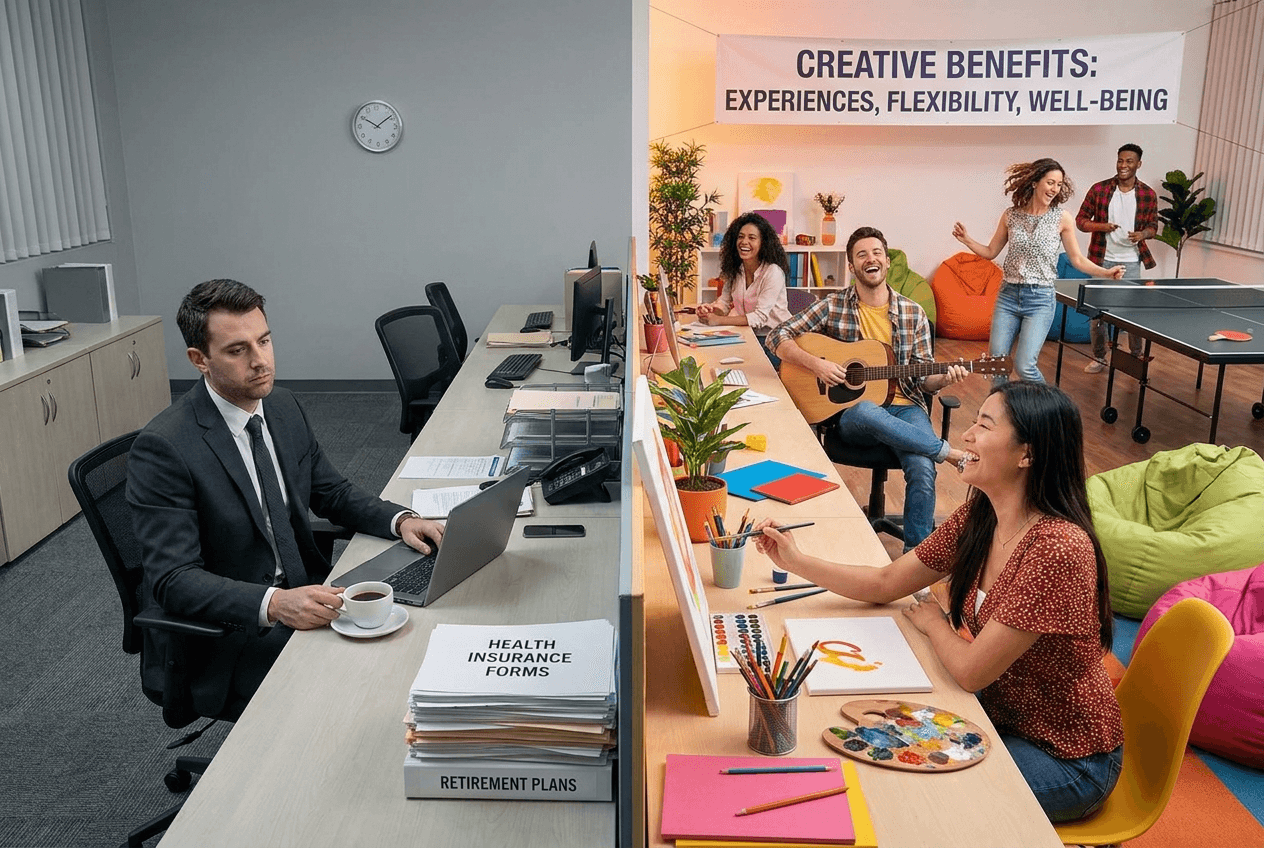
Traditional perks are transactional. They reduce friction or provide conveniences: health cover, commuter benefits, discounts. These are important and expected. But they don't create belonging or meaning. They solve problems. They don't inspire people.
Creative benefits are experiential and relational. They give people stories to tell, skills to develop, and relationships to build. The value isn't in the exchange rate. It's in the transformation.
Here's a practical way to see the difference. A gym subsidy says "we care about your physical health." A weekly music session says "we see you as a creative, expressive human being, not just a resource." The second message is far more powerful, and far more rare.
Why Don't Traditional Perks Retain Talent Anymore?
Traditional perks have lost their power to retain talent because they've become universal. In competitive hiring markets, everyone offers them. Health insurance isn't a differentiator. A laptop isn't a loyalty driver.
Research by Mercer consistently finds that employees rank meaningful work and positive culture far above compensation and benefits when explaining why they stay in a role. And Harvard Business Review has reported that 89% of employees who voluntarily leave a job cite reasons other than pay: management, culture, growth, and connection.
When salary and standard benefits are roughly equal across competitors, the decision comes down to feeling. Does this place feel human? Do I feel seen here? Will I look forward to coming to work?
Traditional perks can't answer those questions. Creative benefits can. They signal something about who you are as a company, and that signal reaches candidates before they even apply. Learn more about our sustainable wellness approach and how it builds culture from the inside out.
What Creative Benefits Are Companies Offering That Actually Work?
 The most effective creative benefits combine regular access, expert facilitation, and a mix of modalities that serve different personalities and interests. Here are the categories that consistently produce strong engagement and retention outcomes:
Music programs: Group music sessions - guitar workshops, vocal harmony classes, rhythm and tabla exploration - are among the most popular creative benefits we offer. They work for all skill levels and create immediate social bonds. The science behind group music-making (oxytocin release, physiological synchrony) makes these particularly powerful for team cohesion. Explore our music courses to see the full range available.
Dance and movement sessions: Bollywood, Kathak, Bharatanatyam, and contemporary dance programs are joyful, energising, and surprisingly inclusive. They're particularly effective at dissolving workplace hierarchies, because everyone's a beginner and everyone can participate. Our dance programs are designed for workplace groups, not performance.
Visual art and craft workshops: Painting, sketching, clay work, and craft activities provide a restorative creative outlet that's especially valued by analytical, high-pressure teams. The making of something tangible - in a world of abstract work - creates a deep sense of accomplishment.
Mindfulness and breathwork: Not every creative benefit needs to be visibly "fun." Mindfulness sessions paired with creative activities provide emotional regulation, stress reduction, and the ability to be fully present, skills that make every other benefit and every work task more effective.
Cultural celebration events: Programs that honour diverse artistic traditions - Indian classical music, folk dance forms, seasonal art - build cultural appreciation and inclusion. For multicultural teams, this is profoundly meaningful.
The key is offering variety and running programs consistently. A one-time event is a nice gesture. A fortnightly creative program is a culture.
How Do Creative Benefits Affect Recruitment and Offer Acceptance Rates?
Creative benefits improve offer acceptance rates by making your company genuinely memorable in a sea of similar-sounding opportunities. Candidates who encounter creative benefits during the recruitment process are more likely to share their experience with their network, which amplifies your employer brand beyond your direct reach.
LinkedIn research has found that candidates who hear about a company's culture from employees are three times more likely to believe it than messages from the company itself. And what do employees talk about? Their experiences. A team that does weekly music sessions will talk about it. A team that participates in a dance workshop will post about it. That organic amplification is worth more than any job board spend.
For talent teams, creative benefits also give you genuine differentiation points in the offer conversation. "We have a strong culture" is vague. "We run weekly Bollywood dance sessions and fortnightly music workshops with professional instructors" is specific and memorable. Candidates can imagine themselves there. That imaginative engagement increases conversion.
How Do Creative Benefits Improve Day-to-Day Employee Experience?
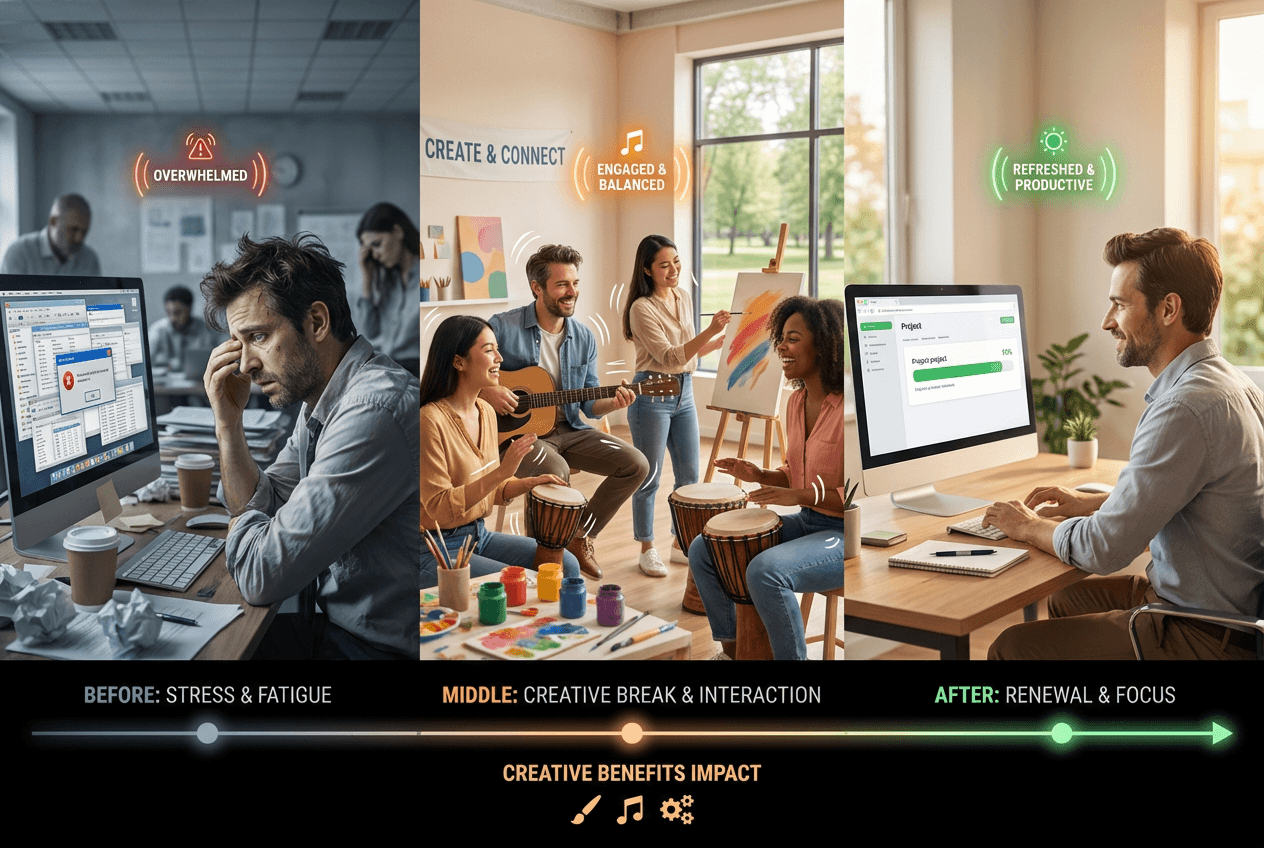 Creative benefits improve the daily employee experience by providing regular moments of joy, restoration, and connection that break the monotony of task-focused work. They give people something to look forward to. And something to look forward to changes how people experience everything else.
There's a psychological phenomenon called the "anticipation effect," studied extensively by behavioural economists. People derive significant wellbeing not just from experiences, but from the anticipation of them. Knowing Thursday has a music session changes how Monday morning feels.
Beyond anticipation, creative programs deliver:
Recovery from cognitive load. Deep work depletes mental resources. Creative activities that are low-stakes and expressive restore those resources faster than passive rest.
Social repair. After a difficult meeting or a frustrating project, a shared creative experience resets the social temperature of a team. It's hard to stay irritated with a colleague when you've just laughed through a dance class together.
Personal identity beyond role. People are more than their job title. Creative benefits give employees permission to be musicians, dancers, and artists at work. That permission is surprisingly meaningful for people who feel reduced to their function.
The cumulative effect of these moments, over weeks and months, is a workplace people feel genuinely good about. That's what real retention looks like. See our plans and pricing to understand how accessible this is.
How Do You Build a Creative Benefits Package That Employees Actually Use?
The failure mode of most benefits packages is low utilisation. Companies offer things, employees don't use them, and everyone quietly agrees to keep pretending the perk is valuable.
Creative benefits avoid this when they're designed correctly. Here's what drives utilisation:
Schedule into work time. Creative sessions that happen during work hours get used. Sessions scheduled "outside work hours" don't. Make it part of the workday, not an addition to it.
Make it social, not solo. Programs that people do together have far higher and more sustained participation than individual benefits like a wellness app or a book allowance. Group creative experiences are inherently more sticky.
Lead from the top. Managers who participate signal that this is a real part of company culture, not an HR initiative that leadership doesn't actually value. The fastest way to kill a creative program is for leadership to visibly opt out.
Give it time. The first session is often the most awkward. By session three, people are comfortable. By session six, they're looking forward to it. Don't judge a program by its launch.
Get professional facilitation. A skilled facilitator transforms a potentially awkward group activity into an experience people genuinely enjoy. Art Gharana's instructors are trained to work with adult beginners in professional settings. Meet our team of experts to see who your employees would learn from.
What Is the ROI of Creative Benefits for Companies?
The return on investment for creative benefits is measurable across four dimensions: retention, productivity, recruitment, and brand.
Retention: Replacing an employee costs, conservatively, 50% of their annual salary. If creative benefits reduce voluntary attrition by even 10%, the cost saving in most organisations far exceeds the program cost.
Productivity: Research consistently links employee wellbeing and creative engagement to higher output. Gallup estimates that disengaged employees cost organisations around $3,400 for every $10,000 in salary due to lost productivity. Moving even a portion of your team from disengaged to engaged has direct financial impact.
Recruitment: A distinctive creative culture reduces time-to-hire and cost-per-hire. Candidates come pre-sold on your culture. Offer acceptance rates improve. Referral hiring increases.
Brand: Employer brand strength affects not just recruitment but customer perception and investor confidence. A company known for genuine culture and happy employees is a more attractive brand on every dimension.
The calculation is straightforward. Creative benefits are not a cost centre. They're an investment with compounding returns. [Book a free trial(https://corporate.artgharana.com/) and let the numbers speak for themselves.
Conclusion
The best companies aren't winning the talent game by throwing more money at people. They're winning by building workplaces that feel genuinely alive. Creative benefits - music, dance, art, mindfulness - are how you build that kind of culture in a structured, sustainable way.
They make your company more human. They make your employees more whole. And they make your employer brand more authentic than any campaign ever could.
If you're ready to move beyond the standard perks package and offer something that truly matters, book a free trial with Art Gharana today.
Frequently Asked Questions
1. What are examples of creative benefits that companies can offer employees?
Creative benefits include structured programs like group music lessons (guitar, tabla, vocal), team dance sessions (Bollywood, Kathak, contemporary), visual art and craft workshops, and guided mindfulness or breathwork sessions. The most effective packages combine multiple modalities, run consistently throughout the year, and are facilitated by professional instructors.
2. How are creative benefits different from typical employee wellness programs?
Traditional wellness programs focus on physical health (gym access, nutrition advice) or mental health (counselling, meditation apps). Creative benefits address a deeper layer: expressive wellbeing. They give people outlets for creativity, identity, and joy that clinical wellness programs can't replicate. They're also far more social, which makes them more effective for team bonding.
3. Do creative benefits only work for certain types of companies or industries?
No. Creative benefits have been shown to work across industries, company sizes, and workforce demographics. They're particularly valuable in high-pressure industries like tech, finance, and consulting where burnout risk is high. The format can be adapted for any team culture, whether the group is introverted and analytical or extroverted and expressive.
4. How do you measure whether creative benefits are working?
Track employee pulse survey scores for wellbeing and connection, voluntary attrition rates over 6 and 12 months, Glassdoor ratings for culture and environment, and referral hiring rates. You can also measure session attendance rates as a simple leading indicator. When people show up consistently and voluntarily, the program is working.
5. How much do creative benefits typically cost compared to other perks?
The cost of a structured creative program is often lower than many companies assume, especially when compared to the cost of attrition, absenteeism, and disengagement. A weekly group session with professional facilitation is typically far cheaper per employee than a gym subsidy, and the engagement impact is far greater. Art Gharana offers flexible plans designed for different team sizes and budgets.