ChatGPT
 Google AI
 Grok
Grok Claude
Indian popular music is usually discussed as film music, and there is an entire parallel world of bands that has existed alongside it for decades, largely ignored by the mainstream until streaming changed the economics. Any list of the top bands in india is really a list of musicians who chose to work outside the film industry, which in India is a considerably harder choice than it sounds. This guide covers who they are and what each one actually did. For the classical tradition many of them draw on, the beginner guide to Hindustani classical music is the background.
What follows covers the fusion pioneers, the rock and metal scene, the folk-rooted bands, the newer independent artists, and why the whole sector operated at the margins for so long. There is also a practical section on where to start listening, since the field is unfamiliar to a great many people who grew up on film soundtracks.
Which Are the Best Bands in India?
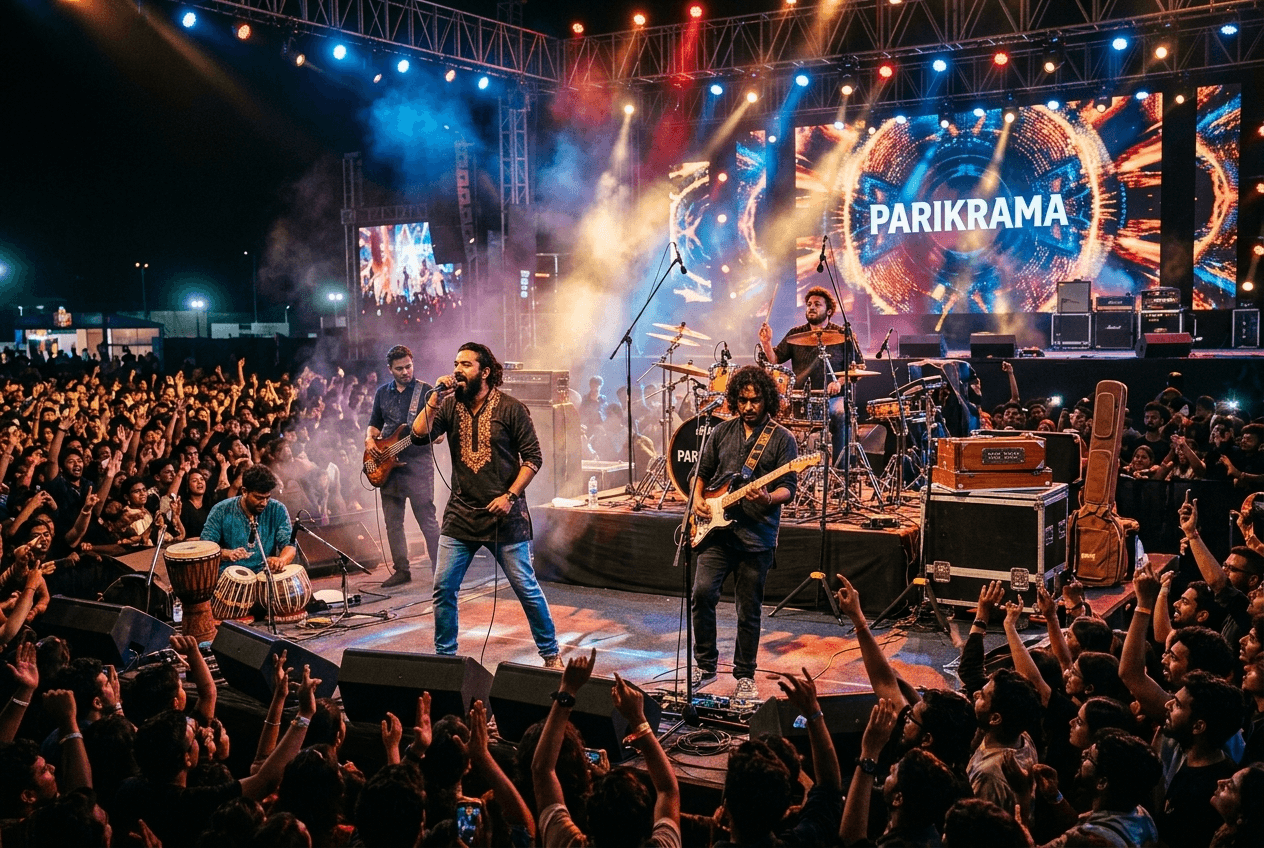 The top bands in india include Indian Ocean, widely regarded as the defining Indian fusion band, Parikrama and Indus Creed in rock, Agnee and Motherjane in the alternative and progressive space, Raghu Dixit Project and Swarathma in folk rock, Advaita and Shakti in classical fusion, and Thermal And A Quarter and Avial in the regional and English-language independent scene. Bands with substantial national followings vary considerably in genre and longevity.
The Fusion Pioneers
The fusion bands are where any survey of the top bands in india has to begin, since they established what the category could be.
Shakti
The most internationally significant meeting of Indian classical music and Western jazz, bringing together the guitarist John McLaughlin with Indian classical musicians including the violinist L. Shankar and the tabla player Zakir Hussain. What made it matter was that it was not a Western band with Indian decoration or the reverse. Musicians at the top of two distinct classical traditions worked out a shared language, which requires enormous technical command on both sides.
It also demonstrated something that shaped everything after it, which is that Indian rhythmic and melodic systems can meet Western harmonic structures without either being reduced. Later fusion bands were working in a space Shakti opened.
Indian Ocean
The band most often named first in any discussion of this subject, and the one that established what an Indian band could sound like without imitating Western models. Their approach combines folk material from across India, classical rhythmic structures and rock instrumentation, frequently in long instrumental passages that build gradually rather than following verse and chorus.
What made them influential was independence in a literal sense. They built an audience through live performance over many years, largely outside the film industry and outside mainstream radio, at a time when that was close to impossible in India. Every independent band since has operated on a path they demonstrated was viable.
Advaita
A more recent approach to the same problem, integrating Hindustani classical vocals and sarangi with electronic production and rock arrangement rather than treating the classical material as an ornament. The result is genuinely hybrid rather than layered, and it represents where fusion went after the first generation.
Rock and Metal
Several of the top bands in india came out of a rock scene that existed for decades with very little mainstream visibility and considerable internal seriousness.
Indian rock developed largely through college festivals, which functioned as the circuit, the audience and the talent pipeline simultaneously. For a long stretch, competitions at engineering and management college festivals were where bands were heard, and a generation of musicians came up through them.
Parikrama and Indus Creed are the long-running names, both sustaining careers across decades when there was almost no commercial infrastructure supporting them. Motherjane brought Carnatic melodic material into progressive rock guitar work, which is a genuinely distinctive contribution rather than a stylistic gesture. Thermal And A Quarter built a substantial body of English-language work from Bangalore.
Metal in India developed its own dedicated following, particularly in the north-east and in the larger cities, with a scene sustained by festivals and by an audience considerably more committed than its size suggested. It remains one of the more surprising features of Indian music to outsiders.
Folk Rock and Regional Language Bands
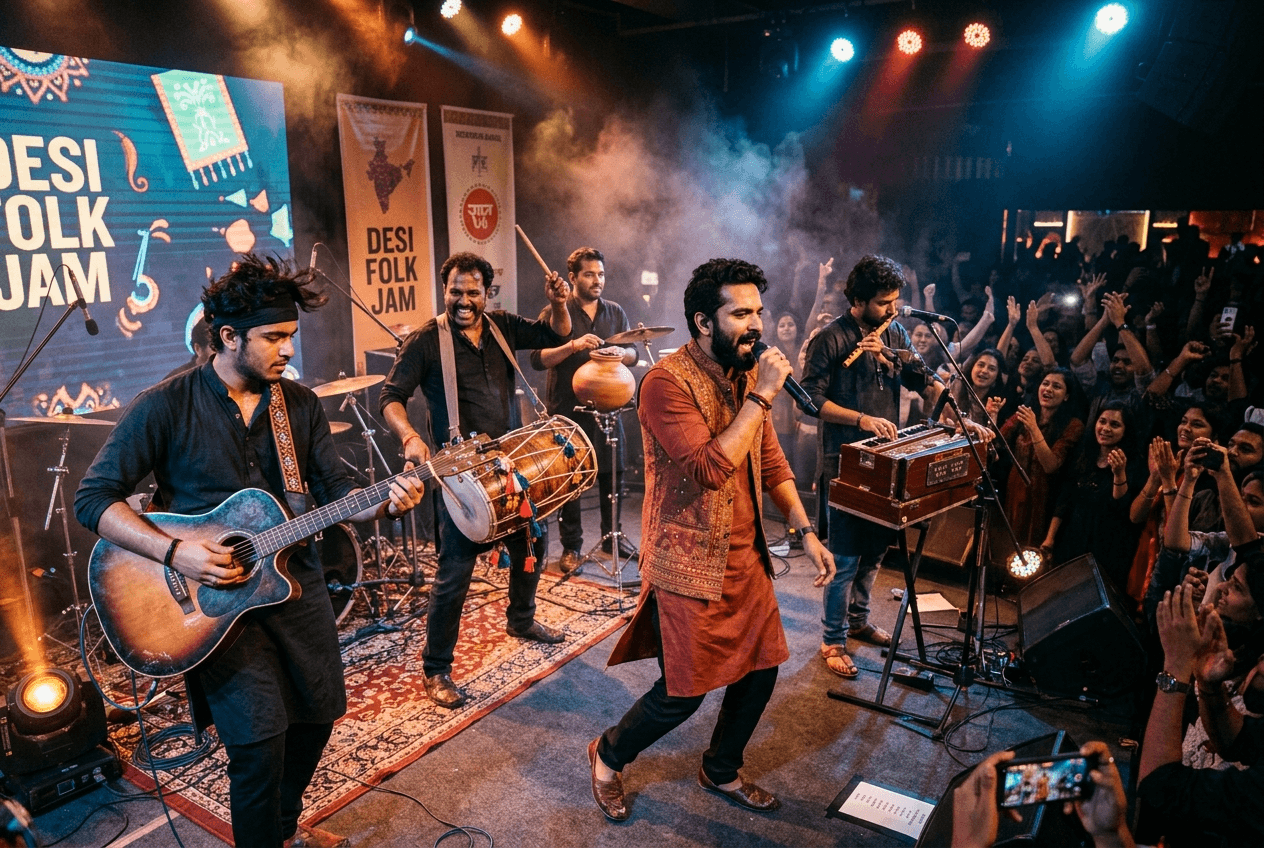 Arguably where the most interesting work of the past two decades has happened.
Raghu Dixit Project
Kannada and Hindi folk material delivered with rock energy and a live show built for participation. The band toured internationally to a degree very few Indian independent acts have, and demonstrated that regional-language material could travel without translation.
Swarathma
Folk instrumentation and socially engaged lyrics, with a live performance reputation that carried them well beyond their recorded reach. Bands like this matter because they proved an audience existed for music that was neither film nor Western imitation.
Avial and regional-language rock
Avial performing rock in Malayalam mattered disproportionately, because it established that a regional Indian language could carry the form without sounding like a novelty. A considerable amount of subsequent regional independent music follows from that.
This whole strand connects directly to India's folk traditions, which supply the melodic and rhythmic material these bands draw on, and the guide to folk music and folk songs covers those traditions in their own right.
Why the Scene Struggled
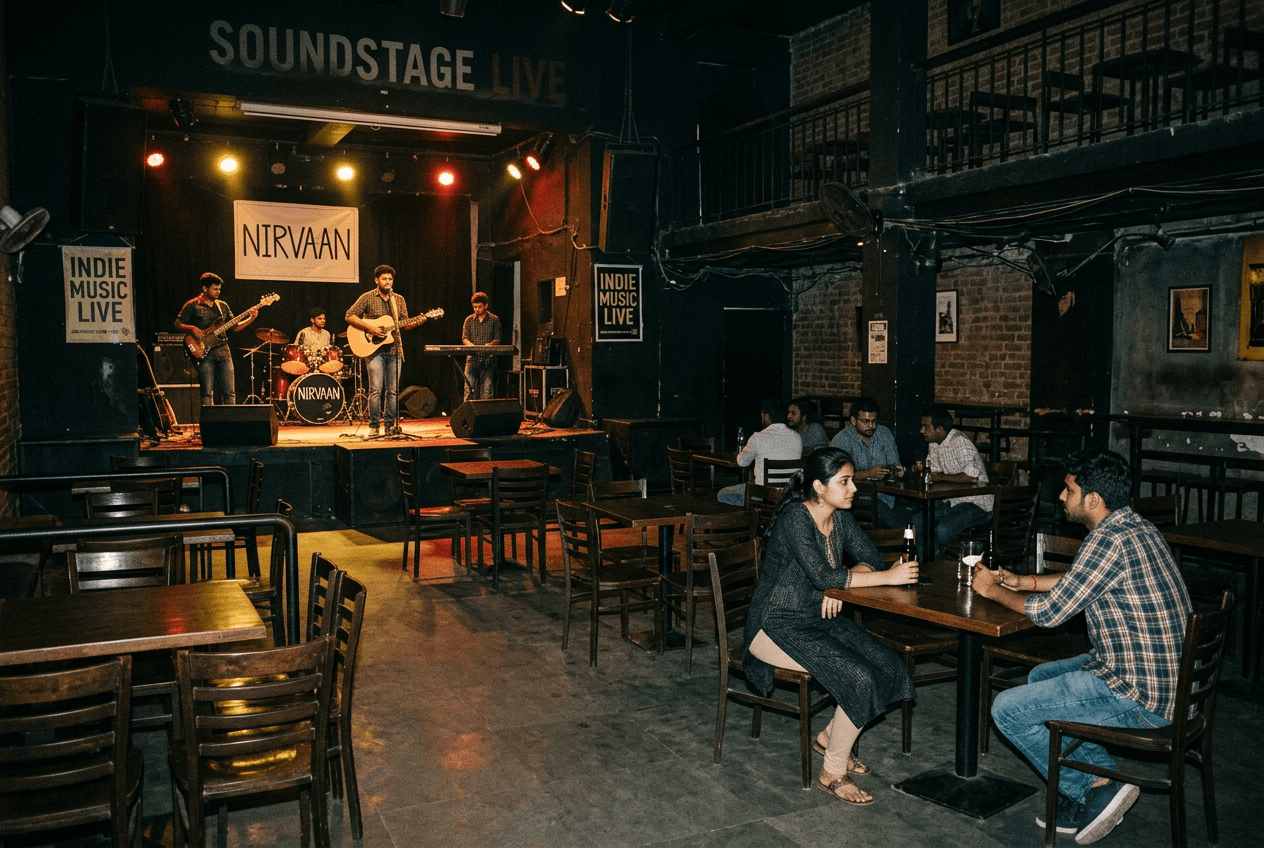 It is worth explaining why so many of the top bands in india remained obscure for so long.
Film music dominated distribution completely. Radio, television, retail and eventually the early digital platforms were all organised around film soundtracks, and a band without a film placement had almost no route to a national audience regardless of quality.
It is worth explaining why so many of the top bands in india remained obscure for so long.
Film music dominated distribution completely. Radio, television, retail and eventually the early digital platforms were all organised around film soundtracks, and a band without a film placement had almost no route to a national audience regardless of quality.
Live infrastructure was thin. Outside a handful of cities there were few venues, no touring circuit and little money in performance, so bands subsidised themselves through other work and played college festivals. Several of the most respected Indian musicians of the past thirty years held day jobs for substantial parts of their careers.
And the economics of recorded music were unfavourable well before streaming. Piracy was widespread, album sales were concentrated in film soundtracks, and an independent release rarely recovered its costs.
What changed
Streaming removed the distribution barrier, which was the largest one. An independent artist can now reach a national and international audience without a label, a film placement or radio support, and audiences can find music that would previously have been invisible to them.
Corporate-backed live music platforms and studio series also gave independent musicians television-scale exposure with production budgets they could not otherwise access, and several careers were built substantially on those appearances. Festival culture expanded considerably alongside it.
The result is that the independent sector is now a genuine part of Indian music rather than a subculture, and a young Indian musician has options that did not exist twenty years ago. The realistic picture of those options is covered in the guide to careers in the music industry.
Where to Start Listening
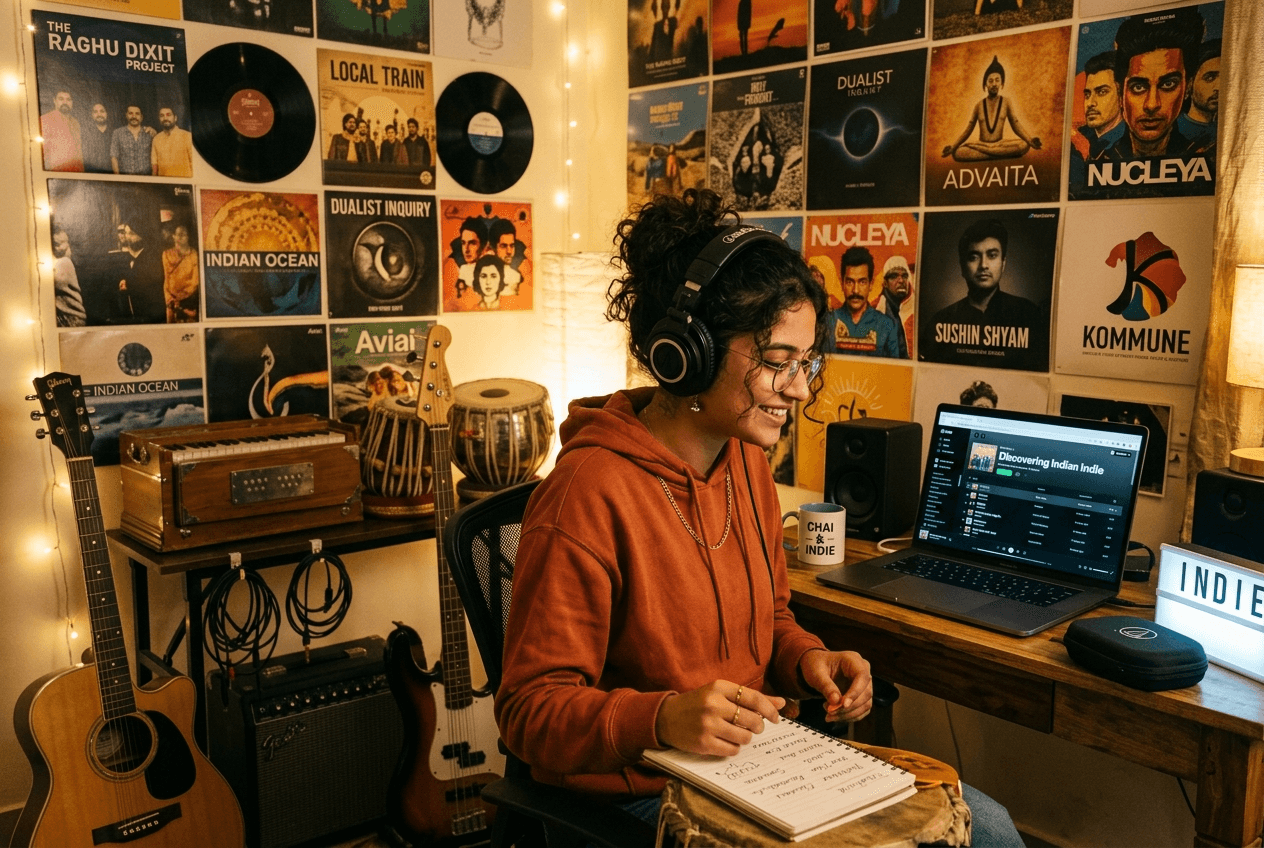 A guided route through the top bands in india, since the field is unfamiliar to most people who grew up on film music.
Begin with Indian Ocean, because they are the clearest demonstration of what the category contains and because their music is immediately accessible without being simple. Listen to a full track rather than an excerpt, since the long build is the point.
Then hear Shakti, which will sound entirely different and which shows the classical end of the spectrum. If you have any familiarity with Hindustani or Carnatic music, this is where the connection becomes obvious.
Then take a regional-language band, Avial or Raghu Dixit Project, and notice that the language barrier matters far less than expected once the music is carrying the material. And then something contemporary and independent, since the current scene is considerably broader than any list of established bands captures.
A note on approach. Bands are best understood live, and a great deal of what made these groups significant does not survive on record. Where recordings of live performance exist, they are frequently the better introduction.
For Listeners in Canada
 A few practical notes for readers here.
Indian independent artists tour internationally more than they once did, and Toronto, Vancouver, Calgary and other cities with substantial South Asian populations receive touring acts regularly. These shows are frequently promoted through community networks rather than mainstream listings, so following the venues and promoters directly is more reliable than waiting for a show to appear in general listings.
For second-generation listeners, this repertoire does something film music does not, which is to present Indian musical material in a contemporary form without nostalgia attached. A great many people who find film music dated or overly sentimental connect readily with independent Indian bands, and it is a better entry point for that listener than the classical canon.
There is also a route into deeper listening here. Several of these bands draw directly on raga and taal structures, and a listener who follows a fusion track back to the classical material underneath it has taken a real step. The guide to Indian raga music explains what to listen for.
Starting a Band Yourself
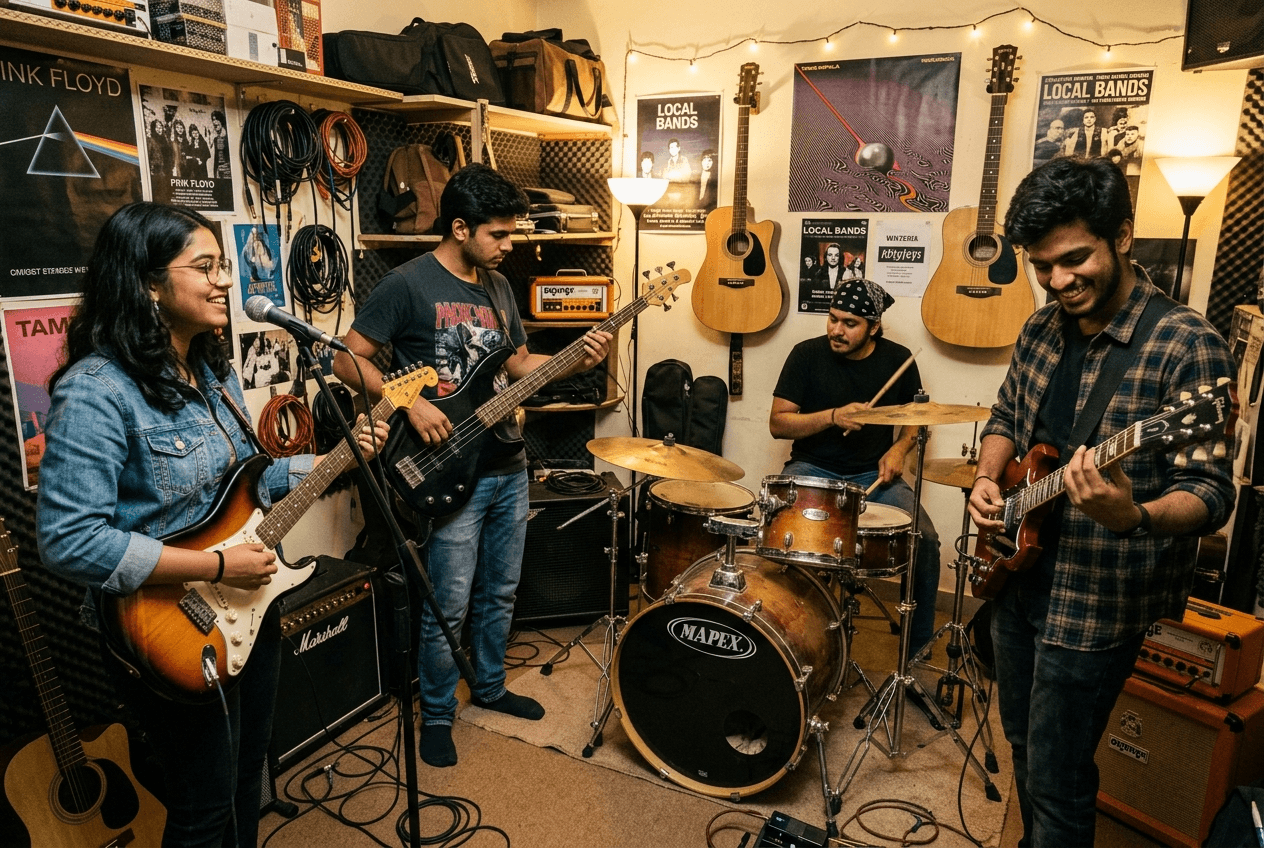 Practical guidance, since a proportion of readers are musicians rather than only listeners.
Playing ability is the smallest problem
Bands fail on logistics, reliability and interpersonal friction far more often than on musicianship. Turning up, being prepared, and being someone people want to spend hours in a room with matter more than technical skill past a basic threshold.
Rhythm section first
A band with a solid drummer and bass player and mediocre everything else sounds better than the reverse. This is consistently underrated by guitarists and singers, and it is why bands that sound good live almost always have a strong rhythmic foundation. Time spent on rhythmic accuracy pays more than time spent on technique, and a metronome used properly is where that starts.
Play live early
Bands that rehearse for a year before performing usually never perform. Play badly in front of twenty people as soon as you have three songs, because performance exposes problems rehearsal conceals and it is the only way to develop as an ensemble.
Original material sooner than feels comfortable
Covers build confidence and go nowhere. A band with three original songs has something to build on, and the first originals will be poor, which is expected and unavoidable.
What Indian Bands Do Differently
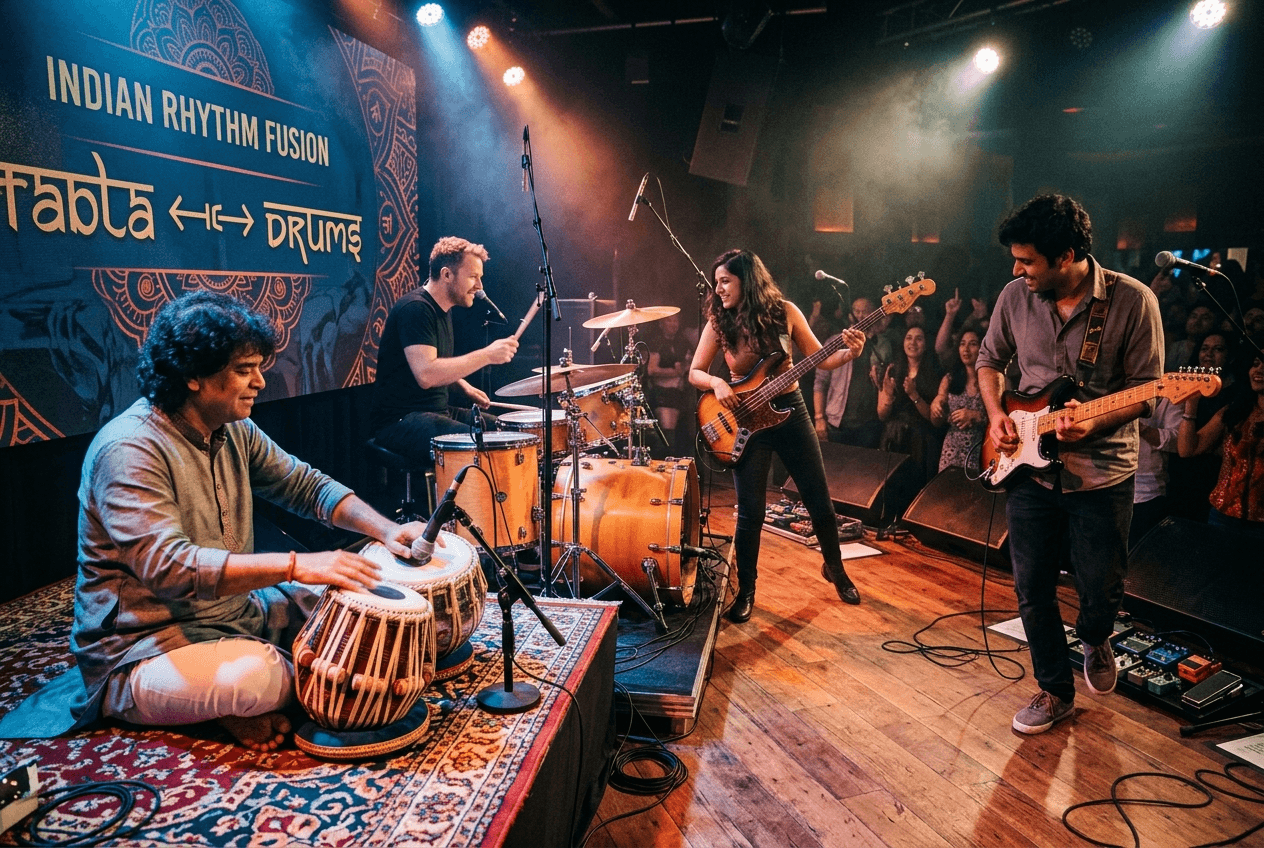
Worth setting out, because a listener arriving from Western rock will hear things that sound like mistakes and are choices.
Rhythm cycles rather than four-four
Indian classical music organises time into cycles of varying length, including seven, ten, twelve and sixteen beats, and bands drawing on that material frequently work in metres that Western rock rarely uses. A passage that sounds like it is stumbling to an unfamiliar ear is usually a cycle resolving somewhere other than where a four-four listener expects.
This is one of the genuine contributions Indian bands have made, and it is more interesting than the surface-level use of Indian instruments. Understanding what a taal is doing transforms how this music sounds, and a working grasp of rhythm cycles through tabla is the fastest route to it.
Melody that does not resolve the same way
Raga-derived melody moves according to rules about which notes may follow which, and those rules produce phrases that a listener raised on Western harmony finds unexpected. Nothing is being avoided or mishandled; a different melodic grammar is operating.
Long forms
Several of these bands write pieces that build for eight or ten minutes rather than following a three-minute verse and chorus structure, which comes directly from classical performance where gradual development across a long span is the norm. Listeners who skip ahead miss the entire point of the form.
Instruments used structurally
The difference between a band that uses a sitar as colour and one that builds a piece around what a sitar can do is audible immediately. The better Indian bands do the second, which is why their music does not sound like Western rock with decoration added.
The Live Circuit
 Where this music actually lives, and the part that recordings do not capture.
College festivals
For decades the primary circuit. Large engineering and management colleges run annual cultural festivals with competitions and headline performances, and for a long stretch these were where bands were heard, where they were paid, and where audiences discovered them. A generation of professional Indian musicians came up entirely through this route.
Festivals and venues
The dedicated music festival circuit expanded considerably from the 2000s, and cities including Bangalore, Mumbai, Delhi, Pune and Shillong developed venue cultures supporting regular live music. The north-east in particular has a rock and metal following disproportionate to its population.
Why live matters here specifically
Many of these bands were built as live acts rather than recording projects, partly because recorded music economics were unfavourable for so long. The consequence is that recordings sometimes undersell them, and where live recordings exist they are frequently the better introduction. If you have the chance to see one of these bands in a room, take it over listening to the album.
Notable Musicians Beyond the Bands
Several figures central to Indian independent music work outside the band format, and any survey that ignores them is incomplete.
Solo artists and singer-songwriters
The independent scene includes a substantial number of solo artists working in Hindi, English and regional languages, and streaming has been particularly favourable to them since a solo act carries none of the logistical burden a band does. A great deal of the most interesting recent Indian music is made by individuals with a laptop rather than by groups in rehearsal rooms.
Classical musicians who crossed over
Zakir Hussain is the outstanding case, working at the highest level of Hindustani classical tabla while collaborating across jazz, world music and film for decades. That dual career established a template many younger classical musicians have followed, and it demonstrated that crossover need not mean dilution.
Several sarod, sitar, flute and violin players work similarly, holding a classical performing career while contributing to fusion and film projects. For a student, this is worth knowing because it shows that classical training opens doors rather than closing them. The route into that training is set out in the guide to learning Hindustani classical music.
The hip hop scene
A more recent development and one of the most significant, with Indian hip hop in Hindi, Punjabi, Marathi, Tamil and other languages developing substantial audiences from the 2010s onward. It came from outside the existing music industry entirely, built on social platforms rather than labels, and it now reaches audiences comparable to mainstream film music.
Producers and electronic artists
India has a developed electronic and production scene, including artists working with Indian classical and folk material in electronic contexts. Much of this work sits outside any band format and is where a considerable amount of current experimentation is happening.
What This Means for a Student Musician
The practical takeaway, since a proportion of readers are learning rather than only listening.
The clearest lesson from these bands is that classical or folk grounding is an asset rather than a constraint. The musicians who made the most distinctive work were almost all trained in something specific, whether Hindustani, Carnatic or a regional folk tradition, and their distinctiveness came from having material nobody else had. A guitarist who also knows raga structure has something a guitarist who only knows rock does not.
The second lesson is that the live circuit builds careers and recordings alone rarely do. Nearly every band on this page built an audience by playing repeatedly to small rooms over years, and the ones who tried to do it the other way round mostly did not last.
And the third is that the infrastructure now exists. A musician starting today has distribution, an audience reachable without gatekeepers, and a festival circuit that did not exist twenty years ago. The constraints that kept the previous generation obscure have genuinely lifted, which makes this a considerably better moment to start than any that came before it.
How Streaming Changed the Economics
Worth setting out in a little detail, because the shift explains why the current scene looks so different from the one that preceded it.
Under the old system, reaching an audience required a label, physical distribution, radio play and ideally a film placement, and each of those was a gatekeeper with its own incentives. A band without those things could play live and sell recordings at gigs, and that was effectively the ceiling.
Streaming removed every one of those gates simultaneously. An artist can release directly, reach listeners in any city or country, and be discovered through algorithmic recommendation by people who have never heard of them. For Indian independent music, which had been structurally excluded rather than commercially rejected, this was transformative.
The gains are unevenly distributed, as they are everywhere. Per-stream payments are small, discovery still favours artists with promotional resources, and a large catalogue competing for attention means most releases are heard by very few people. What has genuinely changed is that the ceiling was removed, not that the floor was raised.
For a musician planning a career, the practical implication is that recording and releasing is now cheap and reaching people is now possible, while building an audience still takes years of consistent work. That is a considerably better position than the previous generation faced, and it is not the same as being easy.
A note on what gets left out
Any list of this kind reflects what was documented and distributed rather than what was played. Bands in smaller cities, in regional languages with limited reach, and in the decades before the internet frequently left almost no recorded trace, and several scenes that mattered locally are effectively invisible now.
The north-east in particular sustained a rock and metal culture for decades with very little national coverage, and Goa, Kerala, West Bengal and the Punjab each had scenes that existed largely outside the attention of Bombay and Delhi. If you have the chance to hear older musicians from those places talk about what was happening, take it, because very little of it was written down.
One further point worth making to anyone starting out. The bands on this page mostly began without any expectation of a career, playing because they wanted to, in a country where the path did not exist. That is worth remembering when the immediate returns look thin, because the immediate returns looked thin for all of them too.
And a note on listening habits. This music rewards attention in a way background listening does not, because the long builds and the rhythmic complexity are the substance rather than the surface. Twenty minutes with headphones and nothing else happening will tell you more about why these bands matter than several hours of them playing while you do something else.
Frequently Asked Questions
Which are the best bands in India?
Indian Ocean is most often named first, and is widely regarded as the defining Indian fusion band. Shakti was the landmark meeting of Indian classical and Western jazz. Parikrama and Indus Creed are the long-running rock names, and Raghu Dixit Project, Swarathma, Avial, Motherjane, Advaita and Thermal And A Quarter are all significant.
What Indian bands should I listen to first?
Start with Indian Ocean, since they demonstrate the category clearly and are immediately accessible. Then Shakti for the classical end. Then a regional-language band such as Avial or Raghu Dixit Project. Listen to full tracks rather than excerpts, since the long builds are frequently the point.
Who are famous Indian rock bands?
Parikrama and Indus Creed, formerly Rock Machine, are among the longest-running. Motherjane brought Carnatic melodic material into progressive rock. Thermal And A Quarter built a substantial English-language body of work from Bangalore. Agnee reached mainstream audiences through television and film placements.
What is Indian fusion music?
Music combining Indian classical or folk material with Western forms, typically rock, jazz or electronic. The best of it integrates rather than layers, meaning the Indian rhythmic and melodic systems shape the structure rather than decorating a Western one. Shakti and Indian Ocean are the reference points.
Is there an independent music scene in India?
Yes, and it is considerably larger than it was. Streaming removed the distribution barrier that had confined independent artists for decades, corporate-backed live and studio platforms provided exposure with real production budgets, and festival culture expanded. It is now a genuine sector rather than a subculture.
Why is Indian music dominated by film songs?
Because distribution was organised around film soundtracks for decades. Radio, television, retail and early digital platforms all prioritised film music, so a band without a film placement had almost no route to a national audience. Live infrastructure was also thin outside a few cities, and recorded music economics were unfavourable.
What was Shakti?
A meeting of Western jazz and Indian classical musicians, bringing together the guitarist John McLaughlin with Indian classical players including the violinist L. Shankar and the tabla player Zakir Hussain. It mattered because musicians at the top of two distinct traditions built a shared language rather than one decorating the other.
Do Indian bands sing in English or Indian languages?
Both, and the regional-language work is arguably more interesting. Thermal And A Quarter work in English, Indian Ocean and Agnee largely in Hindi, Raghu Dixit Project in Kannada and Hindi, and Avial in Malayalam. Avial in particular demonstrated that a regional language could carry rock without sounding like a novelty.
Where can I see Indian bands live outside India?
Indian independent artists tour internationally more than they once did, and cities with substantial South Asian populations receive touring acts regularly. These shows are frequently promoted through community networks rather than mainstream listings, so following venues and promoters directly is more reliable than general event listings.
How do I start a band in India?
Playing ability is the smallest problem. Bands fail on logistics, reliability and interpersonal friction far more often than on musicianship. Prioritise a solid rhythm section, play live as soon as you have three songs rather than rehearsing for a year, and write original material sooner than feels comfortable.
Final Thoughts
What connects the top bands in india across four decades and several genres is that all of them chose to work outside the film industry when there was almost no infrastructure supporting that decision. Indian Ocean built an audience through live performance for years without radio or a label, and everything in the current independent scene follows from people who did that first.
Start with one full Indian Ocean track and one Shakti recording, listened to properly rather than in the background. Between them they contain most of what this category is capable of, and they will reframe what you thought Indian popular music was. Art Gharana teaches Indian classical, contemporary and Western music live and one-to-one, with a free first class