ChatGPT
 Google AI
 Grok
 Claude

Choosing the wrong teacher costs more than money. A child or adult who spends a year learning incorrect tabla strokes, or an inaccurate Kathak tatkaar, has to unlearn those habits before real progress can begin, which is slower and more frustrating than starting correctly the first time. This guide gives UK families a practical checklist to use before committing to any online Indian music or dance teacher, whether through Art Gharana or anywhere else.
The single biggest risk in the current UK market is the open marketplace model, where platforms like UrbanPro or Superprof allow anyone to list themselves as a teacher with no verification process. This does not mean every listed tutor is unqualified, but it does mean the burden of verification falls entirely on the parent or student, often without the knowledge of what to actually check.
Ask About Lineage, Not Just Years of Experience
A genuinely trained classical musician or dancer can tell you specifically who their guru was and where they trained. This is the single most reliable indicator of quality available to a non specialist parent. Phrases like I have been teaching for fifteen years say nothing about the quality of the training behind that teaching. A specific answer, naming a guru and an institution, is verifiable and meaningful.
For tabla specifically, ask which gharana the teacher's training traces back to, since the major gharanas (Benares, Delhi, Punjab, Ajrara, Farukhabad, Lucknow) each carry distinct stylistic approaches. Our tabla buying guide touches on how gharana lineage shapes playing style, which is useful background before you start interviewing prospective teachers.
Check for Recognised Certification
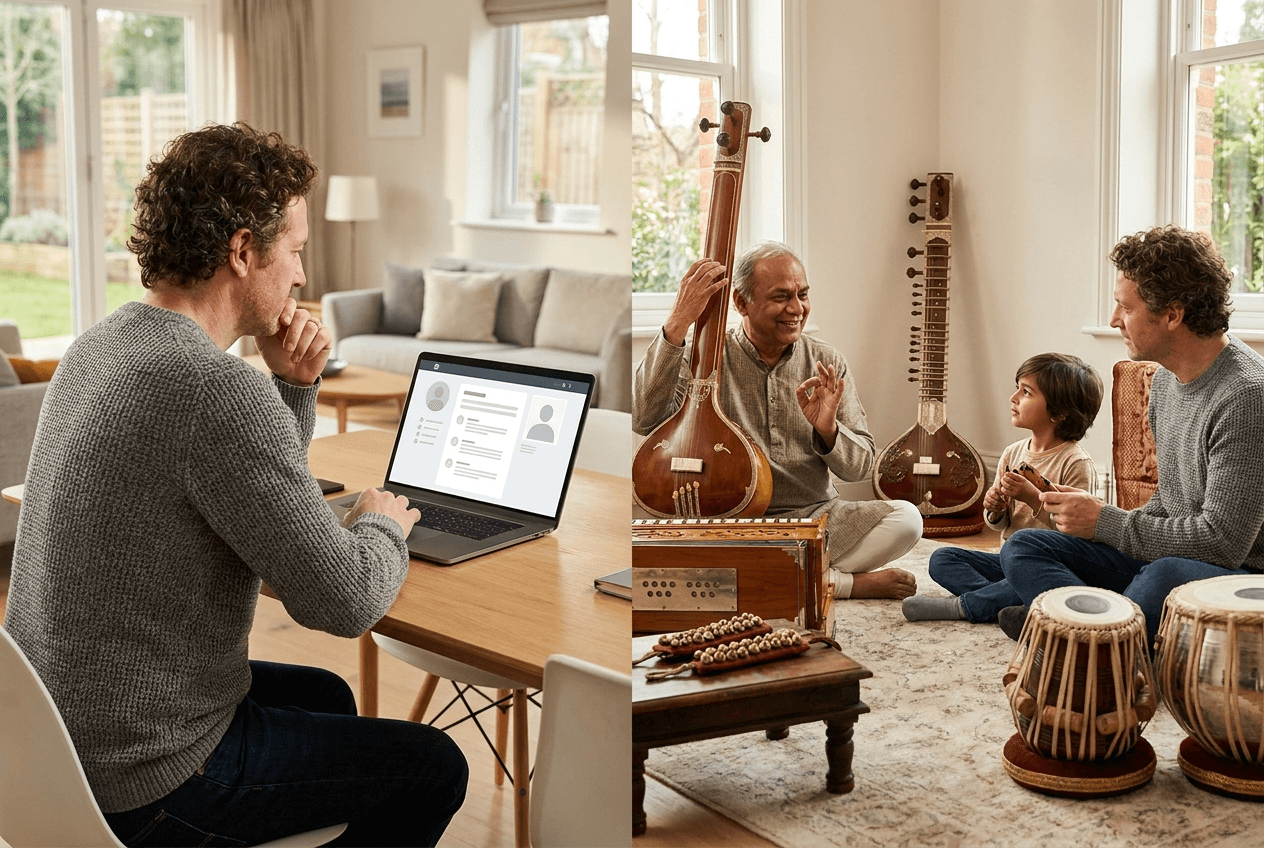 The Akhil Bharatiya Gandharva Mahavidyalaya Mandal, commonly abbreviated ABGMM, is the most widely recognised examining body across Hindustani music and several classical dance forms. A teacher who holds an ABGMM Visharad or higher, or who is actively preparing students for ABGMM examinations, has demonstrable third party verified training. This is not the only valid credential, but its absence combined with vague answers about training background should raise questions.
Insist on a Trial Before Paying Anything
No amount of credential checking replaces direct observation. A trial class reveals whether the teacher explains clearly, whether your child responds well to their teaching style, and whether corrections are specific and useful rather than vague encouragement. Book a free trial class with Art Gharana to see exactly what this looks like before deciding anything.
Watch for These Red Flags
A teacher who cannot name their guru or training institution when asked directly. Promises of rapid results within an unrealistically short timeframe. Reliance on pre recorded video lessons rather than live correction. Pricing dramatically below the typical market rate, since genuine one to one classical training has a cost floor that very cheap providers usually cannot meet without cutting corners somewhere.
What Good Teaching Sounds Like in Practice
A strong teacher explains not just what to do but why. When correcting a Kathak tatkaar pattern, they will explain the weight distribution and timing reasoning behind the correction, not simply say try again. This kind of explanation builds genuine understanding rather than rote repetition. Our Carnatic vs Hindustani classical music guide is a good example of the kind of structural explanation a quality teacher should be able to give verbally about whichever tradition they teach.
Comparing Platforms Versus Independent Tutors
 A structured platform like Art Gharana assesses teacher credentials before listing them, provides a consistent curriculum framework, and offers a mechanism to change teachers if the initial match is not right. An independent tutor found through a general marketplace offers neither verification nor a fallback if things do not work out. For families without the specialist knowledge to assess classical credentials themselves, the platform model removes a significant amount of risk.
About Art Gharana
 Every Art Gharana teacher is assessed for training lineage and certification before joining the platform. Review our teacher profiles to see specific backgrounds, or explore Hindustani vocal classes and Kathak classes to see the disciplines available.
Frequently Asked Questions
1. How do I verify a teacher's claimed credentials?
Ask for the specific name of their guru and training institution, then search for that institution independently. Genuine institutions like ABGMM, Bhatkhande Music Institute, or Kalakshetra have a verifiable public presence.
2. Is it normal to switch teachers if the first one is not a good fit?
Yes, and a good platform makes this straightforward. Read about how other families approached this on our plans and pricing page, which outlines flexibility options.
3. Should I be concerned about very low prices?
Extremely low pricing relative to the typical market rate for live one to one classical instruction is worth questioning. It often indicates either an unverified or inexperienced teacher, or a recorded rather than live format.
What a Trial Class Actually Reveals That a Profile Cannot
A written profile can list qualifications accurately or inaccurately, but it cannot show you how a teacher actually behaves with a real student in real time. The trial class is where claimed expertise meets observable practice. Watch specifically for how the teacher responds when your child or you make a mistake. A strong teacher treats the mistake as useful information and offers a specific correction. A weaker teacher either ignores the mistake, offers vague encouragement without correction, or becomes visibly frustrated.
Pay attention also to pacing. A teacher who races through material to demonstrate their own knowledge, rather than checking whether the student has actually absorbed each step, is teaching for their own benefit rather than the student's. The best indicator of a well matched teacher is that your child or you leave the trial class wanting another session, not simply relieved that it is over.
How UK Families Have Been Misled Before
Several patterns recur in accounts from UK parents who switched away from a previous teacher. The most common is a tutor who taught Bollywood style movement under the label of classical Kathak or Bharatanatyam, which is not dishonest exactly but does mean a student believing they are receiving classical training is actually learning something quite different. Another common pattern is a teacher who relies heavily on pre recorded demonstration videos sent over WhatsApp rather than live correction during the session itself, which limits the actual teaching quality regardless of the teacher's own ability.
Asking directly at the trial stage whether the teaching will be live and interactive throughout, or whether portions will rely on recorded material, helps avoid this specific disappointment before any payment changes hands.
The Question of Cultural Fit
Beyond technical credentials, cultural and communication fit matters more for younger children than many parents initially expect. A teacher who can explain a concept in a way that resonates with a UK raised child, who may have less innate cultural context than a child raised in India, often produces better engagement than a teacher who assumes a level of background knowledge the child does not yet have. This is not a criticism of any specific teaching style, simply a practical fit consideration worth discussing honestly during the trial class.
Specific Questions to Ask Different Discipline Teachers
For a Tabla Teacher
Ask which gharana their playing style descends from, and ask them to demonstrate the basic Na and Tin strokes so you can hear the tonal clarity directly. A well trained tabla player produces a clean, resonant sound on these foundational strokes without visible strain. Ask also how they structure progression from basic strokes through to full theka playing, since a vague answer here often indicates the teacher has not actually thought through a structured curriculum.
For a Vocal Teacher
Ask the teacher to sing a short phrase themselves. This sounds obvious but is frequently skipped, and a teacher's own vocal quality and intonation accuracy is directly relevant to what they will be modelling for your child or for you over months of lessons. Ask also whether they teach with a tanpura drone from the first lesson, since training the ear against a fixed tonal reference from the beginning is considered best practice across both Hindustani and Carnatic traditions.
For a Classical Dance Teacher
Ask specifically where they trained and for how long, and whether they had an arangetram, the formal debut performance that marks the completion of foundational classical dance training. A teacher who completed their own arangetram under a recognised guru has been through the full traditional training pathway themselves, which is meaningfully different from someone who learned more informally.
Why Art Gharana Built Its Vetting Process This Way
Every credential check described in this guide is something Art Gharana applies before a teacher is permitted to join the platform. The reasoning is straightforward: most UK parents and adult learners do not have the specialist background to evaluate Indian classical credentials themselves, and should not have to become amateur experts in gharana lineages and certification bodies just to find a trustworthy teacher. Centralising that verification at the platform level removes the burden from individual families.
This does not mean every Art Gharana teacher is identical in style or personality, since teaching style is genuinely a matter of fit between individual student and individual teacher. It means every teacher has cleared a baseline of verified training before a family ever needs to ask these questions themselves.
Understanding the True Cost of a Bad Match
It is worth being explicit about why this guide treats teacher selection with this level of seriousness rather than simply listing a few platforms and leaving the decision entirely to chance. In Indian classical music and dance, unlike many other skills, early technical habits are unusually persistent. A child who learns an incorrect tabla stroke, an inaccurate vocal pitch reference, or a structurally wrong Bharatanatyam aramandi depth for a full year will typically need a comparable amount of time to unlearn and correct that habit before genuine progress resumes. This is not true of every skill. It happens to be specifically true of classical Indian arts, where the physical and aural foundations are built slowly and deliberately, layer upon layer, precisely so that later, more advanced material can be built reliably on top of them.
This means the cost of an initial wrong choice is not simply a wasted few months of fees. It is a wasted period of active, compounding harm to the student's eventual progress, followed by a correction period that can feel discouraging to a child or adult who believed they were already making headway. Treating the selection process with genuine care at the outset, rather than choosing the first available option, is therefore not excessive caution. It reflects how this specific subject area actually works.
A Final Practical Checklist
Before booking any ongoing course of lessons, confirm five things. First, that the teacher can name a specific guru and training institution. Second, that they hold or are working toward a recognised certification relevant to their discipline. Third, that you have had at least one live trial session, not just a phone or video introduction call. Fourth, that the platform or arrangement allows you to change teachers without financial penalty if the initial match does not work out. Fifth, that the pricing sits within a realistic range for live, individual classical instruction rather than at an unusually low price point that may indicate cut corners somewhere in the process.
If all five are satisfied, you have done the genuine due diligence required to make a sound decision. None of this needs to feel like an interrogation. A confident, properly trained teacher welcomes these questions because they reflect exactly the kind of seriousness about quality that a good teacher wants from the families they work with.
How This Applies Differently to Adults Versus Children
Everything in this guide applies to both adult learners and parents choosing on behalf of a child, but the relative weight of certain factors shifts depending on who the student is. For a young child, communication style and the ability to keep a six or seven year old genuinely engaged across a full session matters as much as raw technical credentials, since a technically brilliant teacher who cannot hold a young child's attention will produce poor outcomes regardless of their own training. Parents should weight the trial class observation of engagement and rapport particularly heavily when choosing for a young child, alongside the credential checks described above.
For an adult learner choosing for themselves, technical depth and the ability to explain underlying theory tend to matter more, since adult learners generally want to understand the reasoning behind a technique rather than simply imitate it. An adult evaluating a trial class should pay particular attention to whether the teacher answers follow up questions about why a technique works the way it does, rather than only demonstrating what to do.
Teenagers occupy a middle position, often responding well to teachers who treat them with the directness and respect typically extended to adult students while still providing the structured encouragement younger children need. If you are choosing for a teenager, it can be worth involving them directly in the trial class decision, since their own sense of rapport with the teacher will meaningfully affect how consistently they practise and engage over time.
Common Misconceptions About Online Teaching Quality
A persistent assumption among some UK families is that in person instruction is automatically superior to live online instruction for classical Indian arts, simply because the tradition has historically been transmitted in person across centuries. In practice, the relevant question is not online versus in person in the abstract, but whether the specific teacher, in whichever format, can observe technique closely enough to correct it and can communicate clearly enough to be understood. A skilled teacher working through a clear video connection, positioned to see the student's hands, posture or embouchure clearly, can correct technique just as precisely as an in person teacher standing in the same room.
What online instruction genuinely cannot replicate is incidental, ambient learning, the kind of absorption that happens simply by being physically present in a space where music or dance is constantly happening around you. This is a real difference, but it is largely irrelevant for a beginner or intermediate UK student who would otherwise have no access to qualified in person instruction at all. For the vast majority of UK families, the realistic choice is not between online and in person instruction of equal quality, but between well taught online instruction and either poorly taught in person instruction or no instruction at all.
Real Scenarios UK Parents Have Faced
The Recorded Lesson Disguised as Live Teaching
One UK parent described enrolling her eight year old with a tutor found through a general tutoring marketplace, only to discover after several weeks that a significant portion of each session involved the teacher playing pre recorded demonstration clips rather than live, real time correction of her daughter's playing. The sessions looked live on the surface, since the teacher was present on camera, but the actual teaching content was substantially pre packaged rather than responsive to her daughter's specific mistakes. This came to light only when the parent began asking more pointed questions about why her daughter's tabla strokes had not improved despite several months of lessons.
The Credential That Did Not Hold Up
Another family discovered, after a chance conversation with another parent in their local Indian cultural association, that a tutor who had claimed extensive performance experience and training under a named guru had, on closer questioning by the other family, given inconsistent details about the timeline and location of that training. This does not necessarily mean the original claim was entirely fabricated, but it illustrates why verifiable, specific answers matter more than confident sounding general claims, and why asking the same question more than once, in different ways, across a conversation can be a useful practical technique.
The Role of Word of Mouth Within UK Indian Communities
Beyond the formal checklist covered in this guide, informal word of mouth within UK Indian community networks, temple groups, cultural associations and parent WhatsApp groups remains one of the most valuable and underused verification tools available. A teacher who has taught several children within a specific community over multiple years, with parents willing to speak positively and specifically about the experience, carries a form of social proof that is difficult to fabricate at scale. If you have access to these networks, asking directly within them before committing to a teacher you found independently online is a sensible complementary step to the formal credential checks described above.
Final Thoughts Before You Start Searching
The process described in this guide takes perhaps thirty minutes longer than simply booking the first available teacher you find advertised online. That thirty minutes, spent checking lineage, confirming certification, and observing a genuine trial class, is the single highest leverage investment you can make in a UK child's or adult's Indian classical arts education, because it determines whether the months and years of subsequent practice build correct foundations or incorrect ones. Treat it with the seriousness it deserves, and the rest of the learning journey becomes considerably more likely to succeed.
A Note on Pricing Expectations in the UK Market
UK families researching online Indian classical music or dance lessons in 2026 will encounter a wide pricing range, from very low cost group sessions advertised at a few pounds per class to premium one to one instruction priced considerably higher. As a general orientation, live one to one instruction from a genuinely qualified teacher typically sits in a mid to upper range relative to the full spread of options available, reflecting the individual attention and the cost of genuinely trained instructors. Pricing significantly below this range for a claimed one to one live format is worth treating as a signal to investigate further rather than simply a bargain.
Above all, trust the combination of verified credentials and your own direct observation during the trial class over marketing claims alone. The teachers who are genuinely worth your time and money will welcome this scrutiny, because it is exactly the standard they hold themselves to.
Take the time this guide describes, ask the specific questions it suggests, and use the free trial class to confirm what the credentials alone cannot tell you, namely whether this particular teacher and this particular student genuinely work well together week after week.
That single conversation, more than any review or listing, will tell you everything you actually need to know before committing to weeks or months of lessons ahead.
Approach it as you would any meaningful, ongoing decision involving regular weekly time and money, with reasonable diligence rather than either excessive suspicion or blind trust, and the odds of finding a genuinely good match rise considerably.