ChatGPT
 Google AI
 Grok
 Claude

At the Chhandayan Center for Indian Music in New York, tabla students are split into two distinct age bands, beginners aged 6 to 14 meeting Monday evenings, and a separate beginner and intermediate group for ages 15 and above meeting an hour later. This is not an arbitrary scheduling choice. It reflects something every experienced Indian classical music teacher in the US has learned through direct practice: a 7 year old and a 16 year old need genuinely different teaching, even when starting the exact same instrument from the exact same beginner level.
Why Age Banding Matters, Even in Group Settings
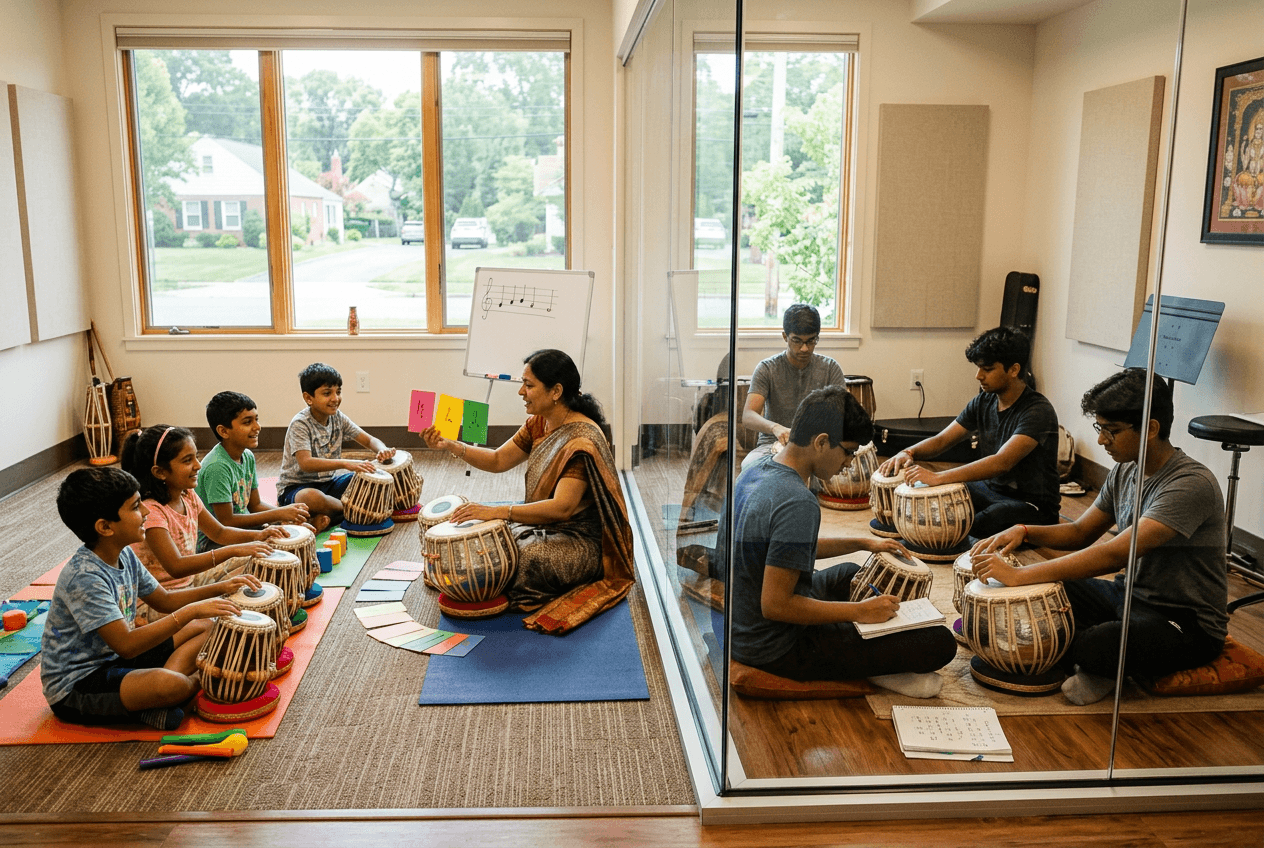 Several well established US Indian classical music institutions structure their group offerings around clear age bands for precisely this reason. Younger children typically need shorter, more frequently varied activity segments within a single class, more game based and repetition heavy instruction, and considerably more patience around attention span limitations. Teenagers and adults, conversely, can sustain longer focused technical segments, engage more directly with abstract theoretical concepts, and generally progress faster through material once foundational technique is established, simply due to greater cognitive and physical maturity.
Ages 5 to 6: The Earliest Realistic Starting Point
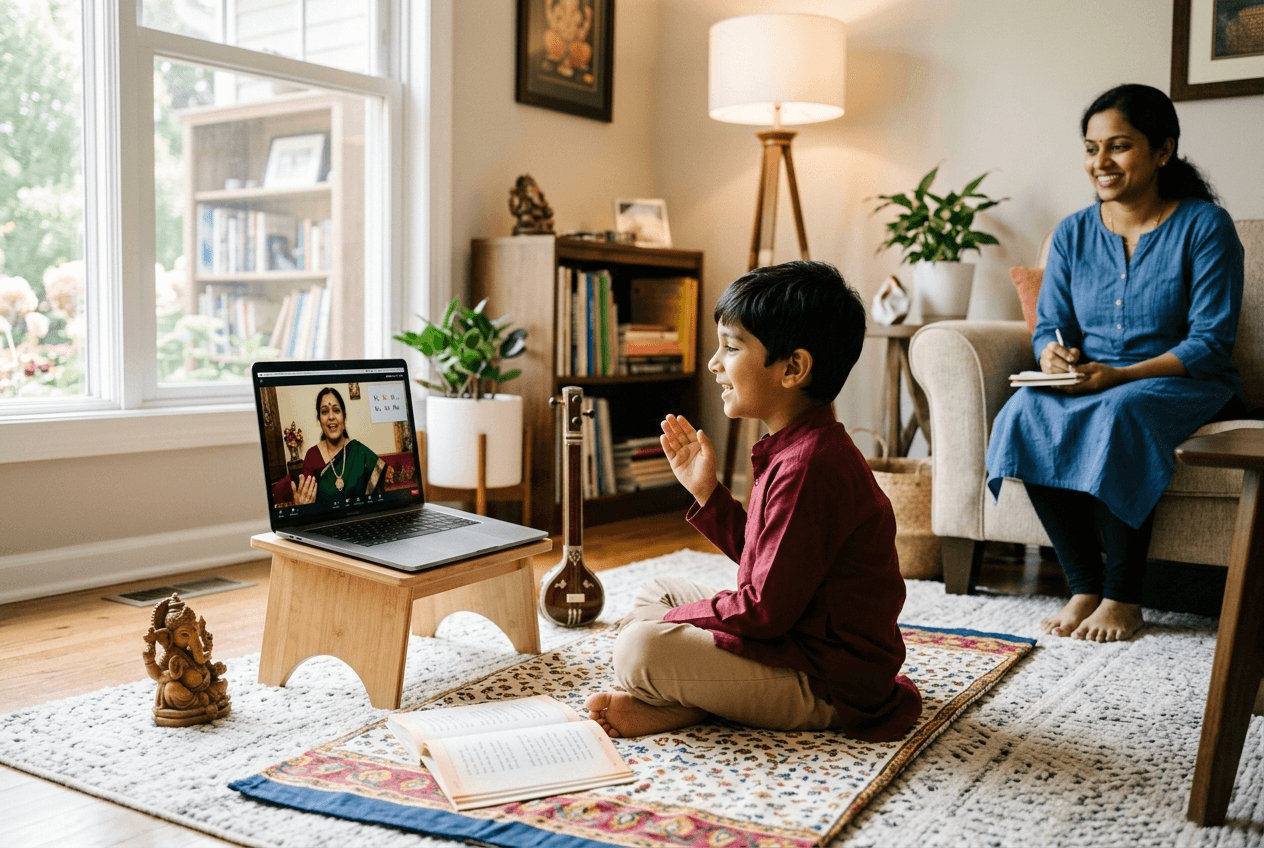 Several reputable US programs specifically design curricula for children as young as 5, particularly for Carnatic and Hindustani vocal training. One established online platform's children specific Hindustani vocal course, designed by an accomplished classical vocalist trained at the Gurukul of Padma Bhushan Dr Prabha Atre, targets ages 5 to 9 specifically, building vocal range gradually through foundational swara patterns and simple sargam geet songs. This kind of age-specific curriculum design, rather than simply applying an adult syllabus at a slower pace, is what genuinely effective early childhood Indian music education looks like.
Ages 6 to 10: Parental Involvement Becomes a Genuine Asset
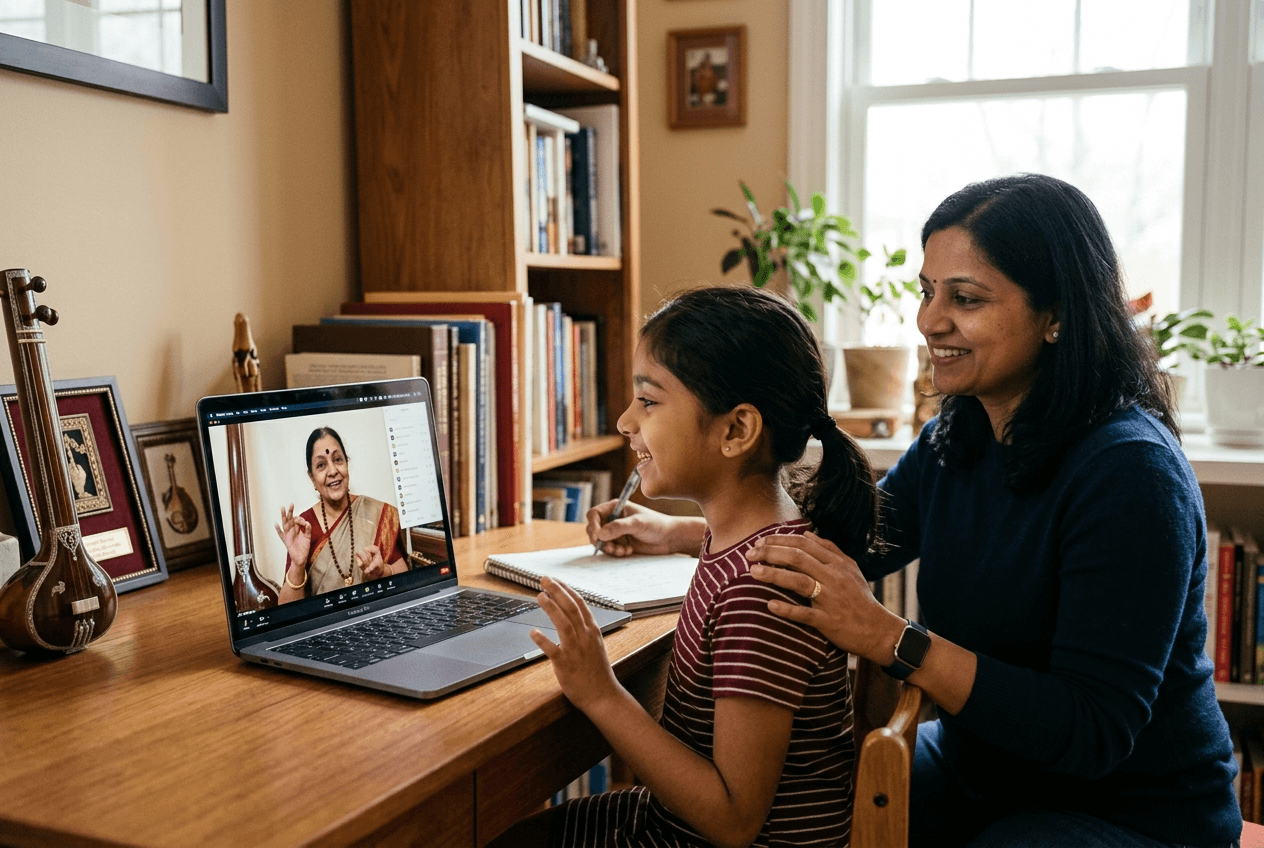 Several established US Indian classical music academies specifically recommend parental presence during lessons for children in the 6 to 10 age range, not as passive supervision but as active support that measurably improves the learning experience. A parent who sits in, encourages and helps reinforce practice between sessions provides exactly the kind of consistency that determines whether a young child's early enthusiasm translates into lasting skill. Our piece on top 10 singing tips for beginners includes guidance parents can use directly to support a young vocal student's home practice during this critical age window.
Why Tabla Specifically Suits Children Around Age 6 to 7
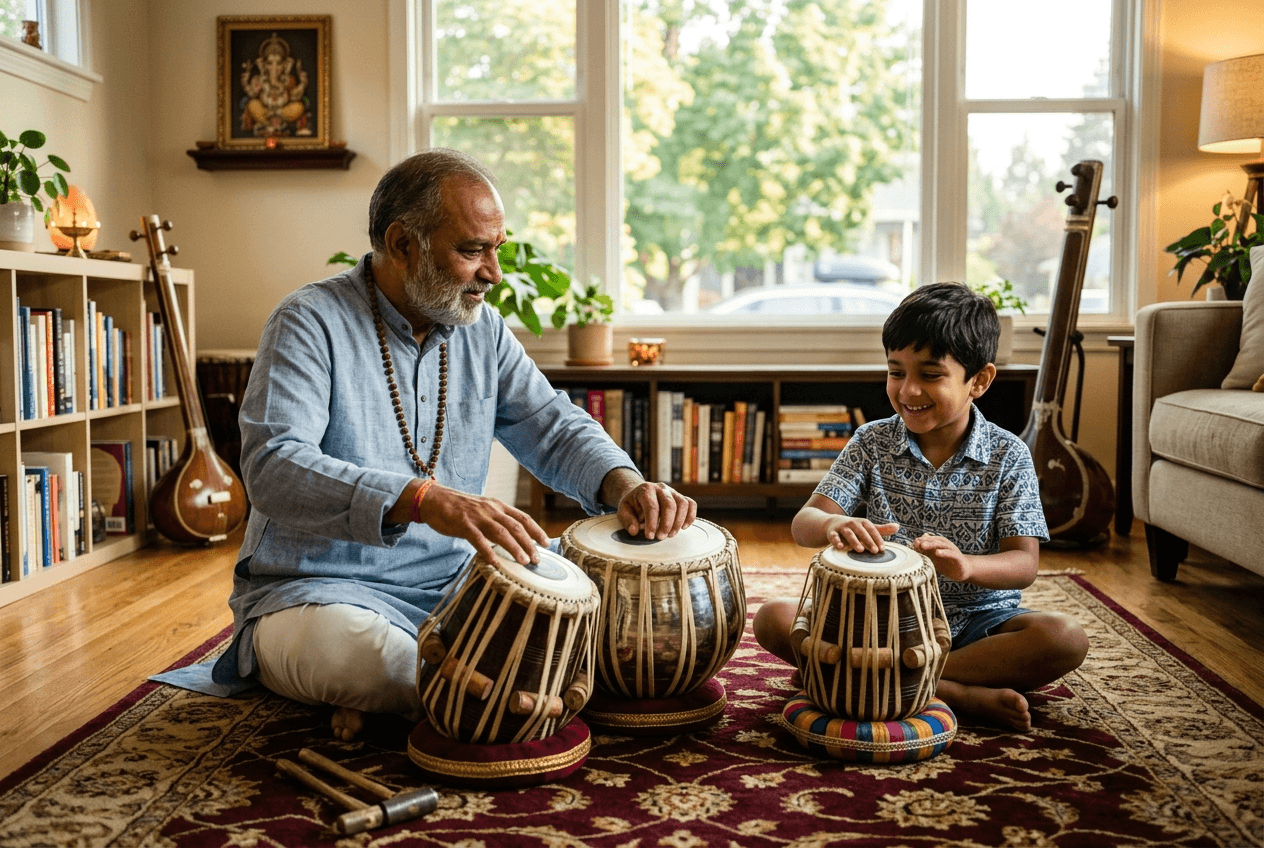 Tabla occupies a specific developmental sweet spot among Indian instruments. The bilateral hand coordination the instrument demands, striking distinct tones with each hand independently, develops reliably by around age 6 to 7 in most children, making this the realistic starting window most experienced tabla teachers recommend. Younger children often find the coordination genuinely frustrating rather than engaging, while children who begin within this window typically experience rapid, motivating early progress that sustains their interest through the more demanding stages that follow.
The Cognitive Research Behind Starting Young
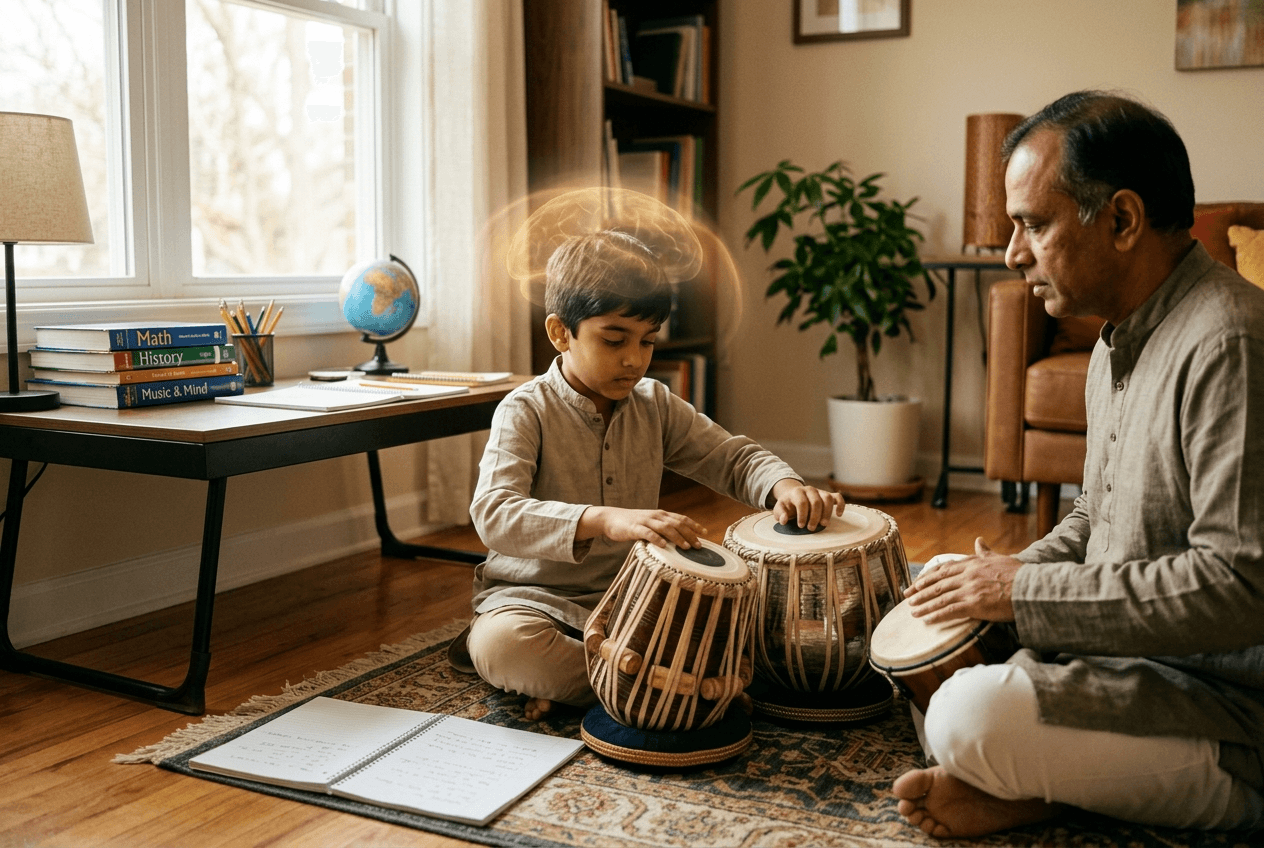 Beyond cultural connection, the cognitive research on childhood music training specifically supports earlier rather than later starts where a child shows genuine interest. Children who receive structured musical training consistently show measurable advantages in working memory, verbal fluency and literacy compared to children without this training, with researchers attributing much of this benefit to music's unique effect on brain plasticity, the developing brain's capacity to form new neural connections that support broader learning across academic domains. Indian classical music specifically, with its complex rhythmic structures and emphasis on patient, sustained practice, appears particularly well suited to building exactly this kind of cognitive foundation. Our overview of types of Indian music gives parents useful context on the range of disciplines available as they consider which specific tradition might suit their child's interests.
Teenagers: A Different Teaching Approach Entirely
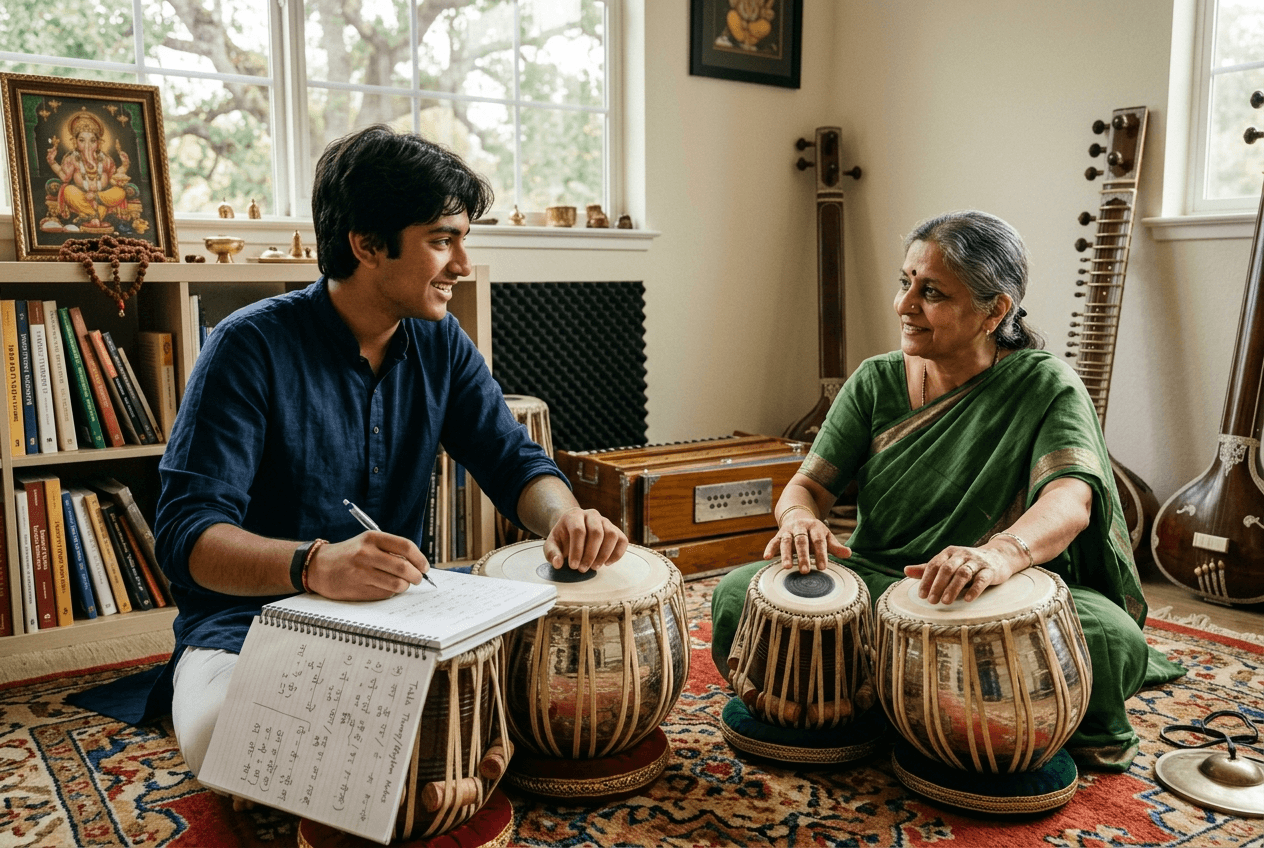 By the young teenage years, students benefit from a meaningfully different instructional approach than younger children require. Teenagers respond well to being treated more as adult learners, with direct explanation of underlying theory, genuine creative input into repertoire choices, and connection to broader performance and certification goals that give their training real-world stakes and motivation. A teenager beginning Indian classical training for the first time, whether due to a recent family move, a personal decision to reconnect with heritage, or simply newly discovered interest, should not be placed in a curriculum designed around younger children's pacing and content, even if technically at the same beginner skill level.
Group Versus One to One for Young US Children
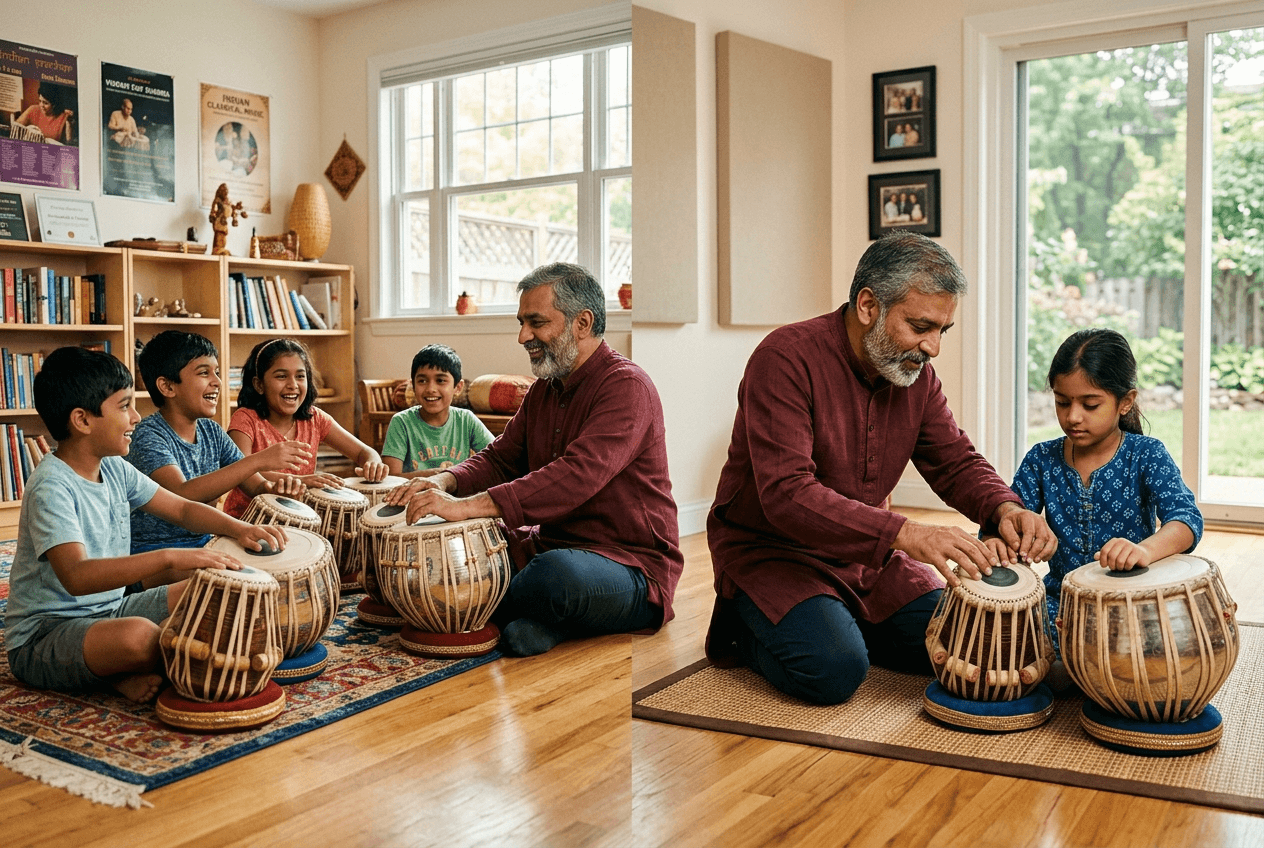 Several established US schools, including Chhandayan's well regarded group model, offer genuinely valuable small group instruction, with individual attention maintained even within groups of five to ten students. This format works well for children who are specifically motivated by peer learning and group dynamics. For families prioritizing the fastest possible individual technical progress, or for children who simply learn better with completely undivided teacher attention, one to one instruction removes the inherent pacing compromise that any group format, however well managed, ultimately requires.
About Art Gharana
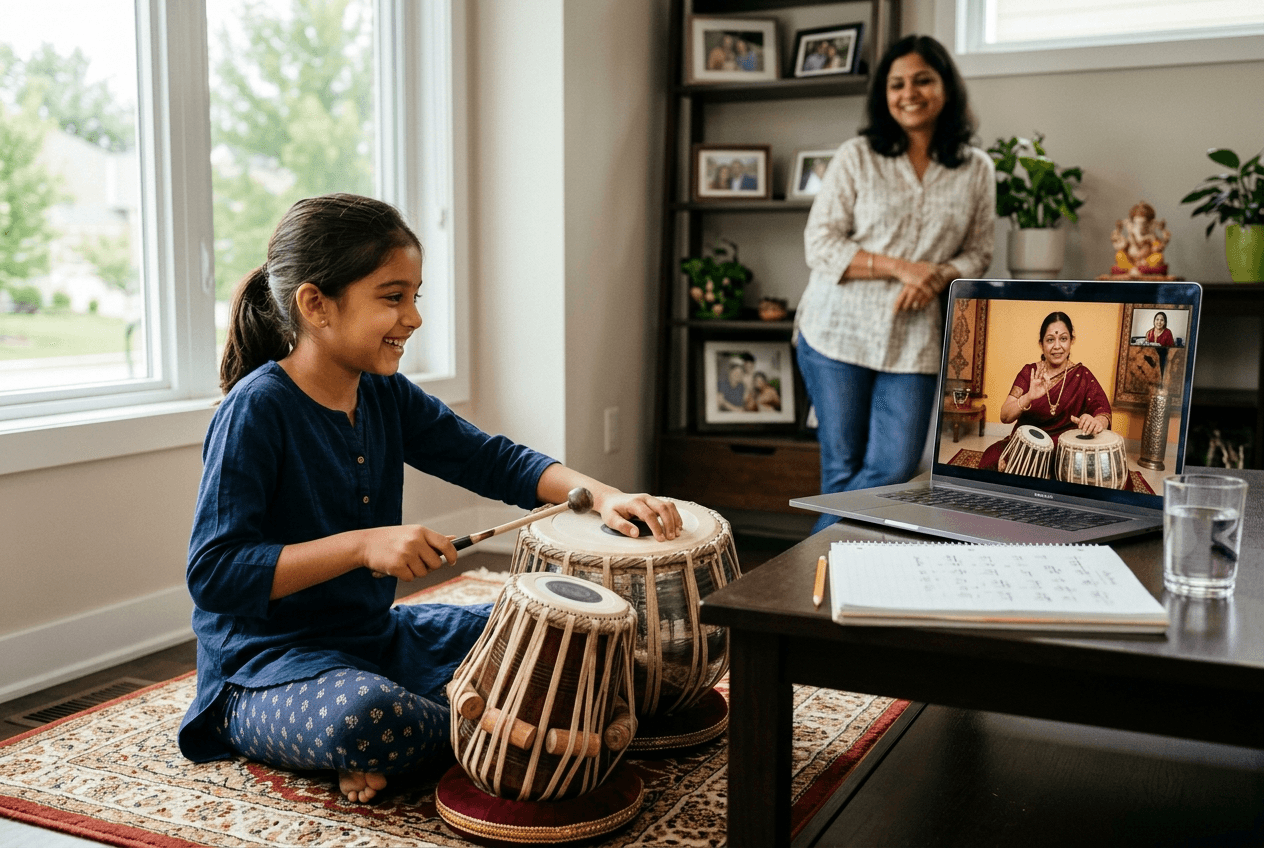 Art Gharana's age-aware curricula and live one to one format mean every US child, from age 5 through the teenage years, receives instruction genuinely paced to their individual developmental stage. Explore tabla classes and Hindustani vocal classes, browse our teacher profiles, and book a free trial class to assess your child's readiness directly.
Frequently Asked Questions
1. What age can a US child start tabla?
Most experienced teachers recommend around age 6 to 7, when the bilateral hand coordination tabla requires has typically developed sufficiently for productive early learning.
2. Is 5 years old too young for Carnatic or Hindustani vocal training?
No. Several reputable US programs specifically design curricula for children starting at age 5, using playful, age-appropriate methods that build foundational skills without requiring the focus and stamina an older child's training demands.
3. Should parents stay present during a young child's online music lesson?
For children roughly age 6 to 10, yes, parental presence and support is widely recommended and genuinely improves outcomes. Our vocal warm up exercises guide is a useful resource parents can review together with their child to reinforce lesson content at home.
Why Schools Frame This as Development, Not Just Music Training
Beyond the specific age recommendations covered above, US parents researching Indian music education for their children should understand a broader pattern that several established schools explicitly build their offerings around: the recognition that musical training is rarely just about producing a skilled performer. The structured discipline of regular practice, the patience required to master incremental technical progress, and the cultural and spiritual context woven into traditional teaching all contribute to broader child development outcomes that extend well beyond musical ability alone.
Several established US Indian classical music schools specifically frame their early childhood offerings around exactly this broader developmental lens, citing benefits including sharpened focus and memory, built discipline and patience, opportunities for creative and emotional expression, and measurable improvements in academic and social skills. This framing matters for US parents weighing whether to prioritize Indian classical music alongside the many other activities competing for a young child's limited after-school time, since the cognitive and developmental case extends well beyond cultural connection alone.
How Progress Tracking Motivates Young Learners Specifically
Several established US Indian classical music programs explicitly track and showcase student progress milestones as a deliberate motivational tool, particularly relevant for younger children who benefit from concrete, visible markers of advancement. Real time progress updates, recorded practice review, and periodic showcases where students perform for an audience of peers and families all serve to make abstract, gradual technical progress feel concrete and rewarding to a child who might otherwise struggle to perceive their own incremental improvement week to week.
For US parents selecting between providers, asking specifically how a program tracks and communicates a young child's progress, and what performance or showcase opportunities exist even at the earliest stages, reveals meaningful information about how seriously a program has thought through the specific motivational needs of young learners, distinct from simply applying adult pedagogical methods at a slower pace.
Session Length and Attention Span: A Practical Consideration
It is worth US parents understanding the practical realities of attention span and session length specifically, since this single factor more than any other determines whether a young child's early lessons feel genuinely productive or frustrating. A standard adult length lesson, typically forty five to sixty minutes, is rarely appropriate for a child under seven, whose realistic sustained focus capacity is considerably shorter. Effective programs for this age group structure sessions around shorter segments, mixing technical practice with games, stories and movement breaks, recognizing that a young child's genuine engagement matters more than maximizing raw instructional minutes.
By contrast, children aged ten and above can typically sustain a full standard length session productively, and indeed often benefit from the deeper, more sustained focus a longer session allows once foundational technique no longer requires constant novelty to maintain engagement. Matching session structure to a child's actual developmental stage, rather than applying a single standard format across all ages, is one of the clearest practical markers of a program that has genuinely thought through age appropriate pedagogy.
Enrolling Multiple Children of Different Ages
US parents of multiple children spanning different ages often ask whether siblings should be enrolled in the same program or even the same general age band, particularly when ages fall close together but on opposite sides of a recommended developmental threshold. The most reliable guidance, consistent across experienced teachers, is to evaluate each child individually rather than assuming a uniform approach across siblings. A precocious six year old who can sustain focus and follow structured instruction reliably may be genuinely ready for content typically reserved for slightly older children, while an eight year old with a more naturally energetic, less easily focused temperament may benefit from a more playful, less rigidly structured approach than their age alone would suggest.
This individualized assessment is precisely why a genuine trial class, rather than simple age based enrollment, remains the most reliable method for determining appropriate placement for any specific US child, regardless of how many siblings or what general family pattern might otherwise suggest a default approach.
Designing Around the Realities of US School Schedules
School schedules across the US vary considerably by district, and several established Indian classical music programs explicitly design their offerings around the realities of typical American school calendars, weekday evening slots after homework is reasonably complete, weekend morning slots that avoid competing with other extracurricular commitments, and summer intensive options for families wanting accelerated progress during the longer break. A program genuinely attentive to these practical US scheduling realities, rather than assuming an India centric daily schedule with more available free time, demonstrates a meaningful understanding of what sustainable practice actually looks like for a typical American child balancing school, homework and multiple extracurricular interests.
When a Child Shows Initial Resistance
An honest acknowledgment worth making directly: not every child shows immediate enthusiasm for Indian classical music, even when a parent feels strongly motivated to provide this cultural and musical education. Several experienced US teachers report that a degree of initial resistance, particularly from children whose primary cultural environment outside the home is thoroughly American, is genuinely common and does not necessarily indicate the activity is wrong for that specific child. Patient persistence through this initial adjustment, paired with genuinely age appropriate, enjoyable teaching, frequently produces a meaningful shift in engagement within the first several months, as the child's own developing competence begins generating its own intrinsic motivation.
That said, ongoing, sustained resistance well beyond a reasonable initial adjustment period is meaningful information worth taking seriously rather than simply pushing through indefinitely. A skilled teacher, genuinely attentive to a specific child's actual experience rather than a parent's hopes alone, will give honest feedback about whether continued resistance reflects a normal adjustment period or a genuine mismatch worth addressing through a different discipline, teacher, or approach entirely.
Practical Logistics: What You Actually Need to Begin
Costume, instrument purchase and other practical logistics deserve brief, direct mention for US parents new to this process. For vocal disciplines, no instrument purchase is required to begin, only a tanpura app and a quiet practice space. For tabla, a basic student set, available through several US based and online specialty retailers, typically represents a modest initial investment well below what comparable Western instrument purchases would require. Costume, where eventually relevant for performance, becomes necessary only once a child reaches a stage where public performance is genuinely imminent, not at the outset of training.
Cutting Through Decision Paralysis
US parents researching this topic for the first time often feel a degree of decision paralysis, faced with genuinely numerous options spanning group community schools, established online academies, and individual independent teachers, each with different age recommendations, formats and philosophies. The most practical way through this paralysis is to start with two or three concrete data points specific to your own child, current age, demonstrated interest or curiosity in music generally, and realistic available weekly time for lessons and practice, and use these to filter the broader landscape down to a genuinely manageable shortlist worth evaluating through actual trial classes.
The One Factor That Matters Most: Sustained Consistency
A final, genuinely important point deserves direct emphasis for US parents at the very start of this research process. Whatever specific age, discipline, format and provider you ultimately choose, the single factor research and experienced teachers alike consistently identify as mattering most to a young child's eventual outcome is not any of these initial choices but rather sustained, consistent engagement over years rather than months. A modest, sustainable weekly commitment maintained faithfully across several years will reliably outperform an intensive, ambitious initial plan that proves unsustainable and is abandoned within the first difficult stretch. Choose conservatively at the outset, prioritizing genuine sustainability over ambition, and adjust upward over time as your specific child's engagement and capacity become clearer through direct experience.
Your Practical Next Step
Taking the practical first step requires nothing more than identifying a discipline that seems likely to interest your specific child and booking a trial session to observe a real teacher engaging with a real beginner, ideally your own child, at their actual current developmental stage. This single direct observation, more than any amount of additional research or comparison reading, will tell you whether the specific teacher, format and discipline genuinely fit your child's needs.
How This Compares to Western Music Lesson Options
Beyond Indian classical disciplines specifically, it is worth US parents understanding how Indian music education compares practically to the Western music lesson options, piano, violin, guitar, that typically dominate the after school activity landscape for American children. Many of the same developmental benefits, discipline, focus, memory, fine motor coordination, apply across both traditions. What Indian classical music adds specifically, for families with relevant heritage, is the additional dimension of cultural and linguistic connection that a Western instrument cannot provide in the same way, while for families without Indian heritage specifically, the rhythmic complexity and distinctive melodic system Indian classical music offers provides a genuinely different and complementary set of musical skills than Western training alone develops.
Does My Child Need Prior Exposure Before Starting
For US parents specifically wondering whether their child needs prior exposure to Indian classical music at home before formal lessons can begin productively, the honest answer is no, though some prior familiarity certainly helps. Children with little or no prior exposure to Indian classical sounds at home learn successfully alongside children who grew up hearing this music daily, with a skilled teacher adjusting their introductory approach to account for whatever baseline familiarity, or lack of it, a specific child brings to their first lesson.
In Closing
In closing, the right age to begin is genuinely less important than many US parents initially assume when first researching this topic. What matters considerably more is finding a teacher and program genuinely attentive to your specific child's actual developmental stage, temperament and interests, whether that child is five or fifteen, and committing to the kind of sustained, patient practice that produces real, lasting skill over years rather than weeks.
A Note on Teacher Experience With US Born Children Specifically
Several Art Gharana teachers have specifically developed expertise in working with young US born children navigating Indian classical music alongside an otherwise thoroughly American childhood, understanding the specific balance of cultural grounding and age-appropriate American pedagogical sensibility that this particular student population benefits from most. This specific experience, distinct from teaching either children raised primarily in India or older diaspora students, is precisely the kind of nuanced fit worth specifically asking about during your trial class conversation.
Book your child's free trial class today, whatever their current age, and see exactly what age-appropriate, individually paced Indian classical music instruction looks like in practice.
Thank You for Reading
Whatever stage your family is at, just beginning to research options or ready to commit to a specific path, we hope this age-specific, practically grounded guide has given you genuine confidence in making the right choice for your particular child.
Every accomplished young musician across the US Indian classical community began exactly where your child stands today, with curiosity, a first lesson, and a teacher willing to meet them at exactly the right level.
Welcome
Welcome to a journey that, however it unfolds, will give your child something genuinely lasting, a skill, a cultural connection, and a confidence that grows quietly with every week of consistent, supported practice.
That first lesson is just a click away.
Final Word
We look forward to meeting your child, wherever they are starting from, and helping build something that genuinely lasts.
A Note on Building Family Tradition
Many of the most successful US families approach Indian classical music not as an isolated activity for one child but as a broader family tradition, with siblings, cousins and sometimes parents themselves participating alongside the youngest learner. This family wide engagement, where practical, tends to reinforce consistency and motivation in ways that a single child's solitary practice sometimes struggles to sustain on its own.
Whatever shape that family tradition eventually takes, it begins with a single decision, made today, to give your child this opportunity.