ChatGPT
 Google AI
 Grok
 Claude

If you have ever sat at a family wedding watching a relative play tabla or sing a thumri and thought, I wish I had learned that, you are not alone. It is one of the most common things British Indian adults say to their Art Gharana teacher in the first trial class. The good news, confirmed by thousands of adult students who began exactly where you are now, is that the answer to is it too late is almost always no.
This guide is written for UK adults, of any background, who are considering Indian classical music or dance for the first time, or returning to lessons they stopped as a child. We cover what to actually expect, how UK time zones work with Indian teachers, what a realistic first year looks like, and the honest answer to the question every adult beginner asks before their first class. Book a free trial class whenever you are ready to find out for yourself.
Is It Too Late to Learn Indian Classical Music as an Adult?
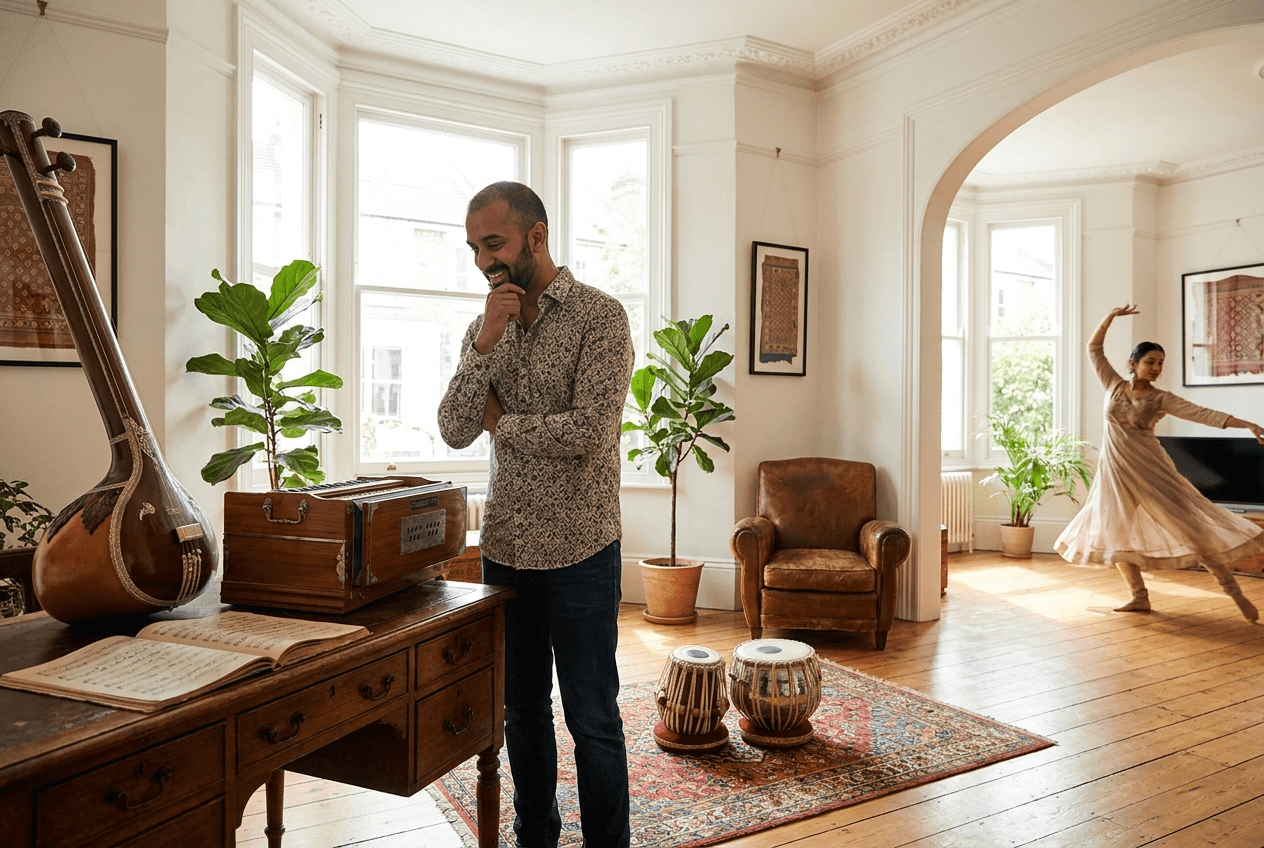 The short answer is no, and the evidence for this is not theoretical. Several of Art Gharana's most accomplished adult students in the UK began in their late 30s and 40s with zero prior musical training. What changes with age is not the capacity to learn but the texture of the learning experience. Adults bring patience, genuine motivation, and a level of cultural understanding that children do not yet have. A 45 year old beginner who grew up hearing Hindustani vocal at home, even without formal training, often progresses faster in the early stages than a complete novice, because their ear is already calibrated to the sound.
What does change is physical flexibility for dance forms, which is why many adults gravitate toward vocal music, tabla, or Bollywood dance rather than the more demanding postures of classical dance disciplines. None of this should discourage an interested adult. It simply means the teacher adapts the starting point and pace to the individual rather than applying a child's curriculum.
UK Time Zones: The Practical Question Behind Every Decision
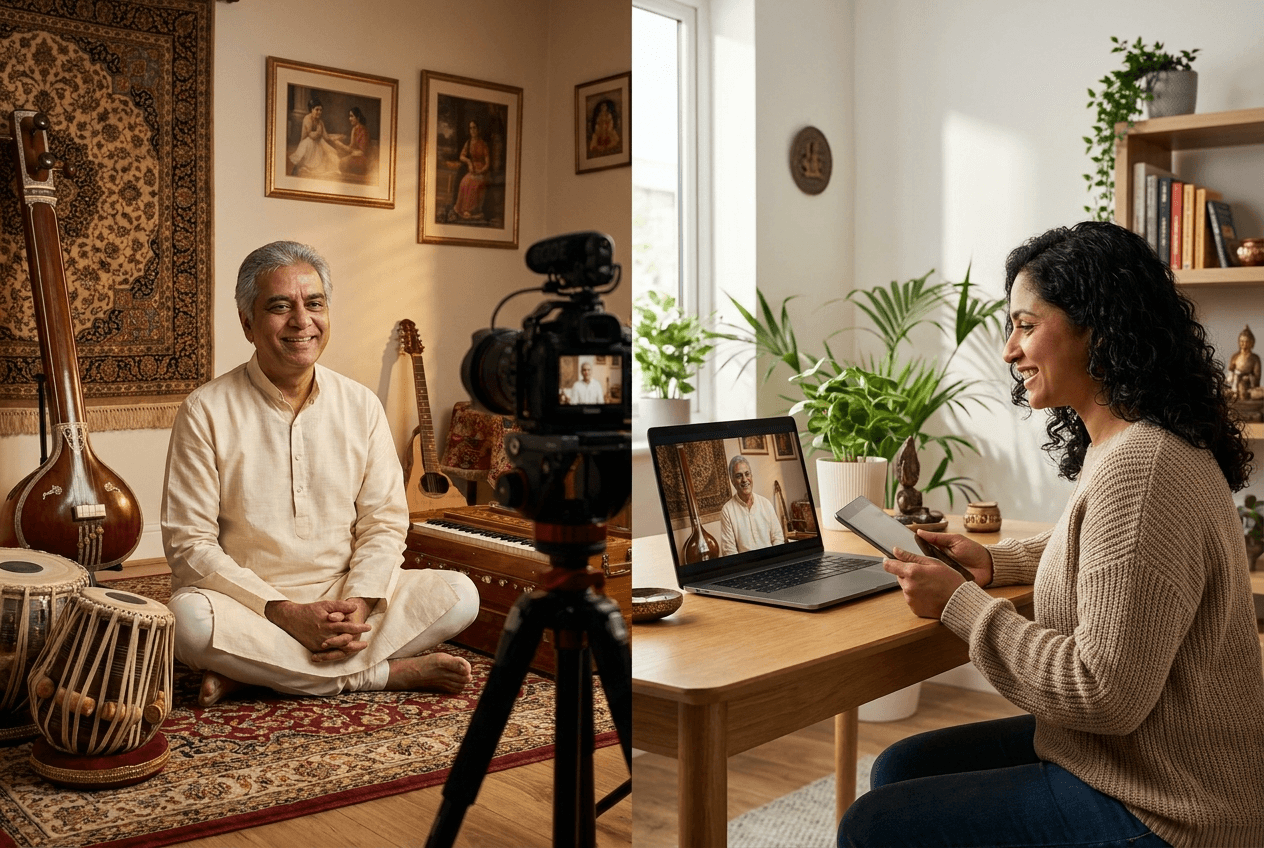 Most UK adults researching Indian music classes quickly discover the time zone problem. India Standard Time is four and a half hours ahead of GMT and three and a half hours ahead of British Summer Time. A teacher based in India running evening classes at 7pm IST is offering a class at 2.30pm GMT, which works for some UK schedules and not others. Several established providers schedule classes purely on IST, leaving UK adults to do the conversion math themselves and often settle for early morning or very late evening slots.
Art Gharana solves this differently. Classes are scheduled directly in GMT and BST from the UK adult's perspective, with teacher availability spanning UK morning, afternoon, evening and weekend slots. There is no mental conversion required and no settling for a 5am class because it was the only slot that lined up. Review our plans and pricing to see the full scheduling options available.
Which Discipline Should a UK Adult Beginner Choose
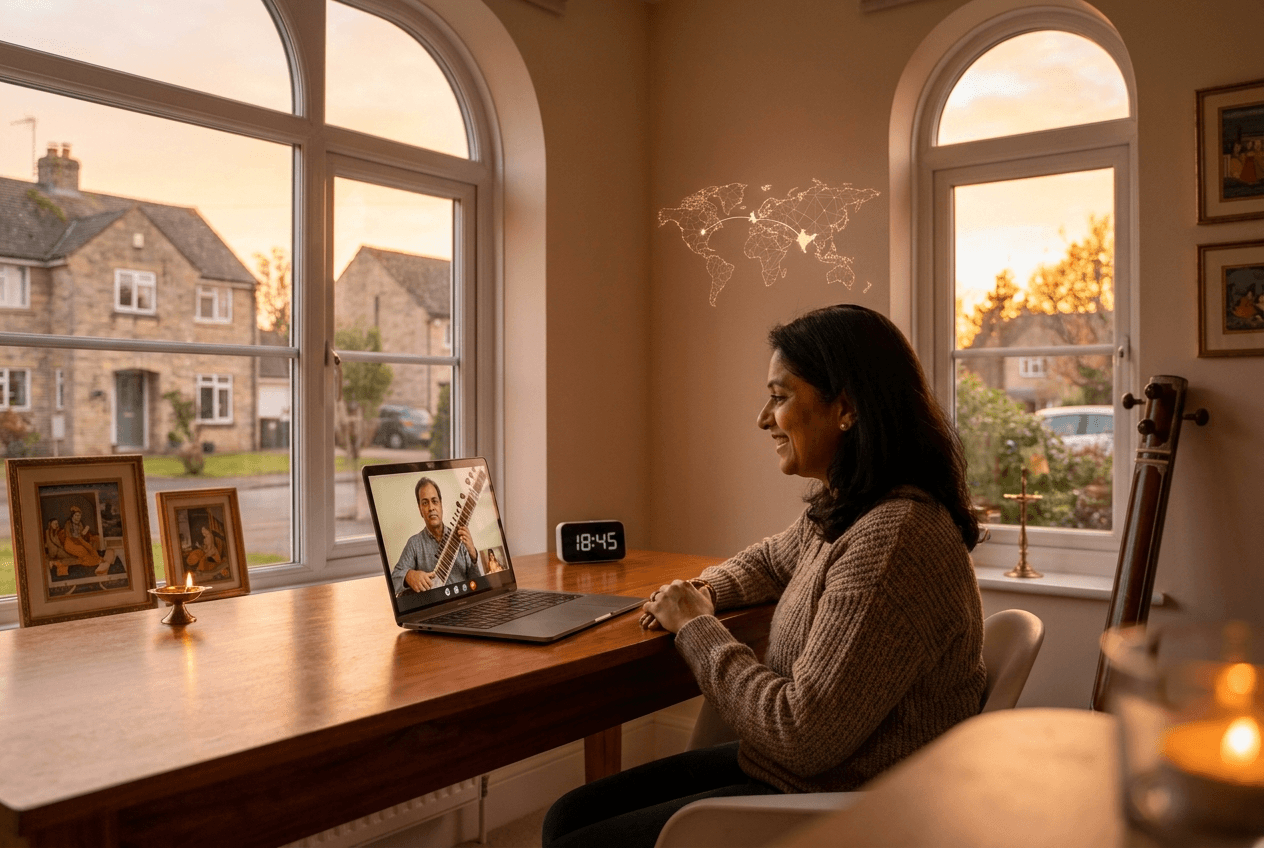
Hindustani Vocal: The Most Popular Starting Point
Hindustani vocal is consistently the most requested discipline among Art Gharana's UK adult students. It requires no instrument purchase, the daily riyaz practice habit fits naturally around a working adult's schedule, and the meditative quality of swara practice is frequently cited by students as the most personally calming part of their week. Our Hindustani vocal classes begin with breath control and basic swara work before introducing the first raga.
Carnatic Vocal for South Indian UK Families
For Tamil, Telugu, Kannada and Malayalam families across the UK, Carnatic vocal offers the most direct route back to the music of home, temple and family gatherings. The Carnatic vs Hindustani classical music comparison on our blog explains the structural differences between the two traditions if you are unsure which suits your background. Explore Carnatic vocal classes to begin.
Tabla: For Adults Who Want Something Physical
Tabla appeals to UK adults who want a more physically engaged discipline without the demands of classical dance. The bilateral hand coordination and mathematical structure of tala appeals especially to adults with analytical or musical backgrounds in Western instruments. Our tabla classes start with the five fundamental strokes before building toward full theka playing.
Bollywood Dance: The Most Immediately Joyful Option
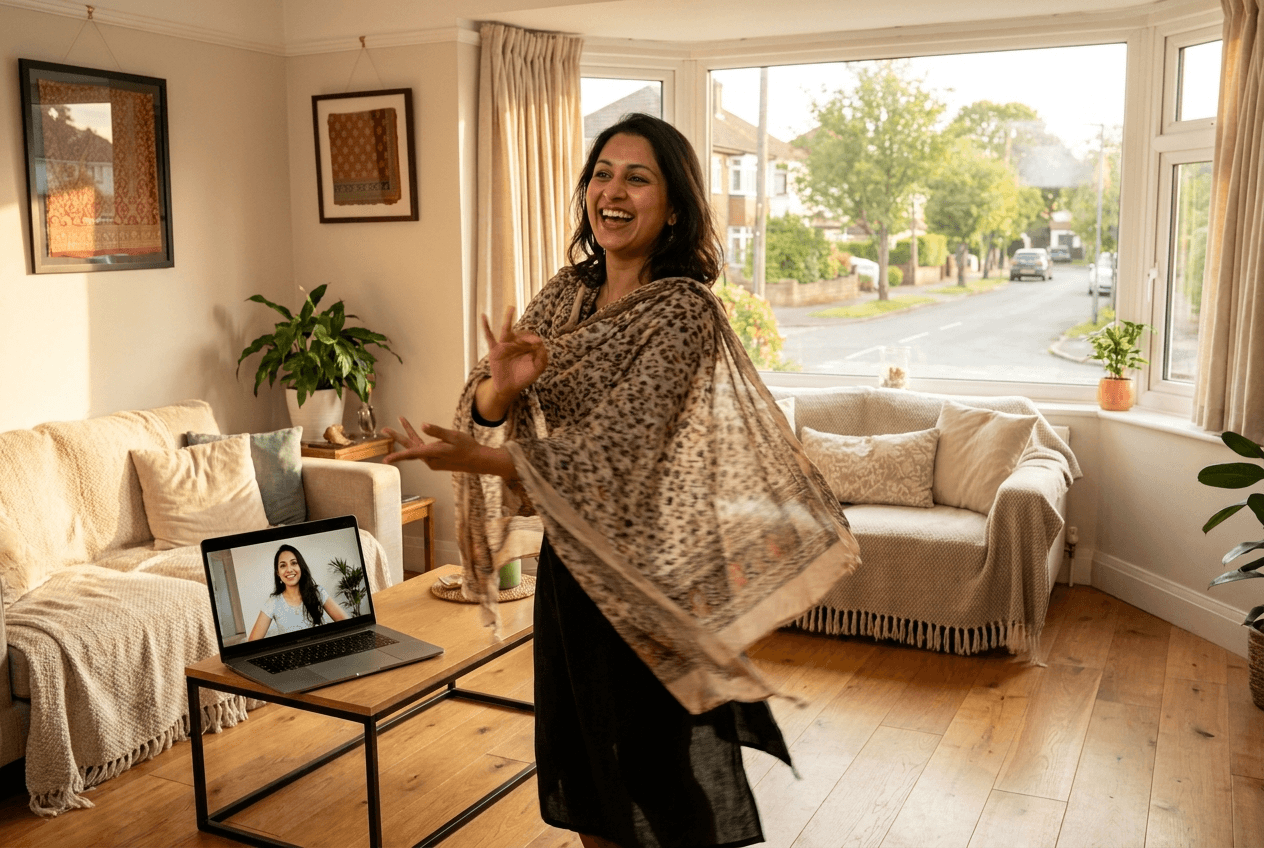 For UK adults who want movement without the steep technical demands of classical dance, Bollywood dance is consistently the most enjoyable entry point. The music is familiar from childhood for most British Indian adults, and the choreography is structured to be achievable within a few sessions rather than requiring years before a student feels capable. Browse Bollywood dance classes or read more about the range of Indian dance traditions in our guide to Indian dance styles.
What a Realistic First Year Looks Like
 Adults who commit to one weekly class and fifteen to twenty minutes of daily practice typically reach a meaningful first milestone within three to four months: a complete tabla theka, a short Hindustani raga phrase, or a simple Bollywood routine ready to perform at a family function. By the six month mark, most students have a small but genuine repertoire they can perform confidently. By twelve months, the foundational technique is secure enough that progress accelerates noticeably, because the basics no longer require conscious thought.
The single biggest predictor of progress is not natural talent but consistency. Adults who practise for fifteen minutes every single day outperform adults who practise for two hours once a week, almost without exception. Art Gharana teachers set specific, achievable daily practice targets after every class precisely because this consistency is what determines outcomes.
Common Concerns UK Adults Raise Before Starting
I Have No Musical Background at All
This is the most common starting point, not the exception. The majority of Art Gharana's UK adult students begin with zero formal music training. The first class is designed to assess exactly where you are and build from there, with no assumption of prior knowledge.
I Will Be Embarrassed in Front of a Teacher
The one to one format exists precisely to remove this worry. There is no group of other students watching you find your footing. It is just you and a teacher whose role is to help you improve, not to judge where you started. Many adults describe the first class as far less intimidating than they expected. Read genuine accounts from past students on our testimonials page.
I Do Not Have Much Time
Fifteen minutes a day, attached to an existing habit such as immediately after the morning coffee or just before bed, is sufficient for steady progress. The challenge is rarely finding time in the abstract, it is building the specific daily habit. Your teacher will help you design a practice routine that fits realistically into your existing schedule rather than an idealised one.
About Art Gharana
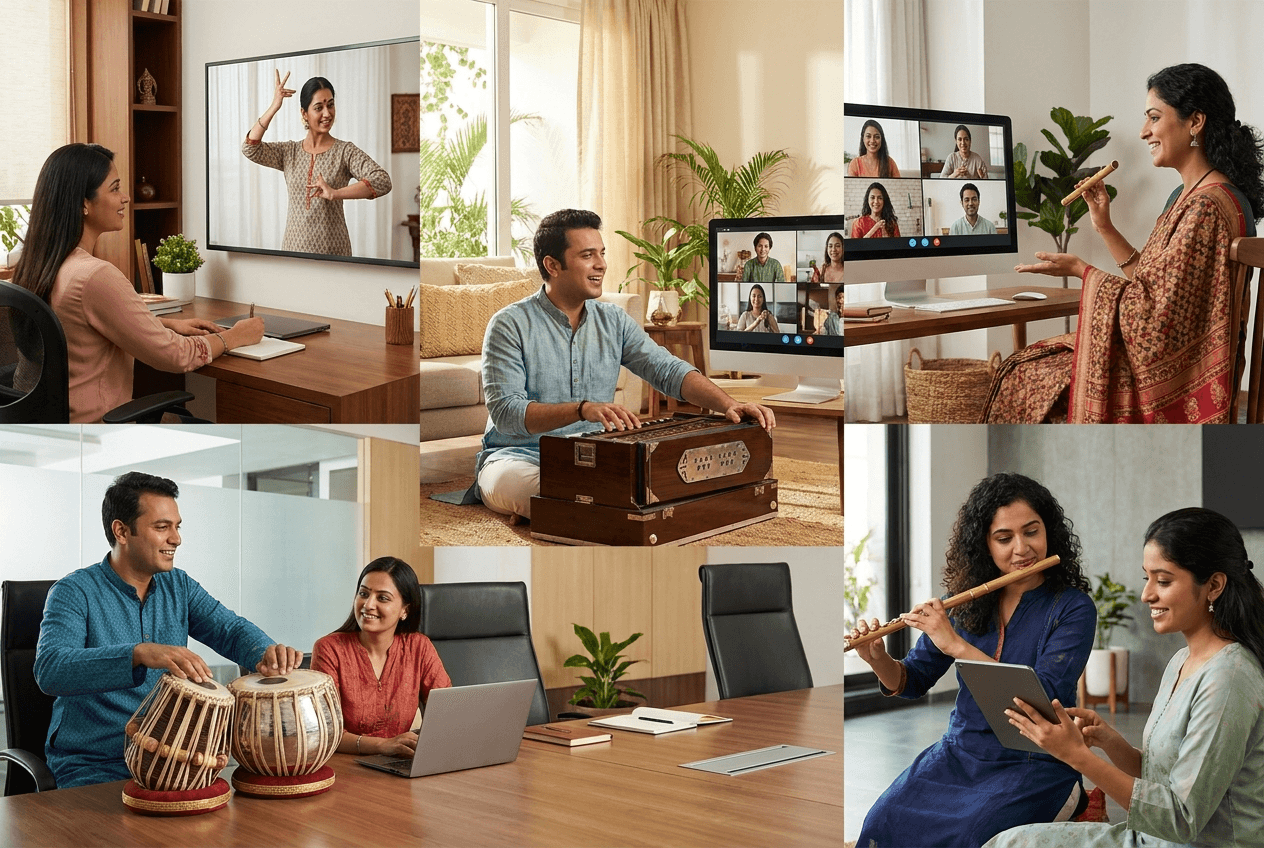 Art Gharana connects UK adults with certified Indian classical music and dance teachers for live one to one online instruction, scheduled directly in UK time zones. View our teacher profiles to see training backgrounds before your free trial.
Frequently Asked Questions
1. Can a complete beginner in their 40s learn tabla in the UK?
Yes. Adult beginners in their 40s and beyond regularly start tabla at Art Gharana with no prior experience. The bilateral coordination required develops with consistent practice regardless of starting age.
2. What time zone problems do UK adults face with Indian music teachers?
India Standard Time runs four and a half hours ahead of GMT, which forces many UK students onto very early or very late slots with India-based platforms. Art Gharana schedules classes directly in GMT and BST to avoid this conversion entirely.
3. How many hours a week should an adult beginner commit?
One forty five minute class per week plus fifteen to twenty minutes of daily practice is sufficient for steady, visible progress over the first year.
4. Is a free trial class genuinely free?
Yes. Book a free trial class with no card details required and no obligation to continue afterwards.
Practising Solo Versus Practising With a Teacher Watching
One question Art Gharana hears often from UK adult beginners is whether self-teaching from YouTube can substitute for live instruction. The honest answer is that self-teaching can take a motivated adult some distance, but it almost always produces technical habits that a trained ear catches immediately and that the student themselves cannot hear in their own playing or singing. A teacher correcting a slightly flat note or an incorrect tabla stroke in the first few sessions saves months of practising the wrong thing confidently.
For a broader picture of how Indian classical music is structured before you commit to a discipline, our guide to types of Indian music walks through Hindustani, Carnatic, folk and devotional traditions in plain language, which is a useful starting point if you are still deciding where to begin.
Building the Daily Habit as a Working Adult
The single most common reason adult beginners stall is not difficulty, it is inconsistency. Life in the UK for a working adult is genuinely full, and a classical music practice habit competes with commuting, family responsibilities and the simple exhaustion of a long day. The adults who succeed are not the ones with more free time, they are the ones who anchor practice to an existing daily routine rather than trying to find a new block of free time each day.
A useful approach many Art Gharana UK students adopt is attaching the fifteen minute practice session to something that already happens every day without fail, such as immediately after making the morning tea or in the few minutes before getting ready for bed. Once the habit is anchored to an existing trigger, it stops requiring willpower and becomes close to automatic within a few weeks.
Our article on top 10 singing tips for beginners includes specific guidance on structuring a short, effective daily vocal practice session, which is equally relevant whether you are studying Hindustani, Carnatic or simply building general vocal confidence.
What UK Adults Say After Their First Year
Adults who complete a full year of consistent weekly classes consistently describe two things changing. First, the music itself becomes genuinely enjoyable rather than a source of performance anxiety, because the early technical struggle has resolved into competence. Second, and more unexpectedly, many describe the weekly class and daily practice as one of the few entirely unhurried parts of their week, a structured pocket of time devoted to something with no professional stakes attached.
This second effect is reported often enough that it is worth naming directly. Indian classical music, with its emphasis on sustained tone, breath and rhythm, has a meditative quality that many adults find genuinely restorative in a way that is separate from the musical achievement itself. This is not a marketing claim, it is simply the pattern that recurs across UK adult student feedback year after year.
Second Generation British Indians Returning to Their Roots
A distinct group within Art Gharana's UK adult community deserves specific mention: second generation British Indians who took a few years of classes as children, stopped during secondary school exams, and are now returning in their late twenties, thirties or forties. This group often makes the fastest visible progress of any adult learner category, because the early childhood exposure left a foundation of ear training and cultural familiarity that resurfaces quickly once formal practice resumes.
If this describes you, mention it specifically at your trial class. Your teacher will assess what remains from your earlier training and design a curriculum that builds on it rather than starting completely from scratch, which can significantly shorten the path back to where you left off and beyond.
What Happens in a Free Trial Class
The free trial class is forty five minutes, conducted live over video call with a certified teacher in your chosen discipline. The teacher will ask about your background, any prior exposure to Indian music, and what you hope to get from learning, whether that is cultural connection, a creative outlet, or simply trying something new. You will then work through a short, achievable first exercise together, whether that is a basic swara pattern, a simple tabla stroke, or an introductory Bollywood movement sequence.
By the end of the session you will have a clear, honest sense of what learning with that specific teacher feels like, and the teacher will have enough information to recommend a realistic starting curriculum. There is no payment required to book the trial and no pressure to continue afterwards if it does not feel right.
Setting Realistic Goals for Your First Year
Avoid setting a goal like becoming fluent in Hindustani vocal within a year. That is not realistic for an adult learner attending one weekly class, and chasing an unrealistic goal is the fastest route to discouragement. A better goal is something specific and achievable, such as being able to sing a complete short bhajan confidently by Diwali, or playing a recognisable tabla theka at a family gathering. Specific, modest, time bound goals keep motivation high because progress toward them is visible week to week.
Discuss your goal honestly with your teacher in the trial class. A good teacher will tell you directly whether your timeline is realistic and will adjust the curriculum to maximise your chance of hitting a meaningful milestone within the period that matters to you, whether that is a family wedding, a school event, or simply your own sense of progress.
The Cost of Waiting
Many UK adults who eventually start Indian classical music describe years of thinking about it before actually booking a first class. The most common reason given is simply not knowing where to start or assuming the commitment required would be larger than it actually is. The honest reality is that the entry point is a single free trial class with no obligation, and the ongoing commitment is a fraction of what most adults assume.
If you have been considering this for some time, the most useful next step is not more research but a single trial session. It answers more questions in forty five minutes than weeks of reading ever will.
What Surprises Most Adult Beginners
Across hundreds of UK adult students, two surprises come up again and again. The first is how quickly the initial awkwardness fades. Most adults expect several months of feeling self conscious before any real comfort sets in. In practice, most report feeling reasonably at ease within two or three sessions, once the structure of the class becomes familiar and the teacher relationship starts to feel less like an evaluation and more like a collaboration.
The second surprise is how much the daily practice habit, once established, becomes something genuinely looked forward to rather than a chore to be ticked off. Adults frequently describe their fifteen minutes of riyaz or tabla practice as the calmest part of an otherwise demanding day, a small structured pocket of focus that has nothing to do with work or family obligations and everything to do with a personal creative pursuit chosen freely.
How Indian Classical Training Differs From Western Music Lessons
UK adults who took Western instrument or singing lessons as children sometimes assume Indian classical training will follow a similar structure, sheet music, graded exam pieces, a relatively linear technical curriculum. The actual experience differs in several important ways. Indian classical music is transmitted primarily through listening and repetition rather than written notation, meaning the ear develops alongside the hands or voice from the very first lesson rather than being a secondary skill layered on top of reading ability.
The relationship with the teacher is also typically closer and more personal than the relatively transactional structure of many Western instrumental lesson traditions. The guru shishya parampara, the teacher student lineage tradition, carries an expectation of sustained, multi year relationship rather than a series of discrete, interchangeable lessons. Adults who embrace this relational dimension, rather than treating classes as a purely transactional service, often report a deeper and more rewarding experience overall.
Starting Today Rather Than Someday
If everything in this guide resonates but you find yourself still planning to start at some unspecified future point when life is less busy, it is worth being honest that this future point rarely arrives on its own. Most UK adults who eventually begin describe doing so not because circumstances became more convenient, but because they decided the modest weekly time commitment was worth making space for despite an objectively busy life. The free trial class exists specifically to make that first step as low risk and low effort as possible.
There is no perfect moment waiting on the other side of a quieter month. There is only the decision to begin now, with whatever time and energy you genuinely have available, and to let the structure of weekly classes and modest daily practice carry you forward from there. Thousands of UK adults have proven this approach works. The only remaining variable is whether you decide to find out for yourself.
A Few Final Practical Notes
Sessions are conducted over standard video call software that most UK adults already use regularly for work, so there is no new technology to learn beyond the music or dance itself. A laptop, tablet or smartphone with a working camera and microphone is sufficient. No specialist equipment is required to begin a vocal discipline, and your teacher will advise on instrument purchase specifically if you choose tabla or another instrumental path, so there is no need to buy anything before the trial class.
Scheduling is handled directly around your stated availability in GMT or BST, with no need to negotiate across a time difference or accept an inconvenient slot purely because it is the only one offered. If your circumstances change, whether work patterns shift or family commitments increase, classes can typically be rescheduled with reasonable notice rather than locking you into a rigid weekly slot regardless of life's inevitable disruptions.
This flexibility, combined with the genuinely free and low pressure trial class, removes nearly every practical barrier that typically delays UK adults from starting something they have wanted to try for years.
The path from curiosity to confident weekly practice is shorter and more achievable than it tends to look from the outside.
Book your free trial class today and find out exactly what that path looks like for you.
Whatever instrument, voice or dance form calls to you most, the door is genuinely open whenever you decide to walk through it.