ChatGPT
 Google AI
 Grok
 Claude

For South Indian families across the UK, Carnatic music is rarely just a hobby choice among many. It is the sound of temple mornings, of grandparents singing along to the radio, of Margazhi season recordings playing in the background of a December household even thousands of miles from Chennai. This guide is written specifically for UK based Tamil, Telugu, Kannada and Malayalam families considering Carnatic vocal training for their children or for themselves, covering what the discipline actually involves, how to evaluate teachers, and what realistic progress looks like.
Carnatic music differs structurally from the Hindustani tradition more commonly associated with North India, in raga structure, in compositional forms, and in the specific ornamental technique called gamaka that gives Carnatic singing its distinctive character. If you are unsure which tradition fits your family background, our guide to Carnatic vs Hindustani classical music explains the structural differences clearly.
What a Beginner Carnatic Curriculum Actually Looks Like
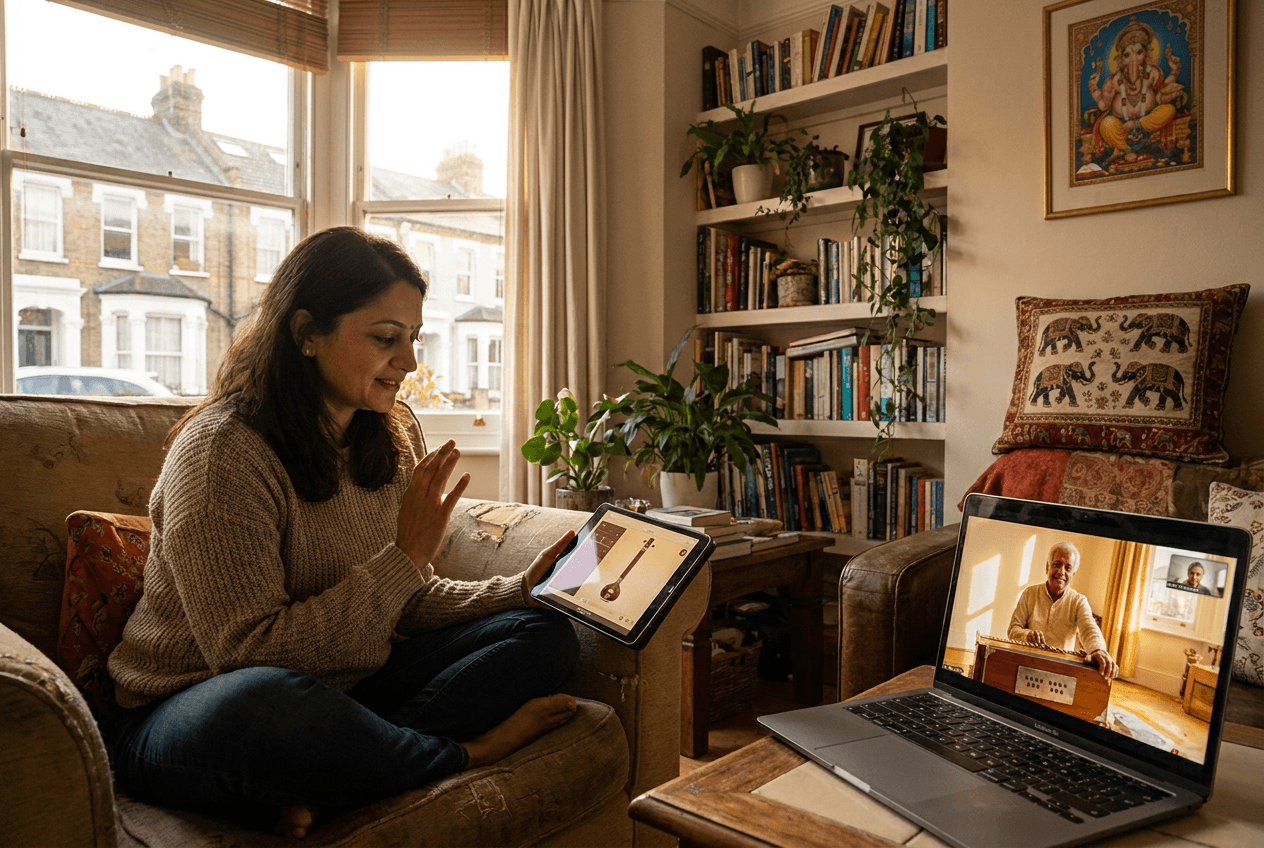 Carnatic vocal training follows a well established progression that has remained essentially consistent for generations. Training begins with sarali varisai, simple ascending and descending note exercises that build the foundational ear training and breath control every subsequent stage depends on. Janta varisai follows, introducing paired note patterns, and alankaram exercises build rhythmic and melodic complexity gradually. Only once these foundations are secure does a student move to geethams, the first proper compositions, typically in accessible ragas like Malahari or Shankarabharanam.
This structured progression is one of the most reassuring aspects of Carnatic training for UK parents who themselves grew up with some exposure to the tradition. The curriculum your child follows today is recognisably the same sequence most South Indian adults experienced in their own childhood training, whether in Chennai, Bangalore or a UK based community class.
Sarali Varisai and Alankaram: Why the Foundation Takes Time
A common frustration among UK parents new to Carnatic training is the apparent slowness of the early stages. Weeks spent on what sounds like simple scale exercises can feel disproportionate to a parent eager to hear their child singing recognisable songs. This patience is well placed, however, since the precision of pitch and breath control built during sarali varisai directly determines how cleanly a student will later execute the gamaka ornaments that define mature Carnatic singing. Teachers who rush this stage to produce quicker, more impressive sounding early results are typically setting students up for technical limitations later.
Gamaka: The Technique That Defines Carnatic Singing
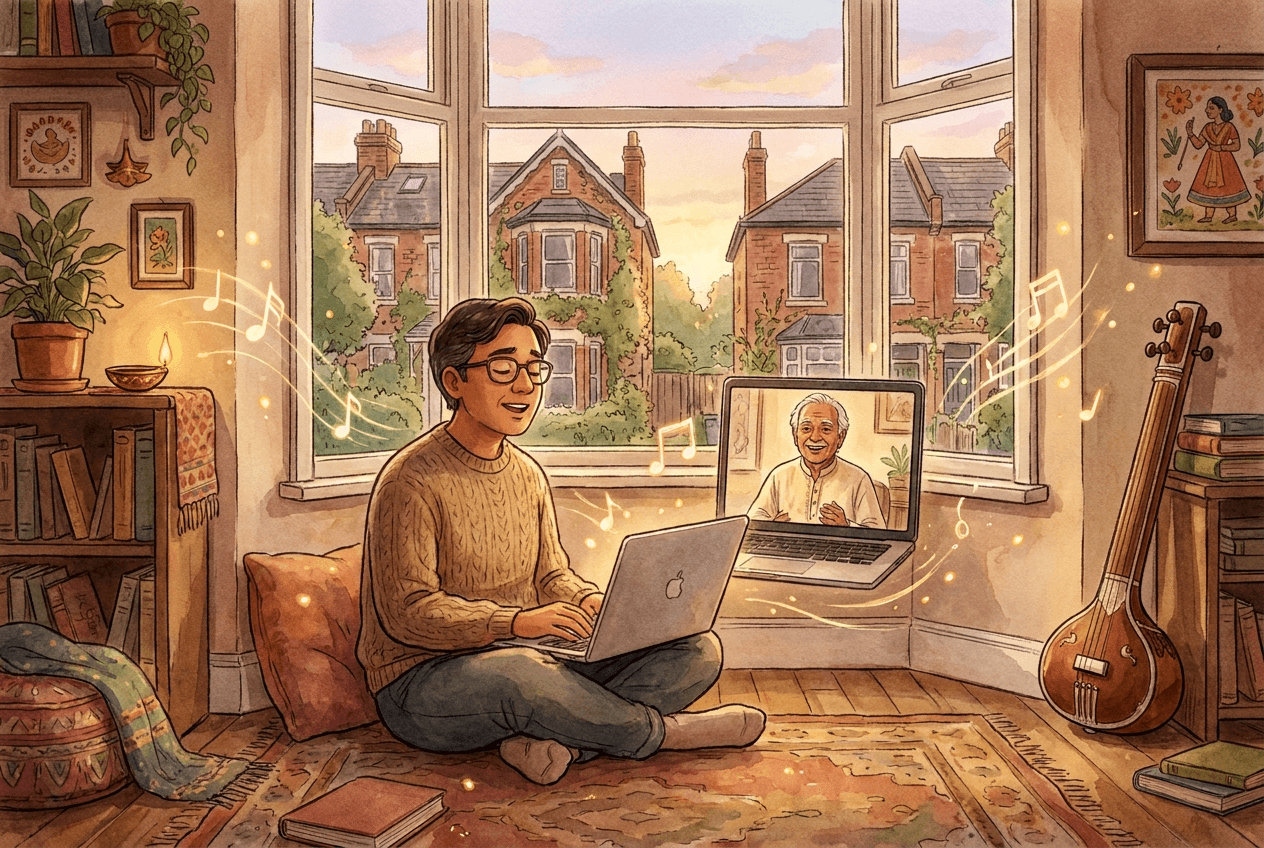 If there is one technical element that most clearly distinguishes Carnatic vocal music to an untrained ear, it is gamaka, the family of oscillations, slides and ornamental movements applied to individual notes. A note in Carnatic music is rarely sung as a flat, static pitch. It moves, bends and oscillates according to specific rules tied to the raga being performed. Learning to execute gamaka correctly, with control rather than as an uncontrolled wobble, is one of the genuine technical achievements of intermediate Carnatic training and typically takes one to two years of consistent practice to develop convincingly.
Choosing a Teacher Who Matches Your Family's Tradition
Carnatic music is sung across Tamil, Telugu, Kannada, Malayalam and Sanskrit, and while the underlying musical system is shared, the specific compositions and pronunciation conventions differ meaningfully by language tradition. A Tamil family steeped in Tyagaraja kritis sung with Tamil pronunciation conventions may want a teacher fluent specifically in that tradition, while a Telugu family may prioritise a teacher comfortable with Telugu language compositions and pronunciation. Ask directly about a prospective teacher's specific language and regional training background rather than assuming all Carnatic teachers are interchangeable across these traditions.
Building a Margazhi Season Connection From the UK
December's Margazhi season in Chennai, with its dense calendar of concerts across the city's sabha halls, is one of the most significant cultural touchpoints in the Carnatic calendar, and many UK South Indian families maintain a connection to it through recordings, livestreams and community gatherings even from thousands of miles away. A child training consistently in Carnatic vocal develops the ear and contextual understanding to genuinely appreciate these recordings as more than background music, recognising specific ragas, appreciating the technical achievement of a particular gamaka, and understanding why a specific Tyagaraja kriti carries the devotional weight it does within the tradition.
How Long Until a Recognisable Composition
For a consistent UK student attending weekly classes with daily practice, the first complete geetham composition is typically achievable within three to six months. A first varnam, the more demanding composition that combines pure rhythmic and melodic elements, generally follows within one to two years. Singing a full Tyagaraja kriti with appropriate raga character and confident gamaka execution is a multi year achievement, generally reached after three to five years of sustained, serious training, which matches the timeline most South Indian trained musicians themselves experienced growing up.
Combining Carnatic Vocal With Bharatanatyam
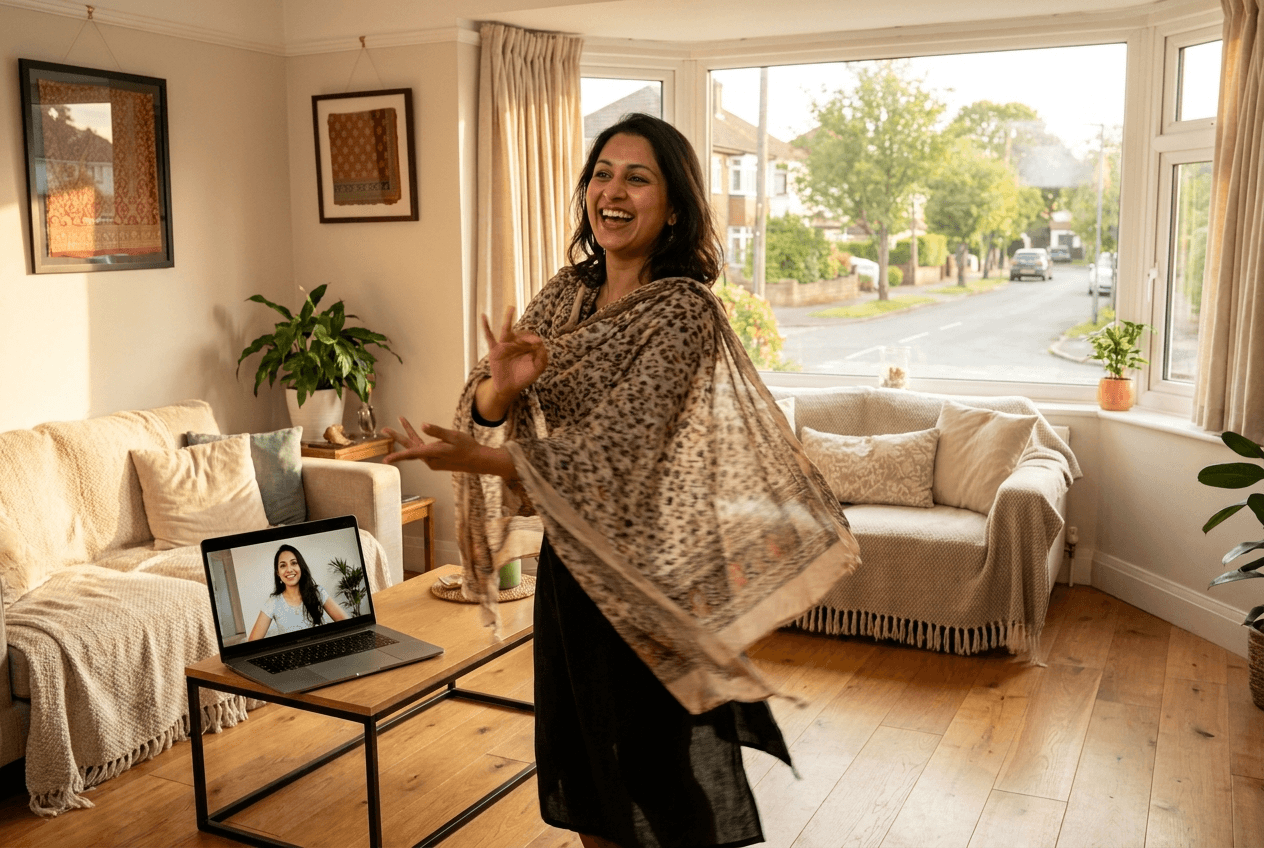 Carnatic music and Bharatanatyam are historically and structurally intertwined traditions, with the same compositions, talas and devotional context underpinning both. Many UK South Indian families pursue both disciplines for their children, finding that progress in one accelerates understanding in the other. Read our piece on the origin and growth of Bharatanatyam for background on this connected tradition, and explore Bharatanatyam classes if dance is also of interest to your family.
Is It Too Late to Start as a UK Adult
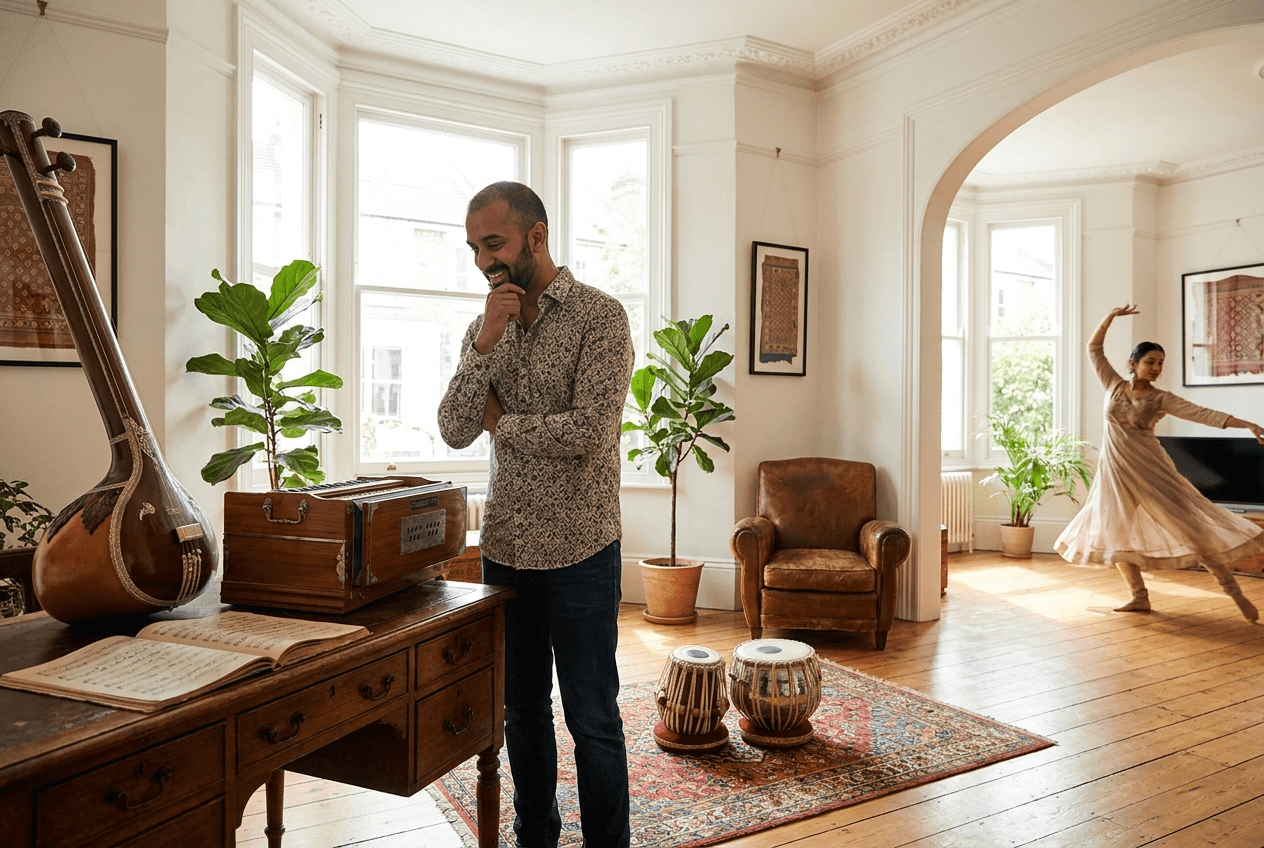 Among UK South Indian adults who grew up with exposure to Carnatic music but never received formal training themselves, a recurring question is whether starting now, in their twenties, thirties or beyond, is realistic. The honest answer, confirmed repeatedly across Carnatic schools worldwide, is that adult beginners regularly progress to genuine, satisfying musical competence. The ear training built through childhood exposure to the tradition, even without formal lessons, often gives adult beginners from South Indian backgrounds a meaningful head start over a complete outsider to the tradition.
About Art Gharana
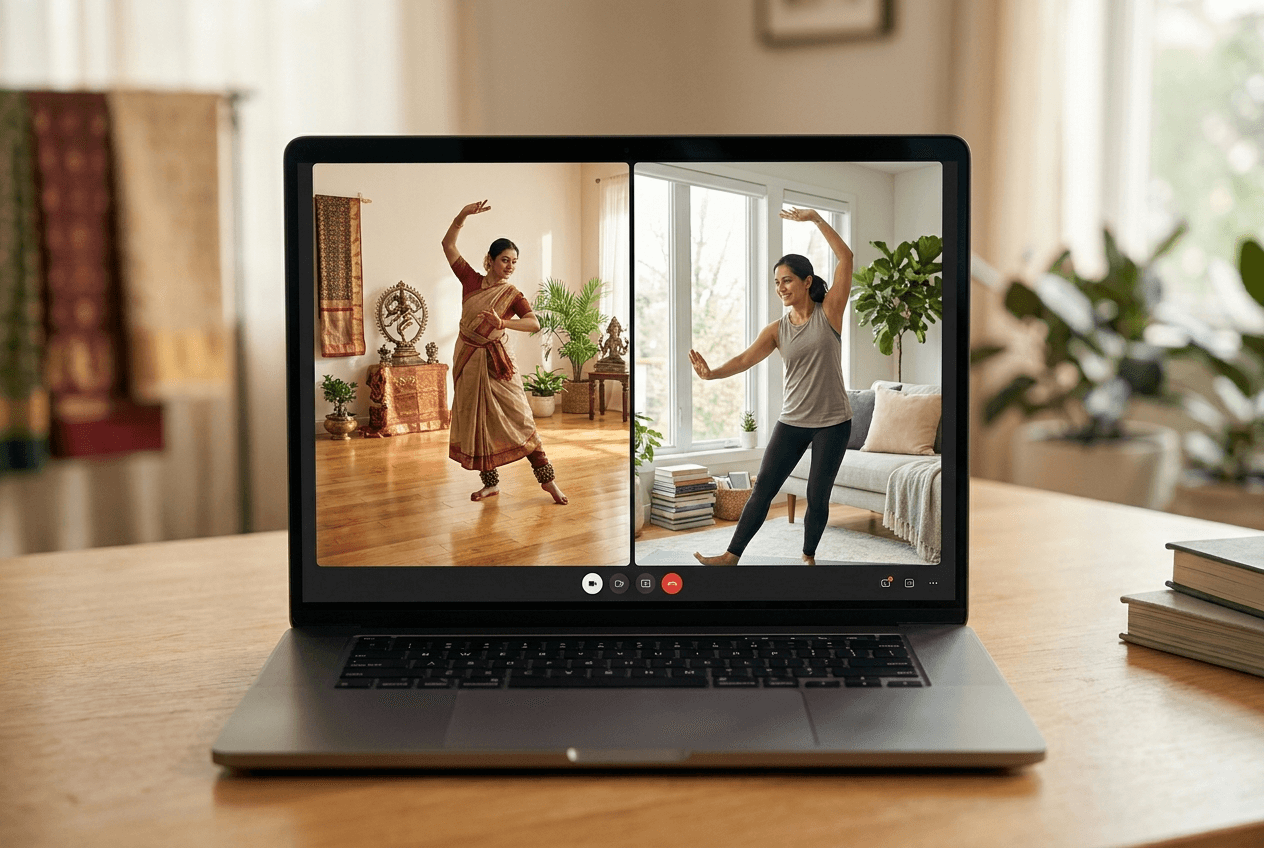 Explore Carnatic vocal classes, review our teacher profiles for specific lineage and language background, and book a free trial class to begin. Our broader guide to types of Indian music places Carnatic music within the wider landscape of Indian classical traditions if you want additional context.
Frequently Asked Questions
1. Does my child need to know Tamil, Telugu or Kannada to start Carnatic music?
No. Many UK born children with limited fluency in their family's South Indian language begin and progress well in Carnatic training, since the early exercises are largely syllabic rather than requiring conversational fluency. Teachers explain meaning and context as compositions become more advanced.
2. What is the difference between Carnatic and Hindustani vocal training for a beginner?
The two traditions share the underlying raga and tala framework but differ in ornamental technique, compositional forms and regional language association. See our detailed comparison in Carnatic vs Hindustani classical music for a full breakdown.
3. How much practice is required between weekly classes?
Fifteen to twenty minutes of daily riyaz practice, ideally with a tanpura drone running for pitch reference, produces steady and visible progress over the course of a year.
The Trinity of Carnatic Composers
No serious Carnatic vocal education proceeds far without encountering the Trinity, the three towering composer saints of eighteenth and nineteenth century South India whose compositions form the backbone of the classical repertoire. Tyagaraja, the most prolific and widely performed of the three, composed devotional kritis primarily in Telugu, many addressed to Lord Rama, characterised by a depth of melodic beauty and devotional sincerity that has made his compositions the most commonly taught entry point into intermediate Carnatic repertoire. Muthuswami Dikshitar composed largely in Sanskrit, with a more structurally elaborate and meditative style, often incorporating Western harmonic influences absorbed during his travels. Syama Sastri, the third of the Trinity, is known for compositions in Telugu and Sanskrit with a particular emphasis on complex rhythmic structures.
Students typically encounter Tyagaraja's compositions first, given their relative melodic accessibility, before progressing to the more structurally demanding works of Dikshitar and Sastri. Understanding which composer a particular kriti belongs to, and the stylistic conventions associated with that composer, becomes an important part of intermediate and advanced Carnatic education, since performance practice differs meaningfully across the three traditions.
Online Versus In Person: What UK Families Should Weigh
For UK South Indian families with access to a strong local Carnatic teacher, often through temple associations or community cultural organisations in cities with significant South Indian populations such as London, Birmingham or Leicester, the choice between local in person instruction and online live teaching is a genuine one worth considering carefully. Local in person teaching offers the advantage of in person community, shared performance opportunities with other local students, and the ambient cultural immersion of attending temple events and local Carnatic concerts alongside a teacher and fellow students.
Online live instruction, by contrast, dramatically widens the pool of available teachers beyond whoever happens to be locally accessible, allowing a family to select specifically for teaching quality, language tradition match and personal rapport rather than settling for the limited local options. For UK South Indian families outside the major metropolitan centres with established South Indian communities, online instruction is frequently the only realistic route to genuinely qualified Carnatic teaching at all.
What to Expect From the First Few Months
The opening months of Carnatic training, regardless of a student's age, follow a broadly predictable arc. The first few weeks focus entirely on posture, breath and the most basic sarali varisai patterns, often feeling repetitive to an eager beginner who wants to move faster. By around two months, most students have internalised the basic varisai patterns well enough that the teacher begins introducing janta varisai and simple alankaram, adding rhythmic interest to the melodic exercises. By the third or fourth month, the first geetham composition typically enters the curriculum, marking the moment most students first feel they are singing real music rather than purely technical exercises.
Parents should resist the urge to compare this pace unfavourably to memories of their own childhood training in India, where daily exposure to ambient Carnatic music, frequent family singing, and sometimes more intensive lesson schedules created a different overall learning environment. A UK child training once weekly with consistent but modest daily practice will naturally progress at a different pace, which is not a deficiency but simply a different and entirely valid context for learning the same tradition.
Carnatic Music and Sanskrit, Tamil, Telugu Language Learning
An often underappreciated benefit of Carnatic vocal training for UK born children is its function as an informal but genuine pathway into Sanskrit, Tamil and Telugu language exposure. Compositions are sung in their original language, and a good teacher explains meaning, grammar and pronunciation as part of the natural teaching process. Many UK South Indian parents report that their child's vocabulary and pronunciation confidence in the family heritage language improved meaningfully as a side effect of consistent Carnatic vocal training, simply through the repeated exposure to correctly pronounced devotional and classical language embedded in the music itself.
A Note on Instruments Alongside Vocal Training
While vocal training is the most common entry point into Carnatic music for UK families, the tradition also encompasses a rich instrumental repertoire including violin, veena, mridangam and flute, each with its own technical demands and teaching lineage. Most Carnatic instrumentalists begin with vocal training first, since the vocal tradition establishes the raga and tala understanding that all Carnatic instruments are built upon. A child who begins with a year or two of vocal foundation before adding an instrument typically progresses faster on that instrument than one who begins purely instrumentally without the underlying vocal and theoretical grounding.
Performance Opportunities Within UK South Indian Communities
UK South Indian community life offers more performance opportunity than many newcomer families initially expect. Temple cultural programmes, particularly around significant festivals, regularly feature young students performing devotional compositions. Tamil, Telugu, Kannada and Malayalam cultural associations across major UK cities organise annual cultural events where Carnatic vocal performance is a standard and welcomed feature. School multicultural assemblies, particularly in areas with significant South Indian populations, frequently invite students to perform a short classical piece. These low pressure, community embedded performance contexts provide exactly the kind of motivating, achievable goals that sustain a young student's enthusiasm through the inevitably slower technical stages of early training.
Art Gharana teachers actively support students preparing for these specific community performance contexts, working backward from a target date to ensure the student has a polished, appropriately paced piece ready, rather than attempting something beyond their current technical level purely for the sake of an impressive showing.
A Realistic Conversation About Commitment
Carnatic music, perhaps more than any other discipline covered across this guide series, rewards patience and sustained, multi year commitment more than it rewards short bursts of intensive early enthusiasm. Families considering this path for their children should approach it with a genuinely long term mindset, understanding that the deepest rewards, fluent gamaka execution, confident rendering of major Trinity compositions, the ability to genuinely appreciate a live Carnatic concert with full technical understanding, arrive several years into consistent practice rather than within the first excited months.
This is not a discouragement. It is simply an honest framing that helps UK families set appropriate expectations from the outset, avoiding the common pattern of high initial enthusiasm followed by disappointment when month three does not yet produce concert level singing. Families who understand and embrace the multi year nature of genuine Carnatic training consistently report the most satisfying long term outcomes, both musically and in terms of the cultural connection the training provides.
Why Many UK Families Choose to Start Now Rather Than Wait
A pattern Art Gharana observes consistently among UK South Indian families is delayed enrolment, often waiting for a child to be slightly older, for family schedules to settle, or for an upcoming visit to India to provide an opportunity to start lessons there instead. In practice, the earlier a foundation begins, even modestly, the more naturally subsequent progress unfolds, and waiting for an ideal starting moment frequently means losing months or years that could otherwise have been spent building the foundational sarali varisai work that everything else depends upon.
The live online format specifically removes the most common reason for delay, the absence of a suitable local teacher, by connecting UK families directly with certified Carnatic vocalists regardless of where in the country they live. A family in a UK city with no significant South Indian community and no local Carnatic teaching tradition has exactly the same access to qualified instruction as a family in London or Leicester.
Getting Started
The recommended first step is a free trial class, allowing both student and parent to experience directly how a specific teacher explains, corrects and engages before any ongoing commitment is made. Bring no specific preparation beyond an open mind, since the teacher will assess your or your child's starting point and build the curriculum from there, whether that starting point is complete beginner or a returning student with some prior exposure to the tradition.
Whatever your family's specific regional and linguistic background within the broad South Indian tradition, Carnatic music offers a genuine, structured pathway to deep cultural connection, available now, in UK time zones, with no requirement to wait for a trip to India or the right local teacher to happen to become available.
A Closing Note on Devotional Versus Concert Tradition
It is worth noting for newcomer families that Carnatic music sits within a tradition that is simultaneously devotional and a sophisticated concert art form. Many compositions are explicitly religious, addressed to specific deities, and carry genuine spiritual weight for practising Hindu families. At the same time, Carnatic music has a rich concert and academic tradition entirely separable from any specific religious practice, appreciated and performed by people of many backgrounds and beliefs purely for its musical sophistication. Families can approach the tradition from whichever angle resonates most authentically with their own values, and a good teacher will respect and work within whatever framing a family brings to the training.
Final Thoughts for UK South Indian Families
Trust the Tradition's Own Pace
Carnatic music has been transmitted through structured, patient teaching for centuries, and the curriculum your child or you will follow today reflects accumulated pedagogical wisdom rather than an arbitrary modern invention. Trusting this established progression, rather than pushing for faster results than the tradition itself recommends, consistently produces stronger long term musicians and a more genuinely satisfying relationship with the music.
Connect the Learning to Living Culture
Wherever possible, connect formal lessons to lived cultural experience, whether that is attending a local temple's musical programme, watching Margazhi season concert recordings together as a family, or simply playing Carnatic recordings at home during daily routines. This ambient exposure reinforces and contextualises what is being learned in weekly lessons far more effectively than lessons in isolation ever could.
Carnatic music has carried South Indian culture across generations and across oceans, surviving migration, displacement and the genuine challenge of transmitting a deeply rooted oral tradition to children raised thousands of miles from its geographic origin. UK South Indian families who choose to begin or continue this tradition with their own children are participating in something considerably larger than a single family's hobby choice. They are keeping a living tradition genuinely alive, one sarali varisai exercise and one carefully learned kriti at a time.
A Practical Starting Checklist
Decide which language tradition matters most to your family, Tamil, Telugu, Kannada or Malayalam, and mention this when arranging your trial class so the teacher match reflects that priority. Set up a quiet practice space at home with a tanpura app ready to use from the very first lesson. Commit honestly to fifteen to twenty minutes of daily practice rather than an ambitious but unsustainable hour. And approach the first several months with patience, understanding that the sarali varisai stage, however repetitive it may feel, is building the precise foundation that everything genuinely beautiful in Carnatic music eventually rests upon.
Book a free trial class whenever you are ready, and let an actual certified Carnatic teacher show you exactly what this journey looks like for your specific family.
The tradition is waiting, and so is the next generation ready to carry it forward.
Whatever stage you are starting from, today is as good a day as any to begin, or to begin again.
Reach out today and take that first step toward a lifelong musical and cultural connection.